Antibiotic overuse and misuse leads to adverse drug reactions, superinfections, and drug resistance and is a financial burden to health care. According to the Centers for Disease Control and Prevention (CDC), as many as 30%–50% of antibiotics are prescribed inappropriately in inpatient settings. 1,2 Antimicrobial stewardship programs (ASPs) reduce inappropriate antimicrobial utilization and are required for inpatient accreditation by the Joint Commission and the Centers for Medicare and Medicaid Services. 3,4 The 2016 Infectious Diseases Society of America (IDSA) and the Society for Healthcare Epidemiology of America (SHEA) guideline identifies best practices, outlines interventions for antimicrobial optimization, and names strategies to measure ASP success. Reference Barlam, Cosgrove and Abbo5 A successful ASP measures antimicrobial utilization, identifies patient care services with opportunities to improve said utilization, and targets improvement interventions based on understanding the dynamics of antimicrobial prescribing.
Limited data exist describing antibiotic prescription differences between junior resident physicians compared to their senior residents or attending physicians. In the outpatient setting, one study reported lower antibiotic prescribing rates among resident physicians compared to practicing physicians. Reference Roumie, Halasa and Edwards6 Two other outpatient-based studies reported either a reduction in appropriate antibiotic prescribing by resident physicians with reduced supervision or similar antibiotic prescribing to staff physicians as the level of resident training progressed. Reference Robinson, Curry and Dallman7,Reference Mincey and Parkulo8 Two qualitative studies reported behavioral factors that influence antibiotic prescribing among physicians in the hospital setting. Resident physicians were influenced by the prescribing practices of their attending physicians and junior trainees followed the prescribing etiquette and hierarchy established by their senior colleagues. Reference Livorsi, Comer and Matthias9,Reference Charani, Castro-Sanchez and Sevdalis10 However, it remains unclear how these behavioral factors or the level of resident training correlate with antimicrobial prescribing rates, especially during periods of autonomy among junior resident physicians (e.g., on call or overnight staffing).
The general medicine (GM) and hospitalist services at University of Wisconsin Hospital use antibiotics often and are a focus of ASP interventions. Differences in antibiotic prescribing practices between junior, senior, and attending physicians have not been investigated previously. Insight into this prescribing dynamic would allow ASP resources tailored to the services with higher antibiotic prescribing rates. In this study, we evaluated antibiotic prescribing patterns between GM and hospitalist services and between junior and senior resident physicians.
Methods
The adult University of Wisconsin Hospital is a 592-bed, tertiary-care, academic medical center in Madison. This project was considered a quality improvement project and was granted exemption by the University of Wisconsin Health Sciences Institutional Review Board.
General antimicrobial use
In this observational, retrospective study, we measured the antibiotic prescribing patterns of our GM and hospitalist services using data from our electronic medical record (EMR) (Epic, Verona, WI) between January 1, 2016, and December 31, 2018, including antibiotic rate and spectrum breadth. We measured antibiotic utilization rates using days of therapy (DOT) per 1,000 patient days (PD), and we calculated a mean DOT per 1,000 PD for each service. A secondary analysis by average DOT per 1,000 PD was conducted based on antibiotic utilization of broad-spectrum, anti-MRSA, and anti-pseudomonal agents compared among services and level of resident experience.
Antimicrobial utilization data were collected from the EMR by querying drug class. Only antibacterial and systemic urinary anti-infective (nitrofurantoin and fosfomycin) drug classes were included. Antifungal, antiviral, antimycobacterial, amebicides, antihelminth, ophthalmic, and antimalarial agents drug classes were excluded. Antibiotics were analyzed according to spectrum range: broad-spectrum antibiotics defined by the investigators included aminoglycosides, anti-pseudomonal β-lactams, fluoroquinolones, carbapenems, and gram-positive agents with activity against methicillin-resistant Staphylococcus aureus (MRSA), vancomycin-resistant Enterococcus spp, or both. Reference Schulz, Osterby and Fox11
Inpatient medicine team structure, patient assignment, and antibiotic ordering
Patients are assigned by a triage physician to either a GM or hospital medicine service in a random fashion based on call cycle or service census. Each day, one GM service provides admission coverage in the afternoon and another GM service provides on-call afternoon and overnight admission coverage. The third GM service is post-call and does not admit new patients. The hospitalist services admit patients 24 hours per day, 7 days per week. GM services are staffed by a single attending physician, 2 residents (PGY2 and PGY3), 2 interns, and 1–3 medical students. The PGY2 is always assigned to the “A” team and the PGY3 is always assigned to the “B” team. Each PGY2 or PGY3 resident supervises the assigned intern (Fig. 1). Hospitalist services do not have residents, interns, or medical students and are staffed with a single attending physician with or without an advanced practice provider (APP). The APPs are randomly and evenly assigned to hospitalist services; thus, they saw 30% of patient visits during the study period.
Description of internal medicine prescribing teams and services.

Antibiotic utilization was first analyzed by teaching services (GM) compared to nonteaching, hospitalist-only services and was further assessed based on attending physician primary location of practice within the GM1, GM2, and GM3 teams and by the level of resident training. The GM1 service is staffed by general internal medicine physicians who practice outpatient medicine 48 weeks per year when not on the GM service; the GM2 service is staffed by geriatricians or hospitalists; and the GM3 service is staffed by hospitalists. Among GM services, prescribing by the junior resident physicians (GMA) was compared to that by senior residents (GMB).
Antibiotics are ordered following physician clinical exam and evaluation. The initial antibiotic prescribing is usually directed by the resident because patients admitted overnight by the on-call team are most often presented to the attending physician the following morning. Empiric antibiotic choices for common infectious diseases are influenced by an antibiotic order set embedded in the EMR; however, the physician may prescribe alternatives. GM and hospitalist services participate in interdisciplinary team rounds each weekday and reassess antibiotic therapy. Clinical pharmacists are expected to optimize antimicrobial utilization through daily monitoring and participation in weekday rounds and have no formal antimicrobial stewardship training. Residents received an introductory stewardship lecture during their PGY2 year, and hospitalists had stewardship grand round education twice yearly. The hospital ASP relies on the seven CDC Core Elements of Hospital Antimicrobial Stewardship Programs and practice recommendations from the Infectious Diseases Society of America and the Society for Healthcare Epidemiology of America (IDSA/SHEA). Reference Barlam, Cosgrove and Abbo5,12 Stewardship prospective audit and feedback conducted 5 days per week for all patients on antimicrobials was standard practice and was applied equally between GM and hospitalist teams. The ASP implemented a fluoroquinolone restriction in 2016 as part of an infection control response to a higher incidence of Clostridioides difficile. This intervention reduced fluoroquinolone utilization in high-risk units and equally across the GM and hospitalist services. Reference Tischendorf, Brunner and Knobloch13
Patient factors
To ensure that GM and hospitalist patients were similar and that antibiotic utilization differences could be attributable to the attending type or level of resident training rather than clinical severity, we analyzed patient demographics. Patient acuity was measured using case-mix index and average length of stay (days). Finally, we accounted for physician workload by measuring average daily census (number of patients per 24-hour period) and percentage of patients discharged to skilled nursing facilities.
Statistical analysis
Antibiotic utilization data for outcomes between hospitalist and GM services, as well as between junior and senior teaching services, were normally distributed and were analyzed as continuous data using the Student t test.
Results
Overall, patients on the GM and hospitalist services were demographically similar during the 3-year period of this observational study. The average patient age under GM services compared to hospitalist services was 59.5 versus 60.6 years, respectively. Female sex was distributed similarly among GM versus hospitalist services (46.9% vs 48.4%).
Daily workload was similar between the GM and hospitalist services, with an average daily patient census of 11 patients for both groups. The case-mix index between GM and hospitalist services was similar (1.45 vs 1.56), which was reflected in similar average hospital length of stay (4.8 days) and a similar percentage of patients discharged to skilled nursing facilities (14.7% vs 15.2%).
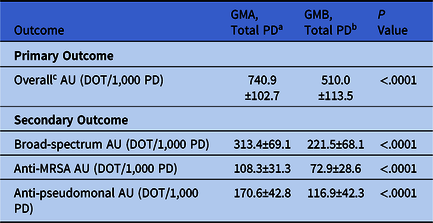
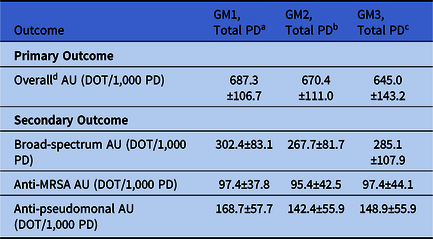
In our primary analysis, GM services prescribed significantly more antibiotics than hospitalist services over the 3-year study period (671.6 ± 74.1 vs 575.2 ± 61.7 DOT per 1,000 PD; P < .0001) (Table 1). Junior resident–led services (GMA) used significantly more antibiotics than senior resident–led services (GMB) (740.9 ± 102.7 vs 510.0 ± 113.5 DOT per 1,000 PD; P < .0001) (Table 2). Antibiotic prescribing was numerically similar among the GM1, GM2, and GM3 services (687.3 ± 106.7 vs 670.4 ± 111.0 vs 645.0 ± 143.2 DOT per 1,000 PD) (Table 3).
Antibiotic Use by Service

Note. GM, general medicine resident physician–led teaching services; AU antimicrobial use; DOT, days of therapy; PD, patient days.
a Overall, broad-spectrum, anti-MRSA, and anti-pseudomonal antibiotic use of nonteaching hospitalist-only services vs GM teaching services.
Antibiotic Use by Service and Resident Training Year

Note. AU antimicrobial use (defined as days of therapy normalized per 1,000 patient days); DOT, days of therapy; PD, patient days.
a GMA – General medicine junior resident physician–led teaching services (PGY2s)
b GMB – General medicine senior resident physician–led teaching services (PGY3s)
c Overall, broad-spectrum, anti-MRSA, and anti-pseudomonal antibiotic use of junior vs. senior resident physician–led general medicine teaching services.
Antibiotic Use by Teaching Service Attending Type

Note. AU, antimicrobial use; DOT, days of therapy; PD, patient days.
a General medicine teaching service led by outpatient internal medicine physicians.
b General medicine teaching service led by geriatricians or hospitalists.
c General medicine teaching service led by hospitalists.
d Overall, broad-spectrum, anti-MRSA, and anti-pseudomonal antibiotic use by general medicine teaching service attending type and primary staffing location.
A secondary analysis based on antibiotic spectrum revealed that GM teaching services prescribed significantly more broad-spectrum, anti-MRSA, and anti-pseudomonal antibiotics than hospitalist services (Table 1). Junior resident–led teaching services prescribed significantly higher rates of broad-spectrum, anti-MRSA, and anti-pseudomonal therapy compared to their senior counterparts (Table 2). Rates of prescribing broad-spectrum, anti-MRSA, and anti-pseudomonal antibiotics were variable among the 3 GM services (Table 3).
Discussion
Our study contributes to the existing literature in several ways. First, we found a significant difference between antibiotic utilization in teaching services and nonteaching services. The GM services prescribed more antibiotics than did the hospitalist services (Table 1). Second, teaching services with junior residents (GMA) used significantly more antibiotics and more broad-spectrum, anti-MRSA, and anti-pseudomonal agents than did the senior services (GMB) (Table 2). Third, when analyzed by teaching service attending subtype, there were no apparent differences in total antibiotic, broad-spectrum, or anti-MRSA prescribing between GM attending physicians (GM1 vs GM2 vs GM3) (Table 3). However, attendings with a primarily outpatient location of practice (GM1) followed a trend toward more total antibiotics prescribed compared with geriatricians and hospitalists (GM2 and GM3) (Table 3). Collectively, these findings suggest that resident level of training as well as attending physician type influence antibiotic prescribing.
Our findings are important because the expectation is that teaching services adhere to the same antimicrobial prescribing standards as nonteaching services. For education purposes, attending physicians on GM services give residents autonomy overnight to make medical decisions for nonemergent issues, including antibiotic prescribing. As our data suggest, junior residents may be likely to prescribe antibiotics and broad-spectrum antibiotics out of an abundance of caution prior to discussing the case with the attending physician.
Our study has several limitations. Because of its retrospective nature, we were unable to determine whether higher prescribing rates were related to illness severity. Although APACHE scores and Charlson comorbidity index scores were not available, basic demographics and case-mix index did not differ between groups. The admission triage process appears random; however, we cannot rule out bias in assigning complex admissions to the medical teaching services, including those with more infectious disease pathologies. These factors would not, however, account for the significant differences noted between junior and senior residents. We did not assess prevalence of antibiotic allergies or rate of antimicrobial stewardship interventions; however, previous data demonstrated equal distribution of patients with β-lactam allergies and stewardship interventions among hospital services. Reference Mancini, Fu and Zhang14 Similarly, we did not assess the role of APPs in patient care. Fortunately, the APP patient care contribution was evenly distributed between hospitalist services and should evenly impact hospitalist prescribing rates.
Our study measured antibiotic utilization using DOT per 1,000 PD. This metric represents one of many and cannot directly link appropriateness. Defined daily dose, new antibiotic starts, and length of therapy per 1,000 PD are alternative metrics that are more challenging to calculate and have limitations. The DOT method is commonly used and increases the external application of our results.
Our assumption that lower antibiotic use represents more appropriate antibiotic prescribing is supported by a recent investigation of ambulatory prescribing practice. It is possible that PGY3-led GM services, having the overall lowest prescribing rate, actually underprescribed antibiotics, although missing antibiotic coverage should lead to worse patient outcomes, including prolonged length of stay. It is more likely that senior residents are more confident in their antibiotic prescribing and that attending physicians allow similar latitude in prescribing with junior and senior residents. We recognize that our study was conducted at a single center, which may limit generalizability, but we believe that our findings, particularly differences between junior and senior residents, are important factors for resident training programs and ASPs.
In conclusion, antibiotics were prescribed at a significantly higher rate in services associated with trainees than those without. Junior resident–led services prescribed at a significantly higher rate than services led by a senior resident. Targeted interventions, such as more aggressive stewardship de-escalation on teaching services, may be merited. Furthermore, ASP initiatives to reduce unnecessary antibiotic exposure, such as discriminating between community-based and healthcare-acquired infections, should be targeted toward resident physicians and especially junior trainees. More studies of the impact of training level on antibiotic prescribing are needed.
Acknowledgments
Financial support
No financial support was provided relevant to this article.
Conflicts of interest
All authors report no conflicts of interest relevant to this article.