

Monts-de-Piété (MdePs) are public and philanthropic pawnbroking institutions where people who pawn goods are charged a rate of interest lower than the prevailing private pawnbroking rate, and where the associated loan terms are also more lenient. An additional feature of the MdePs is that profits derived from lending are applied to charitable purposes, such as building and maintaining hospitals.
In 1837 a high-profile effort was made to establish a Continental style MdeP in the city of Limerick. This was the first institution of its type established in Ireland and inspired a handful of others to follow suit, but by 1853 they had ceased trading. This article is a study of an institutional import, the charitable pawnbroker, and addresses the question: why did it fail in Ireland, despite being successful abroad? The key findings are that failure is associated with an uncritical institutional adoption and that performance differences were related to the market structures in different polities.
In terms of the proportion of the consumer credit provided, pawnbrokers provide a minute fraction of credit in a national economy, but in terms of the number of loans they are highly significant. In nineteenth-century Ireland there was roughly one pledge per person and as many as 16 pledges per person in Dublin City in 1844 (BPP 1845). Pawnbroking has historically played a role in the financial systems of developing countries and is a way of reducing transaction costs and overcoming information asymmetries in short-term lending (Bouman and Houtman Reference Bouman and Houtman1988; Lamberte Reference Lamberte1988). In recent times there has been a significant growth of pawnbrokers, cheque cashing operators and pay-day loans in the US (Caskey and Zikmund Reference Caskey and Zikmund1990; Caskey Reference Caskey1991, Reference Caskey1994; Rivlin Reference Rivlin2010). In Britain, there was a noted decline in pawnbroking in the first half of the twentieth century (Minkes Reference Minkes1953; Hudson Reference Hudson1982; Tebbutt Reference Tebbutt1983), but there has been a revival of late, as well as increases in pay-day lending. These recent increases have led to calls for the regulation of the expanding fringe banking sector (Wintour Reference Wintour2011). This study is therefore of relevance to modern discussion since it analyses the performance of philanthropic pawnbrokers relative to for-profit competitors.
MdePs are relevant to the historiography relating to the Irish Poor Law and microfinance institutions (e.g. Gray Reference Gray2009; Hollis and Sweetman Reference Hollis and Sweetman2001). Contemporary pamphleteers believed that they could establish institutions which offered cheap loans and used the profits from lending to fund charitable ventures. Importantly, they believed that these contradictory goals were attainable because of the French example. Irish MdePs had an ephemeral existence and were never able to raise significant funds for charitable expenditure, whereas French MdePs had a more enduring success.Footnote 2 Therefore, this article uses the history of the French MdeP model to explain why MdePs were unsuccessful in Ireland and finds that the French system benefited from public support and monopoly status, which enabled it to realise economies of scale. Furthermore MdePs are related to the historiography that explores the failure of institutional imports in Ireland (Guinnane Reference Guinnane1994; O'Rourke Reference O'Rourke2007). In contrast to these influential studies, this article argues that the functionally equivalent indigenous institutions were superior to their imported cousins and that the failure of institutional imports is not a slight on the performance of the Irish economy.
The article proceeds as follows. Section I discusses the economic structure of pawnbroking in Ireland. Section II outlines institutional attributes of MdePs, Section III analyses the failure of the Irish MdeP and Section IV concludes.
I
Pawnbroking is a fixed-term credit service where loans are secured by the value of collateral which is left in the possession of the lender. If the loan is repaid, with interest, the borrower can redeem his pledge. If not, the lender assumes ownership of the collateral. Depending on the proportion of the value of the collateral which has been lent, the lender may gain if the customer does not redeem. The traditional practice of pawnbrokers was to make loans on the estimated value of an item and to give the borrower a percentage of this valuation. For example, loans were issued up to 80 per cent of the estimated value of durable goods, namely, plate and jewellery, and at a lower percentage, in the region of 66 per cent or less, for non-durable goods such as clothes. According to Edward Homan, a Limerick pawnbroker, loan valuations were based on what a pawnbroker would ‘get on them after 12 months’ (BPP 1837–8, Qs. 936–8). The role of the pawnbroker, traditionally referred to as a ‘poor man's bank’ (Fitzpatrick Reference Fitzpatrick2001, p. 55), is to provide liquidity to households (Tebbutt Reference Tebbutt1983, p. 22).Footnote 3 Social reformers, such as those who established MdePs in Ireland, were critical of pawnbroking for they believed that the costs of borrowing were high and that poor borrowers were being exploited. The following section discusses the empirical findings of pawnbroking studies and outlines the market conditions in nineteenth-century Ireland.
In a study of US pawnbroking in the 1980s, Caskey argues that the reason for the high cost of borrowing in fringe banking (pawnbroking and cheque cashing) is fourfold: the cost of credit provision via pawnbroking is high; scale economies are not realised; local monopolies exist because of borrower transport costs; and security costs are high (1994, p.112). Caskey finds that pawnbroking is a labour-intensive industry and thus has high transaction costs; for example, the value of collateral is assessed by hand and goods are stored and retrieved manually. Caskey argues that pawnbrokers could reduce costs per transaction if they served more people ‘because fixed costs would be divided among more customers’ (1994, p. 114). However, it is difficult to realise these scale economies, due to customer transport costs. Customers, he finds, are more likely to patronise a local shop than a more distant shop where interest rates are lower. Thus ‘geographic areas are generally served by numerous, dispersed fringe banks, which operate at less than their most efficient scale’ (Caskey Reference Caskey1994, p.114). This in turn increases the cost of providing services but reduces consumer transport costs. As a result, local monopolies can exist and Caskey argues that pawnbroking displays signs of monopolistic competition (1994, pp. 114–15).
Minkes's findings (1953) for British pawnbroking are generally in agreement with those of Caskey (Reference Caskey1994). Minkes argues that successful pawnbroking was based on ‘large numbers of pledges and a frequent turnover of pledges’ (1953, p.16), thus concurring with Caskey's finding (1994) of scale economies. Minkes suggests that the competition in pawnbroking did not appear to be severe. He also argues that transport costs were a significant factor for borrowers; however, Minkes (Reference Minkes1953, p. 13) suggests that ‘habitual attachment may overcome the disadvantage of distance’. Minkes argues that, where prices were constrained, competition could manifest itself in the proportion that was lent to borrowers of the value of their pledges.
Bouman and Houtman (Reference Bouman and Houtman1988) also argue that transaction costs were an important aspect of pawnbroking, since small loans have high transaction costs. The authors suggest that to minimise costs in order to overcome such problems requires a large volume of loans. Lamberte (Reference Lamberte1988, p. 32) finds that economies of scale are an important aspect of pawnbroking in the Philippines and suggests that policy measures should be aimed at increasing pawnbroker size. But how do the findings of Caskey (Reference Caskey1994), Minkes (Reference Minkes1953), Bouman and Houtman (Reference Bouman and Houtman1988) and Lamberte (Reference Lamberte1988) relate to nineteenth-century Ireland?
In Ireland, the main body of legislation regulating pawnbroking was enacted in the late eighteenth century (Irish Parliament, 26 Geo. III, c. 43 & 28 Geo. III, c. 49) and for the most part it remained unchanged until it was reformed in the mid twentieth century (Irish Republic, 31/1964). Pawnbroking in Ireland was always regulated under separate legislation from the pawnbroking establishments in Great Britain, perhaps as a result of its initial legislation being passed under the Irish parliament. Following parliamentary enquiries in the late nineteenth century, pawnbroking laws were reformed in Great Britain, but the reforms did ‘not extend to Ireland’ (35 & 36 Vict., c. 93, section 2).
There were no significant barriers to entry into the pawnbroking trade in nineteenth-century Ireland. Pawnbrokers had to purchase a licence and provide two sureties (bondsmen). This was supposed to be a check on pawnbrokers to ensure that only people of ‘honest repute’ obtained licences (BPP 1837–8, p. xii). It does not seem that licences and bonding carried any substantial cost. In addition, there were no minimum capital requirements. Brokers were self-capitalised but did not accept deposits. Thus, the main condition of entry was an adequate capital base to purchase a licence, acquire premises and lend.
Pawnbroking business activities were constrained by legislation. The loan ceiling was set at £10 (28 Geo III, c. 49, section 19). However, this ceiling was not binding, since there were ways to evade the law (BPP 1837–8, p. xv). Importantly, pawnbrokers in Ireland did not dominate the market for loans greater than £10, for then they faced competitors such as moneylenders, private banks and, from the 1820s onwards, joint-stock banks. This would have limited the potential profitability of pawnbroking in Ireland.Footnote 4
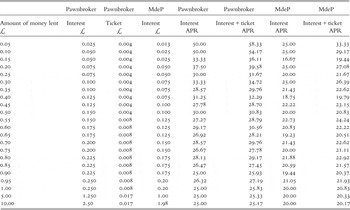
A loan from a pawnbroker tended to be short-term, with longer terms obtainable for more valuable pledges. Three months was the usual term for non-durable goods, which would depreciate in value the longer they were kept in storage. The Irish term structure differed from that in the rest of the UK. In Britain, loan terms were 12 months, whereas in Ireland there were different term limits depending on the size of the initial loan, ranging from 6 to 12 months (BPP 1867–8, p. 27). Interest charges also varied according to the sums lent (BPP 1837–8, p. iv). Table 1 displays an annual interest schedule for Irish pawnbrokers and for the Limerick MdeP. For loans under £10, pawnbrokers were exempt from usury laws but Irish rates were higher than those permitted in Britain (Ó Gráda Reference Ó Gráda1974, p. 132).
Annual interest schedule of Irish pawnbrokers and the Limerick Mont-de-Piété

Sources: BPP (1837–8, pp. 223–5) and (28 Geo. 3) c. 49 [I], section 19.
Note: These are maximum legal rates for 12 months as reported in the appendix of the parliamentary enquiry. They were the nominal monthly rate multiplied by the number of months in the calendar year. The interest schedule increased by ‘one halfpenny per month for each and every sum of two shillings’((28 Geo. 3) c. 49 [I], section 19). For sums greater than £10 pawnbrokers could only charge 6 per cent per annum (BPP 1837–8, p. xv). The Mont-de-Piété rates are those reported in Limerick. The 1786 Pawnbroker Act permitted charging for duplicates: 1d for loans not exceeding 10s (£0.50), 2d for loans from 10s (£0.50) not exceeding 40s (£2), and 4d for loans exceeding 40s (£2) (( 26 Geo. 3) c. 43 [I], section 5). The interest + ticket was included in the original source.
If a borrower defaulted, the forfeited collateral did not automatically become the possession of the pawnbroker because pledges had to be sold at public auction (BPP 1867–8, p. 30). The law stated that the owners of the pledges were to be given notice of such auctions, but it was believed that this practice was unnecessary since defaulting borrowers rarely attended them (BPP 1837–8, Q. 956; BPP 1867–8, p. 30). The main buyers at the auctions were reported to have been dealers in second-hand goods (BPP 1837–8, Qs. 340–1; BPP 1867–8, pp. 29–30). If pawnbrokers had wanted to insure against loss, they would have lent only on pledges which had some market, in this case auction, value. Alternatively, they could have given less in loans than they would have expected to receive at auction.
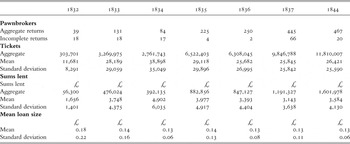
Irish pawnbroking legislation stated that all pawnbrokers were required to submit monthly returns to the Marshal of Dublin, who in turn was required to submit an annual abstract to parliament. This stipulation does not, however, appear to have been enforced. Instead annual sums were requested from pawnbrokers in lieu of their returns (BPP 1837–8, Qs. 886–7). From the isolated returns, we can get a sense of the number of pawnbrokers operating in Ireland and the scale of their activities; the available data are shown in Table 2. The data from the early years seem to be under-reported and enforcement appears to have been sporadic. From 1837, after the Marshal personally visited towns (BPP 1837–8, p. 163), a somewhat more accurate picture of the pawnbroking sector is available.

The high standard deviation in the number of tickets and loans made in Table 2 is accounted for by the position of Dublin City. In 1844 it made up the bulk of pawnbroking business activity, 32 per cent of pledges and 35 per cent of loans, despite having only 9 per cent of registered pawnbrokers. Mean loan sizes from pawnbrokers were relatively small, 2s 6d (£0.13). However, loan sizes were significant in relation to contemporary average weekly wages, which were in the region of 4s 6d (£0.23) in the 1840s (Bowley Reference Bowley1899, p. 401) and less for the ‘poor’, around 2s. If the poor were the main borrowers from pawnbrokers, then the distribution of pawnbroker loans may have been positively skewed. This suggests that pawnbroking was not merely a pastime for the poor – it may have been used by a wide variety of people and for such things as tiding people over temporary unemployment, unexpected disasters and so on.
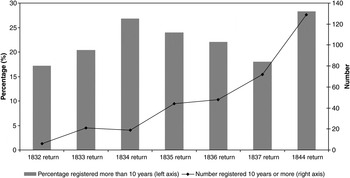
Looking at registration dates from the pawnbroker returns, shown in Figure 1, it is possible to get an insight into the level of competition in pawnbroking. The proportion of the pawnbrokers registered in 1832 who were registered before 1822 was 17 per cent; 28 per cent of the pawnbrokers registered in 1844 were registered before 1834. In both years, all the remaining registered pawnbrokers were new entrants. This suggests that the pawnbroking field was fairly competitive. However, MdePs were introduced on the assumption that there was a lack of competition in the pawnbroking sector (e.g. BPP 1837–8, Q. 727).
Pawnbrokers registered for 10 years or more, number and percentage, 1832–44

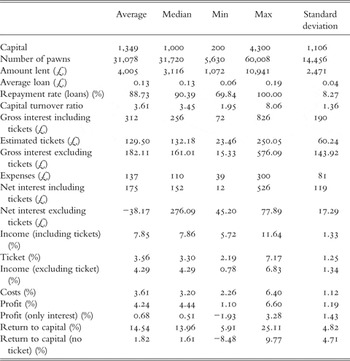
Published pawnbroker returns provided only summary information on the number and amount of loans, making it difficult to generalise about capital levels and the profitability of private pawnbroking. There is, however, a detailed return of 22 pawnbrokers from Cork City for the year 1837, which is summarised in Table 3.
Return of 22 Cork City pawnbrokers, 1837

Source: BPP (1837–8, p. 226).
Note: The commentary in the parliamentary inquiry makes reference to ‘large’ or ‘small’ capital, but there does not appear to be a common understanding of how the capital of a pawnshop should be measured. Pawnbrokers were not joint-stock companies, which suggests that the capital invested is that belonging to the proprietors. The percentage income (including and excluding tickets) is an average of the gross interest including/excluding tickets divided by the loan turnover in each pawnbroker. The percentage costs are an average of the expenses divided by the loan turnover in each pawnbroker. The percentage return to capital is the profit divided by capital for each pawnbroker.
Mean income, including tickets, was 7.85 per cent of loan turnover. This is very similar to the finding by Minkes (Reference Minkes1953, p. 14) of 7 per cent for British pawnbrokers. The mean profit was 4.24 per cent of loan turnover, which gave a mean return on capital of 14.54 per cent. What is interesting is the importance of income from tickets. Borrowers were charged 1d (£0.004) per ticket for loans up to 2s (£0.10). Ticket prices increased incrementally for loans higher than 2s. Table 3 estimates the ticket proportion of the gross interest by assuming that each loan is charged at 1d, possibly underestimating ticket charges if loans were higher than 10s. This allows the calculation of separate figures for interest and ticket. It is striking to reflect that if there had been no ticket charge then many pawnbrokers would have made a loss. Overall, pawnbroking in nineteenth-century Ireland appears to conform to the findings of Caskey (Reference Caskey1994).
II
The following section outlines the historical development of the Parisian MdeP and the key institutional characteristics of Irish MdePs vis-à-vis their Parisian inspiration through a micro-study of the Limerick MdeP, the first and largest MdeP established in Ireland. These findings are representative of other MdePs, which were based on the Limerick model and experienced similar difficulties. For example, the Cork MdeP paid a grant to the Limerick MdeP ‘to ascertain the plan of proceedings there’ (BPP 1842, p. 38).
According to Barrington (Reference Barrington1836), MdePs traced their origins to late medieval money-lending institutions in Italian states which aimed to curb usury and provide credit to poor borrowers. However, this hagiographic account of the Monti di Pietà may not be entirely accurate; surviving records show that they made loans to different social groups and not the poor alone (Sandra Reference Sandra1995; Green Reference Green1991). Monti di Pietà, translated as ‘mounts of piety’, migrated northward and were established in various northern European regions, including the Netherlands, the German states, Spain and France (BPP 1894; Carbonell-Esteller Reference Carbonell-Esteller2012).Footnote 5
The Parisian MdeP was first established in 1777 by royal decree in an effort to combat usury and under this decree was given a monopoly in the field of pawnbroking. Significantly, the MdeP was not intended solely for the poor. In fact, Danieri (Reference Danieri1991, p. 46) argues that ‘the MdeP expected to receive objects from a wide range of clients, from the very rich to the very poor’. Following the French Revolution, in 1789, the MdeP became distrusted as an institution of the ancien régime, and in an attempt to promote laissez-faire economic policies it lost its monopoly status in 1793. Following the removal of barriers to entry, the MdeP faced competition from private lending houses. Political interference in the affairs of the institution restricted its lending activity to small amounts in order to assist the poor and occasionally allowed pawns to be redeemed without charge. The net effect of competition and political interference saw the MdeP close in 1796. It was reopened the following year, but struggled to compete with private institutions. The MdeP was forced to implement a maximum loan policy, and this excluded it from making more remunerative loans (Danieri Reference Danieri1991, pp. 42–76).
Political concern over the level of interest rates resulted in increased support for the MdeP; it was recognised as a public institution under an Act of 1804 and a further law was passed in 1805 which ‘ordered the closing of currently existing’ private pawnbrokers, hence giving the MdeP a monopoly and reinstating pre-revolutionary privilege (Danieri Reference Danieri1991, p. 85). The French MdeP experienced significant growth in business after 1804. Danieri (Reference Danieri1991, p. 87) states that ‘much of this was the result of the closure of private pawnbrokers, which, by the terms of the decree that ordered their closure, could deposit their pawns at the MdeP’.
The first pawnbroker's established along MdeP lines in Ireland was founded by Matthew Barrington (1788–1861), lawyer and philanthropist (Andrews Reference Andrews2009), in the city of Limerick in 1837. In a petition to the UK parliament circa 1838, Barrington states that he was ‘determined on making a trial’ of the Parisian MdeP model in the city of Limerick (BPP 1837–8, p. 228). His experiment was replicated in a number of other locations throughout the island, mainly in urban centres, for example, by Henry John Porter, a land agent in Armagh, who played a role in establishing intertwined MdePs and Loan Fund Societies (LFS), local microcredit institutions, in both Portadown and Tandragee, County Armagh (Anon. 1855, p. 3).
Barrington was motivated to establish an MdeP because he believed that the pawnbroking laws were inherently flawed and that the existing laws were poorly enforced and easily evaded. Furthermore, he believed that this resulted in poor borrowers being subjected to excessive charges and high rates of interest, stating that the pawnbroking system was ‘oppressive upon those very persons whom it was intended to make the special objects of its relief’ (BPP 1837–8, p. 227). He also saw it as a means to fund his family hospital (BPP 1837–8, Qs. 656, 660; Lenihan Reference Lenihan1866, pp. 480–1).Footnote 6
As a result of lobbying by Barrington, advocates of Parisian-style MdePs had an opportunity to give evidence to the 1837 pawnbroking inquiry. Archibald Douglas, an inspector and secretary of the Limerick MdeP, stated that it was the policy of the management to hire an experienced pawnbroker as manager of the MdeP (BPP 1837–8, Q. 505). This pawnbroker was John William Hobbs Haynes, who had 14 years' experience (BPP 1837–8, Qs. 156–8). Haynes stated that the policy of the Limerick MdeP was to lend ‘small amounts’, and that it deliberately targeted poorer borrowers (BPP 1837–8, Q. 238 and 243). The policy was to lend 33 per cent of the value of soft non-durable goods and 80 per cent of the value of hard durable goods (BPP 1837–8, Q. 406 and 408). There were 12 clerks employed in the Limerick MdeP (BPP 1837–8, Q. 370), indicating a heavy workload, but also suggesting high administrative costs. The description of the work suggests that the amount of labour and procedures were excessive but they were intended as a way to monitor the clerks and prevent fraud. Mr Hayes was asked if the expenses entailed by the MdeP operation were greater than an individual pawnbroker's, to which he replied ‘yes, they are; but there may be short modes of check, not so voluminous as those, that would do for a private office’ (BPP 1837–8, Q. 426).
Archibald Douglas gave evidence to clarify how the Limerick MdeP was capitalised. Unlike contemporary private pawnbrokers, the MdeP was able to issue debentures to raise its capital. In 1841 it had a capital of £13,213, which is sizeable in relation to the capital of Cork City pawnbrokers shown in Table 3. Barrington succeeded in recruiting high-ranking support for his MdeP and debentures were bought by a number of notable figures; for example, Daniel O'Connell, a prominent contemporary political figure. These debentures were guaranteed by the assets of the institution. There was a legally imposed 6 per cent ceiling on debentures, subsequently reduced to 5 per cent in 1843 (6 and 7 Vict., c. 91, section 9), and the institution paid the maximum (BPP 1837–8, Q. 476). Barrington believed that the MdeP received credits on the basis of his affiliation with the institution. He stated that he felt ‘a moral obligation that they should not lose by it, and it is on this account I did not increase the capital’ (BPP 1837–8, Q. 707). This suggests that the institution may have been oversubscribed, a view which is supported by the fact that Barrington was offered funds at lower rates but opted to pay 6 per cent (BPP 1837–8, Q. 767). The board of the Limerick MdeP was made up of ex officio religious and secular authorities and debenture holders, many of whom were not residents of Limerick city.
The financial returns of the Limerick MdeP from 1838 show that it made 104,086 loans with an average loan size of 3s 5 1/2d (£0.17) (BPP 1839). This was similar to the average loan size of the Limerick City pawnbrokers in 1837, 2s 11d (£0.15).Footnote 7 According to Douglas, the range of loans was between £0.05 and £0.25, and that 86 per cent of loans were under £0.25 (BPP 1837–8, Qs. 595, 598). Average wages in Limerick in the 1830s were reported to have been 3s 6d (£0.18) (Bowley Reference Bowley1899), again highlighting that it may not have been only the working poor who availed themselves of these services. Haynes stated it was ‘huxters’, small urban traders who sold small quantities of goods in the city, who used the Mont-de-Piété. They pledged their bed linen and used the money they received from dealing to redeem their pledges (BPP 1837–8, Qs. 250–1). Barrington stated that most articles were pledged for one day only and then redeemed (BPP 1837–8, Q. 714).
The Limerick MdeP charged lower rates than private pawnbrokers and did not charge for tickets (see Table 1). Curiously, the rates charged by Irish MdePs were significantly higher than the 9 per cent per annum rate, plus an additional transaction charge, of the Parisian MdeP (Danieri Reference Danieri1991, p. 113) or the 6 per cent per annum rate of the Barcelona MdeP (Carbonell-Esteller Reference Carbonell-Esteller2012, p. 370). Douglas argued that the Limerick MdeP charged more than the Parisian 9 per cent ‘in consequence of paying a much higher rate of interest for the money we borrow, and also for the purpose of not reducing the rate of interest so much below the pawnbrokers as to do them a serious injury in the outset of our operations or to seem to do it’ (BPP 1837–8, Q. 517). In his pamphlet Barrington (Reference Barrington1836, p. 8) was keen to state that the concept of MdePs had received papal approval. Porter was also keen to stress this point, which appears to be related to contemporary criticism of both MdePs and LFSs.Footnote 8 In 1838 the Limerick MdeP received £1,074 in income from interest, which equated to 6 per cent of loan turnover. This was similar to the rate obtained by the Cork City pawnbrokers shown in Table 3, but it was highly significant in relation to the rate of interest on debentures, also 6 per cent, indicating that there was no margin. These reports imply that the average resident of Limerick city took three loans. However, this ratio overlooks the fact that many were multiple borrowers, and also that only certain sections of society were frequent users of the MdeP. There is also the possibility that borrowers were not residents of the city but came from its hinterland.
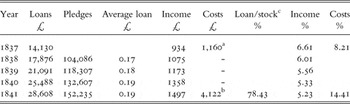
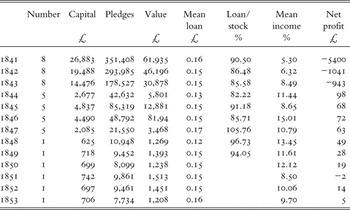
In his petition for a parliamentary inquiry into pawnbroking, Barrington wrote that ‘success has been most complete’ in his trial of an MdeP in Limerick city (BPP 1837–8). However, upon analysing the performance of the MdeP, it can be seen that Barrington may have prematurely declared his experiment a success. Despite a growing business, the number of pledges increasing by 43 per cent and income increasing by 39 per cent between 1838 and 1841, the Limerick MdeP was making a loss in 1841 (see Table 4). A noticeable absence from 1842 onwards in Table 5 is Barrington's pioneering MdeP. The 1843 report of the Loan Fund Board (LFB), the board where the MdePs were registered, states that ‘it would appear that the accounts of this MdeP [Limerick] have been very imperfectly kept, as the manager [Barrington] was unable to furnish any return of its state on 31 December 1842’ (BPP 1843, p. 20). Piesse, the LFB's secretary, alluded to Barrington in his account of the MdePs, stating that ‘the establishment at Limerick is still supported by the munificence of a private individual [Barrington], without whose assistance it must have long since fallen to the ground’ (1841, pp. 44–5). It is difficult to establish why Barrington kept the MdeP open despite the loss-making activity. Possible motivations are the relationship between the MdeP and his family's hospital, the amount of political capital invested in advocating MdePs and his sense of honour to those who supported him. Other MdePs were operated in conjunction with LFSs, but their accounts of the income and costs associated with each business activity were not separated, making it difficult to determine their profitability. However, the Belfast MdeP was reported to have been run at a loss and a drain on the LFS (BPP 1842, p. 46), as were the MdePs operated by Porter (BPP 1842, pp. 8 and 44–5).
Limerick Mont-de-Piété, 1838–41

Sources: Annual reports of the Loan Fund Board, 1838–41; BPP (1837–8, Q. 532–553).
Note: The income measures ‘interest from borrowers’. Costs include ‘expenses and interest on capital’.
a Salaries, £600, interest £360 and rent £200
b Outlay on building £2,535
c Loan/stock = loan per pledge during year as a percentage of stock value per pledge at end of year. The practice of the MdePs was to place an estimated value on the stock rather than estimate it according to the value that was lent. This was contrary to established pawnbroking practice and was criticised for overestimating the profitability of stock (BPP 1837–8, Qs 1181–2).
Monts-de-Piété, 1841–53

Sources: Annual reports of the Loan Fund Board, 1841–53.
Notes: Loan/unredeemed stock, see Table 4, note c.
III
Less than 20 years after the introduction of MdePs in Ireland all such imitations had failed,Footnote 9 suggesting that Barrington spoke too soon in claiming the imitation to have been a complete success. This case is an example of the co-existence of two distinct types of pawnbroking institution in the same market and the aim of this section is to determine why the MdePs were the unsuccessful competitors of the two. Piesse (Reference Piesse1841, p. 50) noted that none of the MdePs had ‘repaid the expense of outfit’. This section attempts to explain why this was the case. A key finding is that the MdeP had low revenue streams, high costs and were unable to cross-subsidise their loan book because they operated in a competitive environment and were unable to realise economies of scale.
The stated goals of the MdeP were to charge lower rates than private pawnbrokers, not to charge for tickets and to concentrate on lending to the poor. In addition, Barrington et al. said that their goal was to finance charitable expenditure through MdeP profits. It was argued that if the Limerick MdeP had a capital of £15,000, after paying 6 per cent interest, it would be able to ‘allocate £4,000 a year towards supporting all the charities of Limerick’ (Anon. 1836, p. 8). Barrington was especially bullish, claiming that annual pawnbroker profits (alongside ‘fines, penalties and forfeited recognizances’, estimated at £32,089) were £500,000 and that ‘after supporting, as is seen, all the Medical charities, this sum would go far in preventing the necessity of Poor Laws, by supporting the aged and infirm, and affording employment to a large portion of the labouring population of the country’ (1836, p. 24). These claims were not met and one of the main barriers to this was the inability of the Irish MdePs to realise high profits to enable them both to cross-subsidise their lending book and finance charitable expenditure. Over the period 1841 to 1853 the mean charitable expenditure of MdePs was £23 per annum, far short of the anticipated amount.
Barrington's expectations were based on research which he undertook by visiting a number of pawnbrokers in Limerick city and pledging goods. He noted the different ticket numbers in the course of a week and estimated the annual number of loans. From this he estimated the annual income, equated as profit, received by pawnbrokers (Anon. 1836, pp. 3–5).Footnote 10 However, this analysis was flawed as it incorrectly assumes that income equals profit.Footnote 11
There are a number of transaction costs in pawnbroking but the procedures of the MdeP appear to have duplicated a number of costs. Each item pledged had to be evaluated by an appraiser, it then had to be recorded in a register before a duplicate ticket was issued. The pledge was then placed in storage and retrieved upon redemption. The ticket had to be cross-referenced with the register and cancelled. These steps create significant transaction costs to the pawnbroking business. When asked if he thought the income from lending was sufficient to cover these costs, Barrington replied ‘I do not think it is fairly remunerated at so low a charge as one farthing [one-fourth of a penny, the minimum interest charge], but the object we had in establishing it was, to bring the matter before the public by competition’ (BPP 1837–8, Q. 727).
Other costs were significant. Insurance was required against fire and damage to stored pledges. Rent, higher than that paid by private pawnbrokers (BPP 1837–8, Q. 767), was being paid on an ornate edifice. MdePs were exempt from taxation, but were required to pay auction duty. Capital costs were also significantly different from those in France, where bonds issued by the French MdePs had government guarantees (BPP 1894, p. 49); essentially, they were publicly tradable municipal bonds. In Ireland the bonds were guaranteed by the propagators and this limited their financial capacity. This was also a reflection of the monopoly status which the institutions enjoyed on the Continent, since investors were aware that their investment was secure and carried a guaranteed income; its Irish progeny did not have similar guarantees. Essentially this was a de facto subsidy, for it enabled the Parisian MdePs to raise capital at lower rates of interest. During the period 1835–45 UK Consols traded at 3.25 per cent, compared with the 6 per cent paid by the Limerick MdeP, indicating a significant bond spread. If Irish MdeP bonds received similar government guarantees the cost of capital would have been significantly reduced. Moreover, as previously discussed, the fact that Barrington essentially guaranteed the Limerick MdeP debentures appears to have made him risk averse and his venture may have lost custom as a result. However, even with a lower cost of capital it would not have reduced the sizeable costs of the Limerick MdeP.Footnote 12
The successful philanthropic New York Provident Loan Society operated on a low-cost model. Initially it was subsidised by capital which paid below market returns to shareholders. It then bought out shareholders and was solely self-financed, reducing costs further because it was exempt from taxation. In addition it aimed to reduce costs by refusing pledges with high storage costs (Caskey Reference Caskey1994, pp. 24–6).
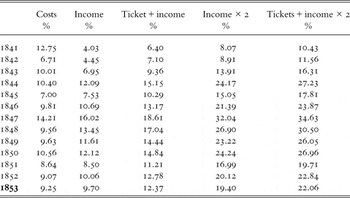
Did the MdeP cheap loan business model lead to failure? First, as noted above, the Irish MdeP rates were not equivalent to the low rates in France. Hugh McCall, a pawnbroker in Lisburn, County Antrim, claimed that he charged as much interest as the Limerick MdeP, plus a ticket charge, and that this was sufficient for him to carry on business (BPP 1837–8, Q. 1096). It was also reported that some pawnbrokers in Limerick lowered their rates to the MdeP level, but retained a ticket charge, and that this did not affect them adversely (BPP 1837–8, Qs. 662, 849). If the MdePs charged for tickets as those in Paris did, recalling the final column in Table 1, would this have increased their profitability? Table 6 estimates MdeP income from 1841 to 1853, using the data in Table 5, assuming that 1d per ticket was charged and also estimating the result of doubling interest rates.Footnote 13 These estimates suggest that charging for tickets alone would have been sufficient to cover costs and an increase in interest rates would have significantly increased profitability. However, the effect on MdeP profitability of MdePs charging higher/lower interest rates plus ticket charges would have been determined by the elasticity of demand for credit and the level of competition, discussed below.
Mont-de-Piété costs and income projections, 1841–53

Notes: Figures are a percentage of loan turnover.
Source: Table 5
Barrington's analysis overlooked the critical point that it was not only the poor who used the services of pawnbrokers. Pawnbrokers are not only ‘poor men's banks’; they also receive pledges from middle-class customers for both consumer and business loans (Minkes Reference Minkes1953, p. 11; Tebbutt Reference Tebbutt1983, p. 3). Piesse stated that:
The most valuable class of pledges, such as plate, watches, jewellery, &c., rarely find their way to a Mont de Piété, the owners preferring to pay a higher rate of interest to the private pawn rather than have their names appear in the books of a Public Institution. Now there is just as much trouble and expense incurred in receiving and releasing an article valued at 6d. [£0.025] as there would be in the receipt and release of one valued at £60. It is the business done in valuable pledges which constitutes one of the chief gains in private pawning, and whilst this practice is sanctioned by the Legislature, the most profitable class of business will never be done at the Mont de Piété. (1841, p. 45)
Pawnbrokers receive greater interest payments on higher-value pledges. The transaction costs per pawn irrespective of value are relatively stable, although higher-value pledges may require higher storage and administrative costs to secure them against theft. Although there was a £10 ceiling on pawnbroker lending, this could be overcome by tacit agreement with borrowers (BPP 1867–8, p. 27). However, Barrington was opposed to such practices and believed that they were an abuse of the pawnbroking laws. In addition, if people from higher socio-economic backgrounds experienced liquidity constraints and wished to pawn but preferred to keep their affairs private to avoid social embarrassment, using an MdeP might not have been ideal. However, the fact that higher loan-to-value ratios could be obtained from private pawnbrokers, discussed below, may also have been a significant factor in the borrower's pawning decision.
The importance of these higher-value pledges is that they can cross-subsidise smaller loss-making loans; the loans which the Irish MdePs wished to make. This is also evident from Porter's account of MdePs in Rome, where he found examples of high-end goods being pawned. In one case a 66 gram diamond ring valued at £1,733 was pawned for £975 and a diamond and pearl necklace valued at £541 was pawned for £325 (Porter Reference Porter1842).Footnote 14 Danieri (Reference Danieri1991, p. 2) states that ‘the Mont-de-Piété never merely served the needs of the destitute poor or even the artisan and shopkeeper in temporary difficulties, but other groups as well’. The significance of cross-subsidisation can also be seen in the distribution of loans made, where low-value pawns, between 3 (£0.15) and 10 francs (£0.40), made up almost 60 per cent of the items pawned, but they corresponded to 20 per cent of the total value of loans. Higher-value pawns were a lower proportion of total pawns, but a high contributor to the total amount lent.Footnote 15
A minimum loan policy whereby no item valued less than 3 francs (£0.12) could be pawned was implemented by the Parisian MdeP (Danieri Reference Danieri1991, p. 183). In 1840 the average pawn was 15 francs (£0.60), which was considerably higher than the average pawn in Irish MdePs, of 4.5 francs or £0.15. The successful Provident Loan Society in New York City also implements a minimum loan policy. This is because transaction costs on small loans are higher than the amount that the society is receiving for them. However, it is a charitable organisation and does provide a limited number of small loans (Caskey Reference Caskey1994, p. 25). The Limerick MdeP appears to have implemented a much lower minimum loan policy, £0.05, than its Parisian progenitor (BPP 1837–8, Q. 596), but more importantly the Irish MdePs operated under a self-binding £10 loan ceiling. Suggestions that small loans were unprofitable to pawnbrokers can be seen from the evidence of pawnbrokers in the later nineteenth century, who believed that high-value pawns were worth more to them (Hardacker Reference Hardacker1892, pp. 204–5). Ultimately, Barrington did not appreciate the significance of such high-value loans to the Parisian MdeP model.
Barrington believed that MdePs would ‘be useful in competition with the ordinary pawnbrokers’ (BPP 1837–8, Q. 766). However, in contrast to Caskey and Zikmund (Reference Caskey and Zikmund1990), Caskey (Reference Caskey1991, Reference Caskey1994) and Minkes (Reference Minkes1953), contemporaries argued that the pawnbroking sector in Ireland was highly competitive. The contention does not appear to be fully reflected in price competition, but instead in the proportion of the value lent on collateral. This does not negate the fact that borrowers' transport costs were significant, but given that additional distance may have resulted in a higher loan this could have reduced the transport costs per pound borrowed.
The Limerick MdeP charged lower interest rates on loans than incumbent pawnbrokers (see Table 1). In addition, it was also offering a much lower proportion of the value of loans (see ‘loan/stock’ in Tables 4 and 5). According to Edward Homan, a Limerick pawnbroker involved in the trade from the beginning of the 1800s, competition in Limerick city was fairly intense. But since the opening of the MdeP he declared that ‘I do more business than ever I have done since I have been at Limerick’ (BPP 1837–8, Q. 841). Homan declared that he, and others in Limerick, charged the legal rate, as outlined in Table 1.
Homan attributed his increase in business to customer satisfaction and honest business practices; however, a significant distinction between him and the MdeP was that he was lending close to 100 per cent on asset values, versus as low as 33 per cent in the MdeP (BPP 1837–8, Qs. 849, 858–61).Footnote 16 McCall also stated that he made loans close to their value (BPP 1837–8, Qs. 1078–82, 1091). The interest schedule of the MdeP (see Table 1) was skewed in favour of smaller loans, but as loan sizes increased the MdeP rate converged with the private rate. For lower loan sizes the MdeP may have been an attractive option, the rate being half that of private pawnbrokers and compensating for a lower loan-to-value ratio. As loan sizes increased there was a smaller interest differential; however, a much larger loan-to-value ratio was attainable from private pawnbrokers. This may have influenced borrowers' decisions.
Caskey (Reference Caskey1994, p. 26) reports that the Provident Loan Society in New York City is also conservative in its valuation of collateral and this ‘apparently leads many customers to commercial pawnbrokers who will make larger loans’. From the evidence of Barrington and Hayes (BPP 1837–8, Qs. 230, 236, 721) risk aversion, given that the MdeP was financed by debentures guaranteed by Barrington himself, appears to have been a factor in the policy of the Limerick MdeP of issuing a lower proportion of the value of pledges.Footnote 17
Customer transport costs did play a role; as Homan stated, ‘the poor person wanting to raise money need not bring as many articles or as much value to me or any pawnbroker in Limerick, as they need to carry to the Mont de Piété’ (BPP 1837–8, Q. 860). The situation of pawnbrokers lending close to 100 per cent on pledge values was reported to have been common throughout Ireland (BPP 1837–8, pp. vii–viii). As a result of competition, profits were not super-normal, as seen in Cork City, and new entrants were common in the market, as shown in Figure 1. Further evidence of competition and credit availability in Ireland is the absence of illegal pawnshops – dollyshops – which existed elsewhere in Britain; this was due to the higher interest rates permitted in Ireland (Ó Gráda Reference Ó Gráda1974, p. 132).
The cases where MdePs existed and were successful in the nineteenth century appear to be related to the fact that they had monopoly status (BPP 1894, p. 47). For example, a parliamentary report on foreign pawnbroking institutions, published in 1894, states that French MdePs were ‘created in most instances by the local authorities and intended to supply the place of private pawnbrokers, and to prevent the abuses and extortion to which the poorer classes are subjected when necessity obliges them to borrow on personal belongings’ (BPP 1894, p.147). The report also says that in France private pawnbroking was illegal but there were reports of illicit pawnshops (BPP 1894, p. 47). In contrast, the Provident Loan Society was successfully operated as a philanthropic pawnshop in New York City in competition with private pawnbrokers from 1894 until the present day (Caskey Reference Caskey1994, pp. 23–6). Caskey (Reference Caskey1994) postulates that philanthropic pawnshops ‘may be feasible only in a densely populated urban area’, suggesting that it is not monopoly per se but scale economies which are important. There are trade-offs associated with scale economies, but a large institution, although more cost-efficient, may lose the familiarity with borrowers which was key to pawnbroking.
Branch networks integral to the Parisian MdeP were not established in Ireland. Commissionaires, private intermediaries used by the Parisian MdeP, mediated between borrowers and the MdeP. They operated in areas in close proximity to borrowers, had longer opening hours and were funded by commissions on loans and redemptions. The commissionaires play a key role in understanding how the MdeP in Paris functioned at this time. Borrowers chose to pledge in the conveniently located commissionaires rather than travel to the central MdeP, which was further away. Furthermore, loans in commissionaires were lower in value than at the central establishment despite the fact that commissionaires levied ‘sometimes exorbitant charges’ compared with the MdeP (Danieri Reference Danieri1991, p. 197). Thus the commissionaires appear to follow Caskey's finding (1991) that borrower transport costs are important in the choice of pawnbroker. Between 1831 and 1839, they ‘pawned nearly 90 per cent of items at the MdeP, and redeemed at least 50 per cent’ (Danieri Reference Danieri1991, pp. 196–7).Footnote 18 The MdeP pawned approximately 17 per cent of the pledges in Limerick City.Footnote 19 This is similar to the situation in Paris, except that the remaining 83 per cent of pledges were not made by subsidiaries but by competitors. The commissionaires and later formal branch system also maintained a level of familiarity with borrowers that a large unit operating at scale would have lost.
Furthermore, it would have been politically difficult to nationalise the private pawnbrokers in existence in Ireland, and by extension Britain, in order to introduce a public pawnbroking system without widespread public support for such an institution. The available evidence suggests that such public support was lacking. For example, a satirical editorial in The Nation (14 December 1844) was critical of both MdePs and LFSs, stating that: ‘pawning has many times been his [the poor borrower's] make-shift before, when, perhaps, even hard necessity could not subdue a feeling of shame; and here is an opportunity of doing the same thing much more respectably, placed just in his way; an office established and managed by gentlemen! by philanthropists! [sic]’ Moreover, nationalisation would have involved interference with property rights, but it would also have been a sizeable public foray into the pawnbroking trade.Footnote 20
Another possible explanation for failure could have been losses due to the Irish Famine (1846–52). Writing in 1842, the LFB suggested that ‘even if worked successfully, and on a large scale, several years must elapse before the cost of outfit is paid off, and the institution rendered productive’ (BPP 1842, p. 6). Unfortunately the timing was not favourable to a long-term MdeP experiment, given the interruption caused by the Irish Famine. Ó Gráda (Reference Ó Gráda1999, pp. 153–4) finds a decline in pawnbroker loans over the course of the Famine caused by an increase in pledge forfeitures. Before the Famine, MdePs had a low forfeiture rate, but as loans increased in 1846 these do not appear to have been repaid and the stocks of forfeited pledges increased. Only the Portadown MdeP remained open after 1847.
The Famine may have restricted time to build up sufficient reserves, but available records suggest that MdePs were struggling pre-Famine. MdeP lending peaked in 1841 at £61,935 (£7,741 per MdeP) and declined thereafter. There was a slight fillip in 1845 when a new MdeP was founded, but the effect did not last long and in 1845, before the onset of the worst Famine years, lending stood at £12,880 (£2,576 per MdeP). In terms of pledges, we find a similar trend; these peaked at 351,408 in 1841 (43,926 per MdeP). Pledges also decreased before the Famine and stood at 85,319 in 1845 (17,063 per MdeP).
IV
In summary, this article has discussed the efforts to establish Continental pawnbroking institutions in Ireland in the 1830s and 1840s. The article argued that the pawnbroking sector in Ireland was competitive and that economies of scale resulting from the monopoly status of MdePs on the Continent were integral to their success. High costs and insufficient income, coupled with high levels of competition, essentially pushed the MdePs out of business in Ireland.
The MdePs introduced to Ireland in the 1830s are an example of a failed institutional imitation. The decision to imitate the MdeP system appears to have been ideologically motivated and did not take the existing market structure, in Ireland or France, accurately into account. There was a complete failure on the part of the MdeP propagators to understand the French context. For example, in Barrington's pamphlet he ambitiously suggests that the MdeP could be used instead of a Poor Law system, but in France the MdeP was a complementary tool in poor relief policy. It had been established in 1777 as ancillary to the pre-existing poor relief system, and was able to feed profits into this system by virtue of the fact that it had a monopoly of the pawning market. This was never possible in Ireland because the markets were competitive and there was a binding ceiling on lending. This would have limited the scope of the MdeP's activity and hindered the possibility of cross-subsidising loans. Nor did they realise that the liberal interest rates pawnbrokers were permitted to offer in Ireland enabled them to provide a better service to the poor.
Taking pre-existing market conditions into consideration is an important factor when undertaking institutional imitation and it is something that has been stressed in recent microfinance literature (Ledgerwood Reference Ledgerwood1998, p.11). A lesson taken from the failure of MdePs in Ireland for governments or charities interested in establishing a philanthropic alternative to pay-day loan companies, pawnbrokers and cheque cashing companies would be to aim for economies of scale by establishing large networks in densely populated areas. Institutions may be subsidised, but for a long-term sustainable institution costs ought not to be overlooked.