Introduction
Depression is frequently associated with interpersonal and social dysfunction (Hames, Hagan, & Joiner, Reference Hames, Hagan and Joiner2013; Kupferberg, Bicks, & Hasler, Reference Kupferberg, Bicks and Hasler2016; Pulcu & Elliott, Reference Pulcu and Elliott2015). For instance, depressed individuals have diminished pleasure in and reduced motivation to socializing (Frey & McCabe, Reference Frey and McCabe2020; Hammen, Reference Hammen2005), and behave inappropriately during social interactions (reviewed in Rottenberg & Gotlib, Reference Rottenberg, Gotlib and M2004; Segrin, Reference Segrin2000). This social dysfunction is proposed to be a trait abnormality, as it remains persistent even after long-term remission of depressive symptoms (Hirschfeld et al., Reference Hirschfeld, Montgomery, Keller, Kasper, Schatzberg, Moller and Bourgeois2000; Rhebergen et al., Reference Rhebergen, Beekman, de Graaf, Nolen, Spijker, Hoogendijk and Penninx2010). Gaining more insight into social dysfunction (and its neuropsychological underpinnings) is therefore important to inform and facilitate intervention and prevention for depression.
Adaptive social functioning and benign social relationship require appropriate processing of social feedback, i.e. verbal or non-verbal evaluative signals from others about the appearance, characteristics or behavior of an individual (Baumeister & Leary, Reference Baumeister and Leary1995; Vossen, Ham, & Midden, Reference Vossen, Ham, Midden, Ploug, Hasle and Oinas-Kukkonen2010). Abnormalities in social functioning, such as those observed in depression may therefore partly be linked to alterations of social feedback processing (Kupferberg et al., Reference Kupferberg, Bicks and Hasler2016). In line with this idea, it has been found that when experiencing/evaluating social feedback, depressed individuals showed hypersensitivity to social rejection and reduced sensitivity to social acceptance (‘social anhedonia’), which are related to dysfunctions separately in the ‘social pain’ network [the insula, the dorsal anterior cingulate cortex (dACC) and the prefrontal cortex] and social reward system (the ventral striatum, VS) (Kupferberg et al., Reference Kupferberg, Bicks and Hasler2016). Specifically, social pain network is involved in the processing of negative social signals/events such as social rejection and peer exclusion. In this neural network, the dACC and the anterior insula have been shown to be sensitive to the detection of negative social experience, while the ventrolateral prefrontal cortex (VLPFC) regulates this negative feeling via inhibiting the response of the dACC (Eisenberger, Lieberman, & Williams, Reference Eisenberger, Lieberman and Williams2003). The responses in the dACC and the VLPFC were found increased in individuals with depression, which contribute to their increased sensitivity to social rejection (Jankowski et al., Reference Jankowski, Batres, Scott, Smyda, Pfeifer and Quevedo2018; Kumar et al., Reference Kumar, Waiter, Dubois, Milders, Reid and Steele2017; Silk et al., Reference Silk, Siegle, Lee, Nelson, Stroud and Dahl2014). Social reward system is active during the processing of positive social signals such as social acceptance and praise, and its hypoactivity is associated with social anhedonia in depression (Porcelli et al., Reference Porcelli, Van der Wee, van der Werff, Aghajani, Glennon, van Heukelum and Serretti2019). Abnormalities in these neural networks have also been observed in people with depression during expectation of social feedback. For example, individuals with depression showed increased anterior cingulate cortex (ACC) response during expectation of positive social feedback when compared to healthy controls (HCs) (He, Zhang, Muhlert, & Elliott, Reference He, Zhang, Muhlert and Elliott2019).
Social feedback sometimes violates our prior expectations (‘expectancy violation’; Somerville, Heatherton, & Kelley, Reference Somerville, Heatherton and Kelley2006). In many studies that have examined social feedback processing, expectancy violation serves as a strong confounding factor (van der Molen, Dekkers, Westenberg, van der Veen, & van der Molen, Reference van der Molen, Dekkers, Westenberg, van der Veen and van der Molen2017). For example, participants in the Cyberball task generally expect social acceptance (receiving the ball from others in the virtual game; Wesselmann, Wirth, Pryor, Reeder, & Williams, Reference Wesselmann, Wirth, Pryor, Reeder and Williams2012). In this context, social rejection (indicated by not receiving the ball) violates expectancy, which makes researchers hard to disentangle the contributions of social rejection v. expectancy violation (Somerville et al., Reference Somerville, Heatherton and Kelley2006; van der Molen et al., Reference van der Molen, Dekkers, Westenberg, van der Veen and van der Molen2017). It also leaves open the question of whether the observed impairment in social feedback processing in depression is due to expectancy violation, feedback evaluation per se, or some combination of the two.
To address this issue, the present study used the Social Judgment Paradigm (SJP) that distinguishes between expected and unexpected social feedback (Somerville et al., Reference Somerville, Heatherton and Kelley2006). In this paradigm, participants are presented with facial pictures of peers and asked to predict whether these peers (called ‘evaluators’) like them or not. The prediction is followed by actual feedback from evaluators indicating social acceptance or rejection that is either congruent or incongruent with participants’ prior expectations. Using the SJP in healthy subjects, cardiac and electroencephalogram studies found prolonged cardiac slowing response and enhanced theta power to unexpected social rejection (van der Molen et al., Reference van der Molen, Dekkers, Westenberg, van der Veen and van der Molen2017; van der Veen, van der Molen, Sahibdin, & Franken, Reference van der Veen, van der Molen, Sahibdin and Franken2014), and enhanced P3 and feedback-related negativity amplitudes to expectancy violations (Dekkers, van der Molen, Gunther, van der Veen, & van der Molen, Reference Dekkers, van der Molen, Gunther, van der Veen and van der Molen2015). These changes have been suggested to be mediated by the ACC (Gunther, Crone, & van der Molen, Reference Gunther, Crone and van der Molen2010; van der Molen et al., Reference van der Molen, Dekkers, Westenberg, van der Veen and van der Molen2017). Neuroimaging studies observed increased activations in VS and medial prefrontal cortex (mPFC) during the expectation period of the SJP, especially when participants make positive expectations (Gunther Moor, van Leijenhorst, Rombouts, Crone, & Van der Molen, Reference Gunther Moor, van Leijenhorst, Rombouts, Crone and Van der Molen2010; Powers, Somerville, Kelley, & Heatherton, Reference Powers, Somerville, Kelley and Heatherton2013). In the feedback evaluation phase of the task, previous studies in healthy subjects have found that while ventral ACC (vACC) is responsive to the experience of social feedback, dACC is more sensitive to expectancy violation (Somerville et al., Reference Somerville, Heatherton and Kelley2006). Furthermore, studies investigating individual differences using the SJP have found that while people with high rejection sensitivity showed hyper-activated VS and dmPFC in positive feedback expectation (Powers et al., Reference Powers, Somerville, Kelley and Heatherton2013), low self-esteem individuals showed reduced vACC/mPFC activation during social feedback experience (Somerville, Kelley, & Heatherton, Reference Somerville, Kelley and Heatherton2010).
Here we employed the SJP to investigate brain responses to expectation and evaluation/experience of expected and unexpected social feedback in individuals with subthreshold depression (SD). Focusing on the SD population allows us to explore potential neuronal indices of depression vulnerability without confounding effects of antidepressant medications or other clinical treatments. The brain regions of interest (ROIs) are VS, dACC and dmPFC, which have been robustly activated in previous neuroimaging studies using SJP (Gunther Moor et al., Reference Gunther Moor, van Leijenhorst, Rombouts, Crone and Van der Molen2010; Powers et al., Reference Powers, Somerville, Kelley and Heatherton2013; Somerville et al., Reference Somerville, Heatherton and Kelley2006; Somerville et al., Reference Somerville, Kelley and Heatherton2010). Based on behavioral findings regarding expectancy violation in depression (Liknaitzky, Smillie, & Allen, Reference Liknaitzky, Smillie and Allen2017), we hypothesized that expectancy violation would play an important role in social feedback processing of SD people, which will be distinctively associated with altered activations in above-mentioned brain ROIs. Specifically, we expected that individuals with SD will show reduced VS response in response to positive social feedback due to social anhedonia (Kupferberg et al., Reference Kupferberg, Bicks and Hasler2016). However, no specific expectation could be made regarding the alterations (hyper-or hypo-activation) of dACC and dmPFC, since there seems to be no previous neuroimaging literature focusing on expectancy violation in depression.
Methods
Participants
In a mental health screening at Shenzhen University, the Beck Depression Inventory Second Edition (BDI-II, Beck, Steer, & Brown, Reference Beck, Steer and Brown1996) and the Trait form of Spielberger's State-Trait Anxiety Inventory (STAI-T, Spielberger, Gorsuch, Lushene, Vagg, & Jacobs, Reference Spielberger, Gorsuch, Lushene, Vagg and Jacobs1983) were administered to all freshman students (~6000 students). The present study included individuals from this sample with SD indexed by BDI-II scores >13. Note: according to the norms of BDI-II (Beck et al., Reference Beck, Steer and Brown1996), BDI-II scores of >13/19/28 indicates mild, moderate and severe depression, respectively.
Exclusion criteria included: (1) any lifetime Axis I disorders other than depression according to Structured Clinical Interview for DSM-IV-TR Axis I Disorders, Research Version, Non-Patient Edition (SCID-I/NP; First, Gibbon, Spitzer, & Williams, Reference First, Gibbon, Spitzer and Williams2002); (2) high level of anxiety, i.e. students with STAI-T scores ranked above 75% of the distribution (He et al., Reference He, Zhang, Muhlert and Elliott2019; Xie, Jiang, & Zhang, Reference Xie, Jiang and Zhang2018); (3) seizure disorder; (4) history of head injury with possible neurological sequelae; (5) self-reported prior use of any psychoactive drugs especially medication for depression; (6) current alcohol or drug dependence. This study used the DSM-IV instead of the DSM-V due to two reasons. First, the fMRI experiment was performed 3 years ago when the DSM-V was not well-established in China. Second, we wanted to use the same criteria as in our previous studies (He et al., Reference He, Zhang, Muhlert and Elliott2019; Zhang, Mano, Ganesh, Robbins, & Seymour, Reference Zhang, Mano, Ganesh, Robbins and Seymour2016) so as to obtain comparable results.
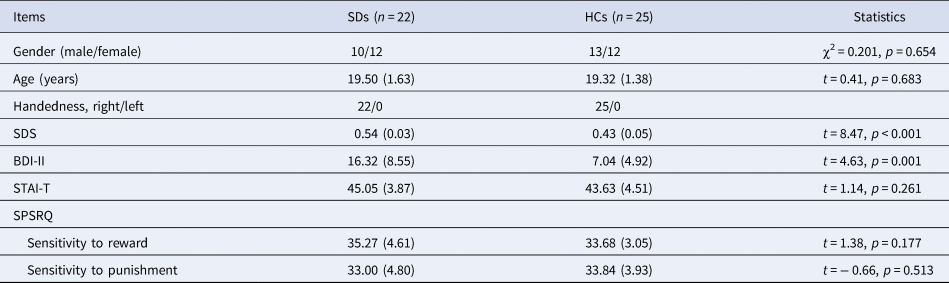
Age and gender matched HCs were recruited from the same sample source as individuals with SD (Table 1). These participants had scores of depressive severity <13 (measured by BDI-II) and satisfied the same exclusion criteria as individuals with SD. Furthermore, the HCs were screened with SCID-I/NP to confirm the absence of depression. Among the students who met the above criteria, 50 individuals (25 individuals with SD and 25 HCs) participated in the current study. Although we allowed to include any individuals with a history of MDD being assigned to the SD group during the recruitment period, none of the participants had a history of depression in this study. Written informed consent was obtained prior to the experiment. The interview and clinical symptom rating were based on consensus of two senior psychiatrists who were trained with a high reliability (κ = 0.89). During the recruitment period, two undergraduate students were excluded because of a history of certain Axis I disorders. Furthermore, three participants with SD failed to complete the experiment due to technical problems or personal discomfort, so the data from 47 individuals were included for data analysis. The study was approved by the Ethics Committee of Shenzhen University.
Demographic characteristics of the participants (mean and standard deviation)
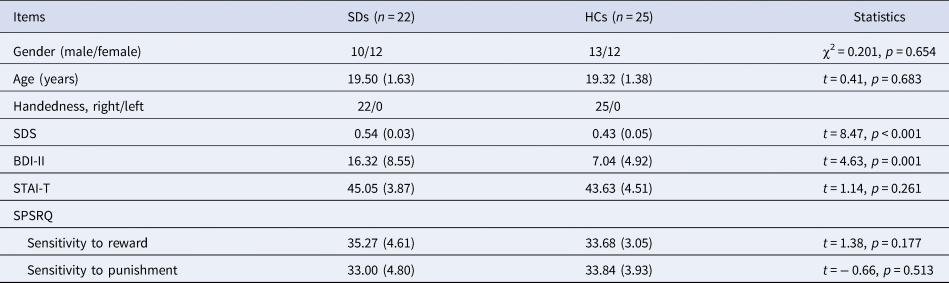
SDS, Self-Rating Depression Scale; BDI-II, Beck Depression Inventory-Second Edition; STAI-T, the Trait form of Spielberger's State-Trait Anxiety Inventory; SPSRQ, the Sensitivity to Punishment and Sensitivity to Reward Questionnaire.
Procedure
One week before fMRI scanning, participants were contacted by phone and asked to take part in a study about ‘first impressions’. They were asked to send an ID photo to the researcher and told that a panel of peers (‘evaluators’) would form first impressions of their photograph during the following week. On the day of the experiment, participants were informed that photos of evaluators would be presented during the scanning session and they need to judge whether they were liked or disliked by evaluators. In reality, no evaluators had judged participants’ ID photographs, and the photos presented during the scanning session were from 60 volunteers (30 males) who provided consent for their photograph to be used for this study. Prior to entering the MRI scanner, participants were required to complete four questionnaires, i.e. the Self-Rating Depression Scale (SDS, Zung, Richards, & Short, Reference Zung, Richards and Short1965), BDI-II, STAI-T and the Sensitivity to Punishment and Sensitivity to Reward Questionnaire (SPSRQ, Torrubia, Avila, Molto, & Caseras, Reference Torrubia, Avila, Molto and Caseras2001). As shown in Table 1, while individuals with SD reported higher SDS and BDI scores than HCs, no significant difference was found between the two groups with respect to gender, age, handedness and scores of STAI-T and SPSRQ.
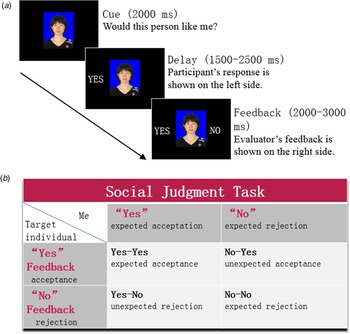
During the experiment, participants performed the SJP (see Fig. 1a). Each trial began with a 2 s cue period, during which an ID photo was presented and participants were required to provide a binary prediction of whether the evaluator liked or disliked them ‘at first impression’ by making a dichotomous (Yes/No) response via two buttons. The cue was then followed by a delay period for a variable duration ranging from 1.5 to 2.5 s while participant's response was shown on the left side of the photo. Finally, participants received the ‘actual’ feedback from the person (Yes/No; 2 to 3 s) on the right side of the photo. Unbeknownst to participants, feedback in the whole task was generated pseudo-randomly by a computer with an equal distribution of ‘Yes’ and ‘No’ feedback. The inter-trial interval ranged from 6 to 8 s (Knorr, Neukam, Fröhner, Mohr, & Marxen, Reference Knorr, Neukam, Fröhner, Mohr and Marxen2020; Zhang et al., Reference Zhang, Mano, Ganesh, Robbins and Seymour2016). Immediately after the scanning, participants were required to estimate the percentage of positive feedback they received during the experiment. After the task, participants were asked if they believed that their photos were evaluated by peers before the task and they received real feedback from the evaluators during the task. None of them reported doubts about the cover story. At the end of the experiment, participants were informed about the whole cover story, including that all the feedback in the task was pseudo-randomly generated by a computer. The schematic of the experimental design is shown in Fig. 1b. Participants’ choice (Yes/No) and the evaluator's ‘choice’ (Yes/No) resulted in four conditions, with ‘Yes-No’ and ‘No-No’ conditions signifying social rejection, ‘Yes-Yes’ and ‘No-Yes’ conditions signifying social acceptance and ‘Yes-No’ and ‘No-Yes’ conditions signifying expectancy violation.
Trial sequence and experimental design. (a) Example of a trial sequence (‘Yes-No’ condition). (b) The within subject factors. Concerning the right of portrait, a picture of one of the authors (DZ) is used here to replace the ID photograph in the task.
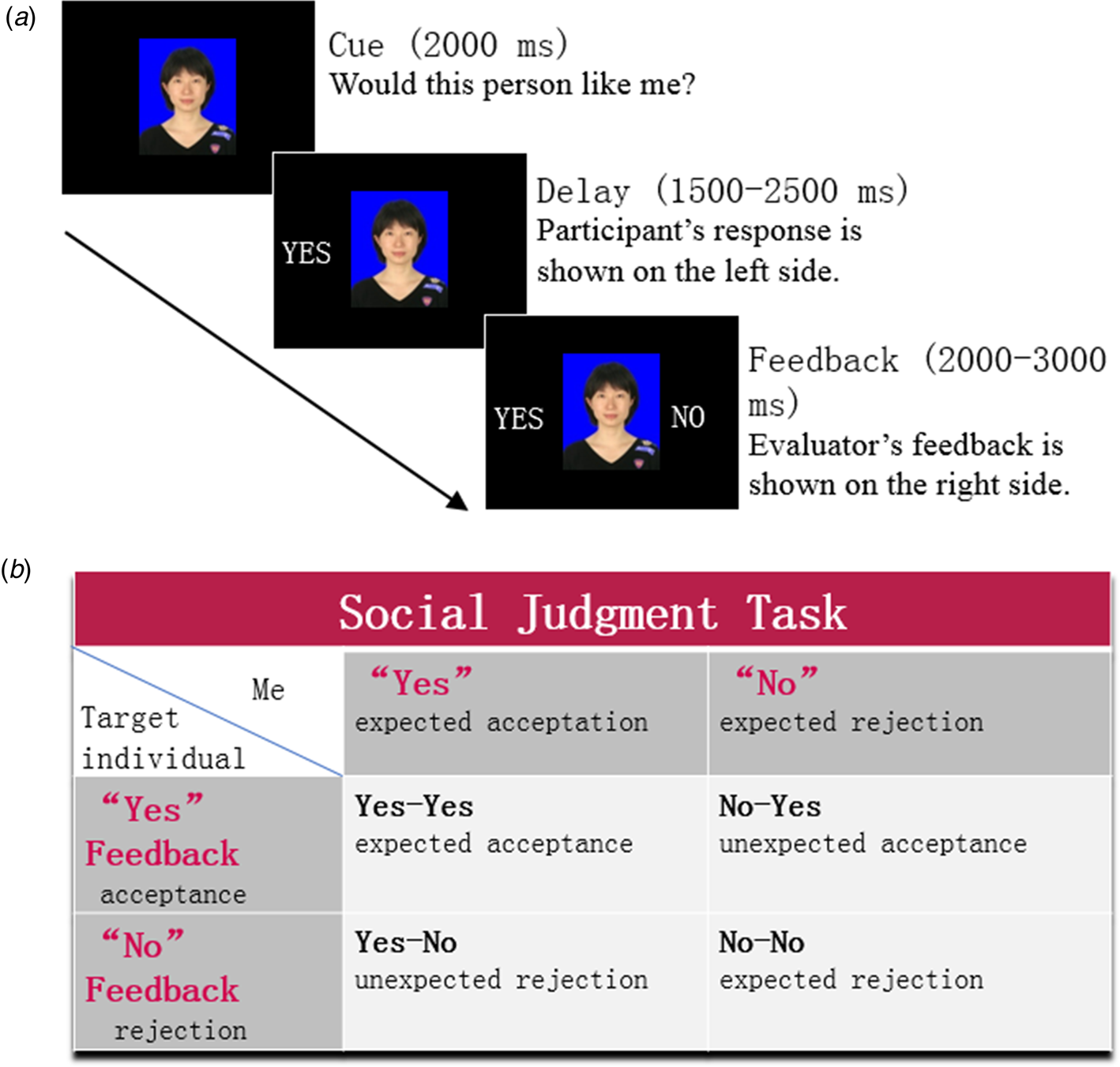
Image acquisition
Brain images were collected using a 3 T Siemens TRIO MR scanner. Functional images were collected using an echo planar imaging sequence [number of slices, 41; gap, 0.6 mm; slice thickness, 3.0 mm; repetition time (TR), 2000 ms; echo time (TE), 25 ms; flip angle, 90°; voxel size, 3 mm × 3 mm × 3 mm; field-of-view (FOV), 200 mm × 200 mm]. Structural images were acquired through 3D sagittal T1-weighted magnetization-prepared rapid gradient echo (192 slices; TR, 2530 ms; TE, 3.39 ms; voxel size, 1.0 mm × 1.0 mm × 1.0 mm; flip angle, 7°; inversion time, 1100 ms; FOV, 256 mm × 256 mm).
Image analysis
Images were pre-processed and analysed using Statistical Parametric Mapping (SPM8; http://www.fil.ion.ucl.ac.uk/spm). The first five volumes were discarded because of signal equilibration and participants’ adaptation to scanning noise. All remaining images were slice time corrected and realigned for motion correction by registration to the mean image. Artifact detection was conducted using the Artifact Detection Tools (ART) toolbox (https://www.nitrc.org/projects/artifact_detect); global mean intensity (>2 standard deviations from mean image intensity for the entire scan) and motion (>2 mm) outliers were identified and entered as a regressor of no interest in the first-level general linear model (GLM; Stoodley, Valera, & Schmahmann, Reference Stoodley, Valera and Schmahmann2012). Then functional images were co-registered with the T1-weighted 3D images, normalized to MNI space and smoothed with a 6 mm full width at half maximum isotropic Gaussian kernel. We chose this parameter for spatial smoothing as it was double the voxel size (3 mm) and would retain resolution for identifying changes in the relatively small brain regions we are interested in (Pizzagalli et al., Reference Pizzagalli, Holmes, Dillon, Goetz, Birk, Bogdan and Fava2009; Ubl et al., Reference Ubl, Kuehner, Kirsch, Ruttorf, Diener and Flor2015).
Pre-processed data were analysed as an event-related design in the context of the GLM approach in a two-level procedure. At the first level, regressors including two delay conditions (expectation after ‘Yes’ and ‘No’) and four feedback conditions (‘Yes-Yes’, ‘Yes-No’, ‘No-Yes’ and ‘No-No’) were modeled (a total of six factors). Both the onsets of delay and feedback display were modeled as a brief block corresponding to the actual delay. No-response trials, i.e. those where participants did not respond within the 2 s cue period were deleted. To account for variance caused by head movement, six realignment motion parameters (three translations/rotations) and outlier scans identified by the ART toolbox were included as nuisance regressors in the model. Each normalized image was then high-pass filtered using a cutoff time constant of 128 s. Contrast images were separately calculated for both delay and feedback stages. Contrasts in delay stage included (1) expectation after ‘Yes’ and (2) expectation after ‘No’. Contrasts in feedback stage included (1) ‘Yes-Yes’, (2) ‘Yes-No’, (3) ‘No-Yes’ and (4) ‘No-No’. The baseline used for the task is the implicit baseline as calculated by SPM.
These contrast images were taken to the second level analysis. First, we performed one-sample t tests, in which whole-brain analyses were computed for all contrasts separately for individuals with SD and HCs to identify whether the paradigm had activated brain regions as established in previous studies (Gunther Moor et al., Reference Gunther Moor, van Leijenhorst, Rombouts, Crone and Van der Molen2010; Powers et al., Reference Powers, Somerville, Kelley and Heatherton2013; Somerville et al., Reference Somerville, Heatherton and Kelley2006; Somerville et al., Reference Somerville, Kelley and Heatherton2010). To detect group differences, two-sample t tests were conducted at the whole-brain level. These tests were set to a threshold of family-wise error (FWE)-corrected p < 0.05. Results are reported in the Supplementary Material.
From our a priori defined ROIs, the dACC was functionally defined from two independent datasets, i.e. Somerville et al. (Reference Somerville, Heatherton and Kelley2006) (MNI coordinates − 6, 28, 32; 6 mm sphere) and Eisenberger et al. (Reference Eisenberger, Lieberman and Williams2003) (MNI coordinates − 8, 20, 40; 6 mm sphere). Specifically, while Somerville et al. (Reference Somerville, Heatherton and Kelley2006) performed the first study using SJP, Eisenberger et al. (Reference Eisenberger, Lieberman and Williams2003) implicated the dACC as a sensitive region to social feedback cues, which showed high relevance to the current study. The VS ROI was also functionally defined, which included two subregions, i.e. the putamen from Gunther Moor et al. (Reference Gunther Moor, van Leijenhorst, Rombouts, Crone and Van der Molen2010) (MNI coordinates − 24, 3, 0; 6 mm sphere) and the VS from Powers et al. (Reference Powers, Somerville, Kelley and Heatherton2013) (MNI coordinates 6, 15, − 3; 6 mm sphere). These two articles were chosen because they used the same task. The dmPFC region from Powers et al. (Reference Powers, Somerville, Kelley and Heatherton2013) (MNI coordinates 6, 54, 21; 6 mm sphere) and Schurz, Radua, Aichhorn, Richlan, and Perner (Reference Schurz, Radua, Aichhorn, Richlan and Perner2014) (− 1, 56, 24; 6 mm sphere) were combined to functionally define the ROI of the dmPFC. Specifically, Powers et al. (Reference Powers, Somerville, Kelley and Heatherton2013) was included as it used the same task, and Schurz et al. (Reference Schurz, Radua, Aichhorn, Richlan and Perner2014) is a meta-analysis of theory of mind (ToM) studies. Focusing on the dmPFC from Schurz et al. (Reference Schurz, Radua, Aichhorn, Richlan and Perner2014) was motivated by a previous study which found that prediction errors on the intentions of a peer's behavior (i.e. expectancy violation) activate ToM regions (Behrens et al., Reference Behrens, Hunt and Rushworth2009). All ROIs were created using the Wake Forest University Pick Atlas (WFU Pick Atlas v2.5; http://fmri.wfubmc.edu/software/PickAtlas). For group inferences (second level), a full factorial analysis, implemented in SPM8, with group (SD, HC) as a between-subject factor and expectation condition (Yes or No) as a within-subject factor, was performed to identify the ROIs that showed group differences in activation during the judgment of the faces. Another full factorial analysis with group (SD, HC) as a between-subject factor and feedback condition (Yes-Yes, Yes-No, No-Yes, No-No) as a within-subject factor, was performed to identify ROIs that showed group differences in activation during feedback processing. Activation within each ROI is reported if it survived a false discovery rate (FDR) correction (p < 0.016; Bonferroni adjusted accounting for the three ROIs). Averaged BOLD signals (parameter estimates) within a ROI were extracted for each individual using the MarsBaR function (Matthew, Jean-Luc, Romain, & Jean-Baptiste, Reference Matthew, Jean-Luc, Romain and Jean-Baptiste2002), which were then submitted to post hoc ANOVA tests and plotted to further characterize the activations for all trial types in these brain regions.
Results
Behavioral results
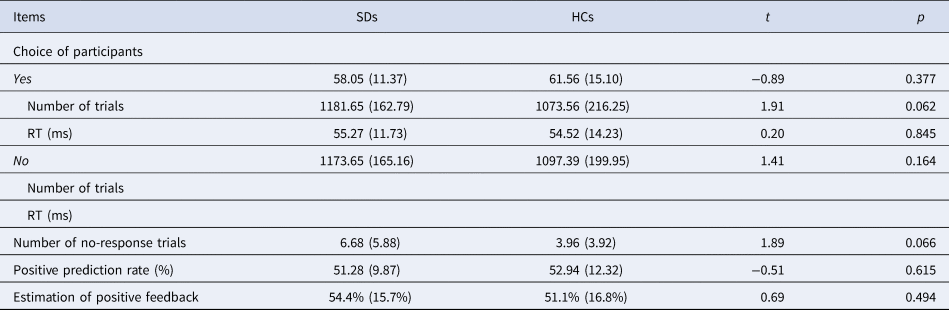
First, a two-way repeated-measures ANOVA was performed on reaction time (RT) in the cue stage, with choice (Yes or No) as the within-subject factor and group (SD or HC) as the between-subject factor. No significant main effects and interactions were found, though SDs responded slightly slower than HCs when providing a ‘Yes’ choice (p = 0.062; Table 2).
Behavioral results related to the social judgment task (mean and standard deviation)
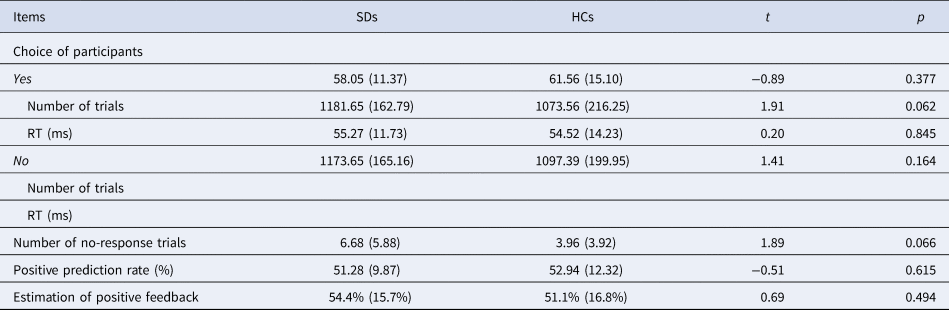
RT, reaction time. Independent samples t test (two-tailed).
Second, positive prediction rate was calculated as the number of trials in which participants made ‘Yes’ choice divided by the total number of responded trials. Although no significance was found in this measure between groups (p = 0.615; Table 2), Pearson correlations revealed that there was a negative correlation between SDS score and positive prediction rate in individuals with SD (r = − 0.561, p = 0.007), while this correlation was not significant in HCs (r = − 0.067, p = 0.749).
Third, no significant difference was found for post-scan estimation of positive feedback between individuals with SD and HCs (Table 2).
Whole-brain analyses
For within-group analyses, the task we used elicited significant response in brain regions typically involved in SJP. These regions included all ROIs, i.e. dACC, VS and dmPFC, and were observed in both HC and SD groups (online Supplementary Tables S1 and S2). For between-group analyses, no regions showed between-group differences surviving correction at p < 0.05 (FWE-corrected). In the following sections, we report results for the between group comparisons using the a priori defined ROIs.
Analyses of a priori ROI
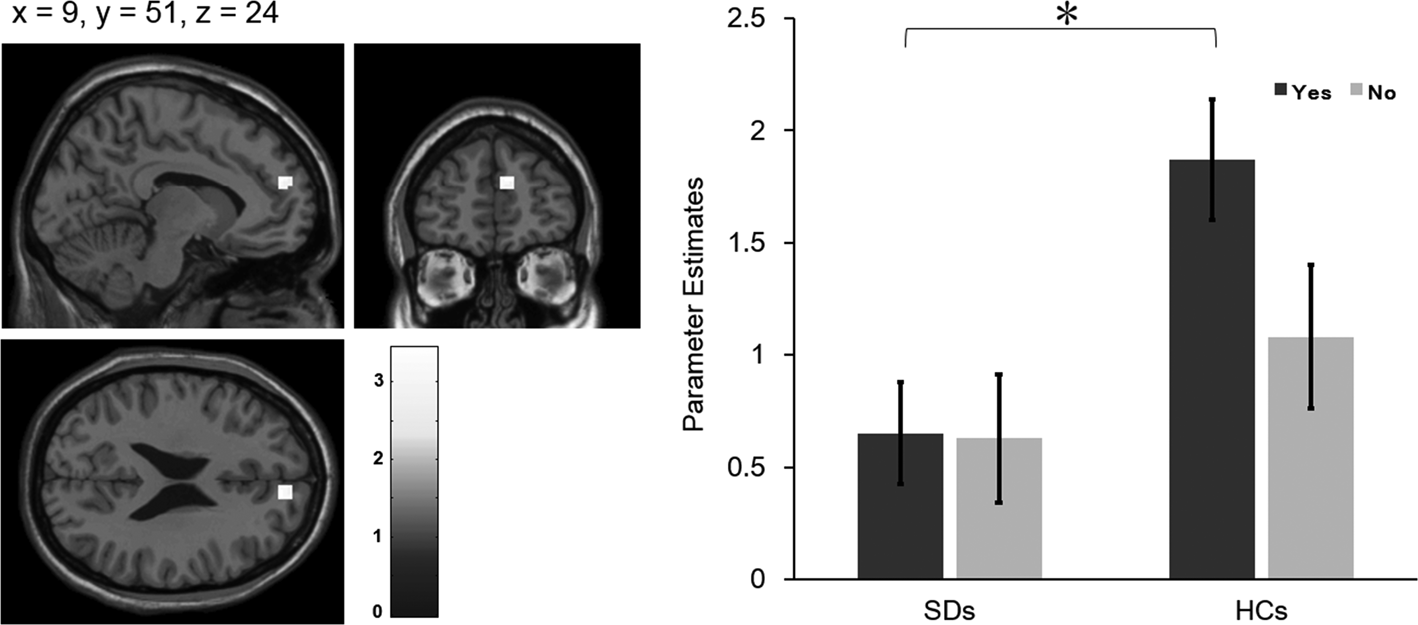
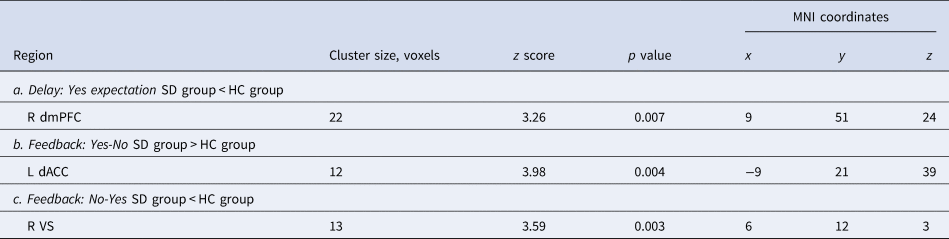
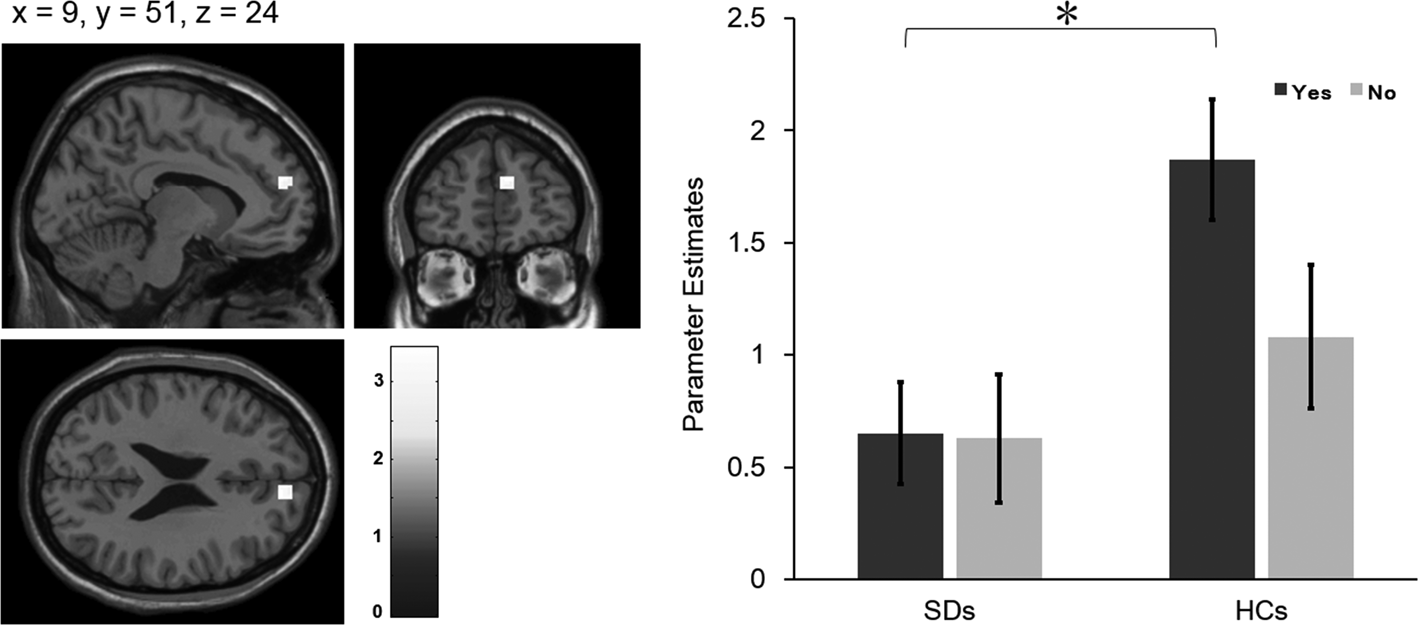
During the delay period, the full factorial analysis demonstrated 22 clusters showing a significant interactions between group and expectation condition in the right dmPFC (x = 9, y = 51, z = 24; p = 0.007, z = 3.26; see Fig. 2a). Post hoc ANOVA of mean cluster parameter estimates revealed a significant interaction between group and expectation condition [F (1,45) = 9.57, p = 0.004, $\eta _p^2 {\rm \;}$ = 0.197; see Table 3a, Fig. 2b]. This was explained by the fact that, while the activation in SDs and HCs did not differ in the ‘No’ expectation condition [F (1,45) = 0.85, p = 0.364; SDs = 0.63 ± 0.29, HCs = 1.08 ± 0.32], SDs (0.65 ± 0.23) showed reduced response compared to HCs [1.87 ± 0.27; F (1,45) = 15.58, p < 0.001] in the ‘Yes’ expectation condition.
The fMRI results: expectation of social acceptance. (a) Activation foci showing decreased activity in individuals with subthreshold depression (SDs) compared with healthy controls (HCs) for ‘Yes’ expectation. (b) The beta weights extracted from the averaged activation within the dmPFC ROI (threshold p < 0.016, Bonferroni-adjusted FDR, displayed on the SPM canonical template). Error bars denote standard error of the mean.
Clusters showing significant group differences and group × condition interactions for (a) Yes expectation in the delay stage, (b) Yes-No feedback and (c) No-Yes feedback on the feedback stage
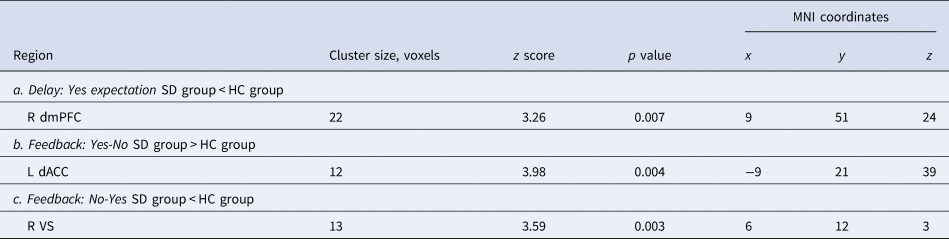
Data are thresholded at p < 0.016 (Bonferroni-adjusted FDR). R: right. L: left.
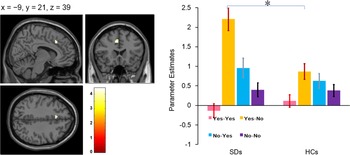
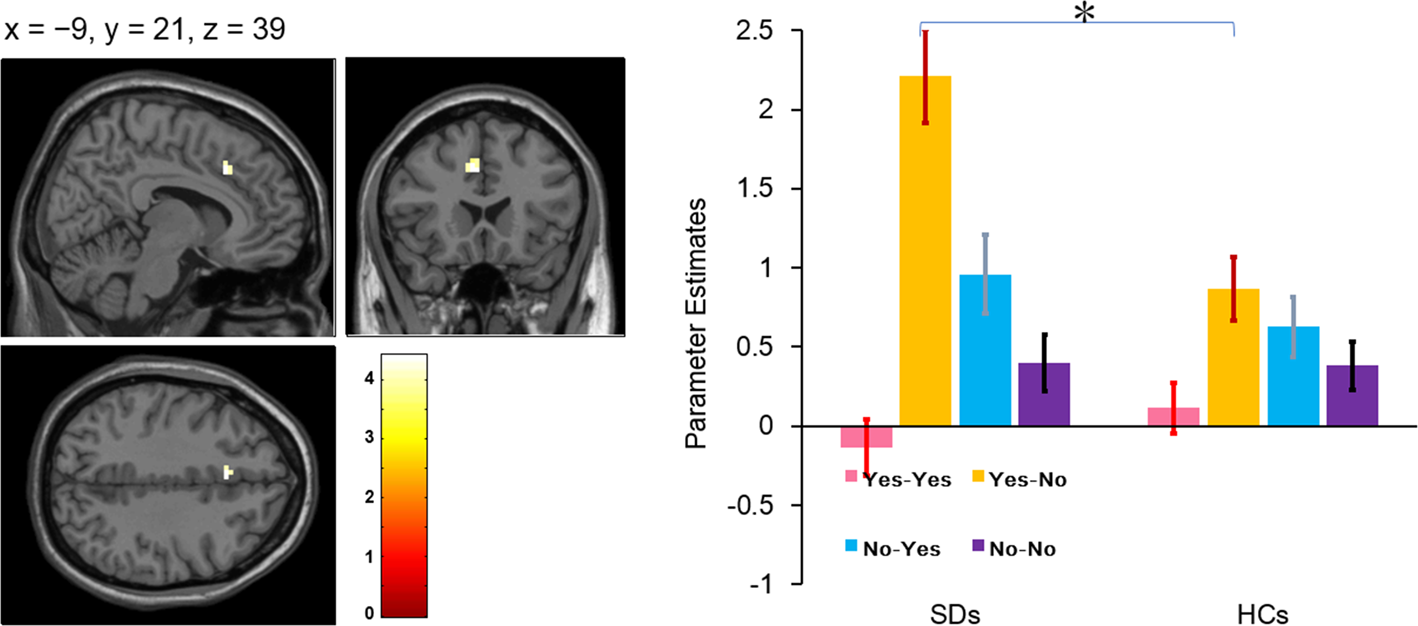
During the feedback period, the full factorial analysis demonstrated 12 clusters showing a significant interaction between group and feedback condition in the left dACC (x = − 9, y = 21, z = 39; p = 0.004, z = 3.98; see Fig. 3a). Post hoc ANOVA of mean cluster parameter estimates revealed a significant interaction between group and feedback condition [F (1,45) = 10.28, p = 0.003, $\eta _p^2 {\rm \;}$ = 0.209; see Table 3b, Fig. 3b]. This was explained by the fact that, while the activation in SDs and HCs did not differ in the ‘Yes-Yes’ [F (1,45) = 0.78, p = 0.381; SDs = − 0.13 ± 0.18, HCs = 0.11 ± 0.16], ‘No-Yes’ [F (1,45) = 1.52, p = 0.224; SDs = 0.96 ± 0.25, HCs = 0.63 ± 0.19], or ‘No-No’ feedback conditions [F (1,45) = 0.87, p = 0.462; SDs = 0.40 ± 0.18, HCs = 0.38 ± 0.15], SDs (2.21 ± 0.30) showed increased response compared to HCs [0.86 ± 0.20; F (1,45) = 13.90, p = 0.001] in the ‘Yes-No’ feedback condition.
The fMRI results: receipt of unexpected social rejection. (a) Activation foci showing increased activity in individuals with SDs compared with HCs for ‘Yes-No’ social feedback. (b) The beta weights extracted from the averaged activation within the dACC ROI (p < 0.016, Bonferroni-adjusted FDR).
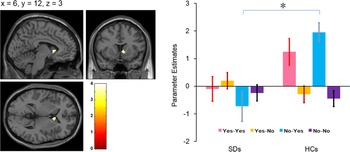
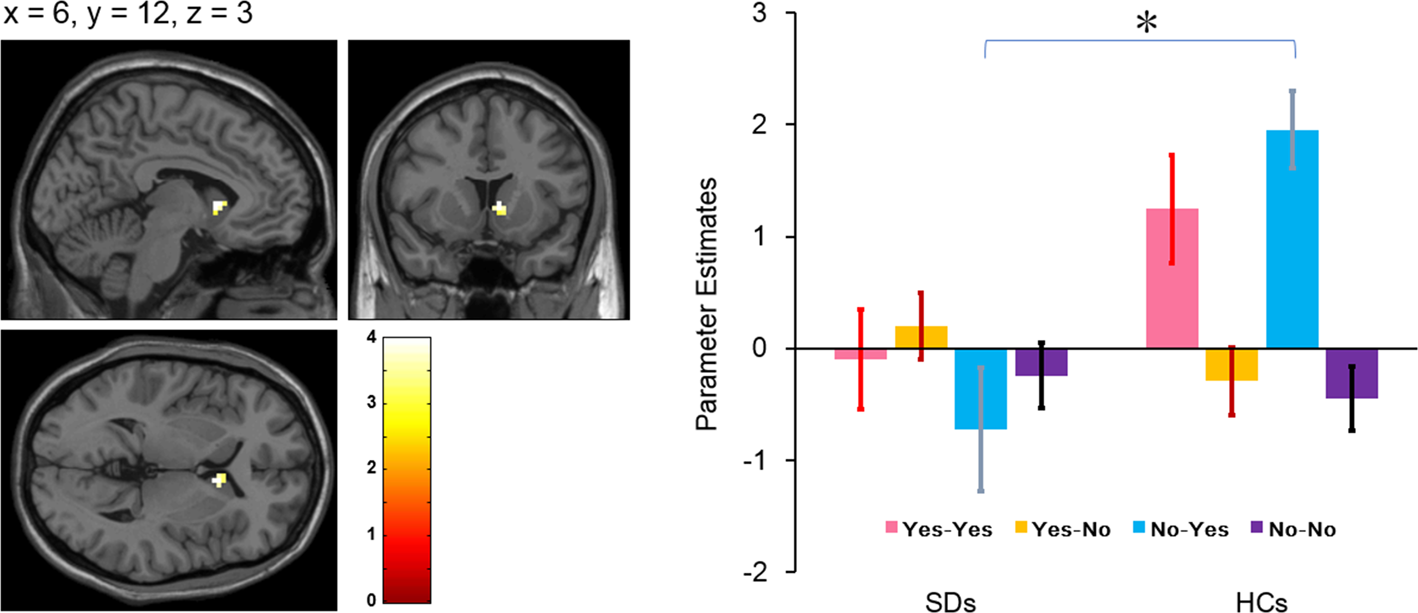
The full factorial analysis demonstrated 13 clusters showing a significant interaction between group and feedback condition in the right VS (x = 6, y = 12, z = 3; p = 0.003, z = 3.59; see Fig. 4a). Post hoc ANOVA of mean cluster parameter estimates revealed a significant interaction between group and feedback condition [F (1,45) = 9.93, p = 0.003, $\eta _{\rm p}^2 {\rm \;}$ = 0.203; see Table 3c, Fig. 4b]. This was explained by the fact that, while activation in SDs and HCs did not differ in the ‘Yes-No’ [F (1,45) = 0.78, p = 0.382; SDs = 0.20 ± 0.30, HCs = − 0.29 ± 0.30] or ‘No-No’ feedback conditions [F (1,45) = 0.39, p = 0.764; SDs = − 0.24 ± 0.29, HCs = − 0.45 ± 0.29], SDs showed decreased response compared to HCs in the ‘No-Yes’ feedback condition [F (1,45) = 8.28, p = 0.006; SDs = − 0.72 ± 0.55, HCs = 1.95 ± 0.34] and in the ‘Yes-Yes’ feedback condition [F (1,45) = 5.58, p = 0.023; SDs = − 0.10 ± 0.45, HCs = 1.25 ± 0.48].
The fMRI results: receipt of unexpected social acceptance. (a) Activation foci showing decreased activity in individuals with SDs compared with HCs for ‘No-Yes’ social feedback. (b) The beta weights extracted from the averaged activation within the VS ROI (p < 0.016, Bonferroni-adjusted FDR).
Discussion
The goal of this study was to investigate whether brain responses to expected and (particularly) unexpected social feedback are altered in individuals with SD. Results revealed that, individuals with SD, relative to HCs, had reduced dmPFC activity when expecting positive feedback; they also showed enhanced dACC following unexpected social rejection, and reduced VS response following unexpected social acceptance.
While behavioral performance in general (positive prediction rate and post-scan estimation of positive feedback) did not show any difference between the two groups, it is found in individuals with SD that depressive symptoms were negatively associated with positive prediction rate. This result suggests that individuals with depressive symptoms prefer to expect negative social feedbacks, which is in line with the previous finding showing relationship between depressive symptoms and lack of positive expectations of future events in individuals at high risk of depression (Horwitz, Berona, Czyz, Yeguez, & King, Reference Horwitz, Berona, Czyz, Yeguez and King2017).
On the expectation stage, individuals with SD exhibited a weaker response of dmPFC for positive social feedback. The dmPFC is largely involved in ToM/mentalizing, thus this region is critical for participants to estimate whether the peer would like them or not (Amodio & Frith, Reference Amodio and Frith2006; Gunther et al., Reference Gunther, Crone and van der Molen2010; Powers et al., Reference Powers, Somerville, Kelley and Heatherton2013). Reduced recruitment of dmPFC for positive expectation of social feedback might reflect reduced mentalizing efforts to understand others’ positive intentions. Consistent with this finding, previous meta-analyses and systematic reviews reported ToM deficits and associated dmPFC alteration in depression (Bora & Berk, Reference Bora and Berk2016; Cusi, Nazarov, Holshausen, Macqueen, & McKinnon, Reference Cusi, Nazarov, Holshausen, Macqueen and McKinnon2012; Weightman, Air, & Baune, Reference Weightman, Air and Baune2014). It is proposed that the ToM impairment contributes to social dysfunctions in depression by diminishing the enjoyment of social interactions and hampering the generation of appropriate social behaviors (Kupferberg et al., Reference Kupferberg, Bicks and Hasler2016; Uekermann et al., Reference Uekermann, Channon, Lehmkamper, Abdel-Hamid, Vollmoeller and Daum2008).
Our results indicated heightened dACC activation to the receipt of an unexpected social rejection in individuals with SD when compared to the HCs. The dACC is considered as a neural alarm system for unexpected social pains (Eisenberger & Lieberman, Reference Eisenberger and Lieberman2004; Somerville et al., Reference Somerville, Heatherton and Kelley2006). The finding of enhanced dACC activation indicates a facilitated alarm procedure for expectation-violating negative outcomes. While previous findings in depression revealed the hyperactivation of dACC for social rejection/punishment with a confounding factor of expectancy violation (Gotlib et al., Reference Gotlib, Hamilton, Cooney, Singh, Henry and Joormann2010; Silk et al., Reference Silk, Siegle, Lee, Nelson, Stroud and Dahl2014), the current study contributes to the depression literature by dissociating expected and unexpected outcomes and suggesting that the enhanced dACC response is specific for unexpected negative social events.
We also observed attenuated VS response to unexpected social acceptance in individuals with SD compared to the HCs. Consistent with this finding, previous studies in depression found reduced VS activity during unexpected reward receipt (Robinson, Cools, Carlisi, Sahakian, & Drevets, Reference Robinson, Cools, Carlisi, Sahakian and Drevets2012; Segarra et al., Reference Segarra, Metastasio, Ziauddeen, Spencer, Reinders, Dudas and Murray2016) and during prediction error encoding for rewarding events (Gradin et al., Reference Gradin, Kumar, Waiter, Ahearn, Stickle, Milders and Steele2011; Kumar et al., Reference Kumar, Waiter, Ahearn, Milders, Reid and Steele2008). While the reward stimuli used in those previous studies are either food, money or happy faces with limited social relevance, the current study extends existing work by revealing that unexpected social acceptance can also elicit reduced striatal response in depression population. Many studies have found that individuals with depression lack optimistic view or devalue the pleasurable experience of unexpected positive information (Korn, Sharot, Walter, Heekeren, & Dolan, Reference Korn, Sharot, Walter, Heekeren and Dolan2014; Kube, Rief, Gollwitzer, Gartner, & Glombiewski, Reference Kube, Rief, Gollwitzer, Gartner and Glombiewski2019). Furthermore, it has been well established that decreased activation in VS during reward processing is linked to the core symptom of anhedonia in depression (Keren et al., Reference Keren, O'Callaghan, Vidal-Ribas, Buzzell, Brotman, Leibenluft and Stringaris2018). We here suggested that reduced VS response in individuals with SD could reflect social anhedonia to unexpected social rewards.
In this study, neural alterations observed in individuals with SD are specific for the processing of unexpected social feedback, which highlights the important role of expectancy violation in social feedback processing in depression. Previous studies using monetary stimuli also suggested that abnormalities in feedback processing in depression might not primarily be driven by improper evaluation of those outcomes, but rather by the corresponding prediction errors, i.e. expectancy violation (Dombrovski, Szanto, Clark, Reynolds, & Siegle, Reference Dombrovski, Szanto, Clark, Reynolds and Siegle2013; Rothkirch, Tonn, Kohler, & Sterzer, Reference Rothkirch, Tonn, Kohler and Sterzer2017). One possibility is that expectancy violation might intensify the experience of feedback (Schultz, Dayan, & Montague, Reference Schultz, Dayan and Montague1997; Wesselmann, Wirth, & Bernstein, Reference Wesselmann, Wirth and Bernstein2017). For example, given that people generally expect acceptance-relevant social cues (Wesselmann et al., Reference Wesselmann, Wirth, Pryor, Reeder and Williams2012), they likely experience unexpected rejection more extremely than expected rejection. We suggest that this may be particularly the case for individuals with depression, and therefore unexpected social feedback might be more sensitive to test their reward processing deficits compared to expected social feedback.
Several limitations should be noted. First, we tested only SD sample. Given that SD individuals have less severe social dysfunctions than depressed patients (Jonsson et al., Reference Jonsson, Bohman, von Knorring, Olsson, Paaren and von Knorring2011), there may be false negative findings regarding behavioral performance and neural responses. In addition, this study is also limited by a small sample size and the use of depressive samples without comorbidities. In reality, many individuals with depression have comorbid disorders, such as substance use disorder and anxiety disorder (Hasin et al., Reference Hasin, Sarvet, Meyers, Saha, Ruan and Stohl2018). Findings in this study may therefore have limited generalizability to those depressed individuals with comorbidities. Second, although we used ID photos with neutral facial expressions, the emotions of these photos were not strictly rated, which may have an impact on participants’ response. Third, some of the SD participants reported elevated severity of depressive symptomatology (e.g. BDI-II scores > 20), which may bias our current findings. Fourth, we did not record the menstrual cycle phases or the use of hormonal contraceptives in female participants. Given the evidence that these two factors might affect reward processing and emotion reactivity (Dreher et al., Reference Dreher, Schmidt, Kohn, Furman, Rubinow and Berman2007; Lewis et al., Reference Lewis, Kimmig, Zsido, Jank, Derntl and Sacher2019), we cannot rule out the possibility that the observed effects in female participants were influenced by these factors.
In previous literature, the ACC, striatum and dmPFC have been reported as the key regions in the salient network, the reward system and the mentalizing network, respectively (Porcelli et al., Reference Porcelli, Van der Wee, van der Werff, Aghajani, Glennon, van Heukelum and Serretti2019). Moreover, these regions are frequently referred as major nodes of the ‘social brain’ (Atzil, Gao, Fradkin, & Barrett, Reference Atzil, Gao, Fradkin and Barrett2018). It would be worthwhile for future studies to examine the functional connectivity within or between these neural networks so as to find valuable connectivity measures that further distinguish different conditions between the two groups. Another future work is to explore how current feedback influences future expectations of social rejection and acceptance. There is growing behavioral evidence showing that people with depression tend to maintain their expectations despite expectation-violating experiences (Kube, Rief, & Glombiewski, Reference Kube, Rief and Glombiewski2017), and they have difficulty in updating negative expectations after unexpected positive experiences (Kube, Schwarting, Rozenkrantz, Glombiewski, & Rief, Reference Kube, Schwarting, Rozenkrantz, Glombiewski and Rief2020). It is worthwhile for future studies to investigate the neurobiological underpinnings of these deficits in depression.
Taken together, the current study provides insight into the neural mechanisms involved in the processing of social feedback in depression. The SD participants are characterized by alterations in neural systems involved in mentalizing, expectancy-violation and reward processing, which are specific to the processing of unexpected social feedback. These findings suggest that expectancy violation plays a significant role in the abnormal neural representation of social feedback processing in depression. Future research regarding the social feedback processing in depression should be mindful of the expectancy during social reward/punishment processing, i.e. whether the social feedback is expected or unexpected. Therapies trying to alleviate distress from negative social events in depressed people might also consider the aspect of expectancy violation so as to provide efficient and personalized treatment.
Supplementary material
The supplementary material for this article can be found at https://doi.org/10.1017/S0033291720003864.
Acknowledgements
This study was funded by the National Natural Science Foundation of China (31970980), Shenzhen Basic Research Project (JCYJ20180305124305294), Shenzhen-Hong Kong Institute of Brain Science (2019SHIBS0003) and Guangdong Key Basic Research Grant (2018B030332001).
Data availability statement
All the data and code used in this study could be available via email zhangdd05@gmail.com (D Zhang).