INTRODUCTION
Death is an inevitable reality that all people share. Death is a truth that cannot be avoided by humans. This truth causes anxiety that is recognizable, when a person and that person's family members receive a diagnosis of an incurable disease. During the past decades, the numbers of people who live with life-threatening disease have risen. They need to have their remaining lifetime be as meaningful as possible, even when they are at the end stage and may have no more than months to live. This need required the palliative care movement from the 1960s (Walter, Reference Walter1996). Palliative care is “an approach that improves the quality of life of patients and their families facing the problems associated with life-threatening illness, through the prevention and relief of suffering by means of early identification and impeccable assessment and treatment of pain and other problems, physical, psychosocial and spiritual.” (WHO, 2003) This kind of care is provided by an interdisciplinary team including nurses, physicians, pharmacists, physiotherapists, and others (Smith, Reference Smith2006). Nurses spend a lot of time caring for dying patients (Puntillo & McAdam, Reference Puntillo and McAdam2006) and actively take part in the decision-making process related to those patients (Latour et al., Reference Latour, Fulbrook and Albarran2009). Usually nurses do not feel confident, adequate, and competent in the care of dying patients (Meraviglia et al., Reference Meraviglia, McGuire and Chesley2003). According to Goldberg et al. (Reference Goldberg, Guadagnoli and Lafarge1987) nurses' low level of knowledge about end-of-life care can be responsible for these feelings. Fox (Reference Fox2007) and Nakazawa et al. (Reference Nakazawa, Miyashita and Morita2009) claim that nurses do not receive appropriate training about end-of-life care. Furthermore, Ferrell et al. (Reference Ferrell, Virani and Grant1999a; Reference Ferrell, Virani and Grant1999b; Reference Ferrell, Virani and Grant2000) assessed nursing textbooks and asserted that only 2% of nursing texts are assigned to palliative care. Kirchhoff et al. (Reference Kirchhoff, Beckstrand and Anumandla2003) assessed 14 critical care nursing textbooks and found that none of these books were allocated to the entire content area of palliative care. In addition, three of them did not contain any of palliative content area. McDermott and Demmer (Reference McDermott and Demmer2008) also evaluated 12 commonly used health textbooks and asserted that the quality and quantity of palliative care information was inadequate in nursing textbooks. Although several textbooks in the past decade have been especially assigned to palliative care, such as Textbook of Palliative Nursing (Ferrell & Coyle, Reference Ferrell and Coyle2006) and Palliative Care Nursing (Matzo & Sherman, Reference Matzo and Sherman2009), there are still many aspects of palliative care that need to be assessed and discussed thoroughly. Palliative care requires nurses to be knowledgeable about different aspects of the care that they provide for dying patients. Nurses' knowledge deficiency is a significant barrier to providing appropriate palliative care (Ogle et al., Reference Ogle, Mavis and Wang2003; Brickner et al., Reference Brickner, Scannell and Marquet2004; Ford et al., Reference Ford, Nietert and Zapka2008). Nurses who have a low level of knowledge about palliative care are not able to skillfully assess patient's needs; consequently, they are not able to recognize which patients need to be referred to palliative care units (Raudonis et al., Reference Raudonis, Kyba and Kinsey2002; Whittaker et al., Reference Whittaker, George Kernohan and Hasson2006). These nurses are not also competent to develop an effective relationship with dying patients and their families (Cramer et al., Reference Cramer, McCorkle and Cherlin2003).
Reviewing literature indicated that there are several studies that actually assessed nurses' knowledge about palliative care in different settings. Ronaldson et al. (Reference Ronaldson, Hayes and Carey2008) used Palliative Care Quiz for Nursing (PCQN) to assess the knowledge of registered nurses (RNs) and Assistants in Nursing (AINs) who worked in residential aged care facilities in Australia. The knowledge mean score for an RN was 11.7 (SD 3.1) and for an AIN was 5.8 (SD 3.3). In Japan Nakazawa et al. (Reference Nakazawa, Miyashita and Morita2009) developed a Palliative Care Knowledge Test questionnaire (PCKT) that consisted of 20 items in five domains, including “philosophy,” “pain,” “dyspnea,” “psychiatric problems,” and “gastrointestinal problems.” They assessed the knowledge of palliative care nurses, and nurses who worked in different wards, about palliative care. They found that nurses who worked in palliative care units were more knowledgeable about palliative care than were nurses worked in the other wards (Nakazawa et al., Reference Nakazawa, Miyashita and Morita2009). Using PCQN and King's Health Questionnaire (KHQ) Knapp et al. (Reference Knapp, Madden and Wang2009) assessed pediatric nurses' knowledge about palliative care in Florida. They found that pediatric nurses had a high level of knowledge about palliative care. In Lebanon, Abu-saad Huijer et al. (Reference Huijer, Dimassi and Abboud2009) conducted a study to evaluate medical and nursing specialists' knowledge about palliative care in different units. They used a self-administered questionnaire consisting of 16 questions. They concluded that their participants' knowledge about palliative care was positively correlated with their practice and educational levels (Huijer et al., Reference Huijer, Dimassi and Abboud2009). In 2012, Brazil et al. used PCQN to assess Canadian palliative care nurses' knowledge about palliative care in four long-term care homes. The percentage of nurses' correct answers in those four settings ranged between 52.5% and 63.41% (Brazil et al., Reference Brazil, Brink and Kaasalainen2012). In the context of Iran, no study was found to assess nurses' level of knowledge about palliative care. This study, therefore, was conducted to examine oncology and intensive care nurses' knowledge about palliative care in Southeast Iran.
CONTEXT
Iranians have strong religious believes about death (Ghavamzadeh & Bahar, Reference Ghavamzadeh and Bahar1997). Most religions are represented in Iran, but the majority of the people in Iran follow Islam. Death is one of the core subjects of Islam. Muslims believe in a life after death. According to Puchalski and O'Donnell (Reference Puchalski and O Donnell2005) death for the Islamic person is a connection between two parts of a continuous life. They base this on the Qur'an, that the afterlife world is as real as this earthly world. Therefore, Muslims are encouraged to do good so as to prepare for the next world (Puchalski & O Donnell, Reference Puchalski and O Donnell2005). Islam encourages its followers to think of death constantly. Iranians are familiar with death. In Southeast Iran, natural disasters, such as the Bam earthquake and accidents, led to considerable collective death in. The three most common causes of death in Iran are cardiovascular disease, accidents, and cancer (Iranian Ministry of Health and Medical Education, 2008). In spite of the high prevalence of death and life-threatening disease in this part of the country, there is no palliative care unit to focus on care of persons at the end of life. Cheraghi et al. (Reference Cheraghi, Payne and Salsali2005) pointed out that there are no hospice care units in Iran like those in Western countries. The majority of persons who are at the end of life spend their dying process in oncology and intensive care units. In these settings, nurses are highly involved in the care of dying patients, although they do not receive formal education about this topic. Furthermore, in the Iranian context, death is culturally well reflected in Rumi's Mathnavi. According to Zahedi et al. (Reference Zahedi, Larijani and Tavakoly Bazzaz2007) Rumi uses the words “dying” or “being reborn in stages” to refer to the change of the human embryo from spiritless matter into the vegetative form, then into the animal form, and finally into the human form. This continues in Rumi's poems; a developed person can turn into an angel through death, or can even go higher than angels (Zahedi et al., Reference Zahedi, Larijani and Tavakoly Bazzaz2007). From an educational point of view, Iranian nursing curricula for all degrees contain neither theoretical nor practical education about palliative care. The nurses' curriculum contains only 2–4 hours of theoretical education about death and caring for a dead body. According to Nikbakht Nasrabadi and Emami (Reference Nikbakht Nasrabadi and Emami2006), Iranian registered nurses must complete a 4 year bachelor's degree at a university and then pass a national licensing examination. They stated that auxiliary nurses complete a 3 year vocational training program, which does not require a high school diploma (Nikbakht Nasrabadi & Emami, Reference Nikbakht Nasrabadi and Emami2006).
METHOD
Design
This is a cross-sectional, descriptive study and was approved by Kerman University of Medical Sciences There was also an approval from the heads of three hospitals supervised by Kerman University of Medical Sciences, prior to the collection of data.
Background Information
First, a questionnaire was designed to obtain background information that was assumed to influence knowledge about palliative care. It was developed based on four categories including: (1) personal characteristics such as gender, age, marital status, and education; (2) professional characteristics such as previous education about palliative care, years of nursing experience, and years of experience of caring for dying persons; (3) duration of experience of caring for a dying member in the family, and previous personal study about palliative care; and (4) religiosity index consisting of intrinsic (belief in God) and extrinsic (attendance at religious services and activities) religiosity.
Instrument
A translated version of the PCQN was employed to examine nurses' knowledge about palliative care. This questionnaire, designed by Ross et al. (Reference Ross, McDonald and McGuinness1996), has been used widely throughout the world. This instrument measures the basic palliative care knowledge of nurses. According to Ross et al. (Reference Ross, McDonald and McGuinness1996) the scale indicated high content validity, and a reasonable reliability (test–re-test = 0.56 and Kuder–Richardson 20 = 0.78). This questionnaire consists of 20 questions categorized in three subscales including: (1) philosophy and principles of palliative care (4 items: 1, 9, 12, and 17), (2) management of pain and symptoms (13 items: 2–4, 6–8, 10, 13–16, 18, and 20) and, (3) psychosocial and spiritual care (3 items: 5, 11, and 19). The answers are formulated as: true, false, and “I do not know.” Answers are coded as follow: 1 = correct, 0 = incorrect and I do not know.
For translation of the questionnaire from English into Farsi, the standard forward–backward procedure was applied. The initial translation was done by two authors (S.I., B.T.) who are nurse educators, and clinically experienced in oncology and intensive care unit (ICU) wards. Their native language is Farsi and their second language English. S.I. has had the experience of living and becoming educated about palliative care in a Western country for 5 years. Therefore, she has knowledge about palliative care in both Eastern and Western cultures. A helpful reference at this stage was the Haiiem English–Farsi dictionary. As the study aim was to use the questionnaire with oncology and critical care nurses, the items were discussed with two oncologists, and two physicians working in ICUs. The translation was revised according to their comments. A teacher of English at Razi Faculty of Nursing and Midwifery then translated the questionnaire back. Both versions were compared by S.I. and B.T. for any discrepancies. Afterward, a pilot group of 10 nurses from the study were asked to read the questionnaire and make their comments on it. Each item was discussed. All items, except item number 19, “the loss of a distant or contentious relationship is easier to resolve than the loss of one that is close or intimate” were straightforward, and no major changes were made. Some nurses in that pilot group said that item 19 was difficult to understand, and that, therefore, an easier option should replace it. They suggested some options, but those options deviated considerably from the original item. Therefore, it was decided to stick to the original version.
Validity and Reliability
The validity and reliability of the PCQN has been checked in previous research (Carroll et al., Reference Carroll and Prud'homme Brisson2005; Kim et al., Reference Kim, Kim and Yu2011). These authors found an acceptable validity and reliability for PCQN. In Iran, no study was found that assessed the reliability and validity of this scale; therefore, the validity and reliability of scale was rechecked. The validity of scale was assessed through a content validity. Ten faculty members at the Nursing and Midwifery School reviewed the content of the scales from cultural and religious perspectives. They agreed that PCQN was a culturally and religiously appropriate questionnaire to be used in the research context. To reassess the reliability of translated scale, an α coefficient of internal consistency (n = 20) was computed. The α coefficient for PCQN was 0.78. Therefore, the translated scale presented acceptable reliability.
Data Collection and Analysis
Accompanied by a letter including some information about the aim of the study, the questionnaires were handed out by the second author to 140 nurses (RNs and auxiliary nurses) who were introduced by the head of each ward at work during a months (April/May 2012) at three hospitals supervised by Kerman University of Medical Sciences. Some oral information about the study was also given by the second author. Participation in the study was voluntary and anonymous. One hundred and forty sets of questionnaires were distributed, with a dropout number of 24. In all collected data, 89% of all questions were answered. Data from the questionnaires were analyzed using Statistical Package for Social Scientists (SPSS).
Descriptive statistics were computed for the study variables. To examine the correlation between PCQN scores and some demographic factors such as: age, years of nursing experience, duration of experience of caring for a dying member of family, and years of experience of caring for dying persons, Pearson correlation coefficient was used. Independent t test was used to examine the correlation between PCQN scores and some other demographic factors including: ward, gender, palliative care education, and previous personal study about palliative care. To check the association between PCQN scores and education and religiosity, one way ANOVA was performed. The significance level was set at 0.05.
RESULTS
Participants
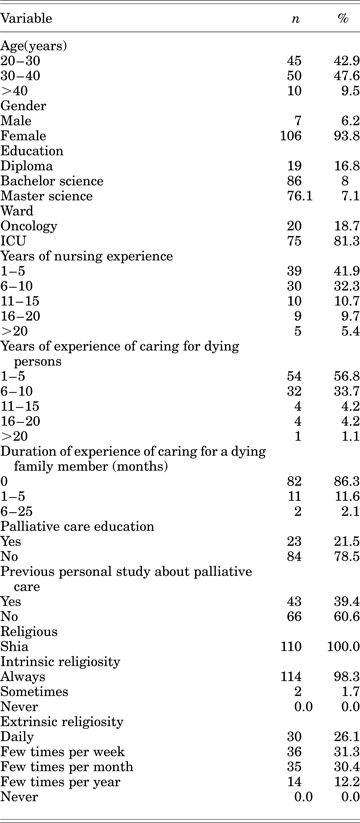
The sample consisted of 116 participants. A descriptive analysis of background information (Table 1) revealed that the participants were 20–45 years of age with a mean age of 31.6 years, and were mainly female (93.8%) and married (74.8). Most of the participants had a Bachelor of Science in Nursing degree (76.1) and stated that they receive no education about palliative care (78.5%). More than half (60.6%) of participants had done no personal study about palliative care. Most (81.3%) of participants were working in an ICU and the rest of them (17.2%) were working in oncology. The mean years of participants' experiences in nursing was 8.4. They reported that their mean number of years of experiences of caring for dying persons was 5.7 years, and 13.7% of participants had experienced caring for a dying family member. The mean years of participants' experiences of caring for a dying member of family was 0.6. All respondents were Muslim and Shia. The majority of participants (98.3%) stated that they always experienced the existence of God in their daily living. All of them claimed that they performed religious activities with varying regularity.
Background characteristics of sample

Descriptive Findings
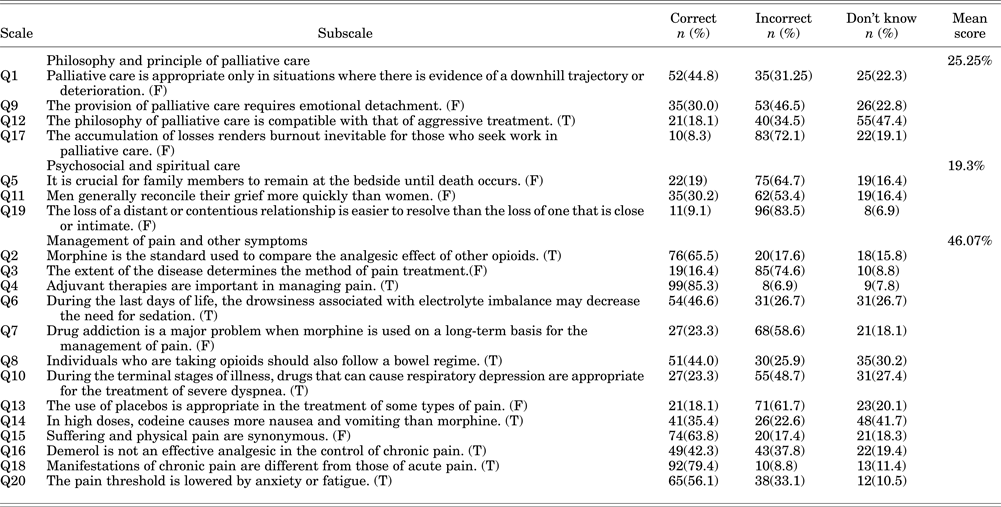
PCQN scores ranged from 0 to 20 based on the number of correct answers. Table 2 shows the percentage of correct answers on the PCQN. In the PCQN, the mean score was 7.59 (SD: 2.28). The minimum score was 1 and the maximum was 12. The rate of correct answers ranged from 85.3% to 8.3%. The most correct answers belonged to the category of management of pain and other symptoms (46.07%). The fewest correct answers belonged to the category of psychosocial and spiritual care (19.3%). Nine of the questions (Q4, Q18, Q2, Q15, Q20, Q6, Q1, Q8, and Q16) were answered correctly by >45% of participants. Five of the questions (Q4, Q18, Q2, Q15, and Q20) were answered correctly by >55% of respondents. The most correct answers belonged to item number 4 (adjuvant therapies are important in managing pain) (85.3%) (Table 2). The fewest correct answers belonged to item number 17 (the accumulation of losses renders burnout inevitable for those who seek work in palliative care) (8.3%) (Table 2).
Palliative Care Quiz for Nursing descriptive results
T, correct answer is “right”; F, correct answer is “wrong”
Correlations
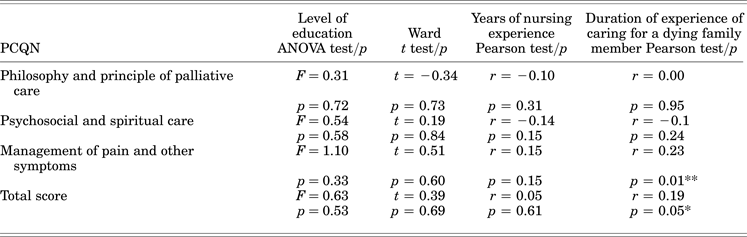
No significant correlation was found between total PCQN score and its subscales with age, gender, education, ward, religiosity, years of nursing experience, and years of experience of caring for dying people (Table 3). There was a significant correlation between the subscale of management of pain and other symptoms, and participants' length of experience caring for a dying family member (p = 0.01).
Correlation between Palliative Care Quiz for Nursing PCQN score and background information
T-test is significant at the level of *p ≤ 0.05 and **p ≤ 0.01.
Misconceptions
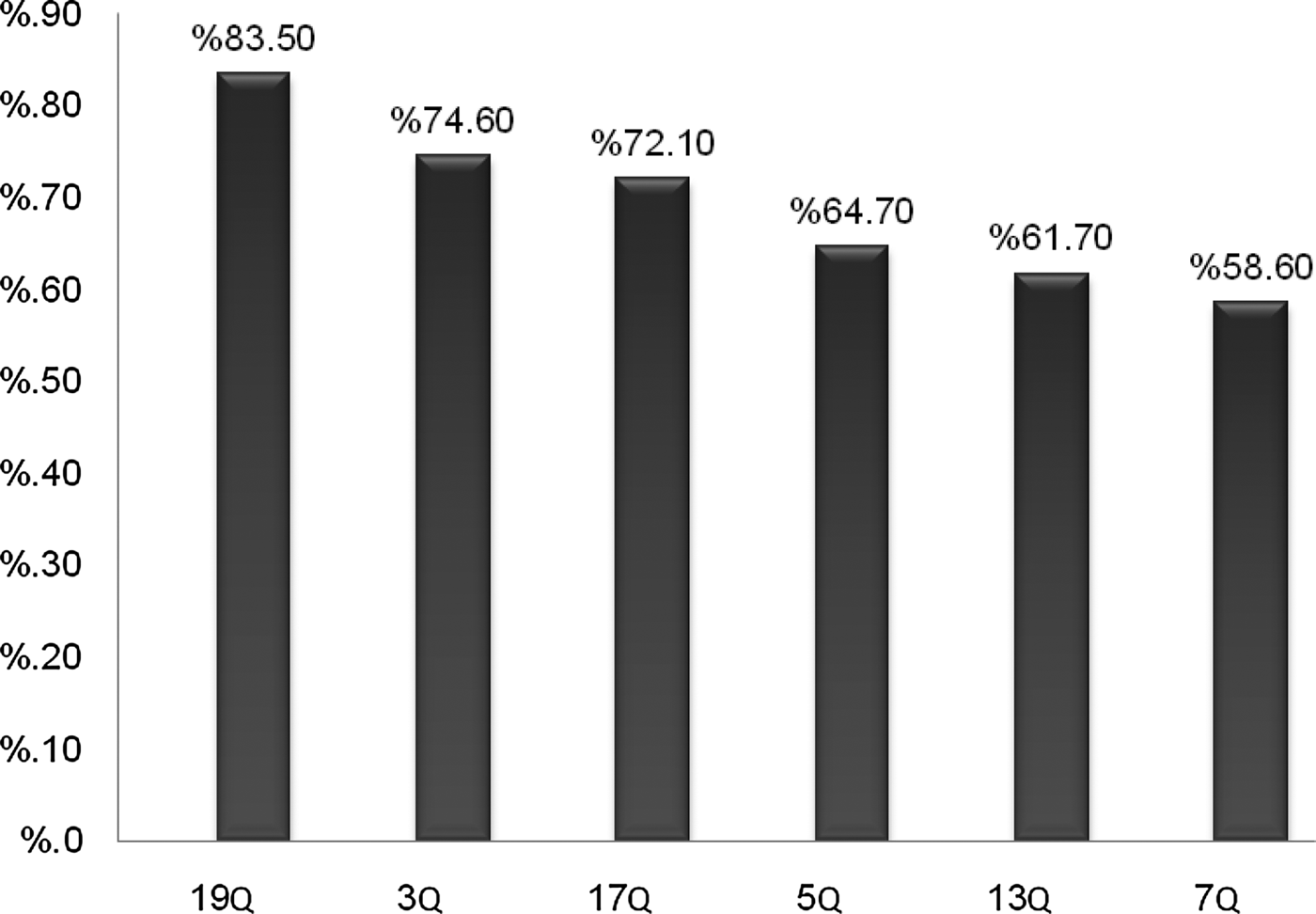
In this study, some misconceptions also were found, which are indicated in Figure 1. The most important misconception was “the loss of a distant or contentious relationship is easier to resolve than the loss of one that is close or intimate,” with 83.5% agreeing with that statement. The second misconception was “the extent of the disease determines the method of pain treatment,” with 74.6% agreeing. The third misconception was “the accumulation of losses renders burnout inevitable for those who seek work in palliative care,” with 72.1 % agreeing.
Misconceptions in answering the Palliative Care Quiz for Nursing (PCQN). Statements that most often are answered incorrectly.
DISCUSSION
The aim of this study was to assess palliative care knowledge of ICU as well as oncology nurses in Southeast Iran. The mean score of respondents' knowledge of palliative care was 7.59 (SD: 2.28). Comparing earlier studies that evaluated nurses' knowledge in different countries (as mentioned in the Introduction), from 1996 to 2012, (Ross et al., Reference Ross, McDonald and McGuinness1996; Raudonis et al., Reference Raudonis, Kyba and Kinsey2002; Ronaldson et al., Reference Ronaldson, Hayes and Carey2008; Knapp et al., Reference Knapp, Madden and Wang2009; Brazil et al., Reference Brazil, Brink and Kaasalainen2012) participants in this study had significantly lower levels of knowledge about palliative care. This could be related to the lack of palliative care education and specific training among Iranian nurses. According to Cheraghi et al. (Reference Cheraghi, Payne and Salsali2005) in Iran, palliative care education is neither included as specific clinical education nor as a specific academic course in the nursing educational curriculum. A large number (78.5%) of this study's participants mentioned that they had never received any formal education about palliative care. The low level of nurses' knowledge about palliative care in this study could also be associated with the lack of specific palliative care units in Iran. In Iran, patients who need special palliative care and those who need routine nursing care are in the same ward (ICUs and oncology wards). Nurses working in such wards, therefore, have to focus on the care of a significant number of patients in critical situations. Therefore, there is much information and many issues about patients that nurses need to know, and, consequently, they are not able to focus on the care of those who need specific palliative care.
On the other hand, Iranian nurses, particularly those work in critical care units and oncology wards, are overworked because of the nursing shortage in the healthcare system (Nikbakht Nasrabadi & Emami, Reference Nikbakht Nasrabadi and Emami2006). Therefore, they have limited time to enhance their knowledge about palliative care. The results also showed that almost 70% of participants claimed that they have done no previous personal study about palliative care. This might be related to nurses' views about end-of-life care. As was revealed by Iranmanesh et al. (Reference Iranmanesh, Dargahi and Abbaszadeh2008a), Iranian nurses do not have a positive attitude toward some aspects of caring for dying patients. These authors also concluded that cultural values and beliefs about death and dying may have contributed to the nurses' negative attitudes toward giving care to dying persons. Moreover, nurses' lack of autonomy in the Iranian healthcare system may lead them to dislike learning about palliative care. They have to follow physicians' orders in all clinical settings (Nikbakht Nasrabadi & Emami, Reference Nikbakht Nasrabadi and Emami2006), and they have no personal motivation to learn about palliative care.
In our study, no significant correlation was found between PCQN score and nurses level of education. On the other hand, several studies (Ronaldson et al., Reference Ronaldson, Hayes and Carey2008; Huijer et al., Reference Huijer, Dimassi and Abboud2009; Knapp et al., Reference Knapp, Madden and Wang2009) reported a positive correlation between nurses' knowledge about palliative care and their level of education. This discrepancy might be because of the similar education that nurses receive about palliative care at all levels of their nursing education. At all levels, nurses receive only 2 hours of academic education about palliative care. Our findings also indicated that nurses' years of experience of caring for the dying was not correlated with their knowledge about palliative care. This is inconsistent with the results of previous studies (Ronaldson et al., Reference Ronaldson, Hayes and Carey2008; Knapp et al., Reference Knapp, Madden and Wang2009; Nakazawa et al., Reference Nakazawa, Miyashita and Morita2009) in which it was found that nurses' knowledge about palliative care was positively correlated with their years of experience of caring for dying people. This contradiction could be explained as a consequence of the lack of specific palliative care units and insufficient academic/continuing education in the Iranian healthcare system. This lack caused there to be no difference between novice and experienced nurses' knowledge about palliative care.
However, the huge need for palliative care led the healthcare system to initiate its continuing education in some hospitals supervised by medical universities. According to the results, the duration of experience of caring for a dying family member was positively correlated with nurses' knowledge about palliative care, specifically about pain and symptom management. According to Iranmanesh et al. (Reference Iranmanesh, Savenstedt and Abbaszadeh2008b), nurses' personal experience of death reduced their fear and anxiety about death, and caused them to be likely to give care to dying people. This positive attitude toward caring for dying persons could have contributed to their adequate knowledge about palliative care as well. In this study, some misconceptions also were found. The most important misconception found in this study was “the loss of a distant or contentious relationship is easier to resolve than the loss of one that is close or intimate.” This could be related to the Iranian kinship relationship, which is completely different from that in Western countries. The relations and sentiments among Iranian families are so strong that in addition to the patient, family members will be severely affected if they are informed that their loved one is near death (Ghavamzadeh & Bahar, Reference Ghavamzadeh and Bahar1997).
CONCLUSION
The findings of this study showed that nurses are not knowledgeable about palliative care in Southeast Iran. The lack of education and experience, as well as some cultural and professional limitations, may have contributed to the nurses' low level of knowledge about palliative care. These findings suggest that nurses' knowledge about palliative care can be improved by establishing specific palliative care units to focus on end-of-life care. This establishment requires incorporation of palliative and End-of-Life Nursing Education Curriculum (ELNEC) into undergraduate nursing studies. As revealed in this study, the experience of caring for a dying family member positively affects nurses' knowledge about palliative care. Novice nurses and nursing students should gain experience in palliative care under experienced preceptorship during their education. Exposure to suitable narratives under individual or group supervision during clinical practice offers serious nurses prospects for receiving an in-depth education, which at the same time can be seen as supporting their essential, personal maturation.