Introduction
Depressive symptoms in the weeks following a non-fatal acute coronary syndrome (ACS) are common, with 15–20% patients experiencing severe depression and a further 20% reporting moderate symptoms (Thombs et al. Reference Thombs, Bass, Ford, Stewart, Tsilidis, Patel, Fauerbach, Bush and Ziegelstein2006; Lichtman et al. Reference Lichtman, Bigger, Blumenthal, Frasure-Smith, Kaufmann, Lesperance, Mark, Sheps, Taylor and Froelicher2008). Depression in the first months after an ACS predicts recurrent coronary events, mortality from coronary heart disease (CHD), poor quality of life, greater healthcare utilization and failure to return to work (Nicholson et al. Reference Nicholson, Kuper and Hemingway2006; Bhattacharyya et al. Reference Bhattacharyya, Perkins-Porras, Whitehead and Steptoe2007; Kurdyak et al. Reference Kurdyak, Gnam, Goering, Chong and Alter2008). These associations are largely independent of markers of disease severity and cardiovascular risk profiles (Kronish et al. Reference Kronish, Rieckmann, Schwartz, Schwartz and Davidson2009). Investigation of the mechanisms relating depression with future cardiovascular morbidity is an active field of research, with candidates including biological processes such as autonomic, inflammatory, neuroendocrine and endothelial dysfunction, together with deficits in adherence to medication and life-style advice (Grippo & Johnson, Reference Grippo and Johnson2009; de Jonge et al. Reference de Jonge, Rosmalen, Kema, Doornbos, van Melle, Pouwer and Kupper2010).
The determinants of depression following ACS are not well understood. History of depressive illness is relevant, but there is accumulating evidence that new onset depression in individuals without a positive history may be particularly cardiotoxic (de Jonge et al. Reference de Jonge, van den Brink, Spijkerman and Ormel2006; Dickens et al. Reference Dickens, McGowan, Percival, Tomenson, Cotter, Heagerty and Creed2008; Parker et al. Reference Parker, Hilton, Walsh, Owen, Heruc, Olley, Brotchie and Hadzi-Pavlovic2008; Carney et al. Reference Carney, Freedland, Steinmeyer, Blumenthal, de Jonge, Davidson, Czajkowski and Jaffe2009). Clinical depression and depressed mood in the general population are inversely associated with socio-economic status (SES) (Lorant et al. Reference Lorant, Deliege, Eaton, Robert, Philippot and Ansseau2003). Lower SES also predicts adverse outcomes after ACS, including more frequent rehospitalization, impaired functional status and mortality (Ickovics et al. Reference Ickovics, Viscoli and Horwitz1997; Alter et al. Reference Alter, Chong, Austin, Mustard, Iron, Williams, Morgan, Tu, Irvine and Naylor2006a). The impact of SES on the development of depression following ACS has been inconsistent. Education shows mixed associations with depression incidence in cardiac patients (Frasure-Smith et al. Reference Frasure-Smith, Lesperance and Talajic1993; Martens et al. Reference Martens, Smith, Winter, Denollet and Pedersen2008; Carney et al. Reference Carney, Freedland, Steinmeyer, Blumenthal, de Jonge, Davidson, Czajkowski and Jaffe2009), but may be a weak indicator of socio-economic circumstances in this population since most patients will have completed their education 30–40 years before developing CHD. It may be more appropriate to study contemporaneous measures of SES, such as income or socio-economic deprivation. One aim of this study was therefore to compare income and education as predictors of depressed mood following ACS. We hypothesized that depression 3 weeks after ACS would be associated with income but not education independently of clinical factors, disease severity and history of clinical depression.
Another relevant factor may be the emotional experience of patients in the period immediately preceding onset of acute ACS symptoms. A proportion of ACS is thought to be stimulated by triggers, defined as short-term stimuli or activities that precipitate the acute physiological or pathophysiological changes that initiate severe cardiac dysfunction (Steptoe & Brydon, Reference Steptoe and Brydon2009). Triggers include physical exertion, heat and cold stress, infection and emotional stimuli such as acute anger, sadness and stress (Strike & Steptoe, Reference Strike and Steptoe2005; Kloner, Reference Kloner2006; Warren-Gash et al. Reference Warren-Gash, Smeeth and Hayward2009). Some studies have involved population-based investigations of events such as earthquakes and sports matches, but most research has been based on individual retrospective reports, analysed using case-crossover methods (Maclure & Mittleman, Reference Maclure and Mittleman2000). The long-term consequences of emotional triggering have not been studied extensively, but a recent analysis from our group found that emotional triggering was associated with elevated anxiety 3 years after an ACS (Bhattacharyya et al. Reference Bhattacharyya, Perkins-Porras, Wikman and Steptoe2010). Notably, the biological mechanisms thought to be responsible for triggering, involving arterial plaque disruption coupled with autonomic dysfunction, inflammation, prothrombotic responses and neuroendocrine activation (Steptoe & Brydon, Reference Steptoe and Brydon2009), are similar to those implicated in depression following ACS. The second aim of this study was to measure the incidence of triggering of ACS by emotional stress and physical exertion and to test associations with subsequent depressive symptoms.
We also tested whether lower SES and emotional triggering act synergistically in predicting depressive symptoms following ACS. Triggering of ACS by negative emotions appears to be more common among lower SES individuals (Mittleman et al. Reference Mittleman, Maclure, Nachnani, Sherwood and Muller1997; Strike et al. Reference Strike, Perkins-Porras, Whitehead, McEwan and Steptoe2006b). Lower SES increases vulnerability to depressive symptoms following stressful events in general (Kendler et al. Reference Kendler, Gardner and Prescott2002), so may have an analogous impact on the occurrence of depression following emotional triggering of ACS.
Method
Study population
Participants were 298 patients admitted with ACS to St. George's Hospital in South London between June 2007 and October 2008. Patients were included if they had a diagnosis of ACS based on the presence of chest pain plus verification by diagnostic electrocardiographic (ECG) changes, troponin T or troponin I ⩾99th percentile of the upper reference limit and/or a creatine kinase measurement more than twice the upper range of normal for the measuring laboratory (Thygesen et al. Reference Thygesen, Alpert and White2007). Additional inclusion criteria were age of ⩾18 years, absence of co-morbid conditions that might influence either symptom presentation or mood, other conditions that might cause troponin positivity and ability to complete interviews and questionnaires in English. The study was approved by the Wandsworth Research Ethics Committee and written consent was obtained.
In-hospital data were collected between June 2007 and October 2008. On the days that recruitment was conducted, 666 potentially eligible patients were admitted. Of these, 125 (19%) had been discharged or transferred to a different hospital before the patient could be recruited into the study, 90 (14%) were too clinically fragile (e.g. critical ischaemia, ventricular tachyarrhythmia) to take part, 58 patients (9%) declined to participate, 27 (4%) could not speak English, 23 (3%) were in confusional states, seven patients (1%) died in hospital and a further 38 (6%) were excluded for other reasons. Patients who were not included in the study were older on average than those who did take part (mean 66.7±14.0 v. 60.2±11.6 years, p<0.001) and were more likely to be female (32.0% v. 16.1%, p<0.001).
Assessment of acute triggers
Patients were interviewed in hospital an average of 2.41±1.6 days after admission with a structured triggering interview based on the Determinants of Myocardial Infarction Onset study and other investigations (Mittleman et al. Reference Mittleman, Maclure, Sherwood, Mulry, Tofler, Jacobs, Friedman, Benson and Muller1995; Moller et al. Reference Moller, Theorell, de Faire, Ahlbom and Hallqvist2005; Strike et al. Reference Strike, Perkins-Porras, Whitehead, McEwan and Steptoe2006b). Patients were questioned about the circumstances surrounding the onset of acute symptoms. Based on previous evidence, we specifically focused on activities and emotional states during a 2-h period before symptom onset. Vigorous physical exertion was defined as activity of at least six metabolic equivalents, as used in earlier studies (Mittleman et al. Reference Mittleman, Maclure, Tofler, Sherwood, Goldberg and Muller1993; Willich et al. Reference Willich, Lewis, Lowel, Arntz, Schubert and Schroder1993). Anger, stress and acute depression or sadness during each hour before symptom onset were assessed on a set of rating scales (ranging from 0=none to 4=extreme) and the reasons for these emotional states were probed. Because the experience of stress, depression and anger during the hazard period overlapped, we based the analysis on combined emotional triggers, rather than the three moods separately. Patients were asked identical questions about the same period of the day 24 h earlier for the pair-matched, case-crossover analysis.
Socio-economic measures
SES was assessed using income and education. Household income was collected in five categories, reduced to three for the purposes of analysis: <£20 000 per annum; £20 000–£40 000 per annum; >£40 000 (equivalent to around <$30 000, $30 000–60 000 and >$60 000, respectively). Education was classified into three groups: primary (basic qualifications); secondary (high school); college/university education.
Clinical measures
Admission ECGs were reviewed and scrutinized for presentation as ST-elevation myocardial infarction (STEMI) or non-STEMI/unstable angina. We computed the composite risk index based on the algorithm developed in the Global Registry of Acute Coronary Events (GRACE) study (Eagle et al. Reference Eagle, Lim, Dabbous, Pieper, Goldberg, van de Werf, Goodman, Granger, Steg, Gore, Budaj, Avezum, Flather and Fox2004). This uses nine criteria (age, history of congestive heart failure, history of myocardial infarction (MI), systolic blood pressure and heart rate on admission, ST segment depression, initial serum creatinine, elevated cardiac enzymes and in-hospital percutaneous coronary intervention) to define risk of 6-month post-discharge death applicable to all types of ACS. The GRACE index was selected because it performs effectively across the SES spectrum (Alter et al. Reference Alter, Venkatesh and Chong2006b). The number of days spent in hospital was also recorded.
Assessment of depression and anxiety
Patients were interviewed in their own homes an average 21.6 days following the ACS, when the Beck Depression Inventory (BDI) and anxiety scale from the Hospital Anxiety and Depression Scale (HADS) were completed (Zigmond & Snaith, Reference Zigmond and Snaith1983, Beck et al. Reference Beck, Steer and Garbin1988). The BDI consists of 21 items rated on a scale of 0–3, so maximum scores can range from 0–63. Patients were also categorized on the basis of giving BDI scores ⩾10. Anxiety scores could range from 0–21 with higher values indicating greater anxiety and individuals were also categorized with anxiety scores ⩾8. The Cronbach α in this sample was 0.86 and 0.88 respectively. Patients were also administered the Depression Interview and Structured Hamilton (DISH) developed for the Enhancing Recovery in Coronary Heart Disease study, from which a 17-item Hamilton Rating Scale for Depression (HAMD) score was derived (Freedland et al. Reference Freedland, Skala, Carney, Raczynski, Taylor, Mendes de Leon, Ironson, Youngblood, Krishnan and Veith2002). As part of the DISH, participants were also questioned about their psychiatric history. Lifetime history of clinical depression was defined as having been diagnosed with depressive disorder and/or taking antidepressant treatments in the past, while pre-ACS depression was defined as a clinical diagnosis within the last 12 months and/or current antidepressive medication.
Assessments of depression and anxiety with the BDI and HADS were repeated at 6 and 12 months following semi-structured telephone interviews with patients by trained interviewers.
Other measures
Habitual physical activity in the months before ACS onset was assessed by asking patients on how many days per week they were sufficiently vigorously active to be out of breath. Chronic stress in the 6 months before ACS was measured with a series of rating scales (from 0=none to 4=extreme) asking about stress in five domains: relationship with partner; relationships in the family; work; other illnesses; financial issues. A total score for stress in the past 6 months was derived. The occurrence of major adverse cardiac events (further ACS, cardiac readmission, surgery or death from cardiac causes) between ACS and follow-up was included as a covariate in the regression analyses on long-term emotional adaptation.
Statistical analysis
Triggering by emotional stress and physical exertion was analysed using the case-crossover approach as detailed by Maclure & Mittleman (Reference Maclure and Mittleman2000). Onset of ACS was defined as the time at which the symptoms that led to admission began. Analyses were carried out separately of emotional stress and physical exertion. Risk of exposure to emotional stress or physical exertion during the 2-h hazard period before ACS onset was calculated relative to the same 2-h period that occurred 24 h earlier (pair-matched analysis). The pair-matched case-crossover design is analogous to a matched-pair case–control design, but with each individual serving as his or her own control. Therefore, frequencies of discordant and concordant exposure in the control and hazard periods are used to derive an odds ratio (OR) with 95% confidence intervals (CI).
The characteristics of participants in the different income categories were compared using χ2 tests for categorical and analysis of variance for continuous variables. The relationship between SES (income or education), triggering by emotional stress or physical exertion, and depression and anxiety scores at 3 weeks and 6 or 12 months was analysed with analysis of covariance, with SES and trigger category as between-person variables and age, gender, ethnicity, marital status, GRACE risk score, days in hospital (log transformed) and depressive history as covariates. Logistic regressions on BDI depression ⩾10 and HADS anxiety ⩾8 were also carried out, involving an interaction term between SES and triggering and the same covariates. In the analyses of longer-term emotional status, the occurrence of major cardiac events in the intervening period was included as an additional covariate. Results are presented as adjusted means with standard deviations and adjusted ORs with 95% CI.
Attrition analysis
Adequate income data were obtained from 279 of the 298 patients and information about emotional experience during the hazard and control periods was obtained from 273 patients (258 provided data on both measures). The remainder were not included in the analysis, because they refused or were unable to provide data on income or were asleep in the 2-h hazard period before symptom onset or during the corresponding control period 24 h earlier. There were no significant differences between the patients who did and did not provide income and acute emotional experience data on any factors. Altogether, 226 patients were assessed for depression 3 weeks after admission (76%). In total, 40 patients (13%) declined to participate in the second phase of the study, 12 (4%) patients were excluded because of extreme ill health (patient too unwell to complete follow-up interview, readmission to hospital, memory problems) and 21 (7%) patients could not be re-contacted despite repeated efforts by telephone and mail. Patients included in the analyses of emotional triggering, income and depression did not differ from the remainder in age, gender or income distribution, the occurrence of emotional stress during the hazard period, ethnicity, employment status, cardiac history, GRACE scores or number of days spent in hospital. However, patients who failed to complete the 3-week interview were less likely to be married (60.0% v. 72.2%, p=0.023) and were less likely to have a history of depression (6.0% v. 30.8%, p<0.001) or depression in the year before ACS (0% v. 6.1%, p<0.001).
Depression and anxiety data were obtained from 155 patients at 6 months and 155 patients at 12 months. Participation in the two phases did not overlap completely. Since associations with SES and emotional triggering were very similar at these two time points, they were combined to maximize numbers (n=186). Patients who did not complete assessments at 6 or 12 months were younger on average (57.55±12.5 v. 60.94±10.7, p=0.023) and more likely to be from an ethnic minority (25.3% v. 13.8%, p=0.027). They did not differ from the remainder in any other characteristics.
Results
Approximately one-third of patients fell into each of the household income categories. Educational attainment was generally low, with 53.5% achieving basic educational qualifications, 30.7% secondary education and only 15.8% having college/university education. Education was positively associated with income (r=0.22).
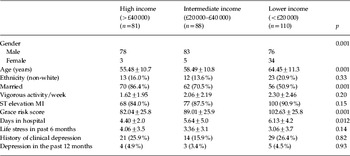
Table 1 summarizes patient characteristics according to household income categories. More female and unmarried patients had low household income (p<0.001), lower income patients tended to be older (p<0.001). Income category was not related to ethnicity, type of ACS or history of acute CHD (result not shown), but less affluent patients had worse GRACE risk scores (p<0.001) and spent more days in hospital (p=0.012). Ratings of life stress over the past 6 months did not differ across income categories. Overall, 22.9% of patients had a history of depressive illness, although only 12 (4.3%) had been depressed in the 12 months before ACS onset. There was no difference between income groups in history of depression.
Study sample

MI, myocardial infarction.
Trigger analysis
A total of 84 patients reported emotional stress during the 2-h hazard period (35 anger, 37 stress, and 29 depression or sadness), of whom 52 also reported emotional stress during the control period 24 h earlier. Altogether, 17 patients reported emotional stress during the control period only. The odds of onset of ACS following emotional stress were 1.88 (95% CI 1.01–3.61).
A comparable analysis was conducted for physical exertion during the period before symptom onset. Of the 273 patients, 55 were physically active in the hazard period, 19 in the hazard and control periods and nine only in the control period. The odds of onset of ACS following physical exertion were 4.00 (CI 1.89–9.44). We therefore replicated previous studies in showing that both emotional stress and physical exertion may acutely increase risk of ACS onset.
Emotional stress during the trigger period was more common among women patients (OR 2.23, CI 1.06–4.70, p=0.034), and was associated with younger age (OR 0.97, CI 0.95–0.99, p=0.011) and greater education (OR 1.56, CI 1.09–2.23, p=0.015). It was not related to household income. By contrast, physical exertion during the trigger period was associated with higher income (OR 1.92, CI 1.17–3.13, p=0.009), even after adjusting for age, gender and habitual physical activity. Neither emotional stress nor physical activity in the trigger period was associated with clinical indicators of disease including GRACE score, number of days in hospital, ACS type, previous MI or cardiac arrest. Life stress in the previous 6 months was associated with emotional stress (r=0.30, p<0.001) but not physical exertion (r=0.02, p=0.76) during the trigger period.
Depression 3 weeks after ACS
The mean BDI rating obtained during the home interviews conducted 3 weeks after ACS averaged 6.89±6.7, while the mean HAMD score was 3.17±6.1; 19.3% had BDI scores ⩾10. Analysis of variance of BDI ratings showed significant effects of emotional triggers (F=7.10, p=0.008) and income (F=8.06, p<0.001), with greater depression in lower SES patients and in those who reported emotional stress during the hazard period. The emotional stress by income interaction was also significant (F=6.88, p<0.001) after adjustment for age, gender, ethnicity, marital status, GRACE score, number of days spent in hospital and history of depression. The results in Fig. 1 indicate that depression was substantially elevated in the lower income patients who experienced emotional stress during the trigger period, compared with all other categories. A similar pattern was recorded for HAMD scores, where the emotional trigger by income interaction was again significant (F=6.62, p=0.002). HAMD scores were more than twice as high in the lower income/emotional trigger category (adjusted mean 9.59±9.55) compared with all others (mean 2.65±5.22). These differences were reinforced by analysis of the proportion of patients with BDI scores ⩾10 (Fig. 1). Just under 50% of lower income patients who experienced emotional stress during the trigger period had depression scores above threshold. A SES gradient was also apparent. In logistic regression on BDI ⩾10, the interaction between income and emotional triggers was significant (adjusted OR 1.52, CI 1.16–2.00, p=0.002), controlling for covariates. Replacing history of depression with depression in the 12 months before ACS did not alter the results.
Mean scores on the Beck Depression Inventory (BDI) (a) and the proportion of patients with BDI scores ⩾10; (b) 3 weeks after acute coronary syndrome (ACS) in patients with higher, medium and lower household incomes. Patients who experienced emotional stress in the hazard period before ACS onset (▪) and no emotional stress (□). Values are adjusted for age, gender, ethnicity, marital status, GRACE risk score, days in hospital and history of depression. Error bars are standard error of the mean.

Analysis of HADS anxiety showed a similar pattern. Overall, anxiety scores averaged 4.80±4.3 and 23.8% had values ⩾8. Analysis of covariance revealed significant effects for income (F=6.55, p=0.002) and emotional triggering (F=4.60, p=0.033), with higher anxiety in lower SES patients and those who experienced emotional stress in the 2-h period before symptom onset, after controlling for covariates. The interaction was significant (F=5.65, p=0.004), with adjusted anxiety scores averaging 8.63±6.2 in the lower SES/emotional trigger category, compared with 4.42±3.8 in all other categories. The proportion of patients in the lower SES/emotional trigger category with anxiety scores ⩾8 was 52.2%, compared with 19.0% in the medium and 23.0% in the higher income categories. In logistic regression on HADS anxiety ⩾8, the interaction between income and emotional triggers was significant (adjusted OR 1.40, CI 1.08–1.81, p=0.010), controlling for covariates.
Physical exertion during the 2-h hazard period was unrelated to depression or anxiety 3 weeks after ACS, although the main effect for income remained significant (F=4.06, p=0.019).
These analyses were repeated with educational attainment as the SES indicator. No consistent association with depression measured with the BDI or HAMD was observed and no significant interactions with emotional stress. Anxiety at 3 weeks was related to education (F=2.87, p=0.040), with adjusted scores averaging 5.74, 4.89 and 3.72 in patients with basic, secondary, and college education respectively. But education did not interact with the occurrence of emotional stress during the hazard period.
Emotional triggering, SES and well-being at 6 and 12 months
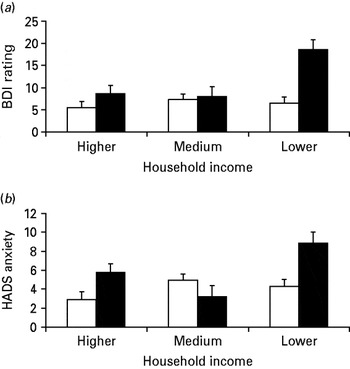
The aggregate BDI rating at 6/12 months was 8.19±8.5, while HADS anxiety averaged 4.76±4.5. Depression ratings were significantly greater in lower SES participants (F=4.74, p=0.010) and in those who experienced emotional stress during the trigger period (F=14.82, p<0.001), controlling for age, gender, ethnicity, marital status, GRACE score, number of days spent in hospital, history of depression and major cardiac events in the intervening period. Additionally, the income/emotional trigger interaction was significant (F=6.29, p=0.002) and is illustrated in Fig. 2. Patients in the lower SES/emotional trigger category had substantially higher BDI scores than all other categories (means 18.65±15.59 v. 7.08±6.43).
Mean scores on (a) the Beck Depression Inventory and (b) the Hospital Anxiety and Depression Scale (HADS) 6/12 weeks after acute coronary syndrome (ACS) in patients with higher, medium and lower household incomes. Patients who experienced emotional stress in the hazard period before ACS onset (▪) and no emotional stress (□). Values are adjusted for age, gender, ethnicity, marital status, GRACE risk score, days in hospital, history of depression and major adverse cardiac events. Error bars are standard error of the mean.

HADS anxiety ratings at 6/12 months were also greater in lower income patients (F=3.63, p=0.029) and those who experienced emotional stress (F=6.52, p=0.012) independently of covariates. As Fig. 2 illustrates, the interaction between income and emotional stress (F=6.45, p=0.002) reflects higher anxiety in the lower income/emotional stress category, compared with all others.
These findings were replicated in separate analyses of 6 and 12 month emotional well-being (results not shown). Physical activity during the 2-h hazard period was not related to long-term emotional adaptation. Analyses with education as the indicator of SES showed no significant associations with longer-term emotional adaptation.
Discussion
The aim of this study was to discovery whether lower SES and emotional triggers influence the occurrence of depression and anxiety following ACS. We found that low household income but not education was related to elevated depression symptoms 3 weeks and 6 and 12 months after ACS independently of other demographic factors, clinical risk and history of depression. The impact of education was less consistent, with an association with anxiety 3 weeks after ACS but not later. The case-crossover analysis indicated that acute emotional stress and physical exertion were both associated with increased risk. Emotional stress but not physical exertion during the trigger period positively predicted symptoms of depression and anxiety 3 weeks after ACS and 6/12 months later. Most interestingly, there was an interaction between emotional triggers and low SES, such that depression and anxiety were particularly elevated in lower income patients who experienced emotional stress during the hazard period. These effects were substantial, with 48% of lower income/emotional stress patients having BDI scores ⩾10 and 50% having anxiety scores ⩾8 at 3 weeks.
The acute triggering effects were similar to those described in previous studies. For example, Mittleman et al. (Reference Mittleman, Maclure, Sherwood, Mulry, Tofler, Jacobs, Friedman, Benson and Muller1995) reported a relative risk of 2.3 (CI 1.7–3.2) of ACS following anger in the 2-h hazard period. An earlier study from our group showed an OR of 2.06 (CI 1.12–3.92) for anger and 2.50 (CI 1.05–6.56) for acute depression or sadness (Steptoe et al. Reference Steptoe, Strike, Perkins-Porras, McEwan and Whitehead2006; Strike et al. Reference Strike, Perkins-Porras, Whitehead, McEwan and Steptoe2006b). The association with physical exertion is also in line with previous studies, although we were not able to replicate the protective effect of regular physical exercise in this investigation (Willich et al. Reference Willich, Lewis, Lowel, Arntz, Schubert and Schroder1993).
The prevalence of elevated BDI scores 3 weeks after ACS was 19.3%, within the range observed in other studies (Thombs et al. Reference Thombs, Bass, Ford, Stewart, Tsilidis, Patel, Fauerbach, Bush and Ziegelstein2006). Previous studies have found inconsistent associations between SES and depression following ACS. Low education has been a significant predictor of depression in some studies (Grace et al. Reference Grace, Abbey, Kapral, Fang, Nolan and Stewart2005; Parashar et al. Reference Parashar, Rumsfeld, Spertus, Reid, Wenger, Krumholz, Amin, Weintraub, Lichtman, Dawood and Vaccarino2006; Rutledge et al. Reference Rutledge, Reis, Olson, Owens, Kelsey, Pepine, Mankad, Rogers, Merz, Sopko, Cornell, Sharaf, Matthews and Vaccarino2006; Frasure-Smith et al. Reference Frasure-Smith, Lesperance, Irwin, Sauve, Lesperance and Theroux2007; Carney et al. Reference Carney, Freedland, Steinmeyer, Blumenthal, de Jonge, Davidson, Czajkowski and Jaffe2009) but not others (Frasure-Smith et al. Reference Frasure-Smith, Lesperance and Talajic1993; Strik et al. Reference Strik, Lousberg, Cheriex and Honig2004; Martens et al. Reference Martens, Smith, Winter, Denollet and Pedersen2008). Other markers of SES have been used less frequently, but Grace et al. (Reference Grace, Abbey, Kapral, Fang, Nolan and Stewart2005) reported that patients with lower family incomes were more likely to have elevated BDI scores in hospital. It should be emphasized that the lowest income category in the present study (<£20 000 per annum) was well above the poverty line in the UK (around £6000 and £10 400 per annum for single and married individuals, respectively, at the time of the study), so patients in this category cannot be considered to have been in poverty.
The finding that household income predicted depression after ACS while education did not highlights the role of current socio-economic circumstances. Education is a marker of future socio-economic trajectories in younger people, predicts occupational opportunities and may equip people with problem-solving skills that are useful in adult life. But family income reflects access to material resources and this may be more relevant to emotional adjustment following ACS.
This study extends previous findings in showing an association between emotional stress immediately before symptom onset and depression and anxiety in the weeks following ACS. The interaction between lower income and emotional stress suggests that limited affluence may make cardiac patients particularly vulnerable to the longer-term emotional consequences of acute emotional stress at the time of ACS. The association may plausibly be a reflection of the general vulnerability of lower SES individuals to depressive symptoms after life stress (Harris et al. Reference Harris, Brown and Bifulco1987; Kendler et al. Reference Kendler, Gardner and Prescott2002). Emotional stress during the trigger period was also associated with life stress over the 6 months before the ACS, indicating that it may occur in the context of chronic adversity. Interestingly, 52 of the 84 individuals reporting emotional stress during the 2-h hazard period also reported stress in the control period 24 h earlier, suggesting that much of the stress experienced in the prelude to ACS is sustained,
The mechanisms underlying these associations are not established. Lower SES individuals may lack material and social resources that allow them to cope effectively with serious cardiac disease. They may also be exposed to a greater extent to chronic stressors that augment the impact of heart disease. Lower SES individuals are less likely to make life-style behaviour modifications following ACS (Chan et al. Reference Chan, Gordon, Chong and Alter2008). Additionally, there are direct associations between lower SES and disturbed stress-related neuroendocrine and inflammatory processes that could contribute to risk of depression. For example, lower SES is associated with heightened inflammatory responses to acute stress and with cortisol dysregulation, both of which are implicated in the development of depression (Brydon et al. Reference Brydon, Edwards, Mohamed-Ali and Steptoe2004; Kumari et al. Reference Kumari, Badrick, Chandola, Adler, Epel, Seeman, Kirschbaum and Marmot2010). Patients who have experienced acute emotional stress before ACS display heightened platelet activation following acute experimental stress (Strike et al. Reference Strike, Magid, Whitehead, Brydon, Bhattacharyya and Steptoe2006a) and this may also be involved in depressive responses (Nemeroff & Musselman, Reference Nemeroff and Musselman2000).
The strengths of this study include its prospective design, assessment of emotional triggers using a widely accepted interview protocol, measurement of depression with standard questionnaire and interview techniques and inclusion of comprehensive indicators of clinical cardiological risk. However, the conclusions that can be drawn from this study are limited by the setting of the investigation – a large hospital in an urban environment in the UK – and by attrition from the study sample. Participants in the study were younger and more likely to be male than those who were potentially eligible but did not take part, indicating that more fragile older women were less likely to be involved. Attrition before the 3-week interview was associated with marital status and history of depression; while at 6/12 months, ethnic minorities and younger patients were less likely to participate. The impact of these factors on the pattern of results is not easy to judge, since associations between lower SES, acute emotional stress and later depression and anxiety were independent of these characteristics.
There is currently debate about the merits of screening ACS patients for depression and identifying individuals who are at elevated risk for poor emotional adjustment (Thombs et al. Reference Thombs, de Jonge, Coyne, Whooley, Frasure-Smith, Mitchell, Zuidersma, Eze-Nliam, Lima, Smith, Soderlund and Ziegelstein2008; Sowden et al. Reference Sowden, Mastromauro, Januzzi, Fricchione and Huffman2010). These findings indicate that attention might usefully be paid to patients' socio-economic circumstances and to their experiences shortly before hospital admission. Lower SES patients may be multiply disadvantaged, since they are not only more likely to develop depressive symptoms, but these symptoms are less likely to be recognized by clinicians (Amin et al. Reference Amin, Jones, Nugent, Rumsfeld and Spertus2006) and they may also receive less active clinical intervention (Alter et al. Reference Alter, Iron, Austin and Naylor2004). In relation to emotional triggers, recommendations have been put forward for reducing exposure to triggering events and for taking precautions in high-risk situations (Tofler & Muller, Reference Tofler and Muller2006; Steptoe & Brydon, Reference Steptoe and Brydon2009), but little work has been done on suitable management of such patients after ACS. The results of this study suggest that emotional triggering may increase risk for depression in cardiac patients, so may contribute to better identification of vulnerable patients.
Acknowledgements
This research was supported by the British Heart Foundation (RG/05/006), Medical Research Council UK, and the Swiss National Science Foundation.
Declaration of Interest
None.