Research on equid milks has greatly increased during the last two decades, and considerable information is available in the literature about the chemical composition, which is similar to human milk for the low casein/whey proteins ratio, low fat content and high lactose level (Salimei & Fantuz, Reference Salimei and Fantuz2012). Recently, donkey milk is gaining increasing attention as a potential functional food, and donkey farming is growing in several European countries such as Italy, Greece and Cyprus. At the same time, the research is increasingly focusing on its functional and technological properties (Cosentino et al. Reference Cosentino, Paolino, Freschi and Calluso2013; Aspri et al. Reference Aspri, Economou and Papademas2017). Nevertheless, investigations about the possibility of making cheese from donkey milk are very rare, probably due to the high costs that make the production of cheese an idea of poor practical interest. However, the assessment of its technical feasibility could open new perspectives, in particular for people presenting allergy to bovine milk proteins. According to the literature, equid milk cannot be coagulated by bovine chymosin (Uniacke-Lowe & Fox, Reference Uniacke-Lowe, Fox, Fuquay, Fox and McSweeney2011) due to the low casein content, but recently Iannella (Reference Iannella2015) overcame the problem by using camel chymosin, whereas Saric et al. (Reference Saric, Saric, Mandic, Hadnadev, Gubic, Milovanovic and Tomic2016) proposed fortification with goat milk. In our opinion, making cheese from donkey milk using calf rennet could be pursued by applying strong coagulation parameters and suitable in-vat operations. Such an approach has already been used for producing cheese from overheated or whey protein-fortified milks, which are also poorly responsive to rennet. Here we present the main results of experimentation carried out to verify this hypothesis. It was performed on pure donkey milk and, for comparison, on two different donkey/goat milk mixtures.
Materials and methods
Milk collection and analysis
Donkey and goat milks were obtained from two herds of local Italian breeds (Martina Franca and Garganica, respectively) reared in private farms (Apulia region, southern Italy) under semi-extensive conditions. Bulk milks were collected within a 40 d period (from the 20th of May to the 30th of June) from lactating donkeys (10) and goats (100) routinely milked twice a day by mechanical milker. Eight samplings were done in total, and the milks were subjected to analysis of gross composition (Infrared Spectroscopy by MilkoScan™ FT1, FOSS, Hillerød, Denmark), somatic cell count (Fossomatic 400 cell counter, Foss Electric, Hillerød, Denmark), total bacterial count (IDF, 1991), beta-galactosidase-positive Escherichia coli (ISO 16649-2: 2001), coagulase-positive staphylococci (EN ISO 6888-2: 1999), Listeria monocytogenes (ISO 11290-1: 1996), Salmonella spp. (ISO 6579: 2002) and Campylobacter spp. (ISO 10272-1: 2006).
Coagulation trials and cheese manufacturing
A series of coagulation trials were performed on pure donkey (D) and two mixtures of donkey/goat milk (85/15 and 70/30, v/v, M1 and M2, respectively). They were conducted at different pH (6·90, 6·70 and 6·50, adjusted with lactic acid) and level of ionic calcium (addition of 0·1, 0·2, and 0·3 g/l−1 calcium chloride), and using different amounts of calf rennet (0·3, 0·5 and 1·0 ml/l−1) at different temperatures (36, 38 and 40 °C). Amount of rennet and coagulation temperature were evaluated first (9 replicates × 3 repetitions for each type of milk). After fixing the optimum values, they were kept constant during testing of the other two parameters (same number of replicates and repetitions). The trials were carried out as follows: 1 l milk, after adjustment of pH and ionic calcium, was transferred in a small pot, heated at the desired temperature and added with rennet; after 40 min the gel was cut with a knife while scalding at 44 °C and left to settle for 10 min. Consistency of the curd was judged by evaluating the resistance to cutting, ease of separation and clarity of the whey released and, finally, by crushing it with a tea spoon. From the results obtained the final protocol was developed, and 4 cheesemaking trials (2 experimentations in duplicate on 2 different days) were performed in 12 l mini-vat heated by thermostatic water bath. Calf rennet was from Caglificio Clerici, Cadorago, Italy (single strength, 75% chymosin, 25% pepsin), the starter was from Danisco/Dupont, Cernusco sul Naviglio, Italy (Choozit Star, Streptococcus termophilus). The cheeses obtained, weighing about 300 g each, were kept at 25 °C for 2 h, then were dry salted and stored overnight under refrigeration. After 24 h from production, the cheeses were exactly weighted for yield calculation (g cheese/100 ml milk), and subjected to chemical, microbiological and sensory analyses.
Chemical, microbiological and sensory analyses of cheese
The chemical analyses were: moisture (IDF, 4:1986), NaCl (IDF 88A:1988), pH (IDF 115A:1989), fat (Soxhlet extraction, IDF, 2001), and total protein (Kjeldhal method, IDF 20B:1993 (IDF, 1993)). The microbiological analyses were the same as milk, except for total bacterial count and Campylobacter spp. The protein fraction was investigated by SDS-PAGE as reported by Harper et al. (Reference Harper, Meyer, Knighton and Lelievre1989). The determination of the protein bands was done by considering the molecular weight and by comparison with the literature data (Fantuz et al. Reference Fantuz, Vincenzetti, Polidori, Vita, Polidori and Salimei2001; Egito et al. Reference Egito, Miclo, Lopez, Adam, Girardet and Gaillard2002; Chianese et al. Reference Chianese, Calabrese, Ferranti, Mauriello, Garro, De Simone, Quarto, Addeo, Cosenza and Ramunno2010; Saric et al. Reference Saric, Saric, Mandic, Hadnadev, Gubic, Milovanovic and Tomic2016). A panel composed of 5 expert assessors performed the sensory evaluation. All of them belonged to the staff of the Section of Food Science and Technology at the University of Bari and had been selected by following international standards (ISO 8586-1: 1993). The panellists carried out a quantitative descriptive analysis (QDA) as reported in a previous paper (Trani et al. Reference Trani, Gambacorta, Loizzo, Cassone and Faccia2016). In brief, a series of sensory descriptors were identified and quantified on a 5 point scale (from 0 = absence of perception to 4 = maximum perception), but only those having a weight percentage (frequency of citations × perceived intensity) greater than 30% were considered.
Statistical analysis
All data were processed using SPSS version 19 (IBM, Armonk, NY). The discrete variables were described by their mode value and compared by the Kruskal Wallis test; the continuous variables were described by the means and compared using 1-way ANOVA.
Results and discussion
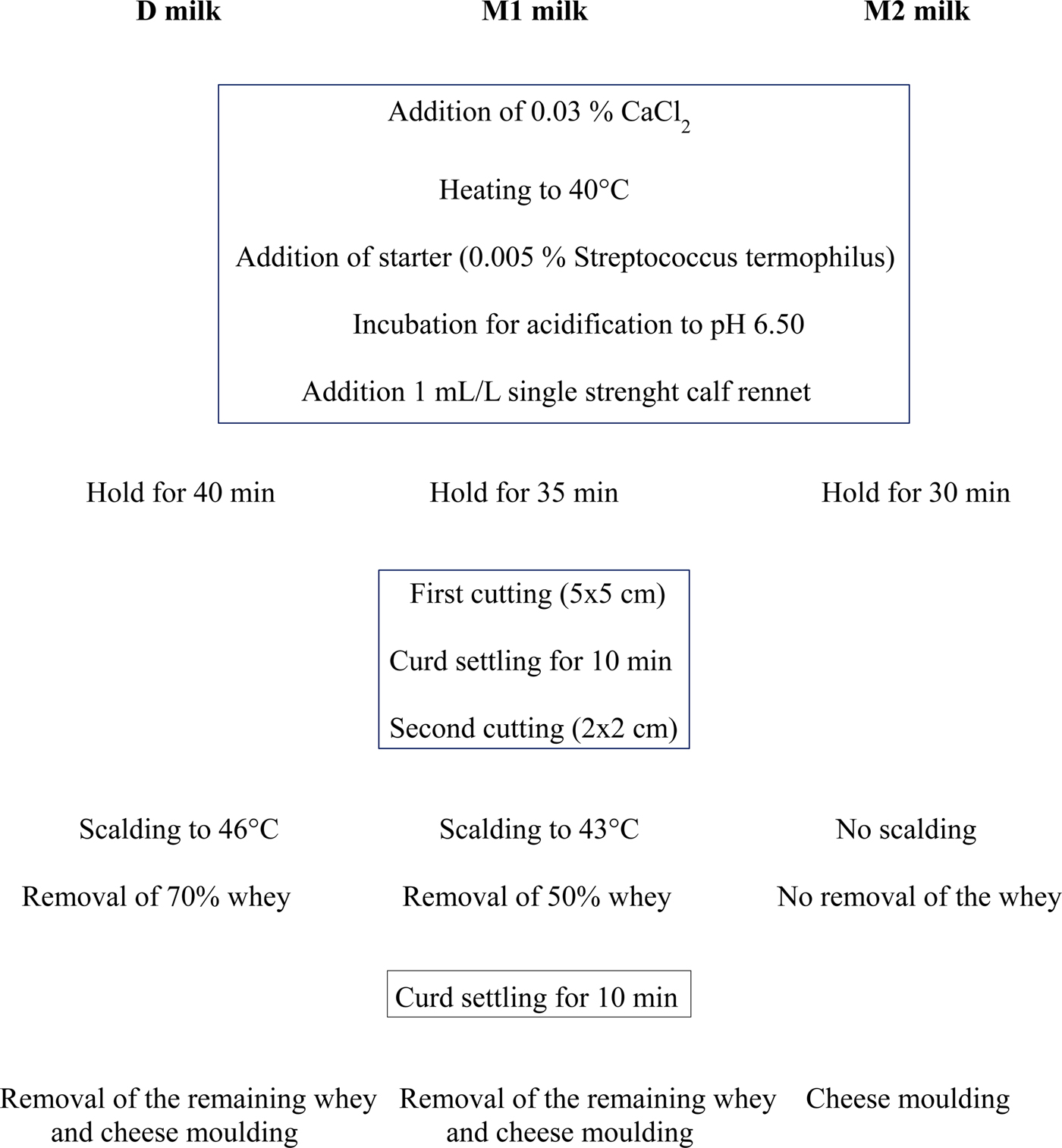
The coagulation behaviour of donkey milk was tentatively monitored by tromboelastography. Unfortunately, the lactodinamograph parameters were not measurable under the conditions routinely used for ruminant milk. We concluded that a dedicated procedure should be developed for obtaining reliable results, and decided to monitor the coagulation trials according to the procedure described above. Even though the procedure was empirical, it gave the information we needed for developing the final cheesemaking protocol. The results demonstrated that even by maximising amount of rennet and coagulation temperature donkey milk did not coagulate completely. Only after lowering pH and adding calcium chloride was satisfactory coagulation observed, and the best results were obtained under the strongest technological conditions (online Supplementary File Table S1). The positive effect of low pH and ionic calcium on curd formation is well known in dairy technology, and derives from the combined effect of lowering the electrostatic repulsion and favoring ionic bonding among the micelles. Differently, firmness of the coagulum obtained from the milk mixtures was satisfactory at all technological conditions, and it increased with addition of goat milk. From these results, and after introducing some modifications, the final protocol of cheesemaking was developed (Fig. 1) and prototypal cheeses were obtained. Modifications concerned milk acidification (use of starter instead of direct acidification), and curd cutting time/scalding temperature/moulding procedure, which were adapted to the type of milk. The total in-vat working time was 100 min for M2, 120 min for M1, and 180 min for D.
Cheesemaking protocol.

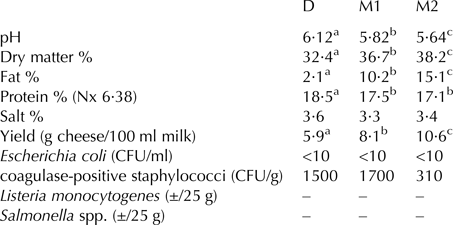
The gross composition of milks used for cheesemaking fell within the typical ranges of the two species, except for the fat content of donkey milk (0·21 ± 0·04) which barely approached the lower limit reported in the literature. The somatic cell count and the bacteria counts revealed good microbiological characteristics (online Supplementary File Table S2). The characteristics of the cheeses are reported in Table 1. All chemical parameters differed significantly among the samples, except for salt concentration. The pH values were directly proportional to the amount of donkey milk present, and the dry matter content corresponded to the levels of curd firmness observed during the coagulation trials (M2 > M1 > D). Yields varied from a minimum of 5·9% (D) to a maximum of 10·6% (M2). The chemical characteristics of donkey cheeses were compared with the only paper reported in the literature (Iannella, Reference Iannella2015): a similar dry matter content (32·4%) was found, but pH (6·12) and yield (5·9%) were higher. These differences could derive from the different cheesemaking protocol used, in particular the type of starter, in-vat operations and working time. The fat content was negligible, reflecting the low fat level observed in milk, and protein represented more than 57% of dry matter. By SDS gel electrophoresis (online Supplementary File Fig. S1) it was ascertained that β-casein was the most abundant protein in donkey cheese, followed by αs-caseins. The bands of para-κ-casein and whey proteins were much less intense, but their presence was not negligible. In M1 and M2 samples the bands of donkey and goat β-lactoglobulin and α-lactalbumin overlapped due to similar molecular weight, and separation of lysozime was partially impaired by the presence of the para-k casein band (Vincenzetti et al. Reference Vincenzetti, Polidori, Mariani, Cammertoni, Fantuz and Vita2008; Ham et al. Reference Ham, Han, Jeong, Seol, Jang, Oh, Kim and Park2012). As regards safety, coagulase-positive staphylococci were the only pathogenic microorganism detected among those contemplated by the European legislation for raw milk cheeses. They probably derived from the cheesemaking environment, as suggested by the higher counts in D and M1 cheeses, which were more manipulated than M2. All cheeses were judged acceptable by sensory evaluation, and the panellists selected a total of 12 sensory attributes for describing them (online Supplementary File Table S3). Eight attributes differed significantly among the samples: donkey cheese had a friable and slightly soluble texture, aroma was described as ‘gamy’ and ‘cooked milk’ at medium level of intensity, and taste was markedly sweet and medium salty. M1 and M2 samples, besides the differences in texture already discussed, had a goaty and sour aroma that overlapped the gamy/cooked milk notes as the presence of goat milk in cheese increased. In the same way, the taste evolved from sweet to acid.
Gross composition, yield and pathogenic microorganism detection of the cheeses after 24 h from production (means ± sd)

Values with different letter are different at P < 0·01.
In conclusion, our experimentation demonstrated that it is possible to produce fresh cheese of acceptable sensory quality from donkey milk using calf rennet by adjusting both the coagulation parameters and the in-vat operations. Fortification with goat milk improved curd firmness, and the cheeses obtained under our experimental conditions could be, in our experience, suitable to ripening for reaching semi-hard consistency.
Supplementary material
The supplementary material for this article can be found at https://doi.org/10.1017/S0022029918000420