Significant outcomes
GSK3B shows a positive association with treatment-free MDD Latino cases.
Other pathways of interest such as inflammation and neuroplasticity did not differ significantly between MDD cases and controls.
TCF7L2 shows the highest number of correlations – of modest size – with MDD-related traits, such as self-esteem, vulnerable cognitive styles, and cognitive complaints.
To our knowledge, this is the first study of gene expression in major depression in a Latino sample.
Limitations
Peripheral expression does not necessarily reflect changes in brain or brain function.
Sample size is small, and the lack of differences may be due to low statistical power.
Candidate gene studies may prompt false negatives or false positive results, thus independent replication is needed to confirm findings.
The dearth of similar studies in Latino samples hinder our capacity to compare our results with previous literature.
The significant p-value is not adjusted for multiple comparisons and should be considered as hypothesis generation information.
Introduction
Major depressive disorder (MDD) has an important impact in loss of health and function (Ustün et al., Reference Ustün, Ayuso-Mateos, Chatterji, Mathers and Murray2004), ranking as the main contributor to global disability (Whiteford et al., Reference Whiteford, Degenhardt, Rehm, Baxter, Ferrari, Erskine, Charlson, Norman, Flaxman, Johns, Burstein, Murray and Vos2013). The World Health Organization reported an estimate of 4.4% of the global population living with MDD – 5.1% of women and 3.6% of men – and a disquieting increase of 18% from 2005 to 2015 (World Health Organization, 2017). Moreover, the clinical presentation of MDD is heterogeneous and complex (Goldberg, Reference Goldberg2011), with varying degrees of response to treatment (Petersen et al., Reference Petersen, Papakostas, Posternak, Kant, Guyker, Iosifescu, Yeung, Nierenberg and Fava2005) and important comorbidities (Kessler et al., Reference Kessler, Berglund, Demler, Jin, Koretz, Merikangas, Rush, Walters and Wang2003). Nevertheless, diagnostic tools (DSM-5 and ICD10) and clinical management guides for MDD (NICE and CANMAT) still rely on symptomatology and lack the integration of biomarkers and precision medicine data (Perlis, Reference Perlis2016).
Approximately 40% of MDD liability is attributable to genetic factors (Kendler et al., Reference Kendler, Gatz, Gardner and Pedersen2006), and although there is an important road ahead in determining the genetic variants responsible for this risk, recent studies have made important advances in finding them, since described samples already include more than 100 000 subjects (Wray et al., Reference Wray, Ripke, Mattheisen, Trzaskowski, Byrne, Abdellaoui, Adams, Agerbo, Air, Andlauer, Bacanu, Bækvad-Hansen, Beekman, Bigdeli, Binder, Blackwood, Bryois, Buttenschøn, Bybjerg-Grauholm, Cai, Castelao, Christensen, Clarke, Coleman, Colodro-Conde, Couvy-Duchesne, Craddock, Crawford, Crowley, Dashti, Davies, Deary, Degenhardt, Derks, Direk, Dolan, Dunn, Eley, Eriksson, Escott-Price, Kiadeh, Finucane, Forstner, Frank, Gaspar, Gill, Giusti-Rodríguez, Goes, Gordon, Grove, Hall, Hannon, Hansen, Hansen, Herms, Hickie, Hoffmann, Homuth, Horn, Hottenga, Hougaard, Hu, Hyde, Ising, Jansen, Jin, Jorgenson, Knowles, Kohane, Kraft, Kretzschmar, Krogh, Kutalik, Lane, Li, Li, Lind, Liu, Lu, MacIntyre, MacKinnon, Maier, Maier, Marchini, Mbarek, McGrath, McGuffin, Medland, Mehta, Middeldorp, Mihailov, Milaneschi, Milani, Mill, Mondimore, Montgomery, Mostafavi, Mullins, Nauck, Ng, Nivard, Nyholt, O’Reilly, Oskarsson, Owen, Painter, Pedersen, Pedersen, Peterson, Pettersson, Peyrot, Pistis, Posthuma, Purcell, Quiroz, Qvist, Rice, Riley, Rivera, Saeed Mirza, Saxena, Schoevers, Schulte, Shen, Shi, Shyn, Sigurdsson, Sinnamon, Smit, Smith, Stefansson, Steinberg, Stockmeier, Streit, Strohmaier, Tansey, Teismann, Teumer, Thompson, Thomson, Thorgeirsson, Tian, Traylor, Treutlein, Trubetskoy, Uitterlinden, Umbricht, Van der Auwera, van Hemert, Viktorin, Visscher, Wang, Webb, Weinsheimer, Wellmann, Willemsen, Witt, Wu, Xi, Yang, Zhang, Arolt, Baune, Berger, Boomsma, Cichon, Dannlowski, de Geus, DePaulo, Domenici, Domschke, Esko, Grabe, Hamilton, Hayward, Heath, Hinds, Kendler, Kloiber, Lewis, Li, Lucae, Madden, Magnusson, Martin, McIntosh, Metspalu, Mors, Mortensen, Müller-Myhsok, Nordentoft, Nöthen, O’Donovan, Paciga, Pedersen, Penninx, Perlis, Porteous, Potash, Preisig, Rietschel, Schaefer, Schulze, Smoller, Stefansson, Tiemeier, Uher, Völzke, Weissman, Werge, Winslow, Lewis, Levinson, Breen, Børglum and Sullivan2018). On the other hand, early MDD gene expression studies showed that baseline differences between cases and controls inflammatory gene expression were associated with antidepressant treatment response (Cattaneo et al., Reference Cattaneo, Gennarelli, Uher, Breen, Farmer, Aitchison, Craig, Anacker, Zunsztain, McGuffin and Pariante2013). These promising results have led to the exploration of gene expression in MDD as baseline and treatment response markers.
Multiple physiological systems have been investigated as potential sources of biomarkers for MDD, including inflammatory and neurotrophic systems (Jani et al., Reference Jani, McLean, Nicholl, Barry, Sattar, Mair and Cavanagh2015; Strawbridge, Young and Cleare, Reference Strawbridge, Young and Cleare2017). One of the most representative research areas in this field is the neuroimmunological dysfunction hypothesis of depression (Miller, Maletic and Raison, Reference Miller, Maletic and Raison2009), in which major depression is the clinical end point of chronic stressors that modify stress response systems, which subsequently increase pro-inflammatory cytokines (Slavich and Irwin, Reference Slavich and Irwin2014). Immunological gene expression studies, ascertaining the differences in the inflammatory system between subjects with depression and non-depressed controls, have revealed a higher expression of pro-inflammatory cytokines (IL-1β, IL-6, IL10, IFN-γ, and TNF-α), and a lower expression of IL-4 – an anti-inflammatory cytokine – in people with depression (Tsao et al., Reference Tsao, Lin, Chen, Bai and Wu2006; Belzeaux et al., Reference Belzeaux, Formisano-Tréziny, Loundou, Boyer, Gabert, Samuelian, Féron, Naudin and Ibrahim2010; Cattaneo et al., Reference Cattaneo, Gennarelli, Uher, Breen, Farmer, Aitchison, Craig, Anacker, Zunsztain, McGuffin and Pariante2013; Jansen et al., Reference Jansen, Penninx, Madar, Xia, Milaneschi, Hottenga, Hammerschlag, Beekman, van der Wee, Smit, Brooks, Tischfield, Posthuma, Schoevers, van Grootheest, Willemsen, de Geus, Boomsma, Wright, Zou, Sun and Sullivan2016).
Another important hypothesis is that of synaptic plasticity disruption, supported by research suggesting that alterations of the mechanisms in charge of synaptic plasticity maintenance and control result in a destabilisation of cerebral networks related to mood and emotions (Duman and Aghajanian, Reference Duman and Aghajanian2012). This is not surprising, as neurotrophins (members of the nerve growth factor family) play a major role in brain development and plasticity of the mature central nervous system (Thoenen, Reference Thoenen1995). There is evidence of disruption of regular neuroplasticity in major depression (Pittenger and Duman, Reference Pittenger and Duman2008; Player et al., Reference Player, Taylor, Weickert, Alonzo, Sachdev, Martin, Mitchell and Loo2013; Noda et al., Reference Noda, Zomorrodi, Vila-Rodriguez, Downar, Farzan, Cash, Rajji, Daskalakis and Blumberger2018), and studies suggest that Brain-derived neurotrophic factor (BDNF) is lower in the serum of treatment-free depressed subjects and normalises after treatment with antidepressants (Molendijk et al., Reference Molendijk, Spinhoven, Polak, Bus, Penninx and Elzinga2014). Furthermore, genetic studies have replicated this finding with mRNA data (Cattaneo et al., Reference Cattaneo, Bocchio-Chiavetto, Zanardini, Milanesi, Placentino and Gennarelli2010, Reference Cattaneo, Gennarelli, Uher, Breen, Farmer, Aitchison, Craig, Anacker, Zunsztain, McGuffin and Pariante2013), as well as a post-mortem study that reported increased expression of BDNF in the brains of people previously treated with antidepressants (Chen et al., Reference Chen, Dowlatshahi, MacQueen, Wang and Young2001).
The canonical Wnt signaling pathway has garnered data that make it a promising system to explore in mood disorder research as well (Duman and Voleti, Reference Duman and Voleti2012). In psychiatry, evidence has accumulated on the participation on the Wnt signaling pathway in several diseases and related phenotypes (Mulligan and Cheyette, Reference Mulligan and Cheyette2017) such as schizophrenia, (Miyaoka, Seno and Ishino, Reference Miyaoka, Seno and Ishino1999; Levchenko et al., Reference Levchenko, Davtian, Freylichman, Zagrivnaya, Kostareva and Malashichev2015; Hoseth et al., Reference Hoseth, Krull, Dieset, Mørch, Hope, Gardsjord, Steen, Melle, Brattbakk, Steen, Aukrust, Djurovic, Andreassen and Ueland2018), bipolar disorder (BD) (Matigian et al., Reference Matigian, Windus, Smith, Filippich, Pantelis, McGrath, Mowry and Hayward2007; Zandi et al., Reference Zandi, Belmonte, Willour, Goes, Badner, Simpson, Gershon, McMahon, DePaulo and Potash2008; Sani et al., Reference Sani, Napoletano, Forte, Kotzalidis, Panaccione, Porfiri, Simonetti, Caloro, Girardi, Telesforo, Serra, Romano, Manfredi, Savoja, Tamorri, Koukopoulos, Serata, Rapinesi, Casale, Nicoletti, Girardi, Del Casale, Nicoletti and Girardi2012; Winham et al., Reference Winham, Cuellar-Barboza, Oliveros, McElroy, Crow, Colby, Choi, Chauhan, Frye and Biernacka2014; Pandey et al., Reference Pandey, Rizavi, Tripathi and Ren2015; Cuellar-Barboza et al., Reference Cuellar-Barboza, Winham, McElroy, Geske, Jenkins, Colby, Prieto, Ryu, Cunningham, Frye and Biernacka2016; Hoseth et al., Reference Hoseth, Krull, Dieset, Mørch, Hope, Gardsjord, Steen, Melle, Brattbakk, Steen, Aukrust, Djurovic, Andreassen and Ueland2018), anxiety disorders (Zhao et al., Reference Zhao, Zhang, Wang, Yu, Yang, Liu, Yao, Liu, Shen, Guo, Wang and Wu2018; Vidal et al., Reference Vidal, Garro-Martínez, Díaz, Castro, Florensa-Zanuy, Taketo, Pazos and Pilar-Cuéllar2019), and depression (Saus et al., Reference Saus, Soria, Escaramís, Crespo, Valero, Gutiérrez-Zotes, Martorell, Vilella, Menchón, Estivill, Gratacòs and Urretavizcaya2010; Enatescu et al., Reference Enatescu, Papava, Enatescu, Antonescu, Anghel, Seclaman, Sirbu and Marian2016; Peng et al., Reference Peng, Wang, Wang, Zhou, Li and Tan2018; Vidal et al., Reference Vidal, Garro-Martínez, Díaz, Castro, Florensa-Zanuy, Taketo, Pazos and Pilar-Cuéllar2019). Several members of the Wnt signaling pathway have been specifically linked to mood disorders.
Although there has been a steady increase in the amount of research dedicated to the study of these three hypotheses of depression and their interconnectedness, efforts to replicate these findings in distinct populations are lacking (Frodl, Reference Frodl2017). This is a priority since population diversity is an important source of genetic heterogeneity (Hodgson, McGuffin and Lewis, Reference Hodgson, McGuffin and Lewis2017) and a major limitation in the generation of both diagnostic and treatment response genetic biomarkers of depression (Mora et al., Reference Mora, Zonca, Riva and Cattaneo2018).
Aims of the study
In this cross-sectional study of a Latino sample, we sought to investigate gene expression markers of MDD and MDD-related traits, by comparing peripheral gene expression levels between depressed treatment-free subjects and mentally healthy controls. We evaluated 16 genes, key members of 3 different biological pathways, namely: IL1A, IL1B, IL4, IL6, IL7, IL8, IL10, MIF, and TNFA (inflammatory pathway); BDNF, p11 and VGF (synaptic plasticity and neurotrophism pathway); TCF7L2, APC, and GSK3B (canonical Wnt signaling pathway), and mTOR.
Materials and methods
Subjects
This project was carried out at the Affective Health Center of the Department of Psychiatry of the University Hospital, Universidad Autónoma de Nuevo Leon, Monterrey, Mexico. It was part of a larger naturalistic study designed to measure peripheral gene expression at baseline and after antidepressant treatment with a selective serotonin reuptake inhibitor treatment in adults with an MDD diagnosis, without treatment at recruitment. The study protocol and procedures were approved by the Institutional Review BoardFootnote 1, and written informed consent was obtained from all subjects prior to participation. The authors assert that all procedures contributing to this work comply with the ethical standards of the relevant national and institutional committees on human experimentation and with the Helsinki Declaration of 1975, as revised in 2008. This study is also registered under Project No. 272616 of the Sectoral Fund of Research in Health and Social Security SS/IMSS/ISSSTE of the National Council of Science and Technology (CONACYT).
After screening with the Patient Health Questionnaire-9 > 5 (Kroenke, Spitzer and Williams, Reference Kroenke, Spitzer and Williams2001), subjects aged 18 to 65 years with a diagnosis of MDD (single episode or recurrent; moderate to severe), and at least treatment-free for 6 months, were included. Candidates who fulfilled diagnostic criteria for psychotic, bipolar I or II, obsessive-compulsive, or severe alcohol use disorders were not eligible for participation. Diagnoses were performed by a board-certified psychiatrist according to the Diagnostic and Statistical Manual of Mental Disorders (DSM-IV-TR) criteria using the Structured Clinical Interview for DSM-IV Axis I Disorders (SCID-I) (First et al., Reference First, Williams, Spitzer and Gibbon2007). Body mass index (BMI) was calculated as the weight of the subject divided by the square of the body height and expressed as kg/m2. Waist circumference was measured at the midpoint between the last palpable rib and the iliac crest.
Montgomery–Asberg Depression Rating Scale (MADRS) scores were used as a measure of symptom severity (Montgomery and Asberg, Reference Montgomery and Asberg1979; Snaith et al., Reference Snaith, Harrop, Newby and Teale1986). Self-report additional clinical scales used in the group of cases were Generalized Anxiety Disorder 7 (Spitzer et al., Reference Spitzer, Kroenke, Williams and Löwe2006), Pittsburgh Sleep Quality Index (Buysse et al., Reference Buysse, Reynolds, Monk, Berman and Kupfer1989), Rosenberg Self-Esteem Scale (RSES) (Rosenberg, Reference Rosenberg1965), British Columbia Cognitive Complaints Inventory (BC-CCI) (Iverson and Lam, Reference Iverson and Lam2013), and Cognitive Styles Questionnaire Short Form (CSQ-SF) (Meins et al., Reference Meins, McCarthy-Jones, Fernyhough, Lewis, Bentall and Alloy2012).
Our study enrolled 100 people in 2 groups: treatment-free depressed cases (n = 50) and mentally healthy controls (n = 50). Sex- and age-matched (± 1 year) mentally healthy controls were administered the SCID-I, the MADRS, and the Patient Health Questionnaire. Individuals were included in the control group when they had no lifetime mood or anxiety disorders and a low score (≤ 6) on the MADRS.
RNA extraction and cDNA synthesis
We collected 4 mL of peripheral blood from cases with MDD and mentally healthy controls into anticoagulant-prepared tubes (EDTA). Total RNA was extracted using the NucleoSpin® RNA Blood kit (MACHEREY-NAGEL GmbH & Co. KG). The quality of the RNA was determined by Bioanalyzer (Agilent Technologies). Complementary RNA (cDNA) was synthesised from 1 μg of RNA with the SuperScript IV Vilo Master Mix kit (ThermoFisher) in accordance with the manufacturer’s instructions.
Gene expression analysis
Gene expression was measured through quantitative PCR (qPCR), using the Step One Plus detection system (Applied Biosystems™) in a 96-well plate format. As internal controls, three genes were used: Beta-2-Microglobulin (B2M), Glyceraldehyde 3-Phosphate Dehydrogenase (GAPDH), and Ribosomal Protein Lateral Stalk Subunit P0 (RPLPO). These were also used for data normalisation.
The TaqMan probes for each gene of interest (IL1A, IL1B, IL4, IL6, IL7, IL8, IL10, MIF, TNFA, BDNF, p11, VGF, TCF7L2, APC, mTOR, and GSK3B) were obtained from Applied Biosystems. The qPCR proceeded as follows: 1 cycle at 95 ° C for 5 min to activate the polymerase, 50 cycles were performed; each cycle consisted of a step of denaturation at 95 ° C for 30 s, an alignment step at 60 ° C for 30 s and an elongation step at 72 ° C for 30 s.
The values of Ct were normalised with the software ArrayStudio (Qiagen). Relative quantification values of mRNA were obtained using the 2-ΔΔCt comparison method. Amplification reactions were performed in triplicate with determined reproducibility.
Statistical analysis
Parametric (Student’s t-test for BMI) and nonparametric (Mann–Whitney U-test for waist) were used to test the differences between the groups depending on normality of the sampled values. Given the challenges of accurately determining the distribution of a qPCR gene expression sample, due to dispersion not being well represented in scenarios with a limited number of biological replicates available, a normal distribution was assumed and parametric tests for gene expression differences (Goni, García and Foissac, Reference Goni, García and Foissac2009) were performed, including an ANOVA [ArrayStudio (Qiagen)].
Linear regression models with age, gender, and BMI as covariates were developed for each gene. Also, correlations between gene expression and clinical traits of depression, anxiety, self-esteem, cognitive styles and cognitive vulnerability were tested (Spearman’s rho test). A p < 0.05 value was considered statistically significant.
Results
Our study enrolled 50 treatment-free depressed subjects and 50 mentally healthy controls. Sixty-six per cent of the total sample were women, with a mean age of 26.7 years (SD 7.9). No significant differences were found between the groups in BMI (t = 1.81, p = 0.07) or waist circumference (U = 1145.50, p = 0.97). Cases had a mean MADRS score of 31.9 (SD 7.8); among them, 68% had moderate depression and 32% had severe depression. Sixty-two per cent of the cases had no history of a previous depressive episode. The demographic and clinical data of subjects are presented in Table 1.
Sociodemographic and clinical data of our study sample (n = 100)

Note. No significant differences were found between case and control BMI (t = 1.81, p = 0.07) or waist circumference (U = 1145.50, p = 0.97).
BMI, body mass index; MADRS, Montgomery–Asberg Depression Rating Scale; GAD-7, Generalized Anxiety Disorder 7; RSES, Rosenberg Self-Esteem Scale; BC-CCI, British Columbia Cognitive Complaints Inventory; CSQ-SF, Cognitive Styles Questionnaire Short Form.
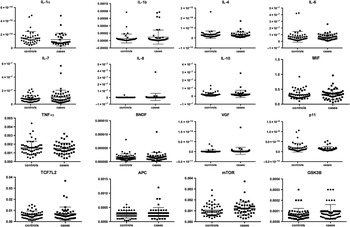
Case and control-grouped gene expression levels are shown in Figure 1. No group-level differences were found between genes belonging to the inflammation or neurotrophic pathways, while a statistically significant difference was found for GSK3B (p = 0.048), a member of the canonical Wnt signaling pathway.
Gene expression of all subjects by group. All 16 genes are accommodated according to their biological pathway (inflammation, neurotrophism, and canonical Wnt signaling).

Linear regression modelling did not show an influence of age, gender or BMI on gene expression levels, except for a small effect of age on IL1A (R2 = 0.081, p = 0.017) and IL6 (R2 = 0.107, p = 0.001) expression. TCF7L2 (r = 0.297, p = 0.036) and IL6 (r = 0.421, p = 0.004) showed a positive correlation with self-esteem as measured by the RSES. TCF7L2 showed a negative correlation with the total vulnerability score of the CSQ-SF (r = −0.296, p = 0.037). IL8 (r = 0.355, p = 0.011) had a positive correlation with cognitive complaints assessed by the BC-CCI, while MIF (r = −0.295, p = 0.04) and TCF7L2 (r = −0.284, p = 0.045) showed negative correlations with the same scale. Complete correlation results are shown in Supplementary Table 1.
Discussion
In this study, we tested the blood gene expression of 16 genes from 3 different biological pathways, namely key members of inflammation, synaptic plasticity and neurotrophism pathways, and the canonical Wnt signaling pathway. We compared 50 treatment-free depressed cases with 50 age and sex-matched mentally healthy controls of Mexican descent and found a statistically significant association of higher GSK3B expression levels in cases versus controls. Additionally, when testing for correlations between gene expression and traits associated with MDD, TCF7L2 showed the highest number of significant correlations, positive with self-esteem, and negative with cognitive vulnerability and cognitive complaints – yet they were of modest size and the p-values are only normal since they were not corrected for multiple comparisons. To our knowledge, this study is not only the first Latino population study of gene expression in major depression but also the first study to explore Wnt signaling members as candidate gene expression biomarkers of MDD. Finally, and again to our knowledge, as the first study to explore gene expression correlations between gene expression levels and cognitive traits related to MDD, it provides interesting hypothesis-generating results.
The canonical Wnt signaling pathway has a key role in the regulation of neurogenesis and synaptic plasticity; moreover, several members of this pathway have been involved in mood disorders and their treatment (Inkster et al., Reference Inkster, Zai, Lewis and Miskowiak2018).Glycogen synthase kinase-3 beta (GSK3B) is an inactivator of the canonical Wnt signaling pathway and also has a role in other pathways related to neuronal development and function. It is a multifunctional serine/threonine protein kinase that contributes to diverse cell functions, including gene expression, neurogenesis, neuroplasticity, cell survival, differentiation, migration, stress responses, and apoptosis, in the immune system, neurotransmitter systems, metabolism, and other functions (Hur and Zhou, Reference Hur and Zhou2010; Valvezan and Klein, Reference Valvezan and Klein2012). GSK-3B has been found to mediate depressive symptoms in a chronic stress mouse model (Peng et al., Reference Peng, Wang, Wang, Zhou, Li and Tan2018), and its inhibition has been shown to produce antidepressant-like effects in other animal models of depression (Gould et al., Reference Gould, Einat, Bhat and Manji2004; Kaidanovich-Beilin et al., Reference Kaidanovich-Beilin, Milman, Weizman, Pick and Eldar-Finkelman2004). Variation in grey matter volume in the hippocampus and superior temporal gyrus of depressed subjects has been associated with GSK3B polymorphisms (Inkster et al., Reference Inkster, Nichols, Saemann, Auer, Holsboer, Muglia and Matthews2009), and, in a post-mortem study of 20 depressed and 20 non-depressed subjects, Karege and collaborators found significant differences in protein levels of GSK-3B and β-catenin (Karege et al., Reference Karege, Perroud, Burkhardt, Fernandez, Ballmann, La Harpe and Malafosse2012). A similar study in post-mortem brains of BD and schizophrenia subjects showed statistically significant differences in protein and gene expression levels of GSK3B and β-catenin in bipolar versus controls, but not in the schizophrenia group (Pandey et al., Reference Pandey, Rizavi, Tripathi and Ren2015), suggesting a potential role in mood disorders. Moreover, BD and MDD can be treated with lithium, an agent that inhibits GSK3B as part of its mechanisms of action (Manji, Moore and Chen, Reference Manji, Moore and Chen2000; Valvezan and Klein, Reference Valvezan and Klein2012). Our findings are consistent with this thread, providing early evidence of differential gene expression of GSK3B in MDD.
TCF7L2 on the other hand encodes a transcription factor of the same name, downstream from the canonical Wnt signaling pathway (Saito-Diaz et al., Reference Saito-Diaz, Chen, Wang, Thorne, Wallace, Page-McCaw and Lee2013). Variants in this gene have been associated with type 2 diabetes risk (Manning et al., Reference Manning, Hivert, Scott, Grimsby, Bouatia-Naji, Chen, Rybin, Liu, Bielak, Prokopenko, Amin, Barnes, Cadby, Hottenga, Ingelsson, Jackson, Johnson, Kanoni, Ladenvall, Lagou, Lahti, Lecoeur, Liu, Martinez-Larrad, Montasser, Navarro, Perry, Rasmussen-Torvik, Salo, Sattar, Shungin, Strawbridge, Tanaka, van Duijn, An, de Andrade, Andrews, Aspelund, Atalay, Aulchenko, Balkau, Bandinelli, Beckmann, Beilby, Bellis, Bergman, Blangero, Boban, Boehnke, Boerwinkle, Bonnycastle, Boomsma, Borecki, Böttcher, Bouchard, Brunner, Budimir, Campbell, Carlson, Chines, Clarke, Collins, Corbatón-Anchuelo, Couper, de Faire, Dedoussis, Deloukas, Dimitriou, Egan, Eiriksdottir, Erdos, Eriksson, Eury, Ferrucci, Ford, Forouhi, Fox, Franzosi, Franks, Frayling, Froguel, Galan, de Geus, Gigante, Glazer, Goel, Groop, Gudnason, Hallmans, Hamsten, Hansson, Harris, Hayward, Heath, Hercberg, Hicks, Hingorani, Hofman, Hui, Hung, Jarvelin, Jhun, Johnson, Jukema, Jula, Kao, Kaprio, Kardia, Keinanen-Kiukaanniemi, Kivimaki, Kolcic, Kovacs, Kumari, Kuusisto, Kyvik, Laakso, Lakka, Lannfelt, Lathrop, Launer, Leander, Li, Lind, Lindstrom, Lobbens, Loos, Luan, Lyssenko, Mägi, Magnusson, Marmot, Meneton, Mohlke, Mooser, Morken, Miljkovic, Narisu, O’Connell, Ong, Oostra, Palmer, Palotie, Pankow, Peden, Pedersen, Pehlic, Peltonen, Penninx, Pericic, Perola, Perusse, Peyser, Polasek, Pramstaller, Province, Räikkönen, Rauramaa, Rehnberg, Rice, Rotter, Rudan, Ruokonen, Saaristo, Sabater-Lleal, Salomaa, Savage, Saxena, Schwarz, Seedorf, Sennblad, Serrano-Rios, Shuldiner, Sijbrands, Siscovick, Smit, Small, Smith, Smith, Stančáková, Stirrups, Stumvoll, Sun, Swift, Tönjes, Tuomilehto, Trompet, Uitterlinden, Uusitupa, Vikström, Vitart, Vohl, Voight, Vollenweider, Waeber, Waterworth, Watkins, Wheeler, Widen, Wild, Willems, Willemsen, Wilson, Witteman, Wright, Yaghootkar, Zelenika, Zemunik, Zgaga, Wareham, McCarthy, Barroso, Watanabe, Florez, Dupuis, Meigs and Langenberg2012) and to BD when accounting for obesity (Winham et al., Reference Winham, Cuellar-Barboza, Oliveros, McElroy, Crow, Colby, Choi, Chauhan, Frye and Biernacka2014; Cuellar-Barboza et al., Reference Cuellar-Barboza, Winham, McElroy, Geske, Jenkins, Colby, Prieto, Ryu, Cunningham, Frye and Biernacka2016). Associations of the expression of this gene and BMI or waist were not found in our sample, perhaps due to insufficient statistical power (Winham and Biernacka, Reference Winham and Biernacka2013). However, we found that TCF7L2 gene expression had the highest number of correlations with MDD-related traits, namely, it was positively correlated with self-esteem and negatively correlated with cognitive traits associated with MDD vulnerability (Chu et al., Reference Chu, Sun, Begum, Liu, Chang, Chiu, Chen, Tang, Yang, Lin, Chiu and Stewart2017; Mac Giollabhui et al., Reference Mac Giollabhui, Hamilton, Nielsen, Connolly, Stange, Varga, Burdette, Olino, Abramson and Alloy2018), which lends support to its biological role in neuroplasticity, neurogenesis, and brain patterning, among others (Kim and Snider, Reference Kim and Snider2011). Research on the canonical Wnt pathway in psychiatric conditions such as BD has shown that cellular lines derived from induced pluripotent stem cells from cases differ importantly in this pathway from those derived from mentally healthy controls (Madison et al., Reference Madison, Zhou, Nigam, Hussain, Barker, Nehme, Van Der Ven, Hsu, Wolf, Fleishman, O’Dushlaine, Rose, Chambert, Lau, Ahfeldt, Rueckert, Sheridan, Fass, Nemesh, Mullen, Daheron, McCarroll, Sklar, Perlis and Haggarty2015). However, its role in MDD has not been explored to the same extent, and our results support further investigation in this disorder. Our exploratory, hypothesis-generating analyses of MDD-related clinical measures and gene expression, reports parameters for the population our sample came from, Latinos of Mexican descent, and supports the merit of future longitudinal studies to establish directionality and gene–environmental interactions that may elucidate whether these cognitive traits predispose cells to an abnormal gene expression (or vice versa) and the mediator environmental factors that may contribute to this effect.
Despite the evidence supporting the role of inflammatory pathways as molecular pathways involved in MDD, conflicting evidence on the role of baseline gene expression of these markers in MDD has emerged (Tsao et al., Reference Tsao, Lin, Chen, Bai and Wu2006; Wright et al., Reference Wright, Sullivan, Brooks, Zou, Sun, Xia, Madar, Jansen, Chung, Zhou, Abdellaoui, Batista, Butler, Chen, Chen, D’Ambrosio, Gallins, Ha, Hottenga, Huang, Kattenberg, Kochar, Middeldorp, Qu, Shabalin, Tischfield, Todd, Tzeng, van Grootheest, Vink, Wang, Wang, Wang, Willemsen, Smit, de Geus, Yin, Penninx and Boomsma2014). Our study did not find differential expression of members of these pathways in MDD cases versus controls, a finding that may be due to a different ancestry from the European Americans recruited in previous investigations, to the limitation of candidate gene studies (Duncan, Ostacher and Ballon, Reference Duncan, Ostacher and Ballon2019), or to other factors. Jansen et al., for instance, did not find differential expression at baseline per se; however, when exploring these markers at the pathway level, they found positive associations for inflammation (Jansen et al., Reference Jansen, Penninx, Madar, Xia, Milaneschi, Hottenga, Hammerschlag, Beekman, van der Wee, Smit, Brooks, Tischfield, Posthuma, Schoevers, van Grootheest, Willemsen, de Geus, Boomsma, Wright, Zou, Sun and Sullivan2016). Our limited number of investigated genes and our sample size prevent from attempting this sort of analysis.
There are several limitations to our study. First, its cross-sectional design hinders our ability to understand the directionality of its results. Second, we used whole blood analysis of gene expression, and several of the genes in this study (such as GSK3B) are differentially expressed in whole blood (median Transcripts Per Million (TPM) = 9.340) when compared to other tissues and organs, and these determinations are not necessarily correlated with their level of expression in the brain (Ciobanu et al., Reference Ciobanu, Sachdev, Trollor, Reppermund, Thalamuthu, Mather, Cohen-Woods and Baune2016). Specifically, certain brain tissues have a particularly high median TPM values, including the cerebellar hemispheres (median TPM = 37.42), the frontal cortex (median TPM = 25.49), and the hypothalamus (median TPM = 17.17) (Data Source: GTEx Analysis Release V7). Even though the statistical analysis of group-level gene expression differences shows a nominally significant difference for one of the genes analysed, we must be cautious when interpreting these data since no multiple testing corrections were made. Testing for the expression of these genes in other tissues and a larger sample size seems warranted. Finally, the dearth of similar studies in Latino populations hinder our capacity to compare our results with previous literature.
It is also important that there is noticeable variability in the methodology for the quantification of gene expression in studies of psychiatric samples published over the last 2 years. When considering only studies that reported their method of gene expression quantification, the most commonly used method was the comparative 2-ΔΔCt method, but there were variations in the data normalisation process: use of one reference gene (Amidfar et al., Reference Amidfar, Kim, Colic, Arbabi, Mobaraki, Hassanzadeh and Walter2017; Bobińska, Gałecka, et al., Reference Bobińska, Gałecka, Szemraj, Gałecki and Talarowska2017; Bobińska, Mossakowska-Wójcik, et al., Reference Bobińska, Mossakowska-Wójcik, Szemraj, Gałecki, Zajączkowska and Talarowska2017; Liu et al., Reference Liu, Zhang, Shugart, Yang, Li, Liu, Sun, Yang, Guo, Shi, Wang, Cheng, Zhang, Yang and Xu2017; Yang et al., Reference Yang, Hu, Li, Wang, Wang, Yuan, Wang, Hong, Lu, Cao, Chen, Wang, Yu, Zhou, Yi and Fang2017; Fries et al., Reference Fries, Colpo, Monroy-Jaramillo, Zhao, Zhao, Arnold, Bowden and Walss-Bass2017; Gałecka et al., Reference Gałecka, Kumor-Kisielewska, Orzechowska, Maes, Górski and Szemraj2017, Reference Gałecka, Talarowska, Maes, Su, Górski, Kumor-Kisielewska and Szemraj2018; Ghafelehbashi et al., Reference Ghafelehbashi, Pahlevan Kakhki, Kular, Moghbelinejad and Ghafelehbashi2017; Hoseth et al., Reference Hoseth, Ueland, Dieset, Birnbaum, Shin, Kleinman, Hyde, Mørch, Hope, Lekva, Abraityte, Michelsen, Melle, Westlye, Ueland, Djurovic, Aukrust, Weinberger and Andreassen2017; Hung et al., Reference Hung, Lin, Kang and Huang2017; Akcan et al., Reference Akcan, Karabulut, İsmail Küçükali, Çakır and Tüzün2018; Sao et al., Reference Sao, Yoshino, Yamazaki, Ozaki, Mori, Ochi, Yoshida, Mori, Iga and Ueno2018), relativity to their own endogenous control (Doolin et al., Reference Doolin, Farrell, Tozzi, Harkin, Frodl and O’Keane2017), two reference genes (Roy et al., Reference Roy, Shelton and Dwivedi2017), and geometric mean of two reference genes (Chau et al., Reference Chau, Mostaid, Cropley, McGorry, Pantelis, Bousman and Everall2018). This source of variability may difficult the interpretation (and comparison) of the results of gene expression studies of psychiatric conditions; moreover, it impedes the realisation of meta-analysis.
Important strengths of this study include the originality of the selected pathways. The inclusion of cases that had been treatment-free for at least 6 months – which is substantially larger than most gene expression studies of MDD – therefore, avoiding the potentially confounding effect of antidepressants, in addition to a clinical phenotype rigorously evaluated by a board-certified psychiatrist with expertise in mood disorders, help to avoid important sources of heterogeneity (Kendler et al., Reference Kendler, Aggen and Neale2013). Another contribution lies in the fact that it is the first exploration of the relationship between cognitive MDD-related traits and gene expression. Finally, the inclusion of Latino subjects adds ancestry diversity to existing studies in the field, fomenting one of the genetics’ current priorities (Hindorff et al., Reference Hindorff, Bonham, Brody, Ginoza, Hutter, Manolio and Green2018).
As the validation of biomarkers increases in consistency, calibration, and ability to discriminate between disease and treatment states, the confidence in diagnostic tools derived from them will also increase (Perlis, Reference Perlis2011), and as such the possibility to develop personalised treatment and finally, primary and secondary prevention strategies. It will be vital to avoid bias and overestimation through a more rigorous systematisation of future studies
Authors contributions
ABCB directed the project. ABCB, IPRS, LEM, and MIR participated in the conception and design of the study. ABCB, JASR, and SG conducted candidate interviews and ABCB conducted structured clinical interviews. GC, JL, and MIR performed the gene expression analysis from the samples. ABCB and JASR performed follow-up of subjects. JASR and SG performed database upkeep. ABCB, JASR, IPRS, SG, GC, JL, and MIR conducted analysis of data and participated in monthly meetings to discuss preliminary results. ABCB, JASR, SG, and MIR drafted the manuscript with contributions from GC, ACE, and JL. IPRS and ACE provided critical feedback and helped to shape the manuscript.
Supplementary material
To view supplementary material for this article, please visit https://doi.org/10.1017/neu.2020.5
Acknowledgements
The Genotype-Tissue Expression (GTEx) Project was supported by the Common Fund of the Office of the Director of the National Institutes of Health, and by NCI, NHGRI, NHLBI, NIDA, NIMH, and NINDS. The data used for the comparisons described in this manuscript were obtained from the GTEx Portal on 05/26/2019 and dbGaP accession number phs000424.v7.p2 on 30/06/2017.
Participation of ACE was made possible by CONACYT CB-252996 grant.
Financial support
This study was performed with the funding provided by the Project No. 272616 of the Sectoral Fund of Research in Health and Social Security SS/IMSS/ISSSTE of the National Council of Science and Technology (CONACYT).
Statement of interest
None.
Conflicts of interest
None.