Preserving the sterility of packaged items after steam sterilization relies on maintaining the barrier integrity of the material within which the items are packaged. Permeation of the wrapping or packaging may allow airborne particles to ingress and contaminate the package contents. Good sterilization practices therefore universally recommend discarding items containing residual moisture that may facilitate microbial contamination after sterilization. 1 – Reference Spry 3 In this study, we assessed the impact of residual moisture on microbial contamination of surgical instruments after steam sterilization in 2 commonly used types of packaging.
METHODS
The study method was adapted from previously reported studies exploiting the high microbial binding properties of penicylinder porcelain carriers.Reference Bruna, Pinto and Graziano 4 , 5
Packages were prepared in (1) reusable sterilization containers (Aesculap 600 mm×300 mm×140 mm; B. Braun Medical Melsungen AG, Melsungen, Germany) incorporating appropriate quality disposable paper filters 6 and (2) double-layer nonwoven sterilization wrap (Halyard Kimguard One-Step H400; Halyard Health, Roswell, GA, USA). Test and positive control packages comprised 3 polypropylene trays, each carrying a surgical instrument set together with 5 porcelain carriers (CeramTec Ceramic, Laurens, SC, USA). The respective positive controls were a container without a paper filter and a double-wrapped package perforated in 5 places immediately after sterilization. For the negative control, 5 porcelain carriers were sealed in a plastic pouch.
Packages were prepared in batches of 6 tests plus 1 positive control and 1 negative control and were then steam sterilized (135°C, 18 minutes, 1-minute drying phase; Getinge HS66; Getinge Infection Control, Getinge, Sweden). After sterilization, packages were stored at 23°C±1°C and 45% relative humidity in the routine stock store. Separate batches were stored for 0, 1, 3, 7, and 14 days, respectively. The inclusion of 30 samples per packaging type achieved the minimum number necessary for a between-group statistical comparison. After storage a single, randomly selected test package and the 2 control packages per batch were evaluated for residual water and potential microbial contamination. Residual water was measured by package weight before and after sterilization.
Assessment of Potential Microbial Contamination
After storage, packages were opened aseptically under laminar airflow. The 5 porcelain carriers from each polypropylene tray were then added to 10 mL trypticase soy broth (TSB) in a glass tube. For each package, 1 mL pooled residual water (if present) was used to inoculate 10 mL TSB in a glass tube. Culture tubes were incubated at 35°C±1°C and visually inspected after 0, 2, 5, 10, and 14 days for the presence of turbidity, which was interpreted as microbial contamination.
Airborne Microbial Contamination
Aerobiocontamination of the store area was measured at the end of 1, 7, and 14 days of storage using a commercial impactor air sampler (Air Ideal 3P; bioMérieux, Durham, NC, USA). The air was sampled at 100 L/min for 10 min using 100-mm culture media plates of Sabouraud agar for yeast and microscopic fungi and trypticase soy agar for bacteria.
For microbial contaminants of package contents and aerobiocontaminants, microbial species were identified using colonial morphology, staining, and growth characteristics.
RESULTS
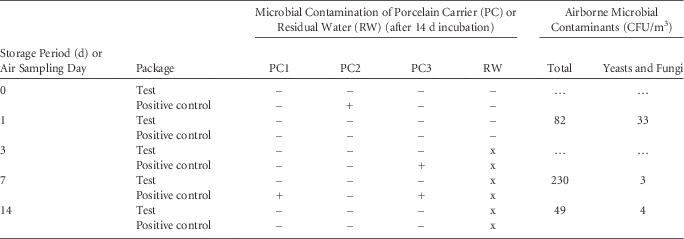
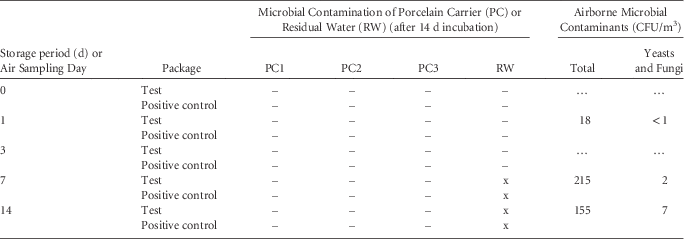
The overall mean (range) residual water volume obtained after sterilization was 31 mL for containers (range, 24–39 mL) and 37.7 mL (range, 30–44 mL) for double-wrapped packages. Residual water was present in container packages on day 0 and day 1, but culture samples showed no contamination of residual water or of porcelain carriers on either day (Table 1). After 3 days of storage, container packages contained no residual water. Samples from positive controls of containers confirmed contamination of the contents after 0, 3 and 7 days storage, although positive controls stored for 1 day and 14 days appeared to remain sterile. Negative controls were sterile, regardless of the duration of storage. Double-wrapped packages contained residual water after 0, 1, and 3 days of storage but were dry after 7 days (Table 2). All porcelain carrier and residual water samples from double-wrapped packages, including the positive and negative controls, were culture-negative.
Microbial Contamination from Porcelain Carriers and Residual Water in Sample Test and Positive Control Container Packages Stored for up to 14 days after Steam Sterilization and in Air Samples from Package Storage Area on Selected Days

NOTE. +, positive culture; –, negative culture; x, no residual water recovered; CNS, coagulase-negative Staphylococcus; PC1–PC3, porcelain carriers from polypropylene tray 1, 2, and 3, respectively; RW, 1 mL sample of pooled residual water.
Microbial Contamination from Porcelain Carriers and Residual Water in Sample Test and Positive Control Double-Wrapped Packages Stored for up to 14 days after Steam Sterilization and in Air Samples from Package Storage Area on Selected Days

NOTE. +, positive culture; –, negative culture; x, no residual water recovered; CNS, coagulase-negative Staphylococcus; PC1–PC3, porcelain carriers from polypropylene tray 1, 2, and 3, respectively; RW, 1 mL sample of pooled residual water.
Contaminants cultured in TSB from porcelain carriers or residual water were invariably identified as coagulase-negative staphylococci (CNS). Air sampling of the stock store area found total airborne contaminants of 18–230 CFU/m3. The most frequently isolated airborne contaminants were CNS and Micrococcus bacterial spp., while common fungal contaminants included Alternaria, Aspergillus, Cladosporium, and Penicillium species.
DISCUSSION
The results of this study showed that both reusable containers and double-layer nonwoven sterilization wrap contained residual water immediately after sterilization, with volumes of residual water near to tolerance limits set by the European norm EN 285. 7 Residual water was also recovered during early storage. Despite the presence of residual moisture, all such packages showed no evidence of post-sterilization contamination, either in residual water or on porcelain carriers. While positive controls of container packages were generally (after 0, 3, and 7 days storage) contaminated as expected, positive controls for double-wrapped packages were, surprisingly, culture-negative. Air quality in the sterilizer area was managed to ISO Class 8 standard and the absence of contamination in these positive control packages might reflect the favorably low microbial concentrations in the environment in which sterilized packages are vulnerable to contamination during cooling. Regular air monitoring measurements confirmed that the test packages had been exposed to a relatively stable concentration of airborne microbes during storage.
This small study has limitations. We noted variability within some of our findings. For example, some control packages had microbial contaminants on ≥1 porcelain carrier cultures (from separate polypropylene trays) but yielded sterile residual water, which had been pooled from the 3 trays within the same package. This result may reflect the low number of contaminants entering the package, or it might reflect the limitations of the test method. Other approaches, such as the use of a higher test inoculum, the inclusion of nutrient media within the packages, and the use of a wider range of culture media and conditions are likely to have increased recovery of contaminants from both test samples and positive controls compared with the method used. While our approach closely simulated “real-world” routine steam sterilization, it would have been unethical to subsequently use the surgical instruments in surgical procedures.
The outcome examined in this study was the presence or absence of contamination rather than the scale of reduction of contamination or the barrier effectiveness of the packaging. The results showed no evidence of contamination and no difference between the 2 types of packaging (obviating between-group comparison). However, confirmation that any item is sterile can only be defined in terms of probability; 10−6 is an established minimum acceptable sterility assurance level.Reference Dunkelberg and Schmelz 8 Demonstrating sterility with good statistical confidence was beyond the scope of this investigation. Follow-up studies could use a larger number of samples, as specified for the standard assessment of sporicidal agents. 5
In conclusion, the results of this study suggest that wet packs/loads remain uncontaminated during subsequent storage and are thus suitable for use. Further studies are needed and, until these results are confirmed, the sterilization of items for medical use should comply with current guidelines.
Acknowledgments
Financial support. No financial support was provided relevant to this article.
Potential conflicts of interest. All authors report no conflicts of interest. All authors submitted the ICMJE Form for Disclosure of Potential Conflicts of Interest, and the conflicts that the editors consider relevant to this article are disclosed here.