Highlights
Description of new Neodiplostomum parasite species found in Patagonian birds.
Species identity confirmed by morphological and genetic analysis (28S and cox1).
Insights into Neodiplostomum diversity in Argentina.
First molecular data for Neodiplostomum species infecting birds in Argentina.
First record of Neodiplostomum species in Patagonia.
Introduction
Neodiplostomum Railliet, 1919 was erected as a genus to include parasites of birds, mainly those recovered from Falconiformes and Strigiformes. A closely morphologically related genus, Fibricola Dubois, 1932, was established to accommodate parasites that use mammals as definitive hosts. The morphological characteristics of these genera are highly similar (Niewiadomska Reference Niewiadomska2002); Fibricola was recently synonymised with Neodiplostomum and is now considered a junior synonym, based on molecular analysis (Achatz et al Reference Achatz, Pulis, Woodyard, Rosser, Martens, Weinstein, Fecchio, McAllister, Carrión Bonilla and Tkach2022). These authors also pointed out that the genus Neodiplostomum comprises two clades within a larger polytomy, indicating the non-monophyly of species traditionally assigned to this genus (Achatz et al Reference Achatz, Pulis, Woodyard, Rosser, Martens, Weinstein, Fecchio, McAllister, Carrión Bonilla and Tkach2022; Achatz and Tkach Reference Achatz and Tkach2025; Heneberg et al Reference Heneberg, Sitko and Těšínský2020).
In the Americas, 26 Neodiplostomum species obtained from birds and mammals have been morphologically described, but sequences are available for seven species (Achatz et al Reference Achatz, Pulis, Woodyard, Rosser, Martens, Weinstein, Fecchio, McAllister, Carrión Bonilla and Tkach2022; Achatz and Tkach Reference Achatz and Tkach2025). Knowledge of this genus is scarce in South America: 15 species have been described, but 2 sequences reported, corresponding to Neodiplostomum vaucheri Dubois, Reference Dubois1983 (Ecuador and Perú) and Neodiplostomum microcotyle Dubois, 1937 (Brazil) (Achatz et al Reference Achatz, Pulis, Woodyard, Rosser, Martens, Weinstein, Fecchio, McAllister, Carrión Bonilla and Tkach2022; Cacique et al Reference Cacique, Barriga, Bello, Pino, Salcedo-Mejía, Ñacari, Cruces, Mondragón-Martínez and Chero2025). In the northeastern region of Argentina, Neodiplostomum travassosi Dubois, 1937 has been described from adult morphology, parasitising Caracara plancus Miller, 1777 (ex Polyborus plancus), Nannopterum brasilianum (Gmelin 1789) (ex Phalacrocorax brasilianus Telfair and Morrison, Reference Telfair, Morrison, Rodewald and Keeney2022) (Lunaschi and Drago Reference Lunaschi and Drago2005), and Buteogallus meridionalis (Latham 1790) (Drago et al Reference Drago, Lunaschi and Draghi2014, Reference Drago, Lunaschi, Cabrera and Barbieri2015). Another species obtained from Nannopterum brasilianum was named as Neodiplostomum sp. (Ostrowski de Núñez Reference Ostrowski de Núñez1970) and later assigned to Posthodiplostomum obesum (Lutz 1928) Dubois, Reference Dubois1977 (Dubois Reference Dubois1977).
Considering the limited knowledge of Neodiplostomum species in South America, particularly in Argentina, we aim to morphologically and molecularly describe specimens of Neodiplostomum sp. obtained from Falco sparverius Linnaeus, 1758, Accipiter bicolor Philippi & Landbeck, 1864, Caracara plancus, and Strix rufipes King, 1828 from Argentine Patagonia.
Materials and methods
Sample collection and morphological identification
A total of 18 birds, belonging to 5 species, were analysed. The samples were obtained from necropsies of dead birds found between 2001 and 2025 in Northwestern Patagonia, Argentina (Table 1, Figure 1). Under a stereomicroscope, helminth presence was determined through examination of the intestines of the following birds: F. sparverius (Falconidae), C. plancus (Falconidae), A. bicolor (Accipitridae), Bubo magellanicus (Gmelin 1788) (Strigidae), and S. rufipes (Strigidae). All adult worms were dead when found; they were counted, then fixed for morphological and molecular studies. Specimens fixed in 5% formaldehyde solution were stained with Langeron stain, mounted, and measured under bright-field microscopy. Specimens were drawn using a camera lucida. All measurements are given in micrometres. Some specimens were selected and fixed in 96% ethanol for DNA isolation and sequencing. In the case of Neodiplostomum sp. 1, the two entire worms were used for molecular analysis after being examined and photographed. Type specimens were deposited in the Colección de Parasitología of the Museo Argentino de Ciencias Naturales ‘Bernardino Rivadavia’ (MACN-Pa), and in the Colección Parasitológica de la Universidad Nacional del Comahue, Bariloche, Argentina (UNCo-Pa).
Data for the examined birds, and infection status

Map showing collection localities of analysed bird samples. Symbols of different colours indicate host species, and numbers alongside represent sample sizes.

Molecular analysis
Genomic DNA was extracted from individual worms obtained from C. plancus, F. sparverius, A. bicolor, and S. rufipes using the DNeasy Blood & Tissue kit (QIAGEN) and following the manufacturer’s instructions. Parasite DNA amplification was performed using the mitochondrial marker cytochrome oxidase 1 (cox1) and nuclear 28S rDNA fragments. To amplify cox1, we used the primer Plat-diploCOX (5′-CGTTTTTRAATTATATACGGATCC-3′) combined with Plat-diploCOXR (5′-AGCATAGTAATMGCAGCAGC-3′) (Moszczynska et al Reference Moszczynska, Locke, McLaughlin, Marcogliese and Crease2009), and for the 28S ribosomal DNA, the primers dig12 (5′-AAGCATATATCACTAAGCGG-3′) with 1500R (5′-GCTATCCTGAGGAGGGAAACTTCG-3′) (Tkach et al Reference Tkach, Littlewood, Olson, Kinsella and Swiderski2003). The PCR reaction was optimised for 2 μL (2.7 ng/μL) of DNA: 1.25 μL of MgCl2 (50 mM), 1 μL of dNTPs (10 μM), 2.5 μL PCR Buffer (10X), 1 μL for cox1 and 0.5 μL for 28S of each primer (10 μM), 1 U of Taq DNA polymerase (Platinum Taq, Invitrogen), to a final volume of 25 μL. The PCR was performed under the following conditions: initial denaturation at 95°C for 2 min followed by 40 cycles of denaturation at 94°C for 40 s, annealing at 49°C for 45 s for cox1 and 55°C for the 28S region, and extension at 72°C for 45 s; a final extension was carried out at 72°C for 5 min. Visualisation of the amplified products was achieved by electrophoresis on 1.5% agarose gel, staining with ECO-Gel (Inbio Highway), and observation under UV light. The amplified products were sent to Macrogen (Korea) for bidirectional Sanger sequencing using the primers used for PCR amplification. Sequence reads were assembled using AliView 1.28 software (Larsson Reference Larsson2014) to evaluate overlap, and chromatograms were manually reviewed using SnapGene Viewer 7.2.1 to confirm sequence quality and resolve any ambiguities.
Phylogenetic analysis
The obtained sequences were compared with other diplostomid sequences available in GenBank. To explore the position of the newly obtained Neodiplostomum sequences from Patagonian birds and to assess their relationships with other representatives of the family Diplostomidae, we selected reference sequences from GenBank that had been published in phylogenetic studies of Neodiplostomum (Achatz et al Reference Achatz, Pulis, Woodyard, Rosser, Martens, Weinstein, Fecchio, McAllister, Carrión Bonilla and Tkach2022; Woodyard et al Reference Woodyard, Rosser and Griffin2017) and had similar sequence lengths to those generated in this study. Alignment of the sequences was performed using the MUSCLE algorithm in AliView 1.28 software (Larsson Reference Larsson2014). The best-fitting nucleotide substitution model for 28S and cox1 was GTR+G+I, as estimated using jModelTest 2.1.10 (Posada Reference Posada2008). Suchocyathocotyle crocodili (Yamaguti 1954) was selected as the outgroup for the 28S analysis based on the topology presented by Achatz et al (Reference Achatz, Pulis, Junker, Tran, Snyder and Tkach2019) and Hysteromorpha triloba (Rudolphi 1819) Lutz, 1931 for cox1 (Locke et al Reference Locke, Van Dam, Caffara, Pinto, Lopez-Hernandez and Blanar2018). Phylogenetic analyses were reconstructed through Bayesian inference (BI) using MrBayes 3.2 (Ronquist et al Reference Ronquist, Teslenko, van der Mark, Ayres, Darling, Höhna, Larget, Liu, Suchard and Huelsenbeck2012). BI phylogenetic trees were constructed with 2 runs of the Markov Chain Monte Carlo (MCMC) for 3,000,000 generations, sampling every 1,000 generations and discarding as burn-in the first 25% of the sampled trees. Genetic pairwise distances between taxa were estimated using p-distance included in MEGA 11.0.13 (Tamura et al Reference Tamura, Stecher and Kumar2021).
Results
Neodiplostomum sparverius n. sp. Martinez, Flores, and Viozzi (Figure 2).
Neodiplostomum sparverius n. sp. from Falco sparverius. A. Drawing of ovigerous specimen. B. Bright-field microphotograph of ovigerous specimen. AT, Anterior testis; CA, Caeca; EG, eggs; GA, Genital atrium; HO, Holdfast organ; MG, Mehlis’ gland; OE, Oesophagus; OS, Oral sucker; OV, Ovary; PH, Pharynx; PT, Posterior testis; VG, Vitelline glands; VR, Vitelline reservoir; VS, Ventral sucker.

Taxonomic summary
Type host: Falco sparverius (Aves: Falconiformes: Falconidae).
Prevalence: 1 of 2.
Intensity: 46.
Type locality: Villa Los Coihues (41°09′08″S, 71°24′54″W).
Ovigerous worms: 3 of 46.
Site of infection: Intestine.
Specimens deposited: holotype (MACN-Pa 818); one paratype (MACN-Pa 819) and 3 immature specimens (MACN-Pa 820 - 822). One paratypes (UNCo_Pa No. 250/1, and 9 immature specimens (UNCo_Pa No. 251/1-9).
Representative sequences: GenBank PX990746 - PX990750 (cox1); PX984686 - PX984690 (28S rDNA).
Etymology: The species name refers to the specific epithet of the definitive host.
Description
Measurements were obtained from 3 ovigerous worms, stained and mounted specimens from F. sparverius. Body distinctly bipartite, pseudosuckers absent, total length 2,125–2,450; anterior segment elliptical to lanceolate 1,250 × 450; posterior segment cylindrical to oval, 875–1,200 × 400–575. Body ratio posterior segment to anterior segment 0.7–0.96. Oral sucker oval, 51 × 51–71. Ventral sucker round, 61–71 diameter. Ventral sucker located from the anterior end at 465–505, representing 37–41% from anterior segment length. Ratio of oral sucker length to ventral sucker length 0.71–0.83. Holdfast organ well developed, oval, with a median slit 434–606 × 222–252. Distance from posterior border of ventral sucker to anterior border of holdfast organ, 12–38. Prepharynx absent. Pharynx 61–81 × 51–71. Oesophagus 40–63, caeca extension not observed. Testes tandem, anterior testis 175–225 × 434–454; posterior testis 163–225 × 404. Ovary pretesticular intersegmentary, elliptical to reniform 63–100 × 113–163. Vitelline follicles initiate at 10–14% of the anterior segment border, reaching caecal bifurcation, terminating in the postesticular space in posterior segment, ventrally forming a distinct inverted ‘Y’-shaped pattern crossing over the midpoint between the two testes. Vitelline reservoir median, between testes. Mehlis’ gland located between testes on the left 75–100 × 88–125. Eggs elliptical 88–95 × 50–65. Genital atrium postesticular occupying less than a quarter of the posterior segment, 150–158 × 163.
Remarks
The specimens of F. sparverius collected in Patagonia have a larger body size than the other species from the Americas. This new species parasitises falconiform birds and can be differentiated from Neodiplostomum cratera (Barker and Noll in Barker 1915) Pearson, 1961, Neodiplostomum lucidum La Rue & Bosma, Reference La Rue and Bosma1927, and Neodiplostomum vaucheri Dubois, Reference Dubois1983 in that they parasitise mammals: the first two parasitise cricetids, mustelids, procyonids, mephytids, and marsupials, among others, while the last-mentioned parasitises bats (Achatz et al Reference Achatz, Pulis, Woodyard, Rosser, Martens, Weinstein, Fecchio, McAllister, Carrión Bonilla and Tkach2022; Cacique et al Reference Cacique, Barriga, Bello, Pino, Salcedo-Mejía, Ñacari, Cruces, Mondragón-Martínez and Chero2025; Dubois Reference Dubois1970). In addition, N. sparverius n. sp. has a smaller oral sucker and a bigger holdfast organ than the other species mentioned (Dubois Reference Dubois1983; Dubois and Rausch Reference Dubois and Rausch1950; La Rue and Bosma Reference La Rue and Bosma1927; Read Reference Read1948; Ulmer Reference Ulmer1955). The species parasitising mammals also have a restricted distribution of the vitelline glands, which extend in the anterior segment to the ventral sucker and in the posterior segment to the anterior edge of the genital atrium at most, whereas in the new species they extend to the caecal bifurcation in the anterior segment and to the posterior edge of the body.
Neodiplostomum sparverius n. sp. differs from other species that parasitise American birds in that it has a larger body than most, with the exception of Neodiplostomum reflexum Chandler & Rausch, Reference Chandler and Rausch1947 (Chandler and Rausch Reference Chandler and Rausch1947; Gallas and Fraga da Silveira Reference Gallas and Fraga da Silveira2013). The new species differs from N. reflexum, which has a larger body size and different segment ratio (N. reflexum 0.5 versus N. sparverius n. sp.: 0.7–0.96). Neodiplostomum reflexum also has a larger ventral sucker than the new species (92–130 versus 61–71), a smaller holdfast organ (285–590 versus 434–606), and vitelline glands beginning at the level of the ventral sucker (Chandler and Rausch Reference Chandler and Rausch1947; Gallas and Fraga da Silveira Reference Gallas and Fraga da Silveira2013).
In Neodiplostomum americanum Chandler & Rausch, Reference Chandler and Rausch1947; Neodiplostomum accipitris Dubois & Rausch, 1948; Neodiplostomum conicum Dubois, 1937; Neodiplostomum microcotyle Dubois, 1937; and N. travassosi (syn. N. rhamphasti), the posterior segment is much smaller than the anterior one, with a ratio that varies between 0.39 and 0.70, whereas values for the new species lie between 0.7 and 0.96. In addition, these species have a much smaller holdfast organ, which is located at greater distances from the ventral sucker than in specimens of N. sparverius n. sp.; also, the beginning of the anterior limit of the vitelline glands is posterior in the other species (14–44% with respect to the anterior segment), while in the new species it is 10–14% (12%) (Dubois Reference Dubois1970; Lunaschi and Drago Reference Lunaschi and Drago2005; Travassos et al Reference Travassos, Freitas and Kohn1969).
Neodiplostomum sparverius n. sp. resembles other species which parasitise birds (Neodiplostomum banghami Penrod, Reference Penrod1947, Neodiplostomum biovatum Dubois, 1937, Neodiplostomum ellipticum (Brandes 1888) La Rue, 1926, Neodiplostomum tamarini Dubois, 1966, Neodiplostomum fastigatum Dubois Reference Dubois1985, and Neodiplostomum isomegacotyle Dubois & Macko, Reference Dubois and Macko1972) in having a similar ratio between segments, but the new species differs in that the ventral sucker is located anteriorly (37–40% of the anterior segment) to the middle of the anterior body segment. Neodiplostomum banghami is the exception, its ventral sucker being in a position (33% of the anterior segment) similar to that of N. sparverius n. sp. In particular, the most marked difference between N. banghami and N. sparverius n. sp. is the distance between ventral sucker and holdfast organ (112–152 in N. banghami versus 13–38 in N. sparverius n. sp.), and egg size, which is larger in the former species (87–123 × 68–81) (Penrod, Reference Penrod1947) than in the new one (88–95 × 50–65).
Neodiplostomum ellipticum and N. tamarini differ from the new species by having a small circular holdfast organ. The vitelline glands also start much further back in these species, at a distance representing 25% of the anterior segment (Travassos et al., Reference Travassos, Freitas and Kohn1969), whereas in N. sparverius n. sp., they start near the caecal bifurcation. The new species can be distinguished from Neodiplostomum pitangi Dubois, Reference Dubois1985, which has a much longer posterior segment, representing a ratio of 1.4 between segments, a small circular holdfast organ with a diameter of 90, vitelline glands that begin near the ventral sucker, and small eggs measuring 78–84 × 50–52 (Dubois, Reference Dubois1985).
Neodiplostomum caracara n. sp. Martinez, Flores, and Viozzi. (Figure 3).
Neodiplostomum caracara n. sp. from Caracara plancus. A. Drawing of ovigerous specimen. B. Drawing of immature specimen. C. Bright-field microphotograph of ovigerous specimen. AT, Anterior testis; CA, Caeca; EG, eggs; GA, Genital atrium; HO, Holdfast organ; MG, Mehlis’ gland; OE, Oesophagus; OS, Oral sucker; OV, Ovary; PH, Pharynx; PT, Posterior testis; VG, Vitelline glands; VR, Vitelline reservoir; VS, Ventral sucker.

Taxonomic summary
Type host: Caracara plancus (Aves: Falconiformes: Falconidae).
Prevalence: 1 of 2.
Intensity: 13.
Type locality: Foyel (41°72′S, 71°45′W).
Ovigerous worms: 2 of 13.
Site of infection: Intestine.
Specimens deposited: holotype (MACN-Pa 823); one paratype (MACN-Pa 824) and two immature specimens (MACN-Pa 825 - 826). One immature (UNCo_Pa No. 252/1).
Etymology: The species name refers to the generic name of the definitive host.
Description
Measurements were obtained from 2 ovigerous, stained, and mounted specimens from C. plancus. Body distinctly bipartite, pseudosuckers absent, total length 2,325; anterior segment elliptical to lanceolate 1,425–1,500 × 425–525; posterior segment cylindrical to oval, 825–900 × 325–375. Body ratio posterior segment to anterior segment 0.55–0.63. Oral sucker round, 40–55 × 43–50. Ventral sucker round, 88–100 diameter. Ventral sucker located from the anterior end at 576–667, representing 40–44% from anterior segment length. Ratio of oral sucker length to ventral sucker length 0.46–0.55. Holdfast organ well developed, oval, with a median slit 404–505 × 202. Distance from posterior border of ventral sucker to anterior border of holdfast organ 150–175. Prepharynx absent. Pharynx 60–63 × 30–38. Oesophagus 70 long. Testes tandem, anterior testis 113–125 × 323; posterior testis 88–163 × 303–313. Ovary pretesticular intersegmentary, elliptical to reniform, 113–133 × 150–188. Vitelline follicles initiate at 25–30% of the anterior segment border midway between the level of the intestinal bifurcation and the ventral sucker, terminating in the postesticular space in the posterior segment, ventrally forming a distinct inverted ‘Y’-shaped pattern crossing over the midpoint between the two testes. Vitelline reservoir median, between testes. Mehlis’ gland located between testes on the left side, 65–88 × 65–80. Eggs elliptical 88–100 × 63–70. Genital atrium postesticular occupying the posterior third of the posterior segment in immature specimens, 130–150 × 150.
Remarks
The Neodiplostomum specimens collected from C. plancus, in general, have a larger body than the other South American species. The new species also parasitises a falconiform and is differentiated from N. cratera, N. lucidum, and N. vaucheri, which parasitise mammals, as already mentioned. Other differences between these species and N. caracara n. sp. are, for example: N. cratera has a smaller ventral sucker (88–100 N. caracara n. sp. versus 42–68) and holdfast organ (88–100 in diameter for N. cratera; 404–505 N. caracara n. sp.) (Ulmer Reference Ulmer1955). The new species is distinguished from N. lucidum by having a larger oral sucker (111 in diameter) and a smaller holdfast organ (217–448) (La Rue and Bosma Reference La Rue and Bosma1927). Finally, it is distinguished from N. vaucheri, which has a similar segment ratio (0.94), by the much longer anterior segment in N. caracara n. sp. (0.55–0.63). Furthermore, N. vaucheri has a smaller ventral sucker (85 in diameter) and holdfast organ (210), and a more restricted distribution of vitelline glands, which extend around only the ventral sucker in the anterior segment (Dubois Reference Dubois1983). The new species, N. caracara, differs from N. accipitris in which both suckers are larger (N. accipitris: OS 34–43; VS 53–64), and the ventral sucker is located in the middle of the anterior segment, whereas in N. caracara n. sp. the ventral sucker is anterior to the middle of the segment (Dubois Reference Dubois1958, Reference Dubois1970).
Specimens of N. reflexum, N. microcotyle, and N. americanum, whose suckers are of similar size, differ from N. caracara n. sp., which has a small oral sucker and a ventral sucker that is almost twice the size of the oral one. They also show differences in the distance between the ventral sucker and the holdfast organ: 45–65 in N. reflexum, 44–59 in N. microcotyle, 200–480 in N. americanum, and 150–175 in N. caracara n. sp. (Gallas and Fraga da Silveira Reference Gallas and Fraga da Silveira2013; Travassos et al Reference Travassos, Freitas and Kohn1969; Woodyard et al Reference Woodyard, Rosser and Griffin2017). Neodiplostomum caracara n. sp. differs from N. banghami, which has oral and ventral suckers of the same size, and the ventral sucker located in the first third of the anterior segment (Penrod Reference Penrod1947), whereas in N. caracara n. sp. the ventral sucker is located in the second third.
The specimens from C. plancus can be distinguished from N. fastigatum, whose anterior and posterior segments are similar in length (1.02–1.10), and whose suckers are both larger than those of N. caracara n. sp. (N. fastigatum OS: 120–145; VS: 80–100); furthermore, the ventral sucker is located closer to the holdfast organ (Dubois Reference Dubois1985) than in N. caracara n. sp. (150–175). Another difference is the extension of the vitelline glands in the anterior segment: in N. fastigatum they reach the ventral sucker (Dubois Reference Dubois1970, Reference Dubois1985), while in the specimens of this work they exceed the anterior edge of the ventral sucker, reaching halfway between the ventral sucker and the caecal bifurcation. Species with a long posterior segment compared to the anterior are N. biovatum, N. conicum, N. ellipticum, N. isomegacotyle, N. pitangi, and N. tamarini; all these species have a smaller holdfast organ than N. caracara n. sp. In general, these species have the ventral sucker located in the middle or behind the middle of the anterior body, whereas in N. caracara n. sp. it is located 40–44% of the anterior segment, anterior to the middle of this segment. All species have smaller suckers and smaller eggs than N. caracara n. sp. except for N. tamarini (OS: 78–115; VS: 73–94; egg: 112–120) and N. isomegacotyle (OS: 115; VS: 110; egg: 102–104) (Dubois Reference Dubois1985; Dubois and Macko Reference Dubois and Macko1972; Fischthal and Nasir Reference Fischthal and Nasir1974; Travassos et al Reference Travassos, Freitas and Kohn1969).
Neodiplostomum sp. 1 (Figure 4).
Neodiplostomum sp. 1. A. Bright-field microphotograph of an ovigerous specimen from Strix rufipes. B. Bright-field microphotograph of an ovigerous specimen from Accipiter bicolor (lacking the anterior end). AT, Anterior testis; CA, Caeca; EG, Egg; GA, Genital atrium; HO, Holdfast organ; OE, Oesophagus; OS, Oral sucker; OV, Ovary; PH, Pharynx; PT, Posterior testis; VG, Vitelline glands; VS, Ventral sucker.

Taxonomic summary
Host: Strix rufipes (Aves: Strigiformes: Strigidae).
Locality: Villa la Angostura (40°45′42″S, 71°38′41″W).
Prevalence: 1 of 12 (8.3%).
Intensity: 1.
Site of infection: Intestine.
Other definitive host: Accipiter bicolor (Aves: Accipitriformes: Accipitridae).
Other locality: Bariloche (41°08′S, 71°17′W).
Prevalence in A. bicolor: 1 of 1.
Intensity in A. bicolor: 1.
Site of infection: Intestine.
Representative sequences: GenBank PX990744-5 (cox1); PX984684-5 (28S rDNA).
Description
Measurements were obtained from 1 ovigerous unmounted specimen from S. rufipes, which was then used for molecular analysis. Body distinctly bipartite, pseudosuckers absent, total length 3,555; anterior segment elliptical with lateral margin incurved, 1,988 × 922; posterior segment oval, 1,060 × 632. Body ratio posterior segment to anterior segment, 0.53. Oral sucker 62 × 76 wide. Ventral sucker 45 × 61. Ventral sucker located from the anterior end at 1,058, representing 52% of the anterior segment length. Ratio of oral sucker length to ventral sucker length 1.4. Holdfast organ well developed, 416 × 319, oval with a median slit. Distance from posterior border of ventral sucker to anterior border of holdfast organ 258. Prepharynx 21 long. Pharynx 81 × 67. Testes tandem, anterior testis 222 × 434; posterior testis 180 × 389. Ovary in posterior segment 110 × 154. Vitelline glands commence at 34% of the anterior segment border, terminating in the postesticular space of the posterior segment. Eggs elliptical 73–99 × 52–57.
Remarks
When comparing the specimen obtained from S. rufipes, it is important to remember that it was not stained or mounted. This specimen is much larger than all other South American species, and has a smaller ventral sucker and a larger holdfast organ than the three species that parasitise mammals (N. cratera, N. lucidum, and N. vaucheri). These characteristics suggest that this could be a new species. Furthermore, Neodiplostomum sp. 1 differs from N. vaucheri, whose segments are of almost the same size; and larger suckers (OS: 65; VS: 62 in N. vaucheri versus OS: 85; VS: 45 in Neodiplostomum sp. 1). In addition, the extension of the vitelline glands in N. vaucheri is confined, not extending beyond the ventral sucker (Dubois, Reference Dubois1983), while in Neodiplostomum sp. 1 they begin at a distance from the anterior end, 34% of the anterior segment. Neodiplostomum sp. 1 also differs by having a smaller egg (73–99) than N. cratera (90–120) and N. lucidum (93–116) (La Rue and Bosma Reference La Rue and Bosma1927; Ulmer Reference Ulmer1955).
The specimen obtained from S. rufipes is similar to the species N. accipitris, N. americanum, N. banghami, N. microcotyle, N. travassosi, and N. reflexum in terms of a similar ratio between segments. However, Neodiplostomum sp. 1 differs from all the mentioned species in having the oral sucker larger than the ventral one, unlike these species. In addition, there are differences in the distance between the ventral sucker and the holdfast organ, which in N. americanum, N. banghami, N. microcotyle, N. travassosi, and N. reflexum is shorter than in the specimen obtained from S. rufipes; Neodiplostomum sp. 1 also differs from N. reflexum by having a longer distance between these organs. The extension of the vitelline glands also varies between species: in N. americanum (19–34%), N. banghami (after caecal bifurcation), N. travassosi (16–39%), and N. microcotyle (14–38%) they begin at a much shorter distance from the anterior end than in Neodiplostomum sp. 1, in which the vitellaria begin approximately at 34% of anterior segment length (Dubois and Macko Reference Dubois and Macko1972; Lunaschi and Drago Reference Lunaschi and Drago2005; Penrod Reference Penrod1947; Travassos et al Reference Travassos, Freitas and Kohn1969; Woodyard et al Reference Woodyard, Rosser and Griffin2017). The new species also differs from N. reflexum, whose vitelline glands begin around the ventral sucker (Chandler and Rausch Reference Chandler and Rausch1947; Gallas and Fraga da Silveira Reference Gallas and Fraga da Silveira2013).
The species N. biovatum, N. conicum, N. ellipticum, N. fastigatum, N. isomegacotyle, N. tamarini, and N. pitangi present a ratio of posterior to anterior segment of about 0.6–0.9, whereas in Neodiplostomum sp. 1 this ratio is 0.53. In general, these species have suckers of similar size, unlike the S. rufipes specimen, where the oral sucker is larger than the ventral one. All the species mentioned have a smaller holdfast organ than Neodiplostomum sp. 1, and a wider extension of the vitelline glands towards the anterior zone (Dubois Reference Dubois1985; Dubois and Macko Reference Dubois and Macko1972; Fischthal and Nasir Reference Fischthal and Nasir1974; Travassos et al Reference Travassos, Freitas and Kohn1969). These morphological characteristics enable us to hypothesise that the specimens belong to a distinct species from those previously described and those described in the present study. However, because of the absence of a physical specimen to designate as a holotype, it is not possible to formally define it as a new species under the International Code of Zoological Nomenclature.
Comparison between Argentine species
Finally, the Argentine species also differ from each other: N. sparverius n. sp. shows greater similarity in the length of its segments (ratio: 0.7–0.9) while the remaining species have a ratio of approximately 0.5. They also differ in the ratio between suckers: Neodiplostomum sp. 1 (1.4), N. sparverius n. sp. (0.71–0.83), N. caracara n. sp. (0.45–0.55), and N. travassosi (1.04) (Lunaschi and Drago Reference Lunaschi and Drago2005). In addition, N. travassosi has a very small holdfast organ compared to the other three species, whose size is relatively similar. Another marked difference is the distance between the ventral sucker and the holdfast organ, which in Neodiplostomum sp. 1 is 258, in N. sparverius n. sp. 13–38, and in N. caracara n. sp. 150–175, in this case falling within the range given for N. travassosi, 115–283 (Lunaschi and Drago Reference Lunaschi and Drago2005). The distribution of the vitelline glands also differs. In N. sparverius n. sp. the vitelline glands begin at the caecal bifurcation, at a distance from the anterior end of 10–14%, while in Neodiplostomum sp. 1 they begin at 34% of the distance from the anterior end, and in N. caracara n. sp. and N. travassosi the extension is the same, starting at a distance of 24–30%. Neodiplostomum caracara n. sp. can be differentiated from N. travassosi by its pointed anterior segment, since the latter species has a flattened one (see Figure 1 from Lunaschi and Drago Reference Lunaschi and Drago2005).
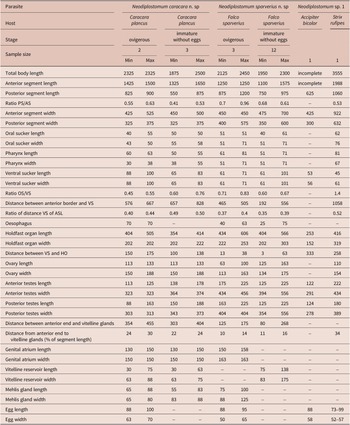
In both N. caracara n. sp. and N. sparverius n. sp., immature specimens without eggs reached total body lengths comparable to those of mature egg-bearing individuals (Table 2). Nevertheless, ovigerous individuals consistently showed higher posterior-to-anterior segment ratios than immature individuals. Reproductive organs such as the ovary, testes, vitellaria, and Mehlis’ gland were larger in ovigerous specimens. The attachment organs, including the holdfast and suckers, showed overlapping ranges between stages, indicating similar development in both immature and ovigerous forms.
Measurements (in microns) of ovigerous and immature specimens of Patagonian Neodiplostomum species

AS, Anterior segment; ASL, Anterior segment length; HO, Holdfast organ; OS, Oral sucker; PS, Posterior segment; VS, Ventral sucker.
Neodiplostomum sp. 1 from S. rufipes differs from N. caracara n. sp. in having a larger and more robust body (up to 3,600 versus 1,900–2,500), mainly due to a proportionally longer and wider anterior segment (up to 1,990 × 922). The vitelline glands in Neodiplostomum sp. 1 begin farther from the anterior extremity (34% of the segment length compared with 22–30% in N. caracara), and the distance between the anterior margin and the ventral sucker is considerably longer (1,058 versus 576–828). The ventral sucker in Neodiplostomum sp. 1 is smaller than the oral sucker, giving a much higher OS/VS ratio (1.4 versus 0.45–0.76 in N. caracara). The holdfast organ is larger and wider (253–416 × 152–319 versus 354–505 × 202), and the testes are broader (up to 556), with a more developed posterior segment (625–1,060). Also, Neodiplostomum sp. 1 parasitising A. bicolor differs from N. caracara n. sp. in body proportions: the available measurements indicate a stouter body with a narrower forebody (425 versus 450–525 in N. caracara n. sp.) and a distinctly smaller posterior segment (625 versus 825–900). The ventral sucker is much smaller (53 × 56) than that of N. caracara n. sp. (88–100), and the distance between the ventral sucker and the holdfast organ is proportionally much greater (333 versus 100–175). The differences between the specimens obtained from S. rufipes and from A. bicolor, such as body size and shape, sucker dimensions, and vitelline distribution, probably reflect host-related morphological plasticity within Neodiplostomum sp. 1 rather than specific divergence.
Molecular characterisation
Sequences were obtained from seven individuals collected from F. sparverius (5), A. bicolor (1), and S. rufipes (1). A total of 14 sequences were obtained, corresponding to the nuclear 28S (7) and the mitochondrial cox1 (7) regions. Unfortunately, no molecular data could be generated for Neodiplostomum caracara n. sp., as the specimen collected from C. plancus was poorly preserved and unsuitable for DNA extraction.
The 28S analysis was based on an alignment of 52 (S1 Supplementary material) sequences of 992 bp long. The phylogenetic tree resulting from the 28S BI analysis distinguishes two separate clades containing Neodiplostomum species within a polytomy of diplostomid members (Figure 5). The sequences obtained from Neodiplostomum spp. of Patagonia were positioned in these distinct clades. Our newly generated sequence of Neodiplostomum sp. 1 clustered within Clade 1 (as defined by Achatz et al Reference Achatz, Pulis, Woodyard, Rosser, Martens, Weinstein, Fecchio, McAllister, Carrión Bonilla and Tkach2022) (100% support), whereas N. sparverius n. sp. was included in Clade 2 (as defined by Achatz et al Reference Achatz, Pulis, Woodyard, Rosser, Martens, Weinstein, Fecchio, McAllister, Carrión Bonilla and Tkach2022) (100% support). Clade 1 consisted of a polytomy including three subclades, one formed by Neodiplostomum sp. 1, N. microcotyle, and an undescribed species from Bubo virginianus Gmelin, 1788 (OL799096), all from the Americas, with 99% support; the second subclade includes Neodiplostomum cf. lucidum, N. cf. cratera and N. reflexum (100% support), also from the Americas; the third subclade is composed of the Eurasian species Neodiplostomum seoulense (Seo et al Reference Seo, Rim and Lee1964) and Neodiplostomum spathula (Creplin 1829) (89% support), which parasitise birds and mammals as definitive hosts. Clade 2 is composed exclusively of American species that parasitise birds as definitive hosts. Neodiplostomum americanum was resolved, with 100% support, as the sister group of a well-supported subclade formed by N. banghami and N. sparverius n. sp. (98% support) (see Figure 5).
Phylogenetic tree of Diplostomidae species obtained by Bayesian inference (BI) from 28S sequences. Values at the nodes correspond to posterior probabilities, expressed as a percentage, and shown with a colour gradient from 70% to 100%. Two main clades of Neodiplostomum spp. (Clade 1 and Clade 2) are identified. New sequences obtained in this study are indicated in bold. GenBank accession numbers are provided after the species names. BI posterior probability values lower than 70% are not shown. ARG, Argentina, ECD, Ecuador; RUS, Russia; USA, United States of America.

Genetic variation of 28S in Clade 1 displays interspecific variation of between 0.3% and 7.5%, and for Clade 2 the interspecific variation ranges from 3.8% to 5.1% (Table 3). Neodiplostomum sp. 1 from Clade 1 has 0.8% divergence from N. microcotyle, whereas N. sparverius n. sp. has 3.9% from N. banghami.
Pairwise comparisons of a 28S alignment, 992 bp long, among Neodiplostomum species (Clade 1 and Clade 2) included in this study. Percentage differences are given above the diagonal, and the number of variable nucleotide positions is given below the diagonal

Note: The new species described herein are written in bold text.
On the basis of the 28S results, two independent phylogenetic analyses were performed on the cox1 mitochondrial gene, because of the high level of genetic divergence between Clades 1 and 2 of the nuclear gene. Analysis of Clade 1 included 22 sequences (S1 Supplementary material), and the alignment was 365 bp long. Bayesian inference shows Clade 1 was strongly supported (100%). Neodiplostomum sp. 1 was resolved as the sister group of a subclade with weak support (77%), which includes N. microcotyle, an unidentified Neodiplostomum sp., N. vaucheri, N. reflexum, N. cf. cratera, and N. cf. lucidum. The subclade including N. reflexum, N. cf. cratera, and N. cf. lucidum is a strongly supported group (100%); however, the species in this group are not fully resolved, and the relationships between them remain unclear (see Figure 6).
Phylogenetic tree of Clade 1 Neodiplostomum spp. obtained by Bayesian inference (BI) from cox1 sequences. Values at the nodes correspond to posterior probabilities, expressed as a percentage. BI posterior probability values lower than 70% are not shown. New sequences obtained in this study are indicated in bold. GenBank accession numbers are provided after the species names.

Genetic distances in the cox1 analysis are higher than those in 28S (see Table 4). Cox1 sequences of Neodiplostomum spp. belonging to Clade 1, excluding those clustering with N. cf. cratera, N. reflexum, and N. cf. lucidum, differed by 8–15% and showed no more than 3% intraspecific variation. Neodiplostomum sp. 1 is well differentiated by the cox1 marker (100% support). The sequences obtained from A. bicolor and from S. rufipes are highly similar, showing only 1% genetic divergence. This evidence indicates that Neodiplostomum sp. 1 constitutes a well-separated lineage within the genus. The cox1 alignment of Clade 2 (Figure 7) was 406 bp long and included 18 sequences (S1 Supplementary material). Bayesian inference shows the sequences of N. sparverius n. sp., N. banghami and N. americanum forming a well-supported clade (100% support). Within this clade, N. americanum was resolved as the sister group to a subclade with strong support (95%), which included N. sparverius n. sp. and N. banghami. The cox1 sequences of N. sparverius n. sp., N. americanum and N. banghami differed by 8.3–13.3%. This lineage showed no more than 3.3% intraspecific variation in cox1 sequences. Intraspecific genetic distances for cox1 were 0–0.3% in N. sparverius n. sp. (see Table 5).
Pairwise comparisons of a 365 bp long cox1 alignment among Neodiplostomum species (Clade 1) included in this study. Percentage differences are given above the diagonal and the number of variable nucleotide positions is given below the diagonal

Note: The new species described herein are written in bold text.
Phylogenetic tree of Clade 2 Neodiplostomum spp. obtained by Bayesian inference (BI) from cox1 sequences. Values at the nodes correspond to posterior probabilities, expressed as a percentage. BI posterior probability values lower than 70% are not shown. New sequences obtained in this study are indicated in bold. GenBank accession numbers are provided after the species names.

Pairwise comparisons of a cox1 406 bp long alignment among Neodiplostomum species (Clade 2) included in this study. Percentage differences are given above the diagonal, and the number of variable nucleotide positions is given below the diagonal

Note: The new species described herein are written in bold text.
Discussion
Integration of the morphological and molecular evidence leads us to propose that three distinct Neodiplostomum species inhabit the Northwestern Patagonian region: N. sparverius n. sp., N. caracara n. sp., and Neodiplostomum sp. 1. Our phylogenetic analysis based on 28S rDNA and cox1 mtDNA gene sequences suggests Neodiplostomum specimens from F. sparverius were placed within the clade that includes N. banghami and N. americanum and corresponds to the clade that in its adult stage parasitises birds from the Americas. Specimens obtained from A. bicolor and S. rufipes correspond to the clade that can parasitise birds and mammals. Morphological differences are mainly based on body and sucker size, extension of the vitelline gland, and the ratio between segments.
The integrative approach adopted in this study, which combines both morphological and molecular evidence, expands our understanding of this genus in the southern cone of South America. The incorporation of molecular data is particularly valuable given the inconsistencies and limitations associated with traditional morphological criteria, which have often proven inadequate for resolving phylogenetic relationships within the Diplostomidae (Achatz et al Reference Achatz, Pulis, Woodyard, Rosser, Martens, Weinstein, Fecchio, McAllister, Carrión Bonilla and Tkach2022; Achatz and Tkach Reference Achatz and Tkach2025). Our findings underscore the importance of combining datasets to achieve more accurate delimitation of species and to reveal previously unrecognised diversity within this complex group.
The intraspecific genetic distances based on the mitochondrial cox1 marker for the Patagonian Neodiplostomum sp. 1 sequences are 1%, and for N. sparverius they range between 0.3% and 0.9%. These values are consistent with expected intraspecific variation in other species of Neodiplostomum, which vary between 1% and 9%. A similar pattern was observed for another diplostomid belonging to Tylodelphys, which presented a variation between 0.2% and 1.2% among intraspecific sequences of cox1 (Blasco-Costa et al., Reference Blasco-Costa, Poulin and Presswell2016). However, divergence between the Neodiplostomum sp. 1 sequences and other species of Neodiplostomum varies between 11% and 15%, which is greater than any other recorded combination (see Table 4). In the case of N. sparverius, the interspecific distance is smaller, ranging between 8.5% and 12%, although this distance lies within the range of other species combinations of Clade 2 (see Table 5), it still lies within the range of species differentiation established for other diplostomids like Tylodelphys in New Zealand (8.6–14.2%) and Diplostomum spp. (5.3–5.9%) (Blasco-Costa et al Reference Blasco-Costa, Poulin and Presswell2016; Blasco-Costa and Locke Reference Blasco-Costa and Locke2017). This molecular evidence, in conjunction with morphological differentiation, supports classification of the newly sequenced specimens as distinct species within the genus Neodiplostomum.
Given that two well-supported clades exist within Neodiplostomum, and that our analyses were restricted to ovigerous specimens, it is likely that the study of other life cycle stages could help clarify species boundaries and phylogenetic relationships. Documenting the complete life cycle traits of these species could provide valuable diagnostic characters. Therefore, future studies should aim to investigate their life cycles, especially focusing on the identity of both first and second intermediate hosts.
This work contributes 14 new sequences to this genus and reinforces the presence of 2 clades, one associated with avian species and the other with birds and mammals; both clades are monophyletic and well supported by the data. The phylogenetic tree topology resulting from the BI analysis of 28S (Figure 3) was similar to that reported by other authors (Achatz et al Reference Achatz, Pulis, Woodyard, Rosser, Martens, Weinstein, Fecchio, McAllister, Carrión Bonilla and Tkach2022; Achatz and Tkach Reference Achatz and Tkach2025; Heneberg et al Reference Heneberg, Sitko and Těšínský2020; Izrailskaia and Besprozvannykh Reference Izrailskaia and Besprozvannykh2023). The less conserved marker, cox1, provides higher resolution to infer the relationships among Neodiplostomum species, confirming that the new sequences are well differentiated from closely related species: Neodiplostomum sp. 1 versus N. microcotyle in Clade 1, and N. sparverius n. sp. versus N. banghami in Clade 2. Nevertheless, additional molecular data and a complete morphological revision are still required to clarify the relationships within Clade 1, particularly regarding the sequences of N. cf. cratera and N. cf. lucidum, and their relationship with N. reflexum.
Among the main limitations of this study, it is important to highlight that the material analysed was restricted to specimens recovered from dead birds brought to the laboratory. This condition often impaired both the quality of morphological observations and the extraction of viable genetic material, as exemplified by N. caracara n. sp., for which no sequences could be obtained. Additionally, the lack of standardised genetic markers among published sequences further constrained comparative analyses. In particular, the cox1 sequences of N. attenuatum, N. spathula, N. spathulaeforme, and N. seulense available from GenBank could not be directly compared with our data due to the use of different primers (Heneberg et al Reference Heneberg, Sitko and Těšínský2020; Izrailskaia and Besprozvannykh Reference Izrailskaia and Besprozvannykh2023). Comparisons were therefore limited to the 28S rDNA region. Given that around 160 species of Neodiplostomum are known worldwide (WoRMS 2025), and at least 26 nominal species in the Americas – although molecular data is available for fewer than 10 – essential steps towards resolving the systematics of this diverse and taxonomically challenging genus would include broader sampling, taxonomic revision, and the integration of standardised molecular markers across life stages. From our results, we are able to reinforce the need for nomenclatural revision, as the two recovered lineages may represent different genera. This study provides the first record of species of the genus Neodiplostomum in Patagonia, and the first molecular sequences for species of this genus in Argentina.
Supplementary material
The supplementary material for this article can be found at http://doi.org/10.1017/S0022149X26101278.
Data availability
Specimens from the type series are deposited in the Colección de Parasitología of the Museo Argentino de Ciencias Naturales ‘Bernardino Rivadavia’, Argentina (see Results for accession numbers). DNA sequences generated in this study were deposited in the GenBank database.
Acknowledgements
We thank S. Márquez for his technical support in the Molecular Amplification Laboratory of the Institute of Biodiversity and Environment Research (INIBIOMA). We also thank A. Urquhart for reviewing the English language of the manuscript.
Author contribution
N. Martinez, V. Flores, and G. Viozzi designed the study and collected and analysed the material. N. Martinez performed morphological, molecular, and phylogenetic analysis. C. Rauque collected and examined bird specimens. All authors wrote and reviewed the manuscript.
Financial support
This study was supported by Agencia Nacional de Promoción Científica y Tecnológica PICT-2020-Serie A-01464, and B264 Universidad Nacional del Comahue.
Competing interests
The authors declare no competing interests.
Ethics approval
This is a taxonomic study of waterfowl parasites, and no ethical approval was required.
Consent to participate
This is not applicable to the present manuscript.
Consent for publication
All authors reviewed and approved the final version of the manuscript.