Implications
Merino sired lambs have a significantly greater adipose tissue response compared to Terminal sired lambs in response to feed deprivation and stress under commercial pre-slaughter conditions. Feed deprivation beyond 36 h has a detrimental effect on carcass weight and dressing percentage in lambs, as well as a negative effect on ultimate pH in Merinos which could affect the profitability of lamb producers and consumer eating quality.
Introduction
Under Australian pre-slaughter management, lambs will normally undergo a period of feed deprivation before slaughter up to 48 h (Jacob et al., Reference Jacob, Pethick and Chapman2005a). Pre-slaughter feed deprivation reduces visible contamination of sheep during transportation and facilitates hygienic carcass processing and accurate prediction of dressing percentage (Pointon et al., Reference Pointon, Kiermeier and Fegan2012). Feed deprivation results in a progressive decline in circulating glucose causing the up-regulation of lipolysis, resulting in increases in plasma non-esterified fatty acids (NEFA) and β-hydroxybutyrate (BHOB) (Pethick et al., Reference Pethick, Harper and Dunshea2005). Liver glycogen phosphorylase is activated by fasting, with depletion of liver glycogen (Jacob et al., Reference Jacob, Gardner and Pethick2009), yet the role of glycogen in skeletal muscle is thought to be less influenced by pre-slaughter feed deprivation and more by the effects of stress or contraction-linked energy demands of muscle (Harris, Reference Harris1992).
Although changes in plasma metabolites are expected, recent work by Stewart et al. (Reference Stewart, McGilchrist, Gardner and Pethick2014) has shown that prime lambs have higher levels of plasma NEFA at slaughter than previously reported (Warriss et al., Reference Warriss, Bevis, Brown and Ashby1989; Pethick et al., Reference Pethick, Harper and Dunshea2005), following routine pre-slaughter management, which included feed deprivation for up to 48 h. Evaluating the metabolic effect of time off feed in a commercial pre-slaughter environment is challenging as levels of circulating metabolites at slaughter are also likely to be impacted by acute stress (Bassett, Reference Bassett1970; Chilliard et al., Reference Chilliard, Ferlay, Faulconnier, Bonnet, Rouel and Bocquier2000; Martin et al., Reference Martin, McGilchrist, Thompson and Gardner2011). Therefore, to understand the role of feed deprivation on plasma metabolite response and the factors that modulate this impact, experimental designs are required that control for acute stress.
The confounding of the effects of feed deprivation and acute stress on pre-slaughter metabolism are also likely to extend to breed types. Based on the work of Martin et al. (Reference Martin, McGilchrist, Thompson and Gardner2011), Terminal breed types, which are typically leaner and more muscular, may be expected to have a greater adipose response during higher stress conditions such as those experienced during commercial slaughter (Ferguson and Warner, Reference Ferguson and Warner2008). Alternatively, Merino sired lambs which are not selected for rapid lean growth have been shown under resting conditions to demonstrate a greater NEFA and BHOB response and lower glucose concentration during 48 h of feed deprivation compared to Terminal sired lambs (Stewart et al., Reference Stewart, McGilchrist, Gardner and Pethick2018). Therefore, further understanding of the impact of breed type (Merino v. Terminal) on the response to feed deprivation under commercial conditions is required, to dis-entangle the metabolic response from that of acute stress.
Genotype has also been shown to alter the metabolic response to both feed deprivation and acute stress. During feed deprivation, lambs with high genetic potential for rapid growth had a reduced NEFA response (Stewart et al., Reference Stewart, McGilchrist, Gardner and Pethick2018), where an increase in Australian Sheep Breeding Values (ASBVs) for post-weaning weight (PWT) from 1 to 12 kg was associated with a 34% reduction in the NEFA response to feed deprivation in Merino lambs. Likewise, genetically leaner lambs had a larger adipose tissue response under feed deprivation, with a decrease in ASBVs for post-weaning fat depth (PFAT) from 1.2 to −1.8 mm associated with a 42% increase in NEFA response in Terminal sired lambs. The acute stress response may also be affected by genetic selection, but in this case via animals selected for muscularity to increase lean meat yield. Martin et al. (Reference Martin, McGilchrist, Thompson and Gardner2011) and McGilchrist et al. (Reference McGilchrist, Pethick, Bonny, Greenwood and Gardner2011) demonstrated in sheep and cattle that animals with higher breeding values for muscling had a higher adipose tissue response following exogenous adrenaline, resulting in elevated plasma NEFA concentrations.
Therefore, under commercial feed deprivation and the imposed stress associated with pre-slaughter conditions, it was hypothesised that Terminal sired lambs would initially demonstrate higher NEFA and BHOB concentrations at slaughter than Merino sired lambs. However, these effects will diminish under conditions of extended feed deprivation (>36 h) due to the greater metabolic response of the Merino genotype to time off feed. In addition, it was hypothesised that the progeny of sires with increased muscling (post-weaning eye muscle depth (PEMD)) breeding values will have greater NEFA and BHOB at slaughter due to their greater adipose response to adrenaline. Alternatively, the progeny of sires with lower PWT and PFAT breeding values will have higher NEFA and BHOB due to their greater response to feed deprivation and these differences will increase with the duration of feed deprivation.
Material and methods
Experimental design and slaughter details
Data were collected from 88 lambs produced by the Meat and Livestock Australia Genetic Resource Flock in Katanning, Western Australia. The design on this flock (formally known as the Sheep Co-Operative Research Centre (Sheep CRC) Information Nucleus Flock) has been described previously (Fogarty et al., Reference Fogarty, Banks, van de Werf, Ball and Gibson2007; Van der Werf et al., Reference van de Werf, Kinghorn and Banks2010). Female (n=44) and wether (n=44) lambs were the progeny of Merino dams artificially inseminated using industry Terminal and Merino sires with a range in ASBVs for PEMD, PFAT and PWT (Table 1). Merino sired (n=45) and Terminal sired (n=43) lambs had previously been used in a prior experiment (Stewart et al., Reference Stewart, McGilchrist, Gardner and Pethick2018) and were randomly allocated to three treatment groups for 24 h (n=29) 36 h (n =30) and 48 h (n=29) of pre-slaughter feed deprivation. Groups were balanced for sex, sire type and sire identification.
Number of sires, number of lambs and mean (min, max) of live weight and Australian Sheep Breeding Values for post-weaning eye muscle depth (PEMD), post-weaning fat depth (PFAT) and post-weaning weight (PWT) of each siretype

Lambs were managed in a small paddock with minimal dry feed and ad libitum access to a commercial pelleted feed (EasyOne®; Milne Feeds™, Welshpool, Western Australia) for 3 weeks. Three days before the commencement of feed deprivation, all lambs were weighed in the paddock and then transported (<2 km) to an undercover shed and maintained under these conditions with ad libitum access to the same pelleted feed and water for 3 days.
On day 4 at 0700 h, jugular blood samples were collected from group 48. Blood samples were collected via venepuncture into 9 ml lithium heparin Vacuette® tubes (Greiner Bio-One, Kremsmuenster, Austria) and immediately placed on ice for ~1 h.
Following blood collection, all feed was removed and ad libitum water provided. The same protocol was applied to the 36 h treatment group at 1900 h on day 4 and the 24 h treatment group at 0700 h on day 5. For all groups, care was taken to avoid excitement or exercise during blood collection. On day 5 at 0900 h, all lambs were transported as a mixed group via truck to a commercial abattoir (3.5 h, 350 km) where they were held in lairage yards, without feed but with free access to water. On day 6, all lambs were slaughtered at 0700 h following electrical stunning and exsanguination. Blood samples were collected from each lamb at exsanguination into 9 ml lithium heparin Vacuette® tubes. Tubes were immediately placed in ice for ~2 h until centrifugation at 3000 rpm for 15 min. Following centrifugation, plasma samples were pipetted in two separate 2 ml aliquots which were stored at −20°C until processing.
Carcass measurements and sample collection
Following slaughter, lambs were dressed according to AUS-MEAT standards and hot carcass weight (HCWT) recorded. Dressing percentage was calculated as HCWT divided by live weight and expressed as a percentage. Carcasses underwent medium voltage electrical stimulation and then chilled overnight at 3°C. At 24 h postmortem, pH was measured on the left portion of the M. longissimus lumborum=(pH24LL) as described by Pearce et al. (Reference Pearce, van de Ven, Mudford, Warner, Hocking-Edwards, Jacob, Pethick and Hopkins2010). At 24 h postmortem pH was also measured in the M. Semitendinosus (pH24ST). At 24 h post-slaughter, the loin (M. longissimus lumborum) was removed from the carcass saddle region caudal to the middle of 12th/13th rib (Anonymous, 2005). From this, the subcutaneous shortloin fat was removed and weighed (LLFAT) and the entire trimmed shortloin weighed (LLWT). GR tissue depth (mm) was measured using a GR knife on the external fat of the carcass 110 mm from the midline and over the 12th rib. C-site fat depth (mm) was measured adjacent to the exposed loin eye at the 12th/13th rib.
Approximately 40 g of diced loin muscle was then collected and stored at −20°C until subsequent freeze drying using a Cuddon FD 1015 freeze dryer (Cuddon Freeze Dry, New Zealand). Intramuscular fat (IMF) was measured on the loin samples using a near infra-red procedure (Perry et al., Reference Perry, Shorthose, Ferguson and Thompson2001) in a Technicon Infralyser 450 (Unity Scientific, Emu Plains, New South Wales, Australia) that were validated with chemical fat determinations using solvent extraction. Intramuscular fat was expressed as percentage fat in wet tissue. For the measurement of loin shear force (SHEARF5), approximately 65 g of loin muscle was vacuum packed and aged for 5 days at 1°C before being frozen at −20°C. Frozen samples were defrosted and then cooked in a water bath to an internal temperature of 71°C and then cooled in running water. Shear force was measured on six replicate samples using a Lloyd texture analyser (Model LRX, Lloyd Instruments, Hampshire, UK) with a Warner–Bratzler shear blade fitted (Hopkins et al., Reference Hopkins, Toohey, Warner, Kerr and van de Ven2010).
Plasma sample analysis
Frozen plasma samples were allowed to thaw to ~2°C at room temperature and then were gently inverted several times, after which 100 μl was pipetted into sample cups for analysis. Laboratory analyses of plasma were carried out as a batch using the Olympus AU400 automated chemistry analyser (Olympus Optical Co. Ltd, Melville, NY, USA) and commercially available reagent kits for glucose, NEFA, BHOB and lactate as previously described (Stewart et al., Reference Stewart, McGilchrist, Gardner and Pethick2018).
Statistical analysis
Basal and slaughter concentrations of plasma NEFA, BHOB, glucose and lactate as well as live weight, HCWT, dressing percentage and composition measures (LLWT, LLFAT, C-site fat depth and GR tissue depth) were analysed using linear mixed effect models (SAS Version 9.1; SAS Institute Cary, NC, USA). In each model, fixed effects for sire type, sex and feed deprivation group were included and relevant interactions tested.
For basal concentration models, live weight was included as a covariate. For slaughter concentration of metabolites, live weight and basal metabolite concentration were included as covariates. Slaughter levels of glucose were included as a covariate in NEFA models and NEFA was included as a covariate in BHOB models. Hot carcass weight and carcass composition indicators (HCWT tested with one of LLFAT, LLWT, C-site fat depth or GR tissue depth) were also included as covariates to determine if weight or composition had an effect on the metabolic response to feed deprivation.
In a separate analysis, slaughter levels of NEFA, BHOB, glucose and lactate response to feed deprivation were also tested for associations with sire ASBVs for PWT, PEMD and PFAT. Initially all three ASBVs were included as covariates in the model, as well as their first order interactions with other terms, and non-significant (P>0.05) terms were removed in a stepwise manner. Due to the correlations that exist between ASBVs in this data set (Merino sired lambs: PWT v. PEMD=0.75; PWT v. PFAT= 0.62; PEMD v. PFAT=0.85; Terminal sired lambs: PWT v. PEMD= 0.33, PWT v. PFAT = 0.17, PEMD v. PFAT= 0.71), this process was repeated with the ASBVs one at a time to test the independence of their effects.
Live weight and carcass parameters (HCWT, dressing percentage), composition indicators (LLFAT, LLWT, GR tissue depth, C-site fat depth) and meat quality variables (SHEARF5, IMF, pH24LL and pH24ST) were analysed using linear mixed models. Fixed effects for feed deprivation group (group 24, group 36, group 48), sire type (Terminal, Merino) and sex (wether, female) were included and relevant interactions tested. For the HCWT models, pre-slaughter live weight was included as a covariate. For composition variables, HCWT was included as covariate. In all models, sire identification was included as a random term. Non-significant (P>0.05) terms were removed in a stepwise manner.
Results
Animal live weight
Pre-slaughter live weight differed (P=0.0513, Table 2) between treatment groups. Lambs in the 24 h group (60.1±1.01 kg) were heavier compared to the 36 h group (57.6±0.99 kg) and 48 h groups (57.2±1.01 kg). Pre-slaughter live weight also differed (P<0.05, Table 2) between sire type and groups. Merino lambs sired from the 24 h group (60.9±1.4 kg) were heavier (P<0.05) than in the 36 h (56.2±1.4 kg) and 48 h (54.7±1.4 kg) group. There was no difference in live weight (P>0.05) between the 36 or 48 h group in Merino sired lambs or the 24, 36 or 48 h groups for Terminal sired lambs. Merino lambs in the 48 h group were lighter (P<0.05) than Terminal sired lambs in the 24 h (59.3±1.4 kg), 36 h (59.0±1.4 kg) and 48 h (59.8±1.4 kg) treatment groups. There was no other differences in live weight (P>0.05) between sire types for any other treatment groups.
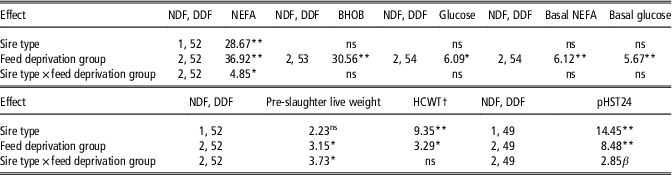
F values, P values and numerator and denominator degrees of freedom (NDF, DDF) for the effects of the base model on non-esterified fatty acid (NEFA), β-hydroxybutyrate (BHOB) and glucose concentrations at slaughter, basal concentrations of NEFA and glucose, pre-slaughter live weight and carcass variables in Merino and Terminal sired lambs

† Hot carcass weight (HCWT) model corrected for live weight; pHST24: M. Semitendinosus pH at 24 h postmortem.
β P<0.1
* P<0.05
** P<0.01.
Basal concentrations of plasma non-esterified fatty acid, β-hydroxybutyrate, glucose and lactate
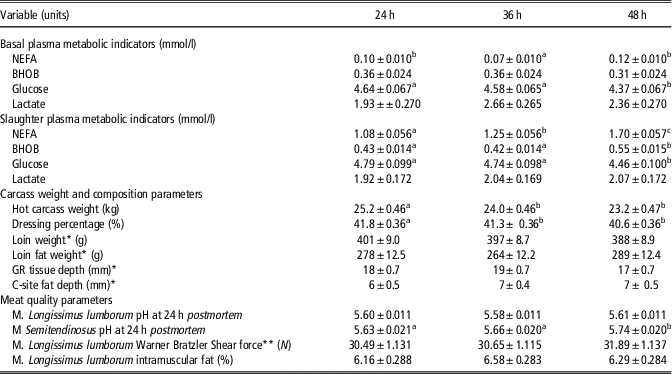
Basal concentrations of NEFA and glucose differed between treatment groups (P<0.05, Table 2). The 48 h treatment group had the highest NEFA and lowest glucose (Table 3), however, in both cases these differences were small. Treatment group, sire type, sex or live weight did not affect (P>0.05) basal BHOB or lactate concentrations.
Predicted Least squared means ± SE and range for basal and slaughter levels of plasma non-esterified fatty acid (NEFA), β-hydroxybutyrate (BHOB), glucose and lactate, and carcass variables measured for lambs in Group 24, Group 36 and Group 48 of feed deprivation

GR tissue depth: measured tissue depth (mm) 110 mm from midline over the 12th rib.
C-site fat depth: measured fat depth (mm) adjacent to the exposed loin eye at the 12th/13th rib.
* Corrected for hot carcass weight.
** Measured on samples aged for 5 days.
a,b,c Means within rows with different superscripts are significantly different (P<0.05).
Metabolic response to feed deprivation
Duration of feed deprivation had an impact (P<0.05; Table 2) on plasma NEFA, BHOB and glucose concentrations at slaughter, although no effect (P>0.05) on plasma lactate concentrations.
Effect of feed deprivation on plasma non-esterified fatty acid concentration
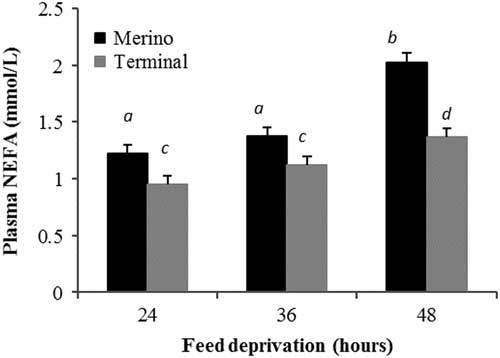
The base model described 62% of the variance for NEFA concentrations at slaughter. Feed deprivation had the largest effect on plasma NEFA concentration (P<0.01; Table 2), with lambs undergoing 48 h of feed deprivation having NEFA levels 57% and 36% higher than at 24 h, and 36 h of feed deprivation (Table 3). The effect of feed deprivation on NEFA concentration also differed between sire types (P<0.01, Figure 1). Non-esterified fatty acids concentrations in Merino sired lambs were 29%, 23% and 48% higher compared to Terminals sired lambs at 24, 36 and 48 h of feed deprivation (P<0.05, Figure 1). Between 24 and 48 h of feed deprivation, this represented an increase of 66% in Merinos, compared to only 44% in Terminal sired lambs. There was no effect (P>0.05) of sex, live weight, carcase composition or basal NEFA concentration on the NEFA response to feed deprivation. A positive association was observed between plasma NEFA and plasma glucose concentrations, however, this effect was only significant in male lambs (P<0.05). Increasing glucose concentrations from 3.8 to 5.8 mmol/l were associated with a 47% increase in plasma NEFA concentration from 1.07±0.096 mmol/l to 1.58±0.111 mmol/l.
Effect of feed deprivation (hours) on plasma non-esterified fatty acid (NEFA) (mmol/l) levels in Merino (black bars) and Terminal (grey bars) sired lambs. a,b,c,dLetters with different superscripts are significantly (P<0.05) different.

Effect of feed deprivation on plasma β-hydroxybutyrate concentration
The base model described 51% of the variance for BHOB concentrations at slaughter. Plasma BHOB concentrations were affected by feed deprivation (P<0.05, Table 2), with no change between 24 and 36 h, but then increasing by 29% from 36 to 48 h (P<0.05, Table 3). These changes were not influenced by either sex or sire type (P>0.05). There was an association between basal BHOB concentration and levels measured at 36 h of feed deprivation (P<0.1). As basal BHOB increased from 0.2 to 0.8 mmol/l there was a 46% increase in BHOB at 36 h of feed deprivation BHOB from 0.37±0.020 mmol/l to 0.54±0.043 mmol/l. This association had no impact on the magnitude of the feed deprivation treatment response described above. There was no association (P>0.05) of live weight, HCWT, LLFAT, LLWT or C-site fat depth on the BHOB response to feed deprivation. However, increasing GR tissue depth from 8 to 30 mm was associated with a 0.13 mmol/l increase in plasma BHOB from 0.41±0.024 mmol/l to 0.54±0.039 mmol/l. Inclusion of GR tissue depth in the model had no impact on the magnitude of the BHOB response to feed deprivation.
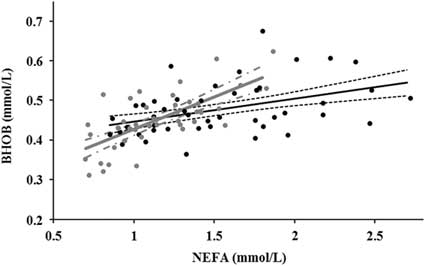
There was a positive association observed between average BHOB concentrations and NEFA concentrations following feed deprivation (P<0.01), which also differed between sire types (P<0.05, Figure 2). In Merino sired lambs, increasing plasma NEFA from 0.85 to 2.7 mmol/l was associated with a 25% increase in plasma BHOB from 0.44±0.022 mmol/l to 0.54±0.032 mmol/l. There was a stronger association observed in Terminal sired lambs, despite having an overall lower NEFA response to feed deprivation (Figure 1). As plasma NEFA concentrations increased from 0.7 to 1.8 mmol/l, plasma BHOB concentrations increased by 47% from 0.38±0.022 mmol/l to 0.56±0.030 mmol/l.
Association between post-feed deprivation β-hydroxybutyrate (BHOB) and non-esterified fatty acid (NEFA) concentrations in Merino (black lines) and Terminal (grey lines) sired lambs. Lines represent least squared means±standard error. Icons denote Merino  and Terminal
 residual sire estimates from the response surface.

Effect of feed deprivation on plasma glucose concentration
The base model described 54% of the variance for glucose concentrations at slaughter. Increasing duration of feed deprivation from 24 to 48 h was associated with a 7% decrease in plasma glucose concentration at slaughter (P<0.05, Table 3), with the bulk of this change occurring between 36 and 48 h. There was no effect (P>0.05) of sex or sire type on the glucose response to feed deprivation.
There was a strong association between glucose concentrations at slaughter and basal glucose (P<0.05). As basal glucose increased from 3.75 to 5.5 mmol/l, glucose concentration at slaughter increased by 15% from 4.37±0.133 mmol/l to 5.03±0.156 mmol/l. This association was consistent in magnitude across each of the feed deprivation treatment groups. In addition, correcting the model for basal glucose levels partially accounted for the effect of feed deprivation on plasma glucose concentration at slaughter, but this effect was small with the 48 h treatment group having concentrations that were only 1% lower at slaughter. There was an association between plasma glucose concentration at slaughter and live weight (P<0.1). Increasing live weight from 45 to 70 kg was associated with an 8.5% increase in plasma glucose from 4.46±0.141 mmol/l to 4.84±0.128 mmol/l. However, this association did not influence the response to increasing feed deprivation, as it was consistent across all feed deprivation treatment groups.
Effect of sire breeding values on metabolic response to feed deprivation
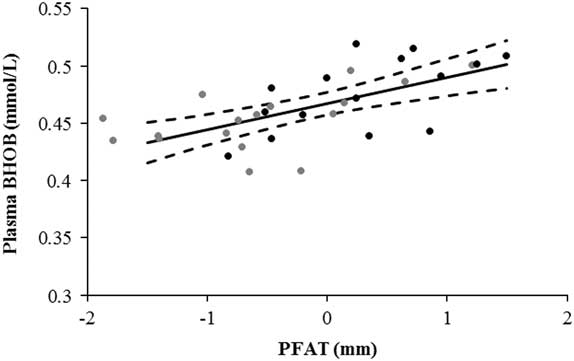
Post-weaning fat depth did not influence the BHOB response to feed deprivation. However, PFAT did show a consistent association with BHOB, with an increase in PFAT from −1.5 up to 1.5 mm, associated with an increase in plasma BHOB of 0.068 mmol/l from 0.43±0.018 mmol/l up to 0.50±0.021 mmol/l (P<0.05, Figure 3). Correcting for HCWT and phenotypic indicators of carcass composition had no effect on the magnitude of this association. There was no effect (P>0.05) of PEMD or PWT on BHOB concentration. There was also no effect (P>0.05) of PWT, PEMD or PFAT on the plasma NEFA, glucose or lactate response to feed deprivation.
Association between β-hydroxybutyrate (BHOB) concentration (mmol/l) in lambs at slaughter and post-weaning fat depth (PFAT) (mm), averaged across the three feed deprivation treatment groups. Line represents predicted mean±standard error. Icons denote Merino and Terminal residual sire estimates from the response surface.

Effect of feed deprivation on carcass parameters and meat quality
Hot standard carcass weight and dressing percentage were affected by duration of feed deprivation and sire type (P<0.05). Increasing feed deprivation from 24 to 48 h was associated with a 3% decrease (P<0.05, Table 3) in HCWT, with the bulk of this change occurring between the 24 and 36 h treatment groups. Likewise, increasing duration of feed deprivation from 24 to 48 h caused a decrease in dressing percentage by 1.2 dressing percentage units, an effect that was the same for both sire types. There was also no difference (P>0.05, Table 3) in LLFAT, LLWT, c-site fat depth or GR tissue depth between feed deprivation groups when adjusted for HCWT. There was a significant effect of feed deprivation on pH24ST (P<0.01, Table 3) which differed between sire types (P<0.1). The effect of feed deprivation on pH24ST was greatest in Merino sired lambs, where feed deprivation from 24 to 48 h was associated with an increase in pH24ST from 5.65±0.030 to 5.83±0.028. There was no effect of feed deprivation on pH24ST in Terminal sired lambs (P>0.05). Feed deprivation had no impact on pH24LL, IMF or SHEARF5 (P>0.05).
Discussion
Metabolic response to feed deprivation
Up to 48 h of feed deprivation under commercial pre-slaughter conditions caused significant changes in intermediary metabolism in lambs assessed by the concentration of blood metabolites at exsanguination. Increasing feed deprivation up to 48 h caused an increase in plasma NEFA and BHOB concentration, reduced glucose concentration and had no effect on plasma lactate concentrations. Contrary to the initial hypothesis, the NEFA concentration in Merino sired lambs had a greater NEFA response compared to Terminal sired lambs at 24 h of feed deprivation. However, in support of the hypothesis, the increase in NEFA concentration between 36 and 48 h was markedly greater in Merinos. This difference in NEFA response is the observed effect of feed deprivation, as the level of stress imposed during curfew, transport and lairage was the same across each treatment group, indicating that the Merino sired lambs had a greater metabolic response to feed deprivation than Terminal sired lambs.
Although NEFA concentrations at slaughter at each time point reflect the combined effect of the stressors associated with pre-slaughter transport and lairage as well as feed deprivation, NEFA concentrations at 24 h may be more strongly reflective of stress responsiveness. Supporting this assertion, previous work has shown that there are no sire type difference in NEFA response to feed deprivation up to 30 h under resting or animal house conditions (Stewart et al., Reference Stewart, McGilchrist, Gardner and Pethick2018, Table 4). This indicates that Merinos have a greater NEFA response to acute stress under commercial pre-slaughter conditions. This result in Merinos was unexpected as previous work has shown that more muscular, higher yielding genotypes have greater adipose tissue responsiveness to adrenaline in both sheep and cattle (Martin et al., Reference Martin, McGilchrist, Thompson and Gardner2011; McGilchrist et al., Reference McGilchrist, Pethick, Bonny, Greenwood and Gardner2011). On this basis, it was expected that Terminal sired lambs would have had a greater adipose response than Merino lambs under the stress of commercial slaughter conditions in the early stages of feed deprivation.
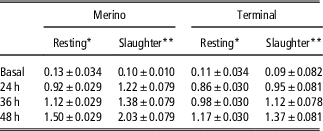
Levels of non-esterified fatty acid (NEFA) concentration (mmol/l) in Merino and Terminal sired lambs at rest and under commercial slaughter conditions

* Resting levels of NEFA from Stewart et al. (Reference Stewart, McGilchrist, Gardner and Pethick2018).
** Basal samples collected before feed removal.
However, an alternative interpretation is that feed deprivation was the stronger driver of NEFA concentration at slaughter. At the level of the adipose tissue, although the more muscular Terminal lambs may have responded more to adrenergic stimulation, the differential in NEFA response between sire types may have been due to greater adipose tissue mobilisation as a result of feed deprivation in the Merinos.
The levels of NEFA at 24 h in Merino sired lambs in the current study were up to 33% higher than previously reported in the same lambs at rest (Stewart et al., Reference Stewart, McGilchrist, Gardner and Pethick2018, Table 4). By contrast, the NEFA concentration at slaughter in Terminal sired lambs were only 10% higher than at rest (Table 4). In addition, the levels of NEFA at 48 h in Merino sired lambs observed in this study were up to 35% higher than previously reported in the lambs at rest (Stewart et al., Reference Stewart, McGilchrist, Gardner and Pethick2018, Table 4). These findings indicate that not only are Merinos more stress responsive than Terminal sired lambs under commercial slaughter conditions but they also respond more to feed deprivation (Gardner et al., Reference Gardner, Kennedy, Milton and Pethick1999).
Contrary to the hypothesis, the BHOB response to feed deprivation was not influenced by sire type. This was unexpected as, the lower NEFA response in Terminal sired lambs is also likely to have also produced differences in ketone production. However, an association between BHOB and NEFA was found which also differed between sire types. In Terminal sired lambs, there was a more rapid increase in BHOB response as NEFA concentration increased compared to Merino sired lambs, despite having a lower NEFA response. This indicates that higher yielding, Terminal sired lambs may have altered intrahepatic mechanisms to allow greater uptake of NEFA and overall ketogenic response (Cameron, Reference Cameron1992). This may reflect an increased use of NEFA as an energy source by lean tissue (Cameron, Reference Cameron1992; Hocquette et al., Reference Hocquette, Ortigues-Marty, Pethick, Herpin and Fernandez1998), which is proportionately greater in Terminal compared to Merino breed type (Anderson et al., Reference Anderson, Williams, Pannier, Pethick and Gardner2015).
The stronger association between BHOB and NEFA in Terminal lambs may also reflect a slower utilisation of BHOB, thus resulting in higher circulating levels observed for this genotype. Selection for increased muscling and leanness is linked to a shift from oxidative to glycolytic muscle fibre type (Greenwood et al., Reference Greenwood, Gardner and Hegarty2006). This shift may have altered substrate (BHOB) utilisation by Terminal lambs under extended periods feed deprivation, as they may be less reliant on fat catabolism due to a reduction in oxidative capacity (Gardner et al., Reference Gardner, Hopkins, Greenwood, Cake, Boyce and Pethick2007).
Indicators of fat metabolism during feed deprivation may also be linked to phenotypic fatness. Increasing GR tissue depth, a crude indicator of phenotypic fatness was found to be associated with an increase in BHOB concentration across all-time points. This suggests that the difference in fat mobilisation during feed deprivation may be partly driven by differences in whole body fatness (Chilliard et al., Reference Chilliard, Ferlay, Faulconnier, Bonnet, Rouel and Bocquier2000). Although this association did not differ between sire types previous work has shown that Terminal breed types have lower percentages of body fat (Anderson et al., Reference Anderson, Williams, Pannier, Pethick and Gardner2015). Therefore, animals with a greater GR tissue depth may have had increased fat turnover contributing to the higher BHOB concentrations.
The positive association between average NEFA concentrations and glucose concentration in male lambs was unexpected and opposite to the association found at rest (Stewart et al., Reference Stewart, McGilchrist, Gardner and Pethick2018). During feed deprivation NEFA concentrations increase as a result of a declining plasma glucose and decreasing insulin : glucagon ratio (Pethick et al., Reference Pethick, Harper and Dunshea2005). However, in this study the association between NEFA and glucose is likely to reflect both hepatic glycogenolysis and lipolysis due to the combined interactions of fasting (Pethick et al., Reference Pethick, Harper and Dunshea2005) and adrenergic stimulation due to stress (Martin et al., Reference Martin, McGilchrist, Thompson and Gardner2011). Hence, the stress driven mobilisation of all substrates is likely to have driven the positive association observed in this study.
Contrary to the hypothesis, there was no sire type difference in the glucose response to feed deprivation. It was expected that Merinos would have the greater decline in plasma glucose due to increasing duration of feed deprivation (Pethick et al., Reference Pethick, Harper and Dunshea2005), contributing to the higher NEFA and BHOB response observed (Stewart et al., Reference Stewart, McGilchrist, Gardner and Pethick2018). However, under commercial slaughter conditions, plasma glucose may be elevated due to adrenergic stimulation and increased rates of hepatic glycogenolysis (Brockman and Laarveld, Reference Brockman and Laarveld1986). The effect of this may have been more pronounced in Merinos, which are more stress susceptible (Gardner et al., Reference Gardner, Kennedy, Milton and Pethick1999). Thus a stress induced increase in plasma glucose at slaughter in Merinos may have masked the hypoglycaemic effect of feed deprivation (Pethick et al., Reference Pethick, Harper and Dunshea2005) and prevented a sire type difference in glucose response at slaughter. The association between slaughter levels of blood glucose and live weight was not unexpected. In young growing lambs as live weight increases, proportionately the liver represents a larger portion of the animals mass (Butterfield, Reference Butterfield1988) and may have contributed to higher glucose levels due to the size-related glycogen depot. This result suggests that larger lambs could be more capable of maintaining glucose levels under feed deprivation.
At slaughter, the plasma lactate concentration did not differ between feed deprivation groups, supporting previous work showing that extended feed deprivation has no impact on plasma lactate concentrations (Daly et al., Reference Daly, Gardner, Ferguson and Thompson2006). In addition, basal and slaughter levels of lactate in this study were above normal for ruminants. This is likely to reflect contraction-linked energy demands of muscle associated with exercise and adrenergic stimulation (Pethick, Reference Pethick1993).
Effect of sire breeding values on the non-esterified fatty acid and β-hydroxybutyrate response to feed deprivation
Contrary to the hypothesis, there was no association between PEMD breeding values and NEFA and BHOB concentrations at slaughter. Therefore, it would be expected that under higher stress commercial slaughter conditions, progeny of sires with high PEMD breeding values would demonstrate a higher NEFA and BHOB response, independent of the metabolic effects of feed deprivation. Moreover in the current study, lower muscled Merinos, demonstrated a greater response to stress than the more muscular terminal sired lambs, as shown by a greater NEFA response at 24 h of feed deprivation. This contradicts the earlier work by Martin et al. (Reference Martin, McGilchrist, Thompson and Gardner2011) and McGilchrist et al. (Reference McGilchrist, Pethick, Bonny, Greenwood and Gardner2011) that showed the adipose response to adrenaline is greater in animals genetically selected for increased muscularity. Alternatively, the sustained metabolic impact of feed deprivation may have explained more variation in the adipose response compared to the rapid, short acting effects of adrenaline at slaughter (Boisclair et al., Reference Boisclair, Johnston, Bauman, Crooker, Dunshea and Bell1997; Pethick et al., Reference Pethick, Harper and Dunshea2005) thereby preventing any stress linked association between PEMD and NEFA and BHOB to be observed. In addition, as there is no evidence suggesting that these breeding values produce differences in stress response, we therefore conclude that the differences across all groups are driven by their differential response to feed deprivation.
Contrary to the hypothesis, progeny with lower PFAT demonstrated a greater BHOB response, which was consistent across feed deprivation groups. However, this effect was small and not mirrored by a similar NEFA response in the same animals. The positive association observed between PFAT and BHOB in the current study indicates that genetically fatter animals may have a greater capacity for ketogenesis, which would enable them to more efficiently utilise adipose tissue during periods of nutritional restriction (Pethick et al., Reference Pethick, Harper and Dunshea2005). Supporting this assertion, Merino lambs from higher PFAT sires have been shown to have higher BHOB concentrations during feed deprivation (Stewart et al., Reference Stewart, McGilchrist, Gardner and Pethick2018). Alternatively, this result may indicate that genetically leaner lambs have a reduced capacity for ketogenesis during extended periods of feed deprivation under acute stress and which could result in greater protein turnover to meet energy demands (Hocquette et al., Reference Hocquette, Ortigues-Marty, Pethick, Herpin and Fernandez1998) and may result in greater carcass weight losses (Thompson et al., Reference Thompson, O’Halloran, McNeill, Jackson-Hope and May1987).
Contrary to the hypothesis, there was no association between NEFA and PFAT or PWT. It is unclear why this association was not found, given the association observed in Terminal and Merino sired lambs during feed deprivation under resting conditions (Stewart et al., Reference Stewart, McGilchrist, Gardner and Pethick2018). In the current study, lower growth Merino lambs had higher stress responsiveness evident at 24 h and greater responsiveness to feed deprivation at 48 h demonstrated by higher NEFA concentrations. Therefore, a possible explanation is that the higher stress responsiveness of lower growth impetus Merino lambs at slaughter masked the association between PWT and the NEFA response to feed deprivation.
Effect of feed deprivation on carcass yield and meat quality
Results from this study demonstrate that feed deprivation greater than 36 h is having a detrimental effect on carcase weight, aligning with previous work in sheep (Thompson et al., Reference Thompson, O’Halloran, McNeill, Jackson-Hope and May1987; Warriss et al., Reference Warriss, Brown, Bevis, Kestin and Young1987). From 36 to 48 h of fasting, lambs lost ~3% of carcass weight. Similarly, there was a loss of ~3% in dressing percentage between 24 and 48 h of feed deprivation. Carcass weight has been shown to be reduced by feed deprivation (Kirton et al., Reference Kirton, Clarke and Carter1967; Carr et al., Reference Carr, Allen and Phar1971; Thompson et al., Reference Thompson, O’Halloran, McNeill, Jackson-Hope and May1987; Warriss et al., Reference Warriss, Brown, Bevis, Kestin and Young1987). Thompson et al. (Reference Thompson, O’Halloran, McNeill, Jackson-Hope and May1987) showed that carcass weight is reduced by 0.1% per hour after 12 h of fasting, although Daly et al. (Reference Daly, Gardner, Ferguson and Thompson2006) reported opposing results. In 18-month-old merino wethers deprived of feed for 0, 2 and 4 days under low stress pre-slaughter conditions, it was found that time off feed had no significant effect on carcass weights or GR fat depth. Similarly, Jacob et al. (Reference Jacob, Walker, Skerritt, Davidson, Hopkins, Thompson and Pethick2005b) found inconsistent effects of increasing lairage times on carcass weight, with only 50% of consignments showing a significant effect of time from 24 to 48 h off feed. Likewise, variation in duration of on-farm curfew is likely to have influenced the inconsistent findings by Jacob et al. (Reference Jacob, Walker, Skerritt, Davidson, Hopkins, Thompson and Pethick2005b) and indicates that total time off feed rather than lairage time is likely to affect carcase yields.
The association between feed deprivation and an increase in the ultimate pH of the M. semitendinosus (particularly in Merinos) was unexpected. Previous work has indicated that feed deprivation does not have an effect on glycogen concentrations or ultimate pH (Kirton et al., Reference Kirton, Quartermain, Uljee, Carter and Pickering1968; Tarrant, Reference Tarrant1989; Jacob et al., Reference Jacob, Walker, Skerritt, Davidson, Hopkins, Thompson and Pethick2005b; Daly et al., Reference Daly, Gardner, Ferguson and Thompson2006). However, extended feed deprivation combined with pre-slaughter factors could be imposing additional stress (Bray et al., Reference Bray, Graafhuis and Chrystall1989) which may be causing increased glycogen turnover in the pre-slaughter period. Moreover, this result supports the earlier findings of Gardner et al. (Reference Gardner, Kennedy, Milton and Pethick1999) who demonstrated the susceptibility of Merinos to dark cutting under commercial slaughter protocols that involved feed deprivation. In the current study, 33% of Merino sired lambs had a pH24ST value above 5.8 compared to only 7% in Terminal sired lambs, with the majority of these lambs in the 48 h group. Therefore, the susceptibility of Merinos to dark cutting may be reduced by ensuring that they are slaughtered within 24 h of feed removal. There was no impact of feed deprivation on pH24LL, SHEARF5 or IMF percentage found in this study. In addition, all carcasses had a pH24LL<5.8 and indicates that loin muscle glycogen levels were sufficient before slaughter. This is in agreement with previous work (Jacob et al., Reference Jacob, Pethick and Chapman2005a and Reference Jacob, Walker, Skerritt, Davidson, Hopkins, Thompson and Pethick2005b; Daly et al., Reference Daly, Gardner, Ferguson and Thompson2006; Toohey and Hopkins, Reference Toohey and Hopkins2006) showing that feed deprivation (<48 h) is unlikely to affect eating quality in lamb.
Conclusion
Merino and Terminal sired lambs differ significantly in in the metabolic response to feed deprivation and stress under commercial slaughter conditions, particularly in regards to adipose tissue turnover. In addition, commercial feed deprivation up to 48 h appears to have a negative effect on ultimate pH in Merinos and requires further research at an industry level. Importantly, increased feed deprivation beyond 36 h is detrimental to the carcass weight and dressing percentage in lambs, which could affect the profitability of lamb producers and warrants further investigation.
Acknowledgements
The authors wish to thank Meat and Livestock Australia, Australian Cooperative Research Centre for Sheep Industry Innovation and the Australian Meat Processors Corporation for funding this project. Technical staff at Murdoch University, the University of New England and the Katanning research stations are thanked for their invaluable assistance in carcass sampling, plasma analysis and on farm management.
Declaration of interest
The authors declare no conflicts of interest.
Ethics statement
This experiment was approved by the Murdoch University Animal Ethics Committee, Perth, Australia (Approval number: R2724/15).
Software and data repository resources
Carcass phenotypic data and sire ASBV data utilised in this experiment are stored in the Sheep CRC database.