Gambling is a popular leisure activity among older adults with 75 per cent of adults over the age of 55 reporting gambling in the past year (McCready, Mann, Zhao, & Eves, Reference McCready, Mann, Zhao and Eves2005). Older adults are the fastest growing age group in the Canadian population (Statistics Canada, 2015), and this trend is likely to continue due to an aging baby boomer population, increased life expectancy, and low birth rate (Human Resources and Skills Development Canada [HRSDC], 2016a, 2016b). Understanding gambling among older adults is, therefore, a priority for informing problem gambling treatment and prevention initiatives.
According to prevalence estimates of problem gambling among older adults in Ontario, 4.3 per cent were “at risk” problem gamblers, 2.0 per cent were “moderate” problem gamblers, and 0.1 per cent were “severe” problem gamblers (Wiebe, Single, Falkowski-Ham, & Mun, Reference Wiebe, Single, Falkowski-Ham and Mun2004). Although problem gambling estimates among the older adult population in Ontario are generally lower than for their younger counterparts (McCready, Mann, Zhao, Birchall, & Eves, Reference McCready, Mann, Zhao, Birchall and Eves2010; Wiebe et al., Reference Wiebe, Single, Falkowski-Ham and Mun2004), a concern with problem gambling among older adults is that their unique life circumstances make it more difficult to overcome gambling losses. Many older adults are transitioning out of the labour force or retired and therefore have limited resources to recover from financial losses (Grant Stitt, Giacopassi, & Nicols, Reference Grant Stitt, Giacopassi and Nicols2003; Ladd, Molina, Kerins, & Petry, Reference Ladd, Molina, Kerins and Petry2003; McCready et al., Reference McCready, Mann, Zhao and Eves2005; Petry, Reference Petry2002). Older adults also have more time for leisure activities such as gambling and are also more likely to experience feelings of uselessness, boredom, and income inadequacy, which may motivate them to gamble (Kerber, Adelman-Mullally, Kim, & Schafer Astroth, Reference Kerber, Adelman-Mullally, Kim and Schafer Astroth2015; Kim & Moen, Reference Kim and Moen2002; Loroz, Reference Loroz2004; McNeilly & Burke, Reference McNeilly and Burke2000; Parekh & Morano, Reference Parekh and Morano2009; Wiebe, Reference Wiebe2002).
Unmarried older adults are more likely to gamble than their married peers (McCready, Mann, Zhao, & Eves, Reference McCready, Mann, Zhao and Eves2008). There are conflicting studies regarding (1) the relationship between marital status and problem gambling (with some research suggesting that there is no association) (Ladd et al., Reference Ladd, Molina, Kerins and Petry2003; Pietrzak & Petry, Reference Pietrzak and Petry2006; Schellinck, Schrans, Walsh, & Grace, Reference Schellinck, Schrans, Walsh and Grace2002; Tse, Hong, & Ng, Reference Tse, Hong and Ng2013) and (2) a positive association (Zaranek & Lichtenberg, Reference Zaranek and Lichtenberg2008) between being married and gambling problems; nonetheless, many studies have demonstrated that married older adults are less likely to gamble (Hirshorn, Young, & Bernhard, Reference Hirshorn, Young and Bernhard2007) and to have gambling problems compared to their unmarried counterparts (Tse, Hong, Wang, & Cunningham-Williams, Reference Tse, Hong, Wang and Cunningham-Williams2012). A recent study of older adults in Ontario found that single older adult gamblers had a 118 per cent higher risk of problem gambling whereas widowed, separated, or divorced gamblers had a 75 per cent higher risk of problem gambling than married gamblers (McCready et al., Reference McCready, Mann, Zhao and Eves2008).
Loneliness and Problem Gambling
One potential mechanism for the relation between marital status and problem gambling among older adults is loneliness. Older adults are at an overall increased risk of experiencing social isolation and loneliness with reported prevalence rates of social isolation for older adults ranging from 20 per cent (Gilmour, Reference Gilmour2012) to 83 per cent (Hall & Havens, Reference Hall and Havens1999). Life changes such as widowhood, death of family and friends, retirement, increased disability and/or declining health, and moving to a retirement home can contribute to increases in social isolation and loneliness among older adults (Cohen-Mansfield, Hazan, Lerman, & Shalom, Reference Cohen-Mansfield, Hazan, Lerman and Shalom2016; Victor, Scambler, Bowling, & Bond, Reference Victor, Scambler, Bowling and Bond2005; Victor & Yang, Reference Victor and Yang2012). Married people report lower rates of social isolation or loneliness compared to unmarried people (Dykstra & de Jong Gierveld, Reference Dykstra and de Jong Gierveld2004; Kobayashi, Cloutier-Fisher, & Roth, Reference Kobayashi, Cloutier-Fisher and Roth2008; Victor & Yang, Reference Victor and Yang2012), likely because unmarried older adults are less likely to have close or intimate relationships (Dykstra & de Jong Gierveld, Reference Dykstra and de Jong Gierveld2004). Losing a spouse and being unmarried may be particularly lonely for men compared to women (Chipperfield & Havens, Reference Chipperfield and Havens2001; Pinquart, Reference Pinquart2003). Loneliness and gambling to escape feelings of loneliness or social isolation are risk factors for problem gambling (McQuade & Gill, Reference McQuade and Gill2012). We therefore expect that unpartnered men may be more likely to be lonely and consequently to have gambling problems compared to women. We would also expect that married older adults would be less likely to gamble because they feel lonely and would be less likely to experience gambling problems.
Social Motivations to Gamble
Although gambling out of feelings of loneliness may increase the likelihood of engaging in problem gambling, gambling also offers older adults the opportunity to alleviate their loneliness and social isolation (Hirsch, Reference Hirsch2000; Wiebe, Single, & Falkowski-Ham, Reference Wiebe, Single and Falkowski-Ham2001; Wiebe et al., Reference Wiebe, Single, Falkowski-Ham and Mun2004). Studies of older adults have demonstrated that gambling to socialize or reduce feelings of isolation are frequently cited motivations for gambling (Hirsch, Reference Hirsch2000; Wiebe et al., Reference Wiebe, Single, Falkowski-Ham and Mun2004). There are also important gender differences in motivations for gambling. Men gamble for social reasons and/or entertainment (Hing, Russell, Tolchard, & Nower, Reference Hing, Russell, Tolchard and Nower2014) whereas loneliness may be one of the main reasons women gamble (Brown & Coventry, Reference Brown and Coventry1997).
Social Context and Problem Gambling
Gambling with others may also help limit problem gambling (Rockloff & Greer, Reference Rockloff and Greer2011) because social ties, and marriage in particular, provide social control over health behaviours (Umberson, Reference Umberson1987; Reference Umberson1992) and can inhibit risky behaviour (Sampson, Laub, & Wimer, Reference Sampson, Laub and Wimer2006). Lack of social control is particularly problematic among aging adults because they are more likely to experience loss of social control through death and changes in social ties (Umberson, Crosnoe, & Reczek, Reference Umberson, Crosnoe and Reczek2010). Having a spouse may provide social control over negative behaviours (such as problem gambling) by providing social norms that discourage risky behaviour or by monitoring and directly intervening when engaging in risky behaviour (Umberson, Reference Umberson1987; Reference Umberson1992).
Social context may, therefore, be an important determinant of problem gambling for unpartnered older adults. Having an observer while gambling (such as a spouse or partner) may offer social control and limit gambling losses (Mishra, Morgan, Lalumiere, & Williams, Reference Mishra, Morgan, Lalumiere and Williams2010; Rockloff & Greer, Reference Rockloff and Greer2011). Alternatively, having friends or family who gamble may make gambling more accessible and appear socially acceptable (Welte, Wieczorek, Barnes, & Tidwell, Reference Welte, Wieczorek, Barnes and Tidwell2006). The presence of friends who gamble could also encourage risky behaviours such as attempting to showcase higher levels of gambling skill and playing longer (Griffiths & Parke, Reference Griffiths, Parke and Reith2003).
Loneliness, social isolation, and social context might therefore mediate the relation between marital status and problem gambling; however, few studies have tested these associations. A recent study found that loneliness mediated the relation between marital status and problem gambling for older adults (Botterill, Gill, McLaren, & Gomez, Reference Botterill, Gill, McLaren and Gomez2016). Unpartnered older adults (divorced, widowed, or single) had higher levels of loneliness, and loneliness was associated with higher problem gambling scores. Interestingly, older adult men who were unpartnered had higher levels of loneliness contributing to higher problem gambling levels than partnered older adults (i.e., married/partnered). Loneliness did not mediate the relationship between marital status and problem gambling among women. Due to small sample sizes, this study was unable to distinguish between marital status groups with respondents categorized as partnered and unpartnered. However, research on social isolation among older adults suggests that loneliness is more significant for those who have lost a spouse (divorced or widowed) (Dykstra, Van Tilburg, & de Jong Gierveld, Reference Dykstra, Van Tilburg and de Jong Gierveld2005; Ferreira-Alves, Magalhães, Viola, & Simoes, Reference Ferreira-Alves, Magalhães, Viola and Simoes2014; Newall, Chipperfield, & Bailis, Reference Newall, Chipperfield and Bailis2014; Ryan, Reference Ryan1996; Victor et al., Reference Victor, Scambler, Bowling and Bond2005). Thus, we would expect that these findings could differ depending on the type of unpartnered relationship (single, divorced, or widowed). For some individuals, gambling may also be beneficial as it offers older adults an opportunity to socialize (Wiebe et al., Reference Wiebe, Single, Falkowski-Ham and Mun2004). To date, there has been a lack of research examining how social context might mediate the relation between marital status and problem gambling.
Current Study
The current study is the first study to examine how three factors mediate the relationship between marital status and problem gambling: (1) gambling because of loneliness; (2) gambling to socialize; and (3) social context. For this study we used an existing survey of a large sample of older adults gambling in casinos and racinos (horse racing venues with slot machines) in Ontario, Canada, that has a high proportion of heavy or problem gamblers (McCready et al., Reference McCready, Mann, Turner, Hamilton, Schrans and Ialomiteanu2014). A limitation of the existing research examining the relation between marital status and problem gambling is that most studies rely on small samples and/or general population-based studies of older adults that include members of the population who are non-gamblers, and this may result in an attenuated understanding of problem gambling among those most at risk for problem gambling (i.e., those who gamble). Use of a sample of existing gamblers, therefore, addressed this limitation.
We expected that being unmarried (e.g., single, married, divorced/separated, widowed) would be associated with a higher likelihood of problem gambling. Further, we expected that social motivations, namely, gambling to socialize or because of loneliness and social context (i.e., gambled with friends or family vs. alone) would mediate the association between marital status and problem gambling. Finally, since motivations for gambling vary by gender, we expected that there would be gender differences in the findings.
Methods
The current study is a secondary analysis of data from the seniors’ gambling in Ontario study led by McCready et al. (Reference McCready, Mann, Turner, Hamilton, Schrans and Ialomiteanu2014), a survey of a sample of older adults in seven casinos and racinos in Ontario, Canada. This study was designed to better understand the role of gambling in the lives of older adults and the prevalence of gambling and problem gambling among this group. We defined older adults as those individuals who are age 55 years and older. This definition was based on how the study defined older adults which is also consistent with other research on gambling among older adults (Bjelde, Chromy, & Pankow, Reference Bjelde, Chromy and Pankow2008; Hirshorn et al., Reference Hirshorn, Young and Bernhard2007; McCready et al., Reference McCready, Mann, Zhao, Birchall and Eves2010; Philippe & Vallerand, Reference Philippe and Vallerand2007; Pilver & Potenza, Reference Pilver and Potenza2013; Tira, Jackson, & Tomnay, Reference Tira, Jackson and Tomnay2014; Tse et al., Reference Tse, Hong and Ng2013). Data were collected between July and September 2013. The study was reviewed by and received approval from the Research Ethics Board at the Centre for Addiction and Mental Health for both the initial research involving human subjects and the secondary analysis conducted for the current study.
Study Population
The target population consisted of Ontario residents age 55 and older who visited one of the following gambling locations in Ontario: Woodbine Racetrack (n = 303); Mohawk Racetrack (n = 300); Flamboro Downs (n = 300); Brantford Casino (n = 300); Woodstock Raceway (n = 300); Slots at Western Fair (n = 300); and Georgian Downs (n = 300). The onsite, intercept survey took 20 minutes on average to complete. The overall response rate was 66 per cent, with response rates varying by location. The final sample size consisted of a random sample of 2,103 Ontario older adults in casinos and racinos.
Sampling
Participants were randomly selected to participate in an onsite, intercept survey in non-gaming areas of the gambling venues (entering/exiting). Respondents were selected by gender and age (55–64, 65–74, 75 and older). Further details about sampling and other protocols are detailed elsewhere (McCready et al., Reference McCready, Mann, Turner, Hamilton, Schrans and Ialomiteanu2014).
Measures
Problem Gambling
Problem gambling was measured using the 9-item Problem Gambling Severity Index (PGSI) derived from the Canadian Problem Gambling Index (CPGI) which has demonstrated validity and reliability (Currie, Casey, & Hodgins, Reference Currie, Casey and Hodgins2010; Ferris & Wynne, Reference Ferris and Wynne2001). Responses for each PGSI item were 0 = never, 1 = sometimes, 2 = most of the time, or 3 = always. Responses across each item were summed to derive an overall PGSI score (ranging from 0 to 27), with higher scores indicating more problem gambling severity. For the purposes of this study, the continuous PGSI score was used which has been used in other gambling research studies (MacLaren, Ellery, & Knoll, Reference MacLaren, Ellery and Knoll2014; MacLaren, Fugelsang, Harrigan, & Dixon, Reference MacLaren, Fugelsang, Harrigan and Dixon2012).
The continuous measure of PGSI score was positively skewed (2.92) and had a high degree of kurtosis (12.80). A natural logarithmic transformation was employed to make the measure more symmetric. The PGSI measure included a score of zero; therefore, 0.001 was added to every score in order to model the data. Although the measure remained skewed after the transformation, the skew (–0.23) and kurtosis (–1.86) was significantly reduced and within an acceptable range.
Social Motivations for Gambling
The study asked respondents to indicate their motivations for gambling: “What are the main reasons why you go to casinos or slot locations? Would you say that you mainly go …<check all that apply>”. The mediation effect of two aspects of socialization was studied in separate analyses. The first analysis examined gambling as a social event using the motivation item “To socialize with family or friends” (coded 1 if the respondent listed “socialize” as a motivation to gamble and 0 otherwise). The second analysis examined loneliness using the motivation item “To be with other people (loneliness or isolation)” (coded as 1 if the respondent listed “loneliness or isolation” as a motivation to gamble and 0 otherwise).
Social Context of Gambling
To determine whether respondents were gambling socially, respondents were asked: “Did you come here today alone or with others such as family members, friends, or both?” Response options were as follows: alone, with family, with friends, with both friends and family. The options were recoded as 0 = came alone (reference category) or 1 = came with family and/or friends.
Marital Status
Marital status was coded into four categories: single/never married, divorced/separated, widowed, and married/equivalent.
Sociodemographic Co-variates
Seven sociodemographic variables included as co-variates were as follows: age, gender, race (non-White vs. White), casino/racino location (Woodbine, Mohawk, Flamboro, Brantford, Woodstock, Western Fair, Georgian), distance (km) to the nearest casino or slot location, total household income (less than $40,000, $40,001–$80,000, greater than $80,000, don’t know/prefer not to answer), and education (vocational training/ high school or less, college or university or post graduate/professional, don’t know/prefer not to answer).
Statistical Analysis
Descriptive analyses were conducted using STATA version 12. A one-way ANOVA was used to test statistical differences in problem gambling severity score by marital status. Independent-sample t-tests were conducted to compare problem gambling score by social motivations for gambling (i.e., to be with others, to socialize), and the social context of gambling. ANOVA and t-tests were run using the log transformation of PGSI score. Chi-square tests were used to test statistical differences in social motivations for gambling (to socialize with family/friends, to be with other people) and the social context of gambling (with family or friends vs. not) by marital status. We conducted analyses overall and then separately for men and women.
Mediation models were analysed using Mplus version 7.4 and followed the Hayes model for a multicategorical predictor, binary mediator, and continuous outcome (Hayes & Preacher, Reference Hayes and Preacher2014). The bootstrap estimates were based on 5,000 bootstrap samples. Bias-corrected 95 per cent confidence intervals were used to determine significant mediation effects. According to Hayes (Reference Hayes2013), a significant mediation effect may be evident even if the individual paths in a model (e.g., the path from X to M) are not significant. Hayes noted that the individual paths in the model as being significant are not important in determining whether the indirect effect is significant (i.e., different from zero) (Hayes, Reference Hayes2013, p. 201). Separate mediation models were tested to examine whether (1) the social context of gambling (gambling with friends/family) mediates the relation between marital status and problem gambling; (2) gambling to be with other people (due to loneliness or isolation) mediates the relation between marital status and problem gambling; and (3) gambling to socialize with family/friends mediates the relation between marital status and problem gambling. To ensure analyses tested each marital status group compared to the married category, we created dummy variables with married/common law as the reference group. Models were first tested overall and then separately for men and women. All models controlled for each of the sociodemographic factors because they are associated with gambling problems (Currie et al., Reference Currie, Hodgins, Wang, el-Guebaly, Wynne and Chen2006). Dummy variables were constructed for casino/racino location (reference = Woodbine), total household income (reference=less than $40,000), and education (reference = vocational training/high school or less) variables.
Results
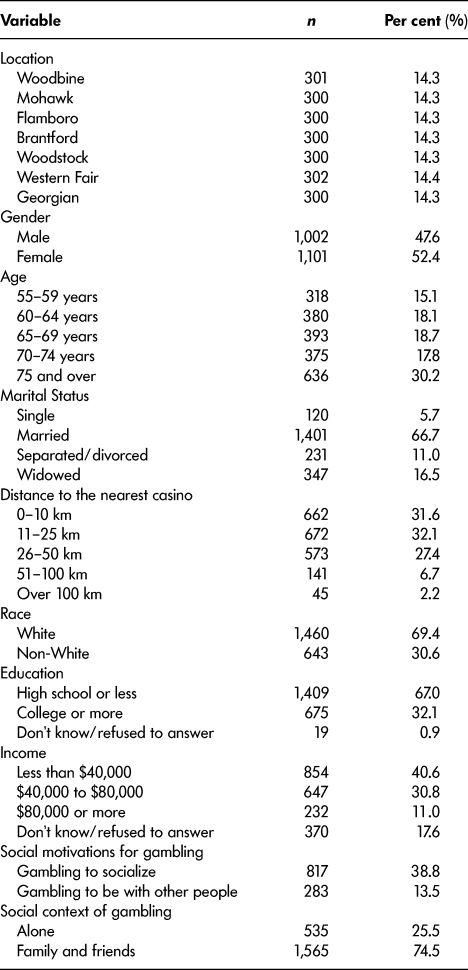
Sample characteristics are presented in Table 1. The majority of the sample was married (66.7%), followed by widowed (16.5%), separated/divorced (11.0%), and single (5.7%). Gambling to socialize was a motivation for gambling among 38.8 per cent of respondents, and gambling to be with people was a motivation for 13.5 per cent of respondents. The majority of the sample (74.5%) were gambling socially (they had come to the casino with family or friends).
Sample characteristics of the seniors gambling in Ontario study (2013)

Mean problem gambling scores (not shown in tables) were significantly higher for older adults who gambled to be with others due to loneliness (M = 2.30, SD = 3.13) than those who did not (M = 1.83, SD = 2.82), t = –3.53, p = 0.001. Older adults who gambled to socialize with friends and family (M = 1.56, SD = 2.46) had significantly lower problem gambling scores than those who did not gamble to socialize (M = 2.11, SD = 3.09), t = 3.16, p ≤ .01. Mean problem gambling scores were lower for respondents who came with family and friends (M = 1.60, SD = 2.54), than for those who did not (M = 2.77, SD = 3.54) t = 6.87, p ≤ .001.
Key Differences in Context and Motivation
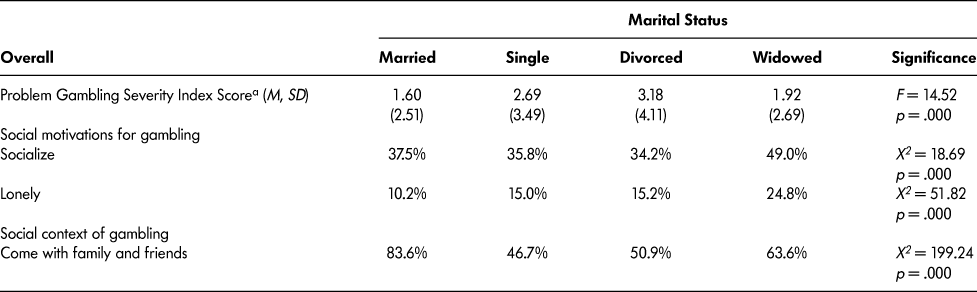
Here we examine differences in problem gambling, social motivations for gambling, and social context of gambling by marital status. As presented in Table 2, there were significant differences in problem gambling severity across each marital status group (p ≤ .001). Problem gambling severity scores were highest among divorced respondents (M = 3.18, SD = 4.11), followed by single (M = 2.69, SD = 3.49), and then widowed (M = 1.92, SD = 2.69). Married respondents had the lowest PGSI score (M = 1.60, SD = 2.51). Table 2 also demonstrates significant differences in social motivations to gamble (p ≤ .001) and social context of gambling by marital status (p ≤ .001). A substantial proportion of widowed respondents indicated that they gambled to socialize (49%), compared to 37.5 per cent of married, 35.8 per cent of single, and 34.2 per cent of divorced respondents. Widowed respondents were also the most likely to indicate that they gamble to be with people (24.8%) compared to married (10.2%), single (15.0%), or divorced (15.2%) respondents. The majority of married respondents (83.6%) were gambling socially (with family and/or friends), followed by widowed (63.6%), divorced (50.9%), and single (46.7%) respondents.
ANOVA and chi-square analyses of the overall association between marital status and problem gambling severity score, social motivations for gambling, and social context of gambling

Note. a For the PGSI score, the log transformation was used to determine significance. M = mean; SD = standard deviation.
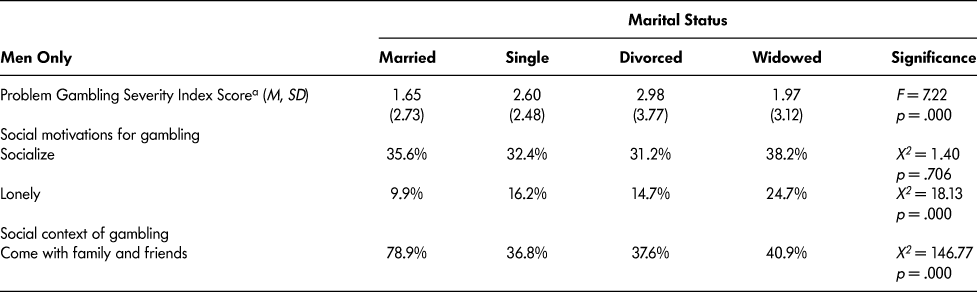
In Table 3, we examine differences in problem gambling scores, social motivations for gambling, and social context of gambling by marital status for men. Divorced men had the highest PGSI scores (M = 2.98, SD = 3.77), followed by single (M = 2.60, SD = 2.48), and widowed men (M = 1.97, SD = 3.12). Married men had the lowest PGSI scores (M = 1.65, SD = 2.73). There were no significant differences by marital status for men that gamble to socialize. Widowed men (24.7%) were significantly most likely to indicate that they gambled due to loneliness, and married men (9.9%) were the least likely to indicate that they gambled due to loneliness. Married men were also the most likely to gamble socially (78.9%).
ANOVA and chi-square analyses of the association between marital status and problem gambling severity score, social motivations for gambling, and social context of gambling for men

Note. a For the PGSI score, the log transformation was used to determine significance. M = mean; SD = standard deviation.
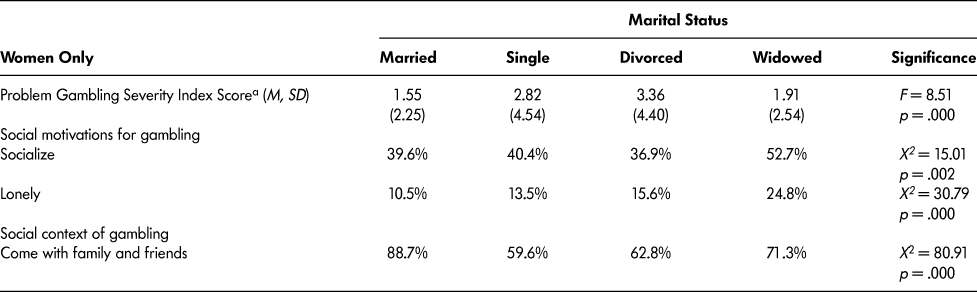
In Table 4, we examine differences in problem gambling scores, social motivations for gambling, and social context of gambling by marital status for women. Similar to men, divorced women had the highest PGSI scores (M = 3.36, SD = 4.40), followed by single (M = 2.82, SD = 4.54), and widowed women (M = 1.91, SD = 2.54). Married women had the lowest PGSI scores (M = 1.55, SD = 2.25). Widowed women (52.7%) were the most likely to indicate that they gambled to socialize, followed by single (40.4%) and divorced women (36.9%). Similar to men, widowed women (24.8%) were most likely to indicate that they gambled due to loneliness and married women (10.5%) were the least likely to state that they gambled due to loneliness. Married women also were the most likely to gamble socially (88.7%).
ANOVA and chi-square analyses of the association between marital status and problem gambling severity score, social motivations for gambling, and social context of gambling for women

Note. a For the PGSI score, the log transformation was used to determine significance. M = mean; SD = standard deviation.
Social Context of Gambling Mediation Models
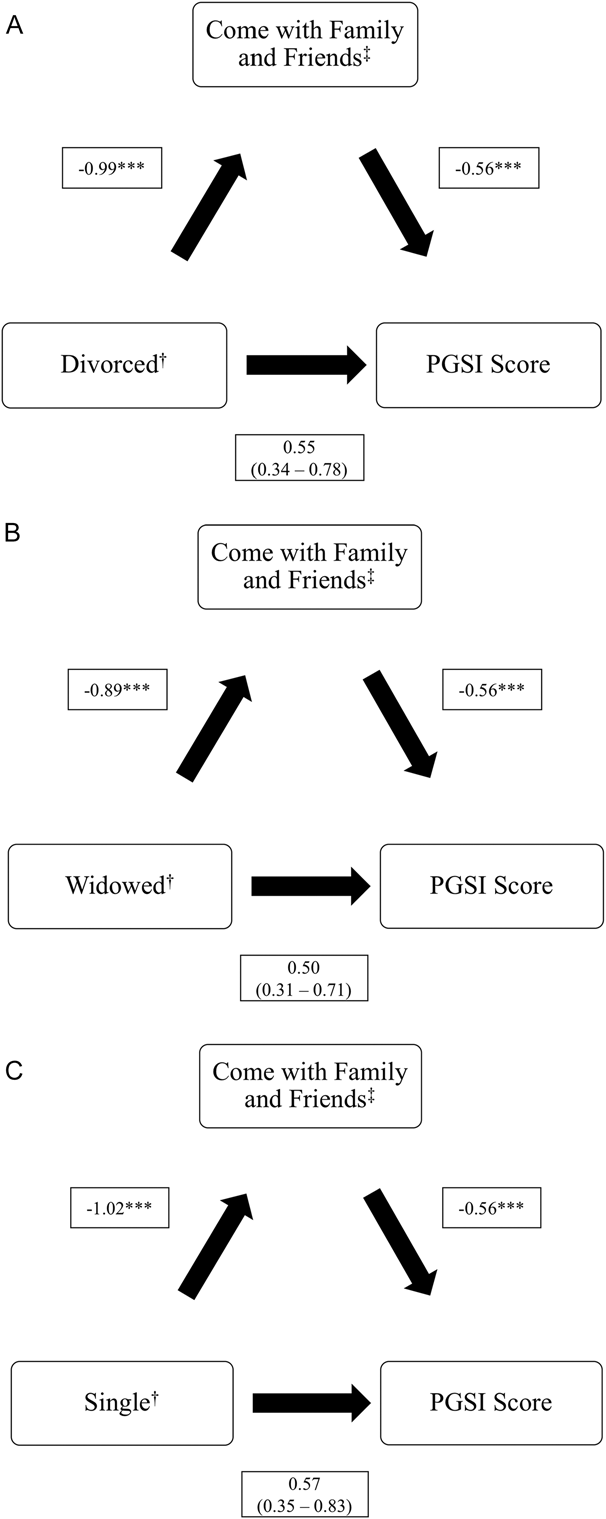
Figure 1 presents results of mediation analyses to test whether the social context of gambling mediates the relation between marital status and problem gambling. Figures 1a-c demonstrate that gambling with friends or family mediates the relationship between marital status and problem gambling for respondents who were divorced (Figure 1a), widowed (Figure 1b), and single (Figure 1c) compared to those who were married. Older adults who were divorced (b = –0.99, p ≤ .001), widowed (b = –0.89, p ≤ .001), or single (b = –1.02, p ≤ .001) were significantly less likely to be gambling with friends or family compared to those who were married. Gambling with family or friends was associated with having significantly lower PGSI scores (b = – 0.56, p ≤ .001). The indirect effect was significant for respondents who were divorced (b = 0.55, 95% CI [0.34, 0.78]), widowed (b = 0.50, 95% CI [0.31, 0.71]), and single (b = 0.57, 95% CI [0.35, 0.83]) relative to married respondents.
(a) Unstandardized regression coefficients for the relationship between divorced and problem gambling as mediated by coming to the casino with family and friendsa (b) Unstandardized regression coefficients for the relationship between widowed and problem gambling as mediated by coming to the casino with family and friendsa (c) Unstandardized regression coefficients for the relationship between single and problem gambling as mediated by coming to the casino with family and friendsa
a Models included controls for: age, race, casino/racino location, distance to the nearest casino or slot location, total household income and education
† Reference category: Married
‡ Reference category: Coming to the casino alone
PGSI = Problem Gambling Severity Index
* = p ≤ .05, ** = p ≤ .01, *** = p ≤ .001.

Social Motivations for Gambling Mediation Models
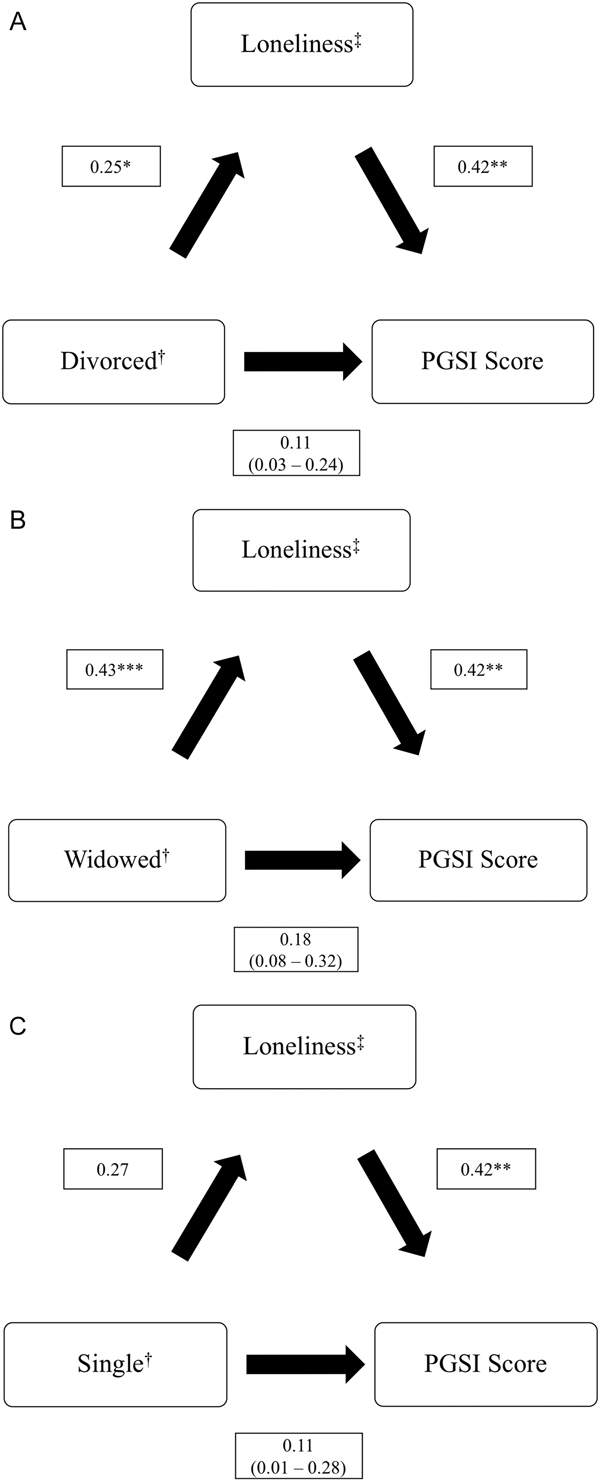
Figure 2 presents results of mediation analyses to test whether gambling to be with other people (loneliness) mediates the relation between marital status and problem gambling. Figures 2a–c demonstrate that loneliness mediates the relationship between marital status and problem gambling score for respondents who were divorced (Figure 2a), widowed (Figure 2b), and single (Figure 2c) compared to those who were married. Older adults who were divorced (b = 0.25, p ≤ .05) or widowed (b = 0.43, p < .001) were significantly more likely to report loneliness as a motivation for gambling compared to those who were married. Single respondents were no more or less likely than married respondents to report loneliness as a motivation to gamble (b = 0.27, p = .09). Loneliness as a motivation to gamble was associated with having a significantly higher PGSI score (b = 0.42, p ≤ .01). The indirect effect was significant for respondents who were divorced (b = 0.11, 95% CI [0.03, 0.24]) and widowed (b = 0.18, 95% CI [0.08, 0.32]). The indirect effect was marginally significant for respondents who were single (b = 0.11, 95% CI [0.01, 0.28]) relative to married respondents.
(a) Unstandardized regression coefficients for the relationship between divorced and problem gambling as mediated by coming to the casino to be with other people (loneliness or isolation)a (b) Unstandardized regression coefficients for the relationship between widowed and problem gambling as mediated by coming to the casino to be with other people (loneliness or isolation)a (c) Unstandardized regression coefficients for the relationship between single and problem gambling as mediated by coming to the casino to be with other people (loneliness or isolation)a
a Models included controls for: age, race, casino/racino location, distance to the nearest casino or slot location, total household income and education
† Reference category: Married
‡ Reference category: “To be with others (loneliness or isolation)” not listed as a motivation to gamble
PGSI = Problem Gambling Severity Index
* = p ≤ .05, ** = p ≤ .01, *** = p ≤ .001.

Gambling to socialize mediates the relation between marital status and problem gambling for widowed compared to married older adults only (not displayed in figures). Although older adults who gamble to socialize had lower PGSI scores (b = –0.37, p ≤ .001), the only significant differences in gambling to socialize relative to married older adults was among widowed respondents. Widowed older adults were significantly more likely than married older adults to gamble to socialize (b = 0.19, p ≤ .05). Divorced (b = –0.11, p = .27) or single (b = –0.05, p = .67) older adults were no more or less likely than married adults to gamble to socialize. Mediation analyses demonstrate that for widowed respondents, gambling to socialize is associated with lower problem gambling severity scores compared to married respondents (b = –0.07, 95% CI [–0.16, –0.02]).
Analyses by Gender
Mediation analyses were conducted among men and women separately to test whether social context or social motivations for gambling mediated the relationship between marital status and problem gambling for male and female older adults in different ways. Mediation analyses examining the social context of gambling among men and women were consistent with the overall models (not displayed in figures). For both men and women, gambling with family or friends mediated the relation between marital status and PGSI score in every marital status group relative to married older adults. Unpartnered older adults were less likely to gamble with family and friends relative to married older adults and had higher PGSI scores:
• Men: divorced b = 0.67, 95% CI [0.36, 1.00]; widowed b = 0.75, 95% CI [0.39, 1.13]; single b = 0.69, 95% CI [0.38, 1.10]
• Women: divorced b = 0.41, 95% CI [0.14, 0.72]; widowed b = 0.33, 95% CI [0.12, 0.60]; single b = 0.43, 95% CI [0.16, 0.81]
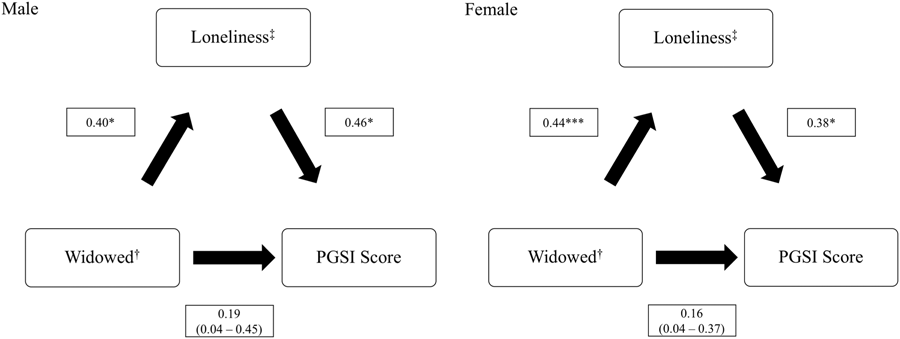
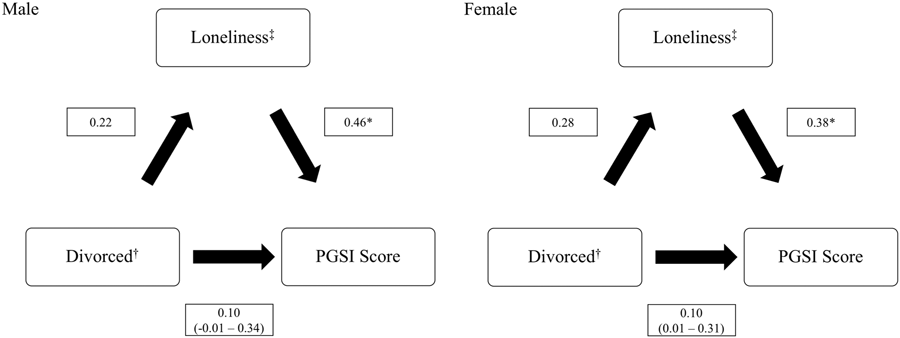
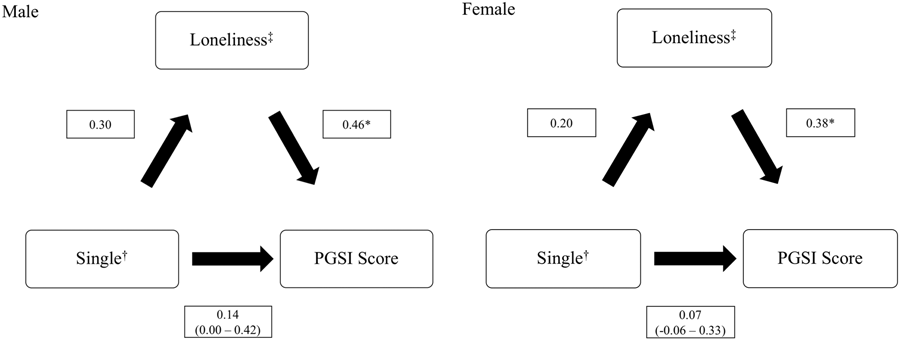
For each marital status group, we tested whether gambling due to loneliness mediates the relation between marital status and problem gambling differently for men and women. The mediations were significant for both male (b = 0.19, 95% CI [0.04, 0.45]) and female (b = 0.16, 95% CI [0.04, 0.37]) widowed older adults (Figure 3), for divorced women (Figure 4), and for single men (Figure 5). Gambling due to loneliness led to significantly higher PGSI scores for these groups. It should be noted, however, that although the indirect effects were significant for divorced women and single men, the direct effect of marital status on gambling resulting from loneliness was not significant (Figures 4 and 5).
Unstandardized regression coefficients for the relationship between widowed and problem gambling as mediated by coming to the casino to be with other people (loneliness or isolation) by gendera
a Models included controls for: age, race, casino/racino location, distance to the nearest casino or slot location, total household income and education
† Reference category: Married
‡ Reference category: “To be with others (loneliness or isolation)” not listed as a motivation to gamble
PGSI = Problem Gambling Severity Index
* = p ≤ .05, ** = p ≤ .01, *** = p ≤ .001.

Unstandardized regression coefficients for the relationship between divorced and problem gambling as mediated by coming to the casino to be with other people (loneliness or isolation) by gendera
a Models included controls for: age, race, casino/racino location, distance to the nearest casino or slot location, total household income and education
† Reference category: Married
‡ Reference category: “To be with others (loneliness or isolation)” not listed as a motivation to gamble
PGSI = Problem Gambling Severity Index
* = p ≤ .05, ** = p ≤ .01, *** = p ≤ .001.

Unstandardized regression coefficients for the relationship between single and problem gambling as mediated by coming to the casino to be with other people (loneliness or isolation) by gendera
a Models included controls for: age, race, casino/racino location, distance to the nearest casino or slot location, total household income and education
† Reference category: Married
‡ Reference category: “To be with others (loneliness or isolation)” not listed as motivation to gamble
PGSI = Problem Gambling Severity Index
* = p ≤ .05, ** = p ≤ .01, *** = p ≤ .001.

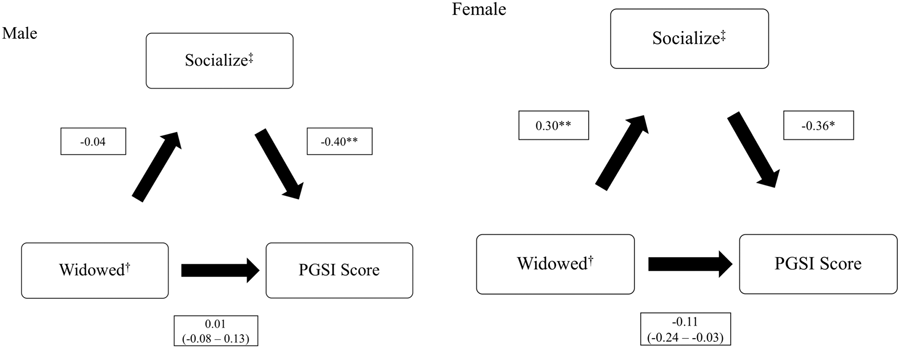
Mediation analyses were also conducted among men and women separately to examine whether gambling to socialize mediates the relation between marital status and problem gambling. Among men, there was no evidence of mediation for any marital status group. Among women, gambling to socialize mediates the relation between marital status and problem gambling for widowed compared to married older adults only (Figure 6). Widowed women were significantly more likely to gamble to socialize (b = 0.30, p ≤ .01) compared to married women. For widowed women, gambling to socialize was associated with significantly lower PGSI scores relative to married women (b = –0.36, p ≤ .05). The overall indirect effect was significant (b = –0.11, 95% CI [–0.24, –0.03]).
Unstandardized regression coefficients for the relationship between widowed and problem gambling as mediated by coming to the casino to socialize with family and friends by gendera
a Models included controls for: age, race, casino/racino location, distance to the nearest casino or slot location, total household income and education
† Reference category: Married
‡ Reference category: ‘To socialize’ not listed as a motivation to gamble
PGSI = Problem Gambling Severity Index
* = p ≤ .05, ** = p ≤ .01, *** = p ≤ .001.

Discussion
This is the first study of older adult gamblers to examine the role of social context and social motivations to gamble on the association between marital status and problem gambling. In findings consistent with those in previous research (Hirshorn et al., Reference Hirshorn, Young and Bernhard2007), being married was a protective factor against problem gambling severity. Unpartnered older adults (single, widowed, divorced) had higher problem gambling scores, with divorced older adults having the highest scores. Social ties (particularly being married or having children in the home) provide social control over negative behaviours (Sampson et al., Reference Sampson, Laub and Wimer2006; Umberson, Reference Umberson1987; Reference Umberson1992). We would therefore expect that divorced people would be more likely to engage in risky behaviours such as problem gambling. Divorced women in particular had the highest problem gambling scores. It should be noted that the causal link between being divorced and problem gambling can be bidirectional. That is, people may have higher problem gambling scores because they are divorced or are divorced because of their problem gambling.
Gambling to socialize and because of loneliness are important reasons why older adults gamble and why many older adults were gambling with family and friends. Gambling to socialize and going to the casino with family and friends were associated with lower problem gambling scores. However, in findings consistent with those of previous research (McQuade & Gill, Reference McQuade and Gill2012), gambling to escape feelings of loneliness or social isolation was associated with higher problem gambling scores.
The social context of gambling mediates the relation between marital status and problem gambling severity for older adults. Single, divorced, and widowed older adults were less likely than married older adults to be gambling with family and friends, and this is consistent with previous research (Bernhard, Dickens, & Shapiro, Reference Bernhard, Dickens and Shapiro2007). However, gambling with family and friends was associated with lower problem gambling severity. Consequently, single, divorced, and widowed older adults had higher problem gambling severity scores compared to those of married older adults. There were no gender differences in these findings, therefore suggesting that the relation between being unpartnered, gambling with friends and family, and problem gambling severity is just as important for male and female older adults.
Gambling due to loneliness mediated the relationship between each of the marital status groups and problem gambling. Divorced and widowed older adults were significantly more likely to state that they gambled due to loneliness than those who were married. The overall impact was that single, divorced, and widowed respondents had higher problem gambling scores. Previous research has shown that married people report lower rates of social isolation or loneliness in comparison to unmarried individuals (Dykstra & de Jong Gierveld, Reference Dykstra and de Jong Gierveld2004; Kobayashi et al., Reference Kobayashi, Cloutier-Fisher and Roth2008; Victor & Yang, Reference Victor and Yang2012). The findings confirm that loneliness is likely an important factor in problem gambling for older adults.
Previous research has found that loneliness mediates the relation between marital status and problem gambling for unpartnered men but not women (Botterill et al., Reference Botterill, Gill, McLaren and Gomez2016). Our findings demonstrate that there are important differences in the type of unpartnered relationship. For both widowed men and women, gambling due to loneliness mediated the relation between marital status and problem gambling. For divorced women and single men, loneliness also mediated the relation between marital status and problem gambling. The gender differences found in previous research may, therefore, reflect the categorization of marital status groups as “unpartnered” versus “partnered” rather than assessing the different types of unpartnered relationships separately.
The motivation to gamble as an opportunity to socialize mediated the relation between marital status and problem gambling for widowed older adults only. Widowed older adults were more likely to state that they gamble to socialize in comparison to other marital status categories, and this is consistent with other research in Ontario (Wiebe et al., Reference Wiebe, Single, Falkowski-Ham and Mun2004). However, we did find that the findings differed significantly by gender. Widowed women were significantly more likely to gamble to socialize compared to married women. Gambling to socialize was associated with lower problem gambling severity. Therefore, relative to married women, widows had a lower problem gambling severity score. There was no evidence of mediation for widowed men. Thus, for widowed women who are motivated to gamble for social reasons, gambling is a positive social benefit that is associated with a lower likelihood of problem gambling relative to married women.
The current study advances the literature in several important ways. Previous studies examining marital status and problem gambling were often based on small sample sizes and/or general population-based studies of older adults that include members of the population who are non-gamblers. Previous research examining the relation between marital status, loneliness, and problem gambling (Botterill et al., Reference Botterill, Gill, McLaren and Gomez2016) also categorized respondents as either partnered or unpartnered. The current study demonstrates that there are important differences in the type of unpartnered relationship (i.e., divorced or single vs. widowed). The findings of this study therefore offer a better understanding for whom and under which circumstances gambling can be a risk or a benefit.
Limitations
This study focused on the gambling behaviour of older adults attending one of seven gambling sites throughout Ontario, who may not be representative of the population of those who gamble at casinos or engage in other types of gambling. Moreover, although respondents were randomly selected from each of the gambling venues, those individuals who attended more frequently had a greater likelihood of being selected into the sample. Further research is needed to determine generalizability.
This study examined older adults aged 55 years and older. We lacked sufficient sample size to be able to analyse our data among subsets of age categories. However, we acknowledge this is a limitation given that this population is not homogenous and encompasses a broad spectrum of individuals with varying experiences.
The severity of gambling behaviour was determined from self-reports of gambling behaviour using the PGSI. As such, it is possible the results are subject to self-report bias resulting from participants engaging in impression management for reasons of social-desirability.
We based the results of this study on cross-sectional survey data. Longitudinal data analysis is needed to verify and validate the causality of mediational relationships observed. Nevertheless, this study contributes to an understanding of the relationship between social motives and severity of problem gambling behaviour.
The study used a secondary data analysis to answer research questions and as with all secondary analyses, we therefore did not have any control over the measures that were included in the study. Although the measure we used to assess the social context of gambling provides some insight into the presence of family and friends on older adult gambling behaviour, it does not necessarily mean that older adults who came with family and friends gambled with these individuals or alone. It is possible some individuals gambled as a group, selecting games they could play together at the same time, one after another, or in the same vicinity with high levels of social engagement. In contrast, other individuals may have selected games that could be played independently or were not in the same vicinity, resulting in lower levels of social engagement. Further research is needed to understand the presence, level of engagement, and role of family and friends on gambling behaviour among older adults.
Conclusion
Recently, the government of Ontario announced plans to expand gambling venues in Ontario (Ontario Lottery and Gaming Corporation [OLG], 2012). With the increase in the accessibility of gambling including new casinos, programs to prevent and treat problem gambling are urgently needed. Older adults represent a significant proportion of gamblers in gambling venues and therefore are an important priority target group for problem gambling prevention and treatment initiatives. This research highlights a number of important considerations for informing these initiatives. First, unpartnered older adults (single, divorced, widowed) are at an increased risk of problem gambling because they are gambling out of loneliness. In particular, both widowed men and women were significantly more likely to gamble because of loneliness and to have higher problem gambling scores. In contrast, widowed women who gambled to socialize had lower problem gambling scores. This suggests that for widows, gambling can have either positive or negative impacts depending on whether they have someone to gamble with. Therefore, treatment and prevention initiatives need to examine ways to decrease levels of loneliness and social isolation among older adults. As previously suggested, gambling treatment and prevention programs should also incorporate strategies to deal with grief and loss in constructive ways (Tira et al., Reference Tira, Jackson and Tomnay2014). Finally, divorced older adults (particularly women) had the highest problem gambling scores, suggesting that prevention and treatment programs targeted to divorced older adults are needed.