


%20--%3e%3c!DOCTYPE%20svg%20PUBLIC%20'-//W3C//DTD%20SVG%201.0//EN'%20'http://www.w3.org/TR/2001/REC-SVG-20010904/DTD/svg10.dtd'%3e%3csvg%20version='1.0'%20id='Layer_1'%20xmlns='http://www.w3.org/2000/svg'%20xmlns:xlink='http://www.w3.org/1999/xlink'%20x='0px'%20y='0px'%20width='64px'%20height='64px'%20viewBox='5.5%20-3.5%2064%2064'%20enable-background='new%205.5%20-3.5%2064%2064'%20xml:space='preserve'%3e%3cg%3e%3ccircle%20fill='%23FFFFFF'%20fill-opacity='0'%20cx='37.785'%20cy='28.501'%20r='28.836'/%3e%3cpath%20fill='%23595959'%20d='M37.441-3.5c8.951,0,16.572,3.125,22.857,9.372c3.008,3.009,5.295,6.448,6.857,10.314%20c1.561,3.867,2.344,7.971,2.344,12.314c0,4.381-0.773,8.486-2.314,12.313c-1.543,3.828-3.82,7.21-6.828,10.143%20c-3.123,3.085-6.666,5.448-10.629,7.086c-3.961,1.638-8.057,2.457-12.285,2.457s-8.276-0.808-12.143-2.429%20c-3.866-1.618-7.333-3.961-10.4-7.027c-3.067-3.066-5.4-6.524-7-10.372S5.5,32.767,5.5,28.5c0-4.229,0.809-8.295,2.428-12.2%20c1.619-3.905,3.972-7.4,7.057-10.486C21.08-0.394,28.565-3.5,37.441-3.5z%20M37.557,2.272c-7.314,0-13.467,2.553-18.458,7.657%20c-2.515,2.553-4.448,5.419-5.8,8.6c-1.354,3.181-2.029,6.505-2.029,9.972c0,3.429,0.675,6.734,2.029,9.913%20c1.353,3.183,3.285,6.021,5.8,8.516c2.514,2.496,5.351,4.399,8.515,5.715c3.161,1.314,6.476,1.971,9.943,1.971%20c3.428,0,6.75-0.665,9.973-1.999c3.219-1.335,6.121-3.257,8.713-5.771c4.99-4.876,7.484-10.99,7.484-18.344%20c0-3.543-0.648-6.895-1.943-10.057c-1.293-3.162-3.18-5.98-5.654-8.458C50.984,4.844,44.795,2.272,37.557,2.272z%20M37.156,23.187%20l-4.287,2.229c-0.458-0.951-1.019-1.619-1.685-2c-0.667-0.38-1.286-0.571-1.858-0.571c-2.856,0-4.286,1.885-4.286,5.657%20c0,1.714,0.362,3.084,1.085,4.113c0.724,1.029,1.791,1.544,3.201,1.544c1.867,0,3.181-0.915,3.944-2.743l3.942,2%20c-0.838,1.563-2,2.791-3.486,3.686c-1.484,0.896-3.123,1.343-4.914,1.343c-2.857,0-5.163-0.875-6.915-2.629%20c-1.752-1.752-2.628-4.19-2.628-7.313c0-3.048,0.886-5.466,2.657-7.257c1.771-1.79,4.009-2.686,6.715-2.686%20C32.604,18.558,35.441,20.101,37.156,23.187z%20M55.613,23.187l-4.229,2.229c-0.457-0.951-1.02-1.619-1.686-2%20c-0.668-0.38-1.307-0.571-1.914-0.571c-2.857,0-4.287,1.885-4.287,5.657c0,1.714,0.363,3.084,1.086,4.113%20c0.723,1.029,1.789,1.544,3.201,1.544c1.865,0,3.18-0.915,3.941-2.743l4,2c-0.875,1.563-2.057,2.791-3.541,3.686%20c-1.486,0.896-3.105,1.343-4.857,1.343c-2.896,0-5.209-0.875-6.941-2.629c-1.736-1.752-2.602-4.19-2.602-7.313%20c0-3.048,0.885-5.466,2.658-7.257c1.77-1.79,4.008-2.686,6.713-2.686C51.117,18.558,53.938,20.101,55.613,23.187z'/%3e%3c/g%3e%3c/svg%3e)
%20--%3e%3c!DOCTYPE%20svg%20PUBLIC%20'-//W3C//DTD%20SVG%201.0//EN'%20'http://www.w3.org/TR/2001/REC-SVG-20010904/DTD/svg10.dtd'%3e%3csvg%20version='1.0'%20id='Layer_1'%20xmlns='http://www.w3.org/2000/svg'%20xmlns:xlink='http://www.w3.org/1999/xlink'%20x='0px'%20y='0px'%20width='64px'%20height='64px'%20viewBox='5.5%20-3.5%2064%2064'%20enable-background='new%205.5%20-3.5%2064%2064'%20xml:space='preserve'%3e%3cg%3e%3ccircle%20fill='%23FFFFFF'%20fill-opacity='0'%20cx='37.637'%20cy='28.806'%20r='28.276'/%3e%3cg%3e%3cpath%20fill='%23595959'%20d='M37.443-3.5c8.988,0,16.57,3.085,22.742,9.257C66.393,11.967,69.5,19.548,69.5,28.5c0,8.991-3.049,16.476-9.145,22.456%20C53.879,57.319,46.242,60.5,37.443,60.5c-8.649,0-16.153-3.144-22.514-9.43C8.644,44.784,5.5,37.262,5.5,28.5%20c0-8.761,3.144-16.342,9.429-22.742C21.101-0.415,28.604-3.5,37.443-3.5z%20M37.557,2.272c-7.276,0-13.428,2.553-18.457,7.657%20c-5.22,5.334-7.829,11.525-7.829,18.572c0,7.086,2.59,13.22,7.77,18.398c5.181,5.182,11.352,7.771,18.514,7.771%20c7.123,0,13.334-2.607,18.629-7.828c5.029-4.838,7.543-10.952,7.543-18.343c0-7.276-2.553-13.465-7.656-18.571%20C50.967,4.824,44.795,2.272,37.557,2.272z%20M46.129,20.557v13.085h-3.656v15.542h-9.944V33.643h-3.656V20.557%20c0-0.572,0.2-1.057,0.599-1.457c0.401-0.399,0.887-0.6,1.457-0.6h13.144c0.533,0,1.01,0.2,1.428,0.6%20C45.918,19.5,46.129,19.986,46.129,20.557z%20M33.042,12.329c0-3.008,1.485-4.514,4.458-4.514s4.457,1.504,4.457,4.514%20c0,2.971-1.486,4.457-4.457,4.457S33.042,15.3,33.042,12.329z'/%3e%3c/g%3e%3c/g%3e%3c/svg%3e)
On June 19, 1912, colonial health authorities in San Juan, Puerto Rico, reluctantly admitted there were cases of bubonic plague in the city and that the disease was taking on epidemic proportions. Most of the cases, and the first ones diagnosed, were in a working-class neighborhood in San Juan known as Puerta de Tierra. The neighborhood had long been known for its unsanitary, overcrowded housing and high rates of infectious diseases, which health officers frequently decried. Yet, through the years, officials had little compunction about using Puerta de Tierra, and the waters that surrounded it, as places to dump garbage, house people with infectious diseases, allow unsanitary docks and stables, quarantine sick animals, and dispose of animal carcasses.
Bubonic plague apparently spread from the docks in Puerta de Tierra and was believed to be imported. US health authorities believed the disease had spread from the Canary Islands, but Port of Spain, Trinidad, and La Guaira, Venezuela, where cases had been reported, were also thought to be the origin.Footnote 1 The epidemic caused alarm bordering on panic that focused on the residents of Puerta de Tierra, especially Afro–Puerto Ricans who lived in the poorest section of the modest neighborhood. The island’s governor, US health officials, their Puerto Rican counterparts, the organized labor movement, and many others now called for the demolition of the poorest people’s homes and the destruction of their property. Residents of other cities on the island demanded that people from San Juan, and especially those from Puerta de Tierra, be prevented from leaving the city.
This article focuses on the nexus of urbanization, the environment, and public health that was exposed by the 1912 plague epidemic in San Juan. The connection between poor health and urban environmental degradation has been described by demographic historians as the “urban penalty,” which occurred in Europe during the second half of the nineteenth century when the health of working-class city dwellers declined in comparison to their rural contemporaries. In Europe this decline was associated with the industrial revolution and chaotic, unplanned urbanization, which included overcrowded, unsanitary housing, contaminated water, lack of sewage systems, and frequently tainted and inadequate food.Footnote 2 These conditions almost perfectly describe the situation in Puerta de Tierra, although there they still existed in the first decades of the twentieth century. And rather than being the result of workers coming to cities to seek work in factories, the situation in San Juan reflected the effects of colonial commodity production, as patterns of raw material extraction for international trade changed in the countryside.
The bubonic plague epidemic climaxed a general health crisis that was precipitated by lack of planning for decent living conditions for the influx of migrants to the city that began in the second half of the nineteenth century. Decline of the sugar economy after 1870, the coffee boom that left many peasants landless, the concentration of agricultural land after US takeover in 1898, and then the collapse of the rural coffee economy as a result of the devastating hurricane of 1899 all contributed to rural-urban migration (Reference Ayala and BernabeAyala and Bernabe 2007, 18–20; Reference SchwartzSchwartz 1992, 309–312; Reference SchwartzSchwartz 2015, 195–200). At the same time, the health of rural workers was far from good. As Steven Palmer (Reference Palmer2010, especially ch. 1) points out, workers who stayed in the countryside were affected by many of the same global processes that brought people into cities, and these could cause extreme ill health; for instance, commercial coffee estates employing many workers became breeding grounds for hookworm disease, which caused severe anemia.Footnote 3 Demographers have debated whether the urban penalty was a universal feature of urbanization, and at what point sanitary reforms in cities caused an “urban health advantage” (Reference Szreter and MooneySzreter and Mooney 1998; Reference WoodsWoods 2003; Reference ReherReher 2001; Reference Vlahov, Galea, Gibble and FreudenbergVlahov et al. 2005). The purpose of this article is not to attempt to prove whose health was worse, that of the rural poor or the urban poor, but rather to show how bubonic plague crystalized the grave public health situation resulting from rapid urbanization and abuse of the environment in Puerta de Tierra.
I also argue that the epidemic exacerbated the class and racial divisions that had contributed to the disastrous living conditions. While the term “environmental racism” was coined in the last decades of the twentieth century to describe the contamination of neighborhoods primarily occupied by people of color,Footnote 4 many of the actions that contributed to the degradation of Puerta de Tierra might be understood as examples of a similar policy. Of course it is difficult to absolutely prove that the use of the area for constructing incinerators, or disposing of dead animals, was specifically done because it was home to impoverished Afro–Puerto Ricans. However, historians of nineteenth-century Puerto Rico have demonstrated that, despite a somewhat more flexible attitude toward race there than in the United States, people of color were stigmatized, discriminated against, and often experienced extreme economic disadvantage (Reference KinsbrunerKinsbruner 1996; Reference Suárez-FindlaySuárez-Findlay 1999). After US occupation in 1898 there is ample evidence of US-style racism in Puerto Rico as North Americans expressed anxiety about incorporating an area populated by “inferior races” into the union, and the island’s military governor, General George W. Davis, wrote that the dark-skinned people of the island were not capable of self-government, and perhaps should be disenfranchised like US blacks (Reference Ayala and BernabeAyala and Bernabe 2007, 25, 30–32). In this atmosphere, considerable numbers of Puerto Ricans tried to have themselves officially designated in the census as white (Reference LovemanLoveman 2007). In the case of Puerta de Tierra, racial separation was well established by the first decade of the twentieth century. According to Arturo Bird Carmona (Reference Bird Carmona2008, 169–170), the 1910 manuscript census shows that within that neighborhood the sections most likely to be used for unhygienic purposes had the highest percentage of people of color.
This article also highlights the varying understandings of the causes and appropriate responses to plague. This is in keeping with scholarship by historians of medicine that has shown that the scientific “breakthrough” of the germ theory of disease did not necessarily mean universal acceptance or translate into different treatment regimes.Footnote 5 With respect to plague, by 1894 Alexandre Yersin and Shibasaburo Kitasato had independently isolated the plague bacillus in their laboratories in Hong Kong. However, Mary Sutphen has demonstrated that during the epidemics in Hong Kong (Reference Echenberg1894) and Calcutta (1896), while government reports and the press “revealed a widespread acceptance of the idea that the plague bacilli existed,” many people including doctors “blended the new germ theories with older miasmatic” ones that traced disease causation to unhealthy vaporous emanations from the earth or water (Reference SutphenSutphen 1997, 83–84). In 1898 Paul-Louis Simond determined that the plague vector was the rat flea, Xenopsylla cheopis (Reference FrithFrith 1912); nonetheless, vector transmission was not generally accepted until around 1902 (Reference EchenbergEchenberg 2007, 265, 70). A study of an outbreak of the disease in Mexico in 1902–1903 reveals contention between doctors who supported miasmatic theories and public health officials who defended the recently accepted vector theory of transmission (Reference CarrilloCarrillo 2005, 1096). And, in an article on plague in Lima and the Peruvian coast from 1903–1930, Marcos Cueto (Reference Cueto1997, 37) has also shown that in the early stages of the campaign against the disease the protocols followed tended to be those associated with miasmatic theory or the belief in person-to-person spread (fumigation, isolation of the ill). An examination of what happened during the 1912 epidemic in Puerto Rico tends to indicate that part of the widespread public fear, and some policy decisions, were the result of the belief that plague was commonly spread by contagion or due to miasmatic theories. I contend that these ideas became intertwined with prejudice against the poor, largely dark-skinned people of Puerta de Tierra. Of course, people whose clothes or possessions were infested with fleas could spread the disease, but in many cases the people themselves were viewed as contagious or as part of the environmental danger.
The Plague and San Juan
The illness that became evident in San Juan in 1912 was part of the third international plague epidemic, which first struck China in 1894 and then traveled through much of the world, generally along maritime trade routes, and eventually abated around 1950. Plague in epidemic proportions is most commonly spread to humans by rats suffering from Yersinia pestis (a rodent disease) through the bite of the rat flea, Xenopsylla cheopis. Plague can also be spread by other less effective flea vectors, such as the human flea, or Pulex irritans, especially if flea excreta or a crushed flea comes into contact with human skin with the bite. Bubonic plague takes its name from the swellings, or buboes, that commonly form in the groin or armpits of the patient and are one common clinical means of diagnosis. Bubonic plague is not generally spread directly from person to person except in the rare and very virulent form of the disease, pneumonic plague, where the disease settles in the lungs. In this form plague can be transmitted by inhaling respiratory droplets of the infected person.Footnote 6
Puerta de Tierra, the section of the city where cases of the disease first appeared, takes its name from the time when what is currently known as Viejo, or Old, San Juan was a walled city occupying a section of a small island (an islet, or isleta in Spanish). This islet was connected to the rest of Puerto Rico by bridges. There were six heavy doors in the wall that were closed at night to protect the capital city. The Puerta de Santiago, the door, or gate, that led from “Old” San Juan to the rest of the small island was popularly referred to as the land gate, the Puerta de Tierra. Thus, the area on the islet, adjacent to the walled city and leading to other areas (today Condado and the beaches and Miramar/Santurce and beyond) was simply known as Puerta de Tierra (see Figure 1). Today the neighborhood has an area of about 0.6 of a square mile.
Map of Puerta de Tierra. Prepared by Tracy Tien, Post-Baccalaureate Spatial Fellow, Spatial Analysis Lab, Smith College.
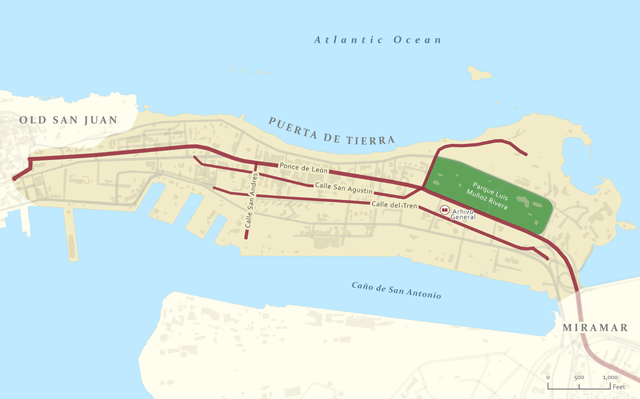
The location of Puerta de Tierra in relation to the capital city of San Juan made it different from some other cities that experienced plague outbreaks in the late nineteenth and the early twentieth century. For instance, in the plague epidemic in San Francisco that began in 1900, health officials at least initially believed that it would be possible to quarantine Chinatown, where most of the cases occurred, and simply seal off the neighborhood from the rest of the city.Footnote 7 The docks and warehouses of Puerta de Tierra sat squarely between San Juan and the rest of the island. San Juan was the center of the government, and many US and Puerto Rican officials and elite families lived there. Residents of San Juan could not leave the isleta to reach the rest of the island without crossing Puerta de Tierra.
Puerta de Tierra grew slowly in the early and mid-nineteenth century. Large sections were controlled by the military, which maintained fortifications along the northern shore to protect the walled city. The residential population in the area before the late 1860s was informal and illegal. In 1846 the population was only 223, including 144 people of color (65 percent) 26 of whom were slaves.Footnote 8 Although the military kept tight control over much of the zone, eventually it ceded lands to the government it did not consider essential to defense, and in 1867 housing plots were auctioned. Most were bought by speculators who did not plan to live there themselves but saw potential for renting to recently arrived workers.
In the second half of the nineteenth century, San Juan, like other Latin American cities, embarked on a program that was designed to beautify, open up, and sanitize the capital (Reference Sepúlveda RiveraSepúlveda Rivera, 1989, 247–300). However, within the walled city the space was absolutely limited, and it would have seemed logical to expand into the adjacent land of Puerta de Tierra once the Santiago gate was demolished. However, by the time the gate was taken down in 1897, Puerta de Tierra was unofficially conceived of as a convenient place to house the overflow poor from San Juan in what Sepúlveda and Carbonell (Reference Sepúlveda-Rivera and Carbonell1990, 35) refer to as “parcelación sin planificación.” A tramway constructed in the late 1800s linking San Juan and Rio Piedras, and a railroad connecting the capital and the city of Ponce, apparently served primarily to carry prosperous people beyond the neighborhood rather than making it attractive for them to live there. At the beginning of US control of the island, in 1899, the population of Puerta de Tierra was 5,453; in 1910 it was 10,836. For comparison, the population of Viejo San Juan was 12, 204 in 1899 and 19,735 in 1910.Footnote 9
Housing and Disease
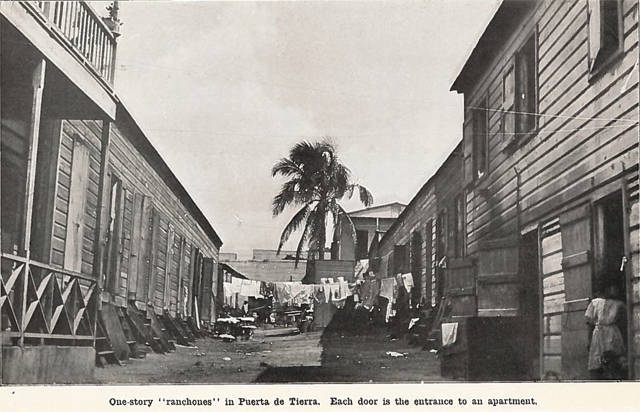
Although there was always some diversity in the zone, by the 1890s tenements, often referred to as ranchones, became the most common type of housing in the area (see Figure 2). Ranchones were one or two stories high and commonly divided into two room apartments. In the 1890s the average room measured 2.25 by 3 meters, or close to 73 square feet (Reference Sepúlveda Rivera, Curbelo, González Vales, Flores, Rivera, Curbelo and CarmonaSepúlveda Rivera and Alvarez Curbelo 2005, 94).
Ranchones in Puerta de Tierra. From Government of Porto Rico, Department of Labor, Charities and Correction, Bureau of Labor, Report on the Conditions of Laborers in Porto Rico, May 30, 1914 (San Juan, Porto Rico: Bureau of Supplies, Printing, and Transportation, 1914), between pages 52 and 53.
Not only were the rooms small, but some of them were literally underground in totally windowless cellars that were sometimes referred to as caves.Footnote 10 Some rented rooms were built over cesspools, a practice that had been declared illegal but continued despite the condemnation of members of the Junta de Sanidad, or Board of Health.Footnote 11
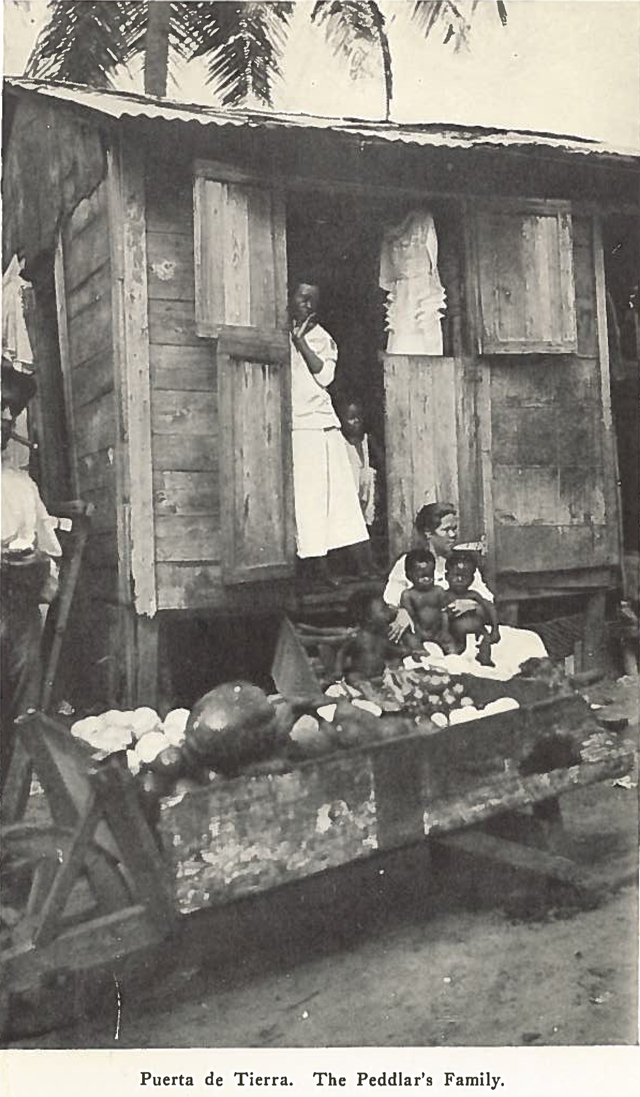
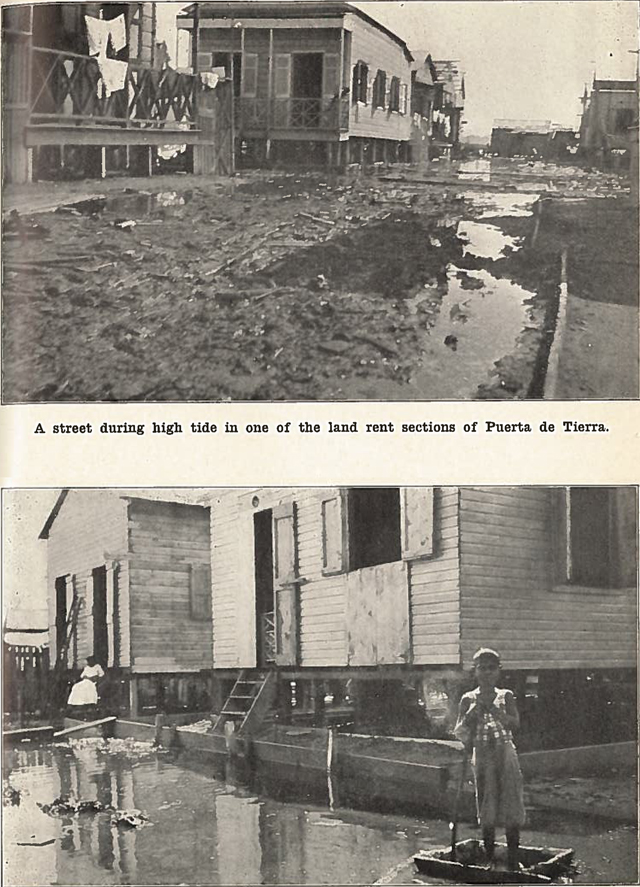
Broadly speaking, Puerta de Tierra had two different residential sections, northern and southern. The northern area extended along the municipal highway, or La Carretera (now Avenida Ponce de Leon), and along the parallel Calle San Agustín, where there were many residences and businesses, especially food stores and warehouses. Although Calle San Agustín was crowded with frame ranchones, and many of the houses on La Carretera accommodated multiple families in murky basement rooms, the north was actually considered the more desirable section of Puerta de Tierra. It was on relatively high ground, accessible to sea breezes that blew across the islet, and was considered a dry environment. Although living conditions here were far from ideal, many of the tenements in this area were occupied by men with skilled jobs in the tobacco industry who might earn between $6.00 and $18.00 a week (Government of Porto Rico 1913, 56). The southern section of the neighborhood was made up primarily of shacks crowded together close to the bay and on swampy ground that was frequently flooded at high tide. Many houses in this zone were raised on poles, and people frequently walked around on planks that were stretched out on top of the mud (see Figures 3 and 4). The poorest people in Puerta de Tierra tended to live in this section in several small communities including Sal Si Puedes (Leave if You Can), Miranda, and Hoyo Frio (Cold Hole).
House on stilts in marshy area of Puerta de Tierra. From Knowlton Mixer, Porto Rico: History and Conditions, Social, Economic and Political (New York: Macmillan Company, 1926), between pages 196 and 197.
Streets of Puerta de Tierra during high tide. From Government of Porto Rico, Department of Labor, Charities and Correction, Bureau of Labor, Report on the Conditions of Laborers in Porto Rico, May 30, 1914 (San Juan, Porto Rico: Bureau of Supplies, Printing, and Transportation, 1914), between pages 48 and 49.
This area was mostly populated by day laborers, including some of the least skilled workers in the tobacco factories, many of whom were women, who earned between $2.00 and $3.00 a week (Government of Porto Rico 1913, 56). This lowland mangrove area was also home to many laundresses, who somehow managed to produce immaculately clean, starched and ironed clothes for the ladies and gentlemen of San Juan. The Bureau of Labor Report for 1912, the year of the epidemic, estimated that about a quarter of the women of Puerta de Tierra worked as laundresses and that they earned about $1.00 to $1.50 per week (Government of Porto Rico 1913, 27). The vast majority of the residents of these southern slums were Afro–Puerto Rican (Reference Bird CarmonaBird Carmona 2008, ch. 6; Reference CreelCreel 1913, 14–15).
Although before the US takeover in 1898 the population of Puerta de Tierra grew relatively slowly, under the Spanish the spread of tenements and alarming rates of disease were already causing official concern, even while authorities continued to permit practices that contributed to these problems. Not only were crowded lodgings in Puerta de Tierra potential breeding grounds for diseases like diphtheria and tuberculosis, but the fact that most of them were constructed of wood made them easily accessible to burrowing rats (Reference CreelCreel 1913, 10–12, 14–15). Common proposals throughout the years, both under the Spanish and the United States, were that people should be moved while their homes were fumigated or sanitized, or that buildings simply be razed. So the idea of destroying buildings as a means of improving sanitary conditions predated the plague epidemic of 1912.Footnote 12
Health and the Environment under Spanish and US Control
Like the officially condemned but tolerated unhygienic housing conditions, there were other serious environmental problems in Puerta de Tierra produced by human inhabitants. Even in an age when sewage systems and waste disposal were generally primitive, some of the conditions shocked health officials but were still not corrected. Although there were changes in organization and emphasis in public health administration after US occupation, there were continuities with the Spanish colonial system as well. Before the US invasion in 1898, public health was largely in the hands of local city governments and charitable institutions, with a Superior Board of Health overseeing the system. In 1899 the US military government named a new Junta Superior de Sanidad (Superior Board of Health) that was made up of three US military doctors, a US Marine Health Services officer, and two civilian Puerto Rican doctors. In 1904 the Junta Superior was incorporated, in a secondary capacity, into the Department of Health, Welfare and Correction, and in 1911 a Public Health Service (Servicio de Sanidad) was created (Reference Rigau-PérezRigau-Pérez 2000, 358–359; Reference Rigau-PérezRigau-Pérez, 2009–2010). Local boards of health (juntas de sanidad) continued to function under US control, most with the same personnel as under the Spanish. In the first years of the US occupation there was a flurry of surveys sent out to local boards requesting information on everything from hospital facilities to unsanitary privies. These were particularly prevalent after the devastating San Ciriaco hurricane in 1899, when the US was forced to rely on local town councils for assessments of injuries and deaths after the storm (Reference SchwartzSchwartz 1992, 309–312). The local health boards also frequently received instructions from the director of health or his secretary to rectify unhealthful conditions in their jurisdictions, and were sometimes praised when they did so.Footnote 13 But more common are archival records full of orders from the US sanitary officials and responses from Puerto Rican officials either disputing the problem or saying they simply did not have the funds to carry out the request.Footnote 14
Under the Spanish, in 1876 plans were submitted to build a municipal hospital on the central highway that ran from east to west through Puerta de Tierra (today Avenida Ponce de Leon). Ultimately the massive structure, completed in 1887, never served as a hospital, but became the municipal jail.Footnote 15 Two years later the municipal council and the mayor, concerned about the spread of leprosy in the city and the number of infected individuals who lived in low lying areas of Puerta de Tierra, decided to build a quarantine barracks for them to the south of the jail in an area at the edge of the mangroves occupied by poor people living in small huts, or bohios.Footnote 16
During Spanish control Puerta de Tierra also became one of the main areas of the city where horses were stabled, and the practice continued under the United States. There were numerous complaints to the board of health about horses being kept either in lean-tos adjacent to living quarters, or below the floors of apartments. Most of the stables were said to be completely unhygienic, and because many of them were just dirt floors with poles supporting ceilings, and had no walls, rats had easy access to any fodder or other food that was stored in them. There also were many cases of horses contracting glanders, and even incidents of humans who worked with the animals dying of the disease.Footnote 17
One aspect of the environment in Puerta de Tierra that everyone agreed was unhealthy and should be eliminated were the mangroves that grew in relatively shallow water around the southern and eastern shores of Puerta de Tierra. The residents of Sal Si Puedes and other low-lying areas actually began the process of filling and drying the mangrove marshes. Public health officials seemed to have an ambivalent attitude toward the mangroves. On the one hand, there was no shortage of reports certifying that they were the cause of malaria and other diseases.Footnote 18 Yet many people seemed to have little awareness of how government-approved uses of the mangroves contributed to environmental degradation and disease, as in 1894, when the Junta proposed throwing the city’s garbage in the mangroves at the end of San Andres Street in Puerta de Tierra.Footnote 19 There were also reports to the Junta of horrible odors in Puerta de Tierra that caused nausea and respiratory problems and were said to be the result of the dumping of animal skins in the shallow waters where mangroves grew,Footnote 20 and of fecal matter floating in the water under the bridge at the east end of the neighborhood.Footnote 21 Another issue was how to dispose of the bodies of animals once they had died. The need for an animal cemetery became more obvious to the members of the Junta de Sanidad because the two earlier means of disposal increasingly were viewed as untenable. One involved throwing the carcasses into the sea on the north side of Puerta de Tierra, where the military installations were, but because this was open water, the waves sooner or later washed them back to shore. The other solution of dumping them in the mangroves off the low-lying areas of southeast Puerta de Tierra was no longer considered possible because this was an area with pedestrian traffic and many inhabitants of the zone bathed in the waters.Footnote 22 No agreement was reached on the question, but the Junta de Sanidad endorsed a proposal by a resident of Puerta de Tierra stating that the greatest aid to public health in the neighborhood would be the drying and filling in of the mangroves.Footnote 23
The US medical officers emphasized attacking particular infectious diseases that not only debilitated the population but often threatened the recently arrived US residents as well. Some of these campaigns later even became models for public health programs in the United States (Reference EspinosaEspinosa 2015; see also Reference Anderson, McCoy and ScaranoAnderson 2009; Reference Ring, McCoy and ScaranoRing 2009; Reference Sutter, McCoy and ScaranoSutter 2009). Within ten to fifteen years of US occupation, several campaigns lead by US medical officers succeeded in reducing smallpox and hookworm (Reference Silvestrini and SilvestriniSilvestrini 1983, 76–77; Reference AshfordAshford 1983; Reference Rigau-Pérez, Santana, de Arellano and Rigau-PérezRigau-Pérez 2008; Reference AmadorAmador 2015, 81). However, the new knowledge of disease etiology did not exclude attacking environmental causes of disease, as had been emphasized by the Spanish. For instance, in the case of malaria, when a campaign against the disease began in earnest in 1911, emphasis was placed on draining and filling mangrove swamps, getting rid of stagnant water, and later building engineering works that would eliminate places where mosquitos bred (Reference Miranda Franco and VélezMiranda Franco and Casta Vélez 1997). And, while hookworm was aggressively treated by giving sufferers doses of thymol and salts, and Bailey K. Ashford, the American military doctor in charge of the campaign, strongly disputed Puerto Rican doctors’ belief that the disease was primarily nutritional or due to poverty, ultimately building latrines and using shoes were also promoted by the Americans to prevent the spread of the worms through fecal matter on the ground.Footnote 24 In fact, neither the campaigns promoted by the United States against specific diseases, nor the often ineffective attempts to clean up the environment, translated into improved health conditions in Puerta de Tierra.
The Epidemic
This, then, was the environment in which the first cases of bubonic plague occurred. The first people to fall ill lived in Puerta de Tierra and were young, robust men. In fact, the majority of the stricken were men under thirty who worked in construction, on the docks, in storage facilities and in sanitation. Of fifty-one cases in the whole city of San Juan (including Old San Juan, La Marina, Puerta de Tierra and Santurce) thirty-nine were men (76 percent), and the oldest was thirty-eight years old (Reference CreelCreel 1913, 40–41). One of the first to die of the disease was Pedro Colón, eighteen years old, who lived in a tenement in Puerta de Tierra called “El Carolina” and was working in construction on a house on Cristo Street in San Juan. He became ill on a Tuesday and died on Friday. His cousin, Jesús Caraballo, twenty, with whom he lived in the same ranchón, also became ill and died in a matter of days in the municipal hospital. Both had high fevers, nausea, and painful inguinal buboes typical of bubonic plague.Footnote 25 Of the cases in Puerto Rico determined to be plague, the mortality rate was 65 percent; however the number of cases may have been higher since there were instances of people hiding patients, and apparently of doctors who shielded prosperous clients from the discomfort and stigma of being taken to the quarantine hospital. For instance, on June 21 a “young lady” attended by Doctor Santana Náter was said to have symptoms of the plague but was allowed to be kept under observation outside the hospital.Footnote 26 In another instance, a sick man who had taken refuge in an entrance hall in Calle Tanca in San Juan had mysteriously disappeared when the ambulance arrived.Footnote 27 Other patients in prosperous neighborhoods or from “good families” often did not receive the diagnosis of plague, such as an occupant of a house at #80 Calle Fortaleza near the governor’s residence.Footnote 28
Responsibility for fighting the disease was divided between the US Public Health and Marine-Hospital Service and the insular Servicio de Sanidad, although their tasks sometimes changed and overlapped. The former was supposed to supply specially trained officers to take charge of plague work; supervise the rat-proofing of buildings, the catching of rats, and their laboratory examination; and oversee the origins, storage, and shipping of outgoing freight. That left the Puerto Rican health service responsible for virtually all of the actual work of containing the disease, from visiting the ill to disposing of garbage, maintaining isolation facilities, disinfecting buildings, inspecting the dead, performing autopsies (sometimes with their colleagues from the US Public Health Service), and sometimes catching rats and enforcing rat-proofing regulations as well.Footnote 29 The actual rat-proofing was either paid for by the city or by individual property owners and was done in two ways. In one, houses were raised two feet above the ground and the space under the building left open so that the area could be cleaned and rat burrows removed. The other method was to surround a structure with concrete walls that extended two feet below the ground and fitted flush to the floor of the building.
The local Servicio de Sanidad advocated widespread trapping and poisoning of rats, and individuals were paid between 2 and 5 cents for each rat that they delivered to authorities. Numerous articles in local dailies specified that the disease could only be spread by fleas that had been in contact with infected rats. Even Bailey K. Ashford (who had pioneered the treatment of hookworm in Puerto Rico and was a widely known and respected public health specialist) wrote an article which appeared on the front page of the June 27 edition of La Correspondencia. In it he cited the 1902 Report of the Indian Plague Commission and declared, a trifle ambiguously, that “it seems a certainty that the means of transmission is the flea.”Footnote 30 Although dogs and cats very seldom carried fleas that spread plague, nonetheless the trapping and destruction of dogs and cats found in the streets was health department policy. When found loose in the city, cats and dogs were sometimes incinerated alive. A reporter from La Democracia reported that in Miranda, in the poorest part of Puerta de Tierra, a woman standing in the doorway of her house had a dog in the folds of her skirt, and a guard simply entered her home, grabbed the dog and beat it to death.Footnote 31
Strict rules of personal hygiene were recommended for all residents of San Juan, Puerta de Tierra, and Santurce; whether or not they were able or wished to follow them was another matter. All floors were to be washed every day with a mixture of one part cresol to two parts water.Footnote 32 People were told to keep their possessions (especially sheets and bedclothes) scrupulously clean and not only to bathe but to anoint their bodies with animal or vegetable fat or a mixture of eight hundred parts water, one part petroleum, and one part phenic acid, to keep away fleas.Footnote 33 In addition to policies on personal hygiene, the widespread emptying of garbage in homes and patios was mandated and enforced. On June 21 La Correspondencia estimated that more than sixteen hundred carloads of garbage had been hauled away. What was being burned was not always literally garbage, as an editorial in El Tiempo explained on the same day. The writer pointed out that the poor were bearing the brunt of these clean-up operations, being forced to throw away garments and even surrender small pieces of household furniture “that might appear useless to some but were essential to their owners.”Footnote 34 There were also complaints that while residents cleaned out their homes, because of a shortage of workers, garbage often was not picked up for days. When it was collected it was deposited at the city’s main refuse dump behind the jail in Puerta de Tierra. But as it accumulated at the dump it could not be burned if there were several days of rain. The interim governor, M. Drew Carrell, maintained that the government had been trying for more than a year to find a more adequate spot for dumping garbage.Footnote 35 Whatever the official intentions, residents of Puerta de Tierra were being ordered to clean out their homes to prevent rat infestation while the dump located in their neighborhood was full of rats.
The Chief of Insular Police ordered a “quarantine” between the isleta de San Juan and the rest of the island. The quarantine was actually porous because it did not prevent people from leaving the islet, nor would that have been politically or socially possible. While many may have felt that residents of Puerta de Tierra should have been literally imprisoned in their neighborhood, Puerta de Tierra lay between San Juan—the center of government and home to many prosperous people—and the rest of the island of Puerto Rico. Government officials and San Juan residents could hardly be prevented from crossing Puerta de Tierra to travel beyond the city. The acting governor and the chief health officer resorted to issuing certificates of health to people who wanted to leave San Juan. In order to get the certificates travelers had to present no signs of illness and produce evidence that their personal possessions contained no fleas or had been fumigated.Footnote 36 This emphasis on certifying that individuals were not ill and that their belongings were not infested indicates a mixture of the flea theory of transmission with a desire to reassure those who believed plague might be spread from person to person.
Once it was known that there was plague in San Juan, continuing passengers on ships stopping in the port of San Juan protested against passengers from San Juan being allowed to come aboard.Footnote 37 At the same time, ships coming into the harbor had to be disinfected before they were allowed to dock.Footnote 38 People traveling from ports believed to be “dirty”—that is, plague infested—such as La Guaira, Venezuela, were held on shipboard until six days had elapsed since their departure from Venezuela and the ships’ cargoes had been disinfected.Footnote 39 Goods shipped out of Puerto Rico also had to be disinfected, and it was reported on June 21 in La Democracia that 15,000 boxes of pineapples had arrived in New York ruined because of this process.Footnote 40 Further, there was international suspicion of ships coming from any Puerto Rican port, and on June 20 the Dominican Republic prohibited ships from Puerto Rico from docking.Footnote 41
Public health officials also used vaccines and sera to either prevent plague or minimize its effects. An antiplague serum was developed by Alexandre Yersin at the Pasteur Institute in 1895. An actual vaccine against the disease was first created by Waldemar Mordechai Haffkine in 1897. Although both the serum and vaccine were only partially effective and had serious side effects, they were used in Puerto Rico and primarily were given to medical workers and those involved in catching rats or clearing debris from buildings where plague cases had been identified. Some patients taken to the quarantine hospital were given injections of the Yersin vaccine to reduce the severity of the disease.Footnote 42
Class Difference and the Plague
The crisis and panic created by the plague exacerbated the differences between the rich and poor. The poor suffered most from having their possessions destroyed, and there were reports of children and the elderly scavenging in the piles of discarded items and carrying off household goods. Newspapers mentioned incidences of the poor using money they needed for food to buy the mandated disinfectants, and landlords were accused of passing on the costs of rat-proofing to their impoverished tenants.Footnote 43 There were also frequent stories in the press of price gouging by merchants both for food and for disinfectant supplies.Footnote 44
In contrast, the rich who were apparently stricken with plague frequently managed to escape the indignity and possible health hazards of being interned in the quarantine hospital, where not only plague victims but patients with tuberculosis and other infectious diseases were housed. For instance Dr. Jacobo Caldela operated on the buboes of wealthy febrile patients in the private Auxilio Mutuo clinic, claiming they suffered from “attacks of more or less epidemic bubonic disease.”Footnote 45 There were also calls in the press for the establishment of special hospital facilities for well-off plague victims.Footnote 46 Even the way cases were reported in the newspapers reflected the social status of the ill. The better off were usually referred to by their names and dignified by terms such as “la Señorita,” “el Señor,” or “la joven,” while the poor were often just referred to as “un individuo” or “la sirvienta” of some local family. Often when a wealthy person died the press was careful to specify that the cause was not plague, even when the case had originally been reported as probably plague, as with Francisco Rivera of Calle San Sebastian in San Juan, who was said to have succumbed to anemia.Footnote 47 In this case and several others, clinical diagnosis—that is, examination of the patient’s symptoms—instead of bacteriological testing could allow a physician to specify that the person had some ailment other than plague.Footnote 48
The control measure that most dramatically affected the poor was the destruction of their homes. According to Richard Creel, a surgeon from the US Public Health Service, “The destruction of buildings was considered unjustifiable in a general way, unless done by the owner in preference to rat proofing” (Reference CreelCreel 1913, 9). However, Creel did not leave the United States for duty in Puerto Rico until June 22 and probably did not arrive until June 27.Footnote 49 By then many houses had been razed in Puerta de Tierra. On June 19 the newspaper El Tiempo reported, “Last night various houses of little value in Puerta de Tierra were destroyed by fire. Today in different parts of the neighborhood they are pulling down many houses.”Footnote 50 The destruction of homes took place almost exclusively in Sal Si Puedes and other neighborhoods near the mangroves, even though Creel later maintained that dwellings in these swampy areas were less likely to attract rats than houses with walls made of various permeable adobe mixtures.Footnote 51 Rats could not burrow in the areas that were frequently flooded, and most of the shacks in the areas like Sal Si Puedes were already elevated above the ground, making them difficult for rats to access. The majority of the cases of plague in Puerta de Tierra in fact were in the crowded but drier and more prosperous area of San Agustín Street, where many somewhat better-off tobacco workers lived. Most of the serious “rat harbors,” as Creel put it, were food storehouses along the same street. While all of Puerta de Tierra was stigmatized, authorities seem to have assumed that the poorest people, many of whom were Afro–Puerto Rican, were the origin of the epidemic. The circle was closed: the neighborhoods of poor black people were used as toxic dumps and then the residents were blamed for spreading the disease, even if most of the cases occurred elsewhere.
On June 20, Acting Governor M. Drew Carroll, Director of Health W. F. Lippitt, and the San Juan chief of police visited areas where plague cases had been reported.Footnote 52 A reporter for El Tiempo reported that they were determined to “tear down as many houses as necessary.”Footnote 53 When the head of the Junta del Sanidad, Francisco del Valle Atiles, was asked if he thought it was necessary to torch all of Puerta de Tierra, he replied that the junta had agreed to authorize the director of the Health Department, W. F. Lippitt, “to destroy what was necessary without any limitations.”Footnote 54 Also, on June 21, the acting governor, M. Drew Carrell, ordered the destruction of many houses “of little importance” in Sal Si Puedes because he had heard that these were dens of rats. He said that the owners of the houses would be indemnified by the government but gave no indication of what would happen to the houses’ occupants, whether they were owners or renters. In fact, the only reference to possible shelter for the recently homeless was that a site for a tent encampment had been selected to house people from infected districts whose houses had been destroyed or who had been exposed to the plague.Footnote 55 As more people died, more houses were razed in Puerta de Tierra: fourteen on June 22,Footnote 56 seventeen on June 24,Footnote 57 and six more on June 25.Footnote 58 It is hard to determine the exact number of dwellings that were destroyed, but they certainly numbered between fifty and one hundred (Reference CreelCreel 1913, 15).
In a climate of near panic, many wealthier San Juaneros fled the city. Some tried to get passage on departing steam ships in order to leave the island altogether. El Tiempo roundly criticized the people who were fleeing for setting a bad example and for increasing the desperation of those who did not have the means to leave. Nonetheless, by June 24 the hotels and guesthouses in Ponce were said to be completely full with families who had fled San Juan.Footnote 59 Despite reassurances that plague could only be spread by fleas, the reaction of other cities on the island was to try to prohibit anyone from San Juan from entering their jurisdictions. There was said to be fear in Aguadilla because many tobacco workers employed in Puerta de Tierra were returning to their homes in that city.Footnote 60 The mayors of Arecibo, Lares, Ciales, Manatí, and Utuado protested the departure of people from San Juan for other parts of the island and asked officials to curtail it. They especially protested the arrival of people from Puerta de Tierra in their jurisdictions.Footnote 61
There are scant references to the residents of Puerta de Tierra protesting the demolition of their homes and destruction of their property; mostly the poor were praised in the press for their cooperation and civic responsibility.Footnote 62 We do not know how people in Puerta de Tierra felt about being accused of being the source of the plague and viewed as pariahs by people in other cities. However, on June 22 El Tiempo reported that neighbors of Puerta de Tierra responded with indignation when it became known that the only contaminated rat that had been found up until that time was in the tenement known as “El Carolina” (which was not in the largely Afro-Puerto Rican zone near the mangroves), yet that building had not been touched while other homes where no cases of the disease had occurred or infected rats had been found were being destroyed “by the dozens.” Another protest that was recorded in the press was that of workers responsible for removing the rubble of razed houses in Puerta de Tierra, who demanded a wage of one dollar a day instead of seventy-five cents and refused to work until they were given antiplague serum.Footnote 63
The Federación Libre de Trabajadores (FLT), a union largely representing skilled craft workers including cigar makers, took an active role during the epidemic, organizing mass meetings to discuss proposals that were put forward by the union’s most important leader, Santiago Iglesias. Iglesias was a pro-US carpenter originally from Spain and one of the founders of the moderate FLT in 1899, which allied with Samuel Gompers’s American Federation of Labor in 1901 (Reference Ayala and BernabeAyala and Bernabe 2007, 61–64). The FLT energetically endorsed the government’s sanitary measures and declared that any pharmacist, merchant, or industrialist who profited from the situation should be criminally prosecuted. The organization’s most important proposal during the plague epidemic concerned remaking Puerta de Tierra. It claimed that for years it had been calling attention to the antihygienic and subhuman living conditions of the barrio. The FLT now demanded radical action, of the type it believed had been taken in San Francisco when plague had threatened the city’s China Town.Footnote 64 It asked workers to proceed “with great energy,” tearing down buildings in order to create orderly streets and hygienic conditions. Santiago Iglesias even went so far as to say that “if it was necessary to impose health measures militarily it should be done; measures should be taken by force without heeding anyone’s protests.”Footnote 65 Iglesias was misinformed about what had actually happened in San Francisco. Although the Chinese area was quarantined and there were plans to destroy it, legal action by Chinese leaders prevented the neighborhood from being razed or quarantined and resulted in a policy of only sealing buildings where plague victims were known to have lived (Reference ShahShah 2001, 143–152; Reference EchenbergEchenberg 2007, 224–228). The FLT was careful to blame the League of Proprietors of San Juan for causing the problem by building substandard housing and overcrowding miserable, below-ground apartments. Union policy called for the creation of a modern, comfortable “barrio obrero” to replace Puerta de Tierra’s slums (Reference Bird CarmonaBird Carmona 2008, 144–145).Footnote 66 Nonetheless, the call for the destruction of homes, even with the possible reconstruction of a more pleasant and healthful neighborhood, demonstrates how out of touch the craft unionists of the FLT were with the reality of most of the inhabitants in the zone, including some women tobacco workers who lived in the poorest marshy areas where their homes were being torn down.
Conclusion
Altogether there were fifty-five cases of plague in Puerto Rico in 1912, and thirty-six of the victims died. All but four of the cases were in the city of San Juan, and the largest geographical concentration was in Puerta de Tierra (twenty-one cases); the last case was reported on September 13. The case mortality rate in San Juan of around 65 percent was not exceptionally high but may not be completely accurate because there were probably unreported cases. It is not clear if the relatively low number of cases and the somewhat “mild” nature of the disease were due to a rapid public health response based on new knowledge, underreporting of the disease, or the lack of the type of fleas that could most effectively spread the disease. Xenopsylla cheopis, the most effective vector, was found on rodents, but so were several other species (Reference CreelCreel 1913, 3).Footnote 67
After the 1912 plague outbreak subsided, Puerta de Tierra suffered through other epidemics, including a devastating measles outbreak in 1917 and another bout of the plague in 1921. Environmental conditions were not rapidly changed, and public health did not dramatically improve for some time. Bubonic plague should have been a wake-up call: the years of treating Puerta de Tierra as a waste heap came back to haunt the officials and residents of San Juan and other parts of the island in the form of a dread disease. Neglect of the environment and inadequate health services apparently now threatened even those who lived elsewhere and who, like Richard Creel, viewed the residents of the zone as “totally indifferent to every law of hygiene” (Reference CreelCreel 1913, 14). It would seem that this should have been the point at which social interdependence in the form of contagious disease caused the upper class to move toward an island-wide health service, as occurred in Brazil in the early twentieth century (Reference HochmanHochman 2016). However, rather than leading to a major effort to improve public health and reduce the “urban health penalty,” plague increased the stigma of Puerta de Tierra, while those who suffered the most were its poorest residents.
Marcos Cueto (Reference Cueto1997, 57) has demonstrated that in the case of Lima and coastal Peru, where plague became endemic in the first decades of the twentieth century, the disease eventually became a motivation for major public health interventions and infrastructural improvements by the government. Why didn’t this happen in Puerto Rico, even after the disease reappeared in 1921? A number of reasons may be suggested. Compared to coastal Peru, the epidemic was rather limited in duration and locale, as was the outbreak in 1921 (thirty cases). Many of the subsequent serious illnesses were most devastating for the poor, such as the 1917 measles outbreak, when many children actually died of malnutrition.Footnote 68 Wealthier people already had drinking water, sewage systems, and uncontaminated food, so they were less likely to feel that public health improvement in poor neighborhoods was an urgent priority.Footnote 69 Even after the plague, many people continued to view illness and death in working-class neighborhoods to be simply the result of the inhabitants’ filth and bad habits.
Importantly, Puerto Rico was a colony, and although the US health authorities frequently demanded sanitary improvements and sometimes initiated specific medical campaigns, they were loath to pay for basic services. Even after 1917, when the Jones Act gave US citizenship to Puerto Ricans, the island legislature could only deal with insular affairs, and the lack of voting representation in Washington meant that Puerto Rico had very limited ability to negotiate for health or construction reforms. José Rigau-Pérez (Reference Rigau-Pérez2000, 359) has demonstrated that, in fact, the greatest improvements in public health occurred between 1940 and 1960, and that this was partly the result of World War II, when the island received more revenue from the federal rum tax because of increased consumption of the beverage when whiskey was scarce on the mainland. Also during the war US troops were stationed in Puerto Rico, and the colonial government therefore became more active in programs to control malaria, sexually transmitted diseases, and gastrointestinal illnesses. It was also in this period that Puerto Rico achieved somewhat greater political autonomy; Luis Muñoz Marín became the island’s first elected governor; and a new project of industrialization was initiated by New Deal government officials and supported by Puerto Rican professionals, who actively organized the programs (Reference RodríguezRodríguez 2011). In the 1940s the muddy slums of Puerta de Tierra began to be replaced with public housing projects that had drinking water and flush toilets. Unlike Europe, where early industrialization created environmental crises in cities that contributed to poor health, in Puerto Rico conditions in cities declined when capitalist commodity production for the world market increased in the countryside and pushed people into the cities. Changing colonial policies during World War II and late industrialization promoted by the colonial government modernized Puerto Rico and brought better health to both rural and urban people.
Acknowledgements
I would like to thank the LARR editors and three anonymous reviewers, who offered excellent suggestions for improving this article. I also want to give special thanks to José Rigau-Pérez, Johnny Torres, Father Manuel Rodríguez, and Raul Mayo Santana for critical suggestions for this research.


 Open access

