I. INTRODUCTION
Recently, behaviors of ions confined in nanoenvironment became an active research area. It is of both important technological relevance and prime scientific interest.Reference Howorka and Siwy1 At a large solid–liquid interface, as a result of surface polarization, solvated ions can form a double-layered structure. Outside the interface layer, the ions are thermally disordered.Reference Bockris and Khan2 However, once liquid molecules and ions are confined in a nanopore or a nanotube, their structures can be entirely different. A confined water phase may exhibit multiple layers, with the effective layer thickness, molecular density, and preferred molecular orientation strongly affected by the solid atoms from all directions.Reference Wan and Fang3 The vital factors include solid species, nanochannel size, temperature, and pressure. Many basic properties, such as density and viscosity, must be redefined. Reference Hummer, Rasaiah and Noworyta4, Reference Chen, Cao, Han, Punyamurtula, Liu, Culligan, Kim and Qiao5 The distribution of confined ions is a function of nanopore/nanotube radius.Reference Daiguji6 Moreover, because of the confinement effect of nanopore walls, the responses of ions to environmental factors, such as temperature and/or electric field, can be different.Reference Qiao, Punyamurtula, Han and Lim7 In molecular-sized pores below 1 nm, the confined liquid/ion behaviors are more complicated. Water molecules would directly interact with the solid wall, resulting in a “column resistance.”Reference Qiao, Liu and Chen8 As the confined liquid moves, the effective viscosity is much smaller than its bulk counterpart and becomes size dependent.Reference Han, Lu, Punyamurtula, Chen, Surani, Kim and Qiao9 Computer simulation indicates that the sequence of infiltration of cations, anions, and water molecules in a nanopore may not be random.Reference Liu, Chen, Lu, Han and Qiao10 In a nanopore, the ions can no longer be fully solvated. They may form crystalline-like ion couples, which considerably changes the system free energy.
Although these investigations revealed many unique nanometer-scale phenomena, the study in this area is still at its early stage. Experimental data on a number of important issues are still unavailable, imposing tremendous challenges to developing counterparts of conventional surface and interface theories for nanoenvironment. One of the important factors that remains inadequately understood is the effective ion concentration in nanopores. According to the conventional surface theory,Reference Bockris and Khan2 the surface ion density can be higher than that in the bulk phase. Therefore, as the surface-to-volume ratio of a nanopore is ultrahigh, the effective ion concentration of the confined liquid might be higher than outside. This will be the focus of the current study.
II. EXPERIMENTAL
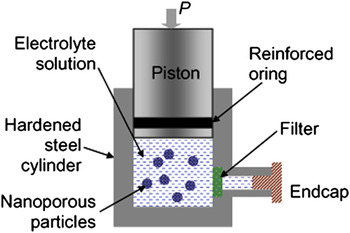
To measure the ion concentration in nanopores, we developed a pressure-induced infiltration (PII) testing system, as depicted in Fig. 1. An air-hardened steel cylinder was used as the container. A side channel was produced so that by slightly loosening the endcapping screw, liquid drops could be harvested when the inner pressure, P, was high. A polyethylene fibrous filter was placed at the inner opening of the side channel, which prevented the suspended particles from entering the side channel.
Schematic of the experimental setup.

A Zeolite Socony Mobil (ZSM)-5 was used as the nanoporous phase. The ZSM-5 was of a regular nanopore structure, with the effective pore size of about 0.7 nm.Reference Lu, Han, Kim, Lim and Qiao11 According to a gas absorption analysis by using a TriStar-2000 Analyzer (Micromeritics, Norcross, GA), the porosity was 220 mm3/g; the Brunauer–Emmett–Teller surface area was around 400 m2/g. The particle size ranged from 5 to 20 μm. The material was received from Zeolyst (Part No. CBV-28014, Conshohocken, PA). It was first vacuum dried at 120 °C for 6 h and then kept in a silicon tetrachloride vapor carried by a nitrogen flow in a vertical furnace at 400 °C for 0.5 h. After furnace cooling, it was washed thoroughly by deionized water and calcined in air at 550 °C for 6 h.
In the steel cylinder, 2.27 g of the treated ZSM-5 crystals was suspended in 5.2 mL of aqueous solution of NaCl. The particles could disperse in the liquid quite uniformly. The initial NaCl concentration, [NaCl], was 3.4 wt% (0.58 M), 8.2 wt% (1.40 M), or 12.2 wt% (2.12 M), measured by a RHS-28 refractometer (Westover, Bothell, WA). The liquid suspension was sealed by a steel piston and the endcapping screw. The endcapping screw was tightened to 0.5 N·m of torque.
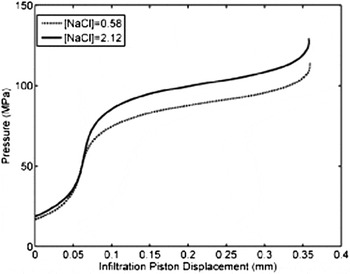
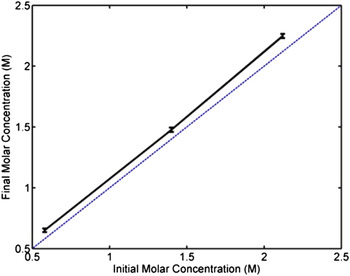
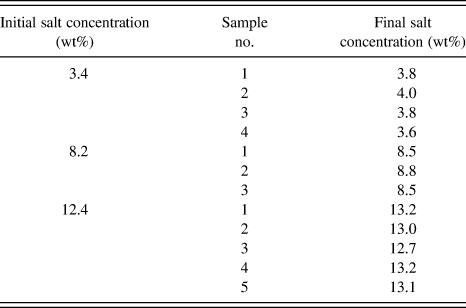
In an Instron 5580 machine (Instron, Norwood, MA), the piston was compressed into the steel cylinder with a constant rate of 1 mm/min, applying a quasi-hydrostatic pressure, P, on the liquid phase. As will be discussed shortly, at a sufficiently high pressure an infiltration plateau could be obtained in the sorption isotherm curve. As the infiltration plateau was completely developed, the piston was kept still by the Instron machine to maintain the high hydrostatic pressure. The endcapping screw was then slightly loosened and a few drop of liquid was collected and its NaCl concentration was measured by the refractometer. Figure 2 shows typical sorption isotherm curves. The behaviors of the ZSM-5 in pure water have been reported elsewhere.Reference Han and Qiao12 Table I and Fig. 3 show the measurement results of [NaCl].
Typical sorption isotherm curves.

Molar concentration variation before and after the high pressure infiltration.

Measurement results of the salt concentrations before and after the pressure-induced infiltration experiment.

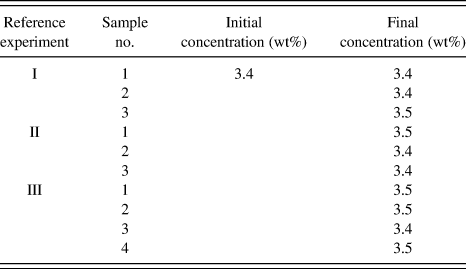
Three reference tests were performed. In the first reference test, only NaCl solution was sealed in the steel cylinder and compressed to 120 MPa. In the second reference test, 5.2 mL of NaCl solution was mixed with 2.27 g of ZSM-5 in the cylinder, but no pressure was applied. In the third reference test, 5.2 mL of NaCl solution was mixed with 2.27 g of ZSM-5 and was compressed to 50 MPa, lower than the minimum pressure that could trigger infiltration. In all these reference tests, no statistically significant variation in NaCl concentration was detected, as shown in Table II.
Measurement results of the reference experiments.

III. RESULTS AND DISCUSSION
The surfaces of the ZSM-5 are hydrophobic, and thus, the nanopores are empty under ambient pressure. In Fig. 2, the horizontal axis is the effective piston displacement, which is defined as the total piston displacement minus the contribution of the linear compression of liquid and the machine compliance, obtained from the first reference test. When the pressure is relatively low, the system is quite rigid. When the initial NaCl concentration is 0.58 M, as the pressure reaches about 60 MPa, the system becomes quite compressible, indicating that the liquid phase is forced into the nanopores.Reference Surani, Kong and Qiao13 As pressure increases, the liquid infiltration continues. When P is about 100 MPa, the infiltration plateau ends; i.e., the nanopores are completely filled.
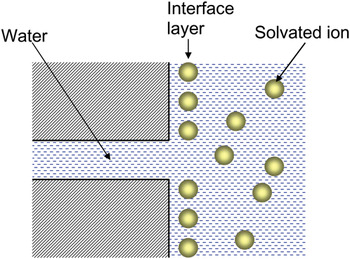
If the effective ion concentration inside nanopores were the same as outside, the NaCl concentration should not vary before and after the experiment. According to the data in Table I and Fig. 3, after the infiltration occurs, the NaCl concentration in the liquid phase outside the nanoporous particles increases by 0.07 M, nearly 12% of the initial NaCl, suggesting that the confined liquid phase has a lower ion concentration. The total pore volume of the 2.27 ZSM-5 is 500 mm3. To achieve the 0.07 M increase in NaCl concentration, almost all the ions in the confined liquid must be repelled out of the nanopores; i.e., the confined liquid is neat water (Fig. 4). This phenomenon is somewhat similar to the recently reported ion exclusion effect of carbon nanotubes.Reference Fornasiero, Park, Holt, Stadermann, Grigoropoulos, Noy and Bakajin14 However, one significant difference is that, in the current study, the nanopore inner surface is highly hydrophobic, and thus, the liquid and ion infiltration is driven by the high external pressure.
Schematic of confined liquid.

The ion sizes of Na+ and Cl− are smaller than but comparable with the nanopore size. According to Fig. 3, as the initial NaCl concentration is higher, there is only a slight variation in the final NaCl concentration. When [NaCl] = 1.4 M, the increase in NaCl concentration is 0.077 M, nearly 5.5% of [NaCl]; when [NaCl] = 2.12, the increase in NaCl concentration is 0.12 M, nearly 5.6% of [NaCl]. The data suggest that, with a relatively high ion concentration, a portion of the ions can enter the nanopores although the [NaCl] of the confined liquid is still much lower than outside. The amount of excluded ions in confined liquid is nearly proportional to the initial ion concentration. These phenomena indicate that (i) the ion repelling is not caused by the relatively large ion size and (ii) the interactions among ions, particularly the interactions between cations and anions, may play a critical role. One possible explanation is related to the interface double layer at the outer surface of a ZSM-5 particle. As depicted in Fig. 4, at the outer surface, ordinary surface polarization should take place, leading to the well-known zeta potential.Reference Sorenson15 If the pore size is large, the electrified outer surface does not have any pronounced influence on the ion behavior. For molecular-sized nanopores, however, each individual ion must move across the surface electric field to enter a nanopore. The zeta potential may help with the infiltration of oppositely charged ions, but will impose a significant energy barrier to like-charged ions. Since formation of monopolar phase is prohibitively difficult, the motion of like-charged ions becomes the “bottleneck,” suppressing the ion infiltration.Reference Lu, Han, Kim, Lim and Qiao11 As the ion concentration in the bulk liquid phase increases, the zeta potential rises nonlinearly, slower than the rate of increase of the required energy barrier of ion repelling, and consequently, partial ion infiltration would occur.
It is clear that the above analysis does not facilitate a definitive understanding of the experimental results. More details of the ion transport behaviors must be investigated through molecular dynamics simulations, which will be an important topic of our future study. Particularly, the relationship between the infiltration pressure, the osmotic pressure, the nanopore size, the free energy of solvation, and the effective interfacial tension will be analyzed; the preference of the entrance of water molecules into the nanopores will be examined, and the optimum ion exclusion condition and the key material parameters that lead to the minimum external work will be identified. Other factors, such as the ion repelling effects of silane groups,Reference Wang and Schaefer16 will also be taken into consideration.
IV. CONCLUDING REMARKS
In conclusion, in a PII experiment, it is noticed that the nanopore walls of a highly hydrophobic ZSM-5 have a strong ion repelling effect. All the ions can be blocked from entering the nanopores if the ion concentration is relatively low. When the ion concentration is relatively high, partial ion blocking is observed. The ion repelling may not be related to the ion size effect but may be associated with the interactions among ions.
ACKNOWLEDGMENT
This work was supported by the National Science Foundation Laboratory under Grant No. ECCS-1028010.