I. INTRODUCTION
Adiabatic shearing is a common form of localized plastic deformation of material under high strain rate loading such as: high speed impact, penetration, erosion, high speed cutting, high speed molding, and explosive cladding. Reference Kennedy and Murr1–Reference Yang and Wang3
At present, due to the limited time for diffusion (in microseconds), the phase transformation under high-strain-rate loading is generally considered to be nondiffusive transformation such as martensitic transformation. Reference Meyers4,Reference Duvall and Graham5 Yuan Reference Yuan, Bian, Jiang, Yang and Wu6 investigated the formation and evolution mechanisms of adiabatic shear band (ASB) in 0.2C5Mn steel and found the fraction of austenite phase is decreased and almost disappeared due to martensitic transformation. And the martensitic transformation was observed in the ASB in several materials such as 304 stainless steel, Reference Meyers, Xu, Xue, Pérez-Prado and McNelley7 and titanium alloy. Reference Wang and Yang8–Reference Yang, Jiang, Zhou, Li, Zheng and Zhang10
Based on our previous work, Reference Li, Yang, Xu, Zheng, Zhu and Zhang11 the precipitates of 2195-T6 aluminum lithium alloy were dissolved instantly in matrix which further confirmed that the diffusive phase transformation took place during adiabatic shearing. According to the phenomenon of instantaneous dissolution of precipitates in the adiabatic shear zone, the thermodynamics, dynamics, and dissolving mechanism of the instantaneous dissolution of precipitates during adiabatic shearing were firstly discussed in the present work.
II. EXPERIMENT
The 2195 aviation aluminum lithium alloy (Al–4.0Cu–1.0Li–0.4Mg–0.4Ag–0.12Zr, wt%) was used in this investigation. The as-received material was previously solution-treated at 773 K for 25 min, and subsequently water quenched, then immediately aged at 453 K for 16 h (peak-aged).
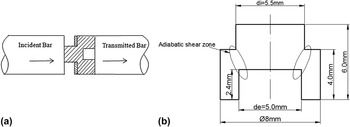
The hat-shaped specimens of the 2195-T6 Al–Li alloy were dynamically compressed using a split Hopkinson pressure bar (SHPB). The material of the incidental bar, the transmission bar, and the striker bar of the SHPB are all TC4 titanium alloy, and they have the same diameters of 14.5 mm. The length of the incidental bar, the transmission bar, and the striker bar are 1200, 1000, and 200 mm, respectively. The apparatus is schematically shown in Fig. 1(a) and the adiabatic shear zone is shown in Fig. 1(b). In this work the specimens were loaded at 293 K.
SHPB: (a) schematic diagram; (b) the hat-shaped specimen.

According to the results of Andrade and Meyers,
Reference Meyer, Manwaring and Murr12,Reference Andrade, Meyers and Vecchio13
the shear stress (τ), strain (γ) and strain rate
 $\left( {\dot \gamma } \right)$
in the shear band were expressed by following Eqs. (1)–(3), respectively. Culver
Reference Culver14
introduced a simple relation between the true strain (ε) and the shear strain (γ) expressed as Eq. (4):
 $$\tau \left( t \right) = {{{E_0}\mathop {{d_{\rm{i}}}}\nolimits^2 {e_{\rm{t}}}\left( t \right)} \over {L\left( {{d_{\rm{i}}} + {d_{\rm{e}}}} \right)}}\quad ,$$
 $$\dot \gamma \left( t \right) = {{2{C_0}{e_{\rm{r}}}\left( t \right)} \over W}\quad ,$$
 $$\gamma \left( t \right) = \int_0^t {\dot \gamma \left( \tau \right){\rm{d}}t} \quad ,$$
 $$\varepsilon = \ln \sqrt {1 + \gamma + {{{\gamma ^2}} \over 2}} \quad ,$$
where E 0 is the elastic modulus (E 0 = 110 GPa for TC4), L and W are the length and width of the shear band, d i and d e are the geometrical parameters of the hat-shaped specimen shown in Fig. 1(b), and e r(t) and e t(t) are the experimentally measured strain of reflected and transmitted stress pulse on the Hopkinson bars.
The chemical attack for 2195 Al–Li alloy was 1.0 mL HF + 2.5 mL HNO3 + 1.5 mL HCl + 95 mL H2O. Investigations of optical microscopy (OM) were performed with a POLYVAR-MET microscope. The samples for transmission electron microscopy (TEM) investigation were cut with a thickness of 0.5 mm along the direction parallel to the sample deformation direction from the hat-shaped specimens by electrical discharge machine. After hand-grinding, the sample was reduced to a thickness of about 0.10 mm, and then the foils were perforated upon the shear band by electro-polishing in solution of HNO3:CH3CH2OH = 1:3 at 243 K. Finally, the foils for the TEM were prepared by the sputter-ion. TEM observations were carried out with a FEI Tecnai G2 20 ST transmission electron microscope and operated at 200 kV.
III. RESULTS AND DISCUSSIONS
A. Dynamic stress–strain response and the deformation parameters in ASB
The starting time for ASB formation was just the instant when the strain rate reached the first vibration peak. Reference Andrade, Meyers and Vecchio13 The strain rate within the shear band can be obtained by Eq. (2). The relation of the true flow stress and true strain in the ASB can be easily obtained using Eqs. (1)–(4), as shown in Fig. 2.
Mechanical response data during formation of ASB: (a) shear signals with hat-shaped specimen attached between the incident bar and transmitted bar, (b) strain rate as a function of time and (c) true shear stress as a function of true strain in ASB during shear deformation.

Figure 2(a) shows the relationship between voltage pulse and loading time in the experiment. The original electric signal in reflected bar and transmitted bar is recorded in this curve. The average strain rate during adiabatic shearing deformation can be calculated from Fig. 2(b) and Eq. (2). It is about 3.2 × 10⁵/s, which is extremely high in comparison with 10−3 to 10−1/s during quasistatic deformation. The adiabatic shearing deformation started from the first peak value of the strain rate to the last loading stress peak. Reference Andrade, Meyers and Vecchio13 The whole process lasted about 71 µs. The strain rate as a function of time is shown in Fig. 2(b), which can be obtained by integrating the SHPB data and parameters into Eqs. (1)–(4). Figure 2(c) shows the deformation characteristics of 2195 Al–Li alloy during the dynamic loading. The maximum stress reached 646 MPa.
The adiabatic temperature rise in the shear band is a significant parameter for the formation of an ASB and the phase transformation. When the strain rate exceeds 103/s, the deformation process of the whole shear area can be considered as the adiabatic deformation. As calculated above, the average strain rate is as high as 3.2 × 10⁵/s, so adiabatic temperature rise in the shear band can be calculated by following equations Reference Yang, Zhang, Li and Li15,Reference Duvall16 :
 $${T_i} = {T_0} + {\eta \over {\rho {C_\nu }}}{S_i}\quad ,$$
 $${S_i} = {{\Delta {\varepsilon _i} \times \left( {{\sigma _i} + {\sigma _{\left( {i + 1} \right)}}} \right)} \over 2},\quad i = \left( {1,2,3, \ldots } \right)$$
where T 0, ρ, C ν, ε, and σ are at room temperature (T 0 = 293 K), the density, heat capacity, strain, and flow stress, respectively. For 2195 alloy, C ν = 902 J/(kg K), ρ = 2470 kg/m3. Generally, the heat conversion coefficient η is 0.9, that is to say, about 90% of the plastic deformation work is converted into heat and about 10% is turned into stored energy, hence it is usually taken as 0.9.
S i is the plastic work per unit area. The dynamic response data in the shear band is shown in Fig. 2(c), which can be divided into lots of continuous blocks with strain increment Δε i , and the area of each block (S i ) can be calculated by Eq. (6). The temperature–time curve can be constructed by substituting S i into Eq. (5), as shown in Fig. 3. The maximum adiabatic temperature rise was 463 K.
Adiabatic temperature rise as a function of time.

In conclusion, there are about five notable characteristics of thermal/mechanical parameters in ASB, such as high adiabatic temperature rise (reached as high as 463 K), high strain rate (average strain rate about 3.2 × 10⁵/s), high strain (about 3.19), high true stress (about 646 MPa), and the short deformation time (just about 71 µs).
B. Instantaneous dissolution of precipitates
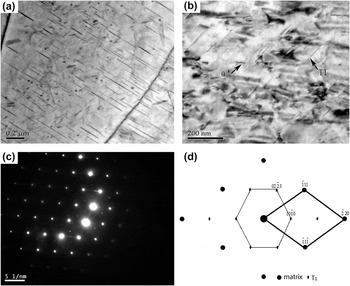
Figure 4 shows microstructures of 2195-T6 aluminum alloy before dynamic loading. The acicular precipitate with an average length of 200 nm is T1 phase, as shown in Fig. 4(a). The bright field image of [110] zone axis in the matrix is shown in Fig. 4(b). It can be observed from Fig. 4(b) that there are a lot of near-vertical acicular T1 phase, small amount of acicular θ′ phase, and few blocky δ′ phase. Figure 4(c) shows electron diffraction pattern of the [110] zone axis and the indexed diffraction pattern is shown in Fig. 4(d). It can be seen that there are two sets of diffraction spots, the bright one has a feature of parallelogram-type characteristic, while the dark has hexagonal feature, as shown in Fig. 4(d). It is deduced that the bright is the diffraction spot of matrix, and the dark is due to T1 phase.
Micrograph of 2195-T6 aluminum alloy before dynamic shear deformation (a) micrograph of matrix, (b) microstructure of the [110] zone axis, (c) electron diffraction pattern of the [110] zone axis and (d) the indexed diffraction pattern.

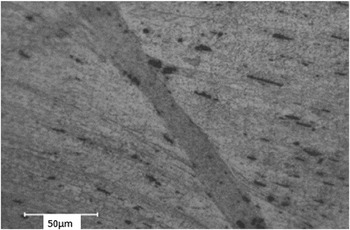
Figure 5 shows the optical micrographs of ASB. The shear-band width is about 20–30 µm, and the microstructure in the shear band cannot be distinguished from Fig. 5.
Optical micrograph of shear deformation zone produced in the hat-shaped specimen in 2195 aluminum alloy.

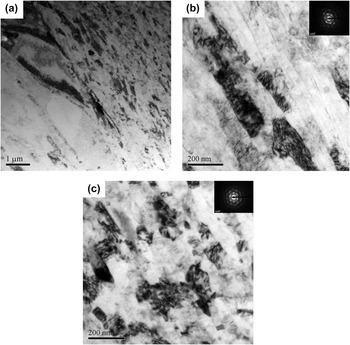
There are elongated subgrains along the shear deformation direction, and the microstructure in ASB has gradually changed from boundary to the internal, as shown in Fig. 6(a). Figure 6(b) shows the elongated subgrains of marginal area in the shear band. The corresponding electron diffraction pattern is a continuous elongated ring. It could be explained that the grains were split into a number of small misorientation subgrains and elongated along shear direction, which induces the shape effect of diffraction spots. As shown in Fig. 6(c), the equiaxed grains formed in the center of the shear band, with grain size of 50–100 nm, which displays the same morphology characteristics with recrystallized grains. The corresponding electron diffraction pattern of the equiaxed grains is polycrystalline pattern of discontinuous ring, which indicated that a large number of high-angle grain boundaries of fine grains exist in this area. The grains in the center of shear deformation zone are significantly refined, and eventually changed into the nanostructure equiaxed grains during adiabatic shear deformation. The rotation dynamic recrystallization mechanism can well explain the possibility of instant and sharp refinement of grains in kinetics, Reference Yang and Wang3,Reference Li, Yang, Xu, Zheng, Zhu and Zhang11 so this issue will not be discussed in this present work. No precipitate phases such as T1 phase, θ′ phase, and δ′ phase were observed in the adiabatic shear zone and no diffraction pattern of precipitates phases was observed in the corresponding electron diffraction pattern (Fig. 6), which indicated that the precipitates were completely dissolved into the matrix during adiabatic shearing. It is a very interesting phenomenon that the diffusive transformation took place during the adiabatic shear deformation, namely the precipitates dissolving in the matrix in the process (within about 71 μs).
Microstructures of the ASB and corresponding selected area diffraction patterns: (a) the boundary between shear deformation zone and undeformed zone, (b) the elongated lath subgrains with no precipitate in the marginal area of the shear band and (c) the nanostructure equiaxed subgrains with no precipitate in the center of the ASB.

C. The dissolution mechanism of precipitates
TEM analysis shows that the precipitates of the 2195-T6 alloy were completely dissolved in grains during adiabatic shearing. There exist several kinds of precipitates in 2195-T6 Al–Li alloy such as T1, θ′, and δ′ etc., but the T1 phase is the main phase. So T1 phase was taken as an example of the precipitates, the dissolution process of T1 phase at high strain rate will be analyzed and a corresponding instantaneous dissolution model will be suggested in the present work.
1. Thermodynamics of precipitates dissolution
From the viewpoint of thermodynamics, the precipitates dissolution in the adiabatic shear zone is due to the disruption of the thermodynamic equilibrium of each phase during adiabatic shear deformation. The shear stress could be reached up to 646 MPa during the shear deformation. A large number of dislocations and serious lattice distortion produced under shear stress, and the free energy of the precipitates and matrix will increase with the increase of lattice distortion energy. But it is well known that the elastic modulus is key characterization for atomic bonding. Therefore, the phases with different atomic bonding energy will produce different distortional energy at the same strain. The phases with high bonding energy are easy to induce lattice deformation, leading to a greater distortional energy. The second phases in the 2195-T6 Al–Li alloy are intermetallic compounds with high hardness and high elastic modulus. A small change of atomic spacing and arrangement of precipitates can greatly increase the free energy of precipitates. And this increasing rate is several times or more than that of aluminum matrix. Reference Liu, Bai, Zhou, Zhou and Gu17 At the same time, T1 phase will be broken from large into small size in the process of adiabatic shear deformation. The pressure within the precipitates will increase due to releasing of surface tension, leading to increase of the free energy of precipitates, which does not happen in the matrix. In addition, in the process of T1 phase size decreasing, the contact surface area between T1 phase and matrix will be increasing, and the surface energy of T1 phase will also increase.
Thus, the free energy of T1 phase was significantly higher than that of the matrix due to stress during adiabatic shearing, which destroyed the energy balance of phases. When the accumulated free energy of T1 phases is larger than that of matrix, then the T1 phases start to dissolve into matrix. In the meantime, the changes of curvature radius of precipitate resulted in change of the solute concentration in matrix after fracture, which destroyed the balance of the concentration of the matrix and T1 phase. And it provided a prerequisite for diffusion of the solute atoms. Therefore, when the free energy difference between precipitates (e.g., T1 phase) and matrix reaches a certain degree, the thermodynamic conditions of precipitates dissolution will be satisfied.
2. The kinetics of precipitates dissolution
The thermodynamic interpretation of phase dissolution was reasonable. However, the kinetics of dissolution of precipitates (e.g., T1 phases) during adiabatic shearing has not yet been illustrated.
There are a lot of researches about the evolution of second phase under the quasistatic (10−3 to 10−1/s) severe plastic deformation. Murayama et al. Reference Murayama, Horita and Hono18 found acicular θ′ transition phase of Al–Cu binary alloy gradually broke down into short chains granules until dissolving into the matrix at room temperature during equal channel angular pressing. Ma et al. Reference Ma, Lu, Qin and Zhang19 and Wang et al. Reference Wang, Shao and Zhen20 have studied the evolution of precipitates in thermal deformation and the result revealed that the precipitates bend, kink, cut off, and finally dissolved into the matrix during the process. Zhang et al. Reference Zhang, Zhang, Cheng and Li21 studied the dissolution characteristics of δ phase under deformation conditions (950 °C, 0.005 s−1) and found the lamellar phase gradually transformed into spherical one under dissolution fracture together with deformation fracture. Wazzan et al. Reference Wazzan and Dorn22 studied the strain-enhanced dissolution in Ni alloy at low strain rate. They considered that the strain rate had a promoting effect on dislocation short-circuiting diffusion and mechanical diffusion apart from the influence of temperature. Ruoff and Balluffi Reference Ruoff and Balluffi23 pointed that the hydrostatic pressure has little effect on the grain boundary diffusion. Morris Cohen Reference Cohen24 put forward a concept of strain-enhanced diffusion that with the strain increasing, the effect of second phase particles dissolve in dislocations for short-range was more obvious. Wazzan, Reference Wazzan and Dorn22 Ruoff Reference Ruoff and Balluffi23 also published related articles that the strain strong increases the diffusion rate of second-phase particles. It can be inferred that the high strain rate strongly increased the diffusion rate of T1 phase. Actually, the hydrostatic stress did not increase the diffusion rate but the shear stress would increase the diffusion rate to some extent, but the effect is not as great as the strain rate.
The dissolution rate of precipitates (e.g., T1 phase) was affected by the high strain rate (3.2 × 10⁵/s), high adiabatic temperature rise (463 K), high stress/strain (646 MPa/3.19), and high density dislocations produced during adiabatic shear deformation. The dissolution of precipitates (e.g., T1 phase) during dynamic loading differs from that under static loading. The dissolution rate of precipitates depends on heterogeneous atom diffusion rate regardless of dynamic loading and static loading conditions. The dissolution time of precipitates under dynamic loading is faster than that under quasistatic loading about 8–10 orders of magnitude. In light of the thermal/mechanical characteristics in the adiabatic shearing, the kinetics of instant dissolution of precipitates will be explored from three aspects in the present work, that is the short-circuiting diffusion of moving dislocations, the mechanical diffusion and the strain rate enhanced diffusion.
The short-circuiting diffusion of dislocations has a great effect on precipitates (e.g., T1 phase) dissolution under a certain circumstance of constant strain rate. Dislocations will be piled up around the T1 phase and then its atoms would be dissolved into the fixed dislocations core. But the moving dislocations can be kept sweeping atoms of precipitate. In this process, the atoms of T1 phase will dissolve into moving dislocations cores and be dragged away from the surface of T1 phase. Therefore, it can be concluded that the movement of dislocations promoted diffusion. T1 phase refines and fracture due to the influence of the external disturbance factors. At the same time, the dislocations around T1 phase would continue to sweep over the breaks, which make the T1 solute atoms dissolve into the dislocations cores.
Mechanical diffusion which was suggested by Ivanisenko Reference Ivanisenko, Lojkowski, Valiev and Fecht25 had great effect on precipitates (e.g., T1 phase) dissolution. T1 phase would be elongated and refined along the shear direction during adiabatic shear deformation. The surface of T1 phase would be burst and refine under the combined effects of shear stress and dislocations, and at the same time it would dissolved in dislocations. Along with the apparent shear deformation of matrix and T1 phase, the solute atoms would be dragged by shear stress and accelerated the diffusion rate. Besides, the high shear stress will also increase the dissolution rate of precipitates.
Atomic diffusion is actually affected by the atomic concentration and chemical potential. The atomic thermal motion is not very intense under static loading, so precipitate dissolution rate is low, and the atomic diffusion distance would be cut down. However, high dislocation density and high adiabatic temperature rise produced under the high-strain-rate loading, which will greatly enhance the dissolution rate of T1 phase. Taking all the diffusion mechanisms dependence of the high strain rate into account, the enhanced diffusion ratio will be obtained as Reference Ruoff26 :
 $${{{D_{\dot \varepsilon }}} \mathord{\left/ {\vphantom {{{D_{\dot \varepsilon }}} {{D_{\rm{l}}}}}} \right. \kern-\nulldelimiterspace} {{D_{\rm{l}}}}} = 1 + K{\left| {\dot \varepsilon } \right|^P}\quad ,$$
 $${D_{\rm{l}}} = {D_0}\,\exp ({{ - Q} \mathord{\left/ {\vphantom {{ - Q} {RT)}}} \right. \kern-\nulldelimiterspace} {RT)}}\quad ,$$
where
 ${D_{\dot \varepsilon }}$
is the diffusion coefficient, is the normal diffusivity in the matrix,
 $\left| {\dot \varepsilon } \right|$
is the absolute magnitude of the strain rate, K and P are temperature-dependent function and pre-exponential coefficient referring to strain rate respectively. The diffusion rate generally increases with the temperature increases, so the K value is greater than 1. P is 1 under static loading.
Reference Ivanisenko, Lojkowski, Valiev and Fecht25
Because the strain rate plays an important role in enhancing diffusion, the P value should be greater than 1 under high-strain-rate loading.
The diffusion distance of heteroatom (X P ) is given by Reference Ruoff26 :
 $${X_P} = 2{\left( {{D_{\dot \varepsilon }}t} \right)^{{1 \mathord{\left/ {\vphantom {1 2}} \right. \kern-\nulldelimiterspace} 2}}}\quad .$$
The following relationship obtained from (7)–(9),
 $${X_P} = 2{\left[ {\left( {1 + k{{\left| {\dot \varepsilon } \right|}^P}} \right){D_0}t\,\exp \left( {{{ - Q} \mathord{\left/ {\vphantom {{ - Q} {RT}}} \right. \kern-\nulldelimiterspace} {RT}}} \right)} \right]^{0.5}}\quad .$$
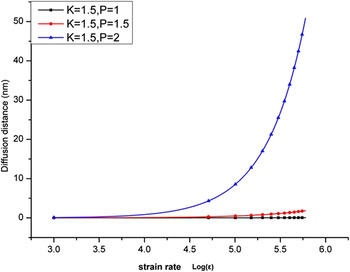
Adiabatic shearing deformation finished within 71 µs in the present work, so that the t = 71 µs. For 2195 alloy, D 0 = 1.71 × 10⁻⁵ m/s, Q = 90 KJ/mol. Reference Dolgopolov, Rodin, Simanov and Gontar27 K is a temperature-dependent parameter and its value is larger than 1, the adiabatic temperature rise reaches 463 K in present work, so the K value could be assumed to be 1.5. The P value should be greater than 1 under high-strain-rate loading, so P value also should be greater than 1, and here it is assumed to be 1.0, 1.5, and 2.0 respectively. The diffusion distance related with strain rate could be shown in Fig. 7. As shown in Fig. 7, the diffusion distance increases with strain rate. When P = 2, the diffusion distance increases sharply with strain rate. And the diffusion distance range is within about one grain size (50–100 nm) in ASB.
Diffusion distance–strain rate curve.

It can be deduced that short-rage diffusion of moving dislocations, the mechanical diffusion and the strain rate enhanced diffusion would be proper to explain the instantaneous dissolution of the precipitates. Hence, it can qualitatively explain the kinetics of instantaneous dissolution of the precipitates during adiabatic shearing.
3. Dissolution model of precipitates
Although precipitates (e.g., T1 phase) in ASB were dissolved into matrix during ∼10−5 s, but it also is still a development process, and this process should include:
-
(1) Dislocation density increased dramatically (especially surrounding T1 phase) at the beginning of deformation, then partially ordered dislocation tangles formed dislocation cells or subgrains as the deformation continuing. At the same time the T1 phase was elongated together with subgrains along the shearing direction. The perturbation of the elongated T1 phase occurred under the joint actions of the shear stress, dislocations, and atoms diffusion, which induced longitudinal shape of T1 phase instability and then led T1 phase to fracture. Finally the T1 phase broke into small size. The broken T1 phase would repeat the above process.
-
(2) At the same time, a large number of dislocations piled up around the T1 phase during the process of deformation. With the decrease of T1 phase size, the increasing surface area and the probability of contact with dislocations, which led to the dissolution rate of T1 phase greatly increased due to the action of the shear stress and adiabatic temperature rise.
-
(3) The size of the T1 phase would get smaller and smaller under the joint action of the perturbation, dislocations, and diffusion. The solubility of the T1 phase will increase with the decrease of its size in light of Gibbs–Thomson equation, which accelerates the dissolution rate of the T1 phase and finally lead to dissolving of the T1 phase.
An instantaneous dissolution model accompanied by perturbation and diffusion could be established from the above analysis, as shown in Fig. 8.
T1 phase dissolution process: (a) T1 phase before deformation, (b) T1 phase elongated and dislocation density near T1 phase increased dramatically during shearing, (c) T1 phase surface scratch to perturbation with the joint actions of shear stress, dislocation and atom diffusion, (d) the elongated T1 phase broke into small size T1 phase by the effect of perturbation, dislocation and diffusion, (e) the small size T1 phase spheroidized and finally dissolved into matrix.

IV. CONCLUSIONS
The 2195-T6 Al–Li alloy was dynamically compressed by means of Hopkinson pressure bar. The analysis and calculation of experimental data indicated that the maximum adiabatic temperature rise reached 463 K, the strain rate was as high as 3.2 × 10⁵/s, the shear strain was 3.19, the shear stress attained 646 MPa in ASB, and the adiabatic shear deformation finished within 71 µs.
The width of ASB is about 20–30 µm. Nano-grains (50–100 nm) were observed in the middle of shear zone. What is more remarkable is that the observation of the diffusive transformation at high strain rate, that is to say the precipitates were dissolved into matrix within 71 µs during the adiabatic shear deformation.
The precipitates (e.g., T1) were fractured and refined during shearing deformation, making its surface energy and distortion energy increasing, finally resulted that the free energy of precipitates was much higher than that of matrix. The difference of free energy between the precipitates and the matrix would get bigger with the decreasing of T1 phase size. The precipitates would be finally dissolved into matrix when the difference of free energy reached a critical value.
The high shear stress, high dislocations density, high adiabatic temperature rise, and high strain rate produced during the adiabatic shearing, which promoted dissolving of the precipitates. The dissolving rate and diffusion distance of solute atoms would increase dramatically during adiabatic shearing. The short-circuiting diffusion of moving dislocation, the strain rate enhanced diffusion and the mechanical diffusion would promote precipitates to dissolve in a very short time.
Based on the analysis of the thermodynamics and kinetics of instantaneous dissolution of precipitates (e.g., T1) during adiabatic shear deformation, an instantaneous dissolution model accompanied by perturbation and diffusion was suggested.
ACKNOWLEDGMENTS
This work was supported by the National Natural Science Foundation (No. 51274245, No. 51574290), NSAF (No. U1330126), the Ph.D. Programs Foundation of Ministry of Education of China (No. 20120162130006), the Hunan Provincial Natural Science Foundation of China (No. 14JJ2011), and the key project of State Key Laboratory of Explosion Science and Technology (No. KFJJ11-1).