1 Introduction
Many people share the intuition that the notion of a subject is, at least in part, an information structural one (see Vallduví Reference Vallduví1992). This idea raises interesting questions about the role of the passive construction in the discourse, and how the passive may be used to manipulate information structure by promoting an internal argument to subject. Seoane (Reference Seoane, van Kemenade and Los2006) and Los (Reference Los2009) propose that in English, the passive construction is used more extensively and in more constructions than in the other Germanic languages in order to compensate for the lack of verb-seconding (V2) word order options, which enable other means of placing topical information at the left edge. Seoane, in particular, suggests that a rise in the frequency of passives in English may be linked to the loss of unmarked topicalization as a strategy to place given information before new.
We are interested in a somewhat simplified hypothesis based on Seoane's (Reference Seoane, van Kemenade and Los2006) proposal: if the rise in passives was linked to the loss of V2-like word orders in English, then we would expect independent evidence that passivization and unmarked object topicalization are pragmatically equivalent strategies to promote a given or topical object. We re-examine this hypothesis from a quantitative perspective and find that, upon further examination, the claims do not hold. The changing frequency of passivization reported by Seoane will be related to effects evident only in specific text styles and genres, of which narratives are not strongly represented. Effectively, perceived change in the rate of passivization in English, and a perceived difference between English and other Germanic languages in this domain, seems to be caused by the availability (or absence) of different strategies for forming impersonal clauses.
The findings shown here in brief represent part of a larger, ongoing study into the syntactic and pragmatic properties of passivization in Germanic languages. The current work focuses in more detail on one additional finding, which demonstrates a ME dialect difference in the syntax/information structure interface. While the New Testament translations provide evidence that the overall rate of passivization remains stable across the history of English in one context, we find, in contrast, a significant difference in the rate of passivization between three translations of the Rule of St Benedict. These texts represent an OE and two ME translations: one Northern translation (the Northern prose Rule of St Benet), and one Southern translation (by William Caxton). The surprising fact revealed by these data is a dialect distinction in ME: the Northern translation passivizes at a significantly lower rate. Working from the initial hypothesis which connects the loss of V2 with increased strategies for creating subjects (like passivization) explored by Seoane (Reference Seoane, van Kemenade and Los2006) and Los (Reference Los2009) one might hypothesize that this is related to a difference in the clausal syntax of the ME dialects considered.
On the contrary, we find that the ME dialect data actually falsifies the hypothesis that the rate of passivization is related to the amount of V2 syntax. Although Northern ME does show a great deal more V2 than Southern ME, closer studies reveal that the difference in passivization is entirely unrelated to V2. Unlike the New Testament, which is primarily a narrative, the Rule of St Benedict text is written as a set of instructions, and passivization is primarily a strategy for expressing clauses in which no agent can be specified (i.e. the agent is often an unspecified authority figure). We find that where the Southern translation of the Rule of St Benedict uses a passive, the Northern translation frequently expresses the same content via an active clause with impersonal man in the subject position. While clauses with impersonal man can be found in both the Northern ME and OE translations of this text, it is wholly absent from the Southern ME translation.
Our result therefore suggests an unexpected dialect difference in the ME period: if the findings from the Rule of St Benedict are indeed representative of the dialect situation at this time, the Southern dialect of ME appears to entirely lack a strategy for forming impersonal clauses which can be readily found in Northern ME and in OE. This, in turn, leads to a rise in the rate of passivization, as passive clauses are used to compensate for the missing strategy. Since the difference in impersonal constructions accounts for the difference in passivization, V2 cannot be a factor.
The paper will be organized as follows. Section 2 will discuss the methodology to be used in the current study, and demonstrates how quantitative data may contribute to our understanding of information structure from both synchronic and diachronic perspectives. Then, in section 3, we will introduce the relevant background on passives and impersonals in the history of English. Section 4 will discuss the results of the study in detail, and finally, in section 5, we will conclude.
2 Using corpora for information structural research
Roughly speaking, information structure considers the ways in which a speaker uses the syntactic and prosodic structures made available by their language to organize the information to be conveyed to a hearer. In many ways, information structure is a very new subfield of research in linguistics, and it remains an area in which theoretical work continues to be tentative and, frequently, contradictory. In addressing questions about information structure, one may ask a number of related questions, including: (1) how can speakers manipulate syntax to signal information structure; (2) how does this look different (or similar) when we compare languages with different syntactic options and constraints; and (3) how can we generate and test hypotheses about these questions rigorously? This section will focus in on the third question, and briefly consider the types of evidence that may support theoretical research in the domain of information structure. The key outcome of our discussion will be to motivate our own use of quantitative corpus data to address questions of this sort.
Constructed data, native speaker intuitions, and experimental work all have an important role to play in linguistics. In terms of information structure, crucially, constructed data allow us to control for context. However, constructed data also involve serious drawbacks in a field where even the questions under consideration remain uncertain. The examples considered will be largely limited to the expectations of the researchers, and thus may disregard some contexts or constructions that could prove centrally relevant to the phenomena considered (see Milroy Reference Milroy2001).
Collected naturally occurring examples, in contrast, are tricky to interpret in terms of information structure, because it is much more difficult to control for context. It is even more problematic to use collections of naturally occurring examples to do cross-linguistic comparative research, because both context and other concerns become increasingly hard to control for across languages. For any specific phenomenon, such work is painstaking, and offers only limited gains.
Another alternative, to be used in addition to supporting evidence from such resources as those mentioned above, is quantitative data extracted from annotated corpora. Using corpora that have been annotated for part of speech and phrase structure, relevant examples can be extracted using automatic search algorithms, allowing one to rapidly collect large sets of naturally occurring examples of any given phenomenon.
It is important to note that the use of corpus data for information structural research is not necessarily straightforward either, of course. Most existing parsed corpora are not annotated for information structural information; in fact, attempts to annotate for information structural categories have met with a variety of challenges (see, for example, Bech & Eide Reference Bech and Eide2011; Cook & Bildhauer Reference Cook, Bildhauer, Dipper and Zinsmeister2011; Kallen & Kirk Reference Kallen and Kirk2012). Attempts at information structural annotations are found to be inconsistent, and studies suggest that we require a deeper theoretical understanding to properly implement them.
Many of the problems may come from the attempt to apply pre-theoretical assumptions to quantitative data; as mentioned previously, information structure is a relatively young subfield within linguistics. One cannot reliably annotate a text for information structural categories when our understanding or identification of these categories remains in flux.
However, unlike production data or collections of naturally occurring examples that have been gathered individually, corpora allow massive sets of naturally occurring examples with the context intact and retraceable. Furthermore, parsed corpora are pre-existing resources, which have been assembled to be used to approach a wide variety of theoretical or descriptive questions. As such, they can provide a data set that is much less biased by the researcher's expectations.
Corpora do, however, share some of the disadvantages of other production data; in particular, unlike constructed examples, we still cannot control for context. We attempt to solve this problem in part by making use of a new type of corpus resource, parallel parsed corpora, as an innovative tool for comparative information structure analyses.
Parallel parsed corpora can be constructed using a single text with multiple translations, spanning either multiple languages or multiple stages in the history of a single language; in some cases, comparison both within and across languages can be possible using such datasets. The most salient text that can be used for parallel corpus building is the New Testament, which has been translated into a large number of languages, and frequently multiple times within a single language. Although not all translations of the New Testament are suitable for work of this sort, many can be, and have been, used to support comparative work using corpus data (see, for example, Resnik et al. Reference Resnik, Olsen and Diab1999).
Significantly, for work in information structure, parallel parsed corpora allow certain benefits that other corpora lack. Since each of the texts to be compared is conveying identical information in the same sequence, the context, as well as general stylistic properties, can be somewhat controlled for between the parallel texts. A researcher can search for a construction of interest within any of the parallel languages, and compare across all of the languages represented within the corpus. Especially where the languages or varieties are known to differ in the availability of certain syntactic options, this allows us to investigate the different choices that each translation makes, given the same source. In this case, the fact that New Testament translations are notoriously conservative gives us an interesting advantage, since it makes it more likely that where the texts can be held constant, they will be.
This article can, in part, be taken as a demonstration of the sort of results that can come from analyses based on parsed corpora, and parallel parsed corpora, in particular, when investigating specific information structural phenomena in related languages. In the following sections, we will develop an investigation of impersonal constructions in the history of English, using quantitative corpus data as the core of our study.
3 Passives and impersonals in the history of English
3.1 Previous studies
Los (Reference Los, Fanego, López-Couso and Pérez-Guerra2002), Seoane (Reference Seoane, van Kemenade and Los2006) and Los (Reference Los2009) investigated a change in the use of passive constructions in the history of English. When viewed broadly, the overall rate of passivization in English has risen significantly since the OE period. Furthermore, they also noted the appearance of new passive-like constructions, such as the so-called ‘prepositional passive’, or pseudo-passive, as in (1). Here, the promoted subject of the passive appears to be extracted from the complement of a preposition.
(1) The cat1 was stepped on t 1.
If both the overall frequency of passives and the availability of different passive-like constructions has increased over time, what might have motivated this change? Los and Seoane suggest that the rise in English passive has an information structural cause: as the language lost certain word orders available in OE, other word orders were commandeered to accomplish the same information structural goal. Seoane (Reference Seoane, van Kemenade and Los2006) presents the hypothesis that descriptively XVS and XSV word orders, in the OE V2-like system, have an information structurally equivalent effect to passivization, namely, each promotes topic-like elements to the left edge.
In V2 languages, like German, the finite verb moves into the C domain; traditionally, it is assumed to occupy C. Only one constituent may then move into the preverbal position (assumed to be Spec, CP). By default, this will be the subject; but in cases of topicalization, some other XP is seen to fill the preverbal position. In this case, topicalization leads to inversion of the subject and the finite verb, creating the typical V2 order.
OE did not have V2 syntax of exactly the type observed in a language like German, as has been well known at least since van Kemenade (Reference Kemenade van1987). In a typical indicative main clause, the subject type played a particular role in OE-style V2 (see Pintzuk Reference Pintzuk1991; Fischer et al. Reference Fischer, van Kemenade, Koopman and van der Wurff2000). Although topicalization triggered subject–verb inversion with full DP subjects, it did not trigger inversion with pronominal subjects, resulting in the word order XPTOP > SUBJPRO > VFIN.
Accordingly, it has been generally accepted since Pintzuk (Reference Pintzuk1991) that the finite verb did not move as high as C in most OE main clauses (with certain exceptions). Between the landing site of fronted constituents and the finite verb was the obligatory position for pronominal subjects, while full DP subjects could appear either above or below the finite verb (see Haeberli Reference Haeberli1999, Reference Haeberli, Pintzuk, Tsoulas and Warner2000, Reference Haeberli2002a, Reference Haeberli and Lightfoot2002binter alia for a full analysis of the two OE subject positions). Thus, most OE V2 orders were the result of nominal subjects appearing in the low subject position, with the finite verb in an IP-domain head (e.g. Tense or Agr). As Haeberli has shown, these V2-like word orders disappeared over time as the grammar of English changed to lose one of the subject positions.
Although this is not ‘true’ V2 of the German type, it did allow V2-like word orders with topicalized objects. Although object topicalization of accented, contrastive objects remains possible in Modern English, topicalization of unaccented objects disappeared after the OE period. It is frequently believed that this is directly or indirectly due to the loss of V2-like word orders. Speyer (Reference Speyer2010) notes that personal pronouns can topicalize in OE, as in (2) and (3), but the rate of pronoun topicalization rapidly declines in ME, in parallel with the loss of V2-like word orders.
(2)

(3)
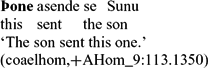

This is the type of construction that Seoane (Reference Seoane, van Kemenade and Los2006) seeks to link to the rise in passivization in the history of English. As English loses the ability to generate V2 word orders, and the language becomes more rigidly SVO, passivization becomes the preferred construction to promote a non-subject argument to a high, unaccented position.
Conceptually, this may be clarified by comparing Modern English to German. Consider an example from Luther's Septembertestament, in (4a). The final clause of this text segment, das hat eyn feyndt than, demonstrates topicalization of a demonstrative pronoun, followed by the subject–verb inversion characteristic of a ‘true’ V2 language, in this case German. Example (4b) offers our constructed translation of the key clause into English: plausibly, one may replace the unaccented topicalization of German with passivization in English. Both offer an opportunity to take a verbal argument and place it at the left edge of the clause, without adding a marked accent, as is obligatory in non-V2 topicalization (see Speyer Reference Speyer2010; Light Reference Light2012).
(4)

According to this hypothesis, both unaccented topicalization and promotion of an argument to subject position in the passive result in marking the DP as informationally topical and/or thematic. Thus, the rise in passivization can be seen as a strategy to compensate for the loss of V2 word orders.
This argument has intuitive appeal, and the information structural/pragmatic assumptions have a great deal of support in the general literature on these constructions. Many general studies on information structure have suggested that unmarked elements at the left edge have the same information structural properties and functions, regardless of their syntactic properties (see for example Vallduví Reference Vallduví1992; Lambrecht Reference Lambrecht1994). The proposal supported by Seoane (Reference Seoane, van Kemenade and Los2006) and Los (Reference Los2009) hinges on such claims, and builds a diachronic account to fit them.
3.2 Old hypothesis, new experiment
The current study began with the following question: how can we investigate the Los and Seoane hypothesis in a more rigorous, quantitative way? Can we examine that hypothesis without relying on speculative assumptions about the basic properties of ‘topics’ (especially since there is no consensus in the field that such a unitary category even exists)? Finally, can we find a way to compare passivization and object topicalization directly?
A careful use of diachronic cross-linguistic, and cross-dialectal corpus data makes this possible. The current study quantitatively compares English to Germanic languages which allow unaccented object topicalization. We also quantitatively compare historical stages of English, and then use parallel parsed corpora in order to make a more detailed investigation of individual utterances containing passives, direct object topicalization, and impersonal constructions. The quantitative and parallel-corpus methods are able to inform our understanding of the information structure of these constructions, without relying on specific assumptions about information structural primitives.
Our quantitative study relies on samples from five highly accurate (i.e. hand-corrected) parsed corpora (or ‘treebanks’): the Icelandic Parsed Historical Corpus (IcePaHC; Wallenberg et al. Reference Wallenberg, Ingason, Sigurðsson and Rögnvaldsson2011), the York–Toronto–Helsinki Parsed Corpus of Old English Prose (YCOE; Taylor et al. Reference Taylor, Warner, Pintzuk and Beths2003), the Penn–Helsinki Parsed Corpus of Middle English, 2nd edition (PPCME2; Kroch & Taylor Reference Kroch and Taylor2000), the Penn–Helsinki Parsed Corpus of Early Modern English (PPCEME; Kroch et al. Reference Kroch, Santorini and Diertani2004) and the Parsed Corpus of Early New High German (PCENHG; Light Reference Light2011).
Each of these has a parsed sample of the New Testament, which includes the Gospel of John (20,000 words): the Icelandic translation by Oddur Gottskálksson, date: 1540; the Early Modern English (EModE) translation by William Tyndale, date: 1525/1534; and the Early New High German (ENHG) translation by Martin Luther Septembertestament, date: 1522. Note that these translations are a particularly good comparison set, as they are contemporary with each other, and all are Protestant Bible translations, and so meant for use by the general literate public. The close timing of the translations also means that the translation influence is mostly Lutheran, rather than from a mixture of sources, and the style and goals of the translators are very similar. The PPCME2 and YCOE also contain samples of earlier New Testament translations into ME and OE, which we compare with Tyndale's translation in section 4.1.
The results from this parallel corpus will then be compared to a study of three translations of the Rule of St Benedict: OE (eleventh century), from the YCOE; Northern ME (fifteenth century), from the PPCME2; and Southern ME (fifteenth century), a text by William Caxton which we parsed and hand-corrected for the purposes of this study.Footnote 1 Like the New Testament subcorpus, these are all translations of the same text, but not slavish ones. Using these texts, we are thus able to compare the use of passives not only across the dimension of time, but also across syntactically distinct dialects within Middle English.
4 Results
In the following section, we will begin by reviewing the quantitative results from the New Testament study, which set the groundwork for our findings. These will then be compared to the findings from the Rule of St Benedict in section 4.2, to determine how these texts differ. Finally, section 4.3 will consider how a more fine-grained investigation of individual example sentences can shed light on the quantitative patterns observed.
4.1 The New Testament parallel subcorpus
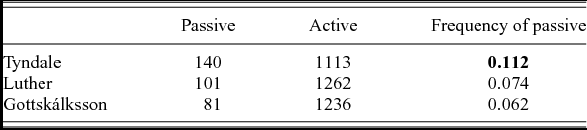
First, we quantitatively tested the most basic hypothesis: passivization and unaccented topicalization serve the same information structural purpose. What we find is that the data do not support the intuitively favourable hypothesis from Los and Seoane. As will be explained, while a superficial consideration of the corpora initially suggest that there is a relationship between passivization and unaccented topicalization, on a more detailed investigation of the corpora, we find that the higher rate of passives in Modern English cannot be directly related to the loss of unaccented topicalization. Instead, it is associated with completely different (and unexpected) factors. Ultimately, the data guide us to a surprising result, which, in turn, lead us to revise our theoretical assumptions. We compared samples from the three contemporary (to each other) translations of the New Testament. The German and Icelandic translations represent two languages in which unaccented object topicalization is expected. The Los and Seoane hypothesis makes the simple prediction that these languages should passivize at a significantly lower rate than English.
While this does turn out to be the case, we will ultimately reject the hypothesis above on the basis of further data from the history of English which demonstrates that the difference between English, Icelandic and German should instead be explained by the confounding factor of other possible impersonal constructions.
As shown in table 1, the EModE translation of John does indeed show a significantly higher frequency of passives than both the ENHG and sixteenth-century Icelandic do.
Comparison: sixteenth-century New Testament translations into English (by Tyndale), German (by Luther), and Icelandic (by Gottskálksson)
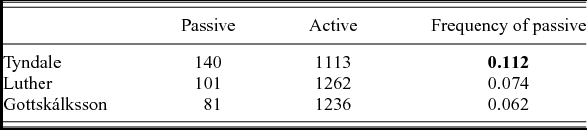
EModE vs ENHG: χ 2 = 10.569 on 1df, p = 0.00115
EModE vs Icelandic: χ 2 = 19.9766 on 1df, p ≈ 0
ENHG vs Icelandic: χ 2 = 1.4862 on 1df, p = 0.2228
On the face of it, these data seem to support the hypothesis that V2 topicalization and passivization are information structurally equivalent. However, a further comparison of New Testament translations from different periods of English shows that this interpretation cannot be correct. (We will return to this and give a full explanation for the effect found in table 1 when we present the verse-by-verse study in section 4.3.)
To further test this, we consider change across the history of English. Another critical element of the Seoane (Reference Seoane, van Kemenade and Los2006) hypothesis is the assumption that the rising rate of passives in English is related to the loss of V2 word orders. For this, we run similar queries to those presented in the cross-linguistic comparison, but now on different historical stages of English. In brief, we expect to find a difference, parallel to the one illustrated in table 1 for English, German and Icelandic, between OE and later stages of the language.
To this end, we compared the Tyndale EModE translation to older available New Testament translations. The Wycliffe translation is a partial sample of the Gospel of John translated into ME (included in the PPCME2 corpus). The West Saxon Gospels contain an OE translation of all four Gospels (included in the YCOE corpus).
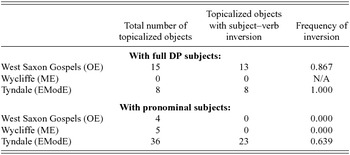
Crucially, these three translations represent different syntactic realizations of the V2 constraint, giving a meaningful sample of different stages of the change that Seoane (Reference Seoane, van Kemenade and Los2006) links to the rise of passivization in English. Consider the rate at which object topicalization triggers subject–verb inversion in each text, in table 2.
Verb-second orders for clauses with a topicalized object in New Testament translations from three periods of English

Each of the New Testament translations seems to represent a different level of access to a V2-generating grammar. The West Saxon Gospels have OE-style V2 orders: subject–verb inversion occurs with full DP subjects (which occupy a low subject position), but not with pronominal subjects (which occupy a high subject position, above Tense). The Wycliffe translation, in comparison, has no object topicalization of any kind, and no subject–verb inversion with topicalized objects. Finally, the Tyndale translation, possibly due to influence from the Luther New Testament, has a high rate of subject–finite-verb inversion with topicalized objects, and in fact allows inversion with all subject types. This text thus seems to show some access to a generalized V2 grammar.
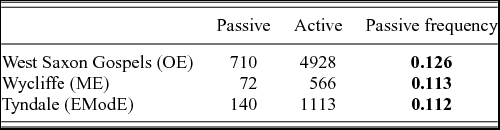
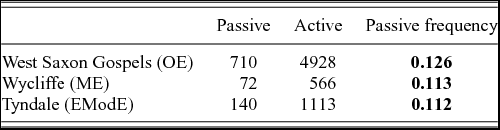
These, thus, allow us to investigate the proposed link between the loss of V2 and the frequency of passivization across the history of English. The raw frequencies of passivization in each text, shown in table 3, are nearly identical across the three translations, against all expectations. The different levels of access to V2-generating grammars do not seem to affect these authors’ use of the passive at all. This finding suggests a challenge to the claim that these two changes are directly linked.
Passive–active comparisons in New Testament translations from three periods of English
4.2 The parallel St Benedict subcorpus: English diachronically and cross-dialectally
Although we have found reason to challenge our hypothesis by considering the rates of passivization across New Testament translations in different stages of English, another test is necessary to confirm that the challenge holds.
Extrapolating from Seoane's proposal, we have hypothesized that varieties of English with higher frequencies of V2 word orders should show lower frequencies of passivization. To further explore this, we compared three translations of the medieval Latin Rule of St Benedict into OE and ME, i.e. the eleventh-century Anglo-Saxon Benedictine Rule, the Northern ME prose Rule of St Benet (1425), and William Caxton's abridged translation of it into Southern ME published in 1490. The OE version of the Rule is found in the YCOE (Taylor et al. Reference Taylor, Warner, Pintzuk and Beths2003), from the Schröer (1885–8) edition; the Northern Prose Rule is found in the PPCME2 (Kroch & Taylor Reference Kroch and Taylor2000), from the Koch (Reference Koch1902) edition; and our parsed (and hand-corrected) William Caxton version of the Rule is also from the Koch (Reference Koch1902) edition.
It is important to be aware that these texts cannot be considered strictly parallel in the manner in which the set of New Testament texts are. This is because the OE text is intended to be a faithful translation of the Latin original while the Northern prose Rule and Caxton's translation of it are not. The Northern Rule of St Benet is an adaptation of the Rule of St Benedict (for monks) directed at nuns and the management of a convent, and Caxton's Rule is, instead, an abridged translation with some paraphrasing of verses in the original. Nevertheless, the texts comprise a corpus which is well balanced for style/genre, and many of the verses do, in fact, match, and are clearly translations of the same source material.Footnote 2
This constitutes a small, semi-parallel corpus that includes two time periods in English which are known to have divergent strategies for clausal syntax producing different frequencies of V2 and non-V2 patterns. In addition, the corpus includes two dialects of ME which are also known to vary with respect to their V2 (and non-V2) syntactic preferences. Importantly, Northern ME, which is very well exemplified by the Northern prose Rule as it originates in an isolated dialect area, has Icelandic-type V2 syntax due to language contact with Scandinavian varieties (Kroch et al. Reference Kroch, Taylor, Ringe, Herring, van Reenen and Schøsler1995; Kroch & Taylor Reference Kroch, Taylor, van Kemenade and Vincent1997). OE likewise has a V2 option due to the low subject position (see Haeberli Reference Haeberli1999, Reference Haeberli2002a, Reference Haeberli, Batllori, Hernanz, Picallo and Roca2005), but also many non-V2 orders. Southern ME (typified by the Caxton 1490 translation), in contrast to the Northern prose Rule, shows some of the OE pattern, but also incorporates many modern English non-V2 sentences in the later period.
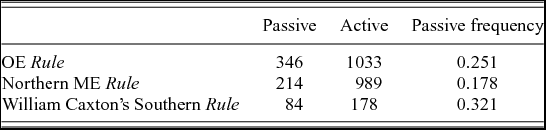
As table 4 shows, the Rule of St Benedict/St Benet translations give a result unlike that shown in the New Testament parallel texts, i.e. different rates of passivization are attested in each corpus. As in the cross-linguistic New Testament comparison, varieties with a V2 grammar have a significantly lower frequency of passivization. Northern ME, which has strict, Scandinavian-type V2, has the lowest frequency of passivization of all three. OE, which does have a V2 option due to the presence of low subjects, still has a significantly lower frequency of passivization than the Southern ME text.
Comparison: Rule of St Benedict translations from three periods of English
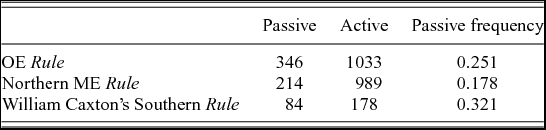
OE vs Northern ME: χ2 = 19.7409 on 1df, p ≈ 0
OE vs Southern ME: χ2 = 5.1774 on 1df, p = 0.02288
OE vs North ME vs. South ME: χ2 = 34.1658 on 2df, p ≈ 0
At first glance then, we seem to find a contradiction between the data found in the New Testament and St Benedict subcorpora: one outcome seems to support the original hypothesis, while the other does not. On the basis of this contradiction, therefore, a more fine-grained examination of the texts seems justified so as to properly account for the differences in the frequency of passivization between them all.
4.3 Comparison of individual verses
By comparing different translations of a single text, we are given an opportunity to weigh up the use of passivization not only on a broad quantitative level, but also more directly. Where a passive construction in one language or variety has been translated as a non-passive elsewhere, we may look more closely to see what syntactic choice was made in place of the passive. This allows us to undertake a more meaningful study of how different languages may choose to encode the same informational content.
As we have seen, the quantitative data alone could lead us in opposing directions since comparisons across different subcorpora seem to either support or refute the predictions that follow from Seoane's (Reference Seoane, van Kemenade and Los2006) basic claim. It is only by following through with a more nuanced investigation that we may clarify this scenario, and begin to make sense of the apparently conflicting results.
A verse-by-verse comparison of the two divergent subcorpora reveals that clauses produced using a passivization strategy do not generally correspond to those with unaccented V2 topicalization. Instead, other interesting patterns become apparent. To begin with, we performed this type of comparison on the three New Testament translations by Luther, Gottskálksson and Tyndale.
In the Luther text, there are 35 non-passive clauses corresponding to passives in the Tyndale translation. Of these, 10 (28.6%) use the German verb werden (‘become’). An additional 9 (25.7%) are translated as reflexives in the German version. Five (14.3%) correspond to intransitives in the German, and 6 (17.1%) to transitive clauses. Crucially, 33 out of 35 (94.3%) non-corresponding clauses had the same referent as the structural subject in the Luther translation as they did in the Tyndale translation.
In Gottskálksson's translation, there are 77 non-passive tokens corresponding to passives in the Tyndale translation. Of these, 50 (64.9%) correspond to -st middle verbs in Icelandic. Another 11 (14.3%) correspond to copular constructions with adjectival predicates. Only 9 (11.7%) correspond to active clauses. The remaining 7 represented other constructions, but showed no reportable pattern. Ultimately, though, 72 out of 77 (93.5%) non-corresponding clauses have the same referent as the structural subject in the Gottskálksson translation as they do in the Tyndale one, including 49 out of 50 of the middle and 8 out of 9 of the active expressions.
A demonstration of the patterns found across the three languages is shown in examples (5) and (6). In each, the English Tyndale translation uses a passive construction. In (5), this passive corresponds to a reflexive in the German, while in (6) the German translation instead uses an active construction with the verb werden. In both cases, these correspond to middle constructions in the Icelandic version.
(5)
(6)


This seems to suggest crucial facts about the information-structural properties of the subject position, namely: (i) the three translations prefer to express the same entity as subject, regardless of clause type and (ii) each language uses different syntactic resources to convey subjecthood to particular entities in the clause.
Although Tyndale and Gottskálksson were strongly influenced by Luther's translation, this alone cannot account for the effect observed here, as the earlier ME Wycliffe translation proves. We can compare this text to Luther's German translation as an additional test. In the Wycliffe translation sample, there are 27 passives which correspond to non-passives in the version by Luther. Of them, 24 (88.9%) have the same referent as the structural subject.
Wycliffe's translation was written at least a century prior to Luther, and thus the close relationship of influence cannot be at play here. However, the effect is still very visible. We can thus conclude that the pattern observed in the Tyndale and Gottskálksson versions cannot be traced back to a translation effect.
According to the data in the New Testament subcorpus, the difference between German, English, and Icelandic comes down to this: German and Icelandic have a wider variety of means to place any given DP into subject position. Where its relatives are able to use options like the reflexive and middle constructions demonstrated above, English compensates for the unavailability of these constructions by substituting passives. This accounts for the higher rate of passivization in English without making any reference to the presence or absence of V2.
This much provides a relatively comprehensive picture of the patterns seen in the New Testament translations. Interestingly, we find a completely different pattern in the Rule of St Benedict subcorpus. As a result, we considered each attested example of a passive in the Southern Caxton translation of the Rule of St Benedict, and compared it to the corresponding verses in the Northern prose Rule of St Benet translation. Of these 84 tokens, 19 had no corresponding verse, and thus could not be included in the comparison. 15 of the remaining 65 were also passives in the Northern Rule. This left 50 clauses in which a passive in the Southern Caxton version was translated as a non-passive in the Northern St Benet.
Unlike the New Testament subcorpus, the difference between these texts does not point to the special status of subjects and instead, we found other patterns to distinguish them. The most striking fact is that 13 of those 50 tokens (26%) involved an instance of impersonal man as the subject of a transitive in the Northern Rule, corresponding to a passive in the Southern Caxton version. Examples (7) and (8) show two such cases. In comparison, only 3 (6%) of the passive subjects in the Southern Rule of St Benedict translation correspond to a topicalized object in the Northern Rule of St Benet, suggesting little or no correlation between passives and object topicalization.
(7)
(8)


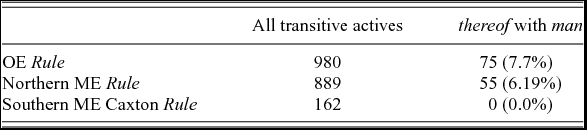
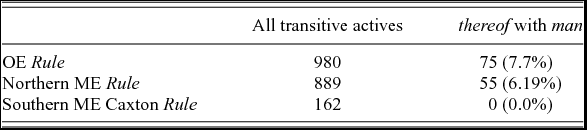
Here, another change appears to have contributed to the rise of passivization, one which has been discussed elsewhere in Los (Reference Los, Fanego, López-Couso and Pérez-Guerra2002). Impersonal man represents an alternative to the passive which was available to the Northern ME and OE translators, but not to the author of the Southern Caxton translation. Overall, impersonal man was a fairly common option in both the OE and Northern ME translations, but would have been entirely ungrammatical for the translator of the Southern Caxton version, as table 5 confirms. While the OE and Northern ME Rule translations use impersonal man in 6–8% of all transitive active clauses, the Caxton version does not use the impersonal man option even once.
Impersonal man in Rule of St Benedict/Benet translations
So, what can account for the variation between the results from the different sub-corpora examined here, namely, the New Testament texts in German, Icelandic and EModE as well as that observed when comparing the dialectally divergent ME Rule corpora and the OE version? Most plausibly, we suggest that the difference is one of text style and genre. An important fact about the passive construction is that it can serve multiple informational functions. In one case, it can be used as a method for promoting a patient or experiencer to the subject position and this is the primary function we see the passive serving in the New Testament subcorpora, which are fundamentally narratives in style. Thus, when we consider parallel cross-linguistic translations in this way, we find that constructions corresponding to passives in one text tend in another text, not surprisingly perhaps, to be constructions that use other mechanisms for promoting objects to subject position, which in this case will be functionally equivalent to the passives.
However, passive constructions can also be used to demote an agent. This is what we see in the Rule of St Benedict text, which is most easily conceptualized as a rulebook for community members. In this sort of text, we thus expect a good number of contexts in which the agent of a clause is unidentified or generic. Consequently, there should be a large proportion of impersonal constructions, and it is in this function that passives are primarily observed. As a result, the functional equivalent of the passive will no longer primarily be those constructions which promote objects to subject position; rather, it will be other types of impersonal construction. As a result, one of the primary equivalent constructions will be clauses using impersonal man as the subject but this will only be the case in those dialects or periods of the language in which impersonals like these happen to be productive.
5 Conclusion
This article began with a hypothesis, namely, following on from research reported in Seoane (Reference Seoane, van Kemenade and Los2006), we tested the proposal that the rise in the rate of passivization in the history of English is primarily motivated by the loss of deaccented object topicalization, via the demise of V2-like word orders. We concluded, however, that this hypothesis cannot be supported by a more detailed study of data drawn from a range of parallel parsed corpora.
To summarize, we have found the following: while we do not contest the rise in the overall rate of passivization noted by Seoane and others, we find no evidence that this change can be directly tied to the loss of V2-like word orders in English. Specifically, the rate of passivization in different English corpora is not quantitatively related to the availability of V2 in those texts, as discussed in section 4.1. The remainder of the paper was then dedicated to the investigation of other potential factors that may account for the changes observed.
What we observe, first and foremost, is that it is a mistake to reduce an information structural analysis of passives to only one informational function. Passives may be used in a variety of informational contexts, and can be observed as a strategy not only to promote a non-agent to subject position, but also to demote an agent where the context may require it. We have found that the rise in the rate of passivization in English cannot be linked solely to a single change. By diversifying our text comparisons to consider different styles or genres, we have seen evidence showing that the rise in passives seems to compensate for not only one, but several different strategies that address multiple potential informational functions of the passive construction.
When we consider the data primarily concerning the passive as an object-promoting construction, we find that the original hypothesis is again refuted: passivization in non-V2 varieties does not correspond to unaccented object topicalization in V2 (or V2-like) varieties, but rather to other strategies to promote a non-agent to the subject position. Our comparison of the parallel New Testament corpora suggests that there is something special about the subject position, and that it is not informationally equivalent to a sentence-initial unaccented object, as has often been asserted. A more detailed discussion of this finding is beyond the scope of the current paper, and must remain for future work.
Additionally, however, we found new evidence of variation and change in the expression of impersonals in the history of English. In the Rule of St Benedict translations, we see the passive construction being used most frequently as a strategy to suppress the subject, in contexts where the implied agent is unspecified. Caxton's translation of the Rule, serving as our representative of Southern ME, shows a higher rate of passivization than either OE or the Northern ME Rule, apparently to compensate for a complete absence of the impersonal pronoun man from the grammar of the translator who produced the Southern Caxton version. Where the other translations use impersonal man as a subject, the Southern Rule uses passives instead. This comparison shows a rise in the rate of passivization as a result of a completely different change in English syntax, emphasizing our claim that an analysis of passives in English must be more fine-grained, and remain open to a variety of potential factors.
We do not suggest that the loss of impersonal man is independently responsible for the quantitative rise in passivization observed by Seoane (Reference Seoane, van Kemenade and Los2006). We do, however, present it as evidence that the loss of V2 word orders is not the only change that has impacted the inventory of information structurally relevant strategies available to speakers of English. In turn, it is not the only phenomenon that should be investigated as a potential link to the subsequent change in the use of passives. We also argue that future work into the importance of accounting for information structural properties in driving language change will benefit most from investigations that start from the data, rather than from our theoretical expectations. While the results of this orientation may be unexpected, as we have seen here, they are key to advancing theories of language change.
On a more specific note, the evidence from the Rule of St Benedict translations can be taken as reason to suspect an unexpected difference between Northern and Southern dialects during the ME period. The Southern dialect appears to entirely lack a strategy for forming impersonal clauses that can be found in Northern varieties of the same era, as well as in OE. Further research is needed to discover the reasons for this dialect difference, and whether it might be due, for example, to the divergent language-contact histories which can be reconstructed for Northern and Southern regions of Britain from the earliest times.
Of course, the current study is preliminary, being based only on a single text comparison. However, we suggest that this apparent dialect difference is clear in the given data, and merits further investigation. We conclude our paper with a call for more research into variation and change within the information structural systems of languages like English to be based on the evidence recently made available by the increasing availability of parallel parsed corpora.