Introduction
Patients in the early stages of Alzheimer's disease (AD) often are impaired in the ability to perform two tasks simultaneously despite being able to perform the tasks separately relatively well (Baddeley, Bressi, Della Sala, Logie, & Spinnler, Reference Baddeley, Bressi, Della Sala, Logie and Spinnler1991; Baddeley, Logie, Bressi, Della Sala, & Spinnler, Reference Baddeley, Logie, Bressi, Della Sala and Spinnler1986; Della Sala, Cocchini, Logie, Allerhand, & MacPherson, Reference Della Sala, Cocchini, Logie, Allerhand and MacPherson2010; Holtzer, Burright, & Donovick, Reference Holtzer, Burright and Donovick2004; Logie, Cocchini, Della Sala, & Baddeley, Reference Logie, Cocchini, Della Sala and Baddeley2004; MacPherson, Della Sala, Logie, & Wilcock, Reference MacPherson, Della Sala, Logie and Wilcock2007; Sebastian, Menor, & Elosua, Reference Sebastian, Menor and Elosua2006). In contrast, healthy younger and older adults are able to perform the same tasks concurrently with very little decline in performance on either task, suggesting that dual task deficits are characteristic of AD but not healthy adult ageing (for a discussion, see Logie, Della Sala, MacPherson, & Cooper, Reference Logie, Della Sala, MacPherson and Cooper2007; and Anderson, Bucks, Bayliss, & Della Sala, Reference Anderson, Bucks, Bayliss and Della Sala2011). This dual task decrement in AD patients is independent from single tasks differences between patients and healthy controls as each participant performs the tasks at their own individual ability levels and therefore the groups are matched in terms of single task performance. The dual task impairment is also independent from overall cognitive demands, as reducing the demands of the two single tasks does not remove the dual task effect whilst increasing the demands has similar effects on patients and healthy individuals (Logie et al., Reference Logie, Cocchini, Della Sala and Baddeley2004). Furthermore, the dual task impairment reported in AD patients increases with disease progression (Baddeley et al., Reference Baddeley, Bressi, Della Sala, Logie and Spinnler1991).
The ability of healthy individuals to perform particular combinations of tasks at the same time has been explained in terms of a multiple-component working memory system (Baddeley, Reference Baddeley1986; Baddeley & Logie, Reference Baddeley and Logie1999). Each of the tasks selected for the dual task paradigm is thought to draw upon different peripheral systems: digit recall draws upon the phonological loop, which provides the processing and temporary storage of verbal information, and tracking taps the visual-spatial scratch pad, which provides the processing and temporary storage of visual-spatial information. Providing the tasks use these different peripheral systems, healthy individuals show little interference performing the tasks simultaneously. Although AD patients are able to perform these tasks alone relatively well when performed at individual ability levels, they are said to have a failure in the mechanism of the central executive which coordinates the operation of the different peripheral systems resulting in a dual task decrement (Baddeley et al., Reference Baddeley, Logie, Bressi, Della Sala and Spinnler1986, Reference Baddeley, Bressi, Della Sala, Logie and Spinnler1991; Della Sala, Baddeley, Papagno, & Spinnler, Reference Della Sala, Baddeley, Papagno and Spinnler1995; Greene, Hodges, & Baddeley, Reference Greene, Hodges and Baddeley1995; Logie et al., Reference Logie, Cocchini, Della Sala and Baddeley2004).
Patients with AD also perform poorly on episodic memory tasks such as free recall, delayed recall and recognition memory (e.g., Grady et al., Reference Grady, Haxby, Horwitz, Sundaram, Berg, Schapiro and Rapoport1988; Greene, Baddeley, & Hodges, Reference Greene, Baddeley and Hodges1996; Welsh, Butters, Hughes, Mohs, & Heyman, Reference Welsh, Butters, Hughes, Mohs and Heyman1991). However, such impairments are also reported in healthy older adults, and therefore while memory decline is highly predictive as an early indicator of AD, it would be advantageous to include in the assessment, a task that demonstrates specific AD-related deficits which does not rely on quantitative differences between AD and healthy ageing (Craik, Reference Craik1994; Park et al., Reference Park, Smith, Lautenschlager, Earles, Frieske, Zwahr and Gaines1996; Park, Lautenschlager, Hedden, Davidson, Smith, & Smith, Reference Park, Lautenschlager, Hedden, Davidson, Smith and Smith2002). Furthermore, as AD progresses, episodic memory performance reaches floor levels, making it difficult to monitor disease progression (Largen, Reference Largen1984; Spinnler & Della Sala, Reference Spinnler and Della Sala1988; Wicklund, Rademaker, Johnson, Weitner, & Weintraub, Reference Wicklund, Rademaker, Johnson, Weitner and Weintraub2007). As the dual task paradigm has the advantage of not demonstrating effects of healthy adult ageing when the tasks are titrated for individual ability, it can be used to assess and follow-up individuals with AD in combination with episodic memory measures.
Our previous work has examined dual task abilities in patients with AD. Yet, the ability of individuals with a genetic susceptibility to develop AD to perform the dual task paradigm has not been investigated until now. They are an important clinical group in determining which cognitive impairments occur in the early stages of AD (Ringman et al., Reference Ringman, Medina, Rodriguez-Agudelo, Chavez, Lu and Cummings2009). In the current study, individuals with the E280A mutation in the presenilin-1 gene were compared with non-carriers of the mutation in terms of dual task performance in an attempt to establish whether this paradigm could differentiate between carriers and non-carriers of the genetic mutation. All individuals who carry this genetic mutation develop an autosomic dominant familial Alzheimer's disease which becomes clinically evident around 48 years of age (see Lopera et al., Reference Lopera, Ardila, Martinez, Madrigal, Arango-Viana, Lemere and Kosik1997 for a clinical description of the disease). More recently, three pre-dementia stages were identified in carriers of this mutation at 35, 38, and 44 years of age (Acosta-Baena et al., Reference Acosta-Baena, Sepulveda-Falla, Lopera-Gómez, Jaramillo-Elorza, Moreno, Aguirre-Acevedo and Lopera2011). Lopera et al. (Reference Lopera, Ardila, Martinez, Madrigal, Arango-Viana, Lemere and Kosik1997) reported that the E280A-related FAD resembles sporadic AD in most of its clinical features. Yet, as carriers of the E280A mutation have demonstrated cognitive deficits as young as 40 years of age (Lopera et al., Reference Lopera, Ardila, Martinez, Madrigal, Arango-Viana, Lemere and Kosik1997), the clinical manifestation of FAD may begin well before it meets the standard criteria for the diagnosis of AD. The aim of this study was to investigate whether carriers of the genetic mutation who did not yet meet the criteria for AD would demonstrate dual task impairments compared with non-carriers.
Methods
Participants
Participants were recruited from a large extended family from the province of Antioquia in Colombia, South America enrolled in the FAD Research Program led by the Neuroscience Group, at the University of Antioquia, Colombia. Members of this family carry the single mutation E280A in the preseniline-1 gene which leads to early-onset familial Alzheimer's disease in 100% of carriers (Lopera et al., Reference Lopera, Ardila, Martinez, Madrigal, Arango-Viana, Lemere and Kosik1997). To confirm the presence of the gene mutation, participants were genetically screened according to the methodology reported by the Alzheimer's Disease Collaborative Group (1995) (see also Lemere et al., Reference Lemere, Lopera, Kosik, Lendon, Ossa, Saido and Arango1996; Lendon et al., Reference Lendon, Martinez, Behrens, Kosik, Madrigal, Norton and Lopera1997) resulting in their categorization as individuals who were carriers of the gene mutation or individuals who did not carry the gene mutation. We were informed about the genetic status after the participants had completed the assessment protocol using an anonymous procedure. Hence, all the participants that entered the study were blindly assessed. Thirty-nine participants tested positive for the E280A mutation (carriers) but had no memory or other cognitive complaints at the time of testing. Indeed, they did not report any subjective complaints of memory difficulties by means of a formal 15-item Subjective Memory Complaints Checklist (Ardila et al., Reference Ardila, Lopera, Rosselli, Moreno, Madigral, Arango-Lasprilla and Kosik2000) where each of the participants and a close relative were asked about the status of the participant's memory. Twenty-nine participants were negative for the E280A mutation (non-carrier healthy control group). The carriers and non-carrier healthy controls did not have any history of neurological or psychiatric disorders and scored ≥24 on Mini-Mental State Examination (MMSE; Folstein, Folstein, & McHugh, Reference Folstein, Folstein and McHugh1975).
The demographic characteristics of the carriers and non-carrier healthy controls are shown in Table 1. The two groups did not significantly differ in terms of age or the number of years of full-time education. The carriers and non-carrier healthy controls were matched for MMSE scores. In addition, the two groups did not significantly differ in their scores on the short form of the Yesavage Geriatric Depression Scale (Yesavage, Reference Yesavage1988), which was administered as a screening measure for depression. The research was completed in accordance with the Declaration of Helsinki.
Means and standard deviations in parentheses for the demographic characteristics of the participants

Background Neuropsychological Measures
The neuropsychological battery included Spanish-language versions (see Aguirre-Acevedo et al., Reference Aguirre-Acevedo, Gómez, Moreno, Henao-Arboleda, Motta, Muñoz and Lopera2007) of the Mini-Mental State Examination (MMSE; Folstein et al., Reference Folstein, Folstein and McHugh1975), verbal IQ from the Wechsler Adult Intelligence Scale – Third Edition (WAIS-III; Wechsler, Reference Wechsler1997), Raven's Advanced Progressive Matrices (Raven, Reference Raven1982), Boston Naming Test (Kaplan, Goodglass, & Weintraub, Reference Kaplan, Goodglass and Weintraub1983), Arithmetic subtest from the WAIS (Wechsler, Reference Wechsler1981), FAS Verbal Fluency Test (adapted from Sumerall, Timmons, James, Ewing, & Oehlert, Reference Sumerall, Timmons, James, Ewing and Oehlert1997), the Modified Wisconsin Card Sorting Test (Nelson, Reference Nelson1976), Part A of the Trail Making Test (Reitan & Wolfson, Reference Reitan and Wolfson1993) and Cancellation As Test (Ardila, Rosselli, & Puente, Reference Ardila, Rosselli and Puente1994). The episodic memory measures included verbal learning (Ardila et al., Reference Ardila, Rosselli and Puente1994), Paired Associates Learning Test (Wechsler, Reference Wechsler1945) and the Rey-Osterrieth Complex Figure Test (Osterrieth, Reference Osterrieth1944; Rey, Reference Rey1941).
Dual Task Paradigm
First, the digit span of each participant was assessed. Then participants were asked to perform a digit recall task at span and then the same digit recall task at span together with a secondary tracking task.
Digit span
Participants were presented with lists of digits, recorded in Spanish by a male speaker, at a rate of two digits per second. After presentation of each list, participants were asked to immediately recall the digits orally in the same order. Participants were first presented with a sequence of two digits. If two out of three sequences with two digits were correctly recalled, the sequence length was increased by one digit. This procedure of increasing the length of the sequences by one digit continued until the participant was unable to serially recall at least two out of three sequences at a given sequence length. Digit span for each individual was taken as the maximum sequence length at which an individual was able to remember two out of three sequences correctly. There were no time limits for recall.
Single digit recall
Participants were presented with a series of lists of digits for a 90-s period. After each list, participants were asked to immediately recall back the digits in the same order as they had previously been presented. The sequence length for each list was fixed for each individual according to their digit span so while one participant might be presented with sequences of 5 digits in length, another participant might be presented with sequences of 6 digits in length. The number of digit sequences presented to each participant within the 90-s period differed, as those with longer spans could complete fewer digit lists within the time period compared with those with shorter digit spans. However, the participants were presented with a similar number of digits overall. For example, an individual with a span of 4 might be presented with 12 lists of digits, totaling 48 digits, whereas an individual with a span of 5 might be presented with 9 lists of digits, totaling 45 digits. There were no time limits for recall. The dependent variable was the percentage of correctly recalled digits in the correct position.
Dual digit recall
Participants performed the dual digit recall task in the same way as the single digit recall task described above but this time they performed the digit task together with a secondary tracking task. Digit recall was performed at individual span. The dependent variable for digit recall was accuracy.
Secondary tracking task
Participants were presented with a sheet of A3 paper which contained a maze of boxes connected by arrows. Participants were asked to place their pencils on the black area marked start and then begin placing a cross in each successive box as quickly as possible for 90 s. If participants managed to cross all the boxes on the A3 sheet before the 90-s period was complete, a second sheet was presented.
Statistical Analyses
When the data were normally distributed, the performance of the carriers and healthy controls on the background measures was compared using an independent samples t test. When the data were not normally distributed, nonparametric Mann-Whitney U tests were conducted. For dual task digit recall performance, a two-way mixed analysis of variance (ANOVA) was conducted with group (carriers vs. healthy controls) and task (single vs. dual) entered as factors. Post hoc analysis was conducted using Bonferroni t tests.
The performance on tasks that significantly differentiated between the two groups was then entered into a hierarchical multiple regression models to determine the proportion of variance that they could account for across groups. Finally, those tests that explained the largest proportion of variance across groups entered receiver operating characteristic (ROC) analysis to determine their sensitivity and specificity.
Results
Background neuropsychological measures
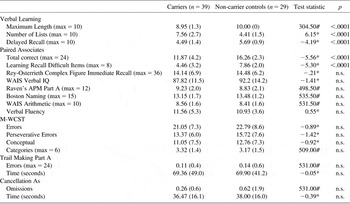
Table 2 shows the means and standard deviations for the performance of the two groups on the background neuropsychological measures. The comparisons between groups revealed that the carriers had significantly poorer memory performance on verbal learning and paired associates than the healthy controls. However, the two groups did not significantly differ in terms of recall of the Rey-Osterrieth Complex Figure. The performance of the carriers did not significantly differ from the healthy controls on any of the other background measures. Therefore, the standard neuropsychological assessment unveiled amnesic deficits which had gone unnoticed by the carriers and their relatives.
Means and standard deviations in parentheses for the background measures performed by the carriers and non-carrier controls

WAIS = Wechsler Adult Intelligence Scale; APM = Advanced Progressive Matrices; M-WCST = Modified Wisconsin Card Sorting Test; * = Independent Samples T-test; = Mann-Whitney U-Test.
Dual Task Paradigm
Table 1 shows the individual digit span means and standard deviations for the carriers and non-carrier controls. An independent samples t test revealed the carriers and controls did not significantly differ in terms of digit span.
Dual Task Performance
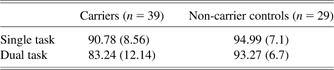
The single and dual task digit recall performance of the groups is shown in Table 3. The mixed ANOVA model revealed a significant main effect of group, F(1,66) = 14.34; p < .0001, ηp2 = .18; condition, F(1,66) = 14.29; p < .0001; ηp2 = .18 and a significant two-way interaction, F(1,66) = 5.65; p < .05, ηp2 = .08. Post hoc Bonferroni analysis revealed that the two groups did not significantly differ in terms of single task performance thus confirming that both groups performed the task at their own capacity. In terms of dual task performance, the carriers performed significantly more poorly than the controls (p < .0001). Moreover, the carriers showed a significant dual task drop in terms of digit recall performance from single to dual task conditions (p < .0001), whereas the non-carrier controls did not.
Mean percentage correct across trials on single task and dual task digit recall performance with standard deviations in parentheses for the two groups

To ascertain the incremental variance associated with including dual task digit recall, verbal learning delayed recall and paired associates learning recall when identifying group differences, performance on these tasks was entered into a hierarchical multiple regression models using the enter method (see Table 4). For the carriers, dual digit recall explained 19.6% of the variance. When verbal learning delayed recall was added to the model, it explained an additional 9.4% of the variance. When both verbal learning delayed recall and paired associates learning recall were added to the model, it explained an additional 5.1% of the variance but verbal learning delayed recall was not a significant predictor. Therefore, the final model which includes dual digit recall and paired associates learning recall as predictors significantly improves the ability to predict the proportion of variance between carriers and non-carrier controls.
Regression model for the carriers versus the non-carrier controls on the digit recall and memory measures

DD = Dual Digit; VL = Verbal Learning Delayed Recall; PA = Paired Associates Learning.
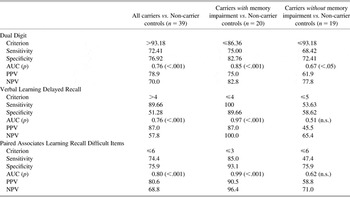
The carriers recruited for the study did not report any memory or other cognitive complaints. Yet, formal neuropsychological assessment revealed that some presented with episodic memory impairments. It was therefore necessary to investigate the classification power of the measures that explained the largest proportion of variance across the carriers with and without episodic memory impairments at the individual level. The carriers were classified as symptomatic (n = 20) if they scored more than 1 SD below the mean of the 29 non-carrier controls on verbal learning delayed recall (mean = 5.69; SD = 0.93) and asymptomatic (n = 19) if they scored less than 1 SD from the non-carrier control mean. This was based on the recent recommendations from the National Institute on Aging and Alzheimer's Association workgroup who suggest that individuals with MCI typically perform 1 to 1.5 SD below the mean for age- and education-matched controls (Albert et al., Reference Albert, DeKosky, Dickson, Dubois, Feldman, Fox and Phelps2011). Area under the curve analysis was then carried out to investigate whether performance on the episodic memory tasks and dual task digit recall was able to classify individuals into these different groups correctly. Table 5 demonstrates the results of this analysis. For the carriers without memory impairments, this procedure resulted in a dramatic drop in the classification power of the memory tests but not of the dual tasking measure, which provided 68% sensitivity and 72% specificity for conversion to FAD.
ROC analysis with the dual digit and episodic memory variables that explained the largest proportion of the variance across groups

Discussion
Previous studies of dual task performance have demonstrated that patients in the early stages of AD show significant dual task impairments (Baddeley et al., Reference Baddeley, Logie, Bressi, Della Sala and Spinnler1986, Reference Baddeley, Bressi, Della Sala, Logie and Spinnler1991; Della Sala et al., Reference Della Sala, Cocchini, Logie, Allerhand and MacPherson2010; MacPherson et al., Reference MacPherson, Della Sala, Logie and Wilcock2007). In the current experiment, individuals who were carriers of the E280A presenilin-1 mutation but did not meet the criteria for AD showed significant dual task decrements compared with healthy non-carrier controls. Further analysis revealed that dual task performance and paired associated learning recall explained the largest proportion of the variance between the carriers and controls. These findings suggest that deterioration in the dual task co-ordination mechanism characterizes E280A-related familial AD in its very early stages.
Although the carriers reported no memory complaints as documented by a self-report and family questionnaire, some individuals did show episodic memory impairments when assessed clinically. Therefore, the carriers were subdivided into those individuals with episodic memory impairments and those without, and area under the curve analysis was conducted. The analysis revealed that splitting carriers according to the presence or absence of memory impairments greatly impacted on the classification power of these standard memory tests (something that is expected from this manipulation) but did not modify the classification power of the dual task variable to the same extent. Therefore, when only the asymptomatic carriers were compared with the non-carriers, that is, individuals who have memory impairments are removed from the analysis, the dual task digit recall combines acceptable levels of sensitivity (68%) and specificity (72%) for carriers who are asymptomatic based on subjective and objective cognitive measures, and yet will go on to develop FAD (see the final column of Table 5). These findings suggest that dual task digit recall performance might be a preclinical marker of AD whereas performance on verbal learning tasks appears to be an early clinical marker of the disease. Taken together, the results presented here suggest that combining these two tasks in the assessment both the preclinical and early clinical characteristics of the disease could be captured, reducing by this means false positives and false negatives.
The dual task costs reported in the carriers do not appear to be related to their performance on the background neuropsychological measures included in this study. The carriers only significantly differed in their performance on the episodic memory measures compared with controls and not on the measures of IQ, executive function or speed of processing. Moreover, the carriers were matched in terms of MMSE scores with the healthy non-carrier controls. This is in line with our previous work with sporadic AD patients which has also shown that dual task performance is not influenced by MMSE scores, for example, MacPherson et al. (Reference MacPherson, Della Sala, Logie and Wilcock2007). However, performance on other neuropsychological measures and their association with dual task performance in our sporadic AD patients has not typically been examined.
It could be argued that the dual task deficits reported in AD patients (and some ageing studies) is simply a consequence of a generalized, diminished cognitive processing resource, that is, speed of processing, rather than an impairment in a specific mechanism responsible for co-ordinating the performance of two tasks at the same time. However, in the current study, the carrier and non-carrier groups did not significantly differ in their speed of processing abilities which were assessed using the Trail Making Test Part A and Cancellation As. This suggests that the dual task deficit in our carrier group was not simply due to slower processing speed. Although this evidence is post hoc, speed of processing differences between AD patient and control groups performing the dual task paradigm does merit further investigation, to add to our confidence that the AD-related dual task effects are not simply due to difficulties in switching between tasks due to slower speed of processing.
Lopera et al. (Reference Lopera, Ardila, Martinez, Madrigal, Arango-Viana, Lemere and Kosik1997) propose that E280A familial AD is similar to late-onset sporadic AD in terms of the majority of its characteristics. Therefore, it could be argued that our asymptomatic carriers are at the equivalent stage in their disease progression as individuals with pre-mild cognitive impairment. As some of these individuals will eventually convert to sporadic AD, dual tasking may be useful for detecting cognitive changes in this vulnerable group. Some previous studies of dual task abilities in mild cognitive impairment (MCI) in sporadic AD have reported significant dual task decrements compared with healthy controls (Dannhauser et al., Reference Dannhauser, Walker, Stevens, Lee, Seal and Shergill2005; Holtzer et al., Reference Holtzer, Burright and Donovick2004; Ritchie, Artero, & Touchon, Reference Ritchie, Artero and Touchon2001), yet others have not (Lopez et al., Reference Lopez, Becker, Jagust, Fitzpatrick, Carlson, DeKosky and Kuller2006; Nordlund et al., Reference Nordlund, Rolstad, Hellstrom, Sjogren, Hansen and Wallin2005; Pettersson, Olsson, & Wahlund, Reference Pettersson, Olsson and Wahlund2005). Our recent work using a similar dual-task paradigm did not find a significant difference between individuals with MCI and a healthy control group (Foley, Kaschel, Logie, & Della Sala, Reference Foley, Kaschel, Logie and Della Sala2011). However, the MCI group were variable in their dual task performance and Foley et al. (Reference Foley, Kaschel, Logie and Della Sala2011) suggest that the MCI individuals who perform dual tasking well may have stable deficits longitudinally, while those who perform dual tasking poorly will be more likely to convert to AD (see also Robert et al., Reference Robert, Berr, Volteau, Bertogliati, Benoit, Sarazin, Legrain and Dubois2006). Another explanation for the different findings in the current study and our previous work (Foley et al., Reference Foley, Kaschel, Logie and Della Sala2011) may be that the dual-task deficit demonstrated in our FAD patients is associated with the E280A mutation in the presenilin-1 gene rather than an early AD-related dual-task deficit. Indeed, other studies suggest that there may be phenotypic differences between genetic and sporadic AD (Holmes, Reference Holmes2002; Mosconi et al., Reference Mosconi, Sorbi, Nacmias, De Cristofaro, Fayyaz, Cellini and Pupi2003).
There may be other confounds which contribute to the poor performance of our asymptomatic carriers on dual tasking such as depression or test anxiety. Although the participants were blind to their status, it may be that the asymptomatic carriers suffer from low or depressed mood. However, in this study, our carriers and non-carrier controls did not significantly differ in terms of their level of depression. Moreover, our previous work has shown that individuals with chronic depression do not show dual task deficits. Of interest, this remains the case even when the chronically depressed individuals were matched for episodic memory performance with AD patients (Kaschel, Logie, Kazen, Della Sala, Reference Kaschel, Logie, Kazen and Della Sala2009). The issue of test anxiety may also affect dual task performance. However, the asymptomatic carriers and non-carrier controls were drawn from the same rural community and were subjected to the equivalent longitudinal neuropsychological assessment, and so test anxiety is likely to have affected the two groups in a similar manner.
In summary, the current findings provide evidence that carriers of the E280A genetic mutation show a specific impairment in performing two tasks simultaneously. These carriers performed as well as non-carrier controls on all background neuropsychological tests except the episodic memory measures, suggesting that dual task impairments are a fundamental characteristic of AD and may be an early indicator for the diagnosis of E280A familial Alzheimer's disease in genetic carriers. The results also showed that dual task performance identifies asymptomatic carriers better and earlier than episodic memory tasks. Remarkably, unlike episodic memory measures, dual tasking has the additional advantage that impairments do not occur in healthy adult ageing.
Acknowledgments
M.A.P.'s work is currently supported by a grant from the Neuroscience Program call of the “San Paolo Foundation.” The study is also sponsored by Colciencias Grants 1115-408-20512 and 1115-343-19127 awarded to the Neuroscience Group, University of Antioquia, Colombia, in collaboration with M.A.P. and S.D.S. The information presented in this manuscript and the manuscript itself has never been published either electronically or in print. The authors have no conflict of interest to declare.