Introduction
In July 2006, in response to a call from the Melbourne Zoo, a home visit was made to examine a 49-year-old female Western Lowland Gorilla (Gorilla gorilla gorilla), who had recently developed a confusional state with the following observed behaviors:
• being apparently lost in her enclosure, which she had occupied for 15 years
• unable to find her food
• defecating in her nest
• unable to locate the entry to her night den after being outside in the enclosure
• loss of her dominant role as the senior matriarch and being bullied by younger females
• apparently unable to see things in certain areas of her enclosure
• being less responsive to her favorite keeper, who had cared for her since 1980.
The staff of the Zoo raised the question: is she developing a dementing illness? A domiciliary consultation by a psychogeriatrician from the University of Melbourne was therefore requested to assess this.
Previous history
The female gorilla had a history of low-grade cardiac disease associated with hypertension, and a serious renal infection had resulted in surgical removal of one kidney in 2003.
Examination
She was enticed to the edge of her enclosure to accept her favorite snack of dates, walking with a slow but steady gait. Using offered dates as targets for an ocular movement examination, the presence of nystagmus was identified, together with bilateral upward gaze palsy.
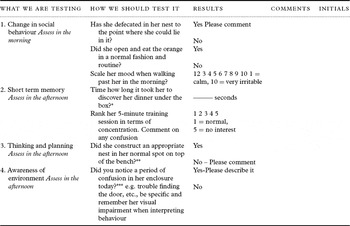
In a team discussion with her keepers and the veterinarian, an observation schedule (Table 1) was developed for use over the next three weeks to track her behavior. At follow-up review, one month later, the observation schedule revealed fluctuating but slow improvement in all domains. On further examination, her ocular signs had settled.
The Melbourne Zoo Primate Confusional State Observation Schedule

*Food was hidden under a box for three consecutive days and then unhidden (normal) for the following three consecutive days. The process is to be repeated as we are trying to establish whether she remembers her food under the box.
**Her nesting material was to be placed under her bench so she had to physically rebuild a nest each night. The quality and placement of the nest will be ranked by the keepers.
***The keepers were of the impression that her previous periods of confusion correlated with a change in routine, which they think is a normal response for a gorilla in that situation. The keepers are keeping her routine the same for the next few weeks during this observation trial.
Diagnosis
A diagnosis of post-TIA delirium was made. Her behavior and general function steadily improved over the next two months. Cerebral infarction has previously been reported in a 29-year old chimpanzee, Pan troglodytes (Fish et al., Reference Fish, Carpenter and Kraft2004).
Outcome
Her physical decline occurred during 2007, and she was euthanized in November 2007 at the age of 50 years.
Autopsy report
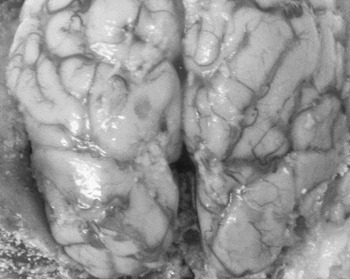
There were multifocal to coalescing often aggregated, multiple small soft, white plaques within the meninges over the middle and posterior dorsal midline surface of the cerebrum (consistent with prominent arachnoid granulations).
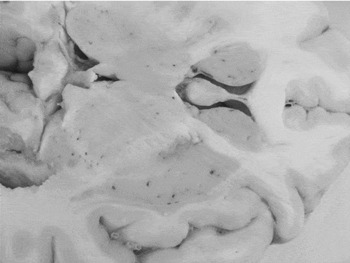
There were bilateral almost wedge shaped foci of malacia and dark-tan discoloration (suggestive of previous hemorrhage) of the globus pallidus, which were most marked on the right side, with minor involvement of the adjacent internal capsule. There was mild, bilaterally symmetrical, brown-green pigmentation in the pons (consistent with the substantia niagra).
Discussion
Autopsy revealed cerebral hemorrhages at globus pallidus and internal capsule, thus confirming the clinical diagnosis (Figures 1–2). Examination of the heart confirmed chronic myocardial fibrosis, and a pancreatic islet cell carcinoma had metastasized to lung and liver.
Arachnoid granulations

Horizontal slice, ventro-dorsal view

We suggest that the observation schedule so developed may be of use in future to observe other primates in captivity which develop confusional states.
Conflict of interest
None.
Description of authors’ role
EC is the psychogeriatrician who assessed the subject, and KB is a veterinarian who works at Melbourne Zoo.
Permission and acknowledgments
Although it is the policy of International Psychogeriatrics that permission from the patient or responsible person be obtained in publishing a case report, discussion with the Editor indicated that this does not apply in this circumstance. The authors wish to thank the keepers at Melbourne Zoo for undertaking careful management of this case.
The authors also thank Dr. Emma Croser for providing Figures 1 and 2.