




The study of aggressive behaviour became a key frontier in the medical sciences during the post-war period. It has emerged both as a field through which physicians sought to understand human conduct and as an object of intervention and control. Driven by the rise of psychopharmacology, the growing use of animal models and genetic research, and later by technological developments such as neuroimaging, research on aggression increasingly shifted towards biologically grounded models.Footnote 1 Central to this transformation was what Nikolas Rose and Joelle M. Abi-Rached have termed a ‘neuromolecular vision of the brain’: a new way of conceptualising human behaviour and subjectivity in which mental processes were increasingly explained as ‘the outcome of biological mechanisms’ and ‘interactions among molecules’ that could be examined, rendered visible, and reshaped.Footnote 2 Within this framework, the brain, and particularly the role of neurotransmitters, came to be seen as a key site for explaining aggressive and violent behaviour.Footnote 3 As the historian Peter Becker has argued, this biological reframing of violence also reshaped perceptions of crime and criminal behaviour, while becoming deeply embedded in wider debates about risk and security in post-industrial societies.Footnote 4 To put it somewhat schematically, the emergence of biological understandings of aggression has therefore often been narrated as the outcome of a specific configuration of science, technology, and politics rooted in the liberal-democratic ‘West’: one propelled by technological innovation in the laboratory and brain sciences, underpinned by privately funded medical research, and closely connected to new policies of crime prevention and social control.
This article reconsiders that narrative through the example of Czechoslovak behavioural pharmacology under state socialism. It does two things. First, it suggests that the biological turn in aggression research emerged within a transnational scientific field that extended across the Iron Curtain. Second, it shows that the scientific uses, legitimation, and institutional embedding of this research diverged across political systems and scientific traditions. In Czechoslovakia, pharmacological research on aggression developed within the structures of late state socialist science, shaped by bureaucratic planning, state-defined public health priorities, and the Communist Party rule. The article therefore examines the social practices and institutional routines that scientists had to navigate in order to participate in international exchange, while also showing how aggression research was legitimised through the public health concerns of state socialism. In doing so, it offers a more differentiated account of the history of aggression research during the Cold War, while also drawing attention to the different ways in which medical research and politics became intertwined in post-war Europe.
At the centre of this article is the Czechoslovak physician and pharmacologist Miloslav Kršiak (1939–2016) of the Pharmacological Institute of the Czechoslovak Academy of Sciences (CSAS), who developed ethological approaches to the study of social behaviour in animal models in the laboratory.Footnote 5 Kršiak’s experiments aimed to examine interactions among mice – such as fighting, fleeing, and dominance – within a standardised laboratory environment. In his research, aggression did not appear as an isolated object of inquiry but formed part of a broader investigation of the different components of animal social behaviour. Kršiak’s work also belonged to a wider transnational network of scientists who, in the post-war period, introduced ethological models into psychopharmacology. Through a microhistorical analysis, this article examines Kršiak’s international connections and institutional environment, as well as the strategies employed by Czechoslovak scientists to maintain international collaborations, navigate political constraints, and legitimise their work within the communist regime during the late 1960s and 1970s. This period was marked by major political upheaval in Czechoslovakia. In the second half of the 1960s, a reform process within the Communist Party gave rise to liberalising tendencies that culminated in the Prague Spring of 1968. After the Warsaw Pact invasion of Czechoslovakia, led by the Soviet Union and intended to suppress these reforms, the regime hardened and the period of so-called ‘Normalisation’ began, marked by political purges within the Party, workplaces, schools, and other organisations, as well as by intensified repression.Footnote 6 The analysis draws on a wide range of archival sources, including records from the Pharmacological Institute, documents of the Communist Party of Czechoslovakia, published memoirs, and secondary literature.
This study builds on several strands of contemporary historiography. As noted above, it contributes to the history of Cold War science. In recent years, historians have increasingly emphasised the relative ‘permeability’ of the Iron Curtain, particularly in the realm of scientific exchange.Footnote 7 As a result, the transnational history of science since 1945 – and its entanglements across Cold War divides – has moved to the fore.Footnote 8 At the same time, the Cold War perspective has been enriched by global approaches that examine not only East-West rivalry, but also longer-term trends in scientific development, the impact of decolonisation, and the role of non-state actors and organisations.Footnote 9 Historians have also stressed that studies of the ‘circulation’ or ‘exchange’ of knowledge must take account of structural inequalities, everyday practices of travel, and the role of state sovereignty.Footnote 10 For example, in his work on the transnational history of scientific knowledge, John Krige has emphasised the motivations behind scientists’ travels and the ways in which encounters with foreign environments shaped their trajectories.Footnote 11 He has also underscored that scientific networks and knowledge transfer were not linear processes but rather ‘hierarchical interpersonal encounters’ and ‘dynamic relationships’ in which actors pursued their own interests.Footnote 12 As recent studies have shown, tracing individual scholarly trajectories and capacities to establish cross-border connections is crucial to understanding the making of transnational relations in Cold War science.Footnote 13
Building on this scholarship, researchers have explored the role of state socialist experts in Eastern Europe’s internationalisation from the mid-1950s onward, particularly their position between national institutions and various non-governmental organisations.Footnote 14 As Dora Vargha’s work has shown, ‘socialist’ medicine has increasingly become the subject of global historical inquiry.Footnote 15 Recent studies further suggest that physicians and other medical professionals were among the key travelling experts under state socialism. This is also evident in the special issue on the transnational history of medicine in East European socialism edited by Alexa Geisthövel and Daniela Koleva.Footnote 16 Medical knowledge and biomedicine were shaped not only alongside the Cold War, but also through forms of collaboration that crossed the Iron Curtain. This gave medical professionals a comparatively privileged position in their domestic settings: access to international research communities and the latest technologies allowed them to create spaces of professional autonomy and, in some cases, to pursue their own agendas.Footnote 17 This body of scholarship also includes research on the pharmaceutical industry and psychopharmacology in Eastern Europe.Footnote 18
This article also engages with current Czech historiography on Czechoslovak science after 1945. Several key scholarly perspectives can be distinguished here. The first consists of initial works on the history of science under socialism published in the early 2000s.Footnote 19 More recent contributions by Martin Franc, Alena Míšková, Věra Dvořáčková, and others have focused on the Czechoslovak Academy of Sciences and on science policy.Footnote 20 A second line of research, which has developed over the past decade, examines the transnational history of Czechoslovak science under state socialism, and emphasises the importance of international exchange, conferences, and scientific diplomacy.Footnote 21 Doubravka Olšáková, for instance, has shown that opportunities for Czechoslovak scientists to engage in international scientific cooperation emerged in the second half of the 1950s as a result of destalinisation.Footnote 22 The transfer of new medical methods has recently been studied by Carles Brasó Broggi and Hana Bortlová-Vondráková, albeit with a focus on the interwar period.Footnote 23 The emigration of medical professionals after 1968 – such as anaesthesiologists – has been analysed by Michaela Šmidrkalová and Miroslav Michela.Footnote 24 However, despite some notable overviews, health care in socialist Czechoslovakia remains relatively understudied.Footnote 25 Similarly, the history of Czechoslovak pharmacology after 1945 has yet to receive sustained scholarly attention.Footnote 26
The article is structured around four sections. The first introduces the use of ethological methods in psychopharmacological research and explores Miloslav Kršiak’s formative experiences in London in the late 1960s. The second examines the institutional and international context of the Pharmacological Institute in Prague in the 1970s, focusing on how researchers like Kršiak maintained and cultivated transnational scientific networks. The third section analyses the political and bureaucratic conditions that shaped scientific mobility and legitimised international participation, including the role of Communist Party institutions and state surveillance. The final section explores how these methods were applied to state-prioritised problems such as addiction and drug safety, and shows how behavioural pharmacology contributed to socialist public health agendas.
Psychopharmacology meets ethology: aggression research in the second half of the twentieth century
The post-war period has been described by some historians as a time of the ‘behavioural revolution’, marked by a growing emphasis on behavioural science across a wide range of disciplines.Footnote 27 A key part of this development was the emergence of ethology, a field established in the first half of the twentieth century at the intersection of zoology and biology, devoted to the study of animal behaviour. Leading figures in this discipline included Konrad Lorenz, Karl von Frisch, and Nikolaas Tinbergen, who were jointly awarded the Nobel Prize in Physiology or Medicine in 1973 for their work.Footnote 28 Konrad Lorenz, a trained zoologist, explored the role of aggression, which he regarded as a natural and innate instinct serving a positive evolutionary function by contributing to the survival of species under conditions of limited resources.Footnote 29 Ethology began to influence pharmacology in the mid-twentieth century, largely as a response to the need for more reliable methods of standardisation.Footnote 30 A key figure in this development was the British scientist and zoologist Michael Chance, who in 1942 conducted tests for the War Office on various stimulants, including amphetamines.Footnote 31 Rather than focusing on the inbreeding of laboratory animals, Chance – building on earlier research – turned his attention to the social interactions of laboratory mice. As the historian Robert Kirk has argued, this methodology ‘opened up a new discourse that prioritised the social to explain the difficulties hitherto experienced in biological standardisation’.Footnote 32 By the early 1960s, Michael Chance had established his own laboratory at the University of Birmingham and continued, with his team, to study drug effects from an ethological perspective.Footnote 33 The application of ethological approaches in pharmacology aimed to replicate models of social interaction in the laboratory, bringing ‘natural behaviour’ into a controlled setting for observation, recording, and statistical analysis. Chance argued that social interactions themselves had physiological consequences, and the ultimate goal was to predict drug effects more accurately. Ethological concepts shifted attention towards the behavioural patterns of test animals, emphasising careful observation and quantitative analysis.Footnote 34 This approach thus integrated several elements: the role of social interaction, quantification, and the adoption of new recording technologies.
In Czechoslovakia, ethological approaches were also developed during the post-war period. Kršiak himself noted that his research was inspired by the pharmacologist Josef Lát (1918–1988), who in the 1960s developed observational methods for studying animal behaviour in the laboratory.Footnote 35 During the liberalisation period of the late 1960s, Kršiak undertook a postdoctoral fellowship in Hannah Steinberg’s laboratory at University College London between 1967 and 1969, where he encountered the use of these ethological methods in psychopharmacology.Footnote 36 Hannah Steinberg (1926–2019) was one of the leading figures in the field of psychopharmacology.Footnote 37 She was well acquainted with these approaches and had co-edited the proceedings of the 1963 Ciba Foundation Symposium, at which the Birmingham group led by Michael Chance presented their research.Footnote 38 The international experience proved formative for Kršiak’s subsequent scientific trajectory. He visited the Birmingham laboratory and maintained contact with several researchers from the group.Footnote 39 Although Kršiak had already shown an interest in aggressive behaviour before his time abroad, his London experience appears to have deepened that interest.Footnote 40 In Steinberg’s laboratory, he collaborated with researchers at similar career stages – such as Ian Stolerman and Channi Kumar – who were also working on behavioural pharmacology. In a letter to his superior Helena Rašková (1913–2010), director of the Pharmacological Institute at the CSAS, Kršiak stated explicitly that ‘the study of the effect of drugs on social behaviour, studied with the help of ethological methods, has fascinated me and I would like to deal with this topic in the future (…) The ethological approach allows us to obtain a very complex picture of the effect of a substance in the same animal in the test’.Footnote 41
One outcome of Kršiak’s time in London was a co-authored review article focusing specifically on psychopharmacology and aggression.Footnote 42 At the time, several experimental models existed for inducing aggression in animals. One of the most common was ‘isolation-induced’ aggression, where the interactions between isolated mice and a stimulus animal were observed.Footnote 43 Another approach relied on ‘pain-induced’ aggression, triggered by electric shocks or neurological stimulation. In their piece, Kršiak and Steinberg advocated the use of ethological methods to analyse the influence of psychotropic drugs on animal social behaviour. This, they argued, could help distinguish between genuine anti-aggressive effects and those that merely resulted from sedation.Footnote 44 The study concentrated on ‘social interactions’ among mice, particularly those involving a drugged and a non-drugged counterpart. Kršiak and Steinberg emphasised the need to ask ‘how far the aggressive and other behaviour of undrugged mice is modified by the presence of drugged opponents’.Footnote 45 Using experimental mice to which various substances had been administered, they classified behaviour into ‘individual acts’ and ‘social acts’, with the latter further classified into ‘aggressive acts’ and ‘flight acts’.Footnote 46 These tests in turn allowed for a detailed assessment of how substances affected mouse behaviour in standardised settings.
Kršiak extended his original fellowship by six months and did not return home until April 1969.Footnote 47 His letters from this period shed light on his impressions of working in Britain. He appreciated the academic freedom and the shared pursuit of ‘the highest possible quality’. This was despite limitations in space or equipment.Footnote 48 He noted Hannah Steinberg’s habit of ‘supplying her boys’ with article reviews – a practice he valued highly.Footnote 49 Letters from autumn 1968 also briefly mention the occupation of Czechoslovakia by Soviet and Warsaw Pact troops. When reading these mostly work-related letters, it is important to bear in mind the limited possibilities for open communication at the time, especially in the case of foreign correspondence. A letter from September 1968 briefly mentioned that he and his wife were ‘intensively experiencing’ events in their ‘homeland’, though the rest of the letter remained focused on work.Footnote 50 Helena Rašková responded by saying only that they were ‘slowly getting work back on track’.Footnote 51 In another letter, dated October 1968, he pledged ‘full loyalty’ to Helena Rašková, and continued: ‘We have lost many illusions and perhaps now see the Western and Eastern hemispheres a little more realistically. At the same time, we have come to appreciate the value of Czechoslovakia. (…) Moreover, many of your generation have shown that it is possible to do a lot for Czechoslovakia and science even under worse conditions’.Footnote 52
Kršiak’s British experience was thus pivotal, not only because of the connections he established, but also because it shaped the direction of his subsequent research. The ethological approaches he encountered in Birmingham and in Steinberg’s laboratory would significantly influence his later scientific work. After his return to Prague, Kršiak and his team spent the following years systematically investigating the effects of various substances on different forms of social behaviour in laboratory animals, primarily mice. They focused on the anxiolytic effects of drugs and on the identification of substances that increased or decreased aggression. His research helped to refine understandings of drug action by distinguishing more clearly between genuinely anxiolytic effects and mere sedation, while also advancing a more differentiated model of laboratory animal behaviour that took account of attack, defence, escape, and locomotor activity. Kršiak and his colleagues frequently published this research first in Czechoslovak specialist journals and presented it at professional meetings before later publishing in international journals, often drawing on similar empirical data and approaches. This suggests that Czechoslovak psychopharmacology relied on shared scientific methods and approaches that crossed Cold War boundaries. However, as the next section shows, its distinctiveness lay in the institutional and political conditions under which such research was organised and in the way personal networks of contact were built.
Building and maintaining the scientific network: personal contacts, correspondence, and research trips
In July 1974, the Collegium Internationale Neuro-Psychopharmacologicum (CINP) held its annual conference in Paris, where Miloslav Kršiak played an active role.Footnote 53 Speaking on a panel dedicated to the pharmacology and biochemistry of anxiety and aggression, Kršiak presented experimental findings on timid behaviour in mice and the anxiolytic effects of drugs.Footnote 54 The research drew on ethological methods to study how different substances influenced both aggressive and timid responses in animals. During the conference, Kršiak met the American scientist Klaus A. Miczek (1945–2024), whose work on aggression similarly employed ethological methods to observe different forms of animal aggression.Footnote 55 This encounter marked the beginning of a collaboration that resulted in a joint publication and several reciprocal visits.Footnote 56 The Paris meeting, however, was more than an occasion for intellectual exchange: it reflected a broader network of Kršiak’s contacts and his position within the scientific community.
Throughout the 1970s, Kršiak frequently travelled abroad.Footnote 57 For example, he spent nearly a month in the United States, visiting Klaus A. Miczek’s laboratory and several other research centres. The purpose of this research stay was to familiarise himself with new findings in the field of drug addiction research, an area also pursued at the Pharmacological Institute.Footnote 58 These trips served not only to advance research but also to cultivate personal connections and host international visitors in Prague. While many guests primarily came from other socialist countries, Czechoslovak pharmacologists also welcomed researchers from Western nations. For instance, Hannah Steinberg came to Czechoslovakia in 1970 in connection with the CINP conference organised in Prague.Footnote 59 Klaus A. Miczek visited Czechoslovakia in the summer of 1974; his visit was facilitated in part because his research aligned with one of the institute’s ongoing projects.Footnote 60 Other foreign experts also came to Czechoslovakia, either to present their own work or to demonstrate new methods and approaches. This was the case, for example, with Robert Roth from the Department of Pharmacology at Yale Medical School, whom Kršiak invited to Prague to provide methodological support for experiments.Footnote 61 In 1973, Desmond R. Laurence, author of a well-known textbook on clinical pharmacology, also visited Prague.Footnote 62 These exchanges, however, were strictly regulated. Any contact with foreigners or foreign organisations had to be reported to the institute’s directors and to the Communist Party’s workplace organisation.Footnote 63 Foreign visitors were monitored during their stay and were only allowed to move within the institute according to a programme pre-approved by the director.Footnote 64
Correspondence played an equally vital role in maintaining scientific relationships and remaining connected to global research. This is evident from the large number of letters Kršiak wrote to scientists from different countries and institutions, requesting current literature, experimental results, reactions to articles, or copies of conference papers. Yet, like travel, correspondence was also governed by regulations. According to institutional rules, all official mail was processed through the filing office, which opened and logged incoming letters.Footnote 65 Only the director or designated Communist Party officials could receive unopened mail, unless it was private. Outgoing international correspondence had to be submitted unsealed to the institute’s mail room, accompanied by a copy and, if in a foreign language, a Czech translation. It also required written confirmation from the department head certifying that no state or official secrets were being disclosed. Employees were also required to provide a list of all contacts from ‘capitalist countries’, which was checked by the director and the Communist Party.
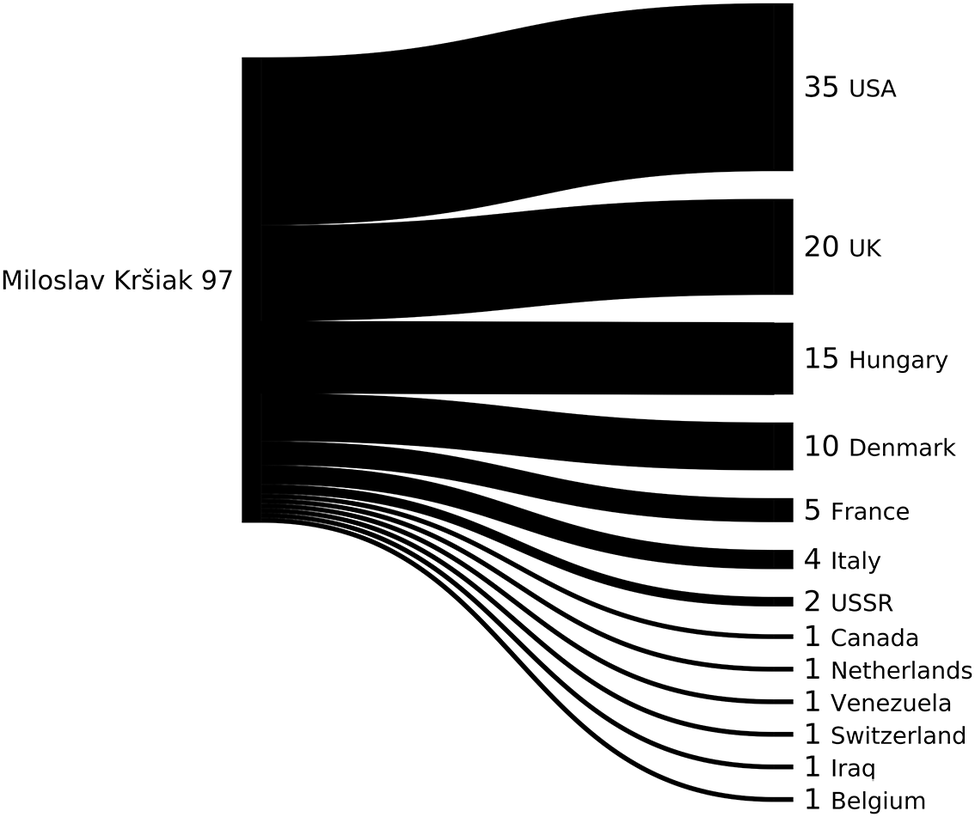
Figure 1 illustrates a preserved fragment of Kršiak’s correspondence, drawn from the Pharmacological Institute’s archives. It shows the ninety-seven letters he sent abroad (not including letters received) between 1969 and 1982, addressed to foreign colleagues and institutions, categorised by country.Footnote 66
Kršiak’s correspondence to foreign countries (colleagues and institutions), 1969–1982.
Source: MÚA AV ČR, f. Farmakologický ústav ČSAV, box 5, sign. 6, Zahraniční vědecké styky, Korespondence M. Kršiaka se zahraničím.

Figure 1. Long description
Excludes correspondence relating to the application for, and the course of, the Riker fellowship, which is treated in a separate section. Included, however, are two letters from 1969 in which Kršiak, after completing the fellowship, reported on its results (Riker Laboratories, IUPHAR). The single 1982 letter is addressed to H. Steinberg. The majority of letters are from 1970–1974. Four letters were handwritten. Source: MÚA AV ČR, f. Farmakologický ústav ČSAV, box 5, sign. 6, Zahraniční vědecké styky, Korespondence M. Kršiaka se zahraničím.
The figure shows the total number of letters divided by the countries of the recipients. The recipients were predominantly fellow scientists but also included representatives of pharmaceutical companies and researchers investigating aggression and violence from other disciplinary perspectives – for example, Philip Zimbardo, whom Kršiak contacted to request publications for a planned review article.Footnote 67 In some cases, a higher number of letters to a given country reflected participation in specific events (e.g., Denmark, the 1972 CINP Congress). In other instances, the correspondence related to journal publications and editorial communication (which also explains the larger number of letters sent to the United States). Letters to Hungary were linked to his developing collaboration with the Department of Pharmacology at Semmelweis University and the organisation of Czechoslovak-Hungarian pharmacological meetings. Letters to the United Kingdom were addressed to his former colleagues and friends. It is important to bear in mind that this is only the preserved correspondence and thus does not provide a complete view of his correspondence activity. While incomplete and reflecting only letters sent (not received), these letters nonetheless offer valuable insights into Kršiak’s international orientation, particularly towards the United States and the United Kingdom. Notably, only two letters were addressed to institutions in Moscow and Leningrad. This imbalance may reflect the global distribution of pharmacological research in the 1970s, when many leading journals and professional organisations were based in the West. Another explanation lies in Kršiak’s strong connection to the English-speaking world, shaped by his formative experience as a Riker Fellow in London.
As the next section will explore, maintaining such wide-ranging international ties was not merely a matter of professional ambition. Within the tightly controlled environment of a communist dictatorship, sustaining international scientific networks – particularly those extending beyond the socialist bloc – required far more than professional merit. It demanded knowing the right people, access to informal networks, skilful navigation of bureaucratic and ideological constraints, and political loyalty. At the Pharmacological Institute, Helena Rašková, until her removal during the political purges of the early 1970s, was one such crucial figure: a well-connected scientist who not only facilitated cross-border collaboration but also supported younger colleagues like Miloslav Kršiak in a system where conducting research or participating in international events required much more than a strong proposal.
Navigating political restrictions in transnational collaboration
In the early Normalisation period, personnel purges were implemented, and decision-making on foreign travel within the CSAS was increasingly centralised. Whether it involved approval processes in various settings, obtaining the necessary documents and permits, financial support, or borders guarded by armed forces, the communist regime sought to severely limit travel, especially private travel and travel to Western European countries.Footnote 68 Permission to travel required approval from multiple authorities: not only the institute director and the Communist Party’s workplace organisation, but also, in the case of men of military age, the military administration.Footnote 69 At the same time, only individuals loyal to the regime, or perceived to be loyal, were allowed to travel abroad.Footnote 70 These changes also affected the Pharmacological Institute. In 1971, the institute was tasked with reviewing its international partnerships and drafting a strategy for foreign relations through 1975, as part of a broader systemic ‘revision’ of CSAS’s external scientific ties.Footnote 71 Officially, the emphasis was to be placed on collaboration with socialist countries, particularly the Soviet Union, through joint research projects.Footnote 72 Yet the strategy as outlined prioritised cooperation with Western institutions, listing prominent American, British, and West German research centres as key partners. Researchers also continued to participate in events held not only within the Eastern Bloc and the Soviet Union, but also across Western Europe and beyond.Footnote 73
Directors of individual institutes were key actors in deciding who would be permitted to travel abroad.Footnote 74 As a result, the directors had to use political influence and lobby higher authorities in order to obtain permission for their staff to travel. One prominent example is Helena Rašková, one of Czechoslovakia’s leading pharmacologists and a founding member of IUPHAR (International Union of Pharmacology). She also spent some time at Oxford University after the Second World War, an experience that greatly influenced her career.Footnote 75 Throughout the 1960s, her career flourished as she assumed numerous influential roles. These included serving as director of the Pharmacological Institute at the Czechoslovak Academy of Sciences, heading the Pharmacological Institute at Charles University, and holding membership in various professional organisations, both domestic and international. At the same time, she chaired the Pharmacological Board of the Ministry of Health until 1970.Footnote 76 Rašková’s prominence in her field led to her appointment by the Section of Pharmacology of the International Union of Physiological Sciences (IUPS) as organiser of the 2nd International Pharmacological Congress in Prague in 1963.Footnote 77 At the end of the 1960s, Rašková was aligned with the reformist wing of the Communist Party and was also a candidate for the Central Committee of the Communist Party of Czechoslovakia.Footnote 78 Beyond her extensive scientific contributions, Rašková proved to be an adept organiser, instrumental in maintaining Czechoslovak pharmacology’s standing on the international stage. Her political and scientific influence was crucial not only in sustaining Czechoslovakia’s visibility within international pharmacology but also in supporting emerging researchers such as Miloslav Kršiak. Thanks to her backing, Kršiak secured a research stay at Hannah Steinberg’s laboratory in London and was later awarded a Riker Fellowship through IUPHAR.Footnote 79 Rašková’s influence is further illustrated by a case from 1970, two years after the Warsaw Pact invasion of Czechoslovakia. She sought to send three institute employees to the EUROTOX conference in Uppsala, Sweden, organised by the European Society for Toxicology. Because other staff members were already abroad in Western countries, an exception had to be requested. Rašková argued that part of the conference programme had been allocated to Czechoslovakia and that non-attendance would weaken the country’s scientific position within the organisation. She pointed out that the effort was a part of a broader strategy ‘to exert a positive influence on this organisation and to promote the interest and influence of other socialist states’.Footnote 80
To secure permission to travel to the West, scientists often employed a variety of strategies.Footnote 81 Although Kršiak was abroad several times in the 1970s, he often alternated between trips to Western Europe and to socialist countries. This can be seen not as a coincidence but as an attempt to maintain a ‘balanced’ travel record. In 1976, he travelled to Moscow, and in 1977 he undertook an almost month-long trip to the United States. Later that same year, however, he returned to Moscow, where he discussed further joint research in the use of sodium oxybate and related substances in therapy.Footnote 82 Moreover, the way in which travel proposals were drafted could be crucial in securing permission for foreign travel. These documents, usually signed by the institute leadership, outlined the purpose of a proposed trip, such as conference attendance or research collaboration, but often emphasised how the visit contributed to the state research plan. They frequently linked the trip to ongoing collaborations with Soviet institutions or presented it as aligned with research already being conducted in the Eastern Bloc.
Financial limitations posed another challenge, particularly in the economically strained conditions of late socialism. The budget of the Czechoslovak Academy of Sciences frequently fell short of the actual costs of sustaining foreign contacts. As a result, expenditure, especially that intended for relations with countries outside the socialist bloc, had to be reduced.Footnote 83 Archival documents from the Pharmacological Institute suggest that trips abroad were funded either by the inviting party, by the institute itself, or by the Czech Literary Fund.Footnote 84 Some travel was also organised through reciprocal arrangements in which expenses were shared by both domestic and foreign institutions.
Political confirmation remained central to the approval process. Research trips were reviewed at the District Committee of the Communist Party in Prague 2, where the Pharmacological Institute was located. Here, the presidium addressed various issues relevant to local scientific life, including academic appointments, award nominations, and requests for travel abroad. For instance, Miloslav Kršiak’s application to attend the International Symposium on Benzodiazepines in Milan, Italy, in the autumn of 1971, was reviewed just weeks before his departure. The primary focus was on Kršiak’s political profile. In the application to the presidium of the district committee, Helena Rašková emphasised not only Kršiak’s academic work but also ‘his involvement in the Communist youth organisation during his studies, along with his membership and activities in the Party’.Footnote 85 Kršiak held several important political positions within the Communist Party and the institute: he was the chair of the institute’s trade union organisation from 1970 and, in the late 1970s, chaired the institute’s Communist Party committee.Footnote 86 His political activity was further highlighted in 1981 when he was interviewed by Rudé právo, the official newspaper of the Communist Party and the regime’s main propaganda outlet. The article portrayed his political activities within the Pharmacological Institute as a role model for other scientific institutions under state socialism.Footnote 87
Because of the strategic importance of pharmacological research and its international connections, the Pharmacological Institute was also subject to surveillance by the Czechoslovak secret police (StB). However, the archival record is fragmented and must be approached cautiously, given the selective and ideologically charged nature of such sources. This brief discussion can only offer a preliminary indication of the issue; a more comprehensive study remains a task for future research.Footnote 88 Available sources show that Helena Rašková and her family were targets of surveillance and repression. In the early 1970s, she was monitored due to her activities during the Prague Spring and because her husband had formerly been employed in Geneva with the WHO.Footnote 89 In 1971–1972, she was removed from her position as director of the Pharmacological Institute (replaced by Karel Mašek) and was forced to leave the Czechoslovak Academy of Sciences.Footnote 90 In addition to her contacts with the ‘western’ pharmaceutical industry and her political activities, secret police reports expressed concern about her ability to place ‘her people’ in important positions within the scientific community. According to these reports, Rašková continued to ‘orchestrate’ the Pharmacological Institute even after she no longer held an official position there in the early 1970s.Footnote 91
Despite the surveillance and political pressures that shaped the professional environment, research at the Pharmacological Institute remained deeply embedded in the broader objectives of the socialist state. Scientific agendas were not only subject to ideological scrutiny, but also increasingly mobilised to address practical challenges.Footnote 92 As the 1970s progressed, state priorities shifted towards the management of newly emerging public health concerns. Within this shifting landscape, Miloslav Kršiak’s ethological research acquired new significance – as it increasingly addressed pressing issues such as analgesic overuse and drug safety. In this context, Kršiak’s research into animal social behaviour could be applied as a testing method for the psychotropic effects of newly developed pharmaceuticals.
From aggression to addiction: applying ethological research to problems of socialist society
As state research priorities evolved in the 1970s, the Czechoslovak Academy of Sciences, and particularly the Pharmacological Institute, was tasked with addressing what communist planners referred to as ‘civilisational burdens’: issues associated with developed industrial societies, particularly hazards to human health and the environment posed by various chemical substances in agriculture and food production, air pollutants or drug addictions.Footnote 93 Like all research conducted at the Czechoslovak Academy of Sciences, Miloslav Kršiak’s work was embedded within the broader state research plan. He was the principal investigator of a project titled ‘Study of the Possibility of Predicting the Psychotropic Effects of Drugs in Humans from Animal Experiments’.Footnote 94 In socialist Czechoslovakia, scientific policy was derived from the state research plan, first introduced in 1957. The Czechoslovak Academy of Sciences initially held considerable influence over the plan’s tasks and objectives; later additional bodies such as the State Planning Office and the so-called State Commission for the Development and Coordination of Science and Technology became involved.Footnote 95 Within this context, Kršiak’s research on the behavioural effects of drugs in animal models gained renewed practical relevance. One notable area of concern was the misuse of and dependence on over-the-counter painkillers such as Algena, Alnagon, and later Dinyl. The socialist government explicitly identified addiction to painkillers as a growing public health concern.
Historian Jan Kolář has observed that the mass consumption of analgesics in socialist Czechoslovakia showed signs of a ‘catastrophe’.Footnote 96 In the 1960s, at least thirty percent of the adult population used analgesics regularly, and ten percent consumed them daily. Whereas in 1952, 100 million tablets of analgesics were consumed, by 1969 the number had risen to 750 million, equivalent to 50 tablets per person per year.Footnote 97 After Algena was removed from open sale in the early 1970s, attention shifted to Dinyl; in 1980 alone, an estimated 200 million tablets were sold.Footnote 98 Middle-aged women were identified as the group most ‘at risk’ of developing dependency. The health problems associated with these analgesics were tied primarily to their chemical composition: at higher doses, some exhibited psychotropic effects comparable to those of amphetamines.Footnote 99 When used regularly and over extended periods, they could also cause kidney, stomach, or blood disorders. Some preparations even contained barbiturates, codeine, or aminophenazone.
In response, the Pharmacological Institute was tasked in 1977 with systematically studying the effects of selected analgesics and developing new compounds that would maintain strong pain-relieving properties while reducing the risk of addiction and toxicity. This effort involved a ‘rationalisation brigade’ made up of researchers from the Pharmacological Institute and the state pharmaceutical company Léčiva. Over several years, they tested new formulations, some of which were released to the domestic market under names like Ataralgin and Dolmina. These new drugs were intended to eliminate addictive or hazardous ingredients while retaining effective analgesic qualities. The first of these products was made available to the public in 1981. Kršiak led this research effort, applying his ethological approaches to the evaluation of new analgesics – particularly in assessing psychostimulant effects on the behaviour of aggressive or timid mice.Footnote 100 His research was also communicated to the broader public through articles in popular science journals such as Věda a technika mládeži [Science and Technology for Youth] and women’s magazines like Květy [Flowers], where he gave interviews about his ethological research, the laboratory testing of mouse behaviour and its role in the development of new drugs. Alongside reporting on pharmacological research and drug discoveries, these articles also reflected the language of socialist propaganda by emphasising that addiction to hard drugs was primarily a problem of capitalist societies. The former, aimed at a younger audience, specifically warned that certain medications could ‘become drugs’ and raised awareness about the risks of substance abuse.
This brief case illustrates that behavioural pharmacology was not only shaped by international influences, but also used to address state-defined social concerns. Kršiak’s research on the effects of psychoactive substances on social behaviour in animals was thus incorporated into a broader pharmacological repertoire for developing new drugs and testing their safety. The experimental methods developed to study social behaviour in animals were subsequently applied to research on drug dependence and newly synthesised analgesics. The use of ethological methods in the field of addiction highlights how pharmacological research under state socialism was intimately tied to broader agendas of public health and economic planning.
Conclusion
In the final decades of the twentieth century, medicine witnessed a renewed interest in the biology of aggression. This shift was the result both of transnational cooperation and of particular configurations of science, technology, and politics in different post-war contexts. The example of Czechoslovak psychopharmacology shows that it was shaped by exchanges across the Iron Curtain, but that its uses and institutional settings diverged. Kršiak’s work was embedded in the institutional routines of state-socialist medical science, where central planning and bureaucracy were intertwined with personal ties, political loyalty, and state-socialist welfare policy. The results of his work found application in the development of new analgesics designed to address growing concerns about widespread dependence on older painkillers. The issue of addiction in state socialist society was directly tied to his research and was discussed not only in party and expert circles but also in popular science and women’s magazines, which identified young people and women as the groups most ‘at risk’. Participation in transnational scientific exchange, however, required Czechoslovak scientists to adopt a variety of strategies. Miloslav Kršiak held important positions within Communist Party structures at his workplace. At the institutional level, the leadership of Helena Rašková, director of the Pharmacological Institute, was equally crucial. She was instrumental in securing foreign fellowships and arranging for her colleagues to attend international conferences. The institute managed to maintain many of its international contacts even after Rašková became a target of the political purges of the early Normalisation period and was removed from her position.
This microhistorical perspective, based on the work of Kršiak’s laboratory in behavioural pharmacology and animal models, shows that the Czechoslovak case was neither an alternative ‘socialist’ science in any strong sense nor merely a copy of Western science. What was specifically ‘socialist’, or at least distinct, was the political and institutional context in which such scientific work took place. Not only were pathways to international contact shaped by the political realities of communist dictatorship, but the study of aggression itself also unfolded within a centrally planned scientific system that required researchers to navigate the structures of state socialist science and bureaucracy. Whereas existing historiography has emphasised the role of technological innovation, privately funded research, and risk frameworks in Western Europe and the United States, the Czechoslovak case highlights a different configuration, in which ethological methods were integrated into state research plans and legitimised through socialist public health priorities.
By tracing how new methods and approaches circulated and were put to use, this article contributes to a more nuanced history of Cold War science, one that takes seriously both the transnational mobility of ideas and the significance of local political settings and personal networks in shaping scientific practice. Future research will need to examine more closely the specific features of distinct models of aggression research, particularly in relation to broader social and cultural questions of control and crime under state socialism. To what extent was ‘dangerous behaviour’ perceived through the lens of risk, in ways similar to those on the other side of the Iron Curtain?
Acknowledgment
The writing of this article, which is part of the project “Taming the European Leviathan: The Legacy of Post-War Medicine and the Common Good,” was supported by the European Research Council (ERC) under the European Union’s Horizon 2020 research and innovation programme (grant agreement No 854503). I would like to thank my colleagues from the ERC Berlin team for their comments and support throughout the research process. I am also grateful to Jan Chodějovský of the Masaryk Institute and Archives of the Czech Academy of Sciences, as well as to Jiří Borovský of the Prague City Archives, for their help with archival research. I would also like to thank the anonymous peer reviewers for their valuable comments and suggestions. The author used Claude Sonnet 5 (Anthropic) for language editing on 22 July 2026.

 Open access

