In late 2018, global media, technology, and business reporting agencies, from Forbes to Afaqs, were awash in incredulous headlines: T-Series – an Indian media company specializing in Hindi films and film music – had become the most popular YouTube channel in the world. With 63 billion total views, 88 million subscribers, and a growth rate of 150,000 subscribers per day, T-Series had outpaced the immensely popular Swedish YouTube gaming star PewDiePie as the most subscribed YouTube channel in the world, a position that T-Series has maintained until the present moment.Footnote 1 As PewDiePie urged his fans to help him boost his subscriber numbers against T-Series, journalists and news outlets sought to make sense of this question: how had India gained such a place of prominence in the competitive, lucrative, and rapidly expanding global field of digital video consumption?
At the time of the ‘Great Subscriber War’, as this geopolitically tinged subscription fight between PewDiePie and T-Series became known, I had already spent several years tracking the growing importance of YouTube as a site of cultural production for Indian ‘independent’ musical acts – that is, those who identified as being outside of the Bollywood culture industry.Footnote 2 This attention to the emerging significance of Indian YouTube was initiated by my experiences in 2013 and 2014 playing violin with the Mumbai-based band Maati Baani (‘Language of the Earth’). Using YouTube as their primary platform, Maati Baani's videos featured collaborations between young urban middle-class musicians and rural folk musicians from across India, as well as with international musicians, stitching together picturesque footage of rural outdoor performance with headphone synchronized performances from bedrooms, public parks, and small recording studios around the world. Having gained remarkable success among twenty-something cosmopolitan middle-class viewers, they were now receiving invitations to perform at the biggest festivals of independent music in India (including YouTube's own live showcase, the YouTube FanFest). Maati Baani was one of the main faces of YouTube's burgeoning image as a platform that could offer a powerful alternative to mainstream culture industries by promoting compelling ‘local content’.
Yet, by the winter of 2018, the moment of T-Series's global ascendance, it was clear that YouTube's priorities had changed and, in tandem, Maati Baani's place within it. When we met to catch up at an artsy Mumbai cafe in January 2019, Maati Baani's lead singer Nirali Kartik lamented the loss of YouTube as an ‘indie space’; now, she reflected, musical acts outside the Bollywood mainstream were being drowned in the circulation of Bollywood videos and covers that dominated the platform. Moreover, YouTube's corporate structure and priorities had changed. Whereas previously Maati Baani had received guidance from YouTube producers on how to best position their carefully produced independent videos, she recalled, now Maati Baani was not even able to get a response from its contacts at YouTube without affiliating itself with an intermediary ‘multi-channel network’ (or MCN). More than simply offering an account of shifting practices in the corporate digital media industry, it was clear that Kartik felt angry and betrayed by a platform she had once viewed as a patron. Her narrative reflected a sense of being used by YouTube as it worked to create a local ‘creator culture’, only to be cut off once the platform had gained sufficient traction.Footnote 3 When I mentioned that I was thinking of writing an article about YouTube in India, she emphatically told me to send my email address ‘and I'll give you some hardcore talking points!’
Digital media industry reports frequently highlight the importance of audiovisual content in drawing users to expanding digital platforms.Footnote 4 However, despite the importance of musical acts such as Maati Baani and music companies such as T-Series to the growth of YouTube, there has been little substantive scholarly discussion of the role that music videos and expressive culture have played in YouTube's ascension to dominance, in both India and beyond.Footnote 5 Following scholars who have begun to investigate the work that music – as a crucial form of digital ‘content’ – and listening perform in the expansion of corporate digital industries and platforms, this article analyses the incredible success of YouTube in India from its domestic launch in 2008 to the seemingly triumphal moment of 2018 by focusing on two central themes.Footnote 6 First, it examines the shifts in India's cellular and digital infrastructure that enabled the widespread consumption of streaming media during this first decade of YouTube's expansion in India. Second, it highlights the importance of music-media aesthetics – in particular, what I call an ‘aesthetics of intimacy’ – and analyses their role in generating ‘engagement’, a most coveted quality in the ‘attention economy’ that undergirds digital media platforms.Footnote 7 I posit that the ‘stickiness’ of this aesthetics of intimacy played a crucial role in maintaining a relatively small, economically elite population of viewers on the platform as India's digital infrastructural capacities slowly increased.Footnote 8
As a range of communications scholars have noted, the rapid expansion of the digital media landscape alongside the global consolidation of this landscape in the hands of select corporate actors has led to ‘platform infrastructuralization’, wherein ‘many of the most widely used digital platforms now seem to operate as infrastructures themselves’.Footnote 9 Conceptually, platform infrastructuralization highlights the ubiquity and dense integration of particular platforms (such as Amazon, Google Search, and YouTube) into daily social life based on their ability to be not just shared, but embedded and made operable across a range of sites and apps. Bringing the fine-grained lens of musical ethnography and audiovisual analysis to bear on conversations about platform infrastructuralization, I demonstrate that YouTube was able to gain traction in India by making use of aesthetics as relational practices to draw in and retain viewer-listeners on the platform.Footnote 10 This article thus attends to the centrality of aesthetic experiences to the processes of corporate digital entrapment and captivation, as Nick Seaver has dubbed it, that have allowed YouTube to become the predominant platform for the dissemination and consumption of videos over the past fifteen years.Footnote 11 As such, it offers important insights into the infrastructuralizing capacities and effects of musical-visual aesthetics as they were deployed to ensure YouTube's ubiquity, pervasiveness, and shareability, that is, to ensure that YouTube became a platform infrastructure in itself.
I begin by detailing the developments in digital and cellular infrastructure that undergirded YouTube's growth in India from 2008 to 2016, culminating in the launch of Jio, a telecom company and cellular network that fundamentally shifted how, and how many, Indians accessed the internet. I then highlight the aesthetics of intimacy that was such a distinctive feature of YouTube music videos prior to the launch of Jio through a case study of Shraddha Sharma, widely considered the first Indian YouTube music star. Analysing Sharma's first viral Bollywood cover song, I demonstrate that the aesthetics of intimacy relied on a set of sonic and visual production strategies that established a diegetic relationship between performers’ bodies and the sounds they produced to create a sense of liveness, direct address, and co-presence between performer and viewer. This aesthetic paradigm thereby functioned to position YouTube's independent producers in contradistinction to the dominant production practices of Bollywood. Thus, rather than consider aesthetics as a set of formal properties that inhere in an audiovisual artefact, I draw out the social work performed by this aesthetics of intimacy, which, in turn, generated a digital musical community of viewers and producers whose engagement was central to YouTube's corporate strategies of expansion and monetization. Instead of taking the idea of ‘corporate strategy’ at face value, however, I argue that the actions and decisions of corporate actors illuminate corporate industry imaginaries: the ways in which they envision, articulate, and orient their work at the intersection of aesthetic practices and infrastructural availability as they seek to realize priorities of platform growth and expansion.
Ultimately, this article uses the remarkable rise of YouTube in India to offer a methodological contribution to the study of music and digital culture – that is, here, how we investigate and conceptualize the role of music within an entity as opaque, diffuse, and unstable as ‘YouTube’. In drawing together aesthetics and infrastructure, I purposefully make use of the perhaps unexpected conjoining of these seemingly distant realms of social life: the former long associated with the essence of musical expression, the latter seen, until recently, as quite removed from core musicological concerns of musical practice and production, sound, and meaning. I suggest that attending to the intersection of aesthetics and infrastructure can illuminate significant shifts in YouTube strategy over the last decade and offer insights into corporate imaginaries of expansion and infrastructuralization in emerging digital markets more broadly.
It is important to note that the musical artists who I take as representative of ‘Indian YouTube’ in this article – Shraddha Sharma and Maati Baani – were being actively foregrounded by YouTube during this period, receiving production support, promotional support in terms of being featured on Indian YouTube's homepage, and additional exposure through YouTube's promotional events such as the YouTube FanFest (discussed later in this article) and the high-profile collaborations that accompanied such events. Thus, in treating Indian YouTube as a corporate agent with strategic intentions, I am using promotional choices made by key YouTube and Google executives as a barometer of how the platform wanted to be perceived and as an indication of the kinds of musical acts, aesthetic practices, and practices of engagement that it was tracking and rewarding in this period of expansion.Footnote 12
Internet infrastructure and the rise of YouTube in India
In suggesting that we must pay attention to changes in infrastructure in order to understand the rise of YouTube in India, I build on a recent ‘infrastructural turn’ marked by an incredible efflorescence of work across the fields of anthropology, cultural geography, media studies, communication, and, recently, music studies.Footnote 13 Infrastructures, building on Brian Larkin, are ‘built networks that facilitate the flow of goods, people, or ideas, and allow for their exchange over space’; in a more expansive definition, he adds, ‘Infrastructures are matter that enable the movement of other matter. Their peculiar ontology lies in the facts that they are things and also the relation between things. As things, they are present to the senses, yet they are also displaced in the focus on the matter that they move around’.Footnote 14 As Larkin's nested definitions suggest, work on infrastructure has highlighted themes of materiality, circulation, and mobility, and a tension between visibility and invisibility in apprehending infrastructures’ presence and effects.
Yet, despite the seemingly empirical and fundamentally material nature of infrastructure, they cannot be understood only as a ‘system of substrates’ that produce results in the phenomenal world.Footnote 15 This is particularly true of digital media infrastructures, which necessitate attention both to the ‘hardware’ of cables and pipes and to rapidly changing software, including algorithms, data compression systems, sets of data protocols, and other forms of code. Digital media infrastructures evolve rapidly, developing and taking form in real time in relation to feedback loops that connect user practices and engagement with the decisions made and embedded into software design, development, and implementation. In this way, tracking digital media infrastructures requires parsing complex and rapidly shifting networks of highly entangled communications systems and human actors.Footnote 16
Keeping in view this centrality of human activity and the significance of complex, dispersed networks of social praxis and meaning, politics, and policy to the production and form of digital infrastructures, South Asia takes on particular import as a site for the examination of global digital culture.Footnote 17 With the second largest number of internet users in the world – a number that is rapidly growing – ‘it is no exaggeration to suggest that users across South Asia and the South Asian diaspora will play a critical role in shaping the trajectory of digital platforms, cultures, and politics in the coming years’, as Aswin Punathambekar and Sriram Mohan suggest.Footnote 18
In this section, I situate the rise of YouTube within changes in India's digital and cellular infrastructure between 2008 and 2016, with particular attention to the increased availability of smartphones, expansion of usable frequency bands, and emergence of affordable data.Footnote 19 YouTube launched in India in May 2008, three years after the video platform's inception in 2005, two years after its acquisition by Google, and one year after YouTube began to address issues of monetization by rolling out banner ads on videos and launching its Partner Program, which allowed those who uploaded videos to earn a few pennies per view.Footnote 20 It was the twentieth such ‘country-specific’ launch, featuring a country-specific domain (youtube.india.co) and a country-specific video search, allowing users to locate videos specifically being produced in India.Footnote 21 At the time, 4.4 per cent of Indians – approximately 52 million people – had regular access to the internet.Footnote 22 The number of internet users was rapidly increasing, however, and by the end of 2011, 10 per cent of Indians had internet access, yielding 100 million users and making it the third largest user base in the world, behind the United States and China.Footnote 23 While most of those users relied on wired connections accessed in cybercafes, private homes, and offices, and even as the Indian government continued to invest in wired internet infrastructure, it was becoming increasingly clear that internet growth in India would depend on the expanding mobile phone market and, by extension, would require addressing challenges to the widespread use of mobile data.Footnote 24
The first challenge pertained to the availability of affordable smartphones. While there were nearly 900 million active mobile connections in 2011, only 10 million of those were smartphones; the remaining 890 million were feature phones that were not equipped to use data.Footnote 25 Premium smartphones were prohibitively expensive for most middle-class consumers, particularly foreign-made phones, which were subject to a steep luxury Value Added Tax for importation.Footnote 26 However, a range of mobile phone manufacturers, including the Korean company LG and the Indian company Micromax, were working to produce more affordable smartphones, utilizing the Android operating system.Footnote 27 These efforts yielded results: as the price of smartphones dropped, amplified by increased competition among mobile phone producers, a study by Nielsen India found an 89 per cent increase in smartphone users between 2012 and 2013, from 27 million to 51 million users.Footnote 28 That same year, the Telecom and Regulatory Authority of India reported that 143 million people accessed the internet through mobile phones.Footnote 29
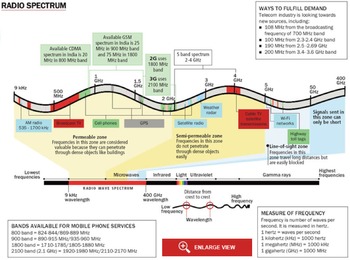
Second, even as smartphone availability increased, the expansion of internet access through mobile phones continued to be hampered by connectivity challenges caused by a scarcity of available telecommunications frequency bands.Footnote 30 Up to 2013, most affordable cellular data networks in India were 2G – that is, they employed ‘second generation’ technology utilizing the 900 MHz and 1800 MHz frequency bands to provide a basic low-speed connection that allowed for texting, internet browsing, and sending emails (Figure 1).
(Colour online) Radio spectrum. Used with permission from DowntoEarth.

Yet even as the number of users making use of these frequencies for cellular internet access was rapidly increasing, the percentage of spectrum available for public (rather than government) telecommunications usage remained relatively low.Footnote 31 As a result, consumers encountered very slow internet speeds and frequent dropped calls. While 3G network technology existed – making use of roughly the same frequency bands but affording faster network connection due to different kinds of data compression and encoding protocols – it was quite expensive.
The third and related challenge was the high cost of data. The year 2013 was marked by the ‘3G price wars’, in which various telecommunications companies sought to expand their customer base by slashing prices on 3G mobile internet services.Footnote 32 Increased use of 3G meant that many more people could use their phones to access GPS, make video calls, and, crucially, stream videos. Meanwhile, the percentage of India's population accessing the internet continued to grow rapidly, reaching 15 per cent (193 million) by 2013 and then nearly doubling to 27 per cent of the total population (or 354 million) by 2015.Footnote 33 In summary, from 2008 to 2015, the percentage of the population using the internet had increased sevenfold and changes in data pricing, cellular infrastructure, and smartphone pricing meant that mobile video streaming was increasingly viable.
These changes had clear benefits for YouTube: by 2015, market consultation company Deloitte estimated that 70 per cent of music and video consumption in India was taking place on YouTube such that the site was receiving 60 million visitors per month, 63 per cent of whom were watching music videos.Footnote 34 YouTube's growth was aided by additional measures to ensure its dominance in India. In 2014, it launched YouTube Go, a service that allowed consumers to download videos to watch at a later point without internet connectivity (a feature rolled out in what YouTube deemed to be its ‘emerging markets’, such as India, Indonesia, and Brazil).Footnote 35 Simultaneously, Google was fuelling internet usage and contributing to internet infrastructure by investing in a variety of user-facing initiatives such as installing free Wi-Fi hotspots in train stations and introducing a new low-cost Android smartphone.Footnote 36
The year 2016 marked a watershed moment in the trajectory of cellular infrastructural development and internet access in India when dominant telecom company Reliance acquired a pan-India 4G licence and launched a new 4G cellular network called Jio.Footnote 37 In an unprecedented move calibrated to shift consumption patterns, Jio gave away SIM cards with plans that included six months of free phone calls, texts, and unlimited high-speed data. According to the Wall Street Journal, ‘Jio transmitted more data in the first year of its operation than any carrier ever world-wide’ and it launched a data pricing war, forcing established rivals to drastically reduce their data rates and pricing plans in order to compete.Footnote 38 In the two years that followed, monthly data usage increased 570 per cent and data prices fell nearly 80 per cent.Footnote 39 As of March 2018, India had the cheapest data rates and the highest mobile data consumption rates of any country in the world.Footnote 40 It was in this context that T-Series ascended as the most subscribed YouTube channel in the world and, simultaneously, that early YouTube content creators experienced their own declining importance. For the remainder of this article, however, I focus on the growth of YouTube from 2011 to 2016, that is, prior to the launch of Jio.
Shraddha Sharma and the aesthetics of intimacy
Even as YouTube was establishing a firm foothold in this emerging market, only 27 per cent of the Indian population was regularly using the internet by 2015. In other words, YouTube was primarily being accessed by a relatively small, young, urban, English proficient and economically elite group of users who were invested in YouTube's potential and self-branding as an alternate realm of cultural production in relation to Bollywood. It is in this context that the aesthetics of intimacy played a key role in YouTube's development.
In April 2011, Shraddha Sharma, a 15-year-old living in Dehra Doon, a small city in the state of Utter Pradesh at the foothills of the Himalayas, uploaded her first Bollywood cover song video. Recorded in Sharma's bedroom using her computer webcam, the video rendition of ‘Main tenu samjhawan ki’ (2010) gained steady traction, garnering nearly 50,000 likes over the next four months.Footnote 41 By August 2011, Sharma's fifth video, a cover of the recently released Bollywood song ‘Haal-e-Dil’ went viral, gaining 700,000 views – a substantial number at that time.Footnote 42 Both songs were dedicated to Sharma's ‘special friend’ who was moving away. Within a span of four months, Sharma's YouTube channel had become the most-subscribed channel in India and she was touted as India's first YouTube music star.Footnote 43
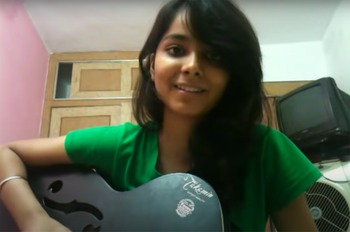
‘Haal-e-Dil, My version’, as the cover is titled, opens with Sharma in her bedroom, framed by a TV and fan on one side and a stained pink accent wall on the other (Figure 2). Sharma sits just in front of the camera, holding a black guitar, and addresses the camera in a shy, subdued voice: ‘Hi everyone, good to be back after two months. First of all, thank y'all for your tremendous support and for liking my videos. Second of all, I'm going to sing “Haal-e-Dil” from Murder 2 – hope you like it.’Footnote 44 She begins awkwardly picking a slightly out-of-tune guitar. As she croons the opening words of the song – ‘hai kash kash yoon hota, har shaam saath tu hota’ (‘If only it would stay this way, that you would be there every evening’) – her voice is breathy and melodious, if occasionally slightly off pitch. Moving into the chorus, her voice opens up into the upper register to sing, ‘haal e dil, tujhko sunati, main agar yeh bol pati’ (‘If I could narrate the condition of my heart, if I could say this’).Footnote 45 As she sings, Sharma stares intently into the camera with a smile playing on her lips, looking down only when she has to change chords. The end of the chorus is marked by a series of ascending ‘oh's; at the highest point of each sequence, Sharma constricts her throat so that the ‘oh’ cuts off with an edge of raspy vocal fry. This expressive, coquettish vocal gesture is matched by Sharma coyly turning towards a raised shoulder, eyes closed. At the end of the song, with the final guitar chord still ringing, Sharma offers a meek ‘thank you for watching’ while she reaches forward to turn off the camera.
(Colour online) Shraddha Sharma, ‘Haal-e-dil, My version’, uploaded 16 August 2011.

This video exemplifies the particular aesthetic sensibility – what I am calling an aesthetics of intimacy – which was so characteristic of both Sharma's early videos and of other Indian YouTube acts during this time. Sitting just feet from the static frame of the computer webcam, Sharma engages in a powerful form of direct address, singing and talking to the camera. The song is clearly recorded in a single take – there are no cuts or changes in camera angle nor does there seem to be any kind of sound recording apparatus apart from the computer, let alone post-production processing. Sharma's direct gaze, breathy sweet voice, and the listener's ability to hear even the tensing of her throat foster a compelling sense of physical and temporal proximity. Equally important is the ordinariness of Sharma's setting and self-presentation, an aesthetic sensibility that sits squarely within what Kate Galloway has called the ‘bedroom aesthetic’ that was such a distinctive feature of YouTube in its early years.Footnote 46 Indeed, the video reveals Sharma as a savvy amateur singer who addresses her rapidly increasing number of fans while maintaining the look and feel of the small-town girl next door.Footnote 47
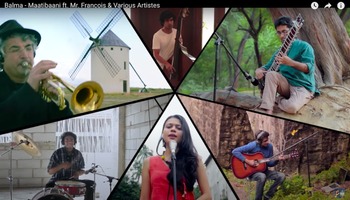
However, the markers of this aesthetics of intimacy go beyond a particular setting or style of performer self-presentation, as evidenced by Maati Baani's videos and the intimacy they engender. For example, in contrast to Sharma's low-fi bedroom recording, the band's videos during this period were often set outside and offered decidedly more high-resolution video and sound production quality. Juxtaposed to Sharma's solo ‘unplugged’ Bollywood covers, their ensemble videos featuring musicians in distinct locales across India and the world had a technophilic quality in which microphones, pick-ups, wires, and headphones were visually prominent within natural and rural settings (such as jungles, beachscapes, and villages) (Figure 3).Footnote 48
(Colour online) Maati Baani, ‘Balma’, uploaded 30 August 2012.

What Sharma and Maati Baani's videos have in common is a connective quality in which the performers are actively relating to each other and the viewer. Further, in addition to highlighting performers singing and playing directly to the camera, the videos draw attention to their synchronous audiovisual recording practices – for Sharma, singing directly into a computer microphone in her bedroom, for Maati Baani, the use of cables, mics, and headphones to capture sound as it is produced by performers across discrete, often globally dispersed locales who are nonetheless clearly engaging with each other through a single musical track. In this way, these videos establish a narrative continuity that explicitly links performers’ bodies to the musical sounds they produce within the space of the video, giving the impression that the performance is unfolding before the viewer in real time. Thus, this aesthetics of intimacy results not from a repudiation of technological mediation (i.e., low-fi, low-res production) nor from a reliance on a particular setting (such as the explicit intimacy of a bedroom), but through specific production choices that yield the sense of shared time and place that has been so central to understandings of ‘liveness’.Footnote 49 It is this emphasis on an embodied ‘liveness’ explicitly oriented towards a YouTube audience that allows for a compelling sense of co-presence and being-with to emerge between viewer and performers, serving as experiential hallmarks of this aesthetics of intimacy.Footnote 50
This sense of intimate co-presence is manifested in the number of viewer comments on Sharma and Maati Baani's videos in which the performers are directly addressed as ‘You’. For instance, Ashumicro writes under ‘Haal-e-dil’ in 2011: ‘God bless u!!!! Shraddha … may u get ur real love’ while Omar Rashid writes in 2013, ‘I don't usually comment but its was nice listening to you.’Footnote 51 In reaction to Maati Baani's first international collaboration, ‘Balma’, Keith Pereira comments in 2014, ‘I am very very very impressed by the music!!<3 Your voice is to die for!<3 This is my 1st video and I'm in love with your music:*’. These and the many other comments that seek to directly engage Sharma and Maati Baani suggest that the synchronous nature of the audiovisual production and the mode of direct address that mark these performance videos invite a reciprocal response. In contrast, the comments for official Bollywood film song videos are marked by viewers primarily talking to each other, as if the glossy highly produced aesthetics of these videos imply a distance and a concomitant understanding by viewers of the futility of addressing star performers.
Indeed, the power of this aesthetics of intimacy that was such a constitutive feature of early YouTube's user-generated music videos seems to lay a great part in the ways it offered a marked contrast to standardized Bollywood musical production practices. Maati Baani and Sharma's videos showcase ‘live’ performances by ordinary (although often highly skilled) performers who demonstrate personal vulnerability (in the form of blemishes or unremarkable clothing), offer musical fallibility (such as Sharma's halting efforts on the guitar), and sustain modes of direct address to the camera to create a sense of approachability and intimacy. In contrast, Bollywood song-and-dance sequences are produced through a process in which playback singers pre-record a song that is then picturized on a lip-synching, dancing actor; sartorial glamour, impressive settings, elaborate choreography, impeccable vocal and musical production, and celebrity beauty are central to their entertainment value.Footnote 52
As such, these videos, and Sharma's story more broadly, underscore how YouTube was actively positioning itself as an important alternative to Bollywood and the established Indian culture industries prior to the advent of Jio.Footnote 53 While Sharma sings faithful covers of famous Bollywood songs – in contrast to Maati Baani, whose repertoire featured a blend of folk, Hindustani classical, and pop performers collaborating on re-composed classical or folk songs – an early feature article quotes Sharma as saying that she has no interest in doing playback singing and that she wants to compose her own songs. It is no coincidence that an early fan uses Sharma's performance to celebrate this possibility of a burgeoning independent music scene in India by way of reference to the world of Western pop music celebrity, writing admiringly in the comments for ‘Haal-e-Dil’: ‘a female Justin Bieber in the making! Keep it up!’Footnote 54 It is also telling that one article compares Sharma's success on YouTube to that of Bollywood heart-throb actor John Abraham: Sharma has 17,598 subscribers while Abraham has only 7,282.Footnote 55
To further illuminate the desirability of this aesthetics of intimacy on YouTube prior to the advent of Jio, I will briefly analyse a video that both draws on, and fails to realize, this intimate aesthetic. ‘Kehdo na’ (‘Won't You Tell Me’) is a ballad by popular playback singer Shweta Pandit, in collaboration with American film and media composer, programmer, and pianist Kevin Doucette. Under the video, Pandit writes: ‘“Kehdo Naa” is my 1st single, written and composed by yours truly! SUBSCRIBE to my channel & I'll make more :)’. Released in August 2012 and billed as a ‘single’, the song is explicitly marked as being independent from any film.Footnote 56
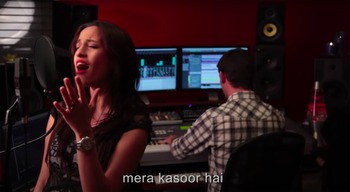
The video opens with a delicate soprano piano line over a sustained high, wispy synthesizer tone; as the image shifts from black and white to colour, we see Doucette's hands playing the piano line. The camera then turns to Pandit, who is standing in front of a mic with a pop filter, wearing headphones. As she begins singing the lilting tune, ‘won't you tell me?’, Pandit stretches her hands out in front of her. For the second half of the line, ‘what's in your heart’, Pandit forms her hands into light fists and then pops her fingers open, furrowing her eyebrows and cocking her head to the side as the vocal line ascends (Figure 4). The premise of the video, of course, is that Pandit is recording the song. However, Pandit's sequence of mannered gestures and stylized sentimental expressions make her performance feel like a choreographed simulacra of ‘live’ performance. To further undermine the effects of liveness and intimacy that the video seems to be striving for, Pandit's voice contains heavy reverb and she never makes eye contact with the camera. In fact, she even turns away from the mic in the midst of singing at certain points while the vocal track continues unchanged. Subsequently, the footage flips back and forth between Pandit singing and interacting with Doucette at his work station as the musical track continues to play uninterrupted. It is clear that the musical track and the video footage were separately produced and that this ‘performance’ of recording has been staged entirely for the camera, in the vein of ‘the making of the song’ videos.
(Colour online) Shweta Pandit, ‘Kehdo Na’, uploaded 10 August 2012.

While Pandit emulates the aesthetics of intimacy in this song, marketed as her first original song, she undermines that aesthetic experience in these crucial ways. Instead, Pandit's video ends up reinforcing her position as part of the Bollywood production model by separating voice from body, musical track from visual footage, and prioritizing glossy audiovisual production values. Pandit's video had only received 35,000 views and approximately fifty comments when I first watched it in 2014; that number has barely climbed since then. In contrast, Shraddha Sharma's video perfectly embodies YouTube's early brand tagline of ‘Broadcast Yourself’, as she reframes a film song in a mode of personal expression to create an experience of liveness and intimate connection.
As should be clear by now, my use of ‘aesthetics’ here rejects a formalist approach that would locate aesthetic experience in a discrete set of sounds and visual elements.Footnote 57 Following popular music scholar Simon Frith, I am conceptualizing an aesthetic as ‘the quality of an experience (not the quality of an object)’.Footnote 58 While Frith goes on to analyse the ways in which an aesthetic experience can catalyse the articulation of personal identity, I follow ethnomusicological scholarship that has theorized aesthetic experiences as both enabling and comprising affective social relations.Footnote 59 Building on this work, I understand aesthetics as fundamentally relational and aesthetic experiences as emerging through the intensity of an interaction between, here, a mediatized performance and a viewer-listener. Far from the ‘aesthetic autonomy’ that a formalist lens would imply, this approach argues that aesthetics are created through and inseparable from human relationships – they are a form of social practice that ‘describe a particular modality of sensory perception’.Footnote 60
To return to Shraddha Sharma and the musical aesthetics of Indian YouTube, I suggest that the aesthetics of intimacy that mark these videos comprise visual and musical representational strategies that produced the experience of temporal and physical co-presence between performer(s) and viewer, yielding feelings of trust, care, and proximity grounded in an experience of being-with. These affective sensations functioned as connective tissue between YouTube performers and audiences, creating the practices of engagement (repeated viewing, liking, commenting, and sharing) that comprised the social fabric of this emergent social media platform. As I will go on to show, this social fabric was integral to the subsequent development and expansion of YouTube in India such that aesthetics – as a mode of sensory apprehension and practice that are also social and socializing forces – were central to the development of YouTube as a platform infrastructure.
Creator culture and the work of aesthetics-as-engagement
Scholars of YouTube have long noted the presence of ‘two YouTubes’, one marked by ‘premium’ content – that is, content pre-produced and re-purposed by established media production companies – and the other by user-generated content (or UGC).Footnote 61 In their work on YouTube's ‘localizing’ strategies in India, media scholars Mohan and Punathambekar note that the ‘localization’, and thus success, of YouTube in India has entailed engaging the constitutive tension between these two YouTubes: ‘localization has meant bridging the gulf between user generated content and material sourced from established screen industries … it is with the emergence of a distinct “creator culture” centred on comedy, food, beauty, technology, children's culture, and web series [and, I would add, music] that YouTube could claim a measure of success in enabling content that resonated with users rooted in language-based cultural regions’.Footnote 62 Thus, while Indian YouTube relied in its early years on content produced by established film houses, production companies, and television channels, generating ‘locally relevant content’ and a robust ‘creator culture’ has been a crucial aspect of YouTube's expansion into various media markets across the world.
This strategy comes through clearly in interviews with high-level Google executives during this time period. In a 2014 video interview with business newspaper Mint, Gautam Anand, the Asia-Pacific Director of Content and Operations at YouTube, reflected on the important role that established media production companies had played in establishing YouTube's foundation in India. He then pivoted: ‘what we're really excited by is seeing this emergence of original content creators coming on to YouTube and really tapping into global fan bases’.Footnote 63 Anand goes on to describe how YouTube is trying to bolster this phenomenon in India through live events such as the YouTube FanFest, YouTube Comedy Week, and YouTube Top Chef before returning to emphasize the potential of user-generated content: ‘So we're very excited about comedy as a genre; obviously, independent musicians, they've been a big part, music has been a big part of YouTube, fashion and beauty, even gaming – these are all very conducive to web-programming.’Footnote 64 These observations about the importance of UGC, and even music in particular, are held in emerging digital markets beyond India; as one digital analyst reflected, ‘As these waves of audiences come online, it feels like music is the first thing that brings people there – and then holds them and trains them to come to YouTube for content … After that, you get kids content, gaming content – all these other verticals that unfold’.Footnote 65
Market strategy research has shown that UGC generates more ‘engagement’; it gets people to watch for longer and share more, to spend more time on YouTube and feel more invested in it.Footnote 66 This insight has proved foundational to YouTube's expansion and monetization strategies.Footnote 67 More viewing time means encountering more ads, which results in more money (for both YouTube and a given ‘creator’). Significantly, YouTube changed its algorithm in 2012, moving from ranking videos depending on how many clicks (or ‘plays’) they received to ‘rewarding engaging videos that keep viewers watching’ – that is, ranking videos based on how long, proportionally, viewers watched for.Footnote 68 This emphasis on engagement extended to the conditions of monetization in 2018, when Google decided that channels would only qualify for its YouTube Partners Program and become eligible to monetize their videos at all if they had 1,000 subscribers or 4,000 hours of viewing time, overriding the previous criteria of 10,000 views.Footnote 69 Indeed, I was told by YouTube executives that Maati Baani's value and visibility within the growth of Indian YouTube was predicated not on their more modest view numbers, but by the engagement they cultivated, as measured by viewing time.
It is within this emphasis on ‘engagement’ – as fostered by ‘local content’ and a strong ‘creator culture’ – that we can understand the importance of this aesthetics of intimacy within YouTube's broader strategy in this period of expansion from 2011 to 2015.Footnote 70 The connective, intimate aesthetics of successful YouTube musicians facilitated ‘engagement’ by building committed fan bases who returned repeatedly to YouTube to consume, catch up on, and support their favourite musicians, whom they often could not hear anywhere else. Indeed, it is for this reason that YouTube employees and music industry officials alike seem as excited about Shraddha Sharma's ability to develop relationships through music as they do about her musical skills. In the words of Devraj Sanyal, the managing director of Universal Music India: ‘I haven't been this excited about the launch of an Indie artist as I am for Shraddha. She's a young girl from Dehradun who built an envious base on YouTube all on her own with no help from anyone.’Footnote 71 Sharma, Maati Baani, and the aesthetics of intimacy that they emblematized were thus central to the platform's strategy of expansion, for their ‘locally relevant content’ helped YouTube to establish legitimacy and build a reliable and active user base within India.Footnote 72
Corporate strategy and industry imaginaries
Were this article written prior to 2018, it might have ended here: as an account of YouTube as an important site of cultural production for musicians who sought to position themselves outside of Bollywood's ambit and the role of their intimate aesthetic practices in popularizing YouTube in India. However, the data revolution effected by the launch of Reliance Jio in 2016 – with its free SIM cards and free data – fundamentally changed patterns of internet usage and consumption in India with profound implications for YouTube. By March 2018, India had the cheapest mobile data in the world, and it was estimated that 80 per cent of the internet population in India used YouTube, which, with 225 million monthly users, had two times as many users as all other video-streaming platforms combined.Footnote 73 In short, many more people were streaming video on their phones, and YouTube had succeeded in establishing itself as their video streaming platform of choice.
In this moment, a noticeable shift occurred in what was being watched on Indian YouTube, which was now dominated by channels such as T-Series and featured glossy, high-quality videos sponsored by Universal Music, and other major production houses.Footnote 74 Simultaneously, the scale, aesthetics, and stakes of finding success on YouTube changed quite significantly, for it takes serious investment to produce and promote these videos. For those artists who had previously received active support from YouTube, there was a sense that the platform was now intentionally rewarding artists who were backed by large production houses and music companies (and who could, by extension, draw wider audiences and bigger profits).Footnote 75 Thus, Nirali Kartik's sense of betrayal, her feeling of being used by YouTube, was insightful: while T-Series had a high-profile channel on YouTube from the time of the site's launch in India (and Bollywood music videos have always received the most views), Maati Baani, Shankar Tucker, and Shraddha Sharma were highlighted and supported by YouTube precisely because their aesthetics of intimacy worked quite effectively to draw viewers to the platform and to allowed it to gain traction as the infrastructural possibilities in India slowly grew.
Indeed, harbingers of this aesthetic and corporate shift had been subtly threaded through my ethnographic research and performance work with Maati Baani even in the ‘indie’ years prior to the launch of Jio. For example, in February 2014, Maati Baani was invited to be a featured act in the second annual YouTube FanFest India. The FanFest concept, started in 2013, was a way of bringing together established YouTube stars and rising ‘local’ content creators for a live showcase before a large audience of ‘fans’ – both live and live-streamed – in a given emerging market (with India, Singapore, and Indonesia being the main foci).Footnote 76 Other acts chosen to represent Indian YouTube included the American-born, white cross-over indie music composer and clarinettist Shankar Tucker; the duo 88 Keys to Euphoria, consisting of pianist Aakash Gandhi and singer Jonita Gandhi, Canadian-Indians who offered acoustic renderings of Hindi film songs; the sketch comedy troupe All-India Bakchod (AIB); the makeup and style vlogger Scheherezade Shroff; and Shraddha Sharma. International YouTube stars included American fashion blogger Bethany Mota and Indian-Canadian stand-up comic and rapper SuperWoman (who was by far the most popular act of the night). In advance of the FanFest, YouTube employees strategically organized collaborations in which these various YouTube creators were featured in each other's videos. The FanFest was thus an astute combination of cross-‘brand’ transnational marketing under the umbrella of a live performance celebrating local creator culture, with a selection of ‘indie’ acts as the face and sound of YouTube India.
Maati Baani's set was one of the first in the line-up and the audience of young cosmopolitan Mumbaikers was enthusiastic, responding positively to the band's original songs combining an upbeat rock aesthetic with Indian ragas and folk instruments. At some point, however, I noticed that the applause and cheers were not dying down – they were getting louder and louder. This was not about us, it was clear, and, as we looked in the direction of the disturbance, we realized what was happening: the iconic Bollywood heart-throb actor Shah Rukh Khan (also known as SRK) had shown up in the audience to drop his daughter off from their nearby mansion and was now being mobbed. Security forces managed to pry the screaming teenagers off of him and we were able to resume and finish our set. Later in the evening, SRK returned and was invited onstage where he gave a brief speech about how YouTube was the wave of the future; turning to SuperWoman, he told her how much his daughter idolized her. Passing one of the YouTube production directors backstage later that evening, I asked her if they had known that SRK would come and she confirmed that they had been speaking with his manager in the hopes that he would make an appearance, although until the last minute, it had not been clear that he would show. ‘These Bollywood stars, they don't need us yet’, I recall her saying. I was puzzled, at the time, by the seeming discrepancy between the indie musical acts YouTube had chosen as the face of YouTube India and the evident desire to partner with the mainstream culture industries, the latter represented by SRK's presence as well as a mid-show album launch by Universal Records for Shraddha Sharma, who had been outfitted in a tight sequined tube dress, curled hair, and tottering heels. In retrospect, SRK's ability to bring the whole show to a halt foreshadowed YouTube's ambivalent attachment to its independent creators and their aesthetics of intimacy as well as the aesthetic turn back towards ‘premium content’, as represented by T-Series, that YouTube would take with the advent of Jio.
Soon after the FanFest, I used the connections I had gained at the after-party to schedule a meeting with Amit Agrawal, head of YouTube partnerships, at the Google headquarters in Goregaon, a booming suburb on the periphery of New Delhi marked by construction dust and tall glass buildings housing multinational corporations. Amit and I sat in the Google cafe and I tried to ask him questions about how YouTube was developing a local creator culture. He, in turn, deftly deflected my queries, expressing surprise at my status as a Ph.D. candidate and researcher, despite the information contained in my introductory email, while trying to convince me that I could be the Indian Lindsey Stirling if I started my own YouTube channel.Footnote 77
I asked if Google was involved in promoting infrastructure or policy to support internet development and he nodded firmly: ‘Yes, they're very involved with that. We believe that the internet is a very liberating space and it aligns with India's economic system and values today.’ When I expressed concerns about limited internet availability to date, he was unfazed: ‘the internet isn't arriving, it's already here … Now, YouTube is trying to be the platform of choice for creators!’ When I mentioned the slow roll-out and inaccessibility of broadband (i.e., of wired terrestrial connections), he countered with, ‘but there are cellular developments, na?’, predicting that in a year's time, 300–500 million users would be using the internet. On the way out, he tried again: ‘tell me, Anaar, why don't you want to start your own channel?’ When I responded that I did not make my own musical content, he changed tactics: ‘you can do violin tutorials!’ As we parted ways, he pitched again: ‘if you really want to know about this new medium from the inside, having your own channel is the best way to understand that! Then you can really talk to your students about that.’ I joked that now he had the right promotional pitch.
Far from a moment of successful ethnographic access to the putative inner sanctum of corporate digital cultural production, this meeting became its own moment of ethnographic opacity marked by a series of puzzling, frustrating, and laughable deflections and misunderstandings. I return to it, then, for the ways in which it demonstrates the importance of ‘the industry logics, practices, and imaginaries that ensure the reach and global scale of dominant platform companies’.Footnote 78 Emphasizing ‘corporate industry imaginaries’ is, I contend, an important way of re-conceptualizing corporate digital platform strategy in a manner that emphasizes its always speculative and emergent nature. To some extent, Agrawal seemed to know what was coming in terms of the infrastructural changes and radical expansion of internet access I traced earlier in relation to the roll-out of Jio; indeed, it is to be expected that Google analysts would be closely tracking the infrastructural investments and moves being made by various major telecommunications players. Yet, rather than treating Agrawal and other corporate actors as omniscient agents of unfolding digital landscapes, it is more accurate to frame their statements and actions as enactments of corporate imaginaries that map possible futures and articulate desired pathways along which digital industries may evolve. Their tenuous prognostications draw together questions of infrastructural availability (who can access what where) and the instrumentality of aesthetics (what kinds of practices yield what forms of engagement and profits), functioning as discursive-material efforts to make those imaginaries into experiential common sense. In other words, as Agrawal attempted to convince me to become the ‘Indian version’ of a white American pop violinist YouTube star whose videos were garnering millions of views, he was working to further a future in which YouTube would be the dominant platform for video consumption and engagement in India, a future in which YouTube would truly be an infrastructuralized platform. These corporate industry imaginaries, however, should not be understood as teleologies of digital culture, as inevitabilities of how digital culture will be. Rather, they illuminate how corporate platform players envision it will be and how they are using the sticky salience of aesthetic practices to navigate this landscape of possibility to bring their desired corporate digital futures into being.
Conclusion: studying digital cultures at the intersection of infrastructure and aesthetics
It is this inability of the ethnographer to apprehend changes in digital corporate platforms as they are unfolding that leads to the broader methodological question that undergirds this article, namely, how do we investigate musical culture in the digital realm when platforms like YouTube are so multifaceted, opaque, and unstable as ‘objects of study’? How do we trace the role of musical sound and practice within the multi-layered and dialectical composition of the hardware, software, activities, and aims that comprise these platforms? This sense of analytical slipperiness is further heightened by the fact that ‘the digital’ is now so densely imbricated with daily life that it seems to structure the very conditions of possibility for our experience of the world.Footnote 79 Bearing in mind these challenges that digital cultural formations pose to standard modes of scholarly analysis in terms of proximity and perspective, speed and instability, I want to conclude by underscoring the methodological importance of holding together infrastructure and aesthetics in the study of digital musical cultures and communities.
As scholars seek to understand various digital musical communities and, more pertinent to my argument, the specific work that music performs in the digital realm, an infrastructural lens requires an attunement to the rapidly shifting entanglements of communications systems and human actors that constitute the complex, dispersed networks of social praxis, meaning, politics, and policy that produce and form digital culture. This wide-angled infrastructural lens is a reminder that the further we get away from ‘the music’ into questions of cellular infrastructure, mobile technology, data pricing, and so on, the more insight we have into digital culture and the ways in which music functions both as ‘content’ and as more than ‘content’ in shifting digital landscapes. Attending to aesthetics in tandem with infrastructure, then, is a move to draw the affectively rich and socially meaningful aspects of musical practice and sound into intimate conversation with the most seemingly distant aspects of contemporary life in all its political, economic, social, and material slipperiness.
Yet, when bringing infrastructure and aesthetics into proximity, it is crucial to avoid reinscribing a technologically deterministic base-cultural superstructure framework by suggesting that infrastructure acts as a material substrate that produces aesthetic and social effects. Following Brian Larkin's observation that ‘the simple linear relation of foundation to visible object turns out to be recursive and dispersed’, the relationship between infrastructure and audiovisual aesthetics is complexly dynamic: aesthetics, and the affective social relations that they comprise, both rely on and are used in the construction of infrastructure.Footnote 80 Indeed, aesthetics can be understood as integral parts of infrastructures and catalysts for processes of infrastructuralization, not just produced by or in response to them. For this reason, scholars must keep the relationship between musical-visual aesthetics and infrastructural conditions of possibility in any given moment as an open site for investigation, one that can yield important insights into the corporate interests and ‘industry imaginaries’ that shape so much of digital musical life today.