From an early age on experiences with peers play an important part in shaping child development (Hay, Payne, & Chadwick, Reference Hay, Payne and Chadwick2004; LaFreniere, Reference LaFreniere1996). Peers provide a context in which children develop and validate their self-conceptions (Butler, Reference Butler1989), acquire social roles (Banaji & Gelman, Reference Banaji and Gelman2013; Mascaro, & Csibra, Reference Mascaro and Csibra2014), and learn the norms and values of their social groups (Barry & Wentzel, Reference Barry and Wentzel2006; Fabes, Hanish, Martin, Moss, & Reesing, Reference Fabes, Hanish, Martin, Moss and Reesing2012).
Peer relations can also jeopardize healthy development by providing an environment that produces and reinforces maladaptive behaviors, such as submissiveness or aggression, which in turn have been associated with numerous negative developmental outcomes during childhood and adolescence, such as chronic stress (Arsenault, Bowes, & Shakoor, Reference Arseneault, Bowes and Shakoor2010), delinquency, substance abuse, or psychiatric illnesses (Arsenault et al., Reference Arseneault, Cannon, Fisher, Polanczyk, Moffitt and Caspi2011; Boivin, Vitaro, & Poulin, Reference Boivin, Vitaro, Poulin, Tremblay, Hartup and Archer2005; Bukowski, Adams, & Santo, Reference Bukowski, Adams and Santo2006; Karevold, Coplan, Stoolmiller, & Mathiesen, Reference Karevold, Coplan, Stoolmiller and Mathiesen2011).
Because in the social domain a child is both an active agent and the target of the social behavior of other individuals, social development occurs in a transactional process in which children's own characteristics, such as temperament, and the social environment influence each other (see Rubin, Hymel, Mills, & Rose-Krasnor, Reference Rubin, Hymel, Mills, Rose-Krasnor, Cicchetti and Toth1991).
Yet, empirical evidence on the role of child characteristics within such a transactional process is limited. Extrapolating from recent evidence (Boivin, Brendgen, Vitaro, Dionne, et al. Reference Boivin, Brendgen, Vitaro, Dionne, Girard and Pérusse2013; Brendgen et al., Reference Brendgen, Boivin, Dionne, Barker, Vitaro and Girard2011) that children's genetically influenced maladaptive behaviors elicit reactions from the environment, the present study sought to examine the contribution of child temperament in the development of peer problems. The present study provides the first longitudinal investigation of child temperament and its association to peer problems, based on a sample of 939 pairs of twins followed from early to middle childhood. We examined the proposed interplay between child characteristics and the environment in two consecutive steps. First, we examined the associations and contributions of four distinct temperamental characteristics to the development of peer problems. Second, we sought to establish the causal influence of child temperament in negative peer experiences within a genetically informed longitudinal design.
Peer Problems in Early Childhood
Given that maladaptive peer relations have been associated with a large group of deleterious implications for early and late emergent adjustment problems (Denham & Holt, Reference Denham and Holt1993; Parker & Asher, Reference Parker and Asher1987; Parker, Rubin, Price, & DeRosier, Reference Parker, Rubin, Price, DeRosier, Cicchetti and Cohen1995), research has made considerable efforts to identify factors that place children at risk for negative social experiences and their harmful consequences.
Studies have usually focused on either of two related aspects of peer problems. Peer rejection describes the experience of being disliked and negatively perceived by peers. This form of peer problems reflects the attitude of the peer group that may induce a certain class of manifest behaviors by peers, such as excessive teasing and active victimization by peers (Boivin, Hymel, & Hodges, Reference Boivin, Hymel, Hodges, Juvonen and Graham2001), or more subtle forms of ostracism and exclusion (e.g., Rubin, Bukowski, & Parker, Reference Rubin, Bukowski, Parker, Eisenberg, Damon and Lerner2006). The other type of peer problems, peer victimization, refers to a class of negative behaviors inflicted by peers, such as repeated harassment. Considering that both forms of peer problems are important markers of maladaptive peer relations and have been associated with a large group of deleterious implications for early and late adjustment problems (Denham & Holt, Reference Denham and Holt1993; Parker & Asher, Reference Parker and Asher1987; Parker et al., Reference Parker, Rubin, Price, DeRosier, Cicchetti and Cohen1995), we define peer problems as children's negative relationships with other children, specifically as experiencing negative attitudes by peers or being the target of peers’ negative behaviors.
Many young children experience their first opportunities for extended peer interaction in preschool and kindergarten settings. At the outset, these first encounters and experiences with peers are often far from harmonious. Peer interaction during early childhood has been found to consist of a high amount of difficulties and conflict (Hanish, Ryan, Martin, & Fabes, Reference Hanish, Ryan, Martin and Fabes2005; Olweus, Reference Olweus1991). As children develop more mature and sophisticated behaviors, emotions, and cognitions related to social behavior, they also become increasingly more apt at establishing and maintaining adaptive social relationships, which is reflected in a decline of observed peer problems across the elementary and middle school years (Solberg & Olweus, Reference Solberg and Olweus2003).
However, this does not mean that the peer relationship quality improves for all children to the same degree. Despite the average normative decreases in peer problems, pronounced individual differences in the quality of peer relationships persist across the ages (Hanish et al., Reference Hanish, Ryan, Martin and Fabes2005; Olweus, Reference Olweus1991). The literature on peer difficulties during the elementary school years has estimated that for roughly 10% of children's peer problems continue beyond the early childhood period (Farmer, Hall, Leung, Estell, & Brooks, Reference Farmer, Hall, Leung, Estell and Brooks2011; Rigby, Reference Rigby2000).
We expected to find similar developmental trends in the present sample. We expected that (Hypothesis 1a) as children grow up, the level of peer problems would drop. In contrast, despite this drop in the overall level of peer problems (Hypothesis 1b), we expected to find substantial rank-order stability in the degree of peer problems, such that the children with the highest degree of peer problems in younger ages would tend to also have relatively higher levels of peer problems as they grow up.
From here we set out to examine the contribution of child temperament to observed individual differences in peer problems.
The Role of Children's Temperament in Peer Problems
Previous nongenetic research has produced a rich body of evidence that explains peer problems with family-related factors, such as socioeconomic status, parental support, or maltreatment (for a review, see Ladd, Profilet, & Hart, Reference Ladd, Profilet, Hart, Parke and Ladd1992), and to a lesser extent has identified factors within the child that contribute to maladaptive social relationships. Specifically, researchers of peer relationships have argued that individual variation in temperamental characteristics may be an important influence in the social development process (e.g., Burgess, Rubin, Cheah, & Nelson, 2001). However, notwithstanding the strong evidence provided by concurrent assessments for the existence of a relationship between peer problems and different individual characteristics such as social withdrawal (Nelson, Reference Nelson2013) and aggression (Hanish & Guerra, Reference Hanish and Guerra2002; Kochenderfer & Ladd, Reference Kochenderfer and Ladd1997), we know relatively little about the unique contributions of different temperamental characteristics to the etiology of peer problems. Moreover, there is little direct evidence for a causal role of temperament in peer problems.
Temperament traits are defined as “early emerging basic dispositions in the domains of activity, affectivity, attention, and self-regulation, and … are the product of complex interactions among genetic, biological, and environmental factors across time” (Shiner et al., Reference Shiner, Buss, McClowry, Putnam, Saudino and Zentner2012, p. 437). These early emerging stable and consistent behavioral tendencies (DePauw, Mervielde, & Van Leeuwen, Reference De Pauw, Mervielde and Van Leeuwen2009) manifest in the way children behave and can elicit reactions from the social environment. A large body of research has revealed correlations between children's temperamental characteristics and various measures of peer relation quality, such as sociometric status, popularity, rejection, and victimization (for a review, see Sanson, Hemphill, & Smart, Reference Sanson, Hemphill and Smart2004).
The present study examined the unique effects of four key temperamental dimensions (Buss & Plomin, Reference Buss and Plomin1984) as they work in concert to influence social experiences: negative emotionality, shyness, sociability, and activity. Below, we define each of these dimensions and propose hypotheses regarding their relationship with peer problems.
Negative emotionality indicates a tendency to experience distress, particularly after frustration. Individuals vary on this dimension from lack of reaction to extreme, out of control emotional responses to negative events (Goldsmith et al., Reference Goldsmith, Buss, Plomin, Rothbart, Thomas and Chess1987). Individual differences in emotionality influence children's reactions and learning in social situations, and affect tendencies to approach or withdraw from others (Rothbart, Ahadi, & Hershley, Reference Rothbart, Ahadi and Hershey1994), which in turn may influence how one is perceived or treated by the social group. For example, children who are more prone to negative emotions are likely to engage in more problem behavior (e.g., anger and aggression). Consequently, these individuals may be avoided by the peer group. In support of this notion, we found in a previous investigation with a sample of 3-year-old twins (partially overlapping with the sample in the current study) a positive relationship between negative emotionality and peer problems (Benish-Weisman, Steinberg, & Knafo, Reference Benish-Weisman, Steinberg and Knafo2009). Extending this work from age 3 to age 6.5, we expected to find (Hypothesis 2a) a positive relationship between children's negative emotionality and their peer problems in early and middle childhood.
In addition to emotionality, research on peer difficulties has provided strong evidence linking shyness with poor peer relationships (e.g., Gazelle & Ladd, Reference Gazelle, Ladd and Schewe2002). Shyness refers mainly to anxious behavior with strangers, but not necessarily with good friends and members of the family. Work on early and middle childhood (Coplan & Arbeau, Reference Coplan and Arbeau2008; Karevold et al., Reference Karevold, Coplan, Stoolmiller and Mathiesen2011) has shown that shyness affects psychological well-being not only directly but also through its links with poor peer relationships (e.g., rejection or victimization; Bowker & Raja, Reference Bowker and Raja2011; Coplan & Arbeau, Reference Coplan and Arbeau2008). Shy children are expected to have a high degree of peer problems, because of the difficulty they experience in approaching social situations and initiating social relationships. Accordingly, we hypothesized that (Hypothesis 2b) positive relationships would be found between shyness and peer problems.
Sociability refers to children's enjoyment of interpersonal contexts (Goldsmith et al., Reference Goldsmith, Buss, Plomin, Rothbart, Thomas and Chess1987). It characterizes children who enjoy the presence of other children and are energized by their peers; they are expected to seek the company of others and therefore are more likely to create and maintain close relationships, in comparison to children who prefer to be alone. Children with low sociability are believed to withdraw from social interactions not because they are anxious but because they are less interested in initiating interactions with peers (Nelson, Reference Nelson2013). The role of sociability in the etiology of peer problems has been much less frequently examined than that of shyness, probably because it has often been conceptualized as inversely related to the socially withdrawn behaviors characteristic of shyness. Yet, children who are low in sociability may experience more peer problems compared to more socially outgoing peers, because their temperamental constitution hinders them from acquiring the behavioral competencies necessary for adaptive interaction (e.g., Coplan & Armer, Reference Coplan and Armer2007). More recent evidence suggests that these children also directly elicit more negative attitudes in their peers (Coplan, Girardi, Findlay, & Frohlick, Reference Coplan, Girardi, Findlay and Frohlick2007). In support, in our previous study of 3-year old twins, sociability related negatively to peer problems (Benish-Weisman et al., Reference Benish-Weisman, Steinberg and Knafo2009). Thus, we expected (Hypothesis 2c) sociability to be negatively associated with children's peer problems in early and middle childhood.
Activity level is composed of vigor and tempo. Children's activity level ranges between lethargy and an extreme push of energetic response (Goldsmith et al., Reference Goldsmith, Buss, Plomin, Rothbart, Thomas and Chess1987). Children who are active and very energetic create more opportunities for contacts and relations as opposed to children who are more passive and less dynamic. Although there is not much direct evidence for the role of activity level in peer problems, there is some evidence that inhibitory control relates positively to social competence (Van Hecke et al., Reference Van Hecke, Mundy, Acra, Block, Delgado and Parlade2007). Thus, extremely active children may have problems relating to their peers and coordinating social activities, as exemplified in a positive association between attention-deficit/hyperactivity disorder and adolescents’ peer problems (Bagwell, Molina, Pelham, & Hoza, Reference Bagwell, Molina, Pelham and Hoza2001). In contrast, the play patterns of young children require at least a moderate degree of activity in order to engage with other children and share social experiences with them, and 3-year-old twins’ activity level related negatively to peer problems (Benish-Weisman et al., Reference Benish-Weisman, Steinberg and Knafo2009). Therefore, we did not have a specific hypothesis regarding the relationship between activity level and peer problems.
In the current investigation, the assessment of four temperamental dimensions in a longitudinal design allows us to address two important questions. First, it allowed us to explore the degree to which the different temperamental dimensions make independent contributions to peer problems concurrently and longitudinally. Such an analysis could elucidate the role of specific temperamental variables, and allow an illustration of how the different characteristics play out in concert to generate temperamental risk or resilience to peer problems. Second, the present longitudinal design allowed us to address the question of directionality. Given that temperament describes constitutionally based dispositions (Shiner & Caspi, Reference Shiner, Caspi, Zentner and Shiner2012), we expected it (Hypothesis 2d) to predict children's peer problems across time, over and above earlier peer problems.
Genetic and Environmental Contributions to Peer Problems
Establishing causation in social relationships is a challenging task: it is difficult to determine who affects whom in interactions. Time precedence used in longitudinal analyses is not necessarily indicative of causality (Reiss, Reference Reiss1995) even when past behavior is controlled for in a cross-lagged design. The advantage of genes is that their place in time is distinct, and therefore they can provide a clearer path of causation. Accordingly, in a second step, we sought to establish children's influence in the development of maladaptive psychosocial outcomes within a genetically informed analysis. The classic twin design compares monozygotic twins (MZ; sharing virtually 100% of the genome) and dizygotic twins (DZ; sharing on average 50% of the genetic variance), who have been raised together, to estimate genetic and environmental contributions to a trait (e.g., Plomin, DeFries, McClearn, & McGuffin, Reference Plomin, DeFries, McClearn and McGuffin2008).
The rationale of the twin design can be extended to measured environments, such as parenting (e.g., Avinun & Knafo, Reference Avinun and Knafo2014), life events (e.g., Button, Lau, Maughan, & Eley, Reference Button, Lau, Maughan and Eley2008), and peer relationships (e.g., Boivin, Brendgen, Vitaro, Dionne, et al., Reference Boivin, Brendgen, Vitaro, Dionne, Girard and Pérusse2013). The extent to which MZ twins are more similar in their peer problems can be used to estimate genetic contributions to peer problems (i.e., heritability, the proportion of variance in a trait that can be attributed to genetic factors). The remaining variance is attributed to environmental factors (i.e., nongenetic influences.) Environmental variance can be further decomposed into shared and nonshared environmental influences. Shared environmental variance refers to any feature of the physical and social environment that family members are jointly exposed to and that influences the siblings in the same way, beyond their genetic resemblance. Nonshared environmental variance is a residual variance that includes environmental influences that are unique to each individual and measurement error.
Individual differences in peer problems among children in middle childhood and adolescence consistently reveal substantial genetic influence, with heritabilities of 0.50–0.60 for parent-reported peer problems (Edelbrock, Rende, Plomin, & Thompson, Reference Edelbrock, Rende, Plomin and Thompson1995) and 0.40 to 0.70 for teacher-reported problems (Saudino, Ronald, & Plomin, Reference Saudino, Ronald and Plomin2005). Ball et al. (Reference Ball, Arseneault, Taylor, Maughan, Caspi and Moffitt2008), for instance, found that almost three quarters of the individual variance in peer victimization at age 10 was explained by genetic factors. The few investigations that have examined peer problems in early childhood (Benish-Weisman et al., Reference Benish-Weisman, Steinberg and Knafo2009, Boivin, Brendgen, Vitaro, Dionne, et al., Reference Boivin, Brendgen, Vitaro, Dionne, Girard and Pérusse2013; Brendgen et al., Reference Brendgen, Boivin, Dionne, Barker, Vitaro and Girard2011) have found similar results in samples of kindergarteners and elementary school-aged children. Accordingly, we hypothesized that (Hypothesis 3a) there would be genetic contributions to children's peer problems.
Moreover, in line with research on behavior problems that has generally found the nonshared environments to be more important for the explanation of behavior problems than shared environmental influences (Oliver & Plomin, Reference Oliver and Plomin2007), we expected to find an increase in the role of nonshared environment (and a decrease in shared environment) from early to middle childhood.
Looking for evidence of a genetic influence on peer problems does not imply it is an intrinsic child characteristic; it merely acknowledges that genetic differences among children are expressed in their individual characteristics, which in turn may affect the way their environment (i.e., peer group) treats them. The phenomenon of an association between a genetic disposition and individual differences in experience has been termed a gene–environment correlation (rGE; Plomin, DeFries, & Loehlin, Reference Plomin, DeFries and Loehlin1977; Scarr & McCartney, Reference Scarr and McCartney1983).
Three main forms of rGE have been suggested (e.g., Plomin et al., Reference Plomin, DeFries and Loehlin1977). Passive rGE occurs when children inherit an environment that is correlated with their genetic dispositions; this process is less relevant in the current case, because children's peer relationships often involve other children who are not genetically related to them. Two kinds of nonpasssive rGE are relevant to peer problems. In active rGE, individuals actively select or create environments (e.g., choose to spend more time with specific peers) that are associated with their genetic propensities. In evocative rGE, partially heritable traits or behaviors evoke reactions from others (e.g., peers) in the environment.
In the only genetically informed study we know of that has specifically focused on the associations between temperament and peer problems, we found that the positive associations between 3-year-olds’ negative emotionality and peer problems, and the negative associations of peer problems with activity and sociability, were accounted for to a large extent by genetic effects, indicating that temperament mediated the association between children's genetic tendencies and their peer problems (Benish-Weisman et al., Reference Benish-Weisman, Steinberg and Knafo2009). The present examination builds on and extends our work by examining the extent to which genetic effects on temperament are associated with genetic effects on peer problems in both early and middle childhood. Moreover, our longitudinal design enabled us to investigate the longitudinal relationship between child temperament and peer problems. We hypothesized (Hypothesis 3b) that genetic effects on temperament would contribute longitudinally to individual differences in peer problems.
The association between the child's heritable characteristics and the environmental responses to them are subject to change over the course of development. Children's abilities to initiate and engage independently in social relationships advance rapidly during early childhood, increasing the potential for peer reaction that is correlated with the child's own genetically influenced behavior. Moreover, the environmental reaction too may exacerbate or maintain children's temperamental characteristics over time (Knafo & Jaffee, Reference Knafo and Jaffee2013). Because these environmental reactions are initiated by partially heritable characteristics, they constitute part of the genetic estimate of peer problems. Accordingly, we hypothesize that (Hypothesis 3c) the heritability of peer problems will increase with age.
Summary of Research Questions of the Current Study
In the present study, we sought to examine the notion that children's biologically predisposed characteristics influence their risk of experiencing peer problems. The research program had three major objectives.
First, we sought to investigate the change and the stability in levels of peer problems from early to middle childhood. We expected to find (see Hypotheses 1a and 1b) an overall drop in average peer problems with age versus rank-order stability in the degree of peer problems. Second, we were interested in children's temperamental correlates of the peer problems they encounter, both concurrently and across time. Specifically, we sought to examine the specific contributions of the four temperamental characteristics as they work in concert and over time (see Hypotheses 2a and 2b). Third, to establish the role of child influence on peer problems, we studied the role of heritable and environmental factors in the etiology of children's peer problems, and how they are associated with temperament from early to middle childhood (see Hypotheses 3a–3c).
Method
Participants
Families in this study were participants in the Longitudinal Israeli Study of Twins, a study of social development, in which parents of all Hebrew-speaking families of twins born in Israel during 2004–2005 were invited to participate via parent questionnaires when the twins reached the ages of 3 and 5 (Avinun & Knafo, Reference Avinun and Knafo2013; Knafo, Reference Knafo2006). At age 6.5, recruitment was done in home or lab visits, which reduced the number of participating families. Because age 6.5 measures focused on same-sex twins, the current report uses data from same-sex twins only. Details on recruitment and representativeness of the sample appear in Avinun and Knafo (Reference Avinun and Knafo2013).
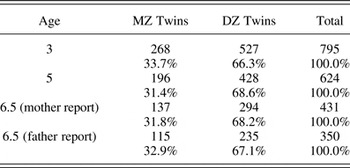
Data were available from 939 twin pairs, for at least one time point (i.e., not all children participated at all three time points); that is, 795 pairs participated at age 3 (M = 3.1 years, SD = 2.43 months), 624 at age 5 (M = 5.1 years, SD = 2.81 months), and 431 at 6.5 (M = 6.6 years, SD = 2.81 months). At the age 6.5 measurements, father reports were also available from 350 pairs. Table 1 presents the distribution of MZ and DZ twins at each age. The sex distribution of the sample was about equal (49.7%–51.9% males) in all waves of the study.
Sample sizes at ages 3, 5, and 6.5

Note: MZ, Monozygotic; DZ, dizygotic.
Procedure
When the twins reached the age of 3 years, and again when they were 5 years old, mothers filled out questionnaires, which included questions on the pregnancy, twins’ behavior, twins’ characteristics, the relationship between the twins, demographic details, socioeconomic status, and questions regarding the twins’ zygosity. At age 6.5, questionnaires were given to mothers at the time of the observational session, and when possible to fathers. Fathers, who were not present at the observational session, received the questionnaire by mail.
Measures
Twin zygosity was assessed using information from DNA samples for 38% of the sample. For the rest of the sample, an algorithm calculated according to a parental questionnaire of physical similarity (Goldsmith, 1991) was used. The results of DNA analyses were in agreement with the algorithm in over 95% of the cases.
Peer problems were assessed by mothers and at age 6.5 also by fathers, using the peer problems subscale of the 25-item Strengths and Difficulties Questionnaire (Goodman, Reference Goodman1997), which measures peer problems, emotional symptoms, conduct problems, hyperactivity/inattention, and prosocial behavior. Items are rated as being not true (0), somewhat true (1), or certainly true (2), and each of the subscales consists of 5 items. Because we were interested in the effects of children's temperament on the reaction they evoked in other children, we had to take out 2 items that could reflect temperamental tendencies, and not only peers’ reactions (“Rather solitary, tends to play alone” and “Gets along better with adults than with other children”). This resulted in a low α (0.38), reflecting the breadth of the covered peer issues and the small number of items. However, the remaining 3 items (“Has at least one good friend” [reverse-scored], “Generally liked by other children” [reverse-scored], and “Picked on or bullied by other children”) loaded highly (0.56 or more) on a single factor, accounting for 46% of the variance, indicating substantial construct validity. Reliability as estimated by Hancock and Mueller's (Reference Hancock, Mueller, Cudeck, Du Toit and Sörbom2001) coefficient H, was 0.66. The 3 items were averaged to form a single peer problems score.
Temperament was rated by mothers using the EAS Temperament Scale (Buss & Plomin, Reference Buss and Plomin1984). The EAS has 20 items, 5 corresponding to each of the temperamental dimensions. Example items are “cries easily” (negative emotionality), “takes a long time to warm up to strangers” (shyness), “prefers playing with others rather than alone” (sociability), and “is off and running as soon as he/she wakes up” (activity). Mothers rated their children on a 5-point rating scale (1 = not characteristic or typical of your child, 5 = very characteristic or typical of your child). Two population-based studies have reported a good factor structure of the EAS for young children (Mathiesen & Tambs, Reference Mathiesen and Tambs1999; Boer & Westenberg, Reference Boer and Westenberg1994), as well as substantial test–retest stability (Mathiesen & Tambs, Reference Mathiesen and Tambs1999). We used a Hebrew version of the EAS that had been translated into Hebrew and backtranslated into English to ensure the validity of the translation, and piloted on an independent sample (Knafo, Reference Knafo2006). One sociability item (“when alone, feels isolated”) was dropped because it did not correspond well with the other items. Temperament scales had moderate to good internal consistency (α = 0.61–0.79).
Overview of analyses
Nongenetic analyses, including descriptive and correlational analyses, were conducted in Mplus (Muthén & Muthén, Reference Muthén and Muthén1998–2007). Twins were considered as clustered within twin pairs using the TYPE = COMPLEX option in Mplus, which takes into account the fact that twin data are nonindependent of each other. We used Mplus's default, maximum likelihood with robust standard errors estimator, which is preferable in the presence of missing data (Little & Rubin, Reference Little and Rubin2014).
Changes in average peer problems (Hypothesis 1a) and rank-order stability (Hypothesis 1b) over time
We implemented latent growth analysis to describe each individual's developmental trajectory and capture individual differences in these trajectories over time. Analyses were based on mother reports of peer problems at ages 3, 5, and 6.5.
Association of temperamental variables and peer problems (Hypotheses 2a–2c)
In addition to correlations between each temperament measure and peer problems at each age, we performed multivariate regression analyses in Mplus, investigating concurrently and longitudinally the joint associations of temperament with peer problems.
Directionality of effects (Hypothesis 2d)
A cross-lagged model was used to investigate the relationships between temperament and peer problems across the three study waves. This model simultaneously estimates three classes of parameters: (a) longitudinal stability of temperament and peer problems; (b) concurrent associations between temperament and peer problems at each measurement; and (c) cross-lagged paths, that is, paths going from one variable (e.g., sociability) to the other (e.g., peer problems) across time.
Genetic analyses were all performed in the Mx structural equation modeling software (Neale, Boker, Xie, & Maes, Reference Neale, Boker, Xie and Maes1999). For peer problems, we ran univariate genetic analyses at each of the three time points and estimated the variance components of additive genetic and environmental influences (Hypotheses 3a and 3c).
To study the genetic and environmental associations between temperament and peer problems (Hypothesis 3b), we ran a multivariate genetic analysis, using a correlated factors model (e.g., Neale et al., Reference Neale, Boker, Xie and Maes1999; Rijsdijk & Sham, Reference Rijsdijk and Sham2002). Multivariate models enable investigation of the genetic and overlap between different variables, by simultaneously estimating the genetic and environmental contributions to all variables and the associations among them: the genetic correlation (e.g., the extent to which the genetic influences on temperament overlap with those on peer problems, regardless of their heritabilities), the shared environment correlation (overlap of shared environmental influences on peer problems and temperament), and nonshared environment correlation (indicating the extent to which the nonshared environmental influences as well as measurement errors overlap for both variables).
Using the heritability of each variable and the genetic correlation between them, it is possible to estimate bivariate heritability, which is the proportion of the phenotypic covariance between two variables that can be attributed to genetic covariance between them (Plomin & DeFries, Reference Plomin and DeFries1979). Similarly, it is possible to estimate the bivariate environmental contributions to the covariance between the two variables.
Longitudinal genetic analysis (Hypothesis 3b)
Because of our interest in the longitudinal associations between temperament and peer problems, we sought to estimate the contributions of genetics and the environment to change and continuity in these traits. We used the Cholesky method to decompose the variance within and between variables based on within-twin and between-twin multivariate variances and covariances. The model is applied to a set of variables, longitudinal data on temperament and peer problems in this case, to identify genetic, shared environmental, and nonshared environmental factors that are stable across the years, and to detect effects that emerge early in development but diminish later, and novel effects.
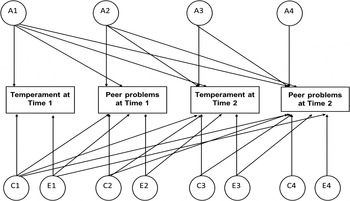
Figure 1 schematically illustrates this model as a path diagram, showing the partitioning of the variance of one temperament variable and peer problems at two measurement times (the rectangles in Figure 1). The order of variables is meaningful, and represents the temporal order of measurement (across ages) as well as the theoretical idea (to be tested below) that temperament contributes to peer problems across time. Variance is partitioned into three components of variance for each variable and covariance across variables: additive genetic (A), shared environment (C), and nonshared environment plus error (E). To the extent that scores for different variables load on the same factor, this indicates overlapping genetic or environmental contributions. It is therefore possible to estimate genetic and environmental contributions to stability (e.g., paths common to earlier and later temperament), change (e.g., a loading of Time 2 temperament on the factors generated for this variable), and cross-trait influences (e.g., a loading of Time 2 peer problems on a factor generated for Time 1 temperament).
Schematic model of Cholesky decomposition of variance for two variables at two measurement points. Rectangles indicate observed scores on temperament and peer problems. Circles indicate genetic and environmental variance components estimates. (A), Heritability; (C), shared environment; (E), nonshared environment (and error). The number in each circle represents the order in which the variable is entered in the analysis.

Results
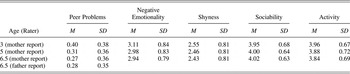
Table 2 presents the means and standard deviations of all study variables at each age. Attrition analyses showed few differences in temperament, peer problems, or demographic variables among families depending on participation in different waves of the study. The details of these analyses are provided in the Appendix A.
Means and standard deviations of scores on the peer problems and temperament scales
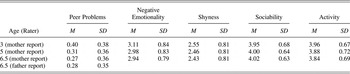
Note: The scale for peer problems ranged from 0 to 2. The scale for temperament ranged from 1 to 5.
Preliminary analyses were run with twins’ sex and zygosity considered as between-family variables and their birth order as a within-family variable. We found no differences between MZ and DZ twins or between firstborn and second-born twins on peer problems at any age. We standardized results separately for MZ and DZ twins in all genetic analyses to account for small and inconsistent differences between MZ and DZ twins in temperament. Because sex differences were small and inconsistent, and to reduce the complexity of our longitudinal multivariate twin data, we grouped boys and girls together for the rest of the analyses. We did however include gender as a covariate when predicting peer problems because it was associated with peer problems at age 3. (See Appendix A for a detailed description of our preliminary analyses.)
Analysis of changes in average peer problems (Hypothesis 1a) and rank-order stability (Hypothesis 1b) over time
In line with our predictions, peer problems were highest among the youngest children and reduced with age (Table 2). A latent growth modeling analysis using mother reports at ages 3, 5, and 6.5 had a good fit to the data, χ2 (1) = 2.29, ns; comparative fit index = 0.987, root mean square error of approximation = 0.026. As hypothesized, a significant slope was found (β = –0.63, p < .005), indicating a reduction in peer problems with age. It is important that there was no correlation between intercept and slope, indicating that change was unrelated to children's initial score on peer problems.
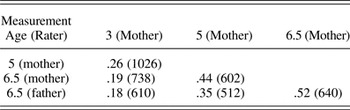
Based on previous research, we also expected to find a degree of rank-order stability in peer problems. In line with these expectations, peer problems showed meaningful stability across ages 3 to 5 (r = .26; 5 to 6.5, r = .44, both p < .001), as shown in Table 3. The 3.5-year longitudinal correlation from age 3 to 6.5 was modest but significant (r = .19, p < .001). It is important that mother and father ratings at 6.5 years correlated highly (r = .52, p < .001), attesting to the consistency of peer problems as observed by mothers and fathers.
Correlations (N) in peer problems across ages and raters

Note: The numbers in parentheses indicate the number of individual children on which the correlations are based; all correlations are significant at p < .001.
Taken together, the changes in levels of peer problems indicate significant change occurring in this key developmental period. Yet, the consistency and stability also observed suggest peer problems reflect some characteristic of the child, which we sought to account for by the relationship of peer problems with temperament and by establishing genetic and environmental contributions to peer problems.
Associations of temperamental variables and peer problems (Hypotheses 2a–2c)
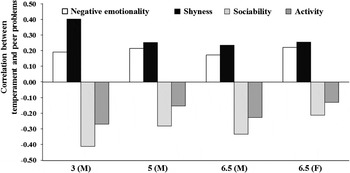
Figure 2 presents the correlations between each temperament dimension and twins’ scores on peer problems. In line with our predictions, temperament was significantly related to children's peer problems: (Hypothesis 2a) peer problems correlated positively with negative emotionality, as hypothesized, for both parents and in all ages (rs = .17 to .22, p < .01); (Hypothesis 2b) shyness correlated positively with peer problems (rs = .24 to .40, p < .001); and (Hypothesis 2c) sociability related negatively to peer problems (rs = –.21 to –.41, p < .001). Finally, activity level, for which we had no specific hypothesis, related negatively to peer problems (rs = –.13 to –.27, p < .001). Overall, the pattern of findings is strikingly similar across ages and replicated when peer problems are reported by fathers.
Correlations between temperament and peer problems. The numbers on the x-axis indicate age of measurement. (M), Mother-reported peer problems; (F), father-reported peer problems. All correlations are statistically significant, at least p < .05.

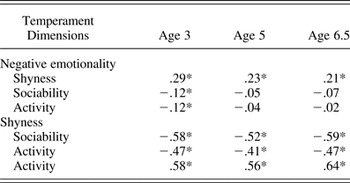
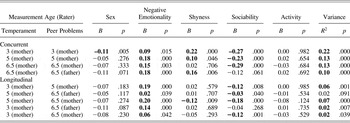
Because temperament dimensions were not independent of each other (see correlations in Table 4), we estimated the independent associations of the different temperament dimensions with peer problems. We ran a multiple regression analysis to examine the joint predictive contributions of the different temperament dimensions to peer problems, both separately for each age and longitudinally. The four temperament variables accounted for 10%–22% of the variance in peer problems measured at the same age and for 2%–7% of the variance longitudinally.
Intercorrelations among temperament dimensions

*p < .01.
Concurrent analyses (Table 5) showed that activity did not predict peer problems over and above the other temperament dimensions, indicating that its associations with peer problems reflected the overlap with other dimensions, and particularly sociability, rs ranging from .56 to .64, p < .001 (using mother reports). Age 3 shyness did predict peer problems over and above sociability and negative emotionality at age 3, but not longitudinally; age 5 shyness predicted peer problems concurrently and longitudinally.
Results of regression analyses predicting peer problems with children's sex and temperament

The two most consistent temperament predictors of peer problems were negative emotionality and sociability, which had independent contributions to peer problems in most of the regression analyses. Negative emotionality was positively associated with peer problems both concurrently and longitudinally, and even across raters. Sociability was negatively related to peer problems in most analyses, concurrently and longitudinally.
Temperamental risk profiles for peer problems
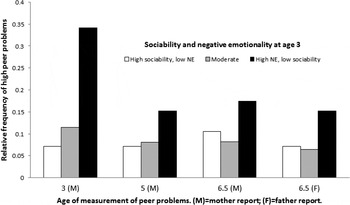
Given that we were specifically interested to investigate the role of children's temperamental characteristics on their likelihood of peer problems, we created temperamental risk-profiles for the experience of peer problems. We looked at the peer problems of children with high temperamental risk for peer problems at age 3 (upper third in negative emotionality, lower third in sociability) and compared them to children with low temperamental risk (lower third in negative emotionality, upper third in sociability) and the rest of the children (see Thompson et al., Reference Thompson, Stevenson, Sonuga-Barke, Nott, Bhatti and Price1996, for similar cutoffs using the EAS). Temperamental risk should predict children's likelihood to score high on the peer problem scale. We defined the high score as 1 or above in our 0–2 peer problem scale (this is equivalent to a 5 on a 0–10 scale in the original five-item scale, where 4 is considered deviant; Goodman, Reference Goodman1997). For this illustrative analysis, we randomly chose one twin per pair.
Figure 3 presents the distribution of children high in peer problem across ages and raters, according to their low versus high temperamental risk-status at age 3. At age 3, 34% of high temperamental risk children showed high peer problems, as compared with only 7% for low temperament risk children. The same temperamental risk derived from the age 3 mother ratings also predicted higher risk for mother-rated peer problems at age 5 (15% vs. 7%, respectively) and 6.5 (17% vs. 11%), and even when peer problems were measured with father reports at age 6.5 (15% vs. 7%).
Proportion of children with high scores in peer problems, based on children's low versus high temperamental risk at age 3. The numbers on the x-axis indicate age of measurement. (M), Mother report; (F), father report; NE, negative emotionality; high problems are indicated as a score ≥1 on a 0–2 scale.

Directionality of effects (Hypothesis 2d)
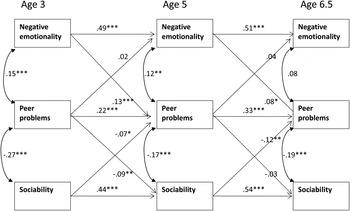
Next, we investigated the longitudinal associations between peer problems and temperament in a cross-lagged model, to gain insight into the presumed causal relationships between temperament and peer problems (because we had mother reports from all three ages, we performed this analysis on mother reports). Given that prior analyses have shown negative emotionality and sociability to be the most consistent predictors of peer problems, we focused in our longitudinal analysis on these two temperamental dimensions. Figure 4 presents the result of a cross-lagged analysis in which temperament and peer problems measured at each age predicted each other, taking into account the concurrent associations between the variables at each age, when estimating longitudinal effects. There was substantial continuity in both temperament dimensions, as well as significant continuity in peer problems (which was stronger between ages 5 and 6.5 than it was between ages 3 and 5). Peer problems had positive relationships with negative emotionality and negative relationships with sociability at all ages.
Cross-lagged analysis of peer problems, negative emotionality, and sociability. The results are standardized regression coefficients and correlations. Concurrent correlations between sociability and negative emotionality were all insignificant and were omitted from the figure for clarity of presentation. *p < .05, **p < .01, ***p < .001.

Reflecting the weak relationships (Table 4) between negative emotionality and sociability, there were no longitudinal associations between the two temperament dimensions, and dropping the cross-lagged paths between them did not affect model fit, χ2 (4) = 5.57, ns. The reduced model had a satisfactory fit to the data, χ2 (21) = 61.31, p < .001; comparative fit index = 0.963; root mean square error of approximation = 0.032.
Negative emotionality predicted change in peer problems across the ages, as indicated by significant positive associations between earlier negative emotionality and later peer problems, while controlling for continuity in peer problems. In contrast, at least during this age period, peer problems did not predict negative emotionality over and above continuity in this temperament dimension. This pattern of associations is compatible with an influence process in which peer problems are affected by negative emotionality, but not vice versa.
Sociability also predicted changes in peer problems, from age 3 to age 5 and from age 5 to age 6.5, indicating the role of temperament in the etiology of peer problems. However, the opposite pattern was also found; peer problems at age 3 predicted changes in levels of sociability. This pattern indicates that reciprocal associations between sociability and peer problems might be age specific.
Genetic and environmental influences on peer problems (Hypothesis 3a)
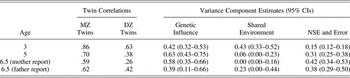
To examine genetic and environmental influences on peer problems, we compared twin correlations obtained within MZ and DZ pairs, presented in Table 6. Very high correlations at age 3 for both MZ and DZ twins suggested a substantial effect for the shared environment. Mother-reported peer problems yielded positive correlations among MZ twins that were about twice as large as among DZ twins, suggesting a genetic influence with little shared environmental effect at ages 5 and 6.5, using mother reports. Father-reported age 6.5 peer problems correlated more strongly for MZ than for DZ twins, but DZ twins did correlate substantially (r = .42, p < .001), more than would be expected by their genetic resemblance alone (i.e., about half the correlation of MZ twins), indicating a shared environment effect for father reports.
Twin correlations and genetic and environmental variance component estimates in peer problems

Note: MZ, Monozygotic; DZ, dizygotic; NSE, nonshared environment. All correlations are statistically significant (p < .0001).
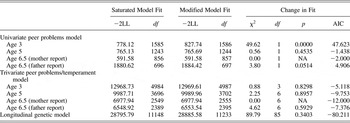
We directly estimated genetic and environmental effects in Mx. Table 6 presents the A, C, and E components of variance, and the corresponding confidence intervals (CIs), in peer problems at ages 3, 5, and 6.5. Table 7 presents information of model fits for the different genetic models.
Model fitting results for saturated and modified models

Note: Modified models dropped shared environment estimates as described in the text, except for the longitudinal genetic model where they also included nonsignificant effects estimated at zero or accounting for <1% of the variance. –2LL, –2 Log likelihood; AIE, Akaike information criterion.
Age 3 showed moderate and significant heritability (42%) for peer problems. In addition, strong shared environmental influences were found, accounting for 43% of the variance. Finally, nonshared environment plus error of measurement accounted for 15% of the variance.
Age 5 showed an increase (as judged by nonoverlapping CIs) in heritability, accompanied by a sharp drop in the influence of shared environmental factors, from 43% to 6%. It was possible to drop the age 5 shared environment component from the model without affecting model fit, Δχ2 (1) = 0.56, ns. The modified model estimated heritability at 0.70 (CI = 0.63–0.75). Finally, the effect of nonshared environment increased significantly from age 3 to age 5.
Using mother reports, age 6.5 showed no further increase in heritability. Shared environment effects were now estimated at 0.00. The increase in the impact of nonshared environment continued at this age, with a significant increase from 0.31 at age 5 to 0.42 at age 6.5. Finally, father-reported peer problems showed a meaningful (39%) heritability; a substantial (23%) shared environment effect was also found, but it was not significant, possibly reflecting the lower power of father reports, which were available from only 350 twin pairs. Although the heritability estimate CI included zero, dropping the genetic component from the model would have resulted in a significant reduction of fit, Δχ2 (1) = 6.906, p < .01. Dropping the shared environment component from the model marginally affected model fit, Δχ2 (1) = 3.796, p = .051. Again, a substantial effect of the nonshared environment was estimated as well.
Genetic and environmental effects on the temperament–peer problems relationship (Hypothesis 3b)
To understand the meaning of the genetic effects on peer problems, we sought to establish the role of temperament in the genetic factors that influence the etiology of peer problems. We therefore ran a trivariate correlated factors genetic analysis, with peer problems and the temperament dimensions of negative emotionality and sociability. Analyses were performed separately at each age (and at age 6.5, separately for father and mother reports of peer problems). From this trivariate model, we derived estimates of the bivariate contributions of genetics and the environment to the relationship between peer problems and each temperament dimension.
Genetic and environmental influences on temperament
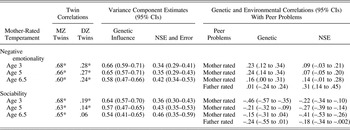
Between-twin correlations on negative emotionality and sociability at each age appear in Table 8. At all ages, and for both temperament variables, MZ correlations were substantially larger than DZ correlations, indicating genetic influence, while DZ correlations were not higher than what would be expected based on genetic relatedness, indicating no effect of the shared environment. Model fitting analyses showed that it was possible to drop the shared environment contributions to each temperament variable, as well as to their relationship with each other and with peer problems, without affecting model fit (Table 7). We therefore proceeded with estimating models including genetic and nonshared environment effects on temperament and its relationship with peer problems (when peer problems showed a shared environment effect, Table 6, it was retained in the model). At all ages, temperament showed substantial and significant heritability (negative emotionality, 58%–66%; sociability, 54%–64%). In addition, nonshared environment plus error of measurement accounted for at 34%–46% of the variance (Table 8).
Twin correlations and genetic and environmental contributions to temperament and to temperaments' association with peer problems

Note: MZ, Monozygotic; DZ, dizygotic; NSE, nonshared environment.
*p < .01.
Genetic and environmental effects on the temperament–peer problems association
Table 8 presents estimates for the genetic correlations between peer problems and negative emotionality and sociability (the extent to which the genetic influences on temperament overlap with the genetic influences on peer problems, regardless of the heritabilities of the two traits). Positive genetic correlations (significant for ages 3 and 5) were found for negative emotionality, indicating that overlapping genetic factors affecting children's negative emotionality also contribute to peer problems. Negative genetic correlations (significant for ages 3 and 5) were found for sociability, indicating that overlapping genetic factors affecting children's sociability contribute to lesser peer problems. This indicates the rGE in which children's temperament contributes to the way their environment (i.e., peers) treats them.
The last column of Table 8 presents the nonshared environmental correlation (the extent to which the nonshared environmental influences on temperament overlap with those influencing peer problems, including the degree of relationship between measurement errors for both variables). Only for father reports was a significant nonshared environmental correlation found between peer problems and negative emotionality, which (together with the lack of genetic correlation) indicates that the association between negative emotionality and father-rated peer problems represents environmental, and not genetic, influences. Significant negative nonshared environmental correlations were found for sociability, indicating that environmental factors associated with children's lesser sociability contribute also to their peer problems.
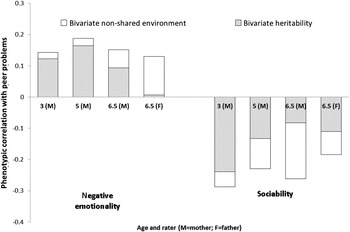
Based on our estimates of genetic and environmental correlations, we further partitioned the phenotypic relationship between peer problems and temperament into its genetic and nonshared environmental components (recall that no shared environmental influence was found for temperament). Figure 5 presents the correlations between temperament and peer problems at each age, divided into their genetic and nonshared environmental components (see figure for details). As indicated by the cross-twin cross-trait correlations, the positive correlations between negative emotionality and peer problems were accounted for in large part by bivariate heritability, exemplifying a rGE process. Again, the correlation between father-rated peer problems and negative emotionality reflected mainly environmental effects. Similarly, the negative correlation between sociability and peer problems largely reflected a bivariate heritability (with genetics accounting for 31%–83% of the phenotypic correlation), as well as a substantial (17%–69%) contribution of the bivariate nonshared environment.
Correlations between temperament and peer problems partitioned to their genetic and environmental components. Each phenotypic correlation is divided into bivariate heritability (in gray, computed as the product of the standardized genetic path coefficients, which is the square root of the heritability estimate of peer problems and temperament, multiplied by the genetic correlation between them, divided by the total phenotypic correlation between the two variables; Plomin & DeFries, Reference Plomin and DeFries1979) and bivariate nonshared environmental contribution (white, computed similarly for the nonshared environment effects on the two variables).

Longitudinal genetic analysis (Hypothesis 3c)
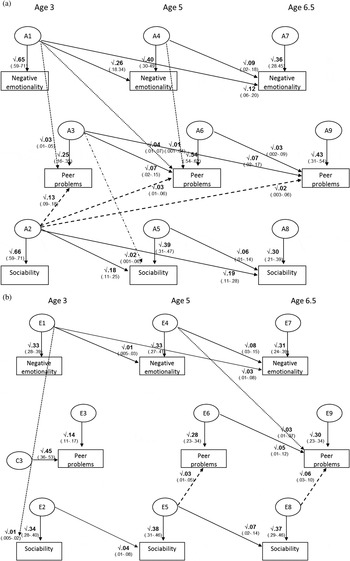
The combined contributions of genetics and the environment to mother-rated peer problems and temperament, taking a longitudinal perspective, were estimated next using Cholesky decomposition (see Methods). Only twin pairs for which age 3 data were available were included in this analysis, because variance partitioning is sensitive to the order of variables. Because earlier analyses showed that temperament predicts peer problems more than the other way around, temperament effects were modeled first in each age (modeling each temperament variable separately did not substantially affect the results). As in the above findings, shared environment effects were dropped from the model, except for those affecting peer problems at age 3. Other nonsignificant paths, all accounting for less than 1% of the variance, were dropped, without significantly worsening model fit, χ2 (86) = 91.61, ns.
Figure 6 present the results from the Cholesky decomposition. The number in each circle represents the order of the factors estimated in the analysis (negative emotionality, sociability, and peer problems estimated at each age). To simplify the figure, the genetic effects are presented in the upper panel, while the environmental components appear in the bottom panel. It should be noted, though, that the two parts of the figure represent a single analysis. Numbers in the figure are presented as the square roots of proportions of variance. The figure also provides 95% CIs for all the coefficients.
Cholesky decomposition of variance components of temperament and peer problems at ages 3, 5, and 6.5: (a) genetic components and (b) shared and nonshared environmental components. Circles indicate variance components estimates, and rectangles indicate observed scores. (A), Heritability; (C), shared environment; (E), nonshared environment (and error). Numbers in circles represent each variable's position in a nine-variable analysis. Numbers in parentheses are 95% confidence intervals.

The squared paths shown leading to the score on each variable, summed across the A, C, and E components, jointly account for the variance. For example, for sociability at age 3, the A, C, and E parameter estimates are 0.66, 0.0, and 0.33, respectively, which, allowing for rounding error, approximates 100% in total. In addition, the sum of all the squared genetic paths shown leading to the score on each variable roughly equals the genetic influence derived above from the univariate analyses. For example, the above estimate of 0.42 for A at age 3 (Table 6) corresponds approximately (deviations reflecting the differences between a univariate and a multivariate model) to the sum of the squares of the paths leading to peer problems at age 3, from the genetic factor of peer problems (0.32), but also from the genetic effects on negative emotionality (0.03) and sociability (0.09). The same is true for environmental estimates.
Same-variable genetic effects
As seen in the upper panel of Figure 6, nine genetic effects were estimated (for three variables at three ages). A genetic effect estimated for negative emotionality at age 3 was carried on to later ages, accounting for 26% of the variance in negative emotionality at age 5, and 12% at age 6.5. The new genetic effect at age 5 accounted for 40% of the variance in age 5 negative emotionality and carried on to explain 9% of the variance at age 6.5. Similarly, the genetic effects estimated for sociability at age 3 extended to ages 5 and 6.5, and a new genetic effect emerged in age 5 for sociability, which extended to age 6.5 sociability. Finally, new genetic effects emerged for the two temperament variables at age 6.5.
For peer problems, a genetic effect was estimated at age 3 (in addition to genetic effects overlapping with those of temperament, as noted below). This early genetic effect contributed to stability in peer problems as it extended to age 5. A new genetic effect accounted for 54% of the variance in age 5 peer problems, and carried on to explain 3% of the variance at age 6.5. Again, a new genetic effect emerged from 5 to 6.5 years. Thus, genetic effects accounted for both stability and change in children's peer problems.
Environmental effects
The lower panel of Figure 6 presents a single shared-environment effect, which contributed to peer problems at age 3. In addition, nine nonshared environment effects were estimated (one for each variable at the three ages). The nonshared environment effect estimated for negative emotionality at age 3, and the one estimated at age 5, extended to age 6.5, accounting together for 11% of the variance in negative emotionality at 6.5 years. The nonshared environment effect estimated for sociability at age 3 extended to ages 5 and 6.5, and a new nonshared environment effect emerged in age 5 for sociability, and extended to age 6.5 sociability. Finally, new nonshared environment effects emerged for the two temperament variables at age 6.5. Similarly, new nonshared environment effects were estimated for peer problems at each age, while nonshared environment also contributed to stability in peer problems, from age 5 to age 6.5. It is interesting that there was also an association between the environmental effects on temperament and peer problems, with a longitudinal association between the nonshared environmental effect on age 5 negative emotionality and peer problems at age 6.5.
rGEs
There was almost no overlap between the genetic effects estimated for negative emotionality and sociability (except for a small effect at age 3), indicating that the two traits had independent genetic origins. However, genetic effects estimated for the two temperament traits were associated also with peer problems, indicating that the genetic factors contributing to temperament also accounted for some of the variance in peer problems: a rGE. The genetic factors estimated for negative emotionality and sociability at age 3 accounted for 3% and 13%, respectively, of the variance in peer problems at this age. Moreover, the genetic factor estimated for negative emotionality at 3 years accounted for 4% of the variance in peer problems at age 5. Similarly, genetic effects estimated for sociability at age 3 accounted for 2%–3% of the variance in peer problems at later ages. There was no genetic effect of peer problems on temperament, except for a small (2%) contribution of peer problems at age 3 to sociability at age 5. Across ages, the genetic effects on the two temperament dimensions accounted for 2%–16% of the variance in peer problems; these effects were both concurrent and longitudinal.
Discussion
The investigation of child influence on peer problems was guided by three major objectives. First, we sought to investigate the change and the stability in levels of peer problems from early to middle childhood. Second, we examined how different temperamental dimensions predict peer problems across time. Our third objective was to examine the genetic and environmental contributions to those relations and to examine a potential rGE.
Our examination yielded three main findings. First, in accordance with our expectations, we found that peer problems were also moderately stable within children over time, such that children who appeared to have more peer problems at age 3 tended to have also more peer problems at school entry (i.e., 6.5).
Second, temperament accounted for 10%–22% of the variance in peer problems measured at the same age and for 2%–7% of the variance longitudinally, indicating that children's temperament has an influence on peers’ attitudes and behaviors toward them. The two most consistent temperament predictors of peer problems over time, after controlling for past behavior, were negative emotionality and low sociability.
Third, genetic factors contributed to peer problems, establishing child influence in the etiology of dysfunctional peer relationships. More important, and for the first time, we could demonstrate that children's heritable temperamental characteristics (longitudinally) predicted peer problems from early to middle childhood.
Genetic factors partly accounted for the association between temperament and peer problems. Results of the study are in line with the existence of an rGE process explaining the correlation between temperament and peer problems. Specifically, children's genetically influenced preference for solitary play and their tendency to react with intensive negative emotions are putting them at a higher risk to experience peer rejection and victimization.
Temperament and peer problems
All four temperamental variables assessed in the EAS (i.e., activity, shyness, sociability, and negative emotionality) have been suggested in the literature on peer relations as potential risk and protective factors in the development of maladaptive social relationships. However, there has been surprisingly little research on the specific contributions of the four temperamental characteristics as they work in concert and over time. Our analysis yielded that perhaps because they are interrelated, not all four temperamental factors have unique contributions to peer problems.
Activity
Replicating and extending our previous finding (Benish-Weisman et al., Reference Benish-Weisman, Steinberg and Knafo2009) to middle childhood, a child's activity level was negatively related to peer problems, suggesting that at least during the early childhood period, activity level is a positive rather than a negative factor in social development. However, because activity did not have a unique contribution to peer problems over and above other temperament variables, it is possible that its association with peer problems may represent the overlap among temperament measures.
Negative emotionality
A large body of research has implicated negative emotionality with difficulties in the social domain, but because negative emotionality has been postulated to reflect a predisposition for aggressive behavior, developmentalists have largely focused on the aggressive and disruptive behavioral components of the trait (see Coplan & Bullock, Reference Coplan, Bullock, Zentner and Shiner2012, for a review). Given that negative emotionality as measured here (Buss & Plomin, Reference Buss and Plomin1984) does not specifically aim at aggressive or hostile behaviors, our finding of a lasting influence of negative emotionality on peer problems contributes to this body of research by indicating that the general lack of ability to adequately modulate negative emotions is conductive to peer problems. Specifically, our analysis suggests that the general tendency to react with disproportionately intensive emotions may irritate others and lead them to avoid or reject those children.
Sociability and shyness
Sociability was both concurrently and longitudinally associated with peer problems. In contrast, we found only concurrent relationships of shyness and peer problems, suggesting low sociability may be more detrimental and have more persistent consequences than shyness. These results are interesting because they counter prevailing conceptualizations of risk as directly caused by the psychological distress within the individual (Nelson, Reference Nelson2013). Specifically, shyness has been assumed to be a risk factor because it causes stress in children who are too anxious to seek out the company they are longing for. In contrast, because low sociability is conceptualized as a lack of motivation or interest in social interaction, it has been assumed to cause less suffering and therefore to be benign (Asendorpf, Reference Asendorpf1990). It is important that the findings support our main proposal, namely, that socially withdrawn behaviors constitute a risk factor not by virtue of the psychological suffering they create directly within the child but rather by virtue of the negative effects they evoke in the social environment.
A recent study of young children's attitudes and responses toward socially withdrawn children corroborates our proposal by showing that children judge social behaviors based on perceived intentionality. Coplan et al. (Reference Coplan and Armer2007) reported that preschoolers tend to interpret shyness as nonintentional but the behavior of unsociable children as intentional and thus offensive; as a result, they were far more accepting of shy than of unsociable children.
Direction of effects: Temperament and peer problems
One of the central questions that arise from a transactional framework of peer problems involves the directionality of influence between the child's biologically driven characteristics and the experience of maladaptive peer relationships (Burgess et al., Reference Burgess, Rubin, Cheah, Nelson, Crozier and Alden2005). Using a cross-lagged analysis, we examined the possibility that different temperamental variables would show distinctive patterns of effects on peer problems over the course of the early childhood years.
Negative emotionality predicted peer problems in a unidirectional fashion across time. In contrast, we found for sociability, in addition to the predictive negative relationships between sociability and subsequent peer problems, a small albeit significant contribution of peer problems to low sociability at subsequent ages. This points at a bidirectional process, where a preference for solitary play and a reduced inclination to interact with the social group evokes negative responses in the peer group and may lead to peer problems, which in turn appears to amplify children's lack of interest in peer interaction.
Different paths of influence have both theoretical and applied implications. It means that in order to account for child influence in the etiology of peer problems, we need to consider the distinctive effects of unique temperamental characteristics. It also means that particular temperamental constellations may represent particular profiles of risk for or resilience to peer rejection and victimization. Our analysis suggests that a temperamental constellation of low sociability and negative emotionality represents a particular risk for the development of adverse peer relationships. Compared with children with a low-risk profile (i.e., low in negative emotionality and high in sociability), children with such a high-risk temperamental profile were longitudinally twice as likely to experience a high degree of peer problems.
Genetic and environmental contributions to peer problems
The final step in the present study of child influence entailed, first, an estimation of the degree to which genetic and environmental factors account for observed individual differences in the experience of peer problems and, second, an estimation of the specific contribution of heritable and environmental aspects of temperament to the development of peer problems.
In line with a number of recent studies on the heritability of peer relations from early childhood onward (e.g., Ball et al., Reference Ball, Arseneault, Taylor, Maughan, Caspi and Moffitt2008; Boivin, Brendgen, Vitaro, Dionne, et al., Reference Boivin, Brendgen, Vitaro, Dionne, Girard and Pérusse2013; Brendgen et al., Reference Brendgen, Boivin, Dionne, Barker, Vitaro and Girard2011), we found genetic factors to increasingly account for a significant proportion of the variance in peer problems. The increasing role of heritability in explaining social experiences, such as rejection and victimization by peers, is in line with genetically informed research of psychological phenomena (e.g., Knafo & Plomin, Reference Knafo and Plomin2006) and indicates that as they grow older, children's temperamentally driven behaviors increasingly evoke negative reactions from peers (and or actively seek out peer groups), which in turn may reinforce children's behaviors.
Yet, similar to other genetically informed research of peer problems (Boivin, Brendgen, Vitaro, Forget-Dubois, et al., Reference Boivin, Brendgen, Vitaro, Forget-Dubois, Feng and Tremblay2013), we did not find a steady increase for the heritability of peer problems beyond age 5. This result reflects the dynamic nature of genetic effects across development and highlights the importance of longitudinal studies that examine the role of genes in generating stability or change in developmental outcomes.
In the present analysis, genes were largely responsible for the change in children's peer problems rather than for their stability. The large proportion of new genetic influence on peer problems at each age (e.g., 54% new vs. 14% overlapping from age 3 to age 5) corroborates the observation that during this age period, peer problems, and contributing genetic factors, are characterized more by change than by stability (Hanish et al., Reference Hanish, Ryan, Martin and Fabes2005).
Nonshared environmental effects on peer problems increased steadily over the three measurement points. In the context of peer relationships, a growing nonshared environment indicates the interaction with increasingly dissimilar peer groups and friends. Seeing that children rarely pick the same friends, as their co-sibling (Pike & Atzaba-Poria, Reference Pike and Atzaba-Poria2003; Thorpe & Gardner, Reference Thorpe and Gardner2006), experiences with peers constitute an important source of nonshared environmental influence during childhood and adolescence (Brendgen, Reference Brendgen2012). In addition, as peer groups are constantly changing as children move from preschool to kindergarten to school, and given that friendships and social relations are more short-lived in early childhood than at later ages (Dunn, Reference Dunn, Lewis and Mitchell1994; Hartup, Reference Hartup1996), the majority of nonshared environmental influence at each age was new, with little overlap with younger ages.
Genetic and environmental contributions to the peer problem–temperament association
Extending our analysis of the general genetic and environmental contribution to individual differences in the development of peer problems, we sought to establish the role of temperament by examining the degree of overlap between the genetic and environmental factors underlying child characteristics and the factors underlying the child's peer problems (Plomin et al., Reference Plomin, DeFries, McClearn and McGuffin2008).
As in previous work (e.g., Benish-Weisman et al., Reference Benish-Weisman, Steinberg and Knafo2009), we found that temperament was substantially heritable. It is important that the genetic factors contributing to temperament also accounted for part of the variance in peer problem, indicative of an rGE process. The rGE process proposes that children's biologically predisposed characteristics lead them to evoke reactions in their environments that are correlated with their inherited temperament (evocative rGE) or to actively select peer environments that fit their predispositions (active rGE), ultimately illustrating child influence in the etiology of maladaptive peer experiences (Scarr & McCartney, Reference Scarr and McCartney1983). The idea that children will elicit reactions and actively seek out social environments that are correlated with their inherited traits explains how we could find a significant genetic contribution to an essentially environmental phenomenon such as peer problems and an estimate for the extent to which children will be at risk of experiencing rejection and victimization at the hands of their peers. Rather than appearing as supporting a deterministic model in which children's genes inevitably lead them to have peer problems, the current results provide important information for the development and application of early intervention approaches.
Strengths, limitations, and future directions for research
The strengths of the study include a genetically informative, longitudinal design, with a large sample, and the corroboration of findings by mother and father reports, as well as cross-rater associations. Our study also has a number of limitations, which need to be kept in mind when interpreting the present results.
In assessing children's temperament and peer problems, we relied on parental reports. The advantage of using mother and father's reports is in the accumulated knowledge they have of their children, and in the ability to reach the large number of twin pairs needed for such an analysis. Future research should seek to replicate the current findings with additional measures, such as peer nominations, teacher reports, and observational measures.
Prior research (Boivin, Brendgen, Vitaro, Dionne, et al., Reference Boivin, Brendgen, Vitaro, Dionne, Girard and Pérusse2013) has shown that an assessment of both peer victimization and peer rejection as markers of children's peer difficulties allows for a more comprehensive coverage of peer difficulties than when only one aspect is considered. These aspects of peer problems were covered in our Strengths and Difficulties Questionnaire scale. However, in order to remove the temperament aspects of the scale, we only relied on three items of the peer problems subscale, reducing its internal consistency. It is important that the factorial structure of the scale did indicate that the scale had validity, and of more importance, the correlations between raters (i.e., mother and father) and across time reflects the reliability of our measure. Nevertheless, in future research we will seek to replicate the present findings with more comprehensive measures, possibly addressing victimization and rejection separately.
The use of twin data may limit generalizability to other contexts. It is possible that because twins grow up together, peer problems and associated phenotypic behaviors in a pair are more positively correlated. Having a co-twin may provide unique social experiences and even some protection against victimization (e.g., Lamarche et al., Reference Lamarche, Brendgen, Boivin, Vitaro, Dionne and Pérusse2007). However, such a special twin environment effect would have been reflected in an increased estimate of shared environment, whereas we found little evidence for shared environment after the age of 3.
The four temperament dimensions accounted for 10%–22% of the variance in concurrent peer problems. While this is a substantial contribution, this figure points to the existence of other influences on temperament and peer problems, not covered in the current investigation. The roles of other associated variables such as children's aggression, their physical attractiveness, and verbal skills (Brendgen et al., Reference Brendgen, Boivin, Dionne, Barker, Vitaro and Girard2011; Boyatzis, Baloff, & Durieux, Reference Boyatzis, Baloff and Durieux1998; Mostow, Izard, Fine, & Trentacosta, Reference Mostow, Izard, Fine and Trentacosta2002) should also be investigated, separately and in conjunction with temperament.
Finally, estimates of genetic and environmental factors provide only a partial answer to the question of how individuals develop and change. That is, quantitative analyses indicate the magnitude of genetic influence and the extent of genetic overlap across age, but they cannot identify specific genes involved in the temperamental characteristics that are responsible for the activation of the maladaptive developmental cycle we have depicted here. Similarly, although these designs can tell us about shared and nonshared environments, they do not provide us with insights about the specific environments that influence the phenotypic behaviors under investigation.
While there is ample research addressing measured environmental correlates of peer problems, such as socioeconomic status, classroom structure, and maltreatment (Bergsmann, Van De Shoot, Schober, Finsterwald, & Spiel, Reference Bergsmann, Van De Schoot, Schober, Finsterwald and Spiel2013; Ladd et al., Reference Ladd, Profilet, Hart, Parke and Ladd1992), only recently has research begun to address specific genetic polymorphisms associated with the reaction of peers. One study found an association between male college students’ likeability and a polymorphism in the 5HT2A serotonin receptor gene (Burt, Reference Burt2009). Another important pathway for advancement of research is to study Gene × Environment interactions in peer relationships (Brendgen, Reference Brendgen2012).
Future directions for translating research on the influential child into preventive interventions
This longitudinal twin study provides important avenues for future research focusing on the temperamental factors that put children at risk to receive negative responses in their peer environment. The evidence in support of a rGE process that links temperamental dimensions with the risk to experience persistent peer difficulties in early childhood emphasizes the need to consider the role children's psychological characteristics play in their own development.
The importance of intervention for childhood peer problems has become increasingly clear as many investigators have documented links between peer problems and a variety of psychological symptoms and later maladjustment (Arsenault et al., Reference Arseneault, Cannon, Fisher, Polanczyk, Moffitt and Caspi2011; Boivin et al., Reference Boivin, Vitaro, Poulin, Tremblay, Hartup and Archer2005; Bukowski et al., Reference Bukowski, Adams and Santo2006; Karevold et al., Reference Karevold, Coplan, Stoolmiller and Mathiesen2011). Our results have important implications for the early identification of children at risk for peer problems and the designing of such interventions. The contribution of child temperament to the experience of peer problems over time highlights the need for early and continuous interventions. In order for intervention programs to be fruitful, they have to consider the particular emotional and behavioral tendencies of children, and the specific attitudes and behaviors they elicit among their age mates.
The current results indicate that some young children are temperamentally at risk for the development of maladaptive peer relations and that this risk will be increased through a combination of gene–environment processes, including rGEs. It is important to emphasize that the finding of a genetic association between child temperament and peer problems does not mean that the negative developmental pathways are set and irreversible. Rather, the findings of child influence points at the importance of moving beyond the traditional conceptualization of peer problems, such as rejection and victimization, as a primarily environmental phenomenon by also taking into account the behavioral and emotional manifestations of children's temperament, which evoke negative reaction in their peers. Specifically, our analysis suggests that in order to devise effective intervention, peer problems must be conceptualized as a transactional process in which children's own characteristics, such as their temperament, and the social environment influence each other (Coplan & Rubin, Reference Coplan, Rubin, Rubin and Coplan2010).
In addition, the differences we found between the concurrent effects of shyness versus the lasting effects of low sociability on peer problems in early childhood emphasize the importance of interventions that are geared toward children with specific social behavioral profiles (i.e., shy, low in sociability, high in negative emotionality, and aggressive), as opposed to being aimed at heterogeneous groups of children with peer problems. Although there are a number of intervention studies tailored to the needs of aggressive children (Gazelle & Ladd, Reference Gazelle, Ladd and Schewe2002), interventions are also needed to addresses the specific difficulties of less sociable children and children high in negative emotionality.
Given the findings that children with low sociability are perceived as unfriendly and aloof (Coplan et al., Reference Coplan, Girardi, Findlay and Frohlick2007), it appears particularly important to encourage children who are low in sociability to interact with their age mates, and to provide them with opportunities for interaction. Moreover, the very notion that children have an influence on the reactions they evoke in their social environment denotes the importance of programs to enhance socially competent behavior.
APPENDIX A
Attrition and preliminary analyses
Attrition analyses
Children whose families dropped out of the study after age 3 did not differ on any of the study variables. Similarly, children from families dropping out after age 5 did not show marked differences on any of the study variables, except for slightly higher sociability scores at age 5, t (615) = 2.43, p < .05, D = 0.18. Children from families joining the study at age 5 did not significantly differ on any study variable from those starting at age 3.
In terms of demographic variables, dropping out from ages 3 to 5 was not associated with children's gender or family religiosity or socioeconomic status. Similarly, families participating at age 6.5 were similar in terms of religiosity and children's gender to those not participating, although parents’ education, mothers: t (543) = 2.99, p < .01, D = 0.26; fathers: t (543) = 2.34, p < .05, D = 0.21, and family income, t (510) = 2.17, p < .05, D = 0.19, was slightly higher for families participating at age 6.5.
At age 6.5, families in which father reports were available did not differ on peer problems or temperament from families in which father reports were not obtained. Families in which fathers participated showed somewhat higher family income than those in which fathers did not participate, t (398) = 2.65, p < .01, D = 0.27, but there were no differences in mother religiosity or education.
Preliminary analyses
At age 3 only, firstborn twins showed slightly higher negative emotionality and shyness, as compared to second-born twins, effects accounting for less than 1% of the variance. Sex differences were found only in peer problems at age 3, with boys scoring slightly higher than girls (β = –0.09, p = .024), an effect accounting for less than 1% of the variance. Sex differences in temperament were small and inconsistent (D = 0.01–0.25). At age 3 girls scored higher on shyness (β = 0.23, p = .002, D = 0.17) and boys were rated as more active than girls (β = –0.23, p < .001, D = 0.25). No sex differences were found at age 5. At age 6.5, mothers rated daughters as slightly more sociable than boys (β = 0.15, p = .037, D = 0.25).
We did include children's sex as a covariate when predicting peer problems because it was associated with age 3 peer problems. Similarly, there were some small MZ-DZ mean differences in temperament, with MZ twins being rated as slightly (Ds = 0.12–0.20) more sociable and active than DZ twins at ages 3 and 5. No differences were found at age 6.5.