Healthcare-associated infections (HAIs) have significant impact on patient health and cost of medical treatment. Recent data suggest that 4% of hospital patients acquire an HAI, resulting in 700,000 infections and 75,000 deaths in 2011.Reference Magill, Edwards and Bamberg 1 Improved control measures are critical to reducing the burden of HAIs, and current evidence-based strategies have the potential to prevent 50%–70% of common HAIs.Reference Umscheid, Mitchell, Doshi, Agarwal, Williams and Brennan 2
Hands of healthcare workers (HCWs) are recognized as a common method of HAI transmission between patients and within the healthcare environment.Reference Allegranzi and Pittet 3 The report of a Pseudomonas aeruginosa outbreak noted that 5% of HCW hands were contaminated with the bacteria and that 80% of infected patients were treated by contaminated employees.Reference Zawacki, O’Rourke, Potter-Bynoe, Macone, Harbarth and Goldmann 4 Similarly, a neonatal case-control study of a P. aeruginosa outbreak noted that case patients were more likely to have been seen by nurses with contaminated hands.Reference Moolenaar, Crutcher and San Joaquin 5 A better understanding of the HCW’s role in transmission of gram-negative bacteria may allow for additional advancements in HAI prevention.
Multidrug-resistant organisms (MDROs), such as carbapenem-resistant Enterobacteriaceae (CRE), pose some of the most urgent HAI threats with few treatment options and poor outcomes for infected patients. 6 Mortality rates up to 48% have been associated with CRE infectionsReference Ben-David, Kordevani and Keller 7 , Reference Patel, Huprikar, Factor, Jenkins and Calfee 8 ; however, most states do not require CRE incidence and prevalence reporting, 9 – 11 resulting in limited available data. Regular perirectal swab surveillance cultures, barrier contact precautions, geographic cohorting, and hand hygiene are all recommended strategies to reduce hospital transmission of CRE. 12 , Reference Enfield, Huq and Gosseling 13
Previous research on CRE has evaluated colonization pressure, same-ward stay, degree of centrality, and clinical characteristics for their impact on acquisition risk, but to our knowledge the direct role of providers has not been assessed.Reference Correa, Martino and Siqueira 14 – Reference Ray, Lin, Weinstein and Trick 17 Prior studies have also used undefined exposure periods.Reference Correa, Martino and Siqueira 14 – Reference Ray, Lin, Weinstein and Trick 17 The objective of this study was to investigate the role providers play in patient-to-patient CRE transmission in a medical center with a long standing and robust CRE surveillance program. We used an electronic medical record (EMR) administrative database, instead of chart review, to track provider interactions in this multiyear retrospective case-control study. We examined acquisition risk by assessing provider overlap with a colonized or infected patient as a proxy for patient-to-patient transmission.
METHODS
Study Population
The study was performed at a 619-bed tertiary-care hospital in central Virginia from May 22, 2011 to May 4, 2015. Case patients were defined as those with positive CRE cultures confirmed using polymerase chain reaction (PCR) for Klebsiella pneumoniae carbapenemase-producing Enterobacteriaceae or Aeromonas sp. Controls were noncolonized patients housed in the same set of hospital units. An attributable unit was assigned to all eligible study participants: A case attributable unit was assigned based on their location 48 hours before their first positive culture, and a control attributable unit was assigned as the unit where the patient had the longest duration of stay. The most consecutive days in 1 unit followed by equal probability randomization were used as tie breakers for controls in multiple units for the same duration. We consolidated 22 patient care units to 10 groups, based on similarity of the patient population, to provide more meaningful and comparable demographic information.
Infection Prevention and Control
Hospital prevention and control measures for CRE have been described previously.Reference Enfield, Huq and Gosseling 13 Surveillance for CRE was performed with perirectal swab cultures collected weekly in the medical and surgical intensive care units (ICU) and any unit with a CRE patient for ≥3 calendar days.Reference Mathers, Poulter, Dirks, Carroll, Sifri and Hazen 18 , Reference Mathers, Hazen and Carroll 19 Precautions for patients with current or historical CRE colonization or infection included standard precautions (ie, hand hygiene before and after care) and contact precautions (ie, gown and glove barrier precautions). CRE status was marked in the EMR, and discontinuation of contact precautions for historical CRE was not performed during the study period.Reference Lewis, Bishop, Heon, Mathers, Enfield and Sifri 20 Hand hygiene was monitored by independent auditors and unit-based staff. During the course of the study, the median quarterly hand hygiene adherence was 81% (range, 74%–89%). No contact precaution adherence was assessed.
An environmental services program used quaternary ammonium or hypochlorite-based disinfectants for routine daily and terminal cleaning. Daily bathing with 2% chlorhexidine gluconate disposable wipes (Sage Products, Cary, IL) was performed for all CRE-colonized or -infected patients, patients with indwelling bladder catheters or central venous catheters, and, from May 2013 through the end of the study, on all patients hospitalized in an ICU. CRE-positive patients were not cohorted, and patient assignments were not grouped during the study period.
Data Sources
We used 2 data sources in this analysis: healthcare provider data and patient data. Both types of data were generated during patient encounters, logged in the EMR, and extracted from an administrative database. The healthcare provider dataset contains documentation of interactions between patients and providers (eg, medication delivery, dressing changes, vital sign measurements). Our data quality review demonstrated an inability to associate the timing and content of physical interactions for attending physicians, postgraduate physicians, and medical students to the time the interactions were charted. Because such irregularities would make data unreliable for understanding provider movement, physicians and medical students were excluded to improve study validity. Providers with high data quality (eg, nurses, therapists, patient care technicians) remained in the study. The patient data set contained test dates and results for identification of CRE infection and/or colonization. Vetted antibiotic usage data and invasive procedure data were not available for the study period due to limitations of EMR data. Creation of the database and analysis were approved by the University of Virginia Institutional Review Board.
Case Definition and Control Selection
We implemented a 1:4 case-control study design in which case patients were included if they acquired CRE during their hospital stay. We defined hospital-associated acquisition as a negative test result within 48 hours of admission and a subsequent positive test. We selected a week-long period for exposure evaluation (days 2–9 before the culture positive date) for all cases. Uncertainty of CRE screening sensitivity <48 hours after exposure and the typical weekly testing frequency should capture acquisition 2–9 days prior to positivity. Cases were therefore required to have a length of stay (LOS) >9 days. Exposure sources (source patients) included cases and any other patient infected or colonized with CRE.
We selected controls from patients staying in the hospital at approximately the same time as the cases (1 week on either side of the case test date to maximize eligible controls). To be eligible, these patients had to have at least 2 days of overlap with this 2-week window. Additionally, we required an LOS >9 days, to allow for sufficient data collection, and a minimum of 2 tests confirming negativity. Patients who tested positive more than 16 days after admission were also eligible to be controls for the period prior to their case evaluation window. Moreover, 16 days were necessary to ensure 2 distinct evaluation periods could be selected for these patients (9 days for case eligibility and 7 for control evaluation).
We used equal probability randomization to select 4 eligible controls for each case. The evaluation window for controls was selected to maximize the overlap between case and control dates (Supplementary Figure). Controls admitted after the case evaluation window start date were evaluated for the first 7 days of admission. Controls discharged before the case evaluation window end date were evaluated for 7 days prior to discharge. Lastly, controls admitted prior to case evaluation end date and discharged after case evaluation start date were evaluated for the same 7 days as their case.
Shared Provider Interactions and Exposure Assessment
To determine whether patients shared providers with source patients, we analyzed patient-provider interactions per day using system codes for actions we determined involved direct patient contact (eg, changing IV medications, taking vital signs, actions coded as “given”). All unique day-level patient-provider interactions were included in assessing exposure. Each patient included in this study was compared to all source patients for each day of their respective evaluation window. Each time a patient had a day-level shared provider with a source, the daily count of shared interactions increased by 1, and ≥1 shared provider interactions with any source, during the evaluation period, indicated the presence of exposure for that patient. Control selection and exposure assessment were completed with R 3.2.4 software (R Foundation for Statistical Computing, Vienna, Austria) in RStudio.
Summary Statistics
To understand the frequency of provider interactions, initial summary statistics were calculated. We determined the average number of unique providers per day by selecting unique providers for each patient day during their evaluation window and averaging per patient group. Unique providers per week were determined by selecting unique providers for the whole window and averaging per patient group. We calculated a per-week level average of source-shared interactions for each patient by taking the mean of each patient’s week level counts; this was divided by 7 for a day-level average.
Measures of Disease Association
An odds ratio (OR) comparing the odds of exposure in cases versus controls was calculated using logistic regression with dichotomous and continuous exposures. The dichotomous predictor was zero for no shared providers and 1 for ≥1 shared providers during the entire evaluation window. The continuous exposure variable, total shared providers, was used to identify a potential dose response for number of shared providers. Multivariate logistic regression was then completed with both exposures. Age and ICU stay were included because they are likely to predict overall health status and account for other risk factors we could not directly account for with available data. Summary statistics and OR measures of disease association were completed using SAS software, version 9.4 (SAS Institute, Cary, NC).
RESULTS
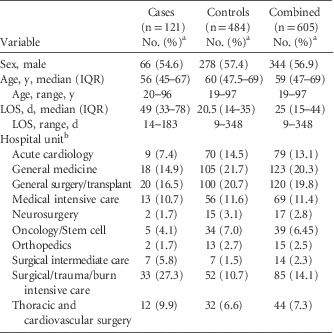
Our study included 121 patients who acquired the CRE pathogen during their hospital stay and met our inclusion criteria. The control group included 484 randomly selected patients with at least 2 negative CRE perirectal swab cultures. Demographic characteristics of the 605 patients are summarized in Table 1. Cases showed longer median hospital stays with 49 days (interquartile range [IQR], 33-78) for cases and 20.5 days (IQR, 14–35) for controls. The most common units for cases were surgical/trauma/burn intensive care, general surgery/transplant, and general medicine units. Similarly, the most common units for controls were general medicine, general surgery/transplant, and acute cardiology units.
Demographic Characteristics the 605 Subjects Selected to be Cases and Controls

NOTE. IQR, interquartile range.
a Unless otherwise specified.
b P<.0001; P values represent comparison between case and control data using χ2 tests.
Summary Statistics
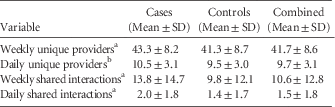
Initial evaluation of provider data showed that cases had on average 43.3±8.2 unique documented provider interactions in 1 week while controls had 41.3±8.7 (Table 2). Day-level unique provider interactions were 10.5±3.1 for cases and 9.5±3.0 for controls. Preliminary counts of providers that had shared interactions with sources showed an average of 13.8±14.7 and 9.8±12.1 per week and day-level averages of 2.0±1.8 and 1.4±1.7 for cases and controls, respectively.
Comparison of the Number of Distinct Providers and Distinct Source-Shared Providers Experienced by Patients at Daily and Weekly Levels

NOTE. SD, standard deviation.
a P<.05; P values represent a comparison between case and control data using t tests.
b P<.0001; P values represent a comparison between case and control data using t tests.
Measures of Disease Association
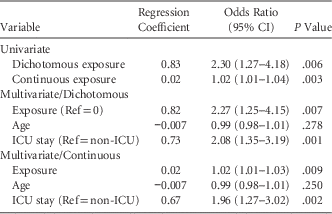
Univariate logistic regression of the dichotomous exposure showed odds of exposure in cases as 2.30 (1.27–4.18) times the odds of exposure in controls. Multivariate odds, controlling for age and ICU stay, of dichotomous exposure in cases compared to controls was 2.27 (1.25–4.15). The univariate continuous exposure showed an OR of 1.02 (1.01–1.04). Multivariate regression of the continuous exposure had the same relationship, with an OR of 1.02 (1.01–1.03) between exposure and case outcomes. Regression coefficients, ORs, and P values are listed in Table 3.
Regression Coefficients and Odds Ratios for Univariate and Multivariate Logistic Regression with Dichotomous and Continuous Exposures of Source-Shared Providers

NOTE. CI, confidence interval; ICU, intensive care unit.
DISCUSSION
Our study consisted of 605 patients (121 case patients and 484 controls) who were evaluated for the number of unique providers and number of providers shared among infected or colonized patients. Case patients had significantly more unique providers at the day and week levels, with 2 more providers per week and 1 more provider per day, on average. This difference is potentially due to variance in patient health status. Patients at high risk for acquisition generally have lower overall health status and may require additional health care attention.Reference Correa, Martino and Siqueira 14 , Reference Schwartz-Neiderman, Braun, Fallach, Schwartz, Carmeli and Schechner 15 , 21 Supporting this notion, Charlson comorbidity scores, sequential organ failure assessment scores, and acute physiology and chronic health evaluation II scores have all been evaluated as predictors of CRE infection and show various levels of association.Reference Correa, Martino and Siqueira 14
Case patients and controls showed a significant difference in the numbers of source-shared providers with 4 more shared providers per week. The odds of a case being exposed (to 1 or more source-shared providers) was 2.27 times the odds of a control being exposed in multivariate dichotomous analysis. Therefore, individuals were at an increased risk of CRE acquisition when sharing ≥1 provider with colonized or infected patients. Continuous exposure showed the same directionality in multivariate regression where each additional shared provider corresponded to an acquisition risk increase of 1.02 times. Despite statistical significance, the small magnitude is not likely clinically significant. It is possible that some threshold number of shared providers might be important to understanding increased acquisition risk.
In both multivariate regressions, ICU stay correlated with a nearly 2-fold increase in the risk of acquisition. This result was consistent with prior research regarding risk factors for CRE acquisition.Reference Correa, Martino and Siqueira 14 , Reference Schwartz-Neiderman, Braun, Fallach, Schwartz, Carmeli and Schechner 15 The increase in risk makes sense when we consider that patients in the ICU are sicker than the remaining hospital population and that lower health status is associated with increased acquisition risk. 21 However, it may also reflect that CRE carriage was assessed on a more frequent basis in the ICUs. The OR for age was also consistent with prior research that has suggested no significant association between age and CRE risk.Reference Correa, Martino and Siqueira 14 , Reference Swaminathan, Sharma and Poliansky Blash 16
The directionality of the ORs for exposures is consistent with our hypothesis that sharing providers with colonized or infected patients increases risk of acquisition. Prior research on CRE risk factors noted that patients staying in the same unit as a case were at a higher risk of acquisition.Reference Schwartz-Neiderman, Braun, Fallach, Schwartz, Carmeli and Schechner 15 Because most ancillary staff analyzed in this study are staffed by unit, this is similar to the results we saw as shared providers likely indicate same-unit stay and potentially patient-to-patient transmission via an HCW who did not adhere to contact precautions or hand hygiene. Research has shown that higher utilization of hand hygiene supplies (eg, soap and alcohol rub) is associated with reduced infection rates in hospitals.Reference Stone, Fuller and Savage 22 This research supports the directionality of the association seen in our study and the need for continued commitment to improve hand hygiene and adherence to other infection control methods.
Despite the consistency and biological plausibility of these findings, several limitations should be considered. Most importantly, we did not evaluate the directionality of interactions in this study. Patients who shared a provider with a source patient could have been seen before the source patient and would not have been exposed to CRE. Because the primary providers included in this study were nurses, this issue is likely mitigated because we expect nurses to see each patient multiple times in 1 day. Similarly, we did not assess the duration or intensity of interactions. One interaction could involve minimal patient contact, while another could be more substantial. Transmission risk for bacteria may vary depending on the type of patient care activity. Reliably evaluating and categorizing different clinical activities would require targeted/manual chart review and may not be accurately captured in a retrospective analysis.
Our study also lacked some generalizability to all healthcare staff because of the inability to obtain reliable physician data. Further research evaluating the role of physicians should be conducted. Prior antibiotic usage, comorbidities, invasive interventions (eg, central venous catheters and mechanical ventilation), and other important factors could influence patient risk but the related data were unavailable.Reference Schwartz-Neiderman, Braun, Fallach, Schwartz, Carmeli and Schechner 15 Instead, ICU stay and age were used as proxy measure of clinical risk; additional covariates would strengthen the model and reduce the risk of type 1 error. Similarly, we did not assess whether CRE colonization versus infection or type of CRE infection may influence CRE transmission. We also were unable to apply molecular typing to the analysis which could have helped delineate actual transmissions and would be important in future studies. Lastly, because cases cannot be considered exposures for themselves, our study favors control exposures because they have more available sources of shared providers. This uneven exposure distribution could have biased our results toward the null.
While there are limitations to the use of administrative database records, this data source also provides access to an enormous amount of patient and provider interaction data. After preliminary cleaning of the data to understand and remove unwanted and inaccurate variables, EMR data make inclusion of many patients more feasible than with chart review–based studies. The time-consuming nature of chart review may cause researchers to limit study populations or the period evaluated, whereas a similar study design using administrative database records could easily be applied to a much larger study population. Our data analysis also applied a limited period to the exposure analysis, whereas many prior studies did not mention duration between exposure and bacterial acquisition. We included this time component because the frequent screening allowed for more accurate predictions of when transmission may have occurred.
In summary, results from this study indicate an important relationship between sharing providers with CRE patients and increasing the risk of CRE acquisition. This finding indicates the importance of hand hygiene in infection prevention as well as the potential for limiting shared providers through additional regulation and improved cohorting of CRE patients, particularly in high-risk units. Our study further develops the understanding of CRE acquisition risk and adds to the growing body of literature on transmission of HAIs while demonstrating a methodology option for future studies. Further research accounting for directionality, duration and intensity of interactions, physician data, molecular characterization, and additional covariates is needed.
ACKNOWLEDGMENTS
Financial support: No financial support was provided relevant to this article.
Potential conflicts of interest: All authors report no conflicts of interest relevant to this article.
SUPPLEMENTARY MATERIAL
To view supplementary material for this article, please visit https://doi.org/10.1017/ice.2017.216.