Clinical Implications
∙ Clozapine is the gold standard in treating refractory psychosis.
∙ The orbitofrontal cortico–striatal–thalamic–cortical (CSTC) circuitry is implicated in disorders of impulse control.
∙ Stimulants may exert their efficacy in impulsive symptoms via modulation of dopamine (D1 and D3) receptors in the CSTC circuit.
∙ Augmenting clozapine with methylphenidate may be a safe and effective treatment for those patients whose psychosis is controlled but who continue to exhibit impulse dysregulation.
Introduction
Forensic psychiatric settings experience an elevated incidence and prevalence of impulsive violence.Reference Quanbeck, McDermott, Lam, Eisenstark, Sokolov and Scott 1 A useful categorization of inpatient psychiatric violence has included 3 primary drivers: psychotic violence, which is the least frequent and easiest to treat; predatory violence, which is responsible for the most severe violence and only possibly treatable; and impulsive violence, which is the most frequent but has only sparsely researched treatment strategies. Due to the frequency and complexity of impulsive violence, its resistance to treatment, and the high rate of injury among patients and staff, a concerted effort has been put forward to develop and implement effective treatments.Reference Warburton 2
Often, forensic psychiatric patients present with a combination of violence drivers. Because psychotic violence is the easiest to treat, with a correlative response to effective antipsychotic treatment, the remaining violence, after psychosis is effectively controlled, is most likely impulsive violence. Antipsychotics and mood stabilizers are typically the first-line treatments for impulsive violence.Reference McDonagh, Peterson, Carson, Fu and Thakurta 3 – Reference Humble and Berk 7 Clozapine is considered by many to be the gold standard treatment for this indication.Reference Volavka 8 – Reference Englisch and Zink 11 Even with these treatments, there are patients who do not have an adequate therapeutic response. This raises a question of further therapeutic options after more common treatments have failed. For some patients, dopaminergic stimulant medications may be a viable option.
Stimulants have well-established efficacy in treating overall impulsivity in attention deficit hyperactivity disorder (ADHD), often diminishing associated impulsive aggression and violence.Reference Dalsgaard and Thomsen 12 What follows is a series of 3 cases in which methylphenidate was added to clozapine to reduce residual impulsive aggression and violence after psychosis was controlled in female forensic psychiatric patients with schizophrenia-spectrum disorders. None of the patients had a pre-psychosis history of ADHD.
Case Studies
Case 1: methylphenidate added to clozapine
Ms. A was a 27-year-old, Latina with a diagnosis of schizoaffective disorder per Diagnostic and Statistical Manual of Mental Disorders, Fourth Edition, Text Revision (DSM-IV-TR) criteria, depressive type, and no significant medical problems, who was admitted to a forensic psychiatric hospital after serving a prison sentence for trying to kill her mother and grandmother due to command auditory hallucinations. Her psychotic symptoms began at 9 years of age and had resulted in several psychiatric hospitalizations. She had also developed psychotic, impulsive, and predatory aggression patterns of behavior resulting in psychiatric and correctional institutional incarcerations over several years. Her psychosis had remained problematic in prison prior to admission, despite taking a combination of paroxetine 50 mg per day and risperidone 6 mg per day.
Upon admission to the forensic psychiatric hospital, she was experiencing auditory hallucinations that would talk with each other and instruct Ms. A to perform certain actions. Risperidone and paroxetine were discontinued, and she was given a trial of high plasma concentration olanzapine 40 mg per day (182 ng/ml), which provided a fair clinical response with respect to her psychosis and psychotically driven aggression in the hospital, though her impulsive aggression and predatory aggression persisted. She continued to frequently verbally and physically assault both patients and staff in response to instrumental designs (predatory aggression) and sudden instances of emotional and physical arousal (impulsive aggression). Lithium carbonate 900 mg per day (maintenance level 1.0 mEq/L) and clozapine 150 mg per day (maintenance level 180 ng/ml) were added, which sharply reduced her predatory aggression and allowed her greater treatment engagement and rapport with her treatment team. Despite her improvement, Ms. A continued to engage in impulsive acts of verbal and physical aggression. Ms. A decompensated when olanzapine taper was tried. Further increases in clozapine were limited by sedation.
She was given a trial of methylphenidate, beginning with 5 mg/day, to evaluate the stimulant’s effect on her ability to exercise control over her impulses. Over the next 12 weeks, her impulsive aggression showed a rapid and sustained reduction. As her maintenance dose of methylphenidate extended release (Concerta®; 36 mg per day) was established, she demonstrated near resolution of episodes of impulsive aggression.
Case 2: methylphenidate started concurrently with clozapine
Ms. B was a 54-year-old African American female with a diagnosis of schizophrenia and alcohol dependence per DSM-IV-TR criteria, who was committed to a forensic psychiatric hospital after having failed conditional outpatient release and treatment. Her first hospitalization was at age 16 following a suicide attempt. Over the ensuing years, her psychiatric symptoms included auditory and visual hallucinations, hostility, impulsivity, and suicidal ideation with suicide attempts. Despite treatment with risperidone 6 mg per day and later aripiprazole 15 mg per day, she continued to have frequent verbal and physical assaults directed toward both patients and staff. During the year prior to starting clozapine and methylphenidate, she had 8 episodes of verbal and physical aggression and needed 18 administrations of PRN medications for agitation, verbal aggression, and physical aggression. Clozapine was initiated and titrated to a dose of 350 mg per day (plasma concentration of 747 ng/ml). Her antipsychotic response to clozapine was overtly evident with near resolution of psychotic signs and symptoms; however, her impulsive aggressive behavior persisted. Methylphenidate was then initiated starting at 5 mg per day and titrated to a final dose of methylphenidate extended release (Concerta) formulation of 36 mg each day.
Over the next 13 months following the initiation of clozapine and methylphenidate, Ms. B had only one incident of minor conflict with another patient. The incident was quickly resolved via staff counseling and both parties apologized. Her medication regimen consisted of aripiprazole 15 mg per day, clozapine 350 mg per day, and methylphenidate extended release (Concerta) 36 mg per day.
Case 3: methylphenidate added to clozapine
Ms. C was a 31-year-old, Latina woman with a diagnosis of schizoaffective disorder per DSM-IV-TR criteria, bipolar type, and mild asthma. She was admitted to a forensic psychiatric hospital after a court determined that her mental illness contributed to her stabbing an 11-year-old victim with a knife. She showed psychosis, aggression, impulsivity, and assaultiveness both in the prison setting prior to her hospitalization and in the forensic hospital setting. She had previously demonstrated a partial response to haloperidol decanoate 300 mg per month in combination with divalproex 2000 mg daily; however, these medications failed to provide adequate antipsychotic or anti-aggression efficacy during her index hospitalization.
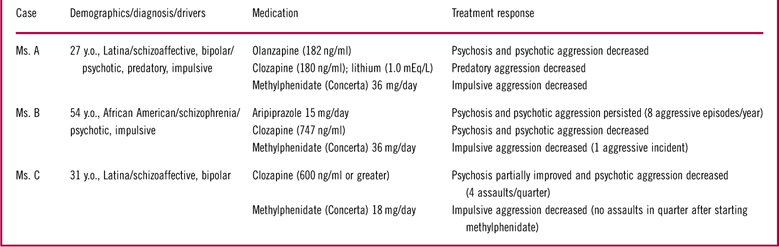
Clozapine was initiated with a partial antipsychotic response at a dose of 400 mg per day (plasma concentrations of 600 ng/ml and greater). She was better able to engage in her psychosocial treatment groups, she was less preoccupied by her persecutory delusions, and she stated that her auditory hallucinations were gone. Despite the decreased symptoms of psychosis, her impulsive aggression persisted. After 20 months on clozapine, the addition of methylphenidate extended release (Concerta) 18 mg daily was associated with an immediate improvement as reflected by Ms. C’s ability to engage in meaningful conversations with peers and staff and to tolerate staff redirection without becoming angry and aggressive. This improvement was sustained over the next 12 weeks with the medication regimen of clozapine 400 mg per day and methylphenidate extended release (Concerta) 18 mg per day (Table 1).
Case descriptions and response to treatment issues

Discussion
The described cases occurred in the setting of a 50-bed, long-term, female forensic unit composed of patients transferred as mentally ill prisoners (California Penal Code Section 2684 ad seq) or committed at the time of parole as mentally disordered offenders (California Penal Code Section 2962 ad seq). Those patients included in the case series carried a diagnosis in the schizophrenia spectrum, namely schizophrenia or schizoaffective disorder. Each patient had failed first- and second-generation antipsychotics as evidenced by continued psychotic signs and symptoms, as well as psychotically driven aggression. Each patient was then started on clozapine, and titrated to plasma concentrations found to be effective and tolerable.
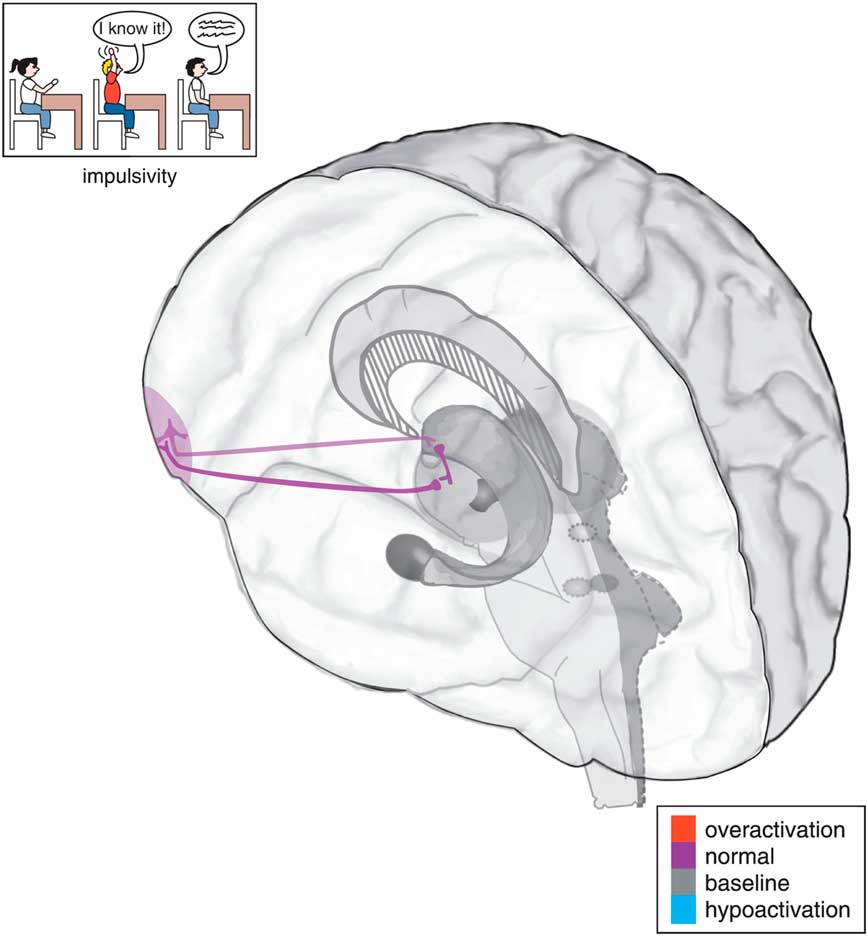
Deficits in activation of the cortico–striato–thalamo–cortical loop involving the orbitofrontal cortex, the striatal complex, and the thalamus have been implicated in disorders exhibiting deficits in impulse control that cross a number of diagnoses, including schizophrenia, attention deficit hyperactivity disorder, posttraumatic stress disorder, and mania (Figure 1).Reference Thomaes, Dorrepaal and Drajijer 13- 14 Optimal release of dopamine (DA) that stimulate D3 receptors and a low-to-moderate stimulation of D1 receptors can be beneficial to prefrontal cortical functioning.Reference Stahl 14 While the available tools, eg, serotonergic antidepressants, alpha-2 agonists, mood stabilizers, etc, to influence these modulatory circuits remain crude, we hope to have clinically demonstrated that with careful observation and control of psychosis, methylphenidate, which has already demonstrated safety and efficacy in the control of impulsive symptoms in attention deficit hyperactivity disorder,Reference Biederman, Mick and Surman 15 can be safely and effectively used as an additional tool in targeting impulsive aggression in selected patients with schizophrenia or schizoaffective disorder.
Impulsivity is modulated by the orbitofrontal cortex. Reprinted from Stahl, SM. Essentials of Psychopharmacology, 5th edition, New York: Cambridge University Press; 2014: 474 (Fig. 12-5).

It should be noted that the observations cited in this report were limited to forensically committed women. Thus, it is not clear that these observations would generalize to men or to dissimilar populations. Furthermore, it should be noted that these observations run counter to prior findings with respect to stimulants in psychotic patients. Previous research indicates a worsening of psychosis with methylphenidate. This research, however, was often designed to intentionally induce psychotic symptoms for diagnostic, not therapeutic, purposes.Reference Lieberman, Alvir and Geisler 16 Methodology often involved administering methylphenidate intravenouslyReference Koreen, Lieberman, Alvir and Chakos 17 , Reference Jody, Lieberman, Geisler, Szymanski and Alvir 18 and removing antipsychotic medications.Reference Lieberman, Alvir and Geisler 16 , Reference Lieberman, Kane, Gadaleta, Brenner, Lesser and Kinon 19
Another frequent limitation in the use of stimulants has been adverse effects, eg, anorexia, insomnia, etc. Such adverse effects, however, are typically dose-dependent.Reference Hammerness, Karampahtsis, Babalola and Alexander 20 Additionally, antipsychotics and mood stabilizers can often treat impulsive violenceReference Giotakos 21 and avoid the risks of stimulant-induced psychosis.Reference Curran, Byrappa and Mcbride 22
A further limitation of the case of Ms. B. is that there was not adequate separation of time between the initiation of clozapine and methylphenidate, specifically, methylphenidate was started 2 weeks after initiation of clozapine. The implication of changing 2 variables within a proximate time frame obfuscates the efficacy of each agent alone vs. in combination. Nonetheless, the change in behavior and sharp reduction of impulsive violence was quite impressive.
Risks of diversion and abuse associated with stimulant medications present a substantial barrier for use in forensic settings. Modern advances in stimulant formulation, eg, controlled-release methylphenidate (Concerta), transdermal methylphenidate (Daytrana®), and pro-drug amphetamine (Vyvanse®), have ameliorated those risks.Reference Weisler and Childress 23
In sum, given the harm inflicted by impulsive violence and aggression in some patients, stimulant treatment appears worthy of consideration in carefully selected patients in whom psychotic signs and symptoms have been controlled as sources of violence. Nevertheless, this hypothesized beneficial use of stimulants needs controlled studies in larger and more diverse populations.
Disclosures
Philip Skoretz and Chin Tang do not have anything to disclose.