Introduction
Tests of verbal fluency are easily administered, are not time consuming, are sensitive to brain dysfunction and, therefore, have utility as bedside tests for assessment of possible cognitive decline (Cottingham & Hawkins, Reference Cottingham and Hawkins2010). In analysis of their psychometric properties, tests of verbal fluency display near perfect interrater reliability of r=0.98 (Norris, Blankenship-Reuter, Snow-Turek, & Finch, Reference Norris, Blankenship-Reuter, Snow-Turek and Finch1995) and a high test–retest reliability of r=0.74 (Ruff, Light, Parker, & Levin, Reference Ruff, Light, Parker and Levin1996). Tests of both semantic fluency (retrieval of words in a specified category, e.g., animals) and phonemic fluency (retrieval of words starting with a specified letter of the alphabet) are reflective of executive functioning abilities and are dependent on dorsolateral prefrontal integrity, while semantic verbal fluency tests have an additional semantic memory component.
Verbal fluency tasks require the engagement of several cognitive processes such as working memory and cognitive flexibility, and while semantic fluency involves a search through categorical or semantic memory, phonemic fluency requires a strategic search through lexical or phonologic memory (Baldo, Schwartz, Wilkins, & Dronkers, Reference Baldo, Schwartz, Wilkins and Dronkers2006). Individuals with frontal lobe lesions (particularly left hemispheric) often exhibit greater difficulty on phonemic fluency because it requires more organization and effort in searching for appropriate lexical items. Those with focal temporal lobe lesions have been shown to have greater deficits in semantic fluency relative to phonemic fluency (Henry & Crawford, Reference Henry and Crawford2004).
Patients with Alzheimer’s disease (AD) exhibit deficits in both semantic and phonemic verbal fluency. Prior studies have generally indicated that their impairments on semantic verbal fluency are disproportionately more severe (Canning, Leach, Stuss, Ngo, & Black, Reference Canning, Leach, Stuss, Ngo and Black2004; Cerhan et al., Reference Cerhan, Ivnik, Smith, Tangalos, Petersen and Boeve2002; Coen et al., Reference Coen, Maguire, Swanwick, Kirby, Burke, Lawlor and Coakley1996; Monsch et al., Reference Monsch, Bondi, Butters, Salmon, Katzman and Thal1992), although the opposite pattern has also been reported (Ober, Dronkers, Koss, Delis, & Friedland, Reference Ober, Dronkers, Koss, Delis and Friedland1986), the pattern depending in part on what categories and letters are being used (Hart, Smith, & Swash, Reference Hart, Smith and Swash1988). The discrepancies in semantic versus phonemic fluency seen in AD have been reported as present to a lesser degree in healthy controls and hence have been hypothesized to represent an exaggerated normal tendency (Laws, Duncan, & Gale, Reference Laws, Duncan and Gale2010), but this is less clear owing to the paucity of normative data in that regard.
Furthermore, discrepancy scores have been shown to have utility in discriminating between etiologies in early dementia and in predicting presence of AD (Canning et al., Reference Canning, Leach, Stuss, Ngo and Black2004). Given the potential clinical implications of the use of discrepancy scores and the fact that both semantic and phonemic fluency scores are widely administered in bedside neuropsychological testing, our study aimed to establish a normative pattern.
Normative data in verbal fluency were summarized by Mitrushina, Boone, and Razani (Reference Mitrushina, Boone and Razani2005); data from 45 studies were combined in regression analysis to a total sample size of 3469 for FAS (phonemic fluency) and 2823 for animal naming (semantic fluency). Significant effects were seen for education and IQ levels. Age related changes in phonemic fluency have a curvilinear pattern, with increase in fluency up to the third decade followed by a gradual decline. In contrast, semantic fluency (animals) shows a linear decline with age. There was a negligible effect of gender on FAS in favor of females. Comparative efficiency for semantic versus phonemic fluency scores was not studied in any of the 45 studies described, and this is described as an area of interest to future investigators of both normal and clinical samples (Mitrushina et al., Reference Mitrushina, Boone and Razani2005).
Indeed, little normative data exist for semantic–phonemic discrepancy scores in healthy subjects. However, one study (Gladsjo et al., Reference Gladsjo, Schuman, Evans, Peavy, Miller and Heaton1999) did report that both large phonemic and large semantic discrepancies were “not uncommon” in their sample of 768 healthy individuals, with large t score differences in 10% of the total sample (favoring both semantic and phonemic fluency). In addition, little is known about whether AD patients show greater variability than healthy participants. A recent meta-analysis (Laws et al., Reference Laws, Duncan and Gale2010) did permit an estimate of the effect size for semantic–phonemic discrepancy scores from large samples of controls (n=2167) and AD patients (n=1771) combined from 50 studies. This analysis revealed that the mean discrepancy effect size for AD patients was almost identical to that of healthy controls, with both showing large effects in favor of phonemic fluency (d=0.76 vs. d=0.78). Although AD patients exhibited a more consistent phonemic fluency advantage than healthy elderly controls, perhaps surprisingly, both groups showed the same mean degree of phonemic advantage.
Studies of relative semantic–phonemic discrepancies in cognitive impairment have yielded discordant findings. Most studies have demonstrated relatively poorer semantic than phonemic fluency in mild cognitive impairment (MCI) subjects when compared to normal controls (Cottingham & Hawkins, Reference Cottingham and Hawkins2010; Lonie et al., Reference Lonie, Herrmann, Tierney, Donaghey, O’Carroll, Lee and Ebmeier2009; Murphy, Rich, & Troyer, Reference Murphy, Rich and Troyer2006; Teng et al., Reference Teng, Leone-Friedman, Lee, Woo, Apostolova, Harrell and Lu2013). However, two studies showed similar patterns in phonemic–semantic verbal fluency discrepancy scores in single domain amnestic MCI and control cohorts (Brandt & Manning, Reference Brandt and Manning2009; Nutter-Upham et al., Reference Nutter-Upham, Saykin, Rabin, Roth, Wishart, Pare and Flashman2008), but both these studies were limited by small sample size. Differential results have been obtained across subtypes of MCI.
For example, a cross-sectional study (Weakley, Schmitter-Edgecombe, & Anderson, Reference Weakley, Schmitter-Edgecombe and Anderson2013) showed no impairment in either semantic or phonemic fluency in single domain amnestic MCI, while multidomain amnestic MCI showed significantly lower total words in both phonemic and semantic fluency as compared to healthy controls. Reduced switching ability appeared to contribute to poorer performance in both fluency measures, which has been linked to executive functioning. A recent well-powered cross sectional study (Teng et al., Reference Teng, Leone-Friedman, Lee, Woo, Apostolova, Harrell and Lu2013) showed relatively greater semantic versus phonemic verbal fluency deficits in amnestic MCI similar to that seen in AD, but this pattern was not observed in non-amnestic MCI.
To interpret the discrepancy scores found in clinical populations, it is imperative to first establish the pattern in a normal population. The aim of this study was to provide normative data for semantic phonemic discrepancy scores, corrected for age and educational level if appropriate from a large community dwelling representative sample of older adults.
Methods
The Irish Longitudinal Study on Ageing (TILDA) is a nationally representative study of the population of Ireland aged 50 and above. TILDA aims to understand how the health, social, and financial circumstances of the older Irish population and how these factors interact. The first wave of data collection was conducted between October 2009 and July 2011. In total, 8175 individuals aged 50 and over participated in the study. A total of 329 interviews were also conducted with younger spouses or partners of participants, leading to a total sample size of 8504.
The design of TILDA is described in full elsewhere (Kearney et al., Reference Kearney, Cronin, O’Regan, Kamiya, Savva, Whelan and Kenny2011), but in brief, each participant underwent a home interview administered by a trained interviewer, was asked to compete and return a questionnaire including more sensitive questions, and was invited to undertake a health assessment, either at a dedicated center or in their own home if travel was impracticable. To generate the TILDA sample, all postal addresses in Ireland were assigned to 1 of 3155 geographic clusters, and a sample of 640 of these clusters was selected, stratified by socio-economic group and geography to maintain a population representative sample. Clusters were selected with a probability proportional to the number of individuals aged 50 and over in each cluster.
Forty households were selected from each cluster (it was estimated that 25,600 addresses in total would be required to achieve the required sample size of 8000). Each of the selected addresses was visited by an interviewer, who attempted to ascertain the eligibility of the address, to contact a household member and determine whether any individuals aged 50 or over lived at that address. All individuals aged 50 or over in each selected household and their partners (even if aged less than 50 themselves) were invited to be included in the study. As part of their assessment, participants were required to name as many animals in 60 seconds as possible. As part of the Montreal Cognitive Assessment (MoCA, Nasreddine et al., Reference Nasreddine, Phillips, Bédirian, Charbonneau, Whitehead, Collin, Cummings and Chertkow2005), they were later asked to name as many words beginning with the letter F as possible in 60 seconds, excluding names of people, places, or numbers. Discrepancy scores were calculated by subtracting phonemic fluency score from semantic fluency score for each participant. Ethical approval for the TILDA study has been obtained from the Trinity College Dublin Research Ethics Committee.
Student’s t test was used to compare performance on verbal fluency tasks according to gender. One-way analysis of variance was used to compare between educational groups. Pearson’s correlation coefficient was used as a measure of correlation and stepwise linear regression was used to assess predictors of performance. Quantile regression was used to estimate normative values. Quantile regression (Koenker & Bassett, Reference Koenker and Bassett1978) is a method for estimating functional relations between variables for all portions of a probability distribution. It provides greater flexibility than other regression methods to identify differing relationships at different parts of the distribution of the dependent variable. A nominal significance level of 0.05 was adopted. Missing data were rare, so missing data with respect to individual measures were assumed to be missing completely at random.
Results
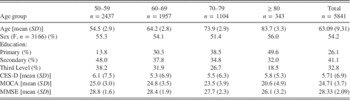
The total TILDA sample consists of 8504 individuals. Exclusion criteria applied were those who scored ≤10 on MMSE (n=6), or were given a diagnosis of dementia or severe cognitive impairment (n=6), AD (n=7), or Parkinson’s disease (n=43) by a doctor. Those under 50 years of age were excluded from the analysis (n=265). Of the 8239 fulfilling inclusion criteria, 5841 individuals had a health assessment carried out. Phonemic fluency data was missing in 34/5841 individuals and semantic fluency data was missing in 28/5841 individuals. There was a valid semantic-phonemic discrepancy score available for 5780 individuals, representing a large community dwelling sample of Irish adults over the age of 50. The mean age was 63.09 (SD 9.31) with an age range of 50–98 and the sample was 54.2% female. The demographic characteristics of the cohort have been described in detail elsewhere (Cronin, O’Regan, Finucane, Kearney, & Kenny, Reference Cronin, O’Regan, Finucane, Kearney and Kenny2013) and are summarized in brief in Table 1.
Demographics for study population

CES-D=Center for Epidemiologic Studies Depression Scale; MOCA=Montreal Cognitive Assessment; MMSE=Mini-Mental State Examination (Folstein).
Mean score for semantic verbal fluency (animals) was 20.9±7.0 (range, 0–50), and mean score for phonemic verbal fluency (letter F) was 11.7±5.1 (range, 0–31). In general, subjects did better on testing of semantic verbal fluency, and the average discrepancy score was 9.2±6.9 words (range, −20 to 37). As expected, phonemic fluency was negatively correlated with age (r=−.18; p<.0001), as was semantic fluency (r=−.25; p<.0001). Discrepancy scores also negatively correlated with age (r=−.12; p<.0001).
There was a statistically significant effect for education on semantic fluency (F(2,5802)=324.5; p<.001) and for phonemic fluency (F(2,5802)=546.4; p<.001) but the effect for education on discrepancy scores was not significant between groups (F(2,5775)=2.8; p=.061). Males had a significantly higher mean discrepancy score (9.6±7.0 vs. 8.8±6.8; p<.001). Women did slightly better on testing of phonemic fluency when compared to men (11.9±5.1 vs. 11.5±5.2; p=.013), but men scored higher on animal fluency (21.2±6.9 vs. 20.7±7.0; p=.006). Semantic and phonemic verbal fluency scores are stratified according to age and educational level and presented in online supplementary material.
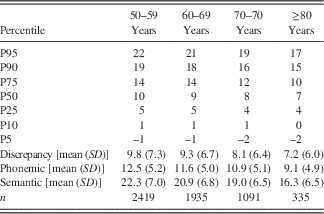
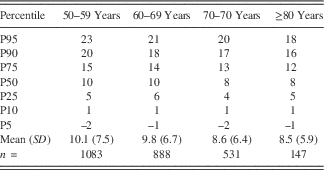
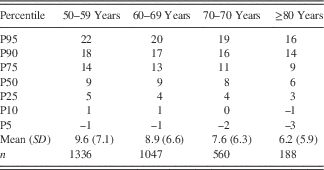
Table 2 shows the percentile scores for discrepancy scores (with means and SD) for the total population stratified according to age. Given the significant differences seen across gender, the scores are presented for males and females in Tables 3 and 4, respectively. Discrepancy scores were not stratified according to educational level, as the effect of education was not statistically significant (being equivalent in both groups and, therefore, partialled out when phonemic fluency is subtracted from semantic fluency). Stratification by age indicates that discrepancy score declines with advancing age.
Verbal fluency discrepancy scores for total population

Note. Discrepancy scores (semantic fluency – phonemic fluency) stratified according to age in a sample of 5780 community dwelling individuals aged 50 and older, without known dementia, Parkinson’s disease, or severe cognitive impairment. Also presented are the means and standard deviations for the raw phonemic and semantic fluency scores.
Verbal fluency discrepancy scores for males

Note. Discrepancy scores (semantic fluency – phonemic fluency) stratified according to age in a sample of 2649 community dwelling male individuals aged 50 and older, without known dementia, Parkinson’s disease, or severe cognitive impairment.
Verbal fluency discrepancy scores for females

Note. Discrepancy scores (semantic fluency – phonemic fluency) stratified according to age in a sample of 3131 community dwelling female individuals aged 50 and older, without known dementia, Parkinson’s disease, or severe cognitive impairment.
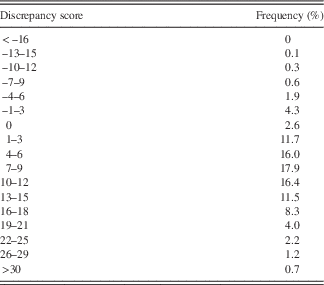
At the fiftieth percentile, those in their fifth decade produced on average 10 more “animals” than “letter F” words. Subjects scored, on average, one word less per decade, with an average of seven more “animal” words produced by those in their eighth decade and beyond. R for regression of discrepancy scores was significantly different from zero, F(4,5772) 28.18, p<.0001. The frequency of occurrence for a given discrepancy score for the total population is shown in Table 5. Cumulatively, only 7.2% of subjects had a discrepancy score of less than 0 (i.e., a phonemic advantage) and the majority of subjects had a phonemic advantage of 7–9 words.
Discrepancy score frequencies for total population, n=5780

Note. The frequency of occurrence for a given discrepancy score for the total population is shown. Cumulatively, only 7.2% of subjects had a discrepancy score of less than 0 (i.e., a phonemic advantage).
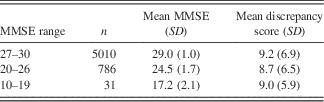
Linear regression analysis revealed age accounts for 1.29% of the variance (p<.0001) and gender accounts for 0.61% of the variance (p<.0001), with a combined R square value of 0.019. Educational level, MoCA, or MMSE scores were not a significant predictor for discrepancy score. Subgroup analysis (see Table 6) was carried out by looking at discrepancy scores stratified by MMSE using cutoffs 10–19, 20–26, and >27 which correspond to MMSE ranges for “moderate cognitive impairment,” “mild cognitive impairment,” and “normal cognitive function” as specified in the MMSE User’s Guide (Folstein, Folstein, McHugh & Fanjiang, Reference Folstein, Folstein, McHugh and Fanjiang2001). For MMSE 27–30 (n=5010, mean MMSE 29.0 SD 1.0, mean discrepancy 9.2 SD 6.9); MMSE 20–26 (n=786, mean MMSE 24.5 SD 1.7, mean discrepancy 8.7 SD 6.5); MMSE 10–19 (n=31, mean MMSE 17.2 SD 2.1, mean discrepancy 9.0 SD 5.9). There was no difference in discrepancy score between MMSE subgroups, F(2,5776) 1.782, p=.168.
Subgroup analysis examining discrepancy score by MMSE

Note. There was no difference in discrepancy score between MMSE subgroups, F(2,5776) 1.782, p=.168.
Discussion
We demonstrate persistence of the semantic advantage right up to the eighth decade. This is in agreement with other studies indicating that healthy subjects produce more animal exemplars than FAS exemplars well into their eighties (Cerhan et al., Reference Cerhan, Ivnik, Smith, Tangalos, Petersen and Boeve2002; Kozora & Cullum, Reference Kozora and Cullum1995). These findings, however, appear at variance with a recent meta-analysis (Laws et al., Reference Laws, Duncan and Gale2010), which reports a commensurable phonemic advantage in a combined sample of 2167 normal controls. This variance may be attributable to the fact that the authors performed a meta-analysis of 50 heterogeneous studies, which may have included multiple measures of phonemic and semantic fluency using an array of letters and categories.
Our study pertains only to “letter F” and “animals,” which has clear implications for its interpretation. It is widely known that there is significant variability in results depending on the fluency task used. For example, using “CFL” is more difficult and has less variability than using “FAS” for measurement of phonemic fluency (Barry, Bates, & Labouvie, Reference Barry, Bates and Labouvie2008). Which categories are contrasted with which letters will also affect the discrepancy pattern (Hart et al., Reference Hart, Smith and Swash1988). In addition to this, the use of combined categories (i.e., three letters / animals, fruits, and vegetable categories) confers greater reliability and better AD discrimination than single letters or single categories (Monsch et al., Reference Monsch, Bondi, Butters, Salmon, Katzman and Thal1992) and is common in research and clinical practice.
As the data in the current study were derived from the TILDA assessment battery just “letter F” and “animals” data were available. However, these are still very widely applicable. The animal category is almost universally used, and an FAS letter combination is also extremely common (Mitrushina et al., Reference Mitrushina, Boone and Razani2005). Obviously any examiner who uses the FAS test can extract the F based score for comparison with our current data. Both FAS test and animal fluency are included in the widely used Delis-Kaplan Executive Function System neuropsychological battery (D-KEFS; Delis, Kaplan, & Kramer, Reference Delis, Kaplan and Kramer2001). The very widely used MoCA (Nasreddine et al., Reference Nasreddine, Phillips, Bédirian, Charbonneau, Whitehead, Collin, Cummings and Chertkow2005) includes just letter F fluency but animal fluency can be quickly added to any assessment protocol.
In addition, if an examiner is pushed for time then the basic combination of animal and letter F fluency can be quickly administered and interpreted in light of our current data. The main point is that while multiple letters and categories have advantages there can also be utility in having comparison data for just letter F and animal fluency. The relatively wide inclusion criteria of the TILDA study could be viewed as a potential limitation of the current study, resulting in a cohort that conceivably includes those with cognitive impairment and possibly undetected dementia.
However, subgroup analysis revealed that the semantic advantage was preserved across the entire sample, even in those groups with low MMSE scores. Our sample can, therefore, be viewed as a normative population-based sample without an implication that all persons are free of disease that might cause impairment in cognition, similar to the approach taken by Crum et al. when reporting population-based norms for the MMSE (Crum, Anthony, Bassett, & Folstein, Reference Crum, Anthony, Bassett and Folstein1993). In addition, our large sample size potentially makes significant relatively small effects, and while the age effect seen in our study is significant, it does account for a small proportion of the variance seen in the regression analysis.
We show an effect of gender on verbal fluency scores, where men perform slightly worse in a phonemic test (using letter “F”) but produce, on average, 0.5 more exemplars than women in a test of semantic fluency (animals category). These differential performances result in a slightly larger discrepancy score for men. However, meta-analysis by Mitrushina et al. (Reference Mitrushina, Boone and Razani2005) revealed only a negligible effect of gender in favor of females in FAS scores. Again, this would suggest that the discrepancy between our study and Mitrushina’s analysis reflects the fact that we use only “letter F versus animals,” where Mitrushina used a combination of “F, A, and S versus animals.” It is known that men produce more animals while women produce more fruits/vegetables in semantic fluency tasks (Marra, Ferraccioli, & Gainotti, Reference Marra, Ferraccioli and Gainotti2007). It has been shown (Weiss et al., Reference Weiss, Ragland, Brensinger, Bilker, Deisenhammer and Delazer2006) that women switch more often between categories in a phonemic test, whereas men trend toward larger cluster sizes leading to a smaller total number of words generated. Our finding that education had no effect on discrepancy score is intuitive, in that education was positively correlated with both semantic and phonemic scores to a similar degree.
The pattern of verbal fluency discrepancy in AD has been shown, in more studies than not, to demonstrate a phonemic advantage (Canning et al., Reference Canning, Leach, Stuss, Ngo and Black2004; Cerhan et al., Reference Cerhan, Ivnik, Smith, Tangalos, Petersen and Boeve2002; Monsch et al., Reference Monsch, Bondi, Butters, Salmon, Katzman and Thal1992). However, in these studies, discrepancy scores did not confer diagnostic accuracy in discriminating impaired from normal subjects due to the significant overlap between discrepancy score distributions, perhaps reflecting the heterogeneity of pathology location in AD (Cerhan et al., Reference Cerhan, Ivnik, Smith, Tangalos, Petersen and Boeve2002).
In contrast, vascular dementia patients have been shown to display a marked phonemic deficit, hypothesized to reflect white matter changes in frontal-subcortical circuits (Lafosse et al., Reference Lafosse, Reed, Mungas, Sterling, Wahbeh and Jagust1997). A study comparing verbal fluency discrepancy scores in patients with Alzheimer’s dementia, vascular dementia, and MCI suggested clinical utility early in the course of dementia in discriminating between etiologies and in predicting presence of AD (Canning et al., Reference Canning, Leach, Stuss, Ngo and Black2004). The provision of discrepancy score normative data in our study will allow the clinician to interpret the discrepancy between semantic and phonemic fluency scores in a more clinically meaningful context. Further work under way by this group will examine discrepancy scores in a clinical sample (MCI and AD) and examine the ability of the discrepancy score to distinguish normal from cognitively impaired individuals.
There is considerable disagreement in the literature with regard to the normal pattern of semantic phonemic discrepancy in healthy ageing. Our study is the first to provide normative data with percentile scores and confirms that, when comparing “letter F” and “animal” fluency the semantic advantage persists into later life in a normative sample. This has clinical implications for the interpretation of this widely used bedside measure. Given that a majority of clinical samples have confirmed a reverse of this normal pattern in Alzheimer’s dementia (i.e., phonemic advantage, reflecting the semantic memory decline that is an early feature of AD), our findings support the clinical utility of brief fluency tests and encourage further research into their use in diagnosis and prediction of progression to dementia.
Acknowledgments
We thank Dr. Cara Dooley, Statistician, TILDA, TCD, and Prof. Teresa Burke, School of Nursing and Human Sciences, DCU, Ireland. Conflicts of Interest: None. Sources of Funding: None. Author Contributions: R.M. Vaughan designed the study, performed the analyses and wrote the study. R.A. Kenny oversaw access to TILDA database and reviewed the study. R.F. Coen and B.A. Lawlor formulated the research question, supervised and supported the process of study design and analysis, and they both reviewed and edited the study. Sponsor’s Role: None.
Supplementary Material
To view supplementary material for this article, Please visit http://dx.doi.org/10.1017/S1355617716000291