1. Introduction
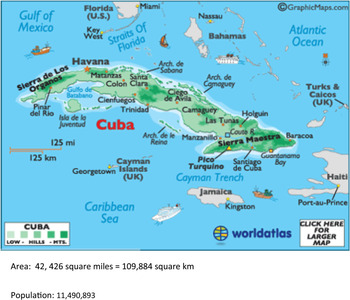
English has played a role in Cuba since the 19th century. This article provides a brief history of English in Cuba (see Figure 1 for Cuba map), contextualizing it in terms of other foreign languages in the Cuban environment, and describing Cubans’ attitudes toward English. This article also overviews the presence of English in the Cuban media, workplace, and diplomacy. Additionally, a large portion of this article is devoted to describing the teaching of English in Cuba at all levels of education. Finally, predications are made about the future of English in Cuba.
Cuba (Worldatlas, n.d.)

2. A brief history of English in Cuba
The English language has been taught in Cuba for over 100 years. During the Cuban War of Independence against Spain (1895–1898), numerous Cubans were banished from Cuba because they opposed Spain's rule. Most of them gathered in the United States to strategize from abroad, and as a byproduct, they learned English. This was the case for José Martí and Calixto García, among many more. Once back in Cuba, while waiting for battle summons, they undertook various jobs to earn their living. Some worked as English teachers in major cities of the island such as Havana (Torres–Cuevas, Reference Torres–Cuevas and Vega2001; Callejas et al., Reference Callejas2010; Velázquez & Pérez, Reference Velázquez and Pérez2010).
English-language teaching officially began in 1899, after the first U.S. intervention in Cuba. During the early 1900s, the U.S. saw the teaching of English as an important way to further its own interests in Cuba (Corona & García, Reference Corona, Garcia, Fishman, Conrad and Rubal–Lopez1996). According to Irizar (Reference Irizar2001), the number of English teachers in Cuba grew steadily from the early 1900s into the 1950s, to the point that in 1952, there were 991 English teachers on the island. Not only did schoolchildren learn English, but night schools for adults offered English courses, and a few bilingual schools opened in Havana, offering English immersion to the children of upper-class parents who could afford it. Corona and García delineate the history of English-language teaching in Cuba, tracing it from its beginnings through the 1959 Cuban revolution and governance under Castro. They argue that the revolution (and resulting hostilities with the U.S.) provided Cuba the necessary conditions to disassociate the English language from the U.S. The Cuban Ministry of Education steered the teaching and learning of English towards British English, and English became important not as a means of fostering ties to the U.S., but instead as a means of international and scientific communication with the broader world. Over the years, the emphasis that Cuba has placed on English has varied according to U.S.-Cuba relations, and for many citizens, English plays a limited role (Corona & García, Reference Corona, Garcia, Fishman, Conrad and Rubal–Lopez1996). However, the teaching of English has continued because English has continued to be considered the most important foreign language for Cubans to learn, given its status as a world language. Because Corona and García provide a detailed description of the development of English-language teaching in Cuba through the mid-1990s, this article focuses on more recent developments related to the role of English in Cuba, focusing especially on the teaching of the English language. (See also Irizar, Reference Irizar2001, who highlights key developments in English language education in Cuba through the turn of this century.)
3. Foreign languages currently taught in Cuba
Foreign languages are seen by Cubans as a way of gaining a broader view of the world; thus, motivation to learn foreign languages in Cuba is very high. The teaching and learning of foreign languages in Cuba has become a social phenomenon, mainly among the young. The Cuban Ministry of Education has therefore made strong efforts to implement an effective strategy for foreign language instruction. English is seen as the most important foreign language for grappling with the challenges of the world. Thus, English is the most taught and learned foreign language in Cuba. Cubans learn English for work, study, and travel. English-language instruction begins in the third year of primary education and continues through the end of university education. It is also taught in (primarily evening) language schools throughout Cuba, as are other foreign languages.
After English, French and German are the next most desired foreign languages because of the increasing number of visitors from Europe to Cuban resorts and because Cuba maintains an important relationship with members of the European Union. Italian is also taught in Cuba and it is gaining more popularity among young students who are interested in Italian culture and who see it as potentially useful since more Italian tourists are coming to the island. Additionally, Portuguese has been taught since the 1970s, when Cuba became militarily involved in Angola's civil war, fighting against the Apartheid factions in South Africa, and in other Portuguese-speaking countries in Africa. The teaching and learning of this language went through a dormant period, but it is now being revived because Cuba is sending doctors, nurses, teachers, and other highly qualified professionals to Brazil and to African nations where Portuguese is spoken. Additionally, Japanese and Chinese are becoming more popular and are taught in Havana, where there are institutions that advocate for the cultures of the peoples speaking those languages. Russian is also taught, but not in the widespread manner that it was in the 1970s and 1980s, when Cuba and Russia had close ties and Russian instruction was therefore imposed in schools for political reasons. Now, Russian is studied only on a limited basis for specific purposes such as tourism, foreign affairs, and trade. On the whole, the social thirst to learn foreign languages in Cuba, especially English, seems to be unquenchable.
4. Attitudes toward English
Cubans hold very positive attitudes toward English, especially American English. Cubans prefer American English because they are part of North America, because most of the English-language media they are exposed to is in American English, and because they see American English as the dominant variety of English in the world; American English is becoming the lingua franca of the 21st century (Crystal, Reference Crystal2003; Schneider, Reference Schneider2011). Despite this, British English has a significant presence in the schools. Some textbooks in use are British, and the Cuban Ministry of Education, in cooperation with the British Council, has implemented the Common European Framework of Reference (CEFR) as the guideline for measuring learners’ achievements in English. Nonetheless, most Cubans prefer American English. They are also interested in Canadian English, given the fact that Canadian tourists can more easily travel to Cuba than can tourists from the U.S. Most Cubans are unfamiliar with other varieties of English.
While interest in English is increasing every day, attitudes toward English vary to some degree according to age; for instance, children and youngsters are the most motivated because they look ahead to future lives in which English will be of paramount relevance. As youngsters in Cuba are enticed by technology and internet access, Facebook, video chatting, and video games, they are also getting into the spirit of the English language. Of course, parents also play an important role in motivating their children.
Attitudes concerning English learning can vary according to region as well. For instance, youngsters from rural areas live in a social context where people typically spend their time in agricultural activities. These young people may study agronomy, veterinary medicine, and natural sciences. Some have little interest in English, but others are motivated to learn it because they know that they can access up-to-date information in their fields in English. In contrast, in urban communities, young people encounter more opportunities to see the usefulness of English in their future lives. Additionally, urban parents are typically better educated and urge their children to learn English, and urban youngsters have more access to technology, which fosters their awareness of English and highlights their need for it. While urban communities provide more support for English learning than rural communities, rural institutions in Cuba are now awakening to the inevitable need for learning English.
The level of one's education also influences attitudes toward learning English. Professionals such as medical doctors, professors, teachers, engineers, interpreters and translators, customs officers, resort staff, journalists, radio and TV announcers, traders, and diplomatic personnel typically display a positive attitude towards English learning. Children whose parents hold university degrees tend to imitate their parents' stance toward education and English-language learning. Many well educated parents want to help their children attain a level of English that will allow them to study in private schools or evening language schools. However, many parents who are not as well educated also show interest in having their children learn English and encourage them to succeed in communicating through this global language.
5. English in the media
In the media, English is present in English-language teaching programs as well as in entertainment. Because of the importance of English, the Cuban Ministry of Education, in collaboration with the national television station, broadcasts foreign language courses to the entire Cuban population. This has been carried out through the popular TV program ‘Universidad para Todos’ (University for Everyone). In conjunction with this TV program, a special language-learning magazine has been distributed by post, one which contains exercises to extend the content taught on TV. (This is the only English-language periodical published in Cuba.) Foreign language television courses also exist in French, German, Italian, and Portuguese, but the most commonly broadcast foreign language instructional programs are in English, with four courses aimed at various levels of proficiency devoted to it. The population has welcomed these courses. Other TV programs have been dedicated to discussing the paramount importance of teaching and learning English in Cuba at each level of education. Additionally, many Cubans watch a program entitled ‘English without Borders,’ which provides instruction in American English by American teachers. Cubans access this via the internet or on flash drives. Besides this, many teachers download ‘English in a Minute,’ ‘Everyday Grammar,’ and other materials from the Voice of America website for use in the classroom.
There is a very strong presence of American English in the Cuban media. Because of technological breakthroughs, most of the cultural, scientific, technical, audiovisual, music, and literary materials consumed by the Cuban society are in American English. In almost every town and city in Cuba, there are movie theaters where American films are shown, mostly westerns, adventures, dramas, science fiction, and suspense. Every two years, Havana hosts an international film festival that always includes American films. However, most Cuban families own a television, and they tend to watch films at home more than in theaters. In addition to the Cuban national television station, there are eight television channels, whose programming includes American films, series, documentaries, and comedies (and occasionally British, French, Italian, Portuguese, and Russian materials). On weekends, especially Saturday nights, Cubans enjoy watching American films broadcast on television. The authors estimate that about 85% of the films shown on TV are American films. Those who don't know English listen to the English-language audio and read the Spanish-language captions; they prefer the program with Spanish-language captions (rather than dubbed into Spanish) because American English audio gives the films a mark of authenticity. On Sunday afternoons, an English-language sports channel shows exclusively films and documentaries about great American baseball players and teams from the Major Leagues. This is very popular and reflects Cubans’ love for baseball. On Tuesday afternoons, ‘Senderos del Oeste,’ or ‘Western Paths,’ shows only American western films.
Additionally, Cubans download to flash drives a popular for-fee ‘package’ from the internet that contains a great deal of American programs. Those who don't have access to the internet are able to pay businesses who download the programs and sell them on flash drives. (These businesses have a license and must pay a monthly fee to the government in order to operate.) Cubans enjoy the ‘package’ because it provides opportunity to learn about American culture. The American comedy sketch show called ‘The President Show,’ which features a Donald Trump impersonator, is especially popular.
Concerning music, the preference in terms of foreign music is for lyrics in English; and, of course, American music is at the top of young people's preferences. On TV, Cubans can watch a music channel called Canal Clave that broadcasts American music videos and American musical films. The authors estimate that about 65% of the music on this channel is in English. There is a great deal of American music on the radio as well.
6. English in the workplace
Tourism is the primary economic source in Cuba and is crucial for the Cuban economy. Most tourists come from Canada, Germany, England, and France. The number of visitors to Cuba is growing significantly every year, and in 2015, a ‘record breaking 3.1 million tourists visited the island’ (Gross, Reference Gross2015). This has entailed the need to form Cuban professionals capable of communicating in one or more foreign languages. Every tourism worker must speak English fluently, along with other languages, as part of the high-quality service that must be offered in each Cuban resort. Thus, there are specialized schools (formatur) where resort staff members undergo a rigorous language education program. They take intensive communicative courses that lead to examinations to measure their foreign language communicative proficiency levels.
English is also essential in academia. When publishing academic articles, scholars often need to write the abstract or the entire article in English. Since the most current academic information in most fields is published in English, academics must also have strong English-language reading skills. Knowledge of English is important for research activity and exchange among students and professionals from other nations as well. For example, when Cuban universities hold international conferences, the official language is English. The authors estimate that about 80% of papers presented at Cuban conferences related to language teaching are presented in English. A clear example of this is WEFLA: International Conference on Foreign Languages, Communication, and Culture, hosted by the University of Holguín. (The conference was originally called Workshop on English as a Foreign Language, but it focuses on a range of foreign languages in addition to English.) At this conference, there is a noticeable presence of English-speaking presentations every year, with the percentage of presentations in English increasing each time the conference is held.
7. English in diplomacy and international exchanges
Cuba maintains relationships with a great number of English-speaking countries in the world, and the teaching of English in Cuba responds to this reality. Cuba belongs to international bodies such as the Caribbean Community, the World Health Organization, the United Nations, the Non-Aligned Movement, the Pan-American Health Organization, the Bolivarian Alliance for the Peoples of America (ALBA–TCP), and the Community of Latin American and Caribbean Sates. In these organizations, English is one of the official languages. Accordingly, all Cuban diplomats can communicate in English (as well as other foreign languages). Additionally, Cuba has established relationships with several English-speaking countries from the Caribbean, Africa, and other areas where English is a dominant language. Thousands of Cuban professionals have received instruction in English related to their professional specialties in order to work in these various English-speaking countries. This is the case for school teachers, university professors, engineers, medical doctors, nurses, paramedic personnel, artists, and others. Even baseball players can be hired to play in English-speaking countries. Additionally, academic exchange programs exist between Cuban universities and Canadian universities, and professors from each country travel to their partner universities. Although exchange programs with Canada are more common, some academic exchanges exist between U.S. and Cuban universities. An example is the Madison fellowship program held every summer in Washington D.C. at James Madison University. It is a course on the U.S. constitution and its history. Dr. Manuel de Jesùs Velàzquez Leòn participated in this program in the summer of 2015 and later taught a postgraduate course to English professors from Holguín on the U.S. Constitution. In 2017, Dr. Kevin R. Hardwick from the Department of History of James Madison University participated in the WEFLA international conference and also taught a post-conference on the U.S. constitution. This was a significant milestone in the history of the University of Holguín as it was the first time that a U.S. professor taught a post-conference workshop on the U.S. Constitution.
English has boomed all over the island, chiefly American English. One of the causes was a moment of diplomatic closeness and understanding between the governments of the United States of America and Cuba just at the end of former U.S. President Barack Obama's time in office. It seemed as if there would be a progressive thawing of relations between the two countries. However, since U.S. President Donald Trump took office in 2017, diplomacy between the two countries has stagnated. But it has not prevented Cubans from continuing to prefer, study and learn American English.
8. English in education
Escalona (Reference Escalona2013) asserts that governmental and educational polices regarding English are very favorable. The Cuban government fosters the teaching-learning process of English at all levels of education. Although there are an insufficient number of computers in schools, several software programs have been devised to aid teaching and learning English, such as ‘Rainbow’ and ‘Sunrise.’ Likewise, magazines and workbooks have been published to support English learning, and video lessons have been created for each level of education.
English teachers are offered methodological education sessions, postgraduate courses, and diploma courses that update them on the latest developments in foreign language didactics. Also, master's degrees and doctoral studies are available for those who meet the academic requirements. This is a very selective and demanding process. In addition, professors of English are asked to write and publish academic articles in Cuba and abroad. Educational authorities also ask professors to actively participate in academic conferences to expand on their research activity in English teaching. Therefore, Cuban professors of English become involved in research projects aiming at the improvement of the teaching and learning of English. The government and universities designate a fund to financially support these research projects, based on the academic, social, scientific and economic impact of the research.
English is mandatory from the third grade of primary education through higher education. Parallel to this, the Cuban Ministry of Education has created night language schools where the main language taught is English. These schools are open to the entire community and students are grouped according to age and language proficiency. Additionally, there are private language schools along the island, mainly in urban areas. Sometimes, these private language schools are preferred over the government night schools because of the high language level of instructors.
In terms of didactics, the Ministry of Education provides schools and teachers with guidelines for teaching English that stipulate that English must be taught according to a communicative approach, with a focus on communicative competence, including linguistic, sociolinguistic, discourse and strategic competence (Canale & Swain, Reference Canale and Swain1980; Richards & Schmidt, Reference Richards and Schmidt1983). The goal is for students to be able to use English as fluently and accurately as possible, and to be able to not only speak and understand English, but to read and write it as well. Schools and universities endeavor to educate professionals who are able to use English in their professional lives to communicate in English with colleagues from other countries. Generally, Cuban students find that reading comprehension is easiest for them, and listening comprehension is the most difficult. While the four skills of reading, writing, listening, and speaking are taught in an integrated manner, more emphasis is placed on speaking due to its role in everyday communication. There is still much work to be done in fostering students’ English proficiency, with continued efforts needed by the Ministry of Education and the government in general in improving English teaching at all levels, especially in primary schools, junior high schools and senior high schools. At these levels, the main challenges teachers face are the lack of computers, updated dictionaries, communicative textbooks, and didactic materials in general.
English in teacher education
Teachers of English participate in a teacher education program with a pedagogical emphasis. This program lasts at least five years. Future teachers are prepared to teach English at any level of education. During their curriculum, they study subjects connected to pedagogical sciences, covering the following areas: psychology, philosophy, sociology, classroom management, communication, and history of education. However, the core of the curriculum is English Language studies, which comprises integrated English Practice, English Linguistic Studies, Didactics of Foreign Language Teaching, History of English Speaking Cultures, Research, Spanish Linguistic Studies, and other subjects that are optional. Students must achieve a C2 level of proficiency, according to the Common European Frame of Reference (CEFR), set out by the Council of Europe. Level C2 is the sixth and highest level in the framework. The CEFR delineates that a learner who achieves level C2 have the following abilities: ‘Can understand with ease virtually everything heard or read. Can summarise information from different spoken and written sources, reconstructing arguments and accounts in a coherent presentation. Can express him/herself spontaneously, very fluently and precisely, differentiating finer shades of meaning even in more complex situations’ (Council of Europe, n.d.). Once students graduate, they are then sent to teach at primary schools, junior high schools, senior high schools, and universities.
When English major students finish their university studies, some of the best ones are selected to continue teaching at the university while others go to other educational levels to find posts as teachers. During and after their university education, English teachers receive additional education through methodological workshops. Methodological workshops are of vital importance because they provide a venue for teachers to exchange their views and experiences on language teaching and how they envision the future of English. These workshops are directed by an experienced senior instructor, and participants discuss the nature of the English content they are teaching. They debate how to implement the communicative approach, how to use procedures, techniques, and teaching media, and how to assess students. They consider how to present the content of language lessons, how to integrate communicative skills and functions, and how to foster student interaction that allows students to become active agents, and the teacher a facilitator and counselor.
Once they graduate from the university, teachers have the opportunity to pursue a PhD, a master's degree, a two-to-three-year specialty course (which is more focused in scope than a master's degree), a diploma course (lasting six to 10 months), or a postgraduate course (lasting two weeks to three months and covering a single topic). In order to teach at the university level, a PhD is strongly encouraged, but a master's degree or specialty course is required unless one has a very high undergraduate grade point average. In that case, a university instructor may teach with only an undergraduate degree but must pursue a postgraduate course and then a master's degree, specialty course, or PhD.
Instructors at all levels are encouraged to participate in national or international scholarly conferences on foreign language teaching. Higher education policy requires university teaching staff to research and publish continually in approved national journals or international journals related to foreign language teaching. Senior high school, secondary school and primary school teachers are not required to publish but they are encouraged to do so.
Below is a brief description of English in each level of education.
English in primary school
Children start to learn English in primary school at the age of eight, when they are in third grade. Primary students receive only one hour of English instruction per week. Students view video lessons and afterwards work on workbook tasks guided by the instructor (O'Farrill et al., Reference O'Farrill, Chala, Arias, Armenteros, Girón and Castro2014). Students learn simple communicative functions such as greeting people, asking and giving personal information, talking about school objects and colors, and describing people and places. They also learn English numbers and basic grammatical rules. The focus is on accuracy rather than on fluency. Students practice short dialogs, complete sentences and phrases, and do a great deal of repetition following the teacher as a model or the patterns provided on video lessons. While speaking is emphasized, there are still limitations in primary school students’ communicative competence. Families generally agree that it is important to start teaching English to children early as they learn faster and better, and they typically support their children's acquisition of English in various ways. They often help with their child's homework or learn along with the child as the child learns English. Extended family members who know English, or even neighbors, often help with a child's English study. Parents may hire private English tutors, and if they can afford it, they may purchase a laptop or other device that will help their children learn English.
At the primary level, ongoing assessment is carried out systematically. It is qualitative and summative in that the teacher keeps track of students’ communicative performance every month in order to provide a final mark at the end of the school year. This education level culminates in sixth grade.
English in junior high school
Once students finish their primary school, they go on to junior high school, which starts in seventh grade and ends in ninth grade. (Students range in age from 12 to 15 years.) Students receive three 45-minute periods of English instruction per week. Here, there is noticeably more rigor in the teaching and learning of English. For instance, students learn new grammatical patterns related to simple verb tenses in present, past and future, as well as passive voice in simple present tense. They learn new vocabulary and undertake systematic practice of pronunciation patterns. During the three years, they practice the English linguistic content they have learned by acting out dialogues, performing monologues, and completing listening comprehension tasks, reading comprehension tasks, and writing assignments. They also undertake projects individually or in pairs, to be handed in and then discussed orally. The skill of speaking is prioritized although teachers try to integrate the teaching of various skills in a communicative manner.
Students show great interest in learning English and are enthusiastic during lessons. However, students cope with some difficulties in the spoken language since they have only three lessons per week and have little practice outside the classroom, except for those who live near resorts. Additionally, other subjects are prioritized over English. Hence, English teachers must be didactically and linguistically up-to-date to properly direct students’ learning, and they must also consider the psychological characteristics of these adolescent students as they are going through complex mental and physical processes. Families and societal institutions support this process, not only in the case of English but in each school subject. In secondary school, students use a workbook in each grade, but they do not rely on a textbook nor on dictionaries. This is an obvious limitation, but teachers and students persevere in their attempts to teach and learn English. They also visit the school computing lab and use English software to complete language tasks.
English in senior high school
Students who finish junior high school with a good grade point average may proceed to senior high school. Otherwise, they attend a polytechnic school or vocational school. Senior high school includes grades 10–12; students range in age from 15 to 17. During senior high school, students continue to receive three periods of English instruction per week. Here, there is more emphasis on pronunciation, vocabulary, and grammar all working as a system at the service of communication. Students learn and practice compound tenses such as present perfect tense, present perfect continuous tense, and past perfect tense. Likewise, they learn about clauses, connectors, more prepositions, modal verbs, passive voice, phrasal verbs, and conditional sentences. Students learn all this in short dialogs first along with listening comprehension, then reading comprehension. Afterwards, they have oral and written practice. Students are to demonstrate knowledge of linguistic, sociolinguistic, discourse and strategic competences. Students use a workbook in each grade of senior high school. There is not a textbook; however, they can interact with English software called ‘Sunrise,’ which includes several modules on linguistic and communicative skills along with cultural aspects of English speaking countries.
English in vocational and polytechnic schools
In vocational and polytechnic schools, English is of great importance. English is taught according to the needs students will have in their future jobs, with an English-language syllabus existing for each future occupation. The focus of teaching includes technical terms since English is taught for specific purposes (Hutchinson & Waters, Reference Hutchinson and Waters1998; Teruel, Reference Teruel2016). For example, a future restaurant waiter learns how to communicate according to the nature of the job. The same happens with those students preparing to be bartenders, taxi drivers, hotel receptionists, hair dressers, electricians, bank attendants, clerks, shop assistants, designers, customs officers, etc. The English-language education is very demanding but is focused to align with students’ occupational aspirations.
English in university
Depending on their major, university students are required to achieve different levels of English-language proficiency. Students of journalism, history, psychology, social communication, philosophy, engineering, mathematics, computing science, law, and all the branches of pedagogical sciences besides English learn English at the Language Center of the university. Since 2016, all universities have had such language centers. They use a series of British textbooks entitled Face to Face. Therefore, the English taught and learned is British, despite most Cubans’ preference for American English. Once students have completed the course successfully, they receive a certificate that vouches for their language proficiency; without it, they cannot graduate. Students of these centers must achieve a B1 level, according to the Common European Framework of Reference (CEFR). According to the CEFR, learners at the B1 level can ‘understand the main points of clear standard input on familiar matters regularly encountered in work, school, leisure, etc. Can deal with most situations likely to arise whilst travelling in an area where the language is spoken. Can produce simple connected text on topics which are familiar or of personal interest. Can describe experiences and events, dreams, hopes & ambitions and briefly give reasons and explanations for opinions and plans’ (Council of Europe, n.d.).
Students in the medical fields take English courses not at language centers, but as part of their curriculum. The students use a textbook series entitled Vision during the first three years, and in their fourth and fifth years, English through Medicine I and II, which focus on medical terminology, specialties, diseases, signs, symptoms, medical treatments, and communicative situations between doctor and patient. Also, students are trained to write and orally discuss case reports about patients’ health conditions in English. In order to conclude their university studies, it is mandatory for them to demonstrate they are capable to communicate according to a B1 level of the CEFR.
As discussed in the section on teacher education, university students studying English can pursue a teacher education track. Besides this pedagogical track, students can pursue an English-language major designed to prepare interpreters and translators. These future professionals receive a level of education that makes them competent to perform their job in any social, national, or international institution or event. The linguistic standards for this program are higher than in any other program. Initially, students must spend an entire academic preparatory year in intensive English courses, increasing their English proficiency. If students satisfactorily complete their preparatory year, they may start the first official year of the five-year program. During this program, a second foreign language, French, is added to their curriculum. Students are required to achieve a C2 level (the highest level of the CEFR) in both English and French. They must demonstrate a high level of accuracy and fluency in Spanish as well since they will become interpreters and translators.
The textbooks used to teach English in the teacher education track for English teachers are the series Face to Face, combined with Spectrums and Interchange. Both students and professors prefer Spectrums and Interchange as they are based on American English while Face to Face is based on British English. Students and professors endeavor to have an American-like accent. However, students of the English Language major also are made aware of some features of other varieties of English, including Canadian, British, Scottish, Australian, New Zealand, South African, West African, and Caribbean Englishes. This is done through studying the following subjects: Literature, Interpretation, Translation, Grammar, Lexicology, Stylistics, Phonetics and Phonology, History of English Speaking Cultures, Listening, Speaking, Reading and Writing, and Comparative Linguistics. Both British and American Englishes are incorporated into assessment. Students must distinguish distinctive features of British versus American pronunciation such as intonation, rhythm, and stress. Likewise, students must identify differences in vocabulary, spelling, and grammar.
In their third year of studies, these students complete their education through real-life practice. For instance, they make transfers from the airport to the resorts, serve as tour guides, and work in hotels, all the time practicing the language with tourists from Canada, England, France, Germany, and other nations. Once students are in their fourth year, they spend the first semester in class, focusing on didactics of foreign language teaching, which prepares them to be university professors as well. They then undertake a practicum, teaching English to students from other university majors.
Teacher attitudes toward American English, British English, and the CEFR standards
Some English teachers in Cuba advocate for the implementation of the Common European Framework of Reference (CEFR) since it is a well-designed, detailed framework of reference. However, many Cuban teachers of English question the rationale behind the educational authorities’ decision to adopt the CEFR because they believe that American English is more suitable for Cuba. Cubans in general tend to favor American English due to the proximity of Cuba to the U.S., their eagerness to learn about American culture and history, and the role of American English around the world. As a result, many Cuban teachers of English would prefer an American framework of reference for teaching English. Additionally, there is concern that some teachers are exaggerating the significance of the CEFR, relying too heavily on it rather than using pedagogically appropriate teaching methods.
English in private language schools
English education is not only relevant to the educational contexts discussed above; it has spread to all of Cuban society. As described above, there is an ‘English boom’ in Cuba. There are private English schools all over the island, chiefly in big cities like Havana, Matanzas, Varadero, Pinar del Río, Holguín, Santiago de Cuba, Villa Clara, Trinidad, Baracoa, Morón and others. But private English education also takes place in small towns and municipalities. In most cases, classes in private schools are taught by freelance instructors who obtain a license and pay a monthly tax to carry out their work. The society welcomes the opportunity for learners to receive high-quality English instruction, and parents who can afford it supplement their children's school study of English with private English courses.
9. The future of English in Cuba
The future of English in Cuba promises to be strong as there is an increasing interest amongst the Cuban population to learn more and better English. This is true especially among the young, who are focused on American English. There is an expectation that in the future, the relationship between Cuba and the U.S. will improve, and that then, there will be more contexts in which to use English as a vehicle of communication. Apart from that, teachers and specialists of English in Cuba are looking forward to a turning point in the way English is taught and learned in Cuba, which will allow students and professionals to gain a higher level of English-language proficiency.
 Ulises Escalona Sánchez is Professor of Didactics of Foreign Language Teaching at the University of Holguín, Cuba, where he also teaches writing, research and postgraduate courses. He has taken part in national and international scholarly conferences. Likewise, he has published articles on foreign language teaching and learning. Additionally, he has been a methodological supervisor and scientific advisor. Email:uescalona@nauta.cu
 Melinda Reichelt is Professor of English at the University of Toledo, where she directs the ESL writing program and teaches ESL writing and linguistics. She has published articles on second language writing and is co-editor, with Tony Cimasko, of Foreign Language Writing Instruction: Principles and Practices (Parlor Press, 2011). With Nur Yigitoglu, she co-edited L2 Writing beyond English (Multilingual Matters, 2019). Email:melinda.reichelt@utoledo.edu