





Introduction
The contested detection of phosphine in the atmosphere of Venus in September 2020 (Greaves et al., Reference Greaves, Richards, Bains, Rimmer, Sagawa, Clements, Seager, Petkowski, Sousa-Silva, Ranjan, Drabek-Maunder, Fraser, Cartwright, Mueller-Wodarg, Zhan, Friberg, Coulson, Lee and Hoge2020) sparked one of the most high-profile scientific debates of the past decade. Phosphine is widely considered a potential biosignature gas on terrestrial planets (Sousa-Silva et al., Reference Sousa-Silva, Seager, Ranjan, Petkowski, Zhan, Hu and Bains2020), and its reported presence on Venus – long regarded as an uninhabitable world (Limaye et al., Reference Limaye, Mogul, Baines, Bullock, Cockell, Cutts, Gentry, Grinspoon, Head, Jessup, Kompanichenko, Lee, Mathies, Milojevic, Pertzborn, Rothschild, Sasaki, Schulze-Makuch, Smith and Way2021) – reopened the possibility of life in a location typically excluded from contemporary habitability discourse. The announcement generated substantial public and scientific attention, followed quickly by critical scrutiny, reanalysis and renewed observational efforts. As a result, the Venus phosphine episode has become an emblematic case for examining how uncertainty, contestation and exploratory ambition interact in the public communication of frontier science.
The tentative detection of phosphine on Venus also had a measurable impact on the astrobiology community itself. Based on two surveys conducted before and after the public announcement of the phosphine findings, Bains and Petkowski (Reference Bains and Petkowski2021) showed that scientists’ confidence that life could exist on Venus was slightly but significantly higher after the discovery than before, despite the planet still being regarded as the least likely candidate for life among major Solar System targets.
Science communication research has long emphasized the importance of uncertainty in reporting scientific developments, whether as a means of preventing premature hype, signaling methodological rigor or preserving public trust in expert institutions (Fischhoff and Davis, Reference Fischhoff and Davis2014; Van der Bles et al., Reference van der Bles, van der Linden, Freeman, Mitchell, Galvao, Zaval and Spiegelhalter2019). Uncertainty is not an exception but a defining characteristic of science in general (Funtowicz and Ravetz, Reference Funtowicz and Ravetz1993) and astrobiological research in particular (Burton, Reference Burton, Salazar and Gorman2023). Yet public interpretations of uncertainty can have profound consequences for trust in science and space policy support (Dominik and Zarnecki, Reference Dominik and Zarnecki2011; Gartrelle, Reference Gartrelle2015; Joyce et al., Reference Joyce, Tomkins and Weinstein2008).
The relationship between communicating scientific uncertainty and public trust is not uniform. Systematic review evidence suggests that the effects of uncertainty portrayals vary according to the type of uncertainty communicated, the topic and characteristics of the audience (Gustafson and Rice, Reference Gustafson and Rice2020). Under some conditions, particularly when uncertainty is not clearly explained or is attributed to poor science, its communication may contribute to confusion, skepticism or reduced trust in scientific institutions (NASEM, 2017). Thus, the phosphine case offers a valuable empirical setting to investigate how the mass media negotiate the tension between extraordinary discovery claims and the epistemic norms that regulate them.
News outlets differ in their market orientation, journalistic cultures, sourcing practices and temporal rhythms of attention (Friedman et al., Reference Friedman, Dunwoody and Rogers2012; Nelkin, Reference Nelkin1987), suggesting that uncertainty may be communicated unevenly across media types. Despite significant scholarly interest in attention cycles and the communication of controversial discoveries (Nisbet and Huge, Reference Nisbet and Huge2006; Schäfer, Reference Schäfer2008; Schönbauer and Müller, Reference Schönbauer and Müller2021), little research has examined how different media types structure the rise, contestation and normalization of scientific uncertainty over time.
Against this backdrop, this study’s central object of investigation is the journalistic communication of scientific uncertainty. Framing is understood as the communicative mode through which this translation occurs, namely through the selection and emphasis of particular aspects of uncertainty. The analysis compares the framing along two dimensions: news outlet type and analytical period of the scientific debate. Journalistic presentation strategies are treated as subordinate indicators of uncertainty framing. The Venus phosphine controversy serves as the empirical use case through which this conceptual structure is examined.
Consequently, this study analyzes English-language news media coverage of the contested phosphine discovery on Venus from September 2020 to June 2025. Through standardized content analysis, we trace the evolution of uncertainty across analytical periods of the scientific debate and compare how different media types contributed to its amplification, modulation and stabilization.
Theoretical framework
Uncertainty communication
In an era of rapidly evolving scientific knowledge and global crises, the question of how science communicates uncertainty has become more urgent than ever. Scientific uncertainty is intrinsic to the research process: it arises from probabilistic reasoning, methodological limitations and the application of findings across diverse contexts. Yet how such uncertainty is communicated to the public remains a point of tension between maintaining trust, ensuring transparency and promoting effective decision-making (Fischhoff and Davis, Reference Fischhoff and Davis2014; Van der Bles et al., Reference van der Bles, van der Linden, Freeman, Mitchell, Galvao, Zaval and Spiegelhalter2019).
An editorial in Nature (2024) has reignited this conversation, advocating that public-facing science communication should adhere to the same standards of research integrity expected in academic publications, including the open disclosure of uncertainty. The editorial draws on a proposal by Rhys Morgan, head of research policy, governance and integrity at the University of Cambridge, who argues that institutions should support researchers in responsibly conveying not only their results but also the limitations and confidence levels associated with them. According to this view, embracing uncertainty in science communication is not a liability but a necessary step toward sustaining public trust.
However, this position is not without contention. In a correspondence published in response, Hannah Little (Reference Little2024), Lecturer in Communication and Media at the University of Liverpool, cautions that the effects of communicating uncertainty on public trust are context-dependent. Citing experimental evidence from the COVID-19 pandemic, she notes that while high-quality evidence may tolerate the disclosure of uncertainty without diminishing trust, communicating uncertainty in situations marked by low evidence quality or expert disagreement may, paradoxically, erode confidence and hinder public compliance. In such cases, omitting or minimizing uncertainty may be a strategic choice to preserve credibility and achieve behavior change.
Gustafson and Rice (Reference Gustafson and Rice2020) explicitly note that the existing evidence is inconclusive as to whether communicating scientific uncertainty has “positive” or “negative” effects, with outcomes varying across uncertainty types, topics, audiences and communicative contexts. This ambivalence is echoed in the National Academies of Sciences, Engineering and Medicine’s foundational report on communicating science effectively (NASEM, 2017). The report outlines how different sources and types of uncertainty interact with audience psychology, risk perception and sociocultural values. While some individuals welcome transparent discussions of uncertainty, others interpret it as a sign of weak science or institutional incompetence. Importantly, the report warns that failing to disclose uncertainty – even when done with good intentions – can create a false sense of certainty, leading to backlash when scientific understanding evolves.
Taken together, these perspectives highlight that how and when to communicate uncertainty is not a simple matter of principle but a nuanced decision influenced by the nature of the science, the audience’s expectations and the communication context. This paper explores the challenges and implications of uncertainty communication in science, with the aim of identifying strategies that balance transparency, credibility and audience engagement.
Framing of scientific uncertainty
Nisbet and Mooney (Reference Nisbet and Mooney2007) argue that when science intersects with societal values, factual clarity alone is often insufficient to influence public understanding or trust. Instead, effective communication hinges on framing – the strategic emphasis of certain interpretive angles that resonate with the audience’s cultural values, identities and prior beliefs. Frames do not alter facts but shape their meaning by highlighting certain aspects of an issue while downplaying others.
Drawing from cognitive science and political communication, the authors demonstrate that citizens often process science through value-based filters, selecting information consistent with their ideological predispositions. As such, discussions that emphasize scientific uncertainty, while honest, may backfire in politically charged contexts unless carefully framed.
Gustafson and Rice (Reference Gustafson and Rice2019, Reference Gustafson and Rice2020) identify four distinct types of uncertainty frames commonly used in science communication. First, technical uncertainty refers to quantifiable imprecision, such as confidence intervals, probability estimates or ranges, and is often perceived as a normal and acceptable part of scientific discourse. Second, deficient uncertainty points to specific gaps in existing knowledge – for example, when scientists acknowledge that certain data are missing or incomplete. Third, scientific uncertainty frames emphasize the evolving and provisional nature of science itself, highlighting that conclusions may change as new evidence emerges. Finally, consensus uncertainty draws attention to disagreement among experts, signaling a lack of unity within the scientific community. Among these, consensus uncertainty is shown to have the most consistently negative effect on public trust, while technical uncertainty often maintains or even enhances credibility. Together, these findings underscore that not only the presence of uncertainty, but its framing, plays a pivotal role in shaping public engagement with science.
Following Gustafson and Rice (Reference Gustafson and Rice2019, Reference Gustafson and Rice2020), technical, deficient, scientific and consensus uncertainty can be regarded as types of “uncertainty frames.” In their view, framing refers to the relative selection and emphasis of these portrayals within coverage. As the study neither systematically compares media articles with a corpus of scientific publications nor investigates journalists’ intentions, it cannot determine whether these portrayals correspond directly to the underlying epistemic structure of the scientific debate or result from deliberate framing choices. It can, however, show how the journalistic end product varies across media types.
Journalistic reframing of scientific uncertainty
Journalistic practices are shaped by economic pressure, space constraints, editorial norms and audience expectations for clarity and decisiveness (Friedman et al., Reference Friedman, Dunwoody and Rogers2012). Consequently, uncertainty is often reframed as certainty, caveats are omitted, and dramatic elements are selectively emphasized to craft more compelling stories.Footnote 1 This reframing can result in the public receiving incomplete or misleading representations of scientific knowledge, particularly in domains prone to sensationalism, such as the case of extraterrestrial life. The cumulative effect is a risk of undermining public trust when later revisions or contradictory findings emerge, revealing the initial over-simplification. Thus, journalistic reframing adds another layer of complexity to the communication of uncertainty, emphasizing the importance of responsible science communication.
Journalistic presentation strategies related to uncertainty framing
Clickbaiting, a pervasive strategy in digital journalism (Blom and Hansen, Reference Blom and Hansen2015), is deeply entwined with how uncertainty is framed – or distorted – in science reporting. As Molyneux and Coddington (Reference Molyneux and Coddington2020) argue, clickbait headlines function in two main ways that both manipulate uncertainty. First, they often rely on withholding critical information, offering just enough to provoke curiosity without enabling the reader to fully understand the story without clicking. This deliberate omission creates a manufactured ambiguity, encouraging speculation and emotional engagement while concealing the limits or caveats embedded in the actual content. Second, clickbaiting also frequently involves overselling the story, using bold or overly confident language that masks the underlying scientific uncertainty. By exaggerating the definitiveness of findings – especially in cases where evidence is still emerging or contested – such headlines may undermine epistemic caution and later provoke disillusionment or distrust when the nuance is revealed.
In both forms, clickbaiting disrupts responsible communication by either amplifying uncertainty to generate intrigue or erasing it to inflate impact. This dual function not only skews public understanding but also places additional pressure on scientists and communicators striving to preserve integrity in how science is framed and interpreted.
Cycles of media attention
Research in communication and innovation suggests that attention to emerging science often develops cyclically rather than linearly. Downs’ (Reference Downs1972) issue-attention cycle describes an initial phase of heightened concern or enthusiasm followed by declining attention as complexity and uncertainty become more apparent (see also Nisbet and Huge, Reference Nisbet and Huge2006; Schäfer, Reference Schäfer2008). Journalistic preferences for novelty, dramatization and emotionalization can further intensify short-lived peaks of attention.
Comparable dynamics are captured by Gartner’s “hype cycle,” which moves from an innovation trigger through inflated expectations and disillusionment toward stabilization (Fenn and Raskino, Reference Fenn and Raskino2008). However, Dedehayir and Steinert (Reference Dedehayir and Steinert2016) show that actual trajectories are often less orderly, with multiple peaks and recurrent shifts between optimism and skepticism.
Scientific debate about phosphine and life on Venus
The search for life in the atmosphere of Venus has deep historical roots, beginning with the seminal work of Morowitz and Sagan (Reference Morowitz and Sagan1967), who proposed that although Venus’s surface is inhospitable, the planet’s cloud decks – specifically the region at altitudes of 50–60 km – where pressures and temperatures are similar to the surface of Earth – could offer a stable, temperate and chemically rich environment suitable for microbial life.
This early speculation gained renewed relevance with the reported detection of phosphine (PH3) in Venus’s atmosphere by Greaves et al. (Reference Greaves, Richards, Bains, Rimmer, Sagawa, Clements, Seager, Petkowski, Sousa-Silva, Ranjan, Drabek-Maunder, Fraser, Cartwright, Mueller-Wodarg, Zhan, Friberg, Coulson, Lee and Hoge2020). Using submillimeter observations from the James Clerk Maxwell Telescope (JCMT) and the Atacama Large Millimeter/submillimeter Array (ALMA), the team identified a spectral signature consistent with phosphine (PH3) at concentrations of ∼20 parts per billion (ppb). Given that phosphine is highly unstable and vanishes quickly in Venus’s oxidizing atmosphere, the authors suggested the possibility of an unknown chemical or biological origin constantly producing it (Greaves et al., Reference Greaves, Richards, Bains, Rimmer, Sagawa, Clements, Seager, Petkowski, Sousa-Silva, Ranjan, Drabek-Maunder, Fraser, Cartwright, Mueller-Wodarg, Zhan, Friberg, Coulson, Lee and Hoge2020).
The publication spurred a robust scientific response. Independent reanalyses challenged the detection on both technical and interpretative grounds. Thompson (Reference Thompson2021) and Villanueva et al. (Reference Villanueva, Cordiner, Irwin, de Pater, Butler, Gurwell, Milam, Nixon, Luszcz-Cook, Wilson, Kofman, Liuzzi, Faggi, Fauchez, Lippi, Cosentino, Thelen, Moullet, Hartogh, Molter, Charnley, Arney, Mandell, Biver, Vandaele, de Kleer and Kopparapu2021) questioned the statistical robustness of the data, attributing the spectral line to artifacts from baseline fitting and noise mischaracterization. Snellen et al. (Reference Snellen, Guzman-Ramirez, Hogerheijde, Hygate and van der Tak2020) also reported no statistically significant detection in their reanalysis, while Encrenaz et al. (Reference Encrenaz, Greathouse, Marcq, Widemann, Bézard, Fouchet, Giles, Sagawa, Greaves and Sousa-Silva2020) and Trompet et al. (Reference Truong and Lunine2021) found upper limits on PH3 well below those reported by Greaves et al. Further challenges proposed that the spectral feature could be attributed to sulfur dioxide (SO2) contamination (Lincowski et al., Reference Lincowski, Meadows, Crisp, Akins, Schwieterman, Arney, Wong, Steffes, Parenteau and Domagal-Goldman2021).
In response Greaves et al. (Reference Greaves, Richards, Bains, Rimmer, Clements, Seager, Petkowski, Sousa-Silva, Ranjan and Fraser2021a, Reference Greaves, Richards, Bains, Rimmer, Sagawa, Clements, Seager, Petkowski, Sousa-Silva, Ranjan, Drabek-Maunder, Fraser, Cartwright, Mueller-Wodarg, Zhan, Friberg, Coulson, Lee and Hoge2021b) provided updated analyses defending the original detection. They argued that the probability of coincidental spectral features at the exact phosphine frequency was low and that the signal persisted across multiple datasets and calibrations. Moreover, they noted that sulfur dioxide contamination could account for no more than 10% of the observed signal and that contemporaneous observations of SO2 did not match the line center frequency.
The debate catalyzed a wave of theoretical studies exploring possible abiotic mechanisms for phosphine production. Proposed sources included volcanically extruded phosphides reacting with atmospheric acids (Truong and Lunine, Reference Truong and Lunine2021), meteoritic ablation (Omran et al., Reference Omran, Oze, Jackson, Mehta, Barge, Bada and Pasek2021) and photochemical pathways involving dust-surface radical chemistry (Mráziková et al., Reference Mráziková, Knížek, Saeidfirozeh, Petera, Civiš, Saija, Cassone, Rimmer and Ferus2024). However, it has been concluded that no known geochemical or photochemical processes could generate the observed phosphine abundances under currently known Venusian conditions (Bains et al., Reference Bains, Seager, Clements, Greaves, Rimmer and Petkowski2024).
The phosphine signal was partially supported by reanalysis of legacy data from the Pioneer Venus Probe (PVP), which suggested part-per-million (ppm) levels of phosphine in the cloud layer (Mogul et al., Reference Mogul, Limaye, Way and Cordova2021). Additionally, Greaves et al. (Reference Greaves, Petkowski, Richards, Sousa-Silva, Seager and Clements2023) claimed to have observed diurnal variability in phosphine abundance, with higher levels detected as the atmosphere transitions from night to day, potentially indicating photolytic degradation during daylight hours.
The most significant recent advance came with the JCMT-Venus project, a long-term monitoring campaign using improved instrumentation and expanded bandwidth. Clements (Reference Clements2024) reported the successful use of Fourier-based signal processing to mitigate systematic noise caused by Venus’s high brightness and internal telescope reflections. These methods yielded confirmed detections of both narrow core and pressure-broadened line wings of phosphine, with a derived abundance of about 0.3 ppm at 55 km altitude – consistent with PVP data and strongly indicative of a cloud-level source. These findings would represent the most compelling observational support to date for phosphine’s presence in the Venusian atmosphere.
Clements (Reference Clements2024) also offered reflections on the scientific and public reception of the discovery. He emphasized the importance of open data practices and the need for measured public communication. Despite cautious outreach efforts, the announcement attracted global media attention, underscoring the public fascination with life beyond Earth and the potential for misinterpretation if uncertainties are not clearly communicated.
While these results mark a potentially important step forward, it is essential to note that the Clements (Reference Clements2024) analysis has only been published as conference proceedings and not yet undergone formal peer review. Early community discussions have welcomed the methodological advances and expanded observational baseline, but also emphasized the need for independent replication and scrutiny of the Fourier-based signal extraction approach. In this context, the Clements findings should be viewed as a promising but provisional contribution, offering renewed momentum to the phosphine discussion while illustrating the importance of open evaluation in frontier astrobiology.
Recent work by Burgasser et al. (Reference Burgasser, Gonzales, Beiler, Visscher, Burningham, Mace, Faherty, Zhang, Sousa-Silva, Lodieu, Metchev, Meisner, Cushing, Schneider, Suarez, Hsu, Gerasimov, Aganze and Theissen2025) further complicates the interpretation of phosphine as a biosignature. The authors report the detection of phosphine in the atmosphere of a brown dwarf, a high-temperature, non-biological environment in which biological production can be ruled out. This finding demonstrates that phosphine can arise through abiotic processes under a wider range of conditions than previously assumed, weakening claims of its specificity as a life indicator. Within the context of the Venus debate, such results underscore the growing epistemic uncertainty surrounding single-molecule biosignatures and reinforce calls for caution in public and scientific communication.
In summary, the presence and origin of phosphine remain unresolved. Whether it actually exists in substantial amounts on Venus and whether it results from unknown chemistry or from aerial microbial life, the phosphine debate has become a touchstone for future biosignature detection efforts, highlighting the intertwined challenges of instrumentation, interpretation and communication in astrobiology.
Four analytical periods of the scientific debate
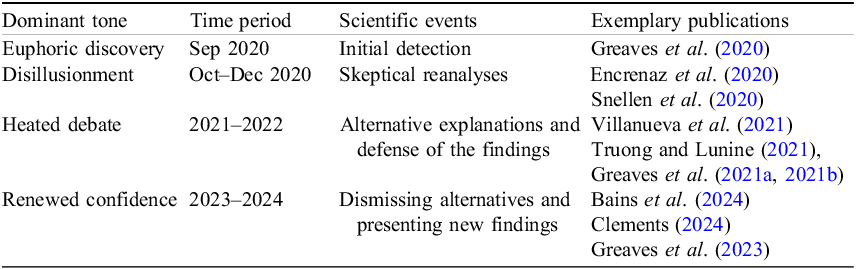
To examine temporal variation in media coverage, we distinguish four analytical periods based on major developments in the scientific controversy (see Table 1). This periodization was defined a priori from the chronology of the scientific debate by means of a qualitative analysis of exemplary publications and serves as a temporal heuristic for comparing the news media coverage. The labels assigned to the periods summarize the dominant tone of the scientific debate during each interval.
Four analytical periods of the scientific debate

Table 1. Long description
The table has four rows and four columns. The columns are labeled Dominant tone, Time period, Scientific events, and Exemplary publications. Row 1: Dominant tone, Euphoric discovery; Time period, Sep 2020; Scientific events, Initial detection; Exemplary publications, Greaves et al. (2020). Row 2: Dominant tone, Disillusionment; Time period, Oct–Dec 2020; Scientific events, Skeptical reanalyses; Exemplary publications, Encrenaz et al. (2020), Snellen et al. (2020). Row 3: Dominant tone, Heated debate; Time period, 2021–2022; Scientific events, Alternative explanations and defense of the findings; Exemplary publications, Villanueva et al. (2021), Truong and Lunine (2021), Greaves et al. (2021a, 2021b). Row 4: Dominant tone, Renewed confidence; Time period, 2023–2024; Scientific events, Dismissing alternatives and presenting new findings; Exemplary publications, Bains et al. (2024), Clements (2024), Greaves et al. (2023).
The Euphoric Discovery period in September 2020 was marked by the initial phosphine announcement (Greaves et al., Reference Greaves, Richards, Bains, Rimmer, Sagawa, Clements, Seager, Petkowski, Sousa-Silva, Ranjan, Drabek-Maunder, Fraser, Cartwright, Mueller-Wodarg, Zhan, Friberg, Coulson, Lee and Hoge2020) and intense global media interest. This momentum quickly transitioned into a Disillusionment period (October–December 2020), during which independent reanalyses challenged the robustness of the signal (e.g., Encrenaz et al., Reference Encrenaz, Greathouse, Marcq, Widemann, Bézard, Fouchet, Giles, Sagawa, Greaves and Sousa-Silva2020; Snellen et al., Reference Snellen, Guzman-Ramirez, Hogerheijde, Hygate and van der Tak2020). The subsequent Heated Debate period (2021–2022) featured both critical assessments and defenses of the original findings, alongside alternative chemical explanations (Greaves et al., Reference Greaves, Richards, Bains, Rimmer, Clements, Seager, Petkowski, Sousa-Silva, Ranjan and Fraser2021a, Reference Greaves, Richards, Bains, Rimmer, Sagawa, Clements, Seager, Petkowski, Sousa-Silva, Ranjan, Drabek-Maunder, Fraser, Cartwright, Mueller-Wodarg, Zhan, Friberg, Coulson, Lee and Hoge2021b; Truong and Lunine, Reference Truong and Lunine2021, Villanueva et al., Reference Villanueva, Cordiner, Irwin, de Pater, Butler, Gurwell, Milam, Nixon, Luszcz-Cook, Wilson, Kofman, Liuzzi, Faggi, Fauchez, Lippi, Cosentino, Thelen, Moullet, Hartogh, Molter, Charnley, Arney, Mandell, Biver, Vandaele, de Kleer and Kopparapu2021). Finally, a Renewed Confidence period (2023–2024) emerged as recent analyses dismissed abiotic alternatives and presented new observational support (Bains et al., Reference Bains, Seager, Clements, Greaves, Rimmer and Petkowski2024; Clements, Reference Clements2024; Greaves et al., Reference Greaves, Petkowski, Richards, Sousa-Silva, Seager and Clements2023).
News outlets differ in their market orientation, professional norms, organizational resources and access to scientific expertise (Friedman et al., Reference Friedman, Dunwoody and Rogers2012). These institutional differences shape how scientific uncertainty is portrayed. Specialist science outlets may have greater capacity to preserve methodological context and epistemic nuance, whereas mass-market outlets may be more strongly influenced by narrative conventions and commercial pressure (Nelkin, Reference Nelkin1987). News outlet type therefore constitutes a central comparative dimension through which uncertainty portrayals, framing patterns and journalistic presentation strategies are examined in this study.
Based on the theoretical arguments above, this study explores the following research questions:
RQ1: How do uncertainty portrayals of life and phosphine on Venus differ across analytical periods?
RQ2: How do uncertainty portrayals of life and phosphine on Venus differ across news outlet types?
RQ3: How do journalistic strategies differ across news outlet types?
Method
Measures
We employed a structured codebook to systematically analyze news media coverage on the potential detection of phosphine and life on Venus in a standardized content analysis.
Certainty measures assessed the degree of proclaimed certainty regarding the detection of phosphine and the existence of life, each ranging on a five-point scale: 1 (no certainty: explicit rejection, e.g., “The signal was an observational artefact”); 3 (moderate certainty: balanced or undecided stance, e.g., “The presence of phosphine remains debated”); 5 (full certainty: presented as settled fact, e.g., “phosphine is present in Venus’ atmosphere”). Hedging markers such as “likely,” “probably,” “plausible” indicated Level 4, whereas “could,” “may,” “possible” indicated Level 3.
Uncertainty framing followed Gustafson and Rice (Reference Gustafson and Rice2020) and distinguished on three-point scales between 0 (=no), 1 (=moderate) and 2 (=high degree) of consensus uncertainty, technical uncertainty, deficient uncertainty and scientific uncertainty. Consensus uncertainty explicitly referred to disagreement among scientists (moderate: “some scientists raise the possibility…”; high: “a heated debate”). Technical uncertainty was indicated by limitations of instrumentation, data quality or methodology (moderate: “measurement error is a likely explanation;” high: detailed accounts of spectroscopic noise, calibration issues). Deficient uncertainty captured the acknowledgement of blind spots (moderate: “a physical process we don’t yet understand;” high: elaborated knowledge gaps). Scientific uncertainty referred to the provisional nature of scientific knowledge (moderate: “these are preliminary findings;” high: “as it is always the case with scientific findings, future studies could revise or refute these results”).
Contextualization was recorded by noting the consultation of independent experts, references to scientific publications (0 = none, 1 = one, 2 = multiple sources/publications) and calls for further action (0 =no mention or call, 1 = mention of further research, 2 = call for further action). Language tone captured whether articles used cautious (=−1), neutral (=0) or sensational language (=1). Clickbaiting strategies were assessed through the withholding or overselling of information about phosphine or life in headline and lead of the articles (0 = no, 1 = yes).
Each article in the corpus was also coded for a set of formal variables capturing basic descriptive and structural characteristics of the news coverage. These variables include the news outlet and section in which the article appeared (e.g., science, environment, international, opinion), article length (short vs. long) and article type (e.g., news story, interpretation piece, opinion, interview). The full coding scheme and category definitions are documented in the study’s codebook in the OSF repository: https://osf.io/aeqhj/overview?view_only=c48d4446d7ae4dc89a81e4fca8f97420.
Reliability
To assess coding quality, a subset of 25 articles (10% of the corpus) was independently coded by two trained human coders. Intercoder reliability was evaluated using percent agreement, Cohen’s κ (weighted where appropriate), Krippendorff’s α and PABAK for low-prevalence binary variables. Agreement for the central multi-level variables was high. Certainty of Phosphine (Agreement = 100%, κ = 1.00, α = 1.00) and Certainty of Life showed similarly strong consistency (Agreement = 96%, κ = 0.97, α = 0.99). Reliability for the uncertainty dimensions was also substantial, including Scientific Uncertainty (Agreement = 96%, κ = 0.95, α = 1.00), Deficient Uncertainty (Agreement = 84%, κ = 0.80, α = 0.81) and Language Tone (Agreement = 92%, κ = 0.86, α = 0.88). Consensus Uncertainty demonstrated acceptable agreement (Agreement = 80%, κ = 0.68, α = 0.73). Basic article classification achieved comparable levels (e.g., Article Type: Agreement = 88%, κ = 0.80, α = 0.80). Lower κ values for rare binary codes – such as withholding or overselling claims – reflected very low category frequency rather than coder disagreement; in those cases, agreement (range = 0.76–1.00) and PABAK values (range = 0.52–0.84) indicated satisfactory reliability. Overall, the coding instrument performed consistently across key analytical dimensions. The full table is documented in the OSF repository.
Sample
To construct the dataset, we conducted a comprehensive news media search using the Nexis Uni database. We queried all English-language articles published between 1 September 2020 and 30 June 2025 containing the terms “phosphine” AND “Venus.” This time window captures the initial discovery announcement, subsequent scientific debate and later mission-focused reporting. We restricted sources to newspapers, web-based news outlets, magazines and journals, ensuring coverage across mainstream news and specialized science communication venues while excluding social media, broadcast transcripts and non-editorial content. This strategy yielded a corpus of N = 245 articles reflecting how the phosphine controversy and the possibility of life on Venus were represented in news outlets across multiple stages of the evolving scientific and policy discourse.
News outlet type
The media typology focused on professional journalistic news outlets and synthesized widely established distinctions in journalism research which are mainly based on market orientation (De Vreese et al., Reference de Vreese, Esser and Hopmann2017; Tunstall, Reference Tunstall1996). Upmarket and mid-market outlets primarily address broad audiences through information-oriented general news reporting, whereas mass-market outlets tend to place greater emphasis on accessibility, personalization and attracting attention. The principal function of wire services is to produce copy for reuse by other news organizations. Specialist science outlets serve audiences with a particular interest in science. Academic and campus outlets are affiliated with educational institutions or student journalism (see Table A1 in the Appendix).
The search string returned 107 outlets that were categorized after retrieval. The sample comprised 89 articles from upmarket/mid-market outlets, 35 from mass-market outlets, 61 from wire services, 21 from science outlets, 14 from academic/campus outlets, 6 from business outlets, 11 from magazines and 8 from broadcast media. As the three latter categories contained relatively few cases, they were collapsed into a residual “Other” category (n = 25). Of the 61 articles in the wire-services category, 58 originated from CE Noticias Financieras English. The strong representation of this service reflects its exceptionally high publication volume – according to its own statements more than 9,000 stories per day. Because the service republishes content, the articles attributed to it represent material from a range of other sources (e.g., AFP, Reuters, AP) and may be understood as a proxy for wire-service content in general rather than as the output of a single newsroom. Nevertheless, its dominance means that findings for the wire-services category should be interpreted cautiously.
Country
The sample included 16 countries and was geographically uneven. The largest shares of articles originated from the UK (n = 77), Mexico (n = 58) and the United States (n = 54), followed by Australia (n = 13), India (n = 12), Canada (n = 9) and New Zealand (n = 7). The remaining nine countries contributed between one and three articles each. The large contribution from Mexico is attributable to CE Noticias Financieras English and should be interpreted cautiously.
Findings
Media coverage of phosphine and life on Venus across analytical periods
Most of the articles (46%) were published during the one-month Euphoric Discovery period, 9% in the subsequent three-month Disillusionment period, 28% in the two-year Heated Debate period and 13% in the two-year Renewed Confidence period. Only 4% of the articles were posted outside these periods. This shows a clear emphasis on the Euphoric Discovery and Heated Debate periods.
Certainty ratings of the articles are displayed in Figure 1 and closely mirror the a priori analytical periods structuring the scientific debate. During the Euphoric Discovery period (September 2020), certainty levels regarding both phosphine and the possibility of life reached their highest values.
Certainty of phosphine and life in news media coverage from 2020 to 2025. From 2021 on, the data represent semi-annual mean scores; earlier periods are aggregated more finely to capture the shorter analytical periods, i.e. a single month (September 2020), and a three-month period (October–December 2020).

This initial enthusiasm gave way rapidly to the Disillusionment period (October–December 2020), as critical reanalyses and calibration concerns entered the public discourse. Certainty declined steeply during this period, reflecting a transition from celebratory reporting to epistemic caution. Journalistic narratives increasingly foregrounded expert disagreement, methodological uncertainty and the provisional status of the original findings. Nevertheless, certainty levels remained moderately high.
Across the Heated Debate period (2021–2022), certainty levels stabilized at lower but relatively consistent values. Rather than converging toward resolution, coverage reflected sustained scientific contestation, with competing interpretations coexisting in parallel. Space mission news – such as NASA’s selection of the DAVINCI + mission in June 2021 and the advancement of ESA’s EnVision mission – reinforced the framing of Venus as a site of unresolved scientific mystery.
The mid- and end-2022 dips observed in Figure 1 correspond to a moment of epistemic saturation within this period, when the debate persisted without decisive new evidence. This period aligns with what Downs (Reference Downs1972) describes as the “realizing the cost” stage of the issue-attention cycle, in which sustained engagement reveals the complexity and intractability of a problem. For journalists, phosphine became a familiar controversy without a clear narrative payoff. Certainty therefore most likely declined not because the signal was disproven, but because the debate entered a holding pattern: technically complex, slow-moving and resistant to definitive interpretation.
In the Renewed Confidence period (2023–2024), certainty about phosphine recovered modestly, particularly following reports of improved observational techniques. However, this renewed optimism proved fragile. By the beginning of 2025, certainty levels declined again, probably because it became increasingly clear that the Clements (Reference Clements2024) analysis remained confined to non-peer-reviewed publication. In the absence of independent validation, media narratives reverted to emphasizing uncertainty, methodological caution and the provisional status of the findings.
The descriptive statistics reported in Table 2 corroborate the temporal patterns observed in Figure 1 and provide additional support for the explanatory power of the analytical periods.
Certainty and uncertainty portrayals across analytical periods (M, SD)

Table 2. Long description
The table presents data on the certainty of phosphine, certainty of life, consensus uncertainty, technical uncertainty, deficient uncertainty, and scientific uncertainty across various analytical periods. It includes six columns: Certainty of phosphine, Certainty of life, Consensus uncertainty, Technical uncertainty, Deficient uncertainty, and Scientific uncertainty. The rows are labeled with different analytical periods: Pre-period, Euphoric discovery, Disillusionment, Heated debate, Renewed confidence, and Post period. Each cell contains values with standard deviations in parentheses. The table provides a detailed comparison of these uncertainties and certainties across different periods.
Note: Certainty of Phosphine and Life was measured on five-point scales from 1 (=no certainty) to 5 (=full certainty), uncertainty frames on three-point scales (0 = none, 1 = moderate, 2 = high).
A series of Kruskal–Wallis tests confirmed the significant effect of analytical period on both certainty of phosphine, χ 2 (3) = 35.53, p < .001, and certainty of life, χ 2 (3) = 33.79, p < .001. Post-hoc Mann–Whitney tests (BH-corrected) showed that articles published during the Euphoric Discovery period exhibited significantly higher certainty levels than articles from all subsequent periods (p < .001 for all tests). The tests also revealed significant differences between analytical periods for consensus uncertainty, χ 2 (3) = 36.62, technical uncertainty, χ 2 (3) = 15.52, deficient uncertainty, χ 2 (3) = 30.74 and scientific uncertainty, χ 2 (3) = 16.41 (p < .002 for all tests). Post-hoc Mann–Whitney tests (BH-corrected) indicated that the Euphoric Discovery period again differed significantly from later periods, showing the lowest consensus uncertainty and the highest deficient uncertainty across all periods (p < .04 for all tests), as well as lower technical uncertainty than in the Disillusionment (p = .005) and Heated Debate periods (p = .013). Although the communication of scientific uncertainty was overall low, it remained relatively stable across periods, except for a significant decrease during the Heated Debate (p ranging from <.01 to <.07).
Media coverage of phosphine and life on Venus across news outlet types
Media coverage of the Venus phosphine debate varied substantially by news outlet type, revealing distinct epistemic profiles across media formats (Table 3). Mass-market outlets reported the highest levels of certainty regarding both phosphine (M = 4.77) and the possibility of life (M = 3.29), while simultaneously exhibiting comparatively low levels of uncertainty indicators. This pattern reflects a strong tendency toward affirmative and simplified framing. Up-/midmarket outlets, while still reporting relatively high phosphine certainty (M = 4.43), displayed lower certainty about life (M = 3.01), indicating less sensational conclusions than the mass-market outlets.
Certainty and uncertainty portrayals by news outlet type (M, SD)

Table 3. Long description
The table presents data on the certainty and uncertainty portrayals by news outlet type, focusing on the Venus phosphine debate. It includes six rows and seven columns. The columns are labeled as follows: News outlet type, Certainty of phosphine, Certainty of life, Consensus uncertainty, Technical uncertainty, Deficient uncertainty, and Scientific uncertainty. The row labels are: Mass-market, Up/midmarket, Academic/campus, Wire services, Science, and Other. Each row provides values for the certainty and uncertainty metrics. For example, Mass-market outlets have a Certainty of phosphine value of 4.77 (0.77), a Certainty of life value of 3.29 (0.86), and so on. The table highlights variations in how different types of news outlets report on the phosphine debate, with mass-market outlets showing the highest levels of certainty and lower levels of uncertainty.
Note: Certainty of Phosphine and Life was measured on five-point scales from 1 (=no certainty) to 5 (=full certainty), uncertainty frames were measured on three-point scales (0 = none, 1 = moderate, 2 = high).
Wire services (i.e., CE Noticias Financieras English) occupied a distinctive position. Although their certainty levels for phosphine (M = 4.31) and life (M = 2.84) were moderate, they reported notably higher consensus uncertainty (M = 0.93) than most other news outlet types. Specialist science outlets showed the lowest certainty levels overall of both phosphine (M = 3.67) and life (M = 2.71) – while reporting the highest levels of consensus uncertainty (M = 1.14) and deficient uncertainty (M = 1.10).
A series of Kruskal–Wallis tests confirmed the significant effect of media type on certainty of phosphine, χ 2 (4) = 15.86, p = .003, and certainty of life, χ 2 (4) = 11.66, p = .020. Mass-market outlets reported significantly higher phosphine certainty than up-/midmarket outlets (p = .022), wire services (p = .022) and specialist science media (p = .002). Pairwise comparisons also verified tendencies for certainty of life, indicating that mass-market outlets were more prone to higher certainty than wire services (p = .050). Consensus uncertainty also differed between media types, χ 2 (4) = 10.66, p = .031, albeit no pairwise comparisons turned out to be statistically significant.
These results indicate that the uncertainty framing of the Venus phosphine debate differed substantially by media type, with mass-market outlets favoring affirmative interpretations and specialist science outlets emphasizing methodological caution.
Journalistic presentation strategies across news outlet types
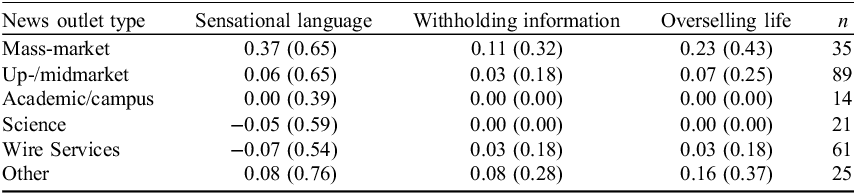
Substantial differences also emerged across media types in the use of clickbaiting (Table 4). Mass-market outlets exhibited the highest levels of sensational language tone (M = 0.37), alongside the greatest prevalence of overselling life-related claims (M = 0.23) and comparatively frequent withholding of qualifying information (M = 0.11). This pattern indicates a tendency toward exaggerated and selective reporting among mass-market outlets.
Clickbaiting by news outlet type (M, SD)

Table 4. Long description
A table comparing clickbaiting metrics across different news outlet types. The table has six rows and four columns. The columns are labeled Sensational language, Withholding information, Overselling life, and n. The rows are labeled Mass-market, Up-/midmarket, Academic/campus, Science, Wire Services, and Other. Row 1: Mass-market, Sensational language 0.37 (0.65), Withholding information 0.11 (0.32), Overselling life 0.23 (0.43), n 35. Row 2: Up-/midmarket, Sensational language 0.06 (0.65), Withholding information 0.03 (0.18), Overselling life 0.07 (0.25), n 89. Row 3: Academic/campus, Sensational language 0.00 (0.39), Withholding information 0.00 (0.00), Overselling life 0.00 (0.00), n 14. Row 4: Science, Sensational language -0.05 (0.59), Withholding information 0.00 (0.00), Overselling life 0.00 (0.00), n 21. Row 5: Wire Services, Sensational language -0.07 (0.54), Withholding information 0.03 (0.18), Overselling life 0.03 (0.18), n 61. Row 6: Other, Sensational language 0.08 (0.76), Withholding information 0.08 (0.28), Overselling life 0.16 (0.37), n 25.
Note: Clickbaiting was measured by Language Tone (–1 = cautious, 0 = neutral, 1 = sensational), Withholding Life (0 = no withholding, 1 = withholding) and Overselling Life (0 = no overselling, 1 = overselling).
Academic/campus publications, science outlets and wire services exhibited the lowest levels across clickbaiting measures, with near-zero instances of withholding information or overselling life and neutral or even cautious language tone. Overall, these results demonstrate that clickbaiting practices were unevenly distributed across media types, with mass-market outlets acting as primary amplifiers of sensational life narratives, while all other media types largely refrained from exaggeration and selective omission.
A Kruskal–Wallis test confirmed a significant difference in language tone across media formats, χ2(4) = 12.82, p = .012. Pairwise comparisons verified the difference between mass-market and wire services (p = .006).
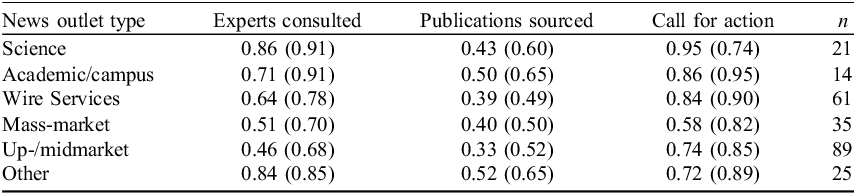
News outlets only differed descriptively in how extensively they contextualized the Venus phosphine debate by consulting experts, sourcing scientific publications and articulating calls for action (Table 5). Science outlets exhibited the highest levels of contextualization across all three indicators, consulting experts most frequently (M = 0.86), citing scientific publications at comparatively high rates (M = 0.43) and regularly framing the issue in terms of future research or action (M = 0.95). Academic/campus publications showed a similar pattern, particularly with respect to sourcing scientific literature (M = 0.50), reflecting strong alignment with formal scientific discourse. However, the Kruskal–Wallis tests did not reveal any significant differences.
Contextualization by news outlet type (M, SD)

Table 5. Long description
The table presents data on how different types of news outlets contextualize the Venus phosphine debate. It includes five columns: News outlet type, Experts consulted, Publications sourced, Call for action, and n. The table has six rows for different news outlet types: Science, Academic/campus, Wire Services, Mass-market, Up-/midmarket, and Other. Each row lists the mean and standard deviation for experts consulted, publications sourced, and call for action, along with the sample size (n). Row 1: Science, Experts consulted 0.86 (0.91), Publications sourced 0.43 (0.60), Call for action 0.95 (0.74), n 21. Row 2: Academic/campus, Experts consulted 0.71 (0.91), Publications sourced 0.50 (0.65), Call for action 0.86 (0.95), n 14. Row 3: Wire Services, Experts consulted 0.64 (0.78), Publications sourced 0.39 (0.49), Call for action 0.84 (0.90), n 61. Row 4: Mass-market, Experts consulted 0.51 (0.70), Publications sourced 0.40 (0.50), Call for action 0.58 (0.82), n 35. Row 5: Up-/midmarket, Experts consulted 0.46 (0.68), Publications sourced 0.33 (0.52), Call for action 0.74 (0.85), n 89. Row 6: Other, Experts consulted 0.84 (0.85), Publications sourced 0.52 (0.65), Call for action 0.72 (0.89), n 25.
Note: Contextualization was measured by Experts Consulted (0 = none, 1 = one source, 2 = multiple sources), Publications Sourced (0 = none, 1 = one publication, 2 = multiple publications) and Call for Action referring to mentioning or calling for further research and missions (0 = no mention or call, 1 = mention of further research, 2 = call for future action).
Discussion
This study examined how English-language media communicated uncertainty surrounding the contested detection of phosphine on Venus. Across analytical periods, news outlet types and uncertainty dimensions, the following core findings emerge that refine existing theories of agenda setting, uncertainty communication and science journalism.
The first insight from the analysis is that certainty ratings for both phosphine and the possibility of life were comparatively high in media coverage when contrasted with the tone identified in the a priori qualitative analysis of the scientific literature. This divergence was most pronounced during the Euphoric Discovery period, when journalistic certainty substantially exceeded the cautious and conditional language used by Greaves et al. (Reference Greaves, Richards, Bains, Rimmer, Sagawa, Clements, Seager, Petkowski, Sousa-Silva, Ranjan, Drabek-Maunder, Fraser, Cartwright, Mueller-Wodarg, Zhan, Friberg, Coulson, Lee and Hoge2020).Footnote 2 Even as the debate matured and scientific publications increasingly emphasized methodological limitations, alternative explanations and unresolved uncertainties, media certainty – particularly regarding phosphine as a real atmospheric signal – remained elevated. However, the study did not systematically measure uncertainty across a corpus of scientific literature, so this should be understood as an implicit comparison.
This pattern persisted beyond the initial hype period, suggesting that journalistic framing retained a degree of affirmative interpretation that outpaced the epistemic restraint characteristic of scientific discourse. Such asymmetry is not necessarily indicative of distortion but rather reflects differences in communicative function: while scientific publications prioritize caution and provisionality, media narratives tend to translate probabilistic findings into more assertive evaluative cues. Nevertheless, sustained discrepancies between scientific caution and media certainty may contribute to inflated public expectations, underscoring the importance of careful calibration when communicating uncertain but high-stakes scientific claims.
Second, the findings point to a close agenda alignment between the scientific debate and media coverage: peaks, declines and partial recoveries in expressed certainty corresponded closely to moments of discovery, critique and renewed investigation in the scientific literature. This pattern suggests that developments within science structured the temporal rhythm of coverage while leaving open the extent to which that alignment was mediated by institutional communication, journalistic news values and broader attention dynamics.
Third, consensus uncertainty emerged as the most prominent uncertainty dimension across the dataset. Media coverage frequently emphasized expert disagreement, competing interpretations and the absence of consensus, accurately reflecting the contested nature of the phosphine debate. While this represents a normatively appropriate form of reporting under conditions of scientific controversy, prior research cautions that persistent exposure to consensus uncertainty may undermine public trust in science if not carefully contextualized (Gustafson and Rice, Reference Gustafson and Rice2019, Reference Gustafson and Rice2020). The prominence of this uncertainty form highlights a tension between faithful representation of scientific disagreement and the risk of fostering perceptions of scientific instability, particularly when controversies remain unresolved over extended periods.
Fourth, media-type differences structured how certainty and uncertainty were communicated. Mass-market outlets expressed higher certainty, stronger sensational tone and lower levels of uncertainty, whereas specialist science and academic outlets adopted more cautious epistemic stances. Wire services occupied an intermediate but structurally important position, combining moderate certainty with elevated consensus uncertainty while avoiding sensationalism.
Fifth, despite heightened public interest and the existential implications of extraterrestrial life, clickbaiting strategies were relatively rare across the corpus. Overselling life-related claims and withholding qualifying information occurred infrequently, particularly outside mass-market media. This finding challenges assumptions that speculative science inevitably invites sensational distortion. Instead, most news outlets maintained restraint even during periods of heightened attention.
Implications for scientific and journalistic practice
For scientific practice, the findings highlight the importance of anticipating how cautious and probabilistic claims may be translated into comparatively high certainty cues in media coverage. Even when scientific publications carefully emphasize limitations, alternative explanations and unresolved uncertainty, these nuances may be attenuated as findings circulate beyond specialist audiences. This suggests a need for scientists – particularly in high-salience fields such as astrobiology – to engage more explicitly with how degrees of confidence are communicated, for example by clarifying what constitutes provisional evidence, how disagreement should be interpreted and what thresholds would be required for stronger claims. Proactive communication strategies that foreground uncertainty as an inherent and productive component of scientific inquiry may help reduce mismatches between scientific caution and public-facing certainty.
For journalistic practice, the results underscore the responsibility of translating complex and contested science without overstating confidence. While the overall rarity of clickbaiting indicates generally high reporting standards, the persistence of elevated certainty relative to the scientific literature suggests room for more explicit calibration between evidentiary strength and evaluative framing. Emphasizing not only the existence of disagreement but also its epistemic meaning – why experts disagree and what remains unknown – may help audiences better contextualize uncertainty without undermining trust. In coverage of frontier science where resolution may be distant, sustained explanatory depth rather than episodic certainty may be key to balancing public engagement with epistemic integrity.
Taken together, the Venus phosphine case illustrates how media and science co-produce public understandings of uncertainty. Rather than a simple cycle of hype and correction, the debate evolved into a regime of managed uncertainty, shaped jointly by scientific agendas, media practices and institutional expectations for future inquiry. As astrobiology increasingly confronts ambiguous signals and long-term observational horizons, such dynamics are likely to become central to the public communication of life beyond Earth.
Limitations and future research
This study has several limitations that provide avenues for further work. First, we rely on English-language media sourced through Nexis Uni, which privileges Western science communication contexts and major international news outlets. As expected, the sample is geographically uneven, with a large share of articles originating from a small number of Anglo-Saxon countries. In addition, the wire-services category is heavily dominated by CE Noticias Financieras English due to its exceptionally high publication volume and has to be interpreted with caution. Second, although our coding scheme demonstrated high reliability, content analysis inevitably involves interpretive judgement, and future studies could complement manual coding with automated linguistic or semantic-network approaches to capture more granular sentiment and framing dynamics. Third, while our analysis focuses on the phosphine controversy as a discrete case, astrobiological reporting increasingly unfolds across distributed planetary contexts (e.g., Mars, Europa, Enceladus, exoplanets). Comparative work could test whether the uncertainty dynamics observed here generalize to other life-related claims or are shaped by the particular scientific, cultural and historical status of Venus. Finally, this research is observational, and causal inferences about how specific events or institutional signals drive media certainty should be treated cautiously. Experimental or audience-reception studies could examine how uncertainty cues influence public interpretations of frontier astrobiology and trust in scientific institutions.
Conclusion
This study shows that media coverage of the Venus phosphine controversy closely followed the trajectory of the underlying scientific debate, underscoring the alignment of scientific developments and public discourse on frontier research. At the same time, certainty ratings for both phosphine and the possibility of life were consistently higher in media reporting than in the scientific literature itself, particularly during the Euphoric Discovery period but also in later periods of sustained debate. While media narratives accurately reflected expert disagreement through the prominent use of consensus uncertainty, they nonetheless translated cautious and provisional scientific claims into comparatively assertive evaluative cues. Media-type differences further structured this dynamic, with mass-market outlets favoring more affirmative and sensational framing and science outlets exercising greater epistemic restraint. Notably, the relative rarity of clickbaiting suggests that high journalistic standards can be upheld even when reporting on existential scientific questions. As astrobiology advances through indirect and probabilistic evidence, understanding how uncertainty is publicly negotiated will be essential for both scientists and journalists seeking to communicate discovery responsibly.
Acknowledgements
This article is based on research conducted within the scope of the Einstein Circle “Exploring otherness on Earth and beyond: Integrating perspectives from natural sciences, social sciences and humanities” funded by the Einstein Foundation Berlin. The authors also acknowledge support by the Freie Universität Berlin via the STRUCTURE and TEAMS funding schemes to initiate research projects in preparation for the DFG-funded Collaborative Research Centre SFB 1759/1 2026 – 551279755.
ChatGPT (OpenAI, version 5.2–5.5) was used for language editing of the manuscript; all substantive content, analysis and interpretations remain the sole responsibility of the authors.
Competing interests
The authors declare none.
News outlets per type

Table A1. Long description
A table categorizing news outlets by type and market orientation. The table has 10 rows and 4 columns. Column headers are Type, Description, Market Orientation, and Examples. Row 1: Type, Upmarket; Description, Address broad audiences through information-oriented general news reporting; Market Orientation, Information-oriented; Examples, The New York Times, The Guardian. Row 2: Type, Mid-market; Description, Address broad audiences through information-oriented general news reporting; Market Orientation, Information-oriented; Examples, USA Today, The Independent. Row 3: Type, Mass-market; Description, Emphasize accessibility, personalization, and attracting attention; Market Orientation, Audience-oriented; Examples, The Sun, Daily Mirror. Row 4: Type, Wire services; Description, Produce copy for reuse by other news organizations; Market Orientation, Service-oriented; Examples, Associated Press, Reuters. Row 5: Type, Specialist science; Description, Serve audiences with a particular interest in science; Market Orientation, Niche-oriented; Examples, Nature, Science. Row 6: Type, Academic; Description, Affiliated with educational institutions; Market Orientation, Educational-oriented; Examples, Harvard Crimson, Stanford Daily. Row 7: Type, Campus; Description, Affiliated with student journalism; Market Orientation, Student-oriented; Examples, The Daily Tar Heel, The Michigan Daily. Row 8: Type, Online-only; Description, Primarily digital news outlets; Market Orientation, Digital-oriented; Examples, BuzzFeed News, Vox. Row 9: Type, Broadcast; Description, News outlets primarily delivering content through television or radio; Market Orientation, Broadcast-oriented; Examples, BBC News, CNN. Row 10: Type, Alternative; Description, Independent news outlets often focusing on local or specific issues; Market Orientation, Community-oriented; Examples, The Village Voice, Vice News.





 Open access

