Introduction
Due to its medico-legal implications, as well as its central role in the doctor–patient relationship, informed surgical consent has often been viewed as a highly contentious and even controversial issue. It has recently come to the fore once again, following a publication that called for significant change in current consenting practice, which has been described as paternalistic by some, towards a more patient-centred approach.Reference Shokrollahi1 It has been postulated that this would not only decrease the medico-legal liability of the involved physician but also improve patient compliance with treatment; however, it has been met with considerable scepticism.Reference Wheeler2
The aim of our study was threefold: (1) to determine whether procedure-specific brochures improve patients' pre-operative knowledge; (2) to determine the amount of information expected by patients during the consenting process; and (3) to determine whether the recently proposed ‘Request for Treatment’ consenting process is a viable alternative to current consenting practice, on a large scale.
Our findings were compared with data collected in a similar study conducted at our institution during 2003.
Materials and methods
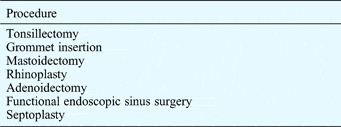
A prospective questionnaire-based study of all patients scheduled for selected elective otorhinolaryngology procedures (Table I) was performed at our institution (The Royal Victoria Eye and Ear Hospital, Dublin, Ireland) during a six-month period. All patients received detailed information in the out-patient department, regarding the proposed intervention, including the proposed benefits as well as potential complications. This was further supplemented by an information brochure, provided at the time of booking, that included the details of an otolaryngology patient information website.
Procedures conducted

Prior to surgery, patients were presented with a standardised questionnaire that, in keeping with Request for Treatment forms, requested patients to state the nature of the proposed surgery, the expected benefits and the potential complications, in their own words. Other data collected included the satisfaction with information provided, other sources of information sought, preferred method of receiving information, awareness of alternatives to the proposed intervention, and the complication rate that patients wished to be informed about. After completion of the questionnaire, patients were consented in the usual manner and a standard consent form was signed.
Results
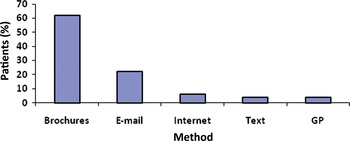
A total of 100 patients were included in the study. Fifty-two parents completed the questionnaire on behalf of their children. Although the overwhelming majority (99 per cent) of patients were satisfied with the information received in the out-patient department, regarding the proposed procedure, half of patients had sought further information elsewhere. The internet was the most popular source (48 per cent), followed by family and friends (36 per cent), and finally the patient's own general practitioner in 15 per cent of cases. The majority of patients (62 per cent) indicated that their preferred method of receiving information regarding any surgical intervention remained a brochure format. This was followed by more modern methods such as e-mail (22 per cent), internet websites (6 per cent), and mobile phone text messages (4 per cent). A small minority of patients (4 per cent) indicated that their preferred source of information remained their general practitioner (Figure 1).
Patients' preferred method of receiving information.

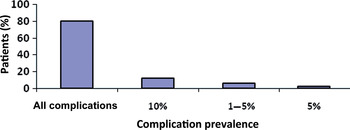
A total of 38 per cent of patients reported that they were unable to correctly state the nature of the surgery or specific procedure they were scheduled to undergo, and only 22 per cent of patients were aware of alternative treatment options available. Whereas the vast majority of patients were able to state the intended benefits of the procedure, only 54 per cent were able to list at least one potential complication related to the proposed procedure. The great majority of patients (80 per cent) indicated that they wished to be informed about all potential complications, even if these occurred in less than 1 per cent of cases. However, 12 per cent stated that they wanted to be informed of potential complications only if these occurred in 10 per cent of cases (Figure 2).
Incidence of complications patients wish to be informed about pre-operatively.

In order to evaluate the impact of elapsed time on patient recall, patients were divided into two groups based on the amount of time elapsed between the date they were listed for the procedure and the date of admission. The first group (n = 64) consisted of patients who had been on the waiting list three months or less, and the second group (n = 36) consisted of patients who had been waiting for more than three months. In group two, 61 per cent of patients were able to list at least one complication, as opposed to only 50 per cent of group one.
Discussion
Informed consent may be defined as uncoerced permission from patients to receive treatment once they have been fully informed of the risks, benefits and alternative treatment options available to them.Reference Burns, Keogh and Timon3, Reference Berry, Unwin, Ross, Peacock and Juma4 It plays a central role in the patient–physician relationship, especially in a surgical speciality, and has come under increased scrutiny as medicine has evolved from a paternalistic model towards a patient-centred, more autonomous model.Reference Janssen, Oort, Fockens, Willems, de Haes and Smets5
This transformation of modern medicine has been reflected in case law concerning informed consent, which has changed dramatically since the first legal proceedings against two surgeons in 1767 for the unconsented re-fracturing of a patient's malunited limb.Reference Ross and Improving surgical6 Recently, there has been a shift away from the Bolam principle, which states that a practitioner cannot be deemed negligent if the level of information provided (including the likely benefits and material risks) is in accordance with the practice of a responsible body of medical peers, towards what a reasonable patient would consider a material risk.Reference Berry, Unwin, Ross, Peacock and Juma4, Reference Wiseman, Wijewardena, Calleary, Masood and Hill7 Material risk is deemed to be adverse events that a patient would attach significance to, and, in general, is accepted to mean complications occurring in greater than 1 per cent of cases, or complications which are so catastrophic that they might deter a patient from proceeding with surgery.Reference Berry, Unwin, Ross, Peacock and Juma4, Reference Bowden, Church, Chiu and Vaughan8
This random figure of 1 per cent has not been tested in a court of law and, at present, there are no set guidelines with regards to the amount of information that should be imparted to patients during the consent process. However, our study demonstrated that 80 per cent of patients indicated that they wished to be informed of all potential complications, even if these occurred in less than 1 per cent of cases. This reflects the findings of Bowden et al., who established that more than 85 per cent of patients consented for functional endoscopic sinus surgery considered all potential complications to be significant.Reference Bowden, Church, Chiu and Vaughan8 Although some might argue that providing patients with an exhaustive list of complications will only serve to unnecessarily raise anxiety levels, two separate studies of patients consented for femoral bypass or carotid surgeryReference Stanley, Walters and Maddern9 and hernia repairReference Kerrigan, Thevasagayam and Woods10 clearly disputed this notion.
A study conducted at our institution in 2003, employing similar methodology to the current study, found that, despite the fact that the overwhelming majority of patients were satisfied with the information provided in the out-patient department, a significant percentage were unable to recall even a single potential complication prior to signing the consent form. Furthermore, 73 per cent of patients indicated that they wished to be informed of all potential complications, even if these occurred in less than 1 per cent of cases. This led to the conclusion that the current consenting process did not meet the information demands of modern patients, and suggested the need for procedure-specific pre-operative patient information brochures to address this need.Reference Burns, Keogh and Timon3 These were implemented as part of the current study and had a significant impact. The percentage of patients seeking further information (often from potentially inferior sources) decreased by 16 per cent, and the proportion of patients able to list at least one potential complication increased by 10 per cent. Although not statistically significant, the number of patients who wish to be informed of all potential complications rose from 73 to 80 per cent. It was not clear whether this was a direct result of the provision of more patient information or whether it was due to increased patient expectations. Surprisingly, the amount of time elapsed between information-giving and surgery did not appear to influence patients' ability to recall potential complications. The interpretation of this finding is however confounded by the unequal, small sample sizes as well as the relatively short period over which the study was conducted.
A substantial amount has been published regarding the limitations and failings of current consenting methods. Some of these concerns include: poor patient comprehension, inadequate time for discussion, poor documentation, paternalistic nature of the process, and failure to determine whether a patient has sufficient mental capacity.Reference Shokrollahi1, Reference Fink, Prochazka, Henderson, Barenfeld, Nyirenda and Webb11 Attempts have been made to address these shortcomings through measures such as ‘repeat back’,Reference Fink, Prochazka, Henderson, Barenfeld, Nyirenda and Webb11 multimedia-based programmesReference Bollschweiler, Apitzsch, Obliers, Koerfer, Mönig, Metzger and Hölscher12 and the introduction of procedure-specific patient information brochures, as used in our study. Although these have been shown to be effective to varying degrees, reported comprehension rates remain relatively low, at 48 per cent,Reference Stanley, Walters and Maddern9, Reference Fink, Pochazka, Henderson, Bartenfeld, Nyirenda and Webb13 which has led some authors to call for a far more radical approach.
In a recent publication, Shokrollahi proposed a completely new patient-centred consenting process.Reference Shokrollahi1 During this Request for Treatment consenting process, patients are provided with information in the out-patient department, regarding the intended surgical procedure, and they are also given a Request for Treatment form that they need to complete prior to admission. Completion of the Request for Treatment form requires that patients state, in their own words, the nature of the surgical procedure and the intended benefits as well as the potential risks. This form is then presented to the surgeon on the day of admission, and constitutes both an official request by the patient to receive said treatment, and a consent form. The Request for Treatment form enables the surgeon to identify any misconceptions the patient may have regarding the perceived benefits of the procedure, as well as clarifying the potential risks involved.
This is a dramatic departure from current consenting processes, in which the onus rests on the surgeon to ensure that the patient is fully informed and has sufficient mental capacity to make an informed decision regarding their surgery. The Request for Treatment procedure transfers this responsibility to the patient; instead of the patient agreeing to surgery, as is the case with current practice, it is now the surgeon who agrees to provide the requested treatment, once satisfied that the patient has demonstrated that they are adequately informed. This process has the potential to act as a ‘soft measure’ of patient comprehension and capacity. It may also potentially reduce the surgeon's medico-legal liability and improve patients' participation and compliance.
• Procedure-specific information brochures make patients less likely to seek potentially inferior information, pre-operatively
• In this study, 80 per cent of patients wanted to be informed of all potential complications, regardless of incidence
• Pre-operatively, many consented patients were unable to recall the proposed procedure (38 per cent) or a single potential complication (54 per cent)
• The proposed Request for Treatment consenting process is not a valid alternative to current practice
Central to the Request for Treatment process is the patient's ability to state, in their own words, the proposed benefits, risks and complications of the procedure. Although this aspect has been lauded as one of the proposed format's strengths, it might well prove to be its Achilles' heel. In our study, only 54 per cent of patients were able to recall a single potential complication of surgery; even more worrying was the fact that 38 per cent of patients were unable to accurately state in their own words the nature of the proposed surgery. This obviously has significant implications for the proposed Request for Treatment consenting process: such lapses in patient recall and comprehension would present the surgeon with an absolute conundrum, and would inevitably see practitioners reverting to current processes.
Conclusion
This study demonstrated that the introduction of procedure-specific information brochures improved patients' pre-operative knowledge and made them less likely to seek additional, potentially inferior information. The failings of current consenting practice are clear, and investigation regarding potential improvement is essential. However, the Request for Treatment consenting process would not appear to be a viable alternative to current practice, due to the large number of patients unable to accurately recall the nature of the proposed surgery or its potential complications.