Obesity is a growing epidemic and is a major public health concern worldwide. The number of bariatric surgeries has grown markedly in recent years, increasing more than 740 percent between 1998 and 2003 in the United States (Reference Santry, Gillen and Lauderdale23). Bariatric surgery remains the gold standard treatment as diet and medications have not shown lasting effects. Although the indications for surgery recommended by the National Institute of Health are straightforward and widely accepted (body mass index [BMI] of greater than 40 kg/m2 and a BMI greater than 35 kg/m2 who also have serious medical problems (15), choosing the method of bariatric surgery remains controversial and is dependent on the surgeon's expertise and experience.
In the United States, laparoscopic Roux-en-Y gastric bypass (L-RYGB) is the most commonly performed bariatric surgery. The surgery consists of creating a gastric pouch connected to a loop of jejunum which bypasses the duodenum and proximal jejunum to inhibit nutrient absorption. In 2001, the Food and Drug Administration approved the use of laparoscopic adjustable gastric banding (LAGB) where a small gastric pouch is made by an inflatable band that can be adjusted by a subcutaneous saline port. Since then, there has been a steady increase in performance of LAGB in recent years (Reference Hinojosa, Varela and Parikh11), perhaps due the perception that its less-invasive, potentially reversible technique leads to better outcomes compared with L-RYGB. From a caregiver's standpoint, surgeons could treat more eligible patients with LAGB per day, due to its shorter procedure time, compared with L-RYGB. Medical device companies have also campaigned for LAGB using direct to consumer advertising, whereas L-RYGB has no support from any commercial sponsor.
L-RYGB leads to greater weight loss and fewer reoperation rates than LAGB, although patients who undergo RYGB tend to have higher short-term morbidity (Reference Angrisani, Lorenzo and Borrelli1). Despite its widespread use, we are not aware of any comparative information on survival benefit between L-RYGB and LAGB. Our aim was to compare the outcome of L-RYGB versus LAGB using quality-adjusted life-years (QALYs) in a Markov decision analysis model.
METHODS
A decision tree was constructed with three principal arms: (i) no surgery, (ii) laparoscopic adjustable gastric banding (LAGB), and (iii) laparoscopic Roux-en-Y gastric bypass (L-RYGB). The latter two arms included perioperative mortality and reoperation rates. The reoperation for LAGB consisted of reversal surgery. We then divided the population into 18 cohorts based on gender, age (35, 45, and 55 years), and body mass index or BMI (40, 50, and 60 kg/m2) (Reference Salem, Devlin, Sullivan and Flum22). We chose laparoscopic over open approach because nearly 75 percent of RYGB nationwide is performed by laparoscopy (Reference Weller and Rosati30). The model was developed using TreeAge Pro Suite software 2009 (Williamstown, MA).
Estimating Probabilities of Perioperative Mortality and Reoperation
An extensive literature search was conducted to obtain information on surgical outcomes on English-language articles in manuscript form, using online literature search engines PubMed, EMBASE, Cochrane Central Register of Controlled Trials, and Google-Scholar. Estimates of perioperative mortality were obtained from a recent meta-analysis (Reference Buchwald, Estok, Fahrbach, Banel and Sledge4) that showed mortality rates ≤30 days after LAGB and L-RYGB of 0.06 percent (95 percent confidence interval [CI], 0.01–0.11) and 0.16 percent (95 percent CI, 0.09–0.23), respectively.
Reoperation rates vary across studies with regards to definition of complications that lead to reoperation, inclusion of procedures that constitutes reoperation (for example, esophagogastroduodenoscopy and port revisions are not considered reoperation in some studies), operator experience particularly on LAGB, and duration of follow-up. The only published randomized clinical trial (Reference Cottam, Atkinson and Anderson5) to date was on fifty-one patients followed for 5 years, showing reoperation rates in four of twenty-six (15.4 percent) who underwent LAGB (two for pouch dilation and two for band removal for failure to lose adequate weight) and three of twenty-four (12.5 percent) who underwent L-RYGB (pouch leak, iatrogenic intestinal perforation, and internal hernia). In a case-controlled study (Reference Cottam, Atkinson and Anderson5) on 181 patients followed for 3 years, fifteen patients in the LAGB group (8.3 percent) and ten in the L-RYGB (5.5 percent) underwent major reoperation. The reoperation rates of these two studies along with other studies were summarized in a systematic review (Reference Tice, Karliner, Walsh, Petersen and Feldman26) and formed the basis of the reoperation rate used in our model (18.4 percent in LAGB and 5.9 percent in L-RYGB).
Predicting BMI for Each Cohort
For the time period immediately after surgery, we predicted the body mass index (BMI) for each cohort for each year as a function of choice of surgery using published data for the first 4 years after LAGB from Branson et al. (Reference Branson, Potoczna and Brunotte3) and first 2 years after L-RYGB from Ma et al. (Reference Ma, Pagoto and Olendzki13).
Post-LAGB BMI. Branson et al. (Reference Branson, Potoczna and Brunotte3) evaluated 404 patients 4 years post-LAGB and measured weight loss in terms of total weight, rather than excess weight loss in BMI units. They also presented BMI units lost for several groups, but not baseline BMI. Using the average height of U.S. adults we were able to derive the BMI. In the study by Branson et al. 4 years after LAGB, the average BMI loss over all groups was 11.5 kg/m2, with females losing 1.8 kg/m2 BMI more than males (female average = 12.4 kg/m2, male average = 10.6 kg/m2). Furthermore, people <50 years of age lose an average of 1.5 more BMI units than those over age 50 years. Assuming that the average age of those over 50 is 55, and those under the age of 50 is 35, we arrived at a correction factor to account for age-specific BMI loss: BMI loss as a function of age can be estimated as (50 – age) × 0.075. [0.075 = 1.5/(55–35)].
From these data, we arrived at a correction factor for the data by Puzziferri et al. (Reference Puzziferri, Nakonezny and Livingston21), who conducted the most comprehensive study of post-LAGB weight loss, but did not account for age. In their study of 631 patients who underwent LAGB and were followed for 2 years, women lost an average of 1.8 more units of BMI than men. Thus, the average figures from Puzziferri et al. was adjusted up by 0.9 for women, and down by 0.9 for men. Puzziferri and colleagues showed the average percent excess weight loss (%EWL) post-banding is 43.53, which is equivalent to a BMI of 12.4 kg/m2.
Thus, our model for BMI units lost over a 4-year period post-LAGB surgery is: BMI units lost = 12.4 – 1.8*gender + (50 – age) × 0.075, where we define gender = 1 for males; 0 for females.
Post L-RYGB BMI. The linear regression equation Ma and colleagues (Reference Ma, Pagoto and Olendzki13) gave to predict %EWL, was converted into BMI reduction. Ma et al. provided coefficients obtained from multiple linear regression predicting %EWL as a function of age, gender, and baseline weight. These can be used to compute the %EWL for each of our cohorts given the regression constant, which Ma did not provide. Thus we took the mean of all the variables, including the mean %EWL, and used it to compute the constant. Our equation for %EWL then becomes:
%EWL = 0.89516−0.003 age + 0.053 gender − 0.0009baseline weight.
Calculation of 2-year postoperative BMI was less straightforward, as Ma et al. (Reference Ma, Pagoto and Olendzki13) did not give a regression equation for this time frame. However, Ma and colleagues showed that, on average, a patient who undergoes L-RYGB loses another 0.9 BMI unit between 1 and 2 years and also showed that the average patient has a BMI of 33.0 one year after surgery. We, therefore, assume that patients will lose 0.9/33.0 = 2.7 percent of their BMI from 1 to 2 years, and calculate 2-year post-op BMI accordingly.
Markov Model
We ran each cohort through a Markov model where a single stage is equivalent to 1 year. Probability of dying is affected by age and BMI. For each year in the Markov model, we can predict the probability of dying because we now know the age and the BMI of a member of each of our simulated cohorts.
Predicting BMI Beyond 2 to 4 Years After Surgery
Heo et al. (Reference Heo, Faith and Mott10) derived a model to predict future BMI of an individual as a function of their age, gender, and BMI. We applied this formula to predict BMI after the effect of surgery on weight is gone. Thus, for both LAGB and L-RYGB groups, we can predict age and BMI for every year after surgery up to age 85.
Model Assumptions
For all cohorts, we assumed that there is no effect on quality of life 2 to 4 years after bypass and banding, respectively, that results directly from the surgery (independent of change of BMI considerations). We also assumed that reversal surgery after initial LAGB procedure will lead to the same outcome as being in the no surgery group.
Probability of Dying as a Function of Age and BMI
For each year of each cohort, we estimated the probability of dying and quality of life (QOL). Probability of dying according to age and BMI was obtained from a table from the U.S. Third National Health and Nutritional Examination Survey (NHANES-III) (17). This table gives the probability of dying in a 1-year period as a function of age (18–85 years) and BMI (17–44). In those (fairly rare) instances when a cohort had a BMI of greater than 44, linear extrapolation was used to approximate the probability of dying.
Quality of Life Adjustment
QOL was estimated using the multiple regression model derived from Hakim et al. (Reference Hakim, Wolf and Garrison8) who measured QOL over a 1-year period by using a standard gamble as a measure of health status preference (HSP) as a function of age, gender, current QOL, and change in BMI. They used data from a previous randomized controlled trial on orlistat (Reference Hauptman, Lucas and Boldrin9) for the treatment of obesity. HSP was measured using a multi-attribute health status system that is validated for obese subjects. Hakim and colleagues showed that neither gender nor age was a statistically significant contributor to QOL, and we, therefore, did not include these factors in our model. The somewhat counter-intuitive claim that age has no effect on QOL has been supported by another study (Reference Netuveli, Wiggins, Hildon, Montgomery and Blane16).
Hakim et al. (Reference Hakim, Wolf and Garrison8) were focused on the change in QOL brought about over a 1-year period by changing BMI. The authors noted that an increase of 1 BMI results in a decrease of 0.0166 QOL. For our purposes, we are concerned only with the degree that higher BMI reduces QOL from a perfect health state. Using a person with average (25) BMI as a reference for “perfect” QOL, we adapted the work of Heo and colleagues (Reference Heo, Faith and Mott10), by modeling QOL as a function of current BMI by the formula: QOL = 1 – (patient's current BMI-25)*.0166.
RESULTS
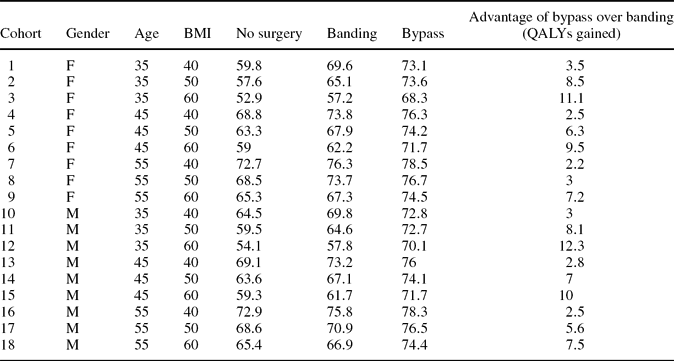
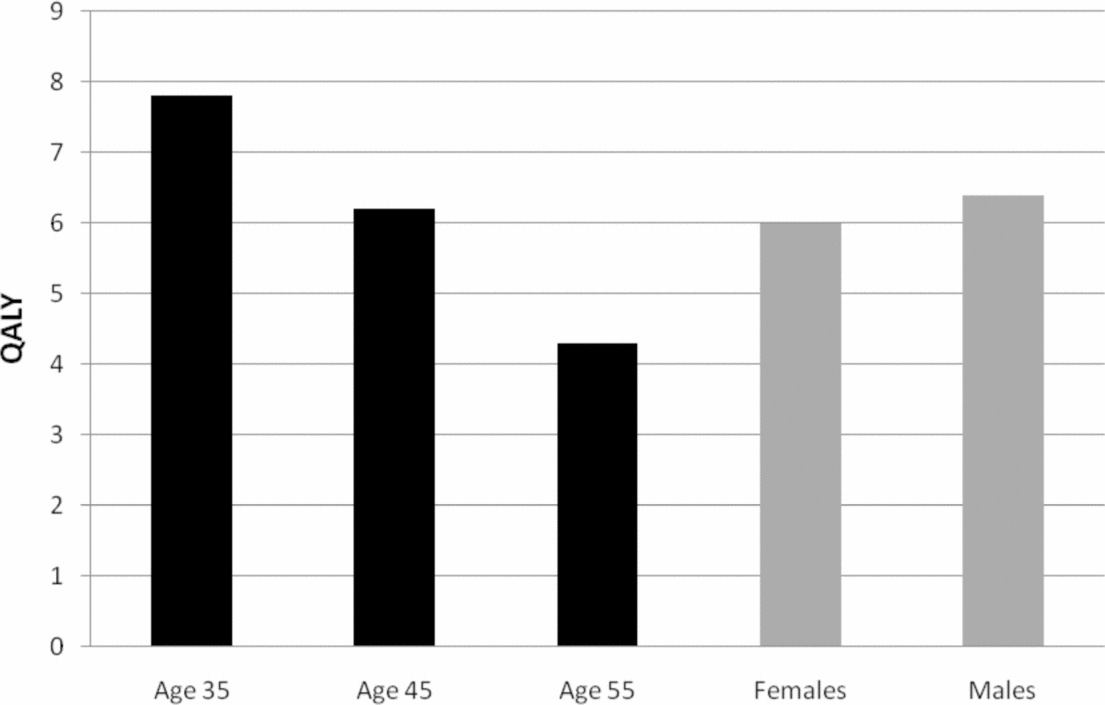
A summary of QALYs gained comparing L-RYGB with LAGB is shown in Table 1. For all cohorts, L-RYGB offers the highest advantage in QALYs compared with LAGB. The youngest cohort showed the greatest discrepancy between the two surgical methods, with 7.8, 6.4, and 4.7 QALYs gained with L-RYGB over LAGB for the age groups 35, 45, and 55, respectively (Figure 1). Those with the highest presurgical BMI acquired the most advantage with L-RYGB, with 2.8, 6.4, and 9.6 QALYs gained with L-RYGB over LAGB for the BMI groups 40, 50, and 60, respectively. Males had a slightly higher advantage with L-RYGB, with 6.5 QALYs gained with L-RYGB over LAGB compared with 6.0 QALYs for females (Figure 1).
Quality-adjusted life-years (QALYs) for all 18 cohorts according to no surgery, gastric banding, and gastric bypass

Note. The QALYs gained after gastric bypass (QALYs after gastric bypass subtracted by the QALYs after gastric banding) was maintained in all cohorts.
BMI, body mass index, kg/m2; QALY, quality-adjusted life-year.
Average quality-adjusted life-years (QALYs) gained with laparoscopic Roux-en-Y gastric bypass (L-RYGB) over laparoscopic adjustable gastric banding (LAGB) according to age group and gender.

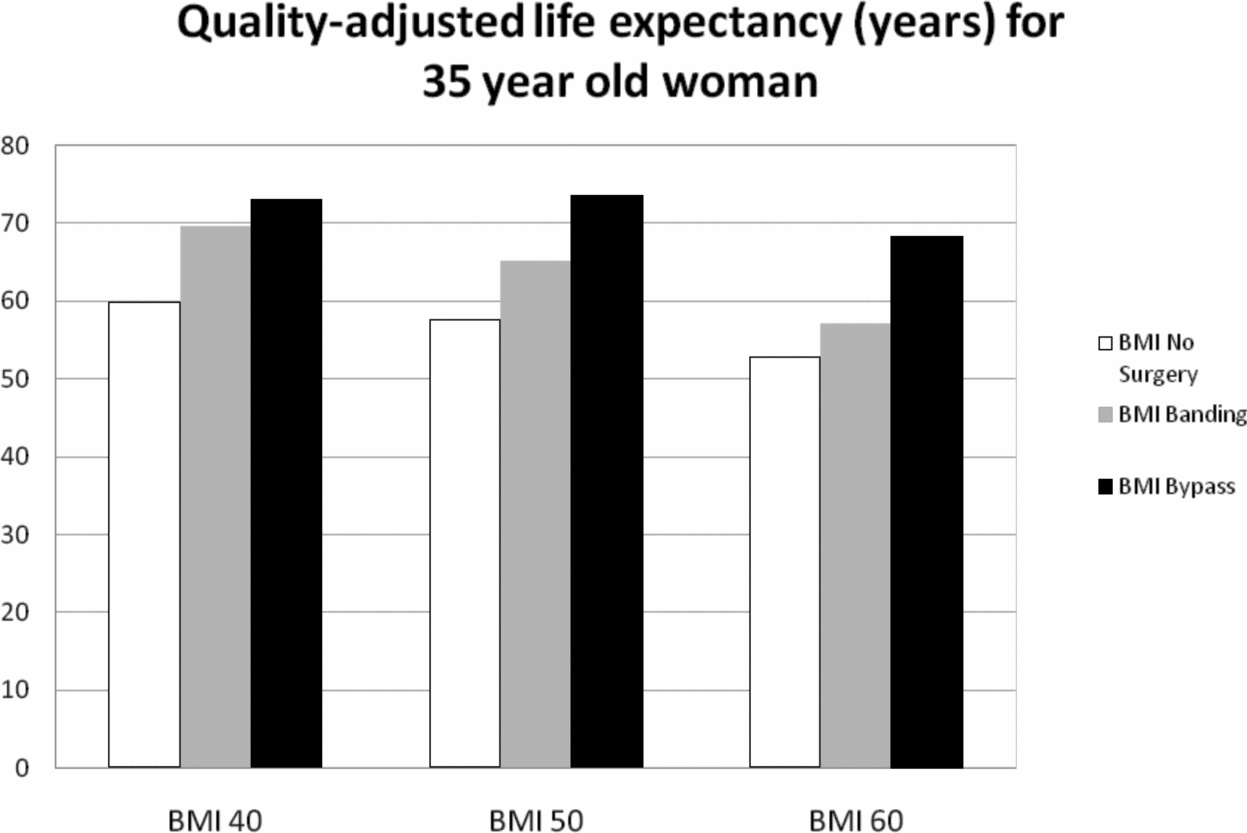
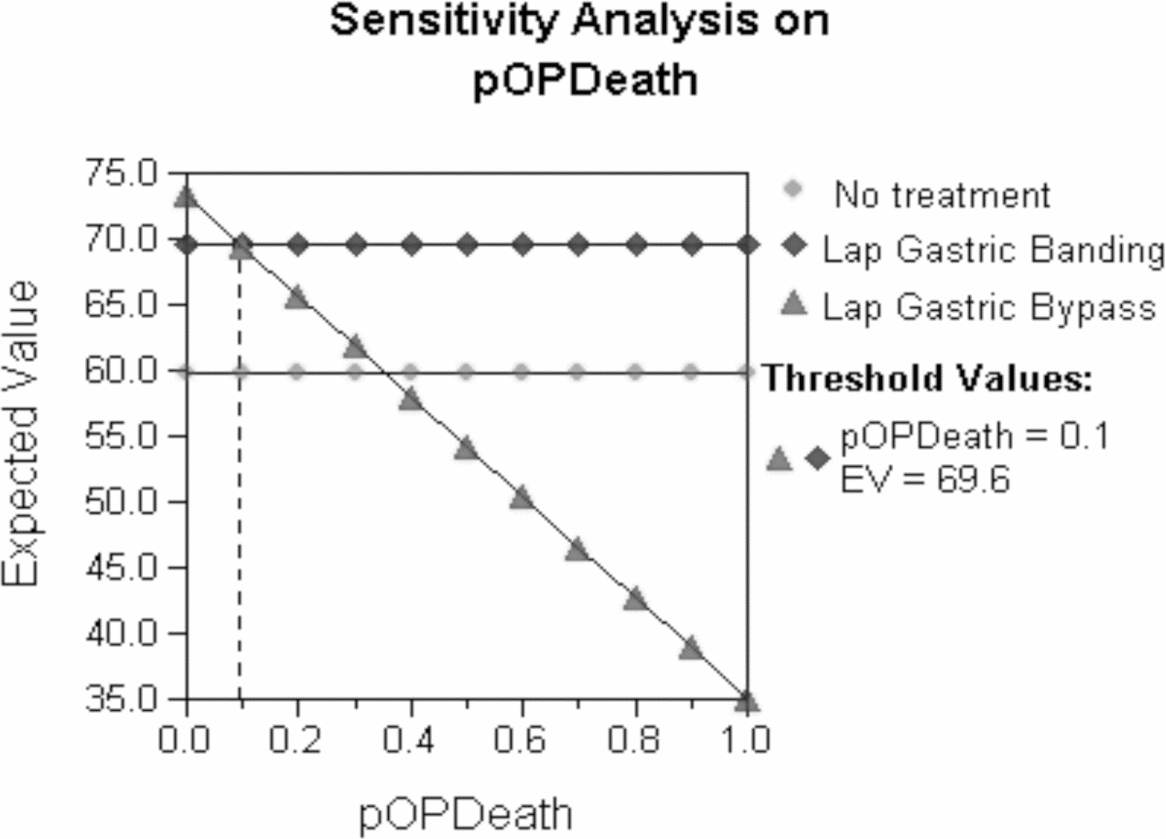
To represent a typical bariatric patient, a 35-year-old woman will have varying degrees of difference in QALYs depending on her presurgery BMI and the type of intervention she chooses (Figure 2). Thus, a 35-year-old woman with a BMI of 60 kg/m2 will gain 11 QALYs if she chooses L-RYGB instead of LAGB. Using sensitivity analysis, the QALY advantage of L-RYGB over LAGB holds true even if the reoperation rates of LAGB were increased by a factor of ten over L-RYGB. Figure 3 illustrates the advantage maintained by L-RYGB over LAGB except when the perioperative risk of death is at or above 10 percent.
Comparative effect on quality-adjusted life expectancy (years) according to pre-surgery body mass index (BMI; kg/m2) and type of intervention (no surgery, gastric banding, and gastric bypass), for a representative 35-year-old woman.

Sensitivity analysis on probability of perioperative death (pOP Death). Laparoscopic gastric bypass maintains its advantage over laparoscopic gastric banding, except when the perioperative risk of death is at or above 10 percent. BMI, body mass index.

DISCUSSION
Obesity affects over 63 million adults nationally and represents a risk factor for numerous chronic diseases that lead to premature death (25). Over a quarter of both male and female populations in the United States are obese (BMI ≥ 30 kg/m2), yet the overwhelming majority of patients who undergo bariatric surgery are females (Reference Martin, Lundberg, Juneau, Raum and Hartman14). Despite the projected increase to over 200,000 bariatric surgeries per year that will be performed in the coming years (Reference Santry, Gillen and Lauderdale23), there has been no consensus on the method of bariatric surgery best suited for a given patient demographic. In 2001, the U.S. Food and Drug Administration approved LAGB for obesity based on a case series of 329 patients (Reference Tice, Karliner, Walsh, Petersen and Feldman27) and, since then, it has been widely accepted as an alternative option to L-RYGB.
We present the first comparative data on life expectancy and QOL between these two bariatric procedures. Our results show that across all age and BMI cohorts, patients can expect a longer quality-adjusted life expectancy following L-RYGB surgery, showing the early advantage gained by LAGB from lower perioperative morbidity is lost over the long-term. Previous studies have reported the advantages of L-RYGB over LAGB in terms of BMI reduction (Reference Angrisani, Lorenzo and Borrelli1;Reference Cottam, Atkinson and Anderson5), resolution of obesity-related co-morbidities, and patient satisfaction (Reference Bowne, Julliard and Castro2), but none have compared the QALYs between the two methods.
There are limitations from published decision analysis papers that we attempted to address in our current model. Only a few studies used Markov models (Reference Patterson, Urbvach and Swanström18;Reference Pope, Finlayson, Kemp and Birkmeyer19;Reference Sendi, Palmer, Hauri, Craig and Horber24), and none have compared L-RYGB and LAGB. Markov models, unlike simple decision trees, allow a more accurate representation of risk that is continuous over time, and when outcomes may happen more than once, such as in bariatric surgery. Several studies also assumed that a person's BMI remained constant over time. However, BMI tends to change over time and is related to gender, age, and current BMI (Reference Heo, Faith and Mott10). Probabilities on perioperative outcomes were based on individual studies and not on systematic reviews where papers were distinguished based on level of quality. Finally, surgical complications were treated with equal weights and few measured QALYs (Reference Craig and Tseng6;Reference Salem, Devlin, Sullivan and Flum22;Reference Tucker, Palmer, Valentine, Roze and Ray28) that incorporated value judgment between benefit versus harm of each treatment strategy.
Our model has certain limitations. Racial subgroups were not represented in our model. Among African Americans, obesity has been associated with smaller excess mortality risks compared with general population (Reference Fontaine, Redden, Wang, Westfall and Allison7). Thus, using our model, the QALYs gained from L-RYGB may actually be underestimated in this subgroup. Baseline weight, gender and age, time elapsed since surgery, psychosocial factors, and presurgery comorbidities are known factors that affect weight loss after surgery. Our model did not take into account obesity-related morbidity such as diabetes, hypertension, hypercholesterolemia, and sleep apnea. What was incorporated into the model was significant morbidity directly caused by the surgical techniques that led to reoperation. We realize that quantifying the effect of obesity on quality of life and life expectancy is multidimensional and is difficult to represent in a single model in light of limited comprehensive, long-term data; however, there is evidence that L-RYGB is superior to LAGB in reducing comorbidities. For example, a recent systematic review (Reference Tice, Karliner, Walsh, Petersen and Feldman26) showed that diabetes resolved in 78 percent versus 50 percent of cases in L-RYGB and LAGB, respectively. Thus we expect the results of our model to hold true even if co-morbidities were taken into account.
We did not integrate cost-effectiveness in our analysis. The rationale for our model was not to inform decisions on the allocation of limited healthcare resources, but rather as a tool to be incorporated in the clinical encounter with a patient who needs guidance in choosing the most appropriate bariatric procedure. Moreover, data from U.S. National Inpatient Survey showed overall hospitalization charges for L-RYGB and LAGB to be $19,794 and $25,355, respectively (Reference Livingston12). Thus L-RYGB appears to have direct economic advantages compared with LAGB. At present, insurance companies in the United States generally base its decisions on reimbursement for a specific treatment on effectiveness and not necessarily cost benefit or cost effectiveness (Reference Powers, Rehrig and Jones20). The same principle holds true for the current form of comparative effectiveness research (Reference Tuma29).
We based our QOL measures from a trial on orlistat (Reference Hauptman, Lucas and Boldrin9), in which the drop in BMI during treatment is not as much as the drop in BMI after bariatric surgery. The graphical representation of QOL for every drop in BMI followed a linear rather than an exponential increase; thus, it underestimates the true effect of bariatric surgery on QOL. To illustrate this point, a drop in BMI from 40 to 35 kg/m2 results in greater improvement in QOL (patients can go back to work, and perform activities of daily living) than a drop in BMI from 35 to 30 kg/m2 which results in a much less dramatic improvement in QOL. Few comparative studies on QOL postbariatric surgery exists using time to trade-off scores. Using a four-point satisfaction scale on morbidly obese subjects with BMI greater than 50 followed for a median 16 months postsurgery, there was greater incidence in the LAGB group who experienced decreased overall satisfaction and weight loss, as well as higher rates of late complications and reoperations, despite the overall longer hospitalization stay attributed to L-RYGB (Reference Bowne, Julliard and Castro2).
We estimated both length and quality of life after surgery using available body of evidence and conclude that L-RYGB is the preferred surgical treatment for obesity in most cases if the sole metric is QALYs. To our knowledge, this type of comparative analysis has not been previously performed. The young and extremely obese are core groups who will gain the most QALYs following L-RYGB. In addition, L-RYGB is probably underutilized in males, who appear to have a slight edge over females in terms of average postsurgical QALYs. Our study highlights the need to incorporate patients’ preference on meaningful outcomes into the decision-making process, especially in the field of bariatric surgery where high-quality studies with comparative long-term data are scarce. Clearly, not all patients will choose to undergo L-RYGB, and there are circumstances where LAGB is a reasonable option. Our findings should provide critical information when helping patients decide on the type of bariatric surgery that is most appropriate for them. It can also serve as benchmark survival data for which funding and regulatory agencies can compare nascent technologies such as minimally invasive bariatric procedures. Requiring only efficacy and complication rates as data inputs for our model, a rational decision can be made on the relative merits of a new bariatric method while awaiting results from long-term survival studies.
CONTACT INFORMAITON
Lyndon V. Hernandez, MD, MPH (lhernand@hsph.harvard.edu), MPH (2009) Quantitative Methods, Harvard University, 677 Huntington Avenue, Boston, MA 02115; Clinical Associate Professor, Medical College of Wisconsin, Department of Gastroenterology, Aurora Medical Center–Kenosha, 10400 75th Street, Suite 208, Kenosha, WI 53142
Dominic Klyve, PhD (dklyve@carthage.edu), Assistant Professor, Department of Mathematics, Carthage College, 2001 Alford Park Drive, Kenosha, WI 53140
CONFLICT OF INTEREST
All authors report having no potential conflicts of interest.