Introduction
Mesthrie & Bhatt (Reference Mesthrie and Bhatt2008: 125) note that ‘all New Englishes varieties treat [θ] or [ð] as something other than an interdental fricative’. Malaysian English, as a variety of New English, constitutes an interesting case study. In Malaysian English, what Mesthrie & Bhatt (Reference Mesthrie and Bhatt2008: 125) call ‘something other than an interdental fricative’ is realized as the dental stop [t] (e.g. thought), which in this paper is dubbed ‘a new [t]’ or presented orthographically as [th > t], whose acoustic quality is strikingly different from the ordinary alveolar stop [t] (e.g. taught).
This paper is an interim report of acoustical experiments conducted in 2013. Twelve Malaysians (six females and six males) were recorded reading texts and talking about specific topics. The findings can be summarized as follows: First, the voice onset time (VOT) of the new [t] is shorter on average than that of the ordinary [t], and this was found in the production of all but two of the speakers, irrespective of their ethnicity, first language or the formality of the speech situation. Second, due to the presence of the new [t] in the sound inventory, the VOT of the ordinary [t] becomes shorter than that of [p]. Third, the new [t] substitutes both voiced and voiceless fricatives. Fourth, the standard pronunciation of TH outnumbers its variant pronunciation [th > t]. Fifth, the occurrence of the new [t] is sporadic. The consistent presence of the new [t], which is non-existent in native English (Hanulíková & Weber, Reference Hanulíková, Weber, Dziubalska-Kołaczyk, Wremble and Kul2010), suggests that Malaysian English is undergoing the process of ‘nativization’, one of the defining features of non-native English. Non-native English in this usage stands in contrast to native English (e.g. British English) as it refers to English whose birth began with the colonial era and which also plays a role as an intra-national means of communication aside from local languages in a present-day society. I highlight two issues in the penultimate section to rethink the validity of nativization. One issue is the sporadic, and hence saltatory, occurrence of [th > t], and the other is its phoneme-based character.
Studies on interdental fricatives in Malaysian English
There are only a handful of studies that describe the pronunciation of the interdental fricatives [θ] or [ð] in Malaysian English. One of the earliest studies that deals with the pronunciation of sounds in Malaysian English (or more precisely, ‘Malayan English’ in the 1960s) is Killingley (Reference Killingley1968), in which the substitution of interdental fricatives with the voiceless alveolar stop [t] is mentioned. Killingley noted (p. 87) that ‘[θ] and [ð] coalesce with each other’. In the 1970s and 1980s, Malaysian English was often treated together with Singapore English (abbreviated as EMS, see Brown, Reference Brown and Foley1988) due to their geographical and historical affinity. For example, Tongue (Reference Tongue1974: 19) observed TH ‘being replaced by something closer to [t]’. Platt & Weber (Reference Platt and Weber1980) drew a slightly different conclusion that TH was ‘invariably changed to something approaching a [d] sound’ (p. 172). These three early studies disclosed the important fact that interdental fricatives are realized as different sounds, particularly as [t] or [d].
More recently, Baskaran (Reference Baskaran2005) has offered a more comprehensive study on Malaysian English in which she claims that both sounds are ‘often realised by the corresponding alveolar stops [t] and [d] respectively’ (Baskaran, Reference Baskaran and Mesthrie2008: 286); I call this feature the ‘corresponding view’. Baskaran (Reference Baskaran and Mesthrie2008) further observes that the substitution occurs equally in the initial, medial and final positions of words. Since Baskaran's (Reference Baskaran and Mesthrie2008) study, the ‘corresponding view’ has been further investigated by scholars. For example, Azirah & Tan (Reference Azirah, Tan, Low and Azirah2012) provide an overview of the sound inventory of Malaysian English by adopting Baskaran's (Reference Baskaran and Mesthrie2008) viewpoint. Other scholars, such as Schneider (Reference Schneider2003a, Reference Schneiderb) and Bautista & Gonzalez (Reference Bautista, Gonzalez, Kachru, Kachru and Nelson2009), essentially agree with the points made by Baskaran (Reference Baskaran and Mesthrie2008). One reason for TH's substitution with alveolar stops might be, as Tongue (Reference Tongue1974: 19) explained, that the interdental fricative is not an easy sound to pronounce (cf. Wester et al., Reference Wester, Gilbers and Lowie2007: 477). Indeed, none of the local languages in Malaysia possess this sound in their sound inventory. For Singapore English, Deterding (Reference Deterding and Cruz-Ferreira2010) analysed the pronunciation of TH based on acoustical measurements, producing the new information that TH (in thought, threaten and third) has two realizations, i.e. one is an interdental fricative and the other is a voiceless alveolar stop. This result is on a par with the present study, but in Singapore English, there is no mention of the new [t].
Participants
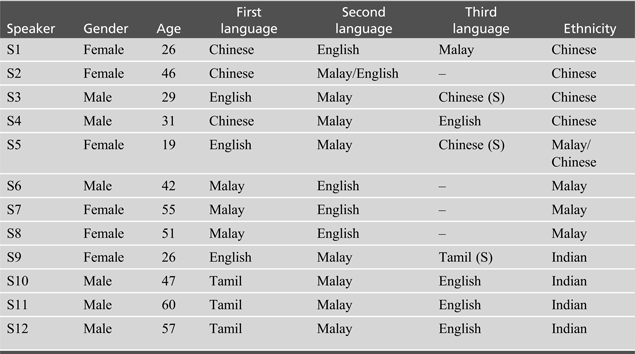
Twelve Malaysians who speak English on a daily basis participated in an acoustical experiment conducted at four different points of time (January, March, May and June 2013). The recordings, one of the major parts of the experiment, were carried out in a recording studio. All of the speakers were either lecturers or teachers working at a local university or a local school or were students pursuing BA or MA degrees at a local university at the time of recording. Three speakers (S3, S5, S9) regarded English as their first language. These speakers acquired English as their first language from their parents and it is English they use at home. For these speakers, English is not the only language they speak. Malay is the second language in which they are proficient. The ethnicity of S5 is both Malay and Chinese due to her parents' cross-ethnic marriage. Five speakers (S1, S2, S6, S7, S8) regarded English as their second language in that they had acquired English at school. S7 differed from the other speakers as she had attended an English-medium school until she started university, where Malay was the medium of instruction, and she used English more frequently than Malay both at home and in the workplace.
The reason why many speakers whose ethnicity is not Malay have Malay as their second language results from the educational system in Malaysia, where Malay is the medium of instruction in schools. S1 was an exception in this regard. She attended a Chinese-medium school in which Malay was only taught in the classroom. She also reported in the questionnaire that her parents encouraged her to master the Chinese language. Four speakers (S4, S10, S11, S12) considered English as their third language in that they use it much less frequently than the other two languages, both at home and in the workplace. They also judged that they were more proficient in Malay than in English. S2 regarded Malay and English as her second languages as she is proficient in both languages to the same degree. This speaker uses Malay more often at her workplace and English more often with her family members and friends. Summing up, in the Malaysian context, the choice of a language as a means of communication is determined by the social and physical settings in which speakers find themselves. The social, ethnic and linguistic information is tabulated in Table 1; (S) stands for ‘spoken language’, meaning that speakers are only proficient in speaking (not in writing) the language or possess passive knowledge (understanding casual speech only).
Social, ethnic and linguistic information on the 12 participants

Recordings and questionnaire
Recordings were carried out in a sound-attenuated room of a studio. Each recording consisted of four parts:
(i) reading a text of 252 wordsFootnote 1 extracted from the beginning of Lewis Carroll's Alice in Wonderland;
(ii) words (35 simplex words);
(iii) sentences (40 simple sentences);
(iv) free talk.
The first text (Text 1) (i) was selected due to its naturalness and practicality. It is a type of text that all participants were expected to be familiar with, and it contained a rich number of stop consonants. The second text (Text 2) (ii) contained words whose initial position is a stop (e.g. time, pea, key) and whose initial, medial and final positions are interdental fricatives (e.g. think, author, north). The third text (Text 3) (iii) consisted of 40 simple sentences, each of which contained a word with an interdental fricative and a stop (e.g. Where is the car?; The past is too far). The entire content of Texts 1–3 is provided in the Appendix. The free talk (iv) part of the recording was based around three topics: ‘what I am currently thinking about’, ‘weather’ and ‘health’ (Texts 4, 5 and 6). Each talk on a topic lasted one to one and a half minutes. The recording of all six texts by each speaker lasted about 10 minutes. Except for the free talk part (Texts 4–6), for which the speakers were allowed to make some notes in advance, each text (Texts 1–3) was shown to the participants shortly before the recording. Each participant had sufficient time to look over the three texts. The first three types of text (Texts 1–3) are considered to be formal and the free talk sample (Texts 4–6) to be informal, aligning with Foulkes & Docherty (Reference Foulkes and Docherty2006: 414–15), who consider word list reading to be formal and conversational speech to be informal.
A questionnaire was distributed by email to the participants after the recording to obtain information about their sociocultural and linguistic background (see Table 1) as well as their impression of the recording. All the speakers said that the texts were not difficult to read and also added that they spoke at their normal pace.
Measurements of voice onset time
The purpose of the recordings was to measure the voice onset time (VOT) of voiceless stops ([th > t], [p], [t], [k]). For the segmentation of sounds and their measurement, the computer programme PRAAT (Boersma & Weeninik, Reference Boersma and Weenink2008) was utilized, which is widely used in phonetic research. As noted in the Introduction, ‘stop consonants’ in this study include the pronunciation of TH by virtue of the fact that interdental fricatives, both voiced [ð] and voiceless [θ], are often, but not always, realized as a dental stop [t]. My intention was to examine and characterize the acoustic properties of the new [t]. Since speakers of Malaysian English tend not to aspirate word initial stops and not to make a clear discrimination between voiced and voiceless stops, measuring VOT is the only method that can fulfil the purpose of this study. My focus was thus to measure the VOT of stops in the word initial position, that is, the initial sound of a word immediately followed by a vowel (e.g. think, tired, peeped, could). VOT refers to the time lag between the release of the stop closure and the onset of the voicing of the following vowel. As shown in previous studies, VOT values are important features for acoustically distinguishing between the categories of voiceless stops. A pioneering early work in this area is the study by Lisker & Abramson (Reference Lisker and Abramson1964), who measured the VOT of stops and concluded that the measurement of VOT is a reliable feature that differentiates stop categories across a wide variety of languages (p. 420). Their study is still the archetype of many studies. For example, a seminal work by Cho & Ladefoged (Reference Cho and Ladefoged1999) confirmed the conclusion drawn by Lisker & Abramson (Reference Lisker and Abramson1964). In the present study, VOT is shown to differ at different places of articulation. A rule of thumb is that the longer the contact of the articulatory organs, the longer the VOT. In other words, the contact of the back of the tongue requires, due to its size, more time to produce [k] than the contact of two lips does to produce [p]. The result is that [k] requires a longer VOT than [p]. Thus, three stop consonants in American English are patterned according to their VOT durations as [p] – [t] – [k] (shortest to longest) (Lisker & Abramson, Reference Lisker and Abramson1964).
Characteristics of the new [t] in Malaysian English
VOT of the new [t] is shorter than the ordinary [t]
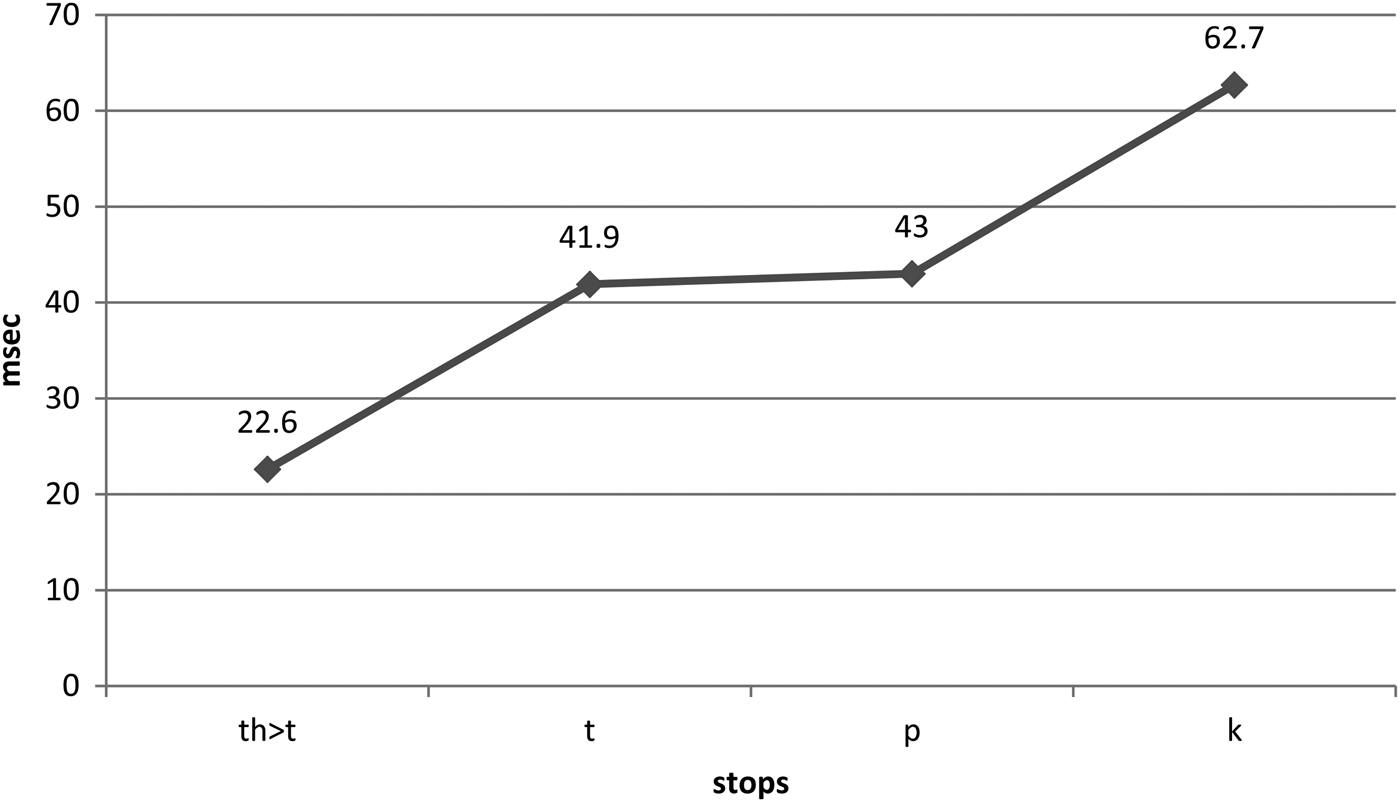
As noted in the introduction, the first characteristic of the new [t] is that its VOT is shorter on average than that of the ordinary [t] (Figure 2). Figure 1 depicts that the new [t] is the shortest of all four stops and thus the four stops are patterned as [th > t] – [t] – [p] – [k] (shortest to longest).Footnote 2
Average duration of voice onset time (VOT) for four stops
The second characteristic of the new [t] is that its presence might have reversed the standard sequence of [p] – [t].
An articulatory factor in the rise of the new [t] is the retention of the dental component of the original sound, which can be corroborated by the following facts. First, all of the speakers produced interdental fricatives more frequently than the new [t] (see Figure 4), indicating that they knew how to pronounce the sound. Second, the shortest VOT value of the new [t] is probably caused by the tongue being placed at the back of the upper teeth instead of interdentally. If we take into account Fougeron & Keating's (Reference Fougeron and Keating1997) hypothesis of articulatory strengthening, one can say that one reason for the production of the new [t] is its ‘articulatory easiness’.
Neutralization of voiced and voiceless differences
The third characteristic of the new [t] is that it is the realization of not only the voiceless interdental fricative [θ] but also the voiced interdental fricative [ð]. The substitution of the voiced interdental fricative [ð] by [d] is rare. It occurred only four times in three words (this, them, mother) in the entire corpus. Note that [θ] was never realized by [d]. It is clear that Baskaran's (Reference Baskaran and Mesthrie2008) corresponding view cannot be supported. Figure 3 depicts the frequency of the substitutions of [ð] and [θ] by [t].
Voice onset time (VOT) of the new [t] and the ordinary [t]
Frequency of [ð] > [t] and [θ] > [t]
Persistence of the interdental fricative
The fourth characteristic is that all of the speakers retained the interdental fricatives more prominently than the new [t]. This is demonstrated clearly by Figure 4. The mean occurrence of words containing [θ], [ð] or [th > t] per speaker was 96 times in all texts.
Frequency of interdental fricatives and the new [t]
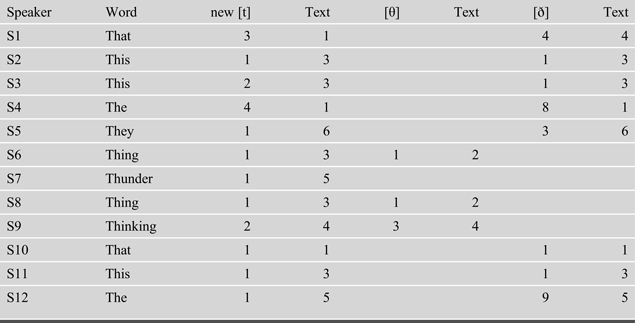
Sporadic realizations
The fifth characteristic is that the occurrence of the new [t] was very sporadic among the speakers and within the production of a single speaker. Table 2 gives some examples of such variation across all 12 speakers. A striking fact is that variation occurred in the same speech sample (S2–5 and S9–12). An interesting case might be S7. As already shown in Figure 3, S7 produced the new [t] only three times, and all of these occurred in Texts 4 and 5 (free talk). In Text 5, she produced the new [t] in the following context: ‘... the moment it rains, it will be so heavy, it will be raining in sheets, you know, and with thunder, lightning, you know, really scary ...’ The TH in thunder was realized as [th > t]. The replacement of [θ] with [th > t] in this sample might have resulted from the emotion attached to her fearfulness of the natural disasters she was talking about. However, not all emotional attachments were expressed by the new [t]. S7 did not replace [θ] with [th > t] when she used thankful to express her relief that Malaysia is not affected by fearful natural disasters: ‘... but I think, I guess, we have to be thankful for small mercies, because some people have to contend with hurricanes, typhoons ...’ In this sample, TH in think was replaced by [th > t].
Examples of double pronunciations
Nativization
Nativization is the process characteristic of non-native varieties of English in which English becomes the language of local people. As this process advances, it forms a sub-variety of non-native English. Kachru (Reference Kachru and Smith1981: 18) employs the term in the following context: ‘English has been completely embedded in the local contexts and has slowly gone through the process of nativisation.’ For Kachru (Reference Kachru and Smith1981), under the assumption that a new language grows ‘under the influence of local languages’ (p. 39), this process parallels the ‘normal historical development’ of natural languages such as Latin and Sanskrit (p. 18). The implication is that local English establishes its own system and identity in a given speech community.
The question is whether the new [t], whose acoustic and articulatory characteristics are presented above, is representative of nativization. The answer is, in my opinion, twofold. The positive answer is that nativization is surely taking place, and this can be argued for from three perspectives. First, the new [t] occurred within the production of all of the participants. Second, the presence of the new [t] influences the quality of the ordinary [t], yielding the sequential reversion between an alveolar stop [t] and a labial stop [p]. Third, the new [t] may have arisen due to the ease of pronouncing interdental fricatives, which suggests that this sub-variety may be found in other varieties of non-native English. Singapore English resembles Malaysian English in this regard (Deterding, Reference Deterding and Cruz-Ferreira2010). However, note that this positive answer may be weakened due to the following three factors. First, the occurrence of the new [t] is quite irregular. Second, changes are phoneme based. Third, changes do not derive from local languages. Lehmann (Reference Lehmann1992: 202) holds that sporadic changes exist in the history of language. In this respect, what is happening in Malaysian English may not be an exception. However, the point is that changes observed in Malaysian English result from the alteration of phonemes but not the rearrangement of allophones. Typically, phoneme-based changes are not ascribed to any phonological pattern, while changes by allophones are. This explains why the emergence of the new [t] does not lead to the loss of the standard pronunciation of [θ] and [ð] and why they are present concurrently.
Another factor is that sporadic changes, as the name implies, only affect sounds in some of their occurrences. Another point worthy of mention is that speakers are often conscious of phonemic changes (whereas they are unconscious of allophonic changes). The voicing of [t] in water in American English is a good example of this (Lehmann, Reference Lehmann1992: 203). Because of ‘speaker-consciousness’, emotional factors, as also noted above, may facilitate the production of the new [t]. Although sporadic changes exist in languages, we should bear in mind that ‘a normal historical development’ of a language, to reiterate Kachru's (Reference Kachru and Smith1981) words, incorporates more regular changes that arise from the rearrangement of the phonetic surroundings of the sounds concerned, that is, sporadic changes are minor. The difference here is that substitutions pertaining to Malaysian English rely solely on phonemes.
It is plain that nativization is not a process existing in its own right. One can say that it co-exists more with non-linguistic factors. Changes are accompanied by individual forces (e.g. expression of emotions or ease of pronunciation) rather than the patterns of a language. The speaker's attitude may therefore affect or contribute to the choice of substitution. Bulley's (Reference Bulley2009) example of the pronunciation invove for involve in British English is probably another excellent example of a phonemic change. He recalls that in the 1980s, involve was realized as invove and ‘one wondered whether it would become widespread’ (p. 56), but he also observes (p. 56) that it ‘is not heard at all’ in present-day British public life. He maintains that one's will to adhere to the ‘proper’ pronunciation plays a key role in caring for the pronunciation. I presume that a similar attitude may be required if people wish to maintain the interdental fricative for TH in Malaysian English.
Conclusion
The results of the acoustic analysis of TH in word initial position have supplemented and refined the observations of previous studies on Malaysian English. It turns out that the facts and factors observed in this paper go far beyond Baskaran's ‘corresponding view’. The key statement of this paper is that there is a new dental stop [t] whose acoustic quality is different from the ordinary alveolar stop [t]. The substitution of [θ] and [ð] with this new dental stop is subsumed under a phonemic change without recourse to a phonological pattern. While the rise of the new [t] bears witness to nativization, the persistent irregularity requires elaboration. Finally, whether or not the new [t] enters the phoneme inventory of Malaysian English or contributes towards the ‘endonormative stabilization’ in Schneider's (Reference Schneider2003b) dynamic model will probably depend on the attitudes and perceptions of speakers, social forces, or the quality of English language education in Malaysia, upon which the country's language policy will certainly have a marked impact.
Appendix
Text 1
Alice in Wonderland
Alice was beginning to get very tired of sitting by her sister on the bank, and of having nothing to do: once or twice she had peeped into the book her sister was reading, but it had no pictures or conversations in it, “and what is the use of a book,” thought Alice, “without pictures or conversations?” [space intended]Footnote 3
So she was considering in her own mind (as well as she could, for the hot day made her feel very sleepy and stupid), whether the pleasure of making a daisy-chain would be worth the trouble of getting up and picking the daisies, when suddenly a White Rabbit with pink eyes ran close by her. [space intended]
There was nothing so very remarkable in that; nor did Alice think it so very much out of the way to hear the Rabbit say to itself “Oh dear! Oh dear! I shall be too late!” When she thought it over afterwards, it occurred to her that she ought to have wondered at this, but at the time it all seemed quite natural. [space intended]
But, when the Rabbit actually took a watch out of its waistcoat-pocket, and looked at it, and then hurried on, Alice started to her feet, for it flashed across her mind that she had never before seen a rabbit with either a waist-coat-pocket, or a watch to take out of it. Burning with curiosity, she ran across the field after it, and was just in time to see it pop down a large rabbit-hole under the hedge.
Text 2
1. thing; 2. case; 3. pal; 4. time; 5. them; 6. key; 7. pea; 8. thought; 9. core; 10. poor; 11. think; 12. test; 13. cold; 14. caught; 15. taught; 16. thirty; 17. kitten; 18. peak; 19. teach; 20. past; 21. task; 22. take; 23. north; 24. earth; 25. mother; 26. author; 27. health ; 28. healthy; 29. truth; 30. feather; 31. pink; 32. pop; 33. could; 34. conversations; 35. curiosity (Participants pronounced these words in the frame ‘Say x’.)
Text 3
1. Where is the car?; 2. Please think about it; 3. The small thing is beautiful; 4. We are thinking of this project; 5. Einstein thought intensively about relativity; 6. The time is changing; 7. John took the spade with him; 8. We have no time; 9. I have no picture; 10. I want to buy a car; 11. We will pay tomorrow; 12. The past is too far; 13. This was a keen choice; 14. He is a careful driver; 15. Please open the mouth; 16. Please come to London now; 17. We will see them tomorrow; 18. He touched the painting; 19. This is a beautiful colour; 20. He was always poor; 21. This is very costly; 22.This is the key to the solution; 23. I can see them over there; 24. I see three things on the table; 25. Past tense is used in the text; 26. We are testing the car; 27. Every thangFootnote 4 is a mystery; 28. He taught us to describe our thinking; 29. Please take the thungs on the table; 30. Please look at the thib; 31. Yesterday was the thirteenth anniversary of his death; 32. No future tense was found in the text; 33. Tom said the task was misspelled as pea; 34. I saw her mother standing near the tree; 35. Both students should come another day; 36. Yesterday the weather was bad; 37. She wore leather boots; 38. The path is small; 39. It is worth painting the wall; 40. His health is going better.
 TOSHIKO YAMAGUCHI is Associate Professor in the Department of English Language at the University of Malaya where she teaches linguistics for postgraduate students and English grammar for undergraduate students. Since she came to Southeast Asia (first to Singapore in 2000 and to Malaysia in 2008), she has been interested in varieties of English in the region. She is also working on expressions of time and person in Japanese language. Email: tyamag@um.edu.my