Introduction
The Brāhmaṇa Saṃyutta of the Pāli Saṃyutta-nikāya (abbreviated SN) is represented in Chinese by two versions, one in the Za Ahan Jing 雜 阿 含 經 (Saṃyuktāgama, abbreviated SA, Taishō vol. 2, no. 99), the other in the Bieyi Za Ahan Jing 別 譯 雜 阿 含 經 (Additional Translation of Saṃyuktāgama, abbreviated ASA, Taishō vol. 2, no. 100). This saṃyutta/xiangying 相 應 is a collection of miscellaneous discourses on the subject of the Brāhmaṇas (usually termed Brahmins/Brahmans in English). The Brāhmaṇas are the traditional Indian sacrificial priests, having their own blood-lineage and regarding themselves as the highest social class. They contrast with the Śramaṇas (P. Samaṇa), renunciants, such as the Buddhist bhikṣus (P. bhikkhu), who are homeless wanderers living on alms. The discourses comprised in the Pāli and Chinese versions of the Brāhmaṇa Saṃyutta are an early textual record of how the Buddha responded to the religious tradition, position, practice, and faith of the priestly social class, the Brāhmaṇas.
In this paper I first briefly examine the textual structure of the three versions. Then I compare the main teachings contained in them, making use of new editions of SA: Yin Shun's Za Ahan Jing Lun Huibian 雜 阿 含 經 論 會 編 [Combined Edition of Sūtra and Śāstra of the Saṃyuktāgama] (abbreviated CSA) and the Foguang Tripiṭaka Za Ahan Jing (abbreviated FSA). This will reveal similarities and significant differences in structure and doctrinal content, thus advancing the study of early Buddhist teachings in this area.Footnote 1
1. Textual structure
The Pāli Brāhmaṇa Saṃyutta is the seventh of the eleven saṃyuttas comprised in the Sagātha Vagga of SN. The two corresponding Chinese versions, contained in SA and ASA, were translated from now lost Indic-language originals. In the CSA edition the SA version bears the title Poluomen Xiangying 婆 羅 門 相 應 (Brāhmaṇa Saṃyukta, Connected with Brāhmaṇas), supplied by the editor, Yin Shun. In earlier editions of SA and ASA, saṃyukta/xiangying titles are lacking and the beginning and end of each saṃyukta have to be inferred from the sūtra contents. The SA counterpart, Poluomen Xiangying, of the Brāhmaṇa Saṃyutta, is also located in the Sagātha Vagga of SA, which is titled Bazhong Footnote 2Song 八 眾 誦 (Eight Assemblies Section) in the SA tradition (Choong Reference Choong2006, p. 62, n. 5). It is the fifth of the eleven xiangyings in this Vagga (Choong Reference Choong2000, pp. 20, 247). The same location – the fifth of the eleven xiangyings – applies also to the reconstructed ASA versions.Footnote 3
The Pāli Brāhmaṇa Saṃyutta belongs to the Tāmraśāṭiya school (often called Theravāda), whereas the SA version belongs to the Sarvāstivāda school, and the ASA version may belong to the Kāśyapīya school.Footnote 4 Thus, these three texts represent three different early Buddhist schools, three different versions of the same collection of discourses on Brāhmaṇas.
The Sagātha Vagga/Bazhong Song pertains to the Geya-aṅga (P. Geyya-aṅga) portion of SN/SA. Geya is one of the three aṅgas represented in the structure of SN/SA: Sūtra (P. Sutta) ‘discourse’ (short, simple prose), Geya (P. Geyya) ‘Stanza’ (verse mixed with prose), and Vyākaraṇa (P. Veyyākaraṇa) ‘Exposition’. These three aṅgas are the first three of nine types of early Buddhist text (navaṅga) classified according to their style and form.Footnote 5 They are regarded by some scholars as historically the earliest ones to have appeared, in sequence, in the formation of the early Buddhist texts (Choong Reference Choong2000, pp. 9–11, 20, 247–249).Footnote 6
The Pāli Brāhmaṇa Saṃyutta comprises twenty-two discourses (SN 7.1–22). Of its Chinese counterparts, SA has thirty-eight discourses (SA 1151–1163, 88–102, 1178–1187) and ASA has thirty-seven (ASA 74–91, 258–268, 92–100). The Pāli Brāhmaṇa Saṃyutta, therefore, has fewer discourses than either of the two Chinese versions.
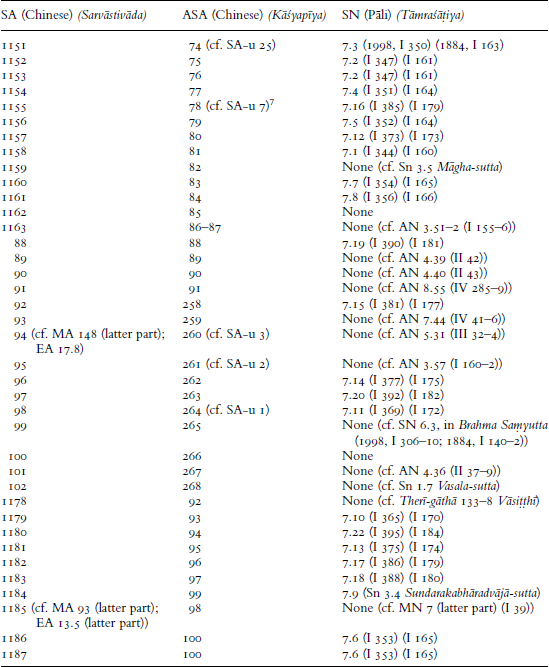
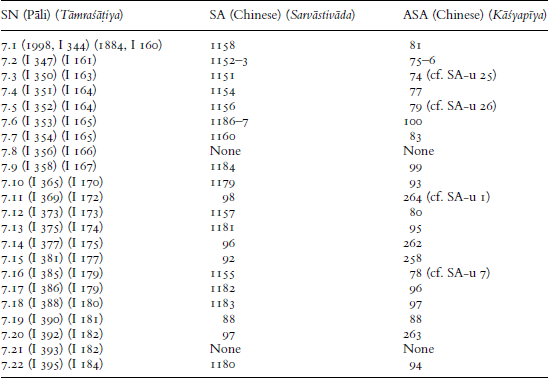
Two discourses in the Chinese SA and ASA versions (SA 1162, 100 = ASA 85, 266) have no Pāli counterparts. Fourteen discourses in SA and fifteen in ASA (SA 1159, 1163, 89–91, 93–95, 99, 101–102, 1178, 1184–1185 = ASA 82, 86–87, 89–91, 259–261, 265, 267–268, 92, 99, 98) have Pāli counterparts found not in the Brāhmaṇa Saṃyutta but in other Pāli collections. On the other hand, two of the twenty-two SN discourses (SN 7. 8, 21) have no Chinese counterparts, and the rest have their Chinese counterparts in the Poluomen Xiangying of SA and ASA. The full set of Chinese-Pāli and Pāli-Chinese counterparts is shown in Tables 1 and 2.
Chinese-Pāli correspondences of the Poluomen Xiangying (Brāhmaṇa Saṃyukta)

Pāli-Chinese correspondences of the Brāhmaṇa Saṃyutta

The identification of the Chinese-Pāli and Pāli-Chinese counterparts shown in these tables is open to discussion. As is evident in Table 1, the discourses of SA and ASA are out of order with regard to the structural arrangement. The rearrangement of the discourses indicated in Table 1 is according to the CSA version.Footnote 8 As can be seen, the discourses in the two Chinese versions match up with each other very closely as regards both sequence and total number, while matching up only loosely with the discourses of the Pāli version. Thus, the SA and ASA versions are structurally much closer to each other than to the SN version.
Fragmentary Sanskrit counterparts of segments of the Chinese SA version (and the ASA version) have been published by Fumio Enomoto (Reference Enomoto1994). The published Sanskrit counterparts of the discourses on the subject of Brāhmaṇas consist of altogether twenty fragments, corresponding to SA 89, 95, 97–98, 100; 1151–1154, 1157–1158, 1161–1163; 1178, 1180–1181, 1184–1185, and 1187 ( = ASA 89, 261, 263–264, 266; 74–77, 80–81, 84–86; 92, 94–95, 99–98, and 100). These fragmentary Sanskrit texts are useful for confirming certain Chinese technical terms.
2. Principal differences in teachings on Brāhamaṇas
Most of the discourses are similar in content in the three versions. Here I will discuss only the principal differences regarding teachings, under three topics: (1) the outcaste, (2) the dharmas that are good for a layperson, and (3) alms.
(1) The outcaste (SA 102 = ASA 268 = Sn 1.7 Vasala-sutta)
SA 102, ASA 268 and their Pāli counterpart Sn 1.7 Vasala-sutta record a shared teaching about what an outcaste is, or what things (fa 法 dharmas/dhammas) make an outcaste (lingqunte 領 群 特 vasala/vasala-ka (wicked outcaste) in SA and Sn; Zhantuolo 旃 陀 羅 caṇḍāla in ASA). They describe in common how a Brāhmaṇa, while performing the fire ritual with a food offering in his house, sees the Buddha coming at a distance, and says to him, “You are an outcaste, do not approach”.Footnote 9 The Buddha, hearing this, asks the Brāhmaṇa whether he knows what an outcaste is, or what things make an outcaste. The Brāhmaṇa replies that he does not know this, and asks the Buddha to teach him. The Buddha then tells him. The three versions record, in verses uttered by the Buddha, details of conduct that make a person an outcaste. The main point of this teaching, shared in common by the three versions, can be represented by this statement: “Not by birth does one become an outcaste, not by birth does one become a Brāhmaṇa; by conduct (evil conduct in ASA) one becomes an outcaste, by conduct (pure conduct in ASA) one becomes a Brāhmaṇa”.Footnote 10 These words clearly present a core teaching on the topic of Brāhmaṇas. However, there are in the three versions two issues that need to be addressed here: 1. conduct regarding prostitution, and 2. an abnormal/magical food offering.
On 1. prostitution, SA 102 states:
He abandons his wife [regarding sexual intercourse], and also does not go to a brothel (yinshe 婬 舍) [for his sexual pleasure]; [instead] he [sexually] assaults those who are loved by others [i.e., their wives and daughters]. He should be known as an outcaste.Footnote 11
Its counterpart ASA 268 has:
He abandons his wife and prostitute (Yinnyu 婬 女); [instead] he does not avoid sexual misconduct with others’ women/girls. He also is regarded as an outcaste.Footnote 12
The corresponding Pāli Sn 1.7 reads:
Whosoever is seen [misbehaving] with the wives of relatives or of friends, either by force or with their consent, he should be known as an outcaste.Footnote 13
Here the SA and ASA versions use the terms brothel (婬 舍) and prostitute (婬 女) respectively. They clearly include the concept of sexual behaviour associated with sex workers, whereas the Pāli version does not contain such references.
Both the SA and ASA versions do not mean to encourage a layperson to find a prostitute for sex. They only indicate that if the person sexually brings harm to others, instead of lawfully having sex with his spouse or a prostitute – in this case, he is regarded as an outcaste. Nevertheless, the two Chinese versions seem to be more tolerant of this kind of sexual conduct for a layperson than the Pāli version – i.e. going to have sex with a sex worker, rather than sexually misbehaving with others who are not in a legitimate sexual relationship with him. Because this content is not shared in common with the corresponding Pāli version, one may conclude that it represents a sectarian view – or perhaps a Chinese view superimposed by the translator.
Regarding 2. an abnormal food offering, ASA 268 records that a Brāhmaṇa, after having heard the Buddha's teaching on outcastes, is delighted and wishes to offer food to the Buddha; but the Buddha rejects his offering, saying: “I see no-one in the world, deva, Māra, Brahmā, Śramaṇa, or Brāhmaṇa, who could eat and digest it properly. Dispose of it in water where there are no living beings”. The Brāhmaṇa then disposes of the food in water. As he does so, the water seethes and hisses, giving off steam and smoke. Seeing this manifestation of supernormal power, the Brāhmaṇa is very surprised. He subsequently becomes a follower of the Buddha. A similar story is found in the corresponding SA 102, but not in the Pāli counterpart, Sn 1.7.
A similar story is also found in other discourses in SA and ASA, some of which have the Buddha tell the Brāhmaṇa to dispose of the food in water where there are no living beings/insects or to throw it away in a place where there is little/no grass.Footnote 14
In contrast, only one Pāli discourse has a similar story, namely SN 7.9 Sundarika-sutta in the Brāhmaṇa Saṃyutta, which is the counterpart of SA 1184 and ASA 99. This Pāli discourse adds that none but the Tathāgata or a disciple (sāvaka) of the Tathāgata could eat and digest the food properly.Footnote 15 The reason for this is not explained in the text itself.
To summarise, SA 102 = ASA 268 = Sn 1.7 Vasala-sutta record an important shared teaching on the subject of Brāhmaṇas. It is that a person's status as Brāhmaṇa or outcaste depends entirely on conduct, not on birth – a clear indication of opposition to the caste system. Two unshared teachings are found in the three versions: a deed associated with prostitution is mentioned only in the SA and ASA versions; and the Pāli version alone describes the abnormal food offering as fit to be eaten and digested only by the Tathāgata or a disciple of the Tathāgata.
(2) The dharmas that are good for a layperson (SA 91 = ASA 91 = AN 8.55 Ujjaya)
SA 91, ASA 91 and their Pāli counterpart AN 8.55 (cf. AN 8.54) record in common how a Brāhmaṇa comes to ask the Buddha to teach him dharmas (practices) that will bring advantage and happiness in this world and in the next life for a layperson or householder (suren-zaijia 俗 人 在 家/zaijiaren 在 家 人, gihī in AN 8.54) such as the Brāhmaṇa himself. The Buddha replies (in summary):Footnote 16
(a) Four dharmas, if attained, lead to a layperson's advantage and happiness in this world:Footnote 17 1. effort, 2. guardedness, 3. good friendship/companionship, and 4. an even life/right livelihood.Footnote 18
(b) Four dharmas, if attained, will lead to a layperson's advantage and happiness in the next life:Footnote 19 1. attainment in faith, 2. attainment in virtue, 3. attainment in charity, and 4. attainment in wisdom.Footnote 20
The teaching of these practices indicates opposition to the traditional practice of sacrificial ritual praised by the priestly Brāhmaṇas.Footnote 21 Most of the contents relating to the above items are generally similar in meaning in the three versions, though there are some differences in wording. However, there are two differences in content, which will be addressed here.
First, in the Pāli version, after teaching about an even life (4) in section (a) and before section (b), the text adds two more sets of four items:
– Four channels for the flowing-away of amassed wealth, namely: careless indulgence with women, careless indulgence in drinking, careless indulgence in gambling, and having friendship, companionship, and intimacy with evil-doers.Footnote 22
– Four channels for the flowing-in of wealth, namely: non-indulgence with women, non-indulgence in drinking, non-indulgence in gambling, and having friendship, companionship, and intimacy with the good.Footnote 23
These are entirely absent from the corresponding SA and ASA versions. They may have become lost in these two Chinese versions, or they may represent a sectarian doctrine developed within the Pāli tradition.
Second, in teaching about faith (1) in section (b), the ASA version mentions the word ‘faith’ but lacks all of the other content, giving none of the explanation or relevant context found in its two counterparts. It is likely that this material has been accidentally lost during the textual transmission in China.
The SA version, when referring to faith, explains:
One has a mind of respectful faith in the Tathāgata (yu Rulai suo, de xinjing xin 於 如 來 所 ∘ 得 信 敬 心 ∘), established fundamentally firm, such that no devas, Māras, Brahmas, or other human beings in the world are able to harm [his mind of respectful faith in the Tathāgata].Footnote 24
The corresponding Pāli version, AN 8.55, reads:
One has faith in the wisdom of the Tathāgata (Tathāgatassa bodhiṃ), thus: He, [the Exalted One (Bhagavā)], is [arhant, perfectly enlightened (sammāsambuddho), complete in knowledge and practice (vijjā-caraṇasampanno), well-gone (sugato), world-knower (lokavidū), unsurpassed (anuttaro) charioteer of men to be tamed (purisa-dammasārathi)], teacher of devas and humankind (satthā deva-manussānaṃ), awakened (buddho), exalted (bhagavā) (IV 288).
Here, “a mind of respectful faith” in the SA version and “faith in the wisdom” in the Pāli version can be seen as not referring to the same concept. The former can mean devotional faith in the Buddha, whereas the latter focuses on confidence in the ‘wisdom’ of the Buddha. Nevertheless, they agree in saying that attainment in faith (xinjuzu 信 具 足, saddhāsampadā) is having definite faith in the Buddha.
To conclude this section, the three versions state in common that there are four dharmas that will lead to advantage and happiness for a layperson in this world and in the next life. They also indicate opposition to the traditional sacrificial practice praised by the Brāhamaṇas.
Two different teachings are found in the three versions. First, regarding even life/right livelihood, only the Pāli version presents a doctrine of four gateways to both the flowing-away and flowing-in of wealth. Second, regarding faith, the ASA version completely lacks the content, whereas the corresponding SA and Pāli versions present instructions on it with minor differences. These are mainly “a mind of respectful faith in the Tathāgata” in the SA version and “faith in the wisdom of the Tathāgata” in the Pāli version; but both versions show in common that having definite faith in the Buddha is the main point in regard to attainment in faith, as one of the four dharmas which, if attained, will lead to advantage and happiness of a layperson in the next life.
(3) Alms (SA 95 = ASA 261 = AN 3.57)
Finally, I discuss what the three versions say about alms.
SA 95 and ASA 261 describe in common how a Brāhmaṇa called Jānukṣīnī (Shengwen 生 聞) comes to ask the Buddha a question. He first tells the Buddha that he has heard a report that the Buddha states that alms should be given to the Buddha himself and his followers, not to others, because alms given to him and his followers obtain great [karmic] profit/fruits, but not so alms given to others. The Brāhmaṇa asks the Buddha if this report is correct, true, not misrepresenting his view and teaching. The Buddha replies that he has never said this, and indeed that he regards one who holds such a view as obstructing action in two ways:
(1) He obstructs the giver in giving alms, and
(2) He obstructs the recipient in receiving the gift.Footnote 25
The corresponding Pāli version, AN 3.57, is similar regarding the question, though the question is posed by the wanderer Vacchagotta (Vacchagotto paribbājaka), who possibly also belongs by birth to a Brāhmaṇa caste. The reply from the Buddha is also similar, except that he regards a person who prevents another from giving alms as causing three obstructions:
(1) He obstructs the giver in acquiring merit,
(2) He prevents the receivers from getting a gift, and
(3) He himself is already ruined, completely ruined.Footnote 26
Thus, the Pāli has one item more than the SA and ASA versions.Footnote 27
After the Buddha has spoken about these obstructions, the ASA version alone states that one who holds such a view about action will eventually fall, after death, into one of the three evil realms (the realms of hell, of animals, and of ghosts).Footnote 28
The three versions then record in common that the Buddha considers that even feeding small creatures will be a source of merit to the giver, how much more so feeding or charitable giving to human beings. Nevertheless, the Buddha in the three versions says that a gift given to the virtuous (chijiezhe 持 戒 者, sīlavant) is of great fruit, but not one given to the wicked.Footnote 29
Both the SA and ASA versions give no information on ‘the virtuous’; only the Pāli version does. In the Pāli the virtuous is one who has abandoned five qualities and possesses five qualities (pañcaṅgavippahīno pañcaṅgasamannāgato):Footnote 30
– 1. Sensual desire (kāmacchando), 2. ill-will (vyāpādo), 3. dullness-and-drowsiness (thīna-middhaṃ), 4. restlessness-and-worry (uddhaccakukkuccaṃ), and 5. doubt-and-uncertainty (vicikicchā) are abandoned (pahīnāni).
– 1. He is possessed (samannāgato) of the morality-aggregate of one beyond training (asekhena sīlakkhandhena), 2. the concentration-aggregate of one beyond training (asekhena samādhikkhandhena), 3. the wisdom-aggregate of one beyond training (asekhena paññakkhandhena), 4. the liberation-aggregate of one beyond training (asekhena vimuttikkhandhena), and 5. the knowledge-and-vision of liberation-aggregate of one beyond training (asekhena vimuttiñāṇadassanakkhandhena).
These are entirely absent from the corresponding SA and ASA versions. They may have been added or developed in the Pāli version.Footnote 31
Accordingly, regarding the teaching on alms in the three versions it is found that the Pāli version has more doctrinal contents than the SA and ASA versions.
Conclusion
This comparison of the Brāhmaṇa Saṃyutta of SN and its two Chinese counterparts has revealed the following main points:
1. The three versions record a shared teaching on the topic of Brāhmaṇas: A person's status as Brāhmaṇa or outcaste is determined by conduct, not by birth. This is a clear indication of opposition to the caste system.
2. Regarding the outcaste, only the SA and ASA versions mention action associated with prostitution. They indicate that if the person sexually misbehaves with others, rather than lawfully having sex with his spouse or with a prostitute, he is regarded as an outcaste. The two Chinese versions in this case seem to be more broadminded toward sex workers.
3. The Pāli version alone speaks of the abnormal food offering that is fit to be eaten and digested only by the Tathāgata or a disciple of the Tathāgata.
4. Only the Pāli version presents the doctrine of four channels to both the flowing-away and the flowing-in of wealth in the teaching on four dharmas that lead to advantage and happiness for a layperson in this world and in the next life.
5. The four dharmas for a layperson's advantage and happiness again indicate opposition to the Brāhamanas’ traditional sacrificial ritual. This teaching is shared in common by the three versions.
6. Regarding alms-giving, the Pāli version has more doctrinal content than the Chinese SA and ASA versions. For example, only the Pāli version gives information on the ‘virtuous’ (sīlavant): one who has abandoned five qualities (pañcaṅgāni pahīnāni) and also possesses five qualities (pañcaṅgehi samannāgato).
Overall, this study has revealed some substantial disagreements among the three versions regarding the major teachings on Brāhmaṇas.
Abbreviations
- AN
Aṅguttara-nikāya
- ASA
Bieyi Za Ahan Jing [Additional Translation of Saṃyuktāgama] (T 2, no. 100)
- CSA
Yin Shun's Za Ahan Jing Lun Huibian [Combined Edition of Sūtra and Śāstra of the Saṃyuktāgama] (3 vols, 1983)
- EA
Ekottarikāgama (T 2, no. 125)
- FSA
Foguang Tripiṭaka Za Ahan Jing (Saṃyuktāgama) (4 vols, 1983)
- MA
Madhyamāgama (T 1, no. 26)
- MN
Majjhima-nikāya
- P.
Pāli
- PTS
Pāli Text Society
- SA
Saṃyuktāgama (T 2, no. 99)
- SA-u
Un-attributed SA (T 2, no. 101)Footnote 32
- SN
Saṃyutta-nikāya
- Sn
Sutta-nipāta
- T
Taishō Chinese Tripiṭaka (the standard edition for most scholarly purposes)
- AN, MN, SN, and Sn references are to PTS editions.
 能 精 勤 ∘ 二 能 守 護 諸 根 ∘ 三 得 善 知 識 ∘ 四 正 理 養 命 ∘’ AN: ‘Uṭṭhānasampadā ārakkhasampadā kalyāṇamittatā samajīvitā’.
 . AN: ‘Tayo kho ‘me . . . aggī . . . āhuneyyaggi, gahapataggi, dakkhiṇeyyaggi.’ (IV 44–5)). On the three fires the three versions have different wording but the main teachings are similar, namely: veneration to parents, to family members including workers of the family, and to Śramaṇas and Brāhmaṇas who lead a solitary, pure life. Here, the ASA 259 version at the end of the discourse adds: ‘爾 時 如 來 ∘ 即 為 呪 願 ∘