1. Introduction
China has hundreds of cities that differ in their economic scales, incomes, factor endowments, levels of openness and levels of environmental degradation. The open-door policy in China, initiated in 1978, progressively stimulated the openness of Chinese cities and widened the gaps between cities. The integrated air quality indexes between 1996 and 2008 illustrate that the gap between the south and the north in the levels of air pollutants' concentrations has become significantly narrower and lower since China entered the WTO in December 2001 (see figure A1 in the online Appendix available at http://journals.cambridge.org/EDE). Using the intensity of international trade (ratio of imports and exports to GDP) and foreign direct investment (FDI) as proxies for the level of openness, the cities in the east of China are found to be more open and to have better air quality, according to the integrated air quality index, than the rest of the cities (see table A1 in online Appendix). It has also been observed that, despite industrial SO2 emissions per capita that are above the national average, eastern cities have strong environmental policies that have increased the removal rate of SO2. Consequently, these cities have lower SO2 concentrations. Does this mean that the continuous deterioration of urban air quality is reversible in the course of China's further openness and urban growth? How have the other forms of international social and economic activities influenced China's urban air quality? These issues are important, as rapid globalisation and the trans-boundary nature of air pollutants may result in tremendous environmental degradation both locally and globally in the coming years (Smith and Taylor, Reference Smith, Taylor, Thi, Rahm and Coggburn2007).
A rising number of studies have attempted to investigate the impacts of the openness policy on air pollution in China. He, (Reference He2009) adopts both the Environmental Kuznets Curve (hereafter EKC) approach and the framework of Antweiler et al., (Reference Antweiler, Copeland and Taylor2001) (hereafter ACT, 2001) and uses Chinese provincial panel data from 1992 to 2003 to model the determinants of industrial SO2 emissions. The findings of He, (Reference He2009) support the pollution haven hypothesis (hereafter PHH) and indicate that freer international trade plays only a marginal role in reducing pollution; indeed, most Chinese provinces are richly endowed with labour forces; commercial openness is therefore unlikely to undermine the sustainable growth of the country. Using provincial panel data from 1993 to 2002, Shen, (Reference Shen2008) provides evidence that supports the factor endowment hypothesis (hereafter FEH) but not the PHH. Using the same approach with Chinese city panel data from 1991 to 2001 and using FDI to measure openness, He and Wang, (Reference He and Wang2012) conclude that openness increases the concentrations of almost all three conventional air pollutants. Using the same approach with data from 112 Chinese major cities from 2001 to 2004, Cole et al., (Reference Cole, Elliott and Zhang2011) find no conclusive results regarding the impacts of FDI on the concentrations of selected pollutants. Dean et al., (Reference Dean, Lovely and Wang2009) assess the behaviour of foreign investors in relation to the PHH and find that investors from high-income countries are not attracted by the lax environmental policies (as they have more environment-friendly technology) and that foreign investors from poorer countries might be attracted by weak environmental policy.
The above-mentioned literature suggests that it is still unclear whether openness is good or bad for Chinese environmental quality. Data inconsistency can be a problem; for example, the use of provincial-level data, the different measures used to assess environmental impacts and different theoretical frameworks are often blamed for inconclusive or seemingly conflicting results. We argue that, in addition to these factors, the associations between openness and pollution are genuinely complicated and that no single research paper can depict the entire picture. Instead, each paper improves our overall understanding, and any conclusions are conditional on the data used and the theoretical approach adopted. The inconclusive or conflicting results presented in the literature imply that the links between openness and pollution are far from well understood. Acknowledging this fact helps us comprehend the literature better and provides the motivation for this paper.
This paper attempts to contribute to the literature in two ways. First, in contrast to the existing literature, we consider a number of factors that are related to the openness of a city, including: economic factors (e.g., the ratio of imports and exports to GDP and FDI); regulatory factors (e.g., special economic zone policy); the natural openness of a city (e.g., proximity to international ports); and international cultural exchange (e.g., number of international sister cities and tourism). Intuitively, the open-door policy in China should influence all of these factors, which, in turn, may have impacts on urban air quality; understanding this framework can provide a more holistic view of the impacts of openness on urban air quality. Second, we used city panel data from 2001 to 2008, a period during which the environmental governance in China underwent a decentralisation process, resulting in larger regulatory disparity across the Chinese cities. Because wide cross-city variations were observed in the success and failure of environmental protection (see the special issue of Environmental Politics 15, 2006 for detailed discussions) and because environmental quality indicators are typically reported at the city level (and are therefore determined by variables measured at the city level), we believe that the use of city-level variables can provide more explanatory power than the use of highly aggregated variables reported at the provincial or national levels.
The remainder of the paper proceeds as follows. Section 2 details uneven urban development in China, considering aspects of openness, economic growth and environmental degradation, and provides a justification of our data collection process. Section 3 investigates whether international trade is good for Chinese urban air quality by adopting the framework used in ACT (2001). Section 4 examines how other measures of openness may have an impact on urban air quality. Section 5 attempts to derive a holistic view on whether openness is good for Chinese air quality and if public environmental policy is the key to reversing the degradation of the Chinese urban environment.
2. Chinese regional disparity and data collection
2.1. Regional disparity
Over the past few decades, China has witnessed fast but uneven urban growth, resulting in regional disparities (see online Appendix, table A1). The 286 prefecture cities examined in this study are tiered by their levels of openness and incomes. Coastal cities are more affluent and enjoy much freer international trade. In 2008 the annual disposable income of the eastern urban household was 14 per cent higher than the national average and 33 per cent higher than that of the western cities. Most Chinese cities are still richly endowed with labour forces; however, the national average ratio of capital to labour in 2008 was 2.4 times higher than the ratio of 2001. There are noticeable disparities in factor endowment among the cities. In 2008 the ratio of capital to labour in the 286 cities varied from 8.7 (RMB Yuan per thousand workers) in the eastern cities to 5.2 in the middle of China and to 6.2 in the west.
The intensity of international trading (the ratio of imports and exports to GDP) is 69 per cent higher in the eastern cities than the national average. The drastic differences in international trading are attributed to the progressive open-door policy and to the establishment of special economic zones in coastal cities; these zones have played a dual role in developing the international trade-oriented economy by exporting products, importing advanced technologies and acting as ‘radiators’ in accelerating inland economic development.
According to the PHH and the FEH, the regional disparities in income and factor endowment in Chinese cities imply that if freer international trade brings the production of dirty goods into China, the environmental impacts would differ by city. On the one hand, the production of dirty goods is likely to be attracted to capital-abundant cities due to the apparent differences in factor endowments among the cities; on the other hand, these cities are likely to have higher incomes and thus more stringent environmental policies. Consequently, the overall impact on China's environment depends on which impact is stronger. This is supported by the higher SO2 emissions, the higher SO2 removal rate and the lower SO2 concentrations (see table A1) in the wealthier and more capital-abundant cities in the east than in the poorer and more labour-intensive cities in the west.
2.2. Data collection
The data sets used in our analysis were obtained from various official Chinese statistical publications and publically available databases (see online Appendix table A2). The first panel data set covers the 286 cities at the prefecture level from 2001 to 2008 with a sample size of 2,288. The pollutant indicator is industrial SO2 emissions per capita. The second data set is an unbalanced panel of 810 observations covering the 112 national key environmental protection cities over the same time period. In 2001 the central government officially identified 112 seriously polluted cities located in 31 provinces; these cities were requested to disclose pollution data and to report their plans for meeting the national air quality standard. The central government releases the official integrated air quality index (IAQI) of these cities; the index consists of the concentrations of three air pollutants, including SO2, NO2 and PM10. A wider range of other pollutant indicators is available, but they do not meet the characteristics discussed in ACT (2001) or are not available for the cities covered in our sample during the investigated period. Hence, in the unbalanced panel data set, three air pollutant indicators, including IAQI, industrial SO2 emissions per capita and SO2 concentrations are chosen. In both data sets, the monitoring sites are chosen to be fairly representative of the geographical and economic conditions that exist in the different regions of China, and the measurement devices used in each city are highly comparable.
The above-mentioned data sets have three desirable features for the present study. First, during the investigation time period, the cities in China experienced fast urban growth, rapid urbanisation and a staggering expansion of heavy industry. The time period also covers China's 10th and 11th Five-Year Plans, which led to the implementation of more environmental regulations and, to a certain extent, an internalisation of the environmental externalities. Second, China's entry into the WTO in 2001 further integrated China into the global economic system, providing us with a desirable quasi-natural experiment to assess the impacts of openness (including the effects of international trade or FDI) on the environment. Third, China's environmental controls were decentralised and diversified in the early 2000s. A range of regulators are now involved, including both economic sectors, non-governmental organisations and government sectors (Shi and Zhang, Reference Shi and Zhang2006). The diversification of environmental regulators reflects an enhanced public awareness of environmental issues.
An inherent problem with city-level data is that trading at the city level includes both trading between cities and international trading. Both could have impacts on the environment. Because information on trading between cities is not officially available, we focused on the impacts of international trading on the environment. In the empirical analysis, the impacts of trading between cities are controlled by economic growth variables. As a result, our results are certainly plausible.
3. Is international trade good for China's urban air quality?
3.1. Econometric model
One important outcome of the open-door policy is the rising international trade in Chinese cities resulting from international trade liberalisation. The pioneering work by Grossman and Krueger, (Reference Grossman, Krueger and Garber1993) has led to a burgeoning literature examining the impacts of trade liberalisation on the global environment; these authors propose three types of economic effects on the environment induced by freer trade. Scale effects measure the increase in pollutants that is generated by the expansion in economic scale caused by freer trade. Technique effects measure the reduction in pollutants due to the transfer of modern (cleaner) technologies to a local economy by foreign producers and the fact that local government may be motivated to implement more stringent environmental policies to capture the trade-induced expansion of national wealth. Composition effect captures the environmental outcomes of the changes in total outputs of the production of dirty goods induced by trade liberalisation, as an open economy can specialise in the sector in which it enjoys a comparative advantage. Copeland et al., (Reference Copeland, Taylor and Scott1994) theoretically decompose the impact of international trade on the environment into these three effects and predict that freer trade is bad for the global environment when the incentives to trade among multiple countries are created by income-induced differences in environmental policy. Their prediction supports the PHH, which assumes that an open economy with relatively weak environmental policy (typically associated with lower income countries) specialises in the production of dirty goods.
ACT (2001) was the first to develop a general equilibrium model to decompose the full impacts of international trade on the environment into four additive effects, namely, scale effect, technique effect, composition effect and trade-induced composition effect. Because the signs of the last two effects are determined by a country's comparative advantages, the theoretical model is unable to predict the overall environmental outcomes of freer trade; these outcomes must be determined empirically. The model argues that the trading pattern is driven by two opposing forces: the differences in environmental policy driven by income (PHH) and the differences in capital abundance (FEH). ACT (2001) empirically uses SO2 concentrations as a measure of environmental quality and concludes that freer trade is good for the global environment. The framework of ACT (2001) has three empirical novelties that are particularly useful for the present paper: it is able to distinguish the negative scale effect from the positive technique effect; it can determine how trade-induced changes in the composition of output influence pollution conditional on the comparative advantage of an open economy; and it distinguishes the pollution consequences of income growth brought about by increased openness from those created by technological processes. However, the empirical work of ACT does not distinguish the determinants of pollutant emissions from the determinants of pollutant concentrations. We argue that economic activities are more directly related to pollutant emissions, while the concentrations are likely affected by both environmental policy and consumption-related emissions. Thus, in the following sections, pollutant emissions are modelled.
Equations (1) and (2) are obtained by slightly modifying the estimable equations in ACT (2001), where a city, indicated by the subscript ‘i’, is assumed to be a small open economy with identical agents producing two final goods (polluting good X and clean good Y). Each set of goods is produced under the assumption of constant returns to scale using two primary factors, capital (K) and labour (L). A reduced econometric model is specified in which the emissions of industrial pollutants (Z) are a function of the seven economic variables. Scale effects (S) indicate that a city with a large economic scale will emit more pollutants. Composition effects (C) indicate that a city devoting more of its resources to producing the polluting goods will emit more pollutants. Technique effects (I) indicate that an increase in emission intensity, which is determined by the environmentally friendly technology present in a city, will increase pollutant emissions. The cross-term of international trade intensity (TI) and the comparative advantage of a city (ψ) measure the trade-induced composition effect. As defined in equation (2), the comparative advantage of a city (ψ) is represented by a function of the city's relative advantages in its factor endowment (rk) and its income (rI) relative to the national average. Both the PHH and the FEH predict that openness to trade will alter the composition of the output of an open economy in a manner that depends on the comparative advantage of the economy (as argued in ACT, 2001). The sign of the trade-induced composition effect is determined empirically. The world price of the polluting good (p n ) is expected to have a positive impact on a city's pollution emissions, as a higher price of the polluting good increases the supply of the polluting good, generating more pollutant emissions. The last factor is related to the characteristics of a city (T) that may affect the emission of pollutants.
 $$Z_i =\pi_1 S_i +\pi_{2}C_i -\pi_{3}I_i + \lambda TI_i \times \psi \lpar rk_i\comma \; rl_i \rpar + \pi_4 T_i + \pi_5 p^n + \varepsilon_i$$
 $$\psi \lpar rk_i \comma \; rl_i\rpar =\psi_0 +\psi_1 rk_i +\psi_2 rk_i^2 +\psi_3 rl_i +\psi_4 rl_i^2 +\psi_5 rk_i \times rl_i$$
where the coefficients π1, π2, π3 and π6 are positive and the signs of λ, ψ0 to ψ5 and π5 are determined empirically. For example, if two cities differ only in their international trade and both cities export polluting goods, pollution will be higher in the city with freer international trade (see proposition 1 in ACT, 2001). Freer trade subsequently influences pollutant emissions, raises the proportion of the city's total production that is occupied by dirty goods and increases the governmental pollution tax for reducing emissions. ACT (2001) proves that the increase in pollution tax is less than proportional to the increase in trade intensity. As a result, the trade-induced composition effect leads to rising emissions, and π4 is positive. Conceivably, π4 could be negative if the cities imported polluting goods.
Further, the trade-induced composition effect may alter the distribution of the production of polluting goods and of industrial pollutant emissions across Chinese cities. If, for example, a city is more capital abundant, freer international trade will make the city more responsive to any foreign demand for polluting goods, thus increasing the city's emission of industrial pollutants. As a result, the FEH will be upheld in Chinese cities if λψ1 < 0 and λψ2 > 0 in equations (1) and (2).
A wealthier city with more stringent environment policies will be less responsive to foreign demand for polluting goods; as a result, industrial pollutant emissions are unlikely to increase in such a city. The production of polluting goods may therefore be allocated to a poorer city. Thus the PHH would be upheld in Chinese cities if λψ3 > 0 and λψ4 < 0.
3.2. Choice of key variables
Based on the discussion above, the estimation function in this analysis is further specified as:
 $$\eqalign{Z_{it} & = \alpha + \pi_1 {TECHNIQUE}_{it} + \pi_2 {TECHNIQUE}_{it}^2 + \pi_3 {ECON}\_{SCALE}_{it} \cr & \quad + \pi_4 {ECON}\_{SCALE}_{it}^2 + \pi_5{KtoL}_{it} + \pi_6{KtoL}^2_{it} \cr & \quad +\pi_7{KtoL}_{it} \times {TECHNIQUE}_{it} + \pi_8 \vartheta_{it}{OPEN\_TRADE}_{it} \cr & \quad + \pi_9{CONTROL}_{it} +\mu_i +\delta_t +\varepsilon_{it}}$$
 $$\eqalign{\vartheta_{it} &=\omega_1 +\omega_2 {RKtoL}_{it} + \omega_3 RKtoL^2_{it} + \omega_3{RINCOME}_{it} +\omega_4{RINCOME}^2_{it} \cr & \quad + \omega_5 \times {RKtoL}_{it} \times{RINCOME}_{it}}$$
where t indexes a year. Following the standard practice, we exploit our panel data by including a city-specific intercept (μ i ) in equation (3). Hence, the city fixed effects remove the persistent differences in air pollution across the cities. Additionally, the model includes year fixed effects (δ t ) to control for the possible common macroeconomic shocks that occur in all cities in a particular year. The global price of dirty goods is empirically unavailable; as a result, it is treated as an error term. Accordingly, we use the year fixed effects to capture this excluded variable that is common to all cities (also see ACT, 2001). ɛ it is the residual term. All variables are measured in real terms with 2000 as the base year and defined in table 1.
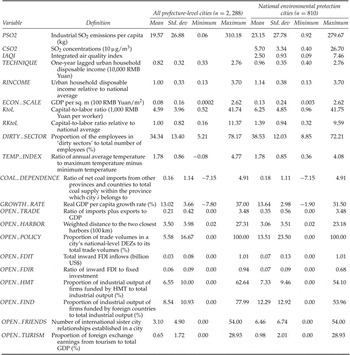
Variable definitions and descriptive statistics

Notes: (1) All the variables are measured in real value and year 2000 is the base. (2) National averages are calculated as the average of all cities for which data are reported in the year t. (3) ‘Dirty sectors’ include manufacturing industry, mining and quarrying industry, production and supply of electricity, gas and water industry. (4) Weight for measuring variable OPEN_HARBOR is the harbors' annual container handling capacity. (5) The distance is computed with the ‘Oblique Spherical Triangle Method’ using the latitudes and longitudes of the cities and harbors. (6) For the cities at the prefecture level and above, China official statistical books report social economic information based on two geographical boundaries, namely ‘Shiqu’ (referring to urbanized area) and ‘Diqu’ (referring to urban area and counties with agricultural production). In the present paper, we choose ‘Diqu’ to indicate urban boundary because some economic figures at the ‘Shiqu’ level are not readily available or not published officially in China, and the administrative boundary of ‘Shiqu’ has been more frequently adjusted than that of ‘Diqu’ during the investigated period. (7) DEZs refer to national-level Special Economic Zones, Shanghai Pudong New Area, Economic and Technological Development Zones, Free Trade Zones and Border Economic Cooperative Zones.
ECON_SCALE indicates the scale effect and is measured by real GDP per square metre. TECHNIQUE indicates the technique effect and is measured by one-year lagged urban household real disposable income. A lag is necessary because the response of environmental outcomes to environmental regulations is likely to be slow. The quadratic terms of TECHNIQUE and ECON_SCALE capture the possibility that the impacts of technique and economic scale may be nonlinear. In the literature, due to data availability, GDP per capita is often used as a proxy for technique effect, which causes problems of multicollinearity between the technique effect and the scale effect. For this reason, Cole and Elliott, (Reference Cole and Elliott2003) do not estimate the scale effect. In addition, the GDP is an indicator of production that may not represent income level well. Using city-level information, we are able to measure the technique effect by household income, allowing us to distinguish scale effects from technique effects; indeed, the demand for environmental quality will be a function of income while the scale effect is likely to be a function of domestic output (Kellenberg, Reference Kellenberg2008). With this measure, the multicollinearity problem is minimised. The overall correlation between GDP per capital and GDP per km2 in our sample was 0.876, while the overall correlation between household income and GDP per km2 was 0.531.
KtoL denotes the ratio of capital to labour and its square term is included to allow capital accumulation to have a marginal diminishing effect. The cross-product of KtoL and TECHNIQUE reflects the joint effect of income and the ratio of capital to labour. OPEN_TRADE indicates the level of international trade intensity and is measured by the ratio of imports and exports to GDP; RKtoL represents a city's ratio of capital to labour relative to the national average, and RINCOME refers to a city's real household income relative to the national average. CONTROL is a set of control variables.
To derive the ratio of capital to labour, the total capital stock of a Chinese city is calculated using the perpetual inventory method proposed by Goldsmith, (Reference Goldsmith1951) and deflated by the corresponding fixed asset investment price index. The total capital stock of a city in the base year (2000) is derived by multiplying the base-year capital stock of the province provided in Zhang, (Reference Zhang2008) by the GDP share of the province. The fixed asset depreciation rates are province specific and collected directly from Wu, (Reference Wu2008).
3.3. Choice of control variables
A city's GDP growth rate (GROWTH_RATE) was used as a control variable, as most of the previously cited works have noted that environmental degradation is driven by how fast the economy grows (Brock and Taylor, Reference Brock, Taylor, Aghion and Durlauf2005). In addition, faster economic growth also implies more trading between cities. Thus, to a certain degree, this variable represents the trading intensity between cities. Its impact on environment is expected to be negative; thus a positive sign is expected in the empirical model.
DIRTY_SECTOR indicates the proportion of city employees that work in the dirty industries. A higher proportion may result in higher pollutant emissions. Hence, this factor is expected to have a negative impact on environment. Using the China Industry Classification 2002, the industries with the top three one-digit coding for the average SO2 emission density (the ratio of annual SO2 emissions to output) between 2000 and 2008 are defined as ‘dirty’ industries (i.e., the manufacturing industry, the mining and quarrying industry, the production and supply of electricity and the gas and water industry). A positive sign is expected for this variable.
COAL_DEPENDENCE indicates the ratio of coal supply imported from other cities to the total coal consumption in a city. Energy consumption in China relies heavily on coal consumption. However, the coal mining industries are not evenly distributed throughout China. Some cities rely heavily on imported coal, which is more expensive than locally produced coal, leading to less coal consumption and fewer pollutants. This variable is expected to have a negative sign.
TEMP_INDEX is measured by the difference in extreme temperatures in a city within a year. Both air pollutant concentrations and emissions are largely influenced by the geographical and climatic conditions. Almond et al., (Reference Almond, Chen and Ebenstein2009) showed that the ambient concentrations of total suspended particulates in winter are dramatically higher in the northern Chinese cities than in the southern cities due to the demand for heating. This variable is expected to have a positive sign.
Table 1 presents variable definitions and descriptive statistics. The average industrial SO2 emissions per capita in the 112 national key environmental protection cities are 18 per cent higher than the national average. The annual disposable income of urban households in the 112 cities is 17 per cent higher than the national average, and the average economic scale in these cities is almost 63 per cent higher than the national average. A further exploration of the data shows that the ratio of capital to labour (KtoL) in these 112 cities is 41 per cent larger than the national average, and the international trade intensity (OPEN_TRADE) of these cities is 67 per cent higher than the national average. These data and the higher industrial SO2 emissions found in these cities imply that if freer international trade has generated a higher demand for the production of dirty goods in China, these goods are likely produced in these 112 cities (according to the FEH), suggesting the existence of a trade-induced composition effect. A further econometric analysis is needed to determine whether the above-mentioned relationships are statistically significant and to assess the scales of the impacts.
3.4. Endogeneity problem
Pollutant emissions and some economic variables may be endogenous. At least two papers have attempted to address the problem of endogeneity. Frankel and Rose, (Reference Frankel and Rose2005) addressed the likely endogeneity of trade and pollution by means of instrumental variables (IVs) using the gravity model. However, their cross-sectional approach cannot control the unobserved heterogeneity. In addition, their approach is based on bilateral trade flows between the countries; thus, it would be difficult for us to adjust the method to the city level. Managi et al., (Reference Managi, Hibiki and Tsurumi2009) used GMM methods to disentangle a variety of likely causal relationships using a cross-country data set. However, the authors did not discuss the instrument relevance. If the instruments are weak, the standard GMM estimates, hypothesis tests and confidence intervals become unreliable. Detecting and coping with weak IVs is more difficult in general nonlinear GMM than identifying and adopting weak IVs in linear IV regression (Stock et al., Reference Stock, Wright and Yogo2002). Weak IVs pose considerable challenges to inference using GMM methods, as they could lead to non-normal sampling distributions for GMM and unreliable confidence intervals (Stock and Wright, Reference Stock and Wright2000). In addition, the IVs are constructed using country-specific characteristics that are likely lurking somewhere in the error terms, which may cause other forms of estimation problems. Finally, a comparison of the results reported by both Frankel and Rose, (Reference Frankel and Rose2005) and Managi et al., (Reference Managi, Hibiki and Tsurumi2009) shows that the OLS estimates are virtually indistinguishable from the IV estimates.
Because of the above-mentioned concerns and the data constraints, we follow the premise of ACT (2001), and the factors on the right-hand side of equation (3) are assumed to be exogenous to pollution levels. A reduced form equation provides us with a simple, straightforward and parsimonious way of linking pollutant emissions to economic determinants.
3.5. Empirical results
3.5.1. Model selection
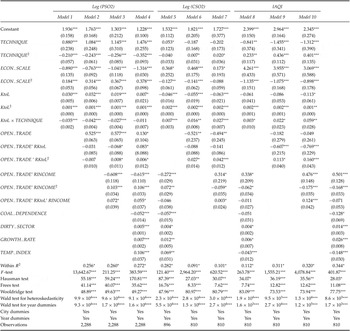
To empirically investigate how international trade intensity influences urban air quality in China, 10 empirical models (see table 2) are estimated against equation (3). Models 1–3 in table 2 are estimated using industrial SO2 emissions per capita as the dependent variable and the full sample of 286 cities. Models 4–10 are estimated using the sub-sample of 112 cities with industrial SO2 emissions per capita, SO2 concentrations and IAQI as the dependent variables.
The impacts of China's trade liberalization on urban air quality

Notes: *, ** and *** stand for statistically significant levels at 10%, 5% and 1%, respectively. Driscoll-Kraay (1998) standard errors are in brackets. All variables are defined in table 1.
When city effects and time effects are considered, the Hausman test favours the fixed-effect models to the random-effect models. Thus, results from the fixed-effect models are reported. Because ignoring spatial and temporal dependences in the estimation of panel models may lead to severely biased statistical results, three statistical diagnostics are employed, including two modified Wald tests to examine possible serial correlations (Wooldridge, Reference Wooldridge2002), heteroscedasticity (Greene, Reference Greene2000) and the test discussed in Frees, (Reference Frees1995) to examine if residuals from a fixed-effect estimation are spatially independent. The error structures in all of the estimated models are heteroscedastic, auto-correlated up to some lags and spatially correlated between the groups, which violates the assumptions of standard panel estimation methods. To produce heteroscedastic consistent standard errors and robust coefficients for the general forms of spatial and temporal dependence, we use the nonparametric covariance matrix estimator developed by Driscoll and Kraay, (Reference Driscoll and Kraay1998).
Our discussion focuses on the empirical findings drawn from models 3, 7 and 10 (table 2) for the following reasons. First, the framework of the ACT is developed to interpret emissions of industrial pollutants. Of the four industrial SO2 emissions models (models 1–4 in table 2), model 3 is estimated using a full set of related explanatory variables and the full sample. The coefficients of model 3 are robust and consistent with the results of model 4, which were estimated using a subsample. Second, model 7 is chosen from models 5–7 and model 10 is chosen from models 8–10 in table 2 based on overall model fits.
3.5.2. The impacts of three key effects on urban air quality
Model 3 in table 2 illustrates that the scale effect, technique effect and composition effect were robust and represented significant variables that explained industrial SO2 emissions per capita across urban China during the investigation period. First, a U-shaped relationship between scale effect and industrial SO2 emissions per capita is found. In China, a city that has a smaller economic scale is typically at an early stage of its urbanisation; its urban population growth rate is likely to surpass its total industrial SO2 emission rate, leading to decreasing industrial SO2 emissions per capita as its economic scale becomes larger. When the economic scale of these cities reaches a certain level, total emissions may be higher than the population growth. Industrial SO2 emissions per capita begin to increase as economic scale continues to increase. Second, an inverted U-shaped relationship between industrial SO2 emissions per capita and technique effect is found, which supports the EKC prediction. Third, a U-shaped relationship between industrial SO2 emissions per capita and composition effect is established. The rapid economic growth of Chinese cities endowed with high ratios of capital to labour was mainly achieved through a staggering expansion of heavy industry, which might have resulted in the accumulation of wastes from toxic chemicals and heavy metals and led to a larger energy consumption and increased emissions of air pollutants during the investigated period. However, environmental regulations resulting from rising income can significantly reduce the impacts of the composition effect, as shown by the negative cross-term of composition effect and technique effect.
In contrast to model 3, the overall model fit of model 7 shows that the ACT (2001) framework is less able to explain variations in SO2 concentrations. Both scale effects and technique effects are non-significant. However, the cities with higher ratios of capital to labour have higher SO2 concentrations; furthermore, rising income enhances the impact of the composition effect, as shown by the positive cross-term of composition effect and technique effect. A closer look at Chinese urban environmental policies during the investigation period reveals that the Chinese government had issued a series of policies to reduce the impacts of industrial SO2 emissions (see the remove rate change illustrated in table A1) on the environment; however, few policies were imposed on consumption-related pollutant emissions. Instead, to boost economic growth, the government has been trying to stimulate consumption. These findings imply that the SO2 concentrations in a Chinese city are mainly from consumption-related SO2 emissions.
The model fit of model 10 shows that the ACT framework performs well and that the coefficients explaining IAQI (an index of four pollutant concentrations) are robust. Although the findings are largely contradicted by the ACT predictions, most are explainable; however, an unexpected inverted U-shaped scale effect is found that cannot readily be explained. The U-shaped technique effect and the U-shaped composition effect show that rising income eventually worsens urban air quality (based on IAQI) and that cities endowed with higher ratios of capital to labour may also have worse air quality; the two effects also appear to reinforce each other (see the cross-term of two effects in model 10). These findings support our conjecture that pollutant concentrations in Chinese cities are mainly from consumption due to weak environmental policy.
In summary, during the investigation period, larger economic scales and higher factor endowments are bad for urban air quality. Because China's environmental policies focus on the control of industrial sources of pollution, rising income increases consumption-related pollutant emissions but fails to bring about a stronger policy to control these emissions.
3.5.3. The impacts of international trade and trade-induced composition effects
Models 3, 7 and 10 in table 2 show that the intensity of a city's international trade significantly increases industrial SO2 emissions, decreases SO2 concentrations and has no significant impacts on IAQI. One possible explanation for this finding is that, when other factors are held constant, freer international trade in a city will increase industrial SO2 emissions because of higher levels of trade-induced production activities; however, freer trade may also bring about international social economic activities that may boost social awareness of environmental protection, leading to increases in the removal of pollutants and lower pollutant concentrations.
For industrial SO2 emissions, international trade does not induce a composition effect (as shown by the non-significant cross-terms of OPEN_TRADE and RKtoL in model 3). For SO2 concentrations, the coefficient of OPEN_TRADE is significantly negative, implying that international trade does not induce a composition effect. This conclusion is further supported by the findings of model 10 in table 2. The same cross-terms appear to be significant. However, the coefficient of OPEN_TRADE is non-significant, suggesting that the significances of the cross-terms are due to the impact of the relative capital abundance (RKtoL) rather than to the trade-induced composition effect. As a result, the FEH should be rejected. A relatively capital-abundant Chinese city with more international trade does not necessarily export more polluting goods.
As shown in model 3, the cross-terms of ‘OPEN_TRADE’ and ‘RINCOME’ are positive and significant, with a U-shaped effect on industrial SO2 emissions per capita. The same cross-terms are not statistically significant in model 7. Although the cross-terms in model 10 of table 2 are negative and significant, the coefficient of OPEN_TRADE appears to be non-significant. Therefore, the significance of the cross-terms does not represent the trade-induced effect. These findings seem to contradict the PHH.
A caveat should be noted here: namely, the trade in a city includes both international trade and the trade between any two cities. Trade between cities is believed to have trade-induced composition effects. However, data reflecting trade between cities are not publicly available. In the present study, both hypotheses are tested by considering only the impacts of international trade on the environment.
A conceivable conclusion is that, during the investigation period, the intensity of international trade directly reduced industrial SO2 emissions and SO2 concentrations; however, the intensity of trade does not significantly induce the redistribution of the production of polluting goods across cities in China.
3.5.4. The impacts of the characteristics of a city
Because imported coal is expensive and forces dirty industries to adopt cleaner technology, Chinese cities that are highly dependent on imported coal have fewer industrial SO2 emissions (model 3) and lower concentrations of integrated air pollutants (model 10). Higher numbers of employees in dirty industries and higher economic growth rates lead to more industrial SO2 emissions and higher concentrations of integrated air pollutants. Extreme local weather increases industrial SO2 emissions but reduces SO2 concentrations (model 7 in table 2) and the overall concentrations of integrated air pollutants. One explanation for this is that extreme weather may result in higher coal consumption but also in windy, rainy and snowy days that can naturally clean the air. These findings show that city characteristics shape the pattern of air pollution.
3.5.5 Which impact is stronger?
Technique, scale and composition effects explain more than 90 per cent of the total variation in air pollution, as shown by the changes in model fits in models 1–3 in table 2. As a result, these factors are best able to explain variations in industrial SO2 emissions. Four control variables explained nearly 5 per cent of the variation, while international trade intensity and trade-induced composition effects explained less than 1.5 per cent of the variation. Table 3 reports the elasticities of the three effects and the impact of international trade intensity (OPEN_TRADE), a variable derived using an average city in each reference group as the reference point in 2001 and 2008 separately.
Elasticity comparison for industrial SO2 emissions

Notes: Elasticities are evaluated at sample means. Rich cities are the income top 30% cities. Poorer cities are the income bottom 30% cities.
In terms of absolute values, technique effects outperform the other two effects and dominate the impact of international trade intensity; this pattern was particularly pronounced in 2008. Technique effects also appear to be much stronger in rich cities and in the wealthier eastern cities, illustrating that environmental policies play an important role in determining urban air quality.
The composition effects are stable and positive in both years and across sub-samples (the elasticities range from 0.020 to 0.026). Surprisingly, the scale effects are negative. This is because the reference city is on the decreasing portion of the U-shaped curve of scale effect; the impact of freer trade was therefore much stronger in 2008 than in 2001 (the elasticity increased from 0.001 to 0.015), reflecting the accumulated effect of freer trade on the environment. The elasticities of industrial SO2 emissions per capita on OPEN_TRADE in the wealthier eastern cities are negative, which is consistent with the conclusions of cross-country studies (Managi et al., Reference Managi, Hibiki and Tsurumi2009). The technique effects indicate that wealthier cities have more stringent environmental policies. In these cities, it is likely that freer trade will enhance the use of cleaner production technology (which reduces industrial SO2 emissions) instead of increasing the production of dirty goods.
In summary, China's urban air quality is largely determined by scale, technique and composition effects. The increased intensity of international trade marginally increases industrial SO2 emissions and decreases SO2 concentrations, implying that international trade may not be a bad thing for urban air quality. Of all of the determinants, technique effects play a dominant role, indicating that environmental policy is the key to reversing urban air degradation.
4. Are other aspects of openness good for the environment?
The openness of a city resulting from the open-door policy in China not only exposes Chinese cities to a wider range of international trade but also brings about changes in many other aspects, including increased numbers of foreign firms, rising FDI inflows and enhanced international cultural exchanges. These international activities may enhance public environmental awareness and bring cleaner production technologies, which, in turn, may have beneficial effects on the environment. This section examines these possible impacts.
4.1. Model specification
Equation (3) is modified to empirically estimate the impacts of openness on the environment. First, openness is measured by five different aspects: trade policies, nature openness, FDI inflows, economic activities of foreign-funded enterprises, and international cultural exchanges. Second, technique, scale and composition effects are included in the model, as they are the main factors affecting industrial SO2 emissions. Finally, the cross-terms between openness and these three factors are omitted, as we are reluctant to posit that measures of openness other than international trade would induce any composition effect.
Trade intensity, measured by the ratio of imports and exports to GDP, is sometimes criticised for combining the effects of trade policy and ‘natural’ openness (e.g., Berg and Krueger, Reference Berg and Krueger2003). Here, we take advantage of the rapid proliferation of designated economic zones (DEZs) established after 1980 and the special geographic features of the Chinese territory to separately examine the impacts of ‘natural’ openness and policy openness on the environment. Given the typical policy package implemented in Chinese DEZs, the ratio of trade volumes at the level of the DEZ to the total international trade in a city (OPEN_POLICY) is used as a proxy for policy openness.
A harbour accessibility index (OPEN_HARBOUR) is constructed to indicate ‘natural’ openness. Because seaports vary considerably in quality, we quantify the differences using the annual container-handling capacity of each seaport. The weighted shortest distance of a city to its two nearest harbours is then calculated. If a city has weak environmental policies, higher accessibility to main harbours leads to greater environmental damage.
After China entered the WTO in 2001, a surge of FDI flowed into the country; these flows were unevenly distributed among the industries and cities in China. Two variables are constructed to study the influence of FDI inflows on air quality. OPEN_FDIR is the proportion of the total investment of a city represented by FDI inflows. If FDI merely represents an infusion of capital into a city (i.e., the advanced clean production technology that it brings does not spill over to the other firms in the city), its influence on the environment will be proportional to its share of the total capital investment of the city. OPEN_FDIT is the total FDI inflows deflated by the GDP deflators (year 2000 as the base). This variable is necessary because it is possible that substantial spillover occurs across the firms in a city through agglomeration effects and backward economic linkages. Higher total amounts of FDI may lead to increased pollutant emissions.
A number of recent studies have demonstrated a ‘pollution halo’ effect, suggesting that newer, cleaner technology, better environmental management systems and demands from ‘green consumers’ have made multinational corporations better vehicles for improving performance than domestic firms (e.g., Eskeland and Harrison, Reference Eskeland and Harrison2003; Cole et al., Reference Cole, Elliott and Strobl2008). Two variables are constructed to capture this effect: the ratio of industrial outputs of the firms funded by foreign countries to the total industrial outputs of a city (OPEN_FIND), and the ratio of industrial output of the firms funded by Hong Kong, Macau and Taiwan to total industrial outputs in a city (OPEN_HMT).
Cultural exchanges may enhance the impact of informal social norms, rules and unwritten codes of conduct, which may increase public awareness of the environment. Since 1973, many Chinese cities have established sister city partnerships with foreign cities. In 2008 approximately 1,084 cities or communities overseas had partnered with 229 Chinese cities, and the number is growing. One goal of the official sister city agreement is to seek solutions for environmental degradation together. Given this background, we use the total number of sister city relationships (OPEN_FRIENDS) established in a city as a measure of the city's cultural openness. Moreover, given the boom in tourism and its lasting effects on the environment (Robinson and Picard, Reference Robinson and Picard2006), the ratio of foreign exchange earnings from international tourism to GDP (OPEN_TURISM) is used as another proxy for China's international culture exchange. The impact of these factors on the environment is expected to be positive.
Table 1 gives the definition of these variables and descriptive statistics. In the next section, a set of empirical models are estimated to test whether these factors have significant impacts on industrial SO2 emissions.
4.2. Estimation results
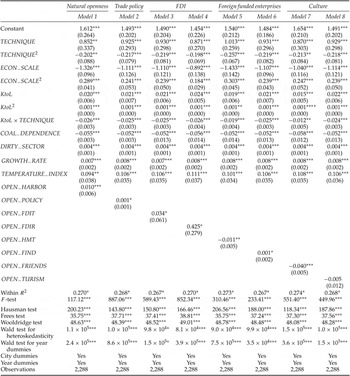
The empirical results of the modelling of industrial SO2 emissions per capita against the full sample of 286 cities are reported in table 4. As shown in table 4, the coefficient of ‘OPEN_HARBOUR’ is significant and positive, while that of ‘OPEN_POLICY’ appears to be non-significant. Yamarik and Ghosh, (Reference Yamarik and Ghosh2011) confirm this finding, suggesting that ‘natural’ openness has a higher impact on the environment than trade policy. When both ‘OPEN_HARBOUR’ and ‘OPEN_POLICY’ are included in the model, ‘OPEN_POLICY’ also appears to be non-significant.
The impact of China's openness on its air quality (dependent variable: log (PSO2))

Notes: *, ** and *** stand for statistically significant levels at 10%, 5% and 1%, respectively. Driscoll–Kraay (1998) standard errors are in brackets. All variables are defined in table 1. Because OPEN_HARBOR measures the inverse of openness, its sign has thus to be reversed to interpret the direction of the estimates as an increase in openness.
In contrast to our expectation, FDI inflows do not have statistically significant impacts on industrial SO2 emissions. He, (Reference He2006) found that a 1 per cent increase in FDI capital inflows results in an increase in industrial SO2 emissions of 0.098 per cent. Since China entered the WTO in 2001, the emergence of FDI in the service sectors has been gradually supplanting FDI in traditional manufacturing. At the same time, FDI in energy-efficient and environmentally friendly clean industries has been encouraged. These recent inter-sector and intra-sector shifts in FDI inflows may be partly responsible for the discrepancy between our findings and those of He, (Reference He2006).
A further investigation of the sources of FDI shows that the industrial activities of the enterprises funded by ethnically Chinese economies produce fewer industrial SO2 emissions, while the enterprises funded by foreign economies have a non-significant impact on emissions. One interpretation of this finding is that following co-ethnic networks and wider processes of globalisation, the joint-equity ventures funded by ethnically Chinese sources are more susceptible to reputation risks, foreign green consumerism and global standards. In contrast, as Copeland et al., (Reference Copeland, Taylor and Scott1994) finds, joint-equity ventures funded by non-ethnically Chinese sources are not sensitive to environmental standards. A good case in point is the pronounced specialisation that occurred in the northwestern region where natural resource-based activities dominate. These firms are subject to impediments in mobility and might use time rather than location to mitigate the adverse effects of regulatory changes. These findings are also supported by Cole et al., (Reference Cole, Elliott and Zhang2011).
The estimated coefficient of ‘OPEN_FRIENDS’ is statistically significant and negative, implying that international cultural exchanges play a significant role in decreasing industrial SO2 emissions per capita. The ‘OPEN_TOURISM’ variable has a non-significant negative coefficient. One possible explanation for this finding is that city-specific differences in international cultural exchanges may already be captured by the fixed effects; another explanation is that international tourism is not a good proxy of actual international cultural exchanges. Research on the role of cultural exchanges in environmental protection has been largely absent in economic research. This is primarily because it is difficult to find an approach that is capable of distinguishing the effects of cultural exchange from those of the economic and institutional factors that also influence the environment.
In summary, the different forms of openness matter in the protection of China's urban environment. Foreign-funded firms and international cultural exchanges may bring in cleaner production technology and enhance public awareness of the environment, which can have a positive impact on China's environmental protection; natural openness, in contrast, tends to be detrimental to the environment. FDI and trade policy appear to be non-significant, perhaps due to measurement error in our models; as a result, further investigation is needed to confirm this finding.
5. Conclusion
Two main conclusions can be drawn from this paper. First, urban air quality in China is mainly determined by scale effects, technique effects and composition effects; technique effects are the dominant of the three, implying that environmental policy is the key to reversing the degradation of urban air. Second, the intensity of international trade plays a marginal negative role in urban air quality, while the variables that represent the portion of foreign-funded firms and international cultural exchanges play a positive role in environmental protection. Both of these findings imply that openness is not necessarily a bad thing for the Chinese environment.
One implication of our findings is that China's environmental policy seems to be effective at controlling the emission of industrial pollutants but ineffective at controlling the emission of consumption-related pollutants. Thus, to reverse the degradation of urban air in China, the government may need to strengthen its control of consumption-related pollutant emissions. While developing energy-efficiency technology is crucial, limiting unnecessary consumption is also important.