Introduction
My personal interest in these matters begins in Rome, Italy at the Bibliotheca Hertziana, Max-Planck-Institute for Art History. A German research institute in the heart of Rome, the Hertziana is home to one of the most extensive collections on Italian art history, with approximately 330,000 modern volumes, 20,000 rare books, and 800,000 photographs. As an employee since 2015, my duties were principally focussed on cataloguing and service at the reference desk. However, when in May 2017 the library experienced a water infiltration, caused by a combination of adverse weather and structural failures, I became interested in the field of emergency preparedness and made the incident a starting point for my Master's thesis in Library and Information Science.Footnote 1 Like many other libraries, museums, and archives, the Hertziana had no emergency plan dedicated to the collection, nor a position for a preservation librarian.
By good fortune, an external team of conservators was at the institute at the time of the water infiltration, working with the Rare Book Collection, and they directed the immediate salvage efforts. As I began to work on issues of prevention and preparedness over the following months, the collaboration with these professionals was invaluable. Merging research, practice, and policy, I integrated many new elements into my other tasks: assessing risks, establishing an emergency team, working on an emergency plan, building an environmental monitoring system, and forging alliances inside and outside the institution, in order to prepare the collection for future emergencies. A special focus lay in climate control, given that on several occasions both library and photographic collections suffered mould infestation.
The survey among national libraries around the world, which I conducted for my MA thesis in early 2018, aimed to determine the level of preparedness of these institutions, presumably leaders in their respective countries. The results were sobering enough to reinforce my determination to search for a deeper understanding of the mechanisms that lead to these limitations and to engage actively in the field of emergency management. Opportunities for both activities readily presented themselves – daily at the Hertziana and in the form of the ARIAH-RIHA fellowship at the Frick Art Reference Library in New York City.
The Frick Art Reference Library
A prestigious art research library situated in the world-famous complex of the Frick Collection on Fifth Avenue in Manhattan, the Frick Art Reference Library (FARL) holds a priceless collection of books and journals, sales and exhibition catalogues, and photographs. Local and international researchers in the field of the fine arts regularly use the collection of about 400,000 volumes and over a million photographs, many of them unique to the library. Dr Stephen Bury, Andrew W. Mellon Chief Librarian at FARL, and his staff were extraordinarily welcoming and willing to share their time and their knowledge. My main goal for the three weeks of my fellowship was to create a risk register and assessment for off-site storage of library materials, in preparation for a major move of the collection.
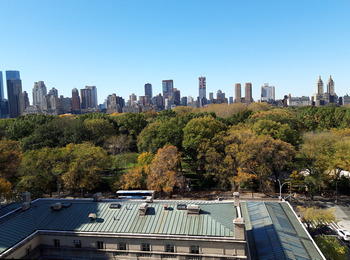
View from the rooftop of Frick Art Reference Library across Central Park. Photography by Cornelia Posch, October 2019.

Project: Risk Assessment
Since 2008, FARL has been keeping parts of the collection offsite in the Tri-State Depository run by Clancy Relocation and Logistics (Clancy). Due to a major building and renovation project involving both the Gallery and the Library, the library needed to prepare to move 100% of their holdings (reference library, rare materials, manuscripts, and photographs) to the off-site storage facility in New York State by the end of March 2020 and, according to the plans, not more than 40% were to come back after completion of the works. To better grasp current and future complications of these moves, the library decided to have a risk assessment generated, comprising every imaginable risk the collection could incur during the move, at the storage facility, and while being handled for delivery requests. The risk register for a digitization project FARL had planned in 2017 served as a model for the assessment.
In order to understand processes and issues at FARL, I worked closely with Director Bury, and with the Head of Public Services, Suz Massen, who coordinated all activities concerning the move of materials to the off-site facility, as well as Luciano Johnson, Head of Conservation, whose team prepared the collection for the move. My first task was to become familiar with the workflow for incoming and outgoing deliveries between the off-site location and the library, which were already in progress at the time of my visit. Next, I joined a small group from FARL to visit the storage facility in upstate New York. This visit enabled me to see and assess the warehouse and talk to officers and workers who handle the books that come and go between the off-site facility and Manhattan. In preparation for our visit, I had sent questions to Clancy covering topics like security, climate control, and disaster preparedness. Most useful in my preparatory research was a checklist produced by the state-based Georgia Archives Preservation Services.Footnote 2
In developing the risk register and assessment, I worked with the Director to set the focus on seven areas of potential harm for the collection: Security/Access, Preservation/Conservation and Housekeeping, Transit, Documentation and Access to Books, Calamities, Maintenance, and Costs. For every area of concern, my goal was to list concrete, potentially damaging events, like theft, damage to books, or issues with the delivery of material to the library. We know now that among “calamities”, we should have included not only fire, earthquakes, storms, floods, and terrorist attacks, but also a pandemic. We had considered the risk of the storage facility being closed due to structural damage after a disaster or due to economic complications, but we had not anticipated the complex ramifications of a shutdown of the library caused by Covid-19.
To obtain an indicator of the level of risk for each of the subcategories, we assigned them a probability (from one to three) on the likelihood of a given event and an impact index (from one to three) to rate the degree of severity of disruption, damage, or other impact. The assigned values for probability and impact were based on the evaluation of my extensive conversations with staff at the library and the storage facility, an examination of internal documents, (e.g. the Frick Emergency Plan), observations during the site visit to the warehouses, and on responses from Clancy to a detailed questionnaire. The resulting risk score (Risk = Probability x Impact) varied, with the most frequent score being three. In a next step, we listed mitigation measures and solutions for contingencies. A second risk score was determined, considering in this instance the potentially positive effect of the mitigation measures. In a meeting with the department heads we discussed responsibilities and timelines regarding the anticipated steps, as well as considerations of duration for a given mitigation, ranging from a few weeks to months or more.
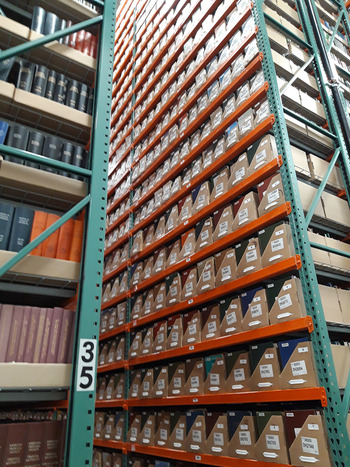
Off-site storage facility, upstate New York. Photography by Cornelia Posch, October 2019.

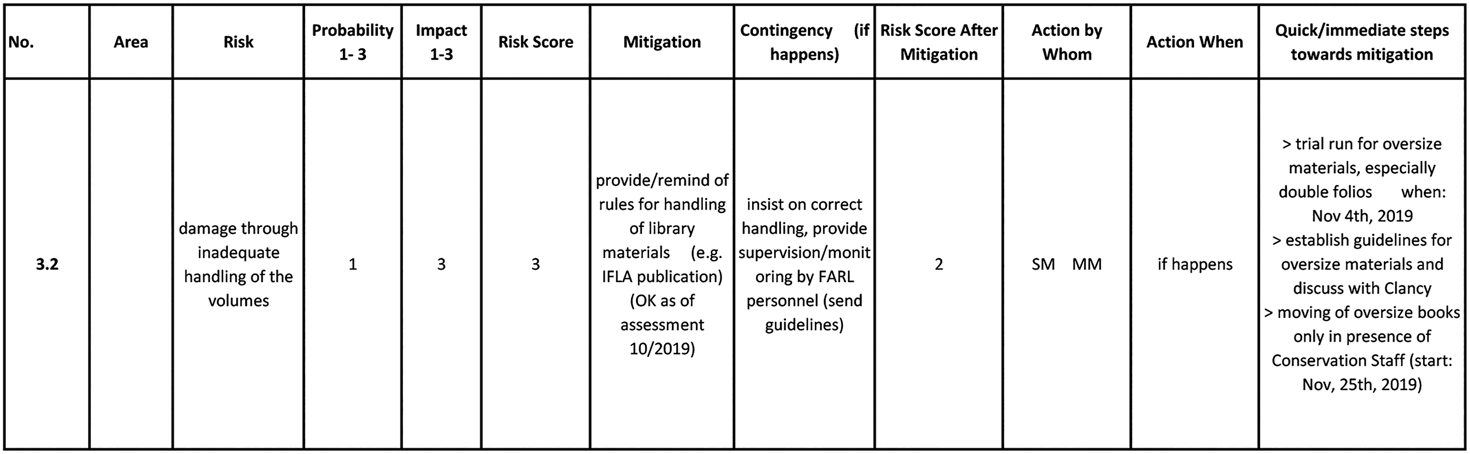
Figure 3 shows an example of the analysis. We analysed the risk of damage through inadequate handling of the volumes as a subcategory of area 3.2, i.e. transit. This risk was particularly relevant for vulnerable materials like oversized volumes. Since the staff at Clancy was trained to handle library materials, a harmful event was not very likely to materialize (=one), nevertheless, the possible impact could have been very significant (=three), resulting in a risk score of three. As a mitigation measure, FARL staff resolved to remind Clancy staff of basic principles for the care and handling of library material and provided them a relevant publication by IFLA (International Federation of Library Associations and Institutions).Footnote 3 In the event of damage, FARL conservation staff would insist on compliance with IFLA standards, providing specific guidelines for conservation, and monitoring the operations. Those measures, which were expected to reduce the risk score from three to two, would be implemented by the liaison for Clancy at FARL and a senior member of the conservation department. Concrete steps for immediate action included a trial run for the transport of oversize materials, the creation of guidelines for handling of oversize materials, as well as the condition that those materials could only be moved in presence of conservation staff.
Detail of Risk Assessment analysis, Frick Art Reference Library.

This method of analysis had several advantages: Breaking down the many aspects of moving a collection off site, it was easier to identify potential risks and take action in manageable ways. A rather simple model for a risk analysis enables a library to perform the assessment autonomously without hiring outside consultants. My collaboration with the FARL gave them the advantage of having somebody knowledgeable in the field but new to the institution to look at the building and the processes with fresh eyes.
The final assessment of the relocation project offered a positive impression of two highly professional partners in a complex enterprise. The moving company ran a smoothly-functioning operation with extraordinary focus on customer needs and customer satisfaction, while the library made sure that its collection was safe and available to its patrons. Cooperation between staff on both ends appeared to work well, on a basis of trust and openness to discuss and resolve emerging issues.
Ten takeaways for libraries that are preparing a move
• Make peace with the fact that risks cannot be fully eliminated. By analysing and planning carefully, they can be reduced to an acceptable level, and by prioritizing rare, unique, and vulnerable volumes in the collections, you do your part to protect the most valuable items.
• When moving a collection, work with companies and professionals who are trained in handling library materials. Moving household items and moving books are not the same.
• Find out what your storage facility offers for remote controls. After being in lockdown for weeks, it has become clear to see how important access to the systems in the facility can be – at a minimum, systems for water, electricity, and the HVAC system should be controllable from a distance.
• Make sure the storage facility shares its up-to-date emergency procedures with you.
• Take the time for trial runs when it comes to special objects or oversize materials. Test ways to pack and transport these items, and make sure there are no surprises when the moving train gets busy.
• If you have a conservation department, make time for it to inspect the collection. There might be a need to box or treat volumes before they can be moved.
• A complex operation like a move of the entire collection has at least one positive aspect: it is an opportunity for review, a moment to make decisions about organization, (de)accession, and change of policies.
• Make time for a site visit at the storage facility to get an understanding of the place with greater precision: Is its access secured (e.g. with magnetic cards)? How thorough is the housekeeping? Are windows and doors tightly sealed? What about pests? How are boxes and books handled?
• Request information about environmental conditions in the storage facility. Demand that temperature and relative humidity are being monitored and get regular reports or direct access to the data.
• Make sure you have open and reliable communication channels, internally and with the external contractors. Misunderstandings or mistakes happen and making sure everybody has updated information at all times can minimize those errors and help to resolve issues when they do occur.
The risk we didn't take into account
The Covid-19 pandemic hit in early 2020, impacting almost every country in the world, on a scale that had not been seen before, even though health and disaster experts had anticipated a large contagious event not too long ago, exercising for a scenario that is eerily close to what the world has been facing since January.Footnote 4
Like numerous other institutions, the Frick had to close in March 2020 and therefore had to alter the timeline of all planned projects. At the time of the writing, the move of the books to storage and of the offices to the Frick Madison (the former Whitney Museum and former Met Breuer), which is the temporary location for the duration of the construction and renovation, has been completed. A small part of staff has resumed work at the new site. Currently, both the Frick Collection and the Frick Art Reference Library plan on reopening to the public in early 2021. Clancy was able to continue operations throughout the year and is delivering books to various locations, including the Frick Madison. Working from home, the staff at the FARL has developed online programs for researchers and the interested public to stay connected and to assist patrons in efforts to obtain remote access to materials from collections all over the world.Footnote 5
While we witness the direct impacts of the pandemic on cultural institutions, we know that it will take years to grasp the full scope of disruption it has caused and may continue to cause. As libraries prepare to reopen, they face new challenges such as the implementation of rules regarding hygiene and social distancing, and the frequently changing guidelines concerning the survival of the virus on surfaces, with consequences for circulating materials and activities in the library. Collective efforts to offer library services and find ways around the crisis are occurring across the world, with librarians, conservators, and scientists convening online to exchange their findings and work on strategies for the future.Footnote 6
Visiting other institutions
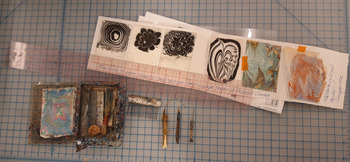
The fellowship gave me the opportunity to meet with many people inside and outside of FARL who have expertise related to my interests. With the assistance of Director Bury, I visited the Conservation Lab at the Morgan Library, where Head Conservator Maria Fredericks was very generous with her time and shared her experience in an extraordinary collection. We compared notes on concerns like emergency procedures and climate control and reviewed some of the current projects of their staff and fellows. Equally fruitful was a visit to the Conservation Lab at the Watson Library (Metropolitan Museum of Art). Preservation Librarian Mindell Dubansky introduced me to their emergency procedures and materials and shared her current research on the Paper Legacy Project, the first collection of original materials by American paper artists. Meetings with Brenna Campbell, Preservation Librarian at Princeton University Library, and Alexis Hagadorn, Head Conservator at Columbia University Libraries gave me an overview of daily routines and special challenges in two outstanding collections.
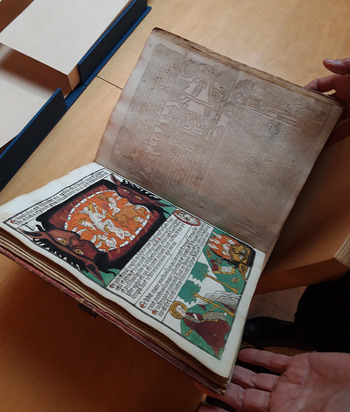
A current project at the Conservation Lab a at the Morgan Library, October 2019. Reproduced with permission of The Morgan Library & Museum. Photography by Cornelia Posch, October 2019.

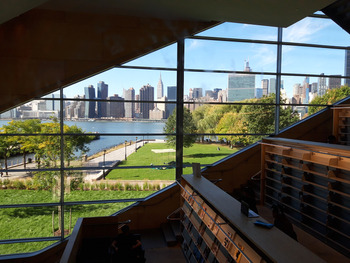
I was also fortunate to participate in “Open House New York” weekend, which allowed wide access to buildings and businesses with cultural interests, many of which are usually not open to the public. The visit to the new Queens Public Library at Hunters Point, which had opened only a few weeks before, confirmed another truism of library work: the importance of involving library staff in planning processes. The brand new construction is fascinating and offers a breathtaking view across the East River, yet it had many issues of accessibility, safety, and practicality, which were discovered only a few weeks before the opening, when the library took possession of the building.
Marbling kit created by Paul Maurer, collected by Mindell Dubansky for the Paper Legacy project. Permalink: https://library.metmuseum.org/record=b1999590~S1 Photography by Cornelia Posch, October 2019.

View from the Queens Public Library at Hunters Point. Photography by Cornelia Posch, October 2019.

Conclusions
Working with staff at FARL was an enriching professional experience. The visit confirmed my conviction that in order to advance the role of libraries as fundamental tools of knowledge and research instruments for the academic community and the general public, exchange of information and collaboration within and outside an institution are key elements for enhancing daily work and special projects.
The experience gave me a newly confirmed appreciation for good (emergency) planning and serious discourse on risks and their mitigation. Special attention to the preservation of collections in the face of climate change, shortage of space, new and different demands by patrons and more heeds to be at the centre of the efforts of staff in libraries and related cultural institutions. Sharing expertise and learning from each other is certainly essential for these facilities to thrive under increasing pressures of all kinds.