I. INTRODUCTION
As an emerging class of structural materials, bulk metallic glasses (BMGs) with excellent mechanical properties have attracted much attention. Reference Eckert, Das, Pauly and Duhamel1–Reference Johnson4 However, at temperatures far below the glass transition and at high stresses, inhomogeneous plastic flow localized within narrow regions, being termed as shear bands, strongly governs both strength and ductility of BMGs. Reference Sun and Wang5–Reference Schuh, Hufnagel and Ramamurty7 Recent studies have demonstrated that a remarkable enhancement of the compressive plasticity of BMGs can be achieved by changing intrinsic properties of BMGs, extrinsic materials properties, and experimental factors to promote the formation of multiple shear bands in the glassy matrix during deformation. Reference Cheng and Ma2,Reference Lewandowski, Wang and Greer8–Reference Wang, Qiao, Tian, Sun, Wang, Xu and Chen14 After elastic deformation but prior to macroscopic yielding, the dominant shear band has already initiated in a progressive propagation manner and then transects the whole sample after obvious yielding. Reference Thurnheer, Haag and Löffler15,Reference Qu, Liu, Wang and Zhang16 With increasing compressive plastic strain, shear bands propagate in a simultaneous sliding manner. Reference Thurnheer, Haag and Löffler15,Reference Qu, Liu, Wang and Zhang16 It is very difficult to control the initiation of the dominant shear band which occurs during the so-called “transition stage” between the elastic and plastic stages since it is mainly governed by intrinsic properties of BMGs. Reference Thurnheer, Haag and Löffler15,Reference Qu, Liu, Wang and Zhang16 Hence, so far, most studies have focused on how to induce the multiplication of shear bands, i.e., on how to manipulate the propagation of shear bands during deformation, Reference Cheng and Ma2,Reference Lewandowski, Wang and Greer8–Reference Schroers and Johnson21 to enhance the ductility of BMGs at room temperature.
During deformation, the interactions of multiple shear bands in the glassy matrix can effectively suppress the rapid propagation of the dominant shear band in a simultaneous sliding manner. Reference Cheng and Ma2,Reference Sun and Wang5–Reference Schroers and Johnson21 Based on the contribution of shear banding to the plasticity, the final plastic strain before fracture of BMGs with a little compressive plasticity can be roughly estimated from the maximum shear offset of the dominant shear band and the shear angle of the shear plane with respect to the loading axis. However, this approach often underestimates the achievable plastic strain for ductile BMGs to some extent. Reference Qu, Liu, Wang and Zhang16 This suggests that it is not sufficient to further enhance the room-temperature ductility only by inducing the multiplication of shear bands in attempt to curb the rapid propagation of the dominant shear band since a great majority of the whole compressive plastic strains of BMGs still originate from the movement of the dominant shear band.
Therefore, it is necessary to clarify whether the formation of multiple shear bands is a necessary and sufficient condition for the enhancement of ductility of BMGs. In this work, to inhibit the rapid propagation of the dominant shear band, ex situ shape memory stainless steel (SMSS) wires were introduced into the Cu47Zr47Al6 BMG. Such ex situ prepared BMG composites were fabricated without considering the bonding of SMSS wires with the glassy matrix to avoid the formation of multiple shear bands during deformation. Meanwhile, the in situ fabricated CuZr-based BMG composites consisting of shape memory B2 CuZr crystals were also prepared in an attempt to induce the multiplication of shear bands during deformation. Then the shear banding stability associated with the serrated flow steps during compression was investigated based on the analysis of stress–strain curves for both of BMG composites as well as BMG samples.
II. EXPERIMENTAL PROCEDURE
Cu47Zr47Al6 (at.%) master alloys were prepared by arc-melting appropriate amounts of the constituting elements (>99.9% purity) under Ti-gettered argon atmosphere. The master alloys were remelted at least three times to achieve chemical homogeneity. Then the rods with a diameter of about 2 mm and a length of 40 ± 35 mm were fabricated using a custom-made suction–casting device under argon atmosphere. Here, ex situ CuZr-based BMGs composites were obtained by inserting SMSS wires into the center of the copper mold during suction casting. The chemical composition of the SMSS wires was estimated to be Fe71.95Cr19.57Ni7.54 Si0.94 (at.%) and their diameter was approximately 560 μm. Reference Kajiwara22 Furthermore, by controlling the melting current and melting time, Cu47Zr47Al6 BMG and its composite with B2 CuZr crystals precipitated in the glassy matrix were fabricated. Reference Song, Pauly, Sun, Tan, Stoica, Kühn and Eckert23,Reference Pauly, Das, Bednarčik, Mattern, Kim, Kim and Eckert24 It has been demonstrated that the serration behaviors in CuZr-based BMG composites during compression become unclear when the crystalline volume fraction is more than 20 vol%, Reference Song, Pauly, Sun, Tan, Stoica, Kühn and Eckert23 which cannot facilitate the statistical analysis of the serrations detected in the compressive stress–strain curves. In this regard, the crystalline volume fractions for the investigated BMG composites were carefully controlled to be less than 12 vol% to obtain clearly serrated flow behaviors in the compressive stress–strain curves. The phase analysis of the as-cast BMG and its composites was carried out using X-ray diffraction (XRD; Rigaku D/max-rB, Rigaku, Tokyo, Japan) in a reflection geometry, scanning electron microscopy (SEM; Gemini 1530, Carl Zeiss Microscopy GmbH, Oberkochen, Germany), and optical microscopy (OM; Axio Scope.A1, Carl Zeiss Microscopy GmbH, Oberkochen, Germany). Room-temperature compression tests were performed on specimens with a diameter of about 2 mm and a height of 4 ± 0.2 mm using an electronic universal testing machine (CMT 5305, New SANS, MTS, Shenzhen, China) at an initial strain rate of 2.5 × 10⁻⁴ s−1. Both the surface and fracture morphologies of the samples after deformation were investigated by SEM.
III. RESULTS AND DISCUSSIONS
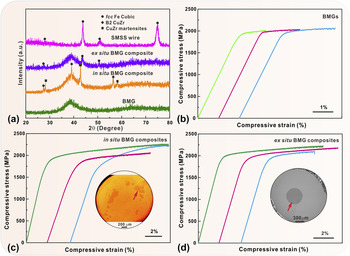
Figure 1(a) shows the XRD patterns of the as-cast Cu47Zr47Al6 BMG and its composites together with the SMSS wire. There were no crystalline reflexes detected in the XRD patterns for the BMG samples. A broad diffraction maximum around 2θ = 38.5° is due to the amorphous nature of the specimens. As shown in Fig. 1(a), some B2 CuZr and CuZr martensitic crystals precipitate in the glassy matrix for the in situ fabricated CuZr-based BMG composites. The applied melting currents and times are smaller and shorter than those commonly used for the fabrication of BMGs so that the arc-melt ingots could be in a semisolid state during actual suction casting. Reference Song, Pauly, Sun, Tan, Stoica, Kühn and Eckert23,Reference Qiao, Jia and Liaw25 When a melt is in a semisolid state, a high density of primary phase already precipitates, which can facilitate the formation of B2 crystals in the glassy matrix during quenching. Reference Pauly, Das, Bednarčik, Mattern, Kim, Kim and Eckert24,Reference Todinov26–Reference Wu, Song, Cao, Li, Wang, Wu, Wan, Ding, Shi, Bai, Kaban and Eckert28 Meanwhile, CuZr martensites should be induced within B2 CuZr crystals by the internal stresses generated during quenching. Reference Pauly, Das, Bednarčik, Mattern, Kim, Kim and Eckert24,Reference Todinov26–Reference Wu, Song, Cao, Li, Wang, Wu, Wan, Ding, Shi, Bai, Kaban and Eckert28 As shown in the insets in Fig. 1(c), some spherical crystals precipitate in the glassy matrix for the in situ prepared BMG composites, and some of them impinge upon each other. On the other hand, compared with the XRD pattern of the SMSS wires, only fcc Fe crystals can be found in the center of the glassy matrix without precipitation of any other crystals [Figs. 1(a) and 1(d)].
(a) XRD patterns of the as-cast CuZr-based BMGs, and BMG composites together with the SMSS wires; Compressive stress–strain curves at room temperature for the (b) BMG samples, (c) in situ, and (d) ex situ fabricated BMG composites.

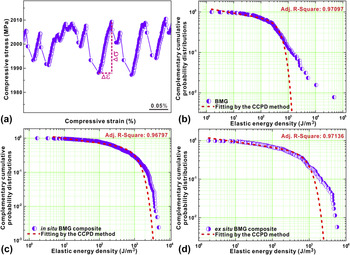
Figures 1(b)–1(d) show the room-temperature compressive stress–strain curves at for the investigated samples. Both the in situ and ex situ fabricated BMG composites show a larger plasticity than the BMG samples. Furthermore, the in situ BMG composites exhibit a slightly lower yield strength due to the presence of B2 CuZr crystals which can easily induce the operation of shear bands during deformation. Reference Song, Pauly, Sun, Tan, Stoica, Kühn and Eckert23,Reference Song, Pauly, Zhang, Li, Gorantla, Narayanan, Kühn, Gemming and Eckert29 In fact, it has been shown that B2 CuZr crystals start to yield at a low strain/stress during deformation. Reference Song, Pauly, Sun, Tan, Stoica, Kühn and Eckert23,Reference Song, Pauly, Zhang, Li, Gorantla, Narayanan, Kühn, Gemming and Eckert29 However, since the volume fraction of B2 CuZr crystals is less than 12 vol%, in our case, such a change in the compressive curves is not very pronounced. Reference Song, Pauly, Sun, Tan, Stoica, Kühn and Eckert23,Reference Song, Pauly, Zhang, Li, Gorantla, Narayanan, Kühn, Gemming and Eckert29 Similarly, for the ex situ prepared BMG composites, the “yielding” of the SMSS wires are also indistinct due to the low volume fraction of the SMSS wires (i.e., <10 vol%). Furthermore, such a small “deflection” in the compressive curves for the ex situ prepared BMG composites could even disappear since the shape memory wire does not well connect with the glassy matrix. In fact, the ex situ prepared BMG composites ultimately yield at a similar high yield strength to the BMG samples. Besides, the compressive stress–strain curves of all the three types of samples exhibit a serrated flow behavior after yielding [Figs. 1(b) and 1(c)]. The serration process is characterized by repeating cycles of an elastic loading part followed by a sudden stress drop [Fig. 2(a)] during plastic deformation. These features correspond to the accumulation and the release of the local elastic energy, respectively. Reference Wang, Chan, Xia, Yu, Shen and Wang30–Reference Tong, Wang, Yi, Ren, Pauly, Gao, Zhai, Mattern, Dahmen, Liaw and Eckert32
(a) Magnified part of a stress–strain curve showing serrations process characterized by repeating cycles of an elastic loading part followed by a sudden stress drop during plastic deformation; The CCPDs of the elastic energy densities for the (b) BMG samples, (c) in situ and (d) ex situ fabricated BMG composites during plastic deformation.

To investigate the serration dynamics and their correlation with shear banding stability, statistical analysis was performed on the three types of metastable alloys. The elastic energy density of one serration event (Δδ) is given by Δδ = ΔδeΔεe/2, Reference Wang, Chan, Xia, Yu, Shen and Wang30–Reference Pan, Zhang, Zhang, Stoica, He and Eckert33 where Δδe and Δεe are the elastic stress and elastic strain in one serration event, respectively [see Fig. 2(a)]. Generally, one might use the complementary cumulative probability distribution to count the accumulation of the local elastic energy density of BMGs during plastic deformation, which can reflect the serration dynamics and the shear banding stability. Reference Wang, Chan, Xia, Yu, Shen and Wang30–Reference Csikor, Motz, Weygand, Zaiser and Zapperi35 Figs. 2(b)–2(d) show that the complementary cumulative probability distribution versus elastic energy density [CCPD, P (≥Δδ)], i.e., the probability that the detected elastic energy density takes on a value larger than Δδ. The CCPDs of the three types of samples [Figs. 2(b)–2(d); only one specimen for each type was shown for simplicity] can be well approximated by a power-law distribution function together with a squared exponential decay function: Reference Wang, Chan, Xia, Yu, Shen and Wang30–Reference Zhang, Zuo, Tang, Gao, Dahmen, Liaw and Lu36
 $$P\left( { \ge \Delta \delta } \right) = A\Delta {\delta ^{1 - \beta }}\exp \left[ { - {{\left( {{{\Delta \delta } \mathord{\left/ {\vphantom {{\Delta \delta } {{\delta _{\rm{c}}}}}} \right. \kern-\nulldelimiterspace} {{\delta _{\rm{c}}}}}} \right)}^2}} \right]\quad ,$$
where A is a normalizing constant, β is the exponent of the power-law relation, and δc is the cut-off elastic energy density. As shown in Figs. 2(b)–2(d), the values of the A, β, and δc can be obtained by fitting the experimental data using Eq. (1). The high Adj. R-Squared values larger than 0.967 imply the present fitting accuracy [Figs. 2(b)–2(d)]. For each specimen, the smaller elastic energy density values follow a power-law distribution, while the squared exponential decay comes into play after the elastic energy density is larger than δc. It has been demonstrated that both the values of β and δc provide a fingerprint reflecting the dynamics of shear deformation in BMGs. Reference Qiao, Yao, Pelletier and Keer17,Reference Wang, Chan, Xia, Yu, Shen and Wang30–Reference Pan, Zhang, Zhang, Stoica, He and Eckert33 On the one hand, β reflects a scale-free behavior of the dynamic events and the appearance of the power-law relation indicates that the dynamics of a system can evolve into a self-organized critical (SOC) state. Reference Qiao, Yao, Pelletier and Keer17,Reference Wang, Chan, Xia, Yu, Shen and Wang30–Reference Pan, Zhang, Zhang, Stoica, He and Eckert33 In our case, the value of β for the as-cast BMG samples is 1.117 ± 0.005 [Fig. 2(b)]. By in situ or ex situ introducing crystals into the glassy matrix, the value of β increases to 1.139 ± 0.007 and 1.141 ± 0.004 [Figs. 2(c) and 2(d)], respectively, suggesting that the plastic flow of these BMG composites shows a more stable SOC dynamics than the BMG sample. Since the local elastic energy is dissipated by avalanche events due to a large number of interacting units and is relatively stable against the external perturbation, a more stable plastic deformation behavior or a larger ductility can be observed when a larger β is achieved. Reference Qiao, Yao, Pelletier and Keer17,Reference Wang, Chan, Xia, Yu, Shen and Wang30–Reference Pan, Zhang, Zhang, Stoica, He and Eckert33 This serration dynamics analysis agrees well with the compressive results [Figs. 2(b)–2(d)].
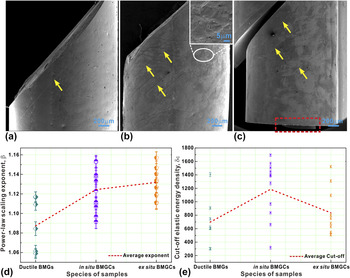
On the other hand, the value of δc, which extends over a large range of local elastic energy densities following the power-law distribution before turning to the exponential decay, also reflects the degree of the system close to the SOC state. Reference Qiao, Yao, Pelletier and Keer17,Reference Wang, Chan, Xia, Yu, Shen and Wang30–Reference Pan, Zhang, Zhang, Stoica, He and Eckert33 During the stress dropping process, the release of the local elastic energy mainly arises from the activated flow events in BMGs, i.e., shear-transformation-zones (STZs). Reference Qiao, Yao, Pelletier and Keer17,Reference Wang, Chan, Xia, Yu, Shen and Wang30–Reference Pan, Zhang, Zhang, Stoica, He and Eckert33,Reference Argon37–Reference Langer40 Thus the local elastic energies of serration events are consumed by the STZs configurationally hopping, leading to the rapid propagation of shear bands. Based on the relationship between the amount of hopped STZs and the volume of the shear band(s) formed in one serration event, Wang et al. proposed that a larger value of δc can be linked with a larger amount of activated STZs and a larger ductility of BMGs. Reference Wang, Chan, Xia, Yu, Shen and Wang30 As shown in Figs. 3(a) and 3(b) as well as the Figs. S1 and S2, the surface morphologies of the BMG and the in situ fabricated BMG composites after fracture were observed to check the distributions of shear bands (see the solid arrows) after deformation. It is obviously seen that the in situ fabricated BMG composites develop multiple shear bands after deformation and display a larger δc {i.e., 1383 ± 10 J/m3 [Fig. 2(c)]} than the BMG samples {i.e., 603 ± 10 J/m3 [Fig. 2(b)]}, corresponding to a larger ductility. However, even though the ex situ fabricated BMG composites show a higher β value and a larger ductility, the value of δc (i.e., 1095 ± 10 J/m3) is only a little larger than that of BMGs [Figs. 2(b) and 2(d)]. Since the value of δc is associated with the shear banding process, the number of shear bands of the ex situ BMG composites should be far less than that of the in situ BMG composites but be similar to that of the BMG samples. Such an assumption is confirmed by the SEM results [see the solid arrows in Figs. 3(a)–3(c) and S1–S3]. Besides, no obvious multiple shear bands (or only a little shear bands near the dominated shear band) but the dominant shear band can be observed for the BMG samples and the ex situ BMG composites [Figs. 3(a), 3(c) and S1, S3], leading to their smaller δc than that of the in situ BMG composites. In fact, the ex situ BMG composites indeed show a little more shear band along the dominate shear band than the BMG samples, leading to a slight increase of the δc.
Surface morphologies of the (a) BMG samples, (b) in situ and (c) ex situ fabricated BMG composites after deformation, and the (d) β and (e) δc values for all the investigated specimens [BMG composites are denoted as BMGCs in (d, e)].

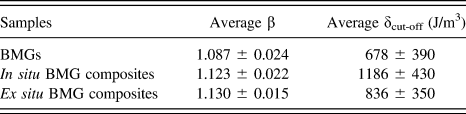
However, since the plastic deformation of BMGs and BMG composites strongly depends on extrinsic materials properties (e.g., sample size) and experimental conditions (e.g., testing machine stiffness, strain rate, and temperature), Reference Cheng and Ma2,Reference Lewandowski, Wang and Greer8–Reference Li, Qiao, Dahmen, Yang, Shen and Chen13 the compressive results should be double checked. Therefore, compression tests for each type of an alloy were repeated for at least five times and their corresponding β and δc values were also calculated, respectively (Table I). It is obvious that the average β values of the BMG composites are larger than those of the BMG samples. However, the average δc value of the ex situ prepared BMG composites is almost equivalent to that of BMG samples but remarkably smaller than that of the in situ fabricated BMG composites, which further confirms our observations above. In this regard, the potential physical mechanisms governing shear banding should be different for the BMG samples and the in situ and ex situ fabricated BMG composites. Reference Qiao, Jia and Liaw25
Average power-law exponents and cut-off elastic energy densities of the different three types of alloys.

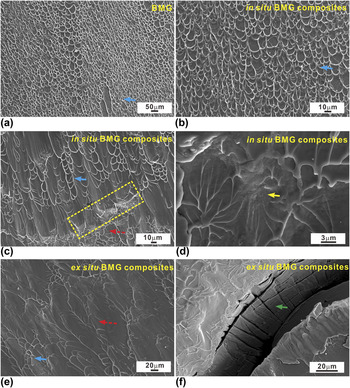
It has been pointed out that the fracture morphologies of BMGs after failure usually consist of two types of zones, i.e., a zone with vein-like patterns and/or river-like patterns and a smooth zone. Reference Sun and Wang5,Reference Song, Bei, Wadsworth and Nieh41–Reference Han and Li43 The features of the former usually develop in the final catastrophic fracture process where the stored elastic energy during deformation is released in a very short time. Reference Sun and Wang5,Reference Song, Bei, Wadsworth and Nieh41–Reference Han and Li43 The latter has been proven to be associated with the stable intermittent sliding of the dominant shear band before fracture, which creates a shear offset and is linked with stress drops in the stress–strain curves. Reference Sun and Wang5,Reference Song, Bei, Wadsworth and Nieh41–Reference Wu, Zhang and Mao45 To further clarify their plastic deformation behaviors, the facture morphologies of three types of alloys were investigated [Fig. 4]. The fracture surfaces of the BMG samples mainly exhibit a vein-like pattern as marked by the solid arrow in Fig. 4(a). However, for the in situ prepared BMG composites, besides the vein-like structures [Fig. 4(b)], some river-like patterns [the solid arrow in Fig. 4(c)] accompanied with a large amount of granular structures [the dashed arrow and the square in Figs. 4(c) and 4(d)] can be observed. This implies that the presence of B2 crystals indeed effectively changes the fracture behaviors of the samples. It is worth noting that less vein-like patterns but more river-like patterns without any granular structures in the glassy matrix were observed after fracture for the ex situ fabricated BMG composites [Fig. 4(e)]. At the interface between the glassy matrix and the shape memory wire, a lot of micro scale cracks appear and the glassy matrix obviously separated from the ex situ shape memory wire [see the solid arrow in Fig. 4(f)] and the SMSS wires are pressed out from the glassy matrix [see the square in Fig. 3(c)]. This could result from the significant thermal residual stresses developed in these composites due to the mismatch of thermal expansion coefficients between the matrix and the reinforcements. Reference Dragoi, Üstündag, Clausen and Bourke46–Reference Fitzpatrick, Hutchings and Withers49
Fracture morphologies of the (a) BMG samples, (b–d) in situ and (e–f) ex situ fabricated BMG composites after deformation.

As shown in Figs. 3(a) and 5(a), the dominant shear band can rapidly penetrate the whole BMG sample while only a few shear bands nearby the dominant shear band also come into operation. It has been shown that the dissipated elastic energy (|ΔG E|) for the BMG samples during plastic deformation is mainly consumed by the initiation and the propagation of the dominant shear band. Reference Liu, Li, Wang, Wu, Lu and Zhang50–Reference Lewandowski and Greer52 Liu et al. proposed that |ΔG E| mainly corresponds to the increase in the volume free energy (ΔG V) and the newly generated interfacial free energy (ΔG I), or/and the dissipated energy in the form of heat within the shear bands (ΔG h), Reference Liu, Li, Wang, Wu, Lu and Zhang50–Reference Lewandowski and Greer52 which can be expressed as follows:
 $$\left| {\Delta {G_{\rm{E}}}} \right| = \Delta {G_{\rm{V}}} + \Delta {G_{\rm{I}}} + \Delta {G_{\rm{h}}}\quad .$$
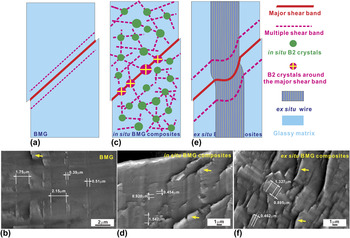
To further clarify the shear band propagation in the samples, the smooth zones related to the shear banding were checked carefully. Within these smooth zones, striations with a regular spacing ranging from 0.40 ± 0.05 to 2.2 ± 0.05 μm are found in the BMG samples after fracture [Fig. 5(b)]. For the brittle Zr65Cu15Ni10Al10 BMG, Reference Sun, Pauly, Tan, Stoica, Wang, Kühn and Eckert53 the spacing of the striations is around 2.8 μm, i.e., much larger than for the BMG studied in this work, further confirming a more stable shear banding process for the present samples. Besides, only somewhat discontinuous and irregular step-like striations with various step sizes are found [Fig. 5(b)], which could be due to the strong interaction between the samples and the indenters of the compressive testing machine during deformation. In our case, since only a few multiple shear bands are observed, the dissipated elastic energy (|ΔG E|) for the present BMG samples should be consumed by the formation and propagation of the dominant shear band.
Schematic diagrams for the shear banding process and actual serrations in the facture surface of the (a, b) BMG samples, (c, d) in situ and (e, f) ex situ fabricated BMG composites, respectively.

On the other hand, it has been proven that the B2 CuZr crystals in CuZr-based alloys or the fcc Fe crystals in the SMSSs can transform into martensites during deformation. Reference Koval, Firstov and Kotko54,Reference Gunkelmann, Bringa, Kang, Ackland, Ruestes and Urbassek55 Hence, for the in situ and ex situ BMG composites, a part of the dissipated elastic energy should also be released in the form of heat and the newly-generated interfacial free energy due to the phase transformation of B2 CuZr crystals or SMSS wires during deformation. Reference Ahlers, Pascual, Rapacioli and Arneodo56–Reference Boyd and Lagoudas58 Therefore, the dissipated elastic energy for the BMG composites during plastic deformation is given by:
 $$\left| {\Delta {G_{\rm{E}}}} \right| = \Delta {G_{\rm{V}}} + \Delta {G_{\rm{I}}} + \Delta {G_{\rm{h}}} + \Delta {G_{\rm{P}}}\quad ,$$
where |ΔG P| is the partial release of elastic energy through the phase transformation. When the martensitic transformation [see the inset in Fig. 3(b) and the dashed arrows in Fig. S2] for the in situ BMG composites becomes more pronounced before the initiation and propagation of shear bands, the dissipated energy would lead to the decrease of the total elastic energy density of the serration events. Besides, shear bands easily initiate at the interface between the glassy matrix and crystals due to their large elastic mismatch. Reference Dragoi, Üstündag, Clausen and Bourke46–Reference Fitzpatrick, Hutchings and Withers49 Therefore, compared with BMGs, it becomes easier for multiple shear bands to form at the interface between the crystals and the glassy matrix [see Figs. 3(b) and 5(c)]. Based on the conservation of energy for the sample-machine system, even though the shear bands can operate more easily, less elastic energy can be consumed for each shear banding event, which can slow down the rapid propagation of the dominant shear band. Most of the B2 crystals themselves [see the spheres without a cross mark in Fig. 5(c)] cannot directly block the rapid propagation of the dominant shear bands but can indirectly slow down their rapid propagation of the dominant shear band with the help of the multiplication of shear bands. Moreover, only a small amount of B2 CuZr crystals, which locate at the driven path of the dominant shear band [see the spheres with a cross mark in Fig. 5(c)], will directly block the rapid propagation of the dominant shear band to some extent. By considering both of effects induced by B2 crystals on the shear-band propagation, it can be understood that the maximum spacing of striations for the in situ prepared BMG composites is decreased to 1.54 ± 0.07 μm [Fig. 5(d)]. Besides, it is surprisingly seen that the discontinuous, bumpy, and irregular step-like striations with various step sizes become more obvious and their number increases [Fig. 5(d)]. As mentioned above, since the dissipated elastic energy for the in situ prepared BMG composites is also consumed by multiple shear bands and B2 CuZr crystals, the propagation of the dominant shear band is strongly inhibited, leading to a smaller maximum spacing of striations. Besides, when the dominant shear band meets the B2 CuZr crystals at its driving path, discontinuous, bumpy, and irregular step-like striations should be also induced by such a “blocking effect”.
For the ex situ BMG composites the situation is somewhat different. Since the SMSS wires do not strongly combine with the glassy matrix and no B2 crystals precipitate in the glassy matrix, the interaction between the wires and the glassy matrix cannot induce too many multiple shear bands [Figs. 3(c) and 5(e)] in the glassy matrix. Therefore, the dissipated elastic energy for the ex situ BMG composites is governed by the propagation of the dominant shear band and the phase transformation within the SMSS wires during deformation. Since the SMSS wires are located at the driven path for the dominant shear band [Fig. 5(e)], they strongly block the rapid propagation of the dominant shear band and thus the shear banding stability can be effectively enhanced during plastic deformation. Therefore, the corresponding spacing of the striations was changed to be between 0.46 ± 0.07 and 1.33 ± 0.07 μm for the ex situ prepared BMG composites [Fig. 5(f)] even though a few multiple shear bands can be induced in the glassy matrix. Since the SMSS wires only play a role in blocking the movement of the dominant shear bands but not in inducing the multiplication of shear bands, the “blocking effect” from the SMSS wires should be rather pronounced, leading to the formation of more discontinuous, bumpy, and irregular step-like striations. Indeed, compared with the BMG samples and the in situ prepared BMG composites, such step-like striations with various step sizes become more obvious and their number is increased [Fig. 5(f)].
Besides, the minimum spacing of the striations for all the investigated samples is around 0.4–0.5 μm, which implies that the serrated flow in the CuZr-based glassy matrix proceeds via certain minimum shear banding steps. Such minimum shear banding steps should only be linked with the intrinsic properties of the glass when the extrinsic conditions during deformation are unchanged. In other words, the B2 CuZr crystals or SMSS wires within the glassy matrix cannot change the nature of the rapid propagation of the dominant shear band but can only discretely suppress its intermittent motion spatially and temporally even though the initial formation of shear bands can be easily induced at the interface between the reinforcement phase and the glassy matrix.
All the observations above imply that the shear banding stability of BMGs and their composites during plastic deformation can not only be enhanced by the formation of multiple shear bands originating from the microstructural heterogeneity but also be further raised by obstructing the movement of the dominant shear band at the driven path. In fact, a lot of studies have focused on the enhancement of ductility for BMGs so far. Recent studies have shown that the shear banding stability of BMGs during plastic deformation can be effectively enhanced by metal coating. Reference Sun, Chen, Lu, Zhu, Zhao, Yang, Chan and Liu59 The lateral tension of the coating layer induced by the “surface shear step” and the bonding between the coating layer and the glass can effectively enhance the stability of the dominant shear band, Reference Sun, Chen, Lu, Zhu, Zhao, Yang, Chan and Liu59 resulting in the enhancement of ductility of BMGs. Furthermore, by ex situ introducing about 40 vol% tungsten wires into the glassy matrix, Reference Qiu, Wang, Zhang, Ding and Hu60,Reference Conner, Dandliker and Johnson61 the stress concentration at the interface triggers the formation of other dominant shear bands when the primary dominant shear band meets an obstacle during deformation, Reference Qiu, Wang, Zhang, Ding and Hu60–Reference Lee, Clausen, Üstündag, Choi-Yim, Aydiner and Bourke62 resulting in the enhancement of the room-temperature ductility of BMGs. When the volume faction of tungsten wires increases gradually to a larger value, the deformation mode gradually changes from a shear mode to localized buckling and tilting. Reference Qiu, Wang, Zhang, Ding and Hu60–Reference Lee, Clausen, Üstündag, Choi-Yim, Aydiner and Bourke62 All these observations are in good accordance with our present analysis.
IV. CONCLUSIONS
According to the serration analysis performed on the plastic deformation behaviors of CuZr-based BMG and BMGs composites, the serration events, which manifest themselves as small displacement bursts or stress drops in the stress–strain, display a SOC behavior. The shear banding stability of CuZr-based BMGs and their composites can be enhanced not only by inducing multiple shear bands in the glassy matrix but also by inhibiting the rapid propagation of the dominant shear band at its driven path. As a result, compared with the serrated flow behaviors of BMG samples, a larger power-law scaling exponent together with a moderate cut-off elastic energy density according to the statistical analysis of serrations read from the compressive stress–strain curves can be observed for the in situ prepared BMG composites due to the formation of multiple shear bands during deformation. Although the ex situ BMG composites show more stable shear banding behavior based on the increase of the power-law scaling exponent, their cut-off elastic energy density related with the number of shear bands during plastic deformation are almost as small as those of BMG samples. Therefore, the enhancement of the shear banding stability of BMGs can be reached by directly hampering the movement of the dominant shear band at its driven path and indirectly inducing the formation of multiple shear bands. Altogether, our findings may provide further understanding of the shear banding stability for BMGs.
Supplementary Material
To view supplementary material for this article, please visit https://doi.org/10.1557/jmr.2017.243.
ACKNOWLEDGMENTS
The authors are grateful to K.L. Wang, Y.Q. Xin, and S.P. Hu for technical assistance and discussions. This work was supported by the support from the National Natural Science Foundation of China (51501103, 51371108, 51501104, and 51671121), the German Science Foundation (DFG) under the Leibniz Program (Grant EC 111/26-1), the European Research Council under the ERC Advanced Grant INTELHYB (Grant ERC-2013-ADG-340025), and the Young Scholars Program of Shandong University, Weihai.