Introduction
The Trauma and Stress Disorder Workgroup of the World Health Organization (WHO) has proposed the inclusion of a new condition of prolonged grief disorder (ICD-11PGD) in the International Classification of Disease (ICD-11). The guideline for ICD-11PGD includes core features of yearning and/or preoccupation with the deceased accompanied by emotional pain. A list of examples of emotional pain is also provided and includes sadness, guilt, and difficulty accepting the death (World Health Organization). A recent case-controlled field study with more than 1700 international health workers demonstrated that this guideline was used correctly by 92% of clinicians (Keeley et al., Reference Keeley, Reed, Roberts, Evans, Robles, Matsumoto, Brewin, Cloitre, Perkonigg, Rousseau, Gureje, Lovell, Sharan and Maercker2016).
There is a strong international agreement about the need for a diagnostic category for this condition, which is most commonly referred to in the literature as complicated grief. It has also been called unresolved (e.g. Lannen et al., Reference Lannen, Wolfe, Prigerson, Onelov and Kreicbergs2008) or traumatic grief (e.g. Prigerson et al., Reference Prigerson, Shear, Jacobs, Reynolds, Maciejewski, Davidson, Rosenheck, Pilkonis, Wortman, Williams, Widiger, Frank, Kupfer and Zisook1999). Persistent impairing grief has been found in virtually every area of the globe, and the WHO workgroup recognized the public health burden of this condition. Moreover, violent loss or loss of a young person is associated with markedly increased risk for persistent impairing grief (Kaltman and Bonanno, Reference Kaltman and Bonanno2003; Kristensen et al., Reference Kristensen, Weisæth and Heir2012) and these experiences are especially common in war-torn or low-income countries. Many countries that rely on the ICD are affected by disaster, war, conflict, widespread disease, and high rates of mortality. This means that recognition and effective intervention is of considerable importance to the WHO.
Diagnosis of persistent impairing grief is important because there is a strong evidence that this condition responds to targeted treatment (e.g. Wagner et al., Reference Wagner, Knaevelsrud and Maercker2006; Boelen et al., Reference Boelen, de Keijser, van den Hout and van den Bout2007; Rosner et al., Reference Rosner, Lumbeck and Geissner2011; Kersting et al., Reference Kersting, Dölemeyer, Steinig, Walter, Kroker, Baust and Wagner2013; Bryant et al., Reference Bryant, Kenny, Joscelyne, Rawson, Maccallum, Cahill, Hopwood, Aderka and Nickerson2014); summarized in (Shear, Reference Shear2015). Further, efficacy of targeted treatment is significantly better than for antidepressants (Shear et al., Reference Shear, Reynolds, Simon, Zisook, Wang, Mauro, Duan, Lebowitz and Skritskaya2016) or depression-focused psychotherapy (Shear et al., Reference Shear, Frank, Houck and Reynolds2005, Reference Shear, Wang, Skritskaya, Duan, Mauro and Ghesquiere2014).
In the absence of a gold standard diagnosis, a new diagnostic criteria for a mental disorder should prioritize treatment need, clinical course, and response to treatment rather than be seen as a label for a disease process (Coggon et al., Reference Coggon, Martyn, Palmer and Evanoff2005). Following this recommendation, we previously undertook a study of our treatment study participants to examine the performance of three major criteria sets for persistent impairing grief: persistent complex bereavement disorder (PCBD) (American Psychiatric Association, 2013), CG (Shear et al., Reference Shear, Simon, Wall, Zisook, Neimeyer, Duan, Reynolds, Lebowitz, Sung, Ghesquiere, Gorscak, Clayton, Ito, Nakajima, Konishi, Melhem, Meert, Schiff, O'Connor, First, Sareen, Bolton, Skritskaya, Mancini and Keshaviah2011), and PGD (PGDPLOS) (Prigerson et al., Reference Prigerson, Horowitz, Jacobs, Parkes, Aslan, Goodkin, Raphael, Marwit, Wortman, Neimeyer, Bonanno, Block, Kissane, Boelen, Maercker, Litz, Johnson, First and Maciejewski2009). Results showed inadequate performance by PGDPLOS as well as Diagnostic and Statistical Manual of Mental Disorders, Fifth Edition (DSM-5) provisional criteria for PCBD (Mauro et al., Reference Mauro, Shear, Reynolds, Simon, Zisook, Skritskaya, Wang, Lebowitz, Duan, First, Ghesquiere, Gribbin and Glickman2017). These findings were later replicated in a community-based study (Cozza et al., Reference Cozza, Fisher, Mauro, Zhou, Ortiz, Skritskaya, Wall, Fullerton, Ursano and Shear2016).
The current study extends our previous findings by including an operationalized version of ICD-11PGD guidelines. We compared the conditional probability of diagnosis by the ICD-11PGD criteria for individuals with persistent impairing grief to the conditional probability of diagnosis by PGDPLOS criteria. This comparison is important because of their shared name and different diagnostic approaches. The current study further examined whether there are clinical or demographic variables that affect diagnostic accuracy and how diagnosis relates to response to treatment.
Subjects and methods
Study participants with persistent impairing grief (n = 261) were enrolled at a university-based psychiatric research clinic at Columbia University (n = 23), Massachusetts General Hospital (n = 82), University of Pittsburgh Medical Center (n = 72), or University of California San Diego (n = 84) as part of the National Institute of Mental Health (NIMH)-funded collaborative treatment study (MH60783; MH85288; MH85308; MH85297). All participants were screened by telephone using the Brief Grief Questionnaire (Shear et al., Reference Shear, Jackson, Essock, Donahue and Felton2006) and in person using the Inventory of CG (ICG) (Prigerson et al., Reference Prigerson, Maciejewski, Reynolds, Bierhals, Newsom, Fasiczka, Frank, Doman and Miller1995). Those who scored ⩾30 on the ICG and lost a loved one at least 6 months ago underwent an extensive baseline assessment. Those for whom eligibility was confirmed were then randomly assigned to receive study treatment. Participants were excluded if they presented with current substance use disorder (past 6 months), lifetime history of psychotic disorder, bipolar I disorder, cognitive impairment [Montreal Cognitive Assessment (Nasreddine et al., Reference Nasreddine, Phillips, Bédirian, Charbonneau, Whitehead, Collin, Cummings and Chertkow2005) score <21 or the Mini-Mental State (Folstein et al., Reference Folstein, Folstein and McHugh1975) score <24], active suicidal ideation requiring hospitalization, concurrent psychotherapy, or pending lawsuit or disability claim related to the death. Assessments were completed between March 2010 and September 2014 (Shear et al., Reference Shear, Reynolds, Simon, Zisook, Wang, Mauro, Duan, Lebowitz and Skritskaya2016).
Bereaved participants without persistent impairing grief (n = 86) were enrolled in other ongoing research studies at the Latelife Depression Prevention and Treatment Center (P30 MH90333) at the University of Pittsburgh Medical Center (n = 62) or the Center for Anxiety and Traumatic Stress Disorders at the Massachusetts General Hospital (n = 24). Inclusion criteria for this bereaved sample without CG included an ICG score ⩽20 and a clinical interview in which a DSM-IV mood or anxiety diagnosis was considered to be the primary problem. Assessments were completed between April 2014 and August 2014.
Measures
At their baseline visit, study participants with persistent impairing grief provided demographic and loss-related information. A Structured Clinical Interview for DSM IV Disorders (SCID IV) (First et al., Reference First, Spitzer, Gibbon and Williams2002) with an additional module for CG [Structured Clinical Interview for CG (SCI-CG), see below] was completed by an experienced clinical rater trained to reliability and monitored throughout the study. Self-report measures of CG symptom severity and grief-related impairment were also obtained. At week 12 or 20, independent evaluators assessed treatment response, defined as a 1 (‘very much improved’) or 2 (‘much improved’) on the CG-anchored Clinical Global Impression – Improvement Scale (Guy, Reference Guy1976; Shear et al., Reference Shear, Frank, Houck and Reynolds2005, Reference Shear, Reynolds, Simon, Zisook, Wang, Mauro, Duan, Lebowitz and Skritskaya2016).
Bereaved participants without persistent impairing grief completed a grief symptom severity measure (ICG) and a self-report version of the structured interview (SCI-CG), as well as demographic information and more limited loss-related information.
The Structured Clinical Interview for CG
SCI-CG is a 31-item semi-structured clinical interview that uses a SCID-like format and scoring (1 = ‘absent’, 2 = ‘unsure or equivocal’, 3 = ‘present’). Ratings can be used to evaluate ICD-11PGD guidelines as well as PGDPLOS, PCBD, and CG criteria sets. The SCI-CG has good internal consistency (Cronbach's α = 0.76) and test–retest reliability (ICC = 0.68) (Bui et al., Reference Bui, Mauro, Robinaugh, Skritskaya, Wang, Gribbin, Ghesquiere, Horenstein, Duan, Reynolds, Zisook, Simon and Shear2015). Copies of the instrument can be obtained at http://www.complicatedgrief.columbia.edu.
The Inventory of CG
ICG is a 19-item self-report questionnaire. Each item is rated on a five-point scale, with responses ranging from 0 = ‘never’ to 5 = ‘always’. The ICG is a well-validated measure of grief symptoms with prior evidence for good internal consistency (Cronbach's α = 0.94) and test–retest reliability (0.80) (Prigerson et al., Reference Prigerson, Maciejewski, Reynolds, Bierhals, Newsom, Fasiczka, Frank, Doman and Miller1995) that has been used in studies worldwide to identify the syndrome variously labeled CG or PGD. According to the American Psychological Association website, ‘this scale has a well-validated clinical cut point. Clients who score over 25 are considered at high risk for requiring clinical care’ (American Psychological Association (n.d.); Prigerson et al., Reference Prigerson, Maciejewski, Reynolds, Bierhals, Newsom, Fasiczka, Frank, Doman and Miller1995, Reference Prigerson, Bierhals, Kasl, Reynolds, Shear, Newsom and Jacobs1996; Boelen et al., Reference Boelen, van den Bout and de Keijser2003).
Operational definition of caseness
In order to evaluate the clinical utility of the diagnostic criteria sets, we first identified a valid and reliable measure of clinically significant distress and impairment. Based on the evidence that an ICG score of 25 or higher identifies clinically significant symptoms and to ensure that we were recruiting individuals clearly above the recommended ICG cut-score, study participants with persistent impairing grief were required to score 30 or higher on the ICG in order to be randomized in the parent study. In addition, they were judged by an experienced clinician to have CG as the condition most in need of treatment. All participants also responded affirmatively to the question: ‘Overall, is grief interfering a lot with your ability to work or socialize or function in other ways?’. We also examined the rates of non-diagnosis among participants who had ICG scores below 20, which we consider a reliable indicator of the absence of persistent impairing grief.
Diagnostic algorithm
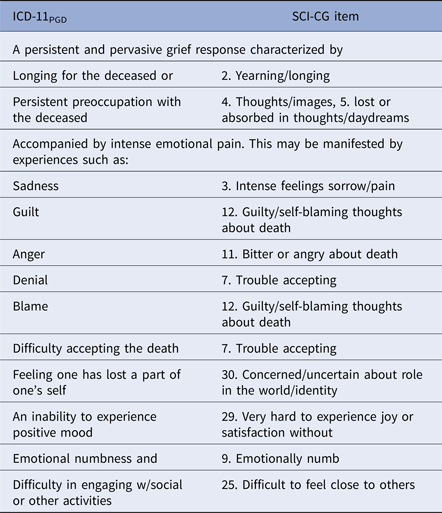
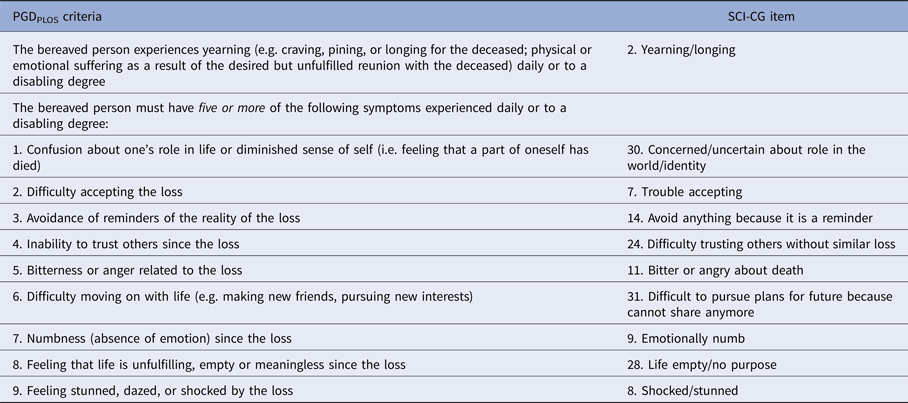
To operationalize the ICD-11PGD guideline and the PGDPLOS criteria set, relevant symptoms were matched with individual items on the SCI-CG (see Tables 1 and 2). A symptom was considered present if the corresponding SCI-CG item was endorsed as 3 = ‘present’. To be diagnosed using the ICD-11PGD guideline, participants needed to endorse longing for the deceased or preoccupation with the deceased, as well as at least one of the accompanying symptoms listed in Table 1. For exploratory purposes, we also examined varying the number of required accompanying symptoms for ICD-11PGD. Participants met criteria for PGDPLOS if they endorsed yearning and at least five of the nine accompanying symptoms listed in Table 2. Relative representation of SCI-CG items on the two criteria sets were similar; ICD-11PGD criteria were matched with 11 items from the SCI-CG, PGDPLOS were matched with 10 items. Five symptoms were common to both.
ICD-11PGD guidelines and symptom matching with the SCI-CG
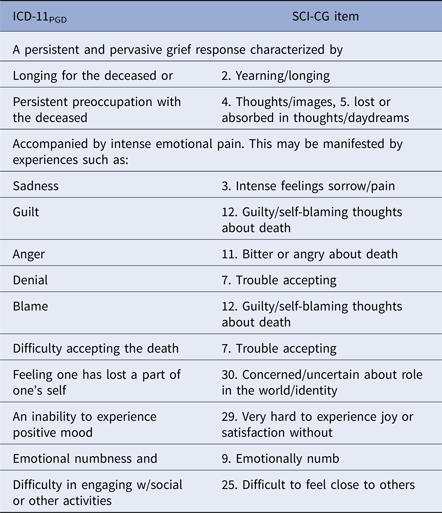
Participants who endorsed longing for the deceased or a preoccupation with the deceased and at least one symptom of intense emotional pain received an ICD-11PGD diagnosis.
PGDPLOS criteria and symptom matching with the SCI-CG
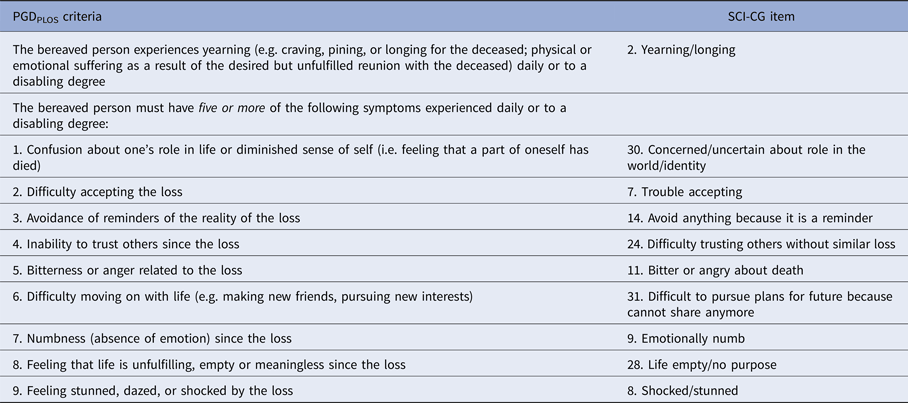
Participants who endorsed yearning for the deceased and at least five accompanying symptoms received a PGDPLOS diagnosis.
Statistical methods
We examined clinical utility of the ICD-11PGD and PGDPLOS criteria sets by determining the proportion of study participants diagnosed by each of the criteria sets in both the study sample with persistent impairing grief and the bereaved sample without persistent impairing grief. This was done by dividing the number of participants diagnosed by the total number of participants in the relevant study sample, to get the conditional probability of diagnosis. Ninety-five per cent confidence intervals (CIs) were computed using the standard formula for binomial proportions. Further analyses were only carried out among the study sample with persistent impairing grief. McNemar's test was used to test for differences in the rates of diagnosis by criteria set. To assess for differences between those diagnosed and not diagnosed on demographic, loss-related information, and treatment outcomes, two sample t tests (continuous measures such as age) and χ2 tests (categorical variables such as loss type) were used. A two-sided p value of 0.05 or less was considered statistically significant. All analyses were carried out using SAS 9.4.
Results
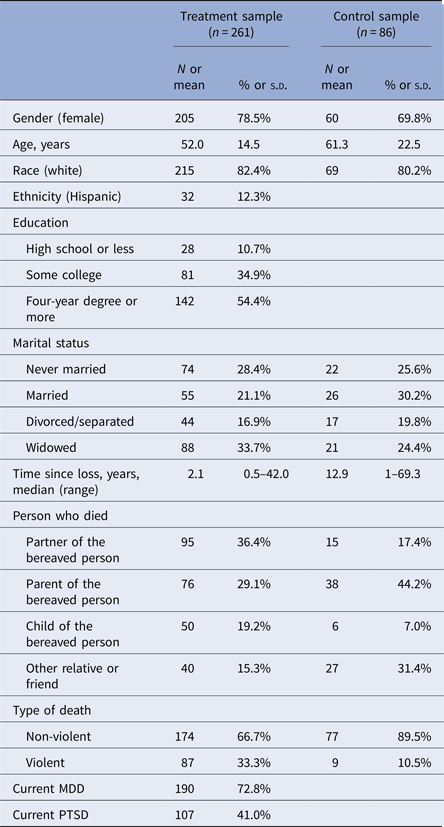
Table 3 presents demographic, loss-related, and clinical characteristics of the two study samples. Study participants with persistent impairing grief were mostly female (79%), white (82%), non-Hispanic (87%), and well educated. There was a considerable variability in marital status, person who died, and type of death. Seventy-two per cent of participants had co-occurring current major depressive disorder (MDD) and 41% current post-traumatic stress disorder (PTSD). They were on average 52 years old and had lost their loved ones around 2.1 years ago (range: 6 months to 42 years). The sample without persistent grief was also mostly female (70%) and white (80%), but were on average 9.3 years older and had longer time since loss (median = 12.9 years).
Demographic, loss-related, and clinical characteristics of the sample

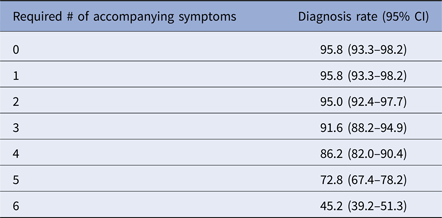
The ICD-11PGD guideline correctly identified 250/261 (95.8%; 95% CI 93.3–98.2%) of the study participants with persistent impairing grief, while PGDPLOS criteria diagnosed only 154/261 (59.0%; 95% CI 53.0–65.0%). These rates of diagnosis are significantly different from one another (χ2 = 96.0, df = 1, p < 0.0001). None of the bereaved sample without persistent grief was diagnosed by either the ICD-11PGD or the PGDPLOS criteria. Rates of ICD-11PGD diagnosis were also examined when varying the number of required accompanying symptoms; results are presented in Table 4.
ICD-11PGD diagnosis rates when the number of required accompanying symptoms is varied

The outcome of our treatment study showed a robust response to CG therapy (CGT), which was clinically and statistically superior to placebo medication while we found no difference between antidepressant and pill placebo (Shear et al., Reference Shear, Reynolds, Simon, Zisook, Wang, Mauro, Duan, Lebowitz and Skritskaya2016). Given the variability in case identification by PGDPLOS criteria, we wondered if these criteria might identify differences in treatment responsiveness. However, we found no indication for this. Among those who received CGT, there was no difference in treatment response among those who did or did not meet the PGDPLOS criteria (85.2% v. 87.7%, χ2 = 0.04, df = 1, p = 0.8345). Adherence to therapy was also nearly identical between the two groups (70.6% v. 74.4%, χ2 = 0.22, df = 1, p = 0.6377). Participants who did not receive CGT were treated with medication and CGT-informed clinical management. Similar to those who received CGT, there was no difference in treatment response among those who did (57.5%) or did not (64.7%) meet PGDPLOS criteria (57.5% v. 64.7%, χ2 = 0.49, df = 1, p = 0.4831). Given the high accuracy of ICD-11PGD in this sample, we could not compare the rates of treatment response between those diagnosed and not diagnosed by ICD-11PGD.
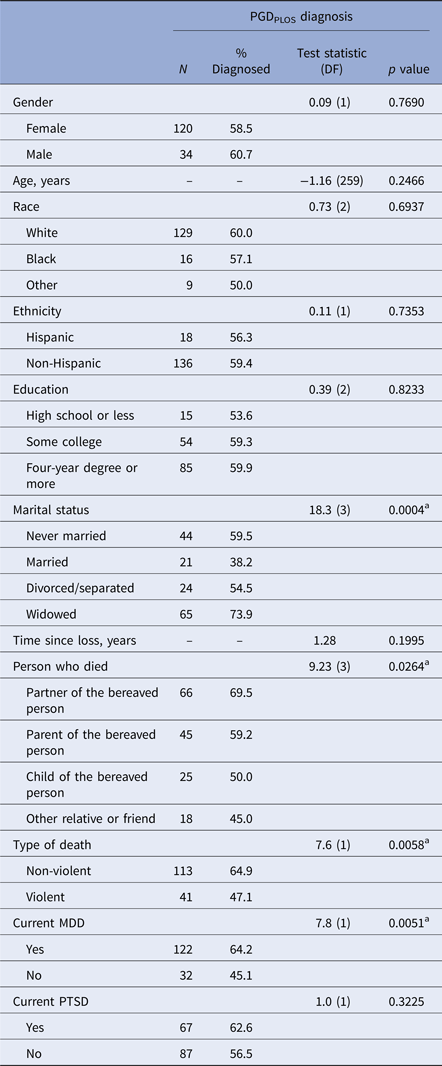
We next examined demographic or clinical variables that might affect diagnostic accuracy. Given that ICD-11PGD identified 96% of the cases in this sample, we could not examine variables that might affect it. Comparisons of demographic, loss-related, and clinical characteristics of those diagnosed and not diagnosed by the PGDPLOS criteria are given in Table 5. There were several variables that significantly affected whether PGDPLOS criteria diagnosed these cases. Widows were more likely to receive a PGDPLOS diagnosis (74%), than other participants, especially those who were married (38%) (χ2 = 18.3, df = 3, p = 0.0004, see Table 4). PGDPLOS criteria were also more likely to identify those bereaved by loss of a partner (partner: 69%) compared with other losses (parent: 59%, child: 50%, other: 45%, χ2 = 9.23, df = 3, p = 0.0264), by a non-violent death [65% of non-violent v. 47% of violent deaths (χ2 = 7.6, df = 1, p = 0.0058)] and when there was a co-occurrence of MDD [64% of those with current MDD v. 45% of those without current MDD diagnosis (χ2 = 7.8, df = 1, p = 0.0051)].
Rates of PGDPLOS diagnosis by demographic, loss-related, and clinical characteristics of the sample

aSignificant at α = 0.05.
Discussion
Persistent impairing grief, often known as CG, is a disabling condition that has been found throughout the world. Treatment studies conducted by our research group have established an efficacious short-term intervention for this disorder and documented low responsiveness to treatment for depression. Good clinical guidelines for assessment and treatment are essential for optimal public health initiatives, such as those envisioned by the WHO, in low-resource countries affected by high rates of natural and man-made disasters that are occasions for grief. The decision by the ICD-11 workgroup to include a diagnostic guideline for PGD is an important one. A recent field study also showed the ease of usability of the ICD-11PGD guideline (Keeley et al., Reference Keeley, Reed, Roberts, Evans, Robles, Matsumoto, Brewin, Cloitre, Perkonigg, Rousseau, Gureje, Lovell, Sharan and Maercker2016). The current data provide preliminary evidence for endorsement of the ICD-11 guideline for PGD as a simple and effective approach that can be used to identify people likely to respond to a targeted treatment.
Clinicians and researchers need to be alert to two important issues related to the name given to this new ICD-11 diagnosis. First, this condition of PGD identified by ICD-11 is the same one that is often referred to in both the academic literature and public media as CG. Second, there are two criteria sets with the name PGD. Recent publications (Maciejewski et al., Reference Maciejewski, Maercker, Boelen and Prigerson2016; Maciejewski and Prigerson, Reference Maciejewski and Prigerson2017) have obscured the difference between these two diagnostic approaches. Our results show that these two criteria sets actually have significantly different rates of diagnosis for individuals with clinically significant persistent impairing grief.
Maciejewski et al. (Reference Maciejewski, Maercker, Boelen and Prigerson2016) attempted to develop an operationalized definition of ICD-11PGD. To do so, the authors reanalyzed data from the Yale Bereavement Study (YBS), the same data that were also used to develop their criteria set for PGDPLOS (Prigerson et al., Reference Prigerson, Horowitz, Jacobs, Parkes, Aslan, Goodkin, Raphael, Marwit, Wortman, Neimeyer, Bonanno, Block, Kissane, Boelen, Maercker, Litz, Johnson, First and Maciejewski2009). They utilized the same mathematically derived criterion standard that was used to develop PGDPLOS criteria. In order to match ICD-11PGD to this criterion standard, the authors (Maciejewski et al., Reference Maciejewski, Maercker, Boelen and Prigerson2016) found that multiple symptoms of persistent emotional pain were required for diagnosis. This is not consistent with the ICD-11 guideline instructions. Using an operationalization that matches the guideline, ICD-11PGD and PGDPLOS criteria sets perform very differently. Performance of ICD-11PGD criteria only align with PGDPLOS criteria in our sample when between five and six or more of the accompanying symptoms are required for diagnosis.
The findings reported here have been replicated in the Military Family Bereavement Study sample (Cozza et al., Reference Cozza, Shear, Reynolds, Fisher, Zhou, Simon, Mauro, Skritskaya, Zisook, Lebowitz, Fullerton and Ursanon.d.) Additionally, these results resemble those reported by Forstmeier and Maercker (Reference Forstmeier and Maercker2007) in a population-based survey comparing Horowitz et al. (Reference Horowitz, Siegel, Holen, Bonanno, Milbrath and Stinson1997) criteria for CG to PGDPLOS in older adults. Analyses in the latter paper showed that just one symptom in addition to yearning or preoccupation was adequate to diagnose CG.
As described previously (Reynolds et al., Reference Reynolds, Cozza and Shear2017), the YBS was a limited sample and lacked sufficient clinical input into the definition of caseness. PGDPLOS criteria were developed from the reports of widows who were bereaved for only 6–12 months. There is still uncertainty about the time period needed to diagnose this disorder, with little data to inform this decision. In DSM-5, a period of at least 12 months is required. Even if PGD can be diagnosed at 6 months, it is not clear that the criteria developed from data with such a limited time period will be adequate to diagnose the condition at later stages. In the current study, as well as most existing treatment studies (e.g. Shear et al., Reference Shear, Frank, Houck and Reynolds2005, Reference Shear, Reynolds, Simon, Zisook, Wang, Mauro, Duan, Lebowitz and Skritskaya2016; Boelen et al., Reference Boelen, de Keijser, van den Hout and van den Bout2007; Bryant et al., Reference Bryant, Kenny, Joscelyne, Rawson, Maccallum, Cahill, Hopwood, Aderka and Nickerson2014), the average time since the death is over 2 years. The YBS has no data pertaining to this period, which could partially explain the low diagnosis rate of PGDPLOS in this study. We suggest that the users of ICD-11 be wary of overdiagnosis or misdiagnosis during the first year after a loss.
Our results may shed further light on the reasons for low rates of diagnosis by PGDPLOS criteria. These criteria were less likely to diagnose those bereaved by violent causes, those who were currently married, or those not bereaved of a spouse. Prigerson et al. (Reference Prigerson, Horowitz, Jacobs, Parkes, Aslan, Goodkin, Raphael, Marwit, Wortman, Neimeyer, Bonanno, Block, Kissane, Boelen, Maercker, Litz, Johnson, First and Maciejewski2009) state that they consider widowhood following an older spouse's death from natural causes to be the prototype for bereavement. However, they acknowledge the need to confirm the findings in more diverse non-widowed samples and to examine longer term bereavement outcomes. Our data comprising a more diverse sample suggest that PGDPLOS criteria perform differentially depending on comorbidities, relationship to the deceased, and circumstances of the death. Diagnostic criteria need to perform well in diverse clinical samples.
Our study has a number of limitations. First, our study lacked a gold standard for diagnosing the condition in question. However, this limitation is unavoidable when there are not yet validated or agreed-upon criteria. Instead, we used a rigorous reliable assessment procedure to determine clinical caseness. We required a score above the published and widely accepted cut-score on a well-validated symptom measure (ICG; Prigerson et al., Reference Prigerson, Maciejewski, Reynolds, Bierhals, Newsom, Fasiczka, Frank, Doman and Miller1995), significant bereavement-related distress and impairment, and confirmation by a clinician that grief was the most important problem in need of treatment. In addition, our study sample was recruited from urban areas in a first world wealthy country and was primarily from the white middle class. This may limit the generalizability of this work. However, we found similar results in a larger more diverse community-based sample of bereaved military families (Cozza et al., Reference Cozza, Shear, Reynolds, Fisher, Zhou, Simon, Mauro, Skritskaya, Zisook, Lebowitz, Fullerton and Ursanon.d.). Future studies need to include the full range of socio-economic levels, age, race, and ethnicity.
Lastly, we were only able to include individuals who we were confident were or were not experiencing the ‘true’ disorder. Therefore, we have no information about the middle group where the presence of the ‘true’ disorder is more ambiguous. Because of this, we are unable to determine sensitivity, specificity, or positive predictive power of these criteria. However, while such clinical samples are not representative of the general population, they are the most relevant group in need of diagnosis (Feighner et al., Reference Feighner, Robins, Guze, Woodruff, Winokur and Munoz1972). In addition, the ability to accurately diagnose those who unambiguously have the disorder is a necessary, but not sufficient, condition for any criteria set to have good sensitivity. Our results show that ICD-11PGD meets this condition, but that PGDPLOS do not. Similarly, the fact that none of the bereaved sample without persistent grief was diagnosed by the ICD-11PGD criteria is a necessary, but not a sufficient condition to ensure that these criteria are not overdiagnosing. One possible explanation for this finding is that those without persistent grief had been bereaved for a much longer period (median = 12.9 v. 2.1 years). Further research should continue to examine the performance characteristics of criteria sets in clinical and representative community-based samples that include people with and without prolonged, impairing grief who enter treatment, as well as those who do not enter treatment.
In conclusion, our data provide preliminary support for the validity and clinical utility of the proposed ICD-11PGD guideline for diagnosing people currently considered to have complicated, prolonged, unresolved, or traumatic grief. Given the estimated prevalence and the availability of efficacious treatment, there is a pressing need to establish and disseminate clinically useful diagnostic guidance for clinicians working with grieving patients. The brief and parsimonious approach used for the ICD-11PGD guideline optimizes its usefulness for busy clinicians. Our data provide incremental support for the adoption of ICD-11PGD. It also demonstrates that ICD-11PGD and PGDPLOS are not diagnosing the same people. It is important for clinicians, researchers, and the general public to be aware of this distinction.
Financial support
This work was supported by the following grants from the National Institute of Health: R01MH070741; R01MH060783; R01MH085297; R01MH085288; R01MH085308; and the following grants from the American Foundation for Suicide Prevention: LSRG-S-172-12. This work was also supported by grants from the Congressionally Directed Medical Research Program Award Numbers: W81XWH-15-2-0042 and W81XWH-15-2-0043.
Conflict of interest
Dr Mauro reports no competing interests. Dr Reynolds reports no competing interests. Dr Maercker is a member of the WHO ICD-11 Working Group on the Classification of Disorders Specifically Associated with Stress, reporting to the WHO International Advisory Group for the Revision of ICD-10 Mental and Behavioural Disorders. The views expressed in this article are those of the author and do not represent the official policies or positions of the WHO. Dr Skritskaya reports no competing interests. Dr Simon reports no competing interests. Dr Zisook reports no competing interests. Dr Lebowitz reports no competing interests. Dr Shear reports a contract with Guilford Press to write a book on grief.
Author disclosure
Co-author Andreas Maercker is a member of the WHO ICD-11 Working Group on the Classification of Disorders Specifically Associated with Stress, reporting to the WHO International Advisory Group for the Revision of ICD-10 Mental and Behavioural Disorders. The views expressed in this article are those of the author and do not represent the official policies or positions of the WHO.