Introduction
Acute Coronary Syndrome (ACS) is a life-threatening condition. Delay in getting immediate and proper health treatment will decrease the survival rate1 and increase the mortality rate in hospitals.Reference Rivero, Bastante and Cuesta 2 Reference Silvain, Vignalou and Beygui 3 Previous studies have shown that there was between a 15-minute and a 10-day delay before ACS patients sought a health professional.Reference Koc, Durna and Akin 4 Another study described ACS patients waiting between 1.6 to 12.9 hours before going to hospitals.Reference Wechkunanukul, Grantham and Clark 5 In Indonesia, 80% of ACS patients come to the hospital more than 12 hours after onset.Reference Dharma, Juzar and Firdaus 6 To obtain optimal results, health care should be administered during the first hours (<120 minutes) of symptom onset.Reference Boersma, Maas and Deckers 7 – Reference Lassen, Bøtker and Terkelsen 9
Previous studies have shown that lacking ACS awareness is the reason for any delay in health-seeking behavior.Reference Koc, Durna and Akin 4 Reference Wechkunanukul, Grantham and Clark 5 Lacking information on ACS, patients will seek traditional treatment and wait until ACS symptoms get worse.Reference Rasmussen, Munck and Kragstrup 10 At the opposite, well-informed individuals will seek immediate treatment.Reference Ottesen, Dixen and Torp-Pedersen 11 – Reference Thuresson, Lindahl and Svensson 13 The objective of this study was to explore ACS patients’ health-seeking behavior. The results are expected to meet the patients’ need for ACS treatment in the prehospital setting so as to reduce morbidity and mortality.
Methods
Research Design
The study used a qualitative survey, of which the purpose was to describe an overview about certain phenomenon or participants’ experience.Reference Padilla-Diaz 14 – Reference Kumboyono, Lestari and Wijayanti 16 The focus of the study was the participants’ subjective experiences on type of health services they looked for when they suffered from ACS for the first time. The qualitative survey study requires researchers to put aside their knowledge or previous experience in order to comprehend the observed phenomenon.
Setting and Participants
The setting of the study was a public health center, Municipality of Malang, East Java, Indonesia. Initially, the prospective participants were identified through data derived from medical records. It included patients having follow-up care in the public health center after being hospitalized because of ACS over the last six months. There were 50 patients determined as the prospective participants in the study. A convenience sampling method was applied for recruiting the participants,Reference Streubert and Carpenter 17 with inclusion criteria which were individuals who suffered from ACS for the first time and registered as patients in the Turen Public Health Center. The study did not involve participants with lack of health condition and those who were not willing to participate in the study. Prior to the interviews, the participants signed informed consent.
Overall, data saturation was achieved after interviews of 34 participants involving 17 ACS patients and 17 family caregivers.Reference Gentles, Charles, Ploeg and McKibbon 18 Family caregivers were the people whom the patients contacted when experiencing ACS at home. In the study, the family caregivers from every patient were interviewed for data source triangulation purposes.
Data Collection
The Board of Ethics from Faculty of Medicine, Brawijaya University (Malang, East Java, Indonesia) has given their approval for this study. They issued a statement letter (216/EC/KEPK/06/2017). The study lasted for four months from September 2017 through December 2017.
The study was conducted by a team of researchers led by a nursing specialist in community nursing. Prior to the data collection, the team explained the objective and procedures of the study to the participants. The team conducted home visits between two and three times in order to obtain valid and detailed information on the participants’ experiences when they suffered from ACS for the first time. The interview processes for patients and family caregivers were done at different times, and they were not interviewed simultaneously. This was done to avoid bias results in the study.
The data collection method was a semi-structured, in-depth interview. The team members visited the participants’ houses for face-to-face interviews. The interviews lasted between 27 and 40 minutes. Audio recording (MP3) was the instrument for recording the interview. The confidentiality principle was applied to the findings of the study.
Data Analysis
The data consisted of the participants’ statements recorded during the interviews. Data analysis used a triangulation method of data sources to identify the category, sub-theme, and theme meaning of participant experience. The statements under the same category were arranged into sub-themes, and then similar sub-themes were arranged into themes. The data analysis was conducted manually using a thematic analysis method.Reference Vaismoradi, Turunen and Bondas 19 The steps were: first, familiarization with the data or reading the interview transcripts repeatedly; second, coding/categorizing important pieces of information to answer the research question; third, searching for themes to arrange the information into sub-themes and themes; fourth, reviewing themes/analyzing matches between the themes and categories; fifth, defining and naming themes to select themes and finding general information from each theme; and the last, writing up, making reports, and finding relevant literature to support the findings.Reference Clarke and Braun 20
Results
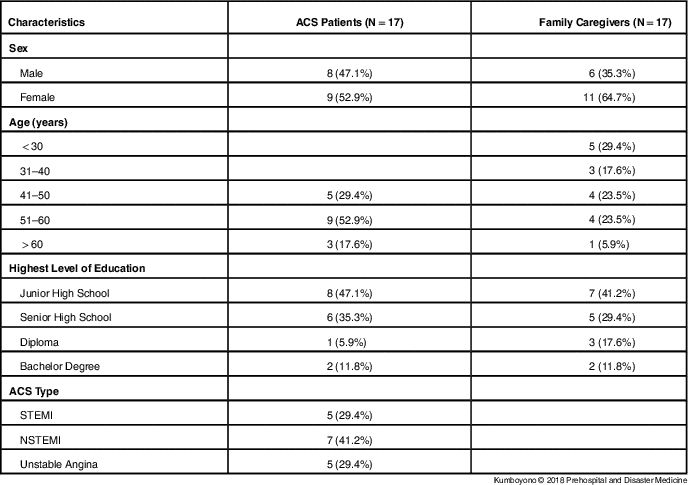
The participants were 34 people, consisting of 17 ACS patients and 17 family caregivers whom the patients contacted when experiencing ACS in Malang, East Java, Indonesia. Table 1 described demographic characteristics of the participants.
Participants Characteristics
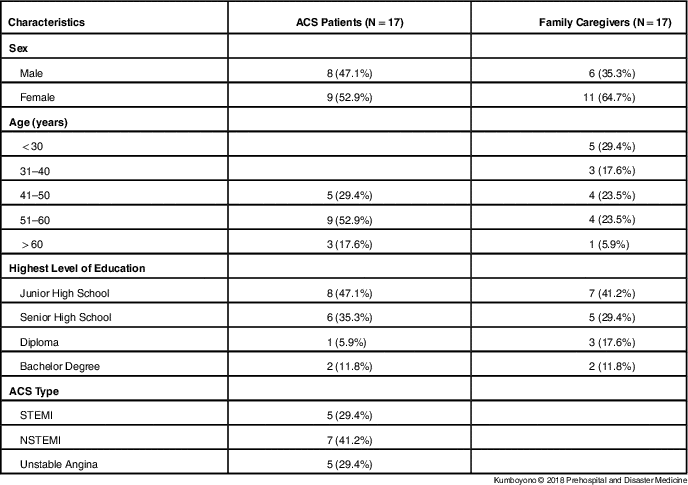
Abbreviations: ACS, Acute Coronary Syndrome; NSTEMI, Non-ST Elevation Myocardial Infarction; STEMI, ST Elevation Myocardial Infarction.
Table 1 identifies that participants were classified into two groups: ACS participants and family members. It can be seen that the first group was dominated by females (52.9%), age of 51–60 years old (52.9%), having highest education level graduated from junior high school (47.1%), and experiencing non-ST-elevation myocardial infarction diagnosis (41.2%). Meanwhile, in the last group, the number of female participants was slightly higher (64.7%). The percentages of family members with age less than 30 years old and having highest education level graduated from junior high school were 29.4% and 41.2%, respectively.
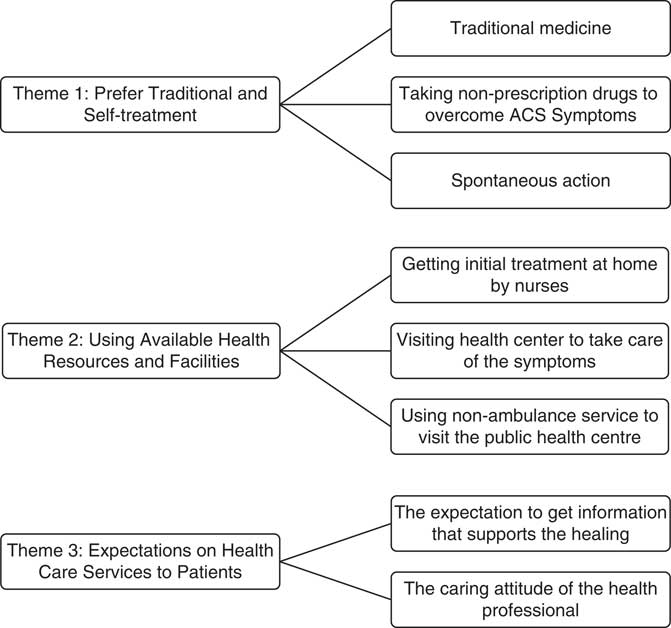
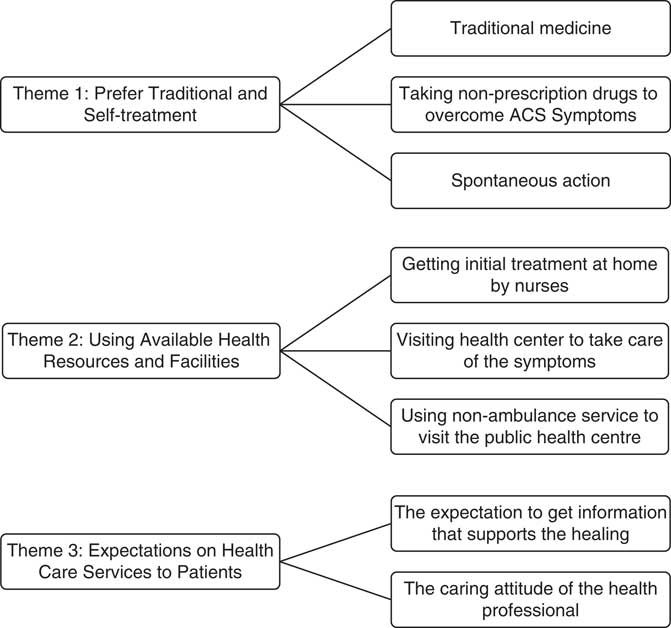
Based on the analysis, the researchers developed three themes: (1) prefer traditional and self-treatment, (2) using available health resources and facilities, and (3) expectations on health care services to patients. Figure 1 depicts a list of themes and sub-themes revealed in the study.
The Themes and Sub-Themes Found with the Research. Abbreviation: ACS, Acute Coronary Syndrome.
Theme 1: Prefer Traditional and Self-Treatment
This referred to the type of treatment the participants selected when they suffered from ACS symptoms for the first time, before the symptoms were getting more severe or before visiting the public health center.
Question that was asked: “What actions have you taken to manage ACS attacks before getting health care services access?”
Before getting aid from health professionals, these participants preferred traditional treatment, took non-prescriptive drugs, and took spontaneous actions.
Traditional alternative treatments referred to acts of using personal experience/habitual actions to decide the type of treatment that could get rid of the ACS symptoms. The patients said that:
I asked my children to give me a massage before and after hospitalization. Massage helps getting rid of some pain on my chest and back (Patient 3).
At 4:00 pm, I suffered from bloated stomach, chest pain, and had difficulty to breath. My family asked me to rub some ointment. I could not bear the pain anymore and at 8:00 pm, my family took me to the hospital (Patient 12).
Based on the interviews, the patients asked for a massage and rubbed on some ointment when they felt ACS symptoms for the first time. Other patients also said that it could be prevented by drinking or compressing warm water. The statements from family caregivers showed the use of traditional ways, such as:
My mother complained that her chest feels heavy, so that I kept rubbing it with medicated oil… I put hot water into the bottle and compressed her with it. She felt a little bit better afterwards (Family Caregiver 9).
Another thing the patients did prior to visiting the public health center was taking non-prescriptive drugs to get rid of ACS symptoms. The patients said that:
Before going to work in the morning, I had a headache and therefore, took Bodrex (non-prescriptive drug). These happened every day. While sitting in the family room on Friday evening, I could not bear the pain anymore (Patient 5).
The statements showed that the patients took non-prescriptive drugs before the ACS symptoms were getting severe. This sub-theme was also supported by statements from family caregivers, including:
Before being hospitalized, my father always vomiting every time he wanted to eat. For a week, he only took Promag (stomach medication) and after that, I called a nurse (Family Caregiver 7).
Bodrex and Promag are two brands of non-prescriptive medicine for headache and gastritis problem. The participants could buy these medicines in nearby stores.
The last thing the patients did to get rid of the ACS symptoms was taking spontaneous actions. It referred to the way the body reacted automatically towards particular symptoms/diseases. The patients said:
I suffered from shortness of breath. I sat down, took a deep breath, and felt better (Patient 8).
I took long, deep breath. I read some reference about that after my older sibling had difficulties in breathing. I inhaled thinking I could get as much oxygen as possible (Patient 15).
The statements explained that the patients took a long deep breath to get maximum oxygen intake in order to reduce the rapid breathing pattern they suffered from.
Theme 2: Using Available Health Resource and Facilities
This provided information on the participants’ efforts to look for effective treatment for ACS or one that got rid of ACS symptoms. The examples were getting preliminary care from nurses, visiting health facilities to get rid of the symptoms, and using non-ambulance facilities to visit the health facilities.
Question that was asked: “What measures have you taken to gain health care access for treating patients with ACS?”
Getting preliminary care from nurses was the first sub-theme from using available health resources criterion. The participants asked for nurses to visit their houses before visiting the public health care centers. The patients stated that:
I feel sharp pain in my chest and had to rest at home for one week before being admitted to the hospital; …until Friday evening, my wife’s sister who works as a nurse took care of myself at home; …I was put on a drip for several days. My wife’s sister returned to Nganjuk City [Nganjuk, East Java, Indonesia] and no one took care of the drip. She told me to visit the health center immediately. At the health center, they conducted health examination. After that I was admitted to Kepanjen Hospital [Malang, East Java, Indonesia], underwent X-ray, and the doctor said I have heart disease (Patient 13).
Based on the statements, the patients preferred home health care by a nurse before visiting the health center and being told they suffered from a heart condition. The same thing was expressed by family caregivers, as in the following statement:
He had nausea at home and did not want to eat. A few days later, I call a nurse and he got an injection. The symptoms were gone, but after three days, it back again. I went to a Puskesmas and they give me some medicines for the stomach, there were no improvements. Finally, the employer of my Dad take him to a doctor in Malang; …the doctor said that the heart is not normal and should be handled by a cardiovascular doctor, …at Nirmala Hospital [Malang, East Java, Indonesia], he was given a blood thinner (Family Caregiver 11).
The second sub-theme from this criterion was visiting health centers to get rid of the symptoms. It referred to the participants’ efforts to visit the health facilities having borne the ACS symptoms for several days. The patients stated that:
It began with cold sweat and then I had difficulties to breathe. My wife took me to Albasirah Clinic [Malang, East Java, Indonesia] and they performed health examination. They found heart abnormalities and later I was admitted to Kepanjen Hospital (Patient 9).
I visited the nearest public health center and was given some medicine but did not feel any improvement. I was referred to Puskesmas Turen [Malang, East Java, Indonesia]; …After that, I was referred to Kepanjen Hospital immediately. I was hospitalized in the Intensive Care Unit for four days (Patient 4).
These statements showed that the patients visited the clinics and public health centers to get identification of the symptoms they suffered from. Other health centers the participants visited were emergency rooms and doctor’s offices. The utilization of health care facilities when experiencing the symptoms was also expressed by family caregivers, as shown in this following statement:
It happened at night, my father was restless and said that his chest feels narrow. He was hard to breathe, I was confused and I called my nephew to help bring to the hospital in Bokor [Malang, East Java, Indonesia]. In there, my father was handled immediately and the heart was examined. He was given an IV and there were drugs put under the tongue. There were many medicines that he takes. The doctor said that there is a constriction in the heart (Family Caregiver 2).
The third sub-theme was using the non-ambulance facility to visit the health centers. It referred to the type of vehicle the participants used to access the health centers. The patients said that:
My younger sibling rented a car to take me to the hospital; …the hospital offered their ambulance, but we decided to use the rented car; I was able to sit at that time (Patient 6).
I rode motorcycles, and was referred to Kepanjen Hospital. I went straight home and my wife rushed me to the hospital. My family took me to the hospital; …I was able to ride my motorbike at that time (Patient 4).
Based on the interviews, the participants used a rented car and a motorcycle to go to the public health centers. Other means of vehicles they used were neighbor’s/other family caregivers’ cars and their own car. The statement of family caregiver which supports this sub-theme was:
My wife experienced the attack at home, she was just getting back from work. Her breath was heavy and I thought it was because of fatigue. It got worse so that I went to the public health center with my own car (Family Caregiver 7).
Theme 3: Expectations on Health Care Services to Patients
This described the services that provided satisfaction and health education to maintain the health of the patients. This theme was formed from two sub-themes, such as the expectation to get information that supports healing and the caring attitude of the health professional.
Question that was asked: “What expectations do you have for improving health care management of patient with ACS?”
The first sub-theme was the expectation to get information that supports healing. This explained the health education that should be provided by health professional so that patients could maintain their health. The patients’ statements related to this sub-theme follow:
I got lots of medicines from Kepanjen. There are medicines that I have to take two times per day, and some, three times a day. There is also like only a half to take. I was confused because I took a lot of medicines but there was no improvement, I even got worse. That usually I drink two or more medicines, because I get confused, I only drink one per day (Patient 16).
I have a routine control…if the doctor is off, I will be told. My doctor was at school so that I did not go… I was given a re-schedule (Patient 10).
The doctor never told me about the information of how to keep my heart healthy, but the doctor told me to do some exercise for my diabetes (Patient 6).
I do not know anything about my blood cholesterol examination results. I want to ask but it happened that it was already reported to the health insurance. I did not have time to copy it. At that time, my husband was also busy take care of me (Patient 12).
The statements of some patients above described the information they needed when accessing health services. Such information included the information on the use of medicines, tips on maintaining cardiovascular health, and the explanation of examination results. The other information needed by patients was in concern to heart diet and doctors’ schedule. The statements of family caregivers which supported this sub-theme were:
In the hospital, I was only told that my husband has a heart disease and must be hospitalized. Just like that. I also want to know if my husband can be healed or not, what kind of disease that he has, and what should I do for that. I asked a lot (Family Caregiver 8).
I don’t know well about health. Yesterday, at the hospital, the health professional just told me to not get tired, that’s it. What is the prohibition, what can I do…I don’t know. From what I heard, this heart disease can attack again if do not eat properly (Family Caregiver 15).
The second sub-theme was the caring attitude of the health professionals. This sub-theme was a way of providing services that health care professionals should show when communicating to participants. The patient statements could be seen as follows:
I expect that the health professional can be humorous because I’m afraid of my heart disease, it scares me. In Panti Nirmala [Malang, East Java, Indonesia], the doctor and nurses are humorous, it calms me (laugh). The doctor said to just be calm (Patient 3).
The doctor or the nurse is primarily in cardiovascular department…my doctor is very nice, humble. I already feel comfortable when I came because a disease can not only be cured with medicine, but with affection such as humble nurses and doctors (Patient 11).
The service, it’s fine, it’s been a long time so that we already know each other. The nurse also already knows me so that I feel comfortable; because it is familiar. We also do not shy to each other anymore (Patient 15).
The above statements illustrated how the attitude of the health professional was favored by the patients. In interacting with patients, a health professional should have a friendly attitude, such as being humorous and being familiar, especially to cardiovascular patients. A health professional who showed a friendly attitude would provide peace and comfort in patients which would increase the satisfaction of the patients. The other attitudes of health professional to provide satisfaction for patients could be in the form of a direct attitude to serve and provide an explanation of the therapy or program received by the patient.
Discussions
Participants’ statements showed the social paradigm on how ACS patients use health facilities. The findings showed that before being diagnosed with ACS, the patients sought treatment at home and went to public health centers or hospitals when ACS symptoms were getting worse. They also preferred non-ambulance services to go to hospitals.
Acute Coronary Syndrome requires emergency health service; ACS patients need immediate and proper treatment.Reference Cameron, Jelinek and Kelly 21 , Reference Venkatachelam, Adilakshmi and Manohar 22 Otherwise, ACS can cause conduction disorder and cause death.Reference Joob and Wiwanitkit 23 Early management restores blood flow to the infarct area immediately.Reference Mega and Morrow 24 Thus, immediate care by a health professional is the most suitable treatment for ACS patients rather than home health care.
Kakou-Guikahue, et al explained that means of transporting patients use to come to hospitals plays a significant role in ACS patient prehospital management.Reference Kakou-Guikahue, N’Guetta and Anzouan-Kacou 25 Patients with possible ischemic symptoms should be taken to the hospital using emergency ambulance instead of other vehicles because studies revealed one in every 300 patients with chest pain who was transported to the hospital using a private vehicle suffered from a heart attack before arriving there.Reference O’Gara, Kushner and Ascheim 26 In addition, the ambulance got special priority on the street, making it the most effective means of transportation for patients, particularly those who needed immediate help.Reference Pusponegoro and Sujudi 27
Emergency ambulances equipped with nurses and paramedics are other elements playing an important role in ACS patient prehospital management. Using ambulances, the patient survival rate would increase since trained paramedics can provide Basic and Advanced Life Support while the patients were transported to the hospital without delay.Reference Mooney, O’Brien and McKee 28 This ambulance also provides definitive therapy on the way to the hospital24 and electrocardiogram evaluation of accelerating reperfusion therapy.Reference O’Gara, Kushner and Ascheim 26
The findings also revealed that before the ACS symptoms were getting more severe, the patients preferred traditional alternatives (eg, massage, ointment oil, and drinking hot water), non-prescriptive drugs, and spontaneous action (taking a deep breath) before seeking a health professional’s care. They selected the alternatives based on their previous knowledge and other health issues they had suffered from.
Theoretically, the first things individuals should do when they suffer from ACS symptoms are to take heart medication and contact emergency services. 29 The participants did not take any of these actions. Inaccurate treatment will result in delay in getting professional health care and increase mortality risk. To prevent these incidents, policy makers should develop cardiac emergency response programs that include introducing signs and symptoms of ACS to the public, prehospital emergency service activation systems (Emergency Medical Service; EMS), as well as promoting pulmonary cardiac resuscitation and automatic external defibrillators (AEDs) for patients suffering from heart attacks.Reference O’Connor, Brady and Brooks 30
In Indonesia, EMS is known as SPGDT (Sistem Penanggulangan Gawat Darurat Terpadu); SPGDT is an integrated emergency care mechanism equipped with emergency ambulance and call center (119) that involves the community (The 2016 Decree of the Minister of Health, number 19). Prawira, et al explained that Jakarta (Java, Indonesia) had a successful SPGDT implementation.Reference Prawira, Noor and Nurani 31 The SPGDT call center in this province is accessible 24/7, waiting time for service is 30 minutes, and the health service provided is supported by competent health professionals who have a good attitude and respond to public health need immediately; for instance, one related to hospital referral services, health information, and ambulance. However, SGPDT has yet to be accessible nation-wide.Reference Prawira, Noor and Nurani 31 This may be the reason for people having different perceptions on which type of health services to use.
In Indonesia, the ambulance is not much different from other means of transportation. This ambulance is not equipped with health professionals and advanced medical equipment to provide early emergency health treatment. As the effect, people who live in areas in which SPGDT is not available tend to choose private vehicles compared to the ambulance. Thus, one effort to increase ACS patients’ life expectancy is to apply SPGDT nation-wide. Accessible SPGDT will encourage people to use an ambulance instead of private vehicles when they need to go to the hospitals.
After the patients obtain a treatment at the health service, the results of the analysis show the things needed by participants when they access health services. The statements from the participants indicate that a health service which provides satisfaction and convenience for patients is a service equipped with caring health professionals and a therapy program accompanied by health information that supports the health of the patients (such as information on healthy lifestyles, examination results, and medical practice schedule).
According to Watson, caring is a form of interpersonal relationships that satisfy patients when their needs are met by the health professional.Reference Alligood 32 In the health care environment, caring promotes the growth of health and individuality and helps facilitate the trust relationship of the patients with health professionals through feelings that can be expressed, perceived, and accepted.Reference Alligood 32 The form of caring behavior manifestations includes: fostering communication in the preferred ways, showing a warm attitude, motivating the patient in the treatment, and identifying the psychological needs of the client.Reference Hardisman 33 When the health professionals are able to show caring behavior, the patient will appreciate every action he/she receives. The research conducted by Chan, et al explained that patient satisfaction increases after the health professionals apply caring behavior.Reference Chan, Chu and Yen 34 Therefore, it is important for health care institutions to promote caring behavior to a health professional in order to provide or to increase patients’ satisfaction.
The need for health information is important to be met by health professionals. Health information serves as a basic knowledge of treatment programs that must be understood by patients to speed up the process of healing and to prevent complications. The failure to understand and adhere to a treatment contributes to a disease recurrence and complications that are not expected. The post-hospital care program of ACS patients should include: (1) a detailed list of drugs and instructions; (2) clear follow-up arrangements (health control); (3) diet instruction; (4) physical activity instruction; (5) plans for bad effects treatment and intervention; and (6) cardiac rehabilitation.Reference Busby-Whitehead and Alexander 35
Limitation of the Study
The participants are limited to patients with ACS undergoing follow-up care in Turen Public Health Center. Thus, the study results are applied merely for the community of patients with ACS having characteristics, treatments, and inclusion criteria similar to the study. The findings of this qualitative survey approach are interpreted not for aiming a generalization but to describe lived experiences of patients suffering from ACS.
Conclusion
The results show that prior to accessing the emergency services, ACS patients tried to reduce the symptoms perceived by using traditional means, taking non-prescription drugs, and taking spontaneous acts like deep breathing. As the symptoms became more severe, they utilized health services in different ways. This difference can be seen from the presence of patients who prefer to receive early home health care from the nurse rather than immediately seek treatment in health services. The patients also are more concerned to use non-ambulance vehicles to access the emergency services. After receiving treatment, the results showed that patients with ACS felt comfortable and satisfied when the health officers showed a caring attitude, explained the results of the examination, and provided health information so that they could maintain their health.
The results also point out that to prevent morbidity and mortality, a health professional should provide health education to the community in regards to ACS, such as the prevention of ACS and its potential threat if they receive late treatment. Furthermore, to optimize the management in the prehospital setting, it is important for governments to implement prehospital emergency services nation-wide. Through these efforts, the patients’ delay in obtaining emergency services when experiencing ACS can be reduced, thus increasing the life expectancy of ACS patients in the hospital.