1 Introduction
The Old English word hwæt is well known within Anglo-Saxon studies as the first word of the epic poem Beowulf. In editions of Beowulf this hwæt is often followed by a comma (e.g. Klaeber Reference Klaeber1922; Fulk Reference Fulk2010) or an exclamation mark (Kemble Reference Kemble1935; Harrison & Sharp Reference Harrison and Sharp1893). It is commonly held that the word can be ‘used as an adv[erb]. or interj[ection]. Why, what! ah!’ (Bosworth & Toller Reference Bosworth and Toller1898, s.v. hwæt, 1; emphasis original) as well as in its normal sense, familiar from Modern English, as the neuter singular of the interrogative pronoun hwā ‘what’.
In this article I present evidence from Old English and Old Saxon constituent order which suggests that the additional punctuation after ‘interjective’ hwæt and its Old Saxon cognate huat is inappropriate: not only are hwæt and huat not extra-metrical, they are also unlikely to be extra-clausal in the vast majority of cases of their occurrence.Footnote 2 I argue that ‘interjective’ hwæt is not an interjection or an adverb but rather is parallel to Modern English how as used in exclamative clauses such as How you've changed!. In other words, it is hwæt combined with the clause that follows it that delivers the interpretive effect of exclamation, not hwæt alone.
Section 2 introduces hwæt, outlining the contexts in which it may be used and reviewing the previous scholarship on the subject as well as flagging up a number of defects of the traditional view. Section 3 presents the constituent order data from Old English and Old Saxon, demonstrating that clauses following hwæt are significantly more likely to deviate from the common verb-initial/verb-second patterns of these languages. Section 4 presents a syntactic–semantic analysis of this construction and makes a proposal regarding its diachronic origin. Section 5 recapitulates and concludes with some implications of these results for editors and translators of Old English and Old Saxon.
2 An introduction to hwæt, and what it is not
2.1 The interjection hypothesis
As alluded to earlier, hwæt, as well as being the nominative/accusative neuter singular of the interrogative pronoun, was able to perform an extra role in Old English, as in the first line of Beowulf:
(1)

Bammesberger (Reference Bammesberger2006) follows Stanley (Reference Stanley, Roberts and Nelson2000) in suggesting that hwæt ‘can function more or less as an adverb’ (Reference Bammesberger2006: 5), and accordingly translates it as ‘truly’. Other translations include ‘What ho!’ (Earle Reference Earle1892), ‘Lo!’ (Kemble Reference Kemble1937), ‘Hear me!’ (Raffel Reference Raffel1963), ‘Yes,’ (Donaldson Reference Donaldson1966), ‘Attend!’ (Alexander Reference Alexander1973), ‘Indeed’ (Jack Reference Jack1994), ‘So.’ (Heaney Reference Heaney1999) and ‘Listen!’ (Liuzza Reference Liuzza2000). The OED (s.v. what, B.I.1) states that hwæt can be ‘used to introduce or call attention to a statement’ in older English, citing the above example among others. Mitchell & Robinson (Reference Mitchell and Robinson1998: 45) and Mitchell & Irvine (Reference Mitchell and Irvine2000) go so far as to analyse this instance of hwæt as an extra-metrical ‘call to attention’, although this is far from universally accepted (see, e.g., Stanley Reference Stanley, Roberts and Nelson2000: 555; Bammesberger Reference Bammesberger2006: 7, fn. 5).
This use of hwæt is found not only in early Old English verse but also in prose, as in the following examples from the writings of Ælfric and the Old English Bede:Footnote 3
(2)
(3)

In the closely related language Old Saxon, the cognate item huat can be found with an apparently similar interpretation, and in the editions this is similarly partitioned off from the clause following it by a comma (e.g. Sievers Reference Sievers1878, and the Heliand text in Behaghel & Taeger Reference Behaghel and Taeger1984) or an exclamation mark (e.g. the Genesis text in Behaghel & Taeger Reference Behaghel and Taeger1984).
(4)
(5)

Grimm (Reference Grimm1837: 448–51) remarked that within Germanic this use of the interrogative pronoun was specific to these two languages,Footnote 4 emphasising that the sense was not interrogative here, since the pronoun was not followed directly by the verb as in true interrogatives; furthermore, he demonstrates that the pattern cannot be merely an artefact of translation from a Latin original, since hwæt is often inserted in translations (e.g. the Old English Bede) even when it corresponds to nothing overt in the original. Grimm notes that it always stands at the beginning of a clause, and that it often serves to introduce speech, or even a whole poem as in the case of Beowulf. His conclusion is that it is ‘purely an exclamation, albeit in a very moderate sense’.Footnote 5
Brinton (Reference Brinton1996) analyses hwæt as a pragmatic marker, suggesting that its function is ‘very similar to that of you know in Modern English’ (Reference Brinton1996: 185).Footnote 6 Brinton's discussion reveals a remarkable range of functions for hwæt: for instance, it may serve to introduce an insulting ‘verbal assault’ on the addressee, but may also express deference or solidarity (Reference Brinton1996: 188). Hwæt is also not uniform with respect to the status of information it introduces: it may indicate that the information to follow is common or familiar, serve to renew interest in that information and/or focus attention on its importance, but it may also precede new information (Reference Brinton1996: 187–8). Several useful observations are made: for instance, that hwæt frequently (but not exceptionlessly) occurs with a first- or second-person pronoun (Reference Brinton1996: 185). Brinton also discusses a potential path of grammaticalization of hwæt from its origins as an argumental interrogative pronoun (Reference Brinton1996: 199–206). She suggests that it has lost its characteristics as a pronoun, e.g. its inflectional morphology and clause-internal syntactic position, and undergoes ‘decategorialization’ to a particle or interjection. Thus a situation of divergence, in the terminology of Hopper & Traugott (Reference Hopper and Traugott2003: 118), obtains, with hwæt continuing to function as an argumental interrogative in the grammar of Old English. The general view of Old English hwæt (and Old Saxon huat) as having undergone grammaticalization is a cogent one, and will be adopted in section 4.3. As argued in sections 2.2 and 3, however, the data do not support the view that hwæt has proceeded to become a category-neutral particle or interjection.
Garley, Slade & Terkourafi (Reference Garley, Slade, Terkourafi and Wood2010) also discuss hwæt in relation to Beowulf and their article provides a useful summary of the received wisdom regarding the word. They take it to be a discourse-structuring formula, ‘a marker employed in the representation of spoken discourse’ (Reference Garley, Slade, Terkourafi and Wood2010: 218). Supporting this, all 25 of the Old Saxon examples I have found in the Heliand occur in the speech of a character within the text. It ‘signals the character's intention to begin a dialogue or a narrative’ (Reference Garley, Slade, Terkourafi and Wood2010: 219); eight Old English poems other than Beowulf begin in this way (Reference Garley, Slade, Terkourafi and Wood2010: 219), and 15 of the 25 Old Saxon examples initiate a character's speech, as in example (5) above. This might also explain the frequency of first- and second-person pronouns in clauses preceded by hwæt noted by Brinton. A number of cases exist, however, in which hwæt does not have this discourse-initiating role. Garley et al. note that it may also occur in the middle of a character's speech, as in the remaining 10 Old Saxon examples, e.g. (4) above. Even more problematic than this is its occurrence (e.g. (2), (3)) in texts such as Ælfric's Lives of Saints, and in particular the Old English Bede, which are far less associated with prototypical orality and in which it therefore makes little sense to view hwæt as being representative of speech or functioning as a ‘call to attention’. Although hwæt clearly had this discourse-opening function in Old English and Old Saxon, this function alone does not suffice to characterize its meaning.
2.2 Problems with the interjection hypothesis
Stanley (Reference Stanley, Roberts and Nelson2000) provides a recent and extensive discussion of hwæt in Old English, although without discussing clausal word order. His conclusions are much the same as Grimm's, and in addition he adduces metrical evidence to show that hwæt cannot have been a strong interjection: if it were stressed, then various instances of it in verse would have led to double alliteration, ‘breaking a basic prosodic rule’ (Reference Stanley, Roberts and Nelson2000: 554). Against the Mitchell & Robinson view that hwæt was extra-metrical he argues that ‘if an opening word were felt to be divorced from the phrase that follows we might have expected it to be occasionally followed by a mark of punctuation, as is hwætla in a good Ælfric manuscript’ (Reference Stanley, Roberts and Nelson2000: 555). In actual fact, Old English manuscripts never show punctuation between hwæt and a following clause (Reference Stanley, Roberts and Nelson2000: 525), and the same is true of Old Saxon: no punctuation mark is ever found between huat and a following clause in any of the manuscripts of the Heliand containing a relevant example (Cotton, Munich, Straubing).Footnote 7 Furthermore, Stanley points out that Ælfric's grammar of Latin and Old EnglishFootnote 8 (edition Zupitza Reference Zupitza1880) did not include hwæt as an interjection, commenting that ‘Ælfric's omission is surprising seeing that this word when used to open a sentence appears to function often as an interjection’ (Reference Stanley, Roberts and Nelson2000: 541).
So far, then, we have seen that the traditional view of hwæt as an adverb or interjection (Bosworth & Toller Reference Bosworth and Toller1898, s.v. hwæt) outside the clause and potentially extrametrical, possibly serving as a ‘call to attention’ (Mitchell & Robinson Reference Mitchell and Robinson1998), suffers from a number of problems, many already noted by Grimm (Reference Grimm1837) and Stanley (Reference Stanley, Roberts and Nelson2000). These are listed below for ease of reference:
(a) Hwæt must usually be analysed as being unstressed;
(b) no punctuation between hwæt and the following clause is ever found;
(c) a contemporary grammarian did not analyse hwæt as an interjection;
(d) hwæt is not exclusively found in texts connected to primary orality, and does not always serve to initiate speech.
To this list will be added facts from constituent order in section 3, making the case for hwæt as an interjection or extra-clausal particle untenable. In section 4 I propose an alternative analysis that has the merit of being consistent with the facts in (a)–(d) as well as with the constituent-order facts.
Traditional philological works on syntax make little mention of constituent order in connection with hwæt. Behaghel (Reference Behaghel1923–32) does not mention the construction at all. Visser (Reference Visser1969: 1547) provides several examples of what he considers to be SV word order with initial interrogative hwæt, but as Mitchell (Reference Mitchell1985: 680) points out, ‘these can all be taken as non-dependent exclamations’. Hopper (Reference Hopper and Hopper1977: 483) suggests that the hwæt-construction is quasi-formulaic and may therefore be likely to have the ‘archaic’ verb-final order, but does not go into any detail on this point. Likewise, Mitchell (Reference Mitchell1985: 299–300, fn. 95) suggests that interjections like efne ‘lo!/behold!’ and hwæt may influence word order, but does not elaborate on this. More recently, within a generative framework, Koopman (Reference Koopman1995), in his discussion of verb-final root clauses in Old English prose, observes that ‘influence of style is . . . noticeable in the word order after the interjection hwæt’ (Reference Koopman1995: 140); as section 3 demonstrates, however, the constituent-order patterns found in both Old English and Old Saxon are too pervasive and significant to be ascribed to archaism or stylistic choices alone.
For completeness, it must be mentioned that hwæt and huat had additional roles in Old English and Old Saxon (and in other older Germanic languages) that are not shared by Modern English what. Firstly, Old English hwæt and Old Saxon huat can be used as indefinite pronouns:
(6)
(7)

Secondly, in various older Germanic languages hwæt and its cognates can mean not only ‘what’ but also ‘how’ and ‘why’. This is demonstrated by examples from Old English and Old Saxon in which hwæt cannot be an argument of the verb:
(8)
(9)


Similar examples exist in Old Norse (Cleasby & Vigfusson Reference Cleasby and Vigfusson1874, s.v. hvat, A.I.3) – as well as in other languages, both within Germanic and outside it. The relevance of such examples is made clear in section 4.
3 Constituent order in clauses following hwæt
While in the past Old English philologists often expressed the opinion that constituent order was ‘free’ (e.g. Fries Reference Fries1940: 199), more recent scholarship (e.g. Mitchell Reference Mitchell1985; van Kemenade Reference Kemenade1987; Pintzuk Reference Pintzuk1999) has come a long way in delimiting the classes of possible and probable constituent orders. Van Kemenade (Reference Kemenade1987) proposed that Old English was essentially an asymmetric verb-second (V2) language like Modern Dutch and German, and although the evidence is not as clear-cut as for these languages there is nevertheless a clear asymmetry in Old English between declarative root and subordinate clauses. The vast majority of root clauses are verb-first (V1) or verb-second. In quantitative studies, Koopman (Reference Koopman1995) found that between 0.5 and 6.1% of Old English root clauses had later (V3+) finite verbs, depending on the text, and Pintzuk (Reference Pintzuk1993: 22, fn. 22) found that 16 of 252 root clauses (6.3%) had later finite verbs (though see Pintzuk & Haeberli Reference Pintzuk and Haeberli2008 for the claim that the pattern underlying this order may have been more common than previously thought).Footnote 9 Subordinate clauses, by contrast, exhibit V1 or V2 only around 35% of the time, with the verb usually surfacing later (Fischer et al. Reference Fischer, van Kemenade, Koopman and van der Wurff2000: 109).
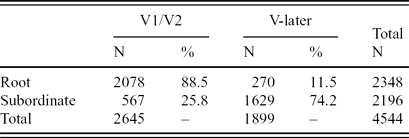
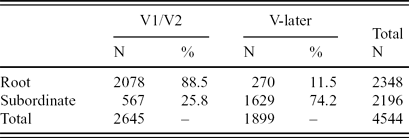
Little syntactic work has been done on Old Saxon. Erickson (Reference Erickson, Dürscheid, Ramers and Schwarz1997) speculates that analyses of Old English such as that of van Kemenade (Reference Kemenade1987) may carry over to Old Saxon, and a quantitative study shows that this is, broadly speaking, the case (see Walkden Reference Walkden2012: chapter 3): of the 2,348 root clauses in the Old Saxon Heliand, only 270 (11.5%) have the verb in a position later than second. Of the subordinate clauses in the Heliand, on the other hand, 1,629 of 2,196 (74.2%) display this pattern, as in table 1. The difference is greater than one would expect if the distribution of clauses were due to chance (Fisher's exact test; p < 0.0001).Footnote 10
Frequency and percentage of V1/V2 vs V-later root vs subordinate clauses in the Heliand
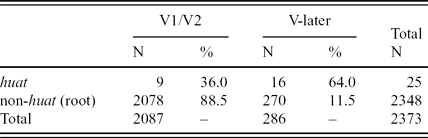
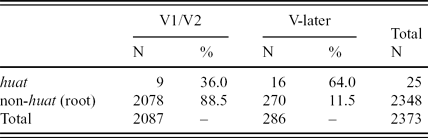
Clauses preceded by huat have so far not been considered. Under the hypothesis that huat is an extra-clausal interjection, separated from the clause itself by a comma in writing which corresponds to a pause in speech, the null hypothesis as regards the constituent order of the following clause would be that no difference would obtain between these and other root clauses. Table 2 gives the verb position of all the non-interrogative clauses preceded by huat in the Heliand, as compared to other root clauses. The null hypothesis is not supported by the data in this table.Footnote 11 Although the number of huat-clauses is very small, once again, the difference between the two types of clause is clearly statistically significant (p < 0.0001). For anyone who takes huat to be clause-external, this result must surely be a mystery: if huat influences the constituent order of the clause that follows it, it must be a part of that clause, and hence not an ‘interjection’.
Frequency and percentage of V1/V2 vs V-later huat-clauses vs non-huat root clauses in the Heliand
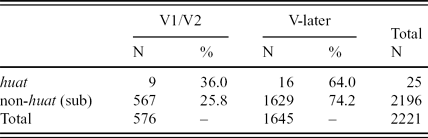
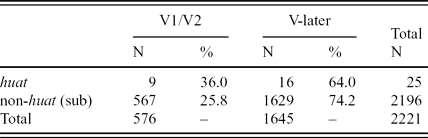
It is also instructive to compare clauses followed by huat to subordinate clauses, as in table 3. Here the difference between the two types of clause is not statistically significant at the 0.05 level (p = 0.2545). This suggests that we should hypothesize that these two types of clause pattern together; in other words, clauses introduced by huat have the word order of subordinate clauses.
Frequency and percentage of V1/V2 vs V-later huat-clauses vs non-huat subordinate clauses in the Heliand
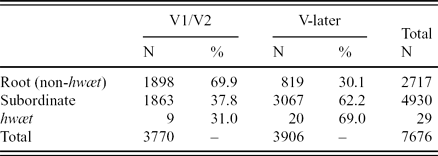
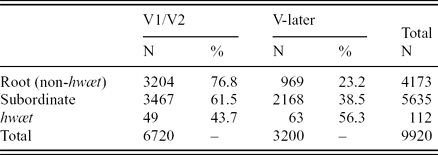
Similar results are found for Old English. In the translation of Bede's Historia ecclesiastica gentis Anglorum (henceforth the Old English Bede), 20 of the 29 clauses preceded by hwæt (69.0%) have the verb in a position later than second, and in Ælfric's Lives of Saints, excluding five examples of the true interjection hwæt la (see Stanley Reference Stanley, Roberts and Nelson2000), 112 clauses preceded by hwæt can be found, 63 of which have the verb in a position later than second (56.3%). The results of contingency tests based on these data are clear.Footnote 12Table 4 considers verb position in root, subordinate and hwæt-clauses in the Old English Bede; table 5 does the same for Ælfric's Lives of Saints. As in the Old Saxon Heliand, root and subordinate clauses pattern distinctly differently in the Old English Bede (p < 0.0001). While the constituent order in hwæt-clauses and root clauses is once again dramatically different (once again p < 0.0001), the difference between constituent orders in hwæt-clauses and in subordinate clauses falls well short of significance (p = 0.5657). The argument for hwæt-clauses patterning with subordinate clauses in this text is thus even stronger than for the huat-clauses in the Heliand.
Frequency and percentage of V1/V2 vs V-later root vs subordinate vs hwæt-clauses in the Old English Bede

Frequency and percentage of V1/V2 vs V-later root vs subordinate vs hwæt-clauses in Ælfric's Lives of Saints
Ælfric's Lives of Saints is a substantial Old English text dated around 996–7. Although direct sources in Latin can be identified, Ælfric's translation is generally agreed to be very free and idiomatic (see, e.g., Bethurum Reference Bethurum1932), making it a suitable object for syntactic investigations. This text has a very different range of constituent order patterns than that found in the Old English Bede. While the position of the verb differs substantially between root and subordinate clauses (p < 0.0001), subordinate clauses themselves far more often have the verb in an early position than in the Old English Bede. As a result, hwæt-clauses, which more frequently have the verb later, differ very significantly from both root (p < 0.0001) and subordinate (p = 0.0002) clauses. Here, then, it cannot be said that hwæt-clauses pattern with subordinate clauses; instead they seem to follow a pattern of their own, with the verb much more likely to be later than in other clauses in general.
The fact that broadly the same results are obtained for Old English and Old Saxon – a general preference for verb-later order in hwæt-clauses – makes it unlikely that the constituent order differences between hwæt-clauses and other root clauses are the result of innovation in both languages; although parallel innovation (perhaps contact-facilitated) cannot be ruled out, by the criterion of diachronic parsimony it should be assumed that the verb-late pattern was the original one, and that hwæt-clauses patterned with subordinate clauses from their inception (on which see section 4).
To recapitulate: in terms of constituent order, clauses introduced by hwæt in Old English and Old Saxon generally pattern statistically with subordinate clauses (including dependent questions and free relatives), rather than with root clauses as would be expected if hwæt were a free-standing interjection. The constituent order data presented in this section therefore give us strong reason to doubt that hwæt had such a syntactic role or status. In the next section I discuss the correct interpretation and analysis of hwæt-clauses, and their diachronic origin.
4 The syntax and interpretation of hwæt-clauses
4.1 The polysemy of interrogative pronouns cross-linguistically
As a starting point for an investigation into the role of hwæt it is instructive to look at other languages in which the interrogative pronoun appears to exhibit polysemy. Munaro & Obenauer (Reference Munaro and Obenauer1999) discuss three such languages: German, French and Pagotto (a subvariety of the northeastern Italian dialect of Bellunese). Interestingly, the sets of meanings contributed by the interrogative pronouns in these (not very closely related) languages do not appear to differ arbitrarily but instead intersect in several key ways. Firstly, in all three of these languages the interrogative pronoun can be used non-argumentally to mean ‘why’ or ‘how’ in questions, as in examples (10) from German, (11) from FrenchFootnote 13 and (12) from Pagotto:
(10)
(11)
(12)



As mentioned earlier, similar examples can be found in Old English (8) and Old Saxon (9), as well as in Old Norse:
(13)
(14)


Latin also permits this non-argumental use of the interrogative pronoun quid:
(15)
(16)


Such non-argumental uses of interrogative pronouns can also be found in Dutch, some varieties of Norwegian (Vangsnes Reference Vangsnes2008), and the early Celtic languages (Lewis & Pedersen Reference Lewis and Pedersen1937: 226–9).
Secondly, German (17), French (18) and Pagotto (19) also permit the interrogative pronoun to occur non-argumentally in exclamatives; German was and French que alternate in this role with the more usual wie and comme, respectively.
(17)
(18)
(19)


Dutch also permits exclamatives using the interrogative pronoun wat, as in (20) (see Corver Reference Corver1990):
(20)
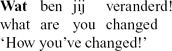
Such a construction is also possible for older speakers of Afrikaans (Theresa Biberauer, p.c.). For present purposes, the important thing to note about all these examples is that certain other languages systematically exhibit a range of possible uses/meanings for their interrogative pronoun that are not possible with Modern English what.
Munaro & Obenauer discuss two possible analyses of this state of affairs: either the wh-words with argumental and non-argumental function are identical in phonological form by chance, or the two are closely and intrinsically related (Reference Munaro and Obenauer1999: 185). The first view, ascribing the variety of meanings of what looks like the interrogative pronoun to accidental homophony of a variety of lexical items, cannot be ruled out, as there are many cases of such homophony throughout attested human languages: indeed, it seems plausible that this is the case with the Old English adjective hwæt ‘quick, active, vigorous, stout, bold, brave’, which is generally agreed not to be related to the interrogative pronoun hwæt but to the verb hwettan ‘to whet’ (see, e.g., Bosworth & Toller Reference Bosworth and Toller1898, s.v. hwæt, 2). However, as Munaro & Obenauer point out (Reference Munaro and Obenauer1999: 222), when the same range of meanings for the interrogative pronoun crops up in language after language it becomes increasingly unlikely that this is due to chance homophony, especially when the languages in question are not closely related.
Munaro & Obenauer instead pursue an analysis in which the relevant interrogative pronoun in German, French and Pagotto may in each of these languages be semantically underspecified for certain features. They adduce distributional syntactic data from these languages to illustrate this. For instance, normal wh-words can be co-ordinated in German, as in (21) and (22), but this is not possible with ‘why’-like was or ‘how much’-like was, as illustrated in (23) and (24).
(21)
(22)
(23)
(24)


These non-argumental uses of was are also unable to function as contrastive focus and cannot appear in truncated questions (Munaro & Obenauer Reference Munaro and Obenauer1999: 227); the same restrictions hold, mutatis mutandis, in French and Pagotto (Reference Munaro and Obenauer1999: 229–33).
In the spirit of Cardinaletti & Starke (Reference Cardinaletti, Starke and van Riemsdijk1999), who account for the difference between strong and weak pronouns cross-linguistically in terms of structural impoverishment, Munaro & Obenauer propose that a piece of word-internal syntactic structure is absent from the structure of underspecified wh-items. They do not state explicitly what the missing piece of structure is, but they suggest that it ‘must be linked to the expression of argumenthood, and contain the semantic restriction . . . [+thing]’ (Reference Cardinaletti, Starke and van Riemsdijk1999: 236). The correct interpretation of the wh-item – as an argument in certain questions when fully specified, as ‘why’ or ‘how’ when underspecified and non-argumental in questions, and as ‘how’ or ‘how much’ when underspecified in exclamatives – must be determined by the particular context in which it occurs. Specifically, in its non-argumental use speakers prefer the wh-item to be accompanied by an expression of the speaker's attitude, particularly of surprise: this is inherently present in exclamatives (on which see section 4.2 below), and can be expressed in e.g. German questions by use of a modal particle such as denn, or by a particular intonation pattern.
Jäger (Reference Jäger2000) and Holler (Reference Holler and Müller2009), within Minimalist and HPSG syntactic frameworks respectively, have also argued independently that there must exist a form of was in German that is underspecified for [thing] and therefore non-argumental, as in examples (10) and (17) above.Footnote 14 If the underspecification logic outlined above holds in general, then it is tempting to analyse the Old English interrogative pronoun hwæt along the same lines as Modern German was, French que and Pagotto cossa etc., namely as a wh-item which may occur non-argumentally in an underspecified form. Although it is not possible to test for contrasts such as those in (21)–(24) in Old English or Old Saxon for obvious reasons, the corpus data we have are compatible with the analysis outlined above. So where does this lead us with regard to examples of clauses such as (1)–(5)? Clearly, as observed by Grimm (Reference Grimm1837: 449), these clauses cannot be interrogative, since the word order is not that of matrix questions, hwæt cannot be argumental in these clauses, and no sensible interrogative interpretation is available in the contexts in which they occur. The remaining possibility is that these clauses are exclamatives, and this is the hypothesis that I shall pursue in section 4.2.
4.2 Hwæt-clauses as exclamatives
Munaro & Obenauer (Reference Munaro and Obenauer1999) have little to say about the analysis of exclamatives, or how the underspecified interrogative pronoun receives its interpretation of ‘how’ or ‘how much’, speculating only that ‘since it is structurally and . . . semantically deficient in ways parallel to ‘why’-like WHAT, the interpretation it eventually gets should again be construed from elements of the sentential context’ (Reference Munaro and Obenauer1999: 248). To pursue the matter further we must turn to analyses of exclamatives themselves, since the hypothesis that hwæt-clauses are exclamatives can only be tested through comparison with the properties and structures of exclamatives in general.
Current and past analyses of exclamatives have generally proposed that a key component of the interpretation of exclamatives is that their content must involve something related to degree/scalarity (e.g. Bolinger Reference Bolinger1972; Corver Reference Corver1990; D'Avis Reference D'Avis2002; Zanuttini & Portner Reference Zanuttini and Portner2003; Sæbø Reference Sæbø2005; Rett Reference Rett2008, Reference Rett, Friedman and Ito2009). For simplicity's sake I will adopt here the semantic proposal of Rett (Reference Rett2008, Reference Rett, Friedman and Ito2009), who suggests the following two restrictions on the content of exclamatives:
(25) The Degree Restriction
An exclamative can only be used to express surprise that the degree property which is its content holds of a particular degree.
(Rett Reference Rett2008: 147; her (4))
(26) The Evaluativity Restriction
The content of the exclamative must additionally be evaluative: the degrees it makes reference to are restricted such that they must exceed a contextual standard.
(Rett Reference Rett2008: 155)
The Degree Restriction is key for our purposes. Consider (27) (from Rett Reference Rett2008: 147; her (5b)):
(27) What languages Benny speaks!
This can be taken to express surprise at the number of languages Benny speaks, even in the absence of any overt degree morphology, for example in the context where Benny is an American and you expect him to speak only English (the ‘amount reading’). Another context might be one where Benny is a Romance linguist and you expect him to speak only Romance languages, but in fact he speaks languages from other obscure/exotic language families; this is the ‘gradable reading’ of (27), in which surprise is being expressed at the degree to which the languages Benny speaks are exotic. Note that no overt gradable predicate ‘exotic’ is present in the sentence, but this interpretation is nevertheless available. Rett takes this to mean that a null gradable predicate  $\mathbb{P}$, an adjective (or adverb) which receives its value from context, must be posited for the gradable reading as a ‘necessary evil’ (2008: 149). In a situation where you expect Benny to speak French and Italian but discover that he instead speaks Portuguese and Romanian, on the other hand, uttering (27) would be expressively incorrect. The impossibility of this ‘individual reading’ of (27) leads Rett to conclude that the degree reading, and hence the Degree Restriction, is an essential part of exclamativity: ‘non-degree readings are impossible interpretations of exclamatives’ (2008: 151; emphasis original).
It follows that syntactic constructions used to express wh-exclamatives must be able to denote a degree property (Rett Reference Rett2008: 168–9). The two possible candidates are (degree) constituent questions and free relatives. The one systematic syntactic difference between these two types of construction in Modern English is that subject–auxiliary inversion is required in constituent questions (contrast (28) and (29)) and impossible in free relatives (30)–(31); in English, subject–auxiliary inversion is impossible in traditional wh-exclamatives too ((32)–(33); though see footnote 14).
(28) How big is your car?
(29) *How big your car is?
(30) *I'll buy what are you selling.
(31) I'll buy what you are selling.
(32) *How big is your car!
(33) How big your car is!
Questions and free relatives differ morphosyntactically in many languages other than English, and here Rett makes a stronger claim: ‘in any such language I know of, exclamatives pattern in their morphosyntax with free relatives rather than with questions’ (2008: 173), although she cautions that ‘a thorough crosslinguistic study of these constructions is necessary to give any serious weight to this claim’.Footnote 15 In Hebrew, for instance, exclamatives and free relatives require an overt complementizer, but questions do not (2008: 175–6). While Rett's semantic analysis is in principle neutral as to whether the morphosyntactic structure underlying wh-exclamatives is that of a question or a free relative, she favours the latter view.
Rett's claim that exclamatives pattern morphosyntactically with free relatives rather than questions fits perfectly with an account of Old English (and Old Saxon) hwæt-clauses as exclamatives, since, as I demonstrated in section 3, hwæt-clauses pattern with embedded clauses in terms of verb position. Constituent questions in Old English are exceptionlessly V2 (see, e.g., Fischer et al. Reference Fischer, van Kemenade, Koopman and van der Wurff2000: 106). In contrast, in free relatives such as (34), as in other embedded clauses and in hwæt-clauses, the verb is in a later position (Fischer et al. Reference Fischer, van Kemenade, Koopman and van der Wurff2000: 61). Rett's generalization thus provides support for an analysis of Old English (and Old Saxon) hwæt-clauses as exclamatives.
(34)
What about the interpretation of these ‘exclamative’ hwæt-clauses? Consider examples (2)–(5), repeated below as (35)–(38) for ease of reference.
(35)
(36)
(37)
(38)


Example (35) receives a straightforward and satisfying analysis as an exclamative. According to Rett's analysis outlined above, underspecified hwæt must receive a degree reading, and a natural item for it to range over is the verb onwrēon ‘to unbind/unwrap’. The interpretation of the clause would thus be ‘How he truly uncovers the nakedness of his father!’ A similar analysis can be given for the Old Saxon example in (37). If the predicate that huat ranges over is understood as the verb ‘to know’, the clause then relates to the extent of the addressee's knowledge: ‘How well you know the customs of these people!’
(36) and (38) are less straightforward. At first sight it appears that there is no predicate for hwæt/huat to range over, since the verbs ‘to bless’ and ‘to promise’ do not seem gradable in any intuitive sense. However, Rett's analysis allows for a null gradable predicate $\mathbb{P}$ which receives its value from context (recall that this null predicate is independently necessary to account for English examples such as (27) under the gradable reading). In this case we can posit a null adverb which receives a meaning ‘fervently’ for (36), yielding a reading ‘How fervently Eugenia then blessed herself!’. Likewise, (38) could be viewed as containing a null adverb ‘earnestly’ or ‘faithfully’, and receiving the reading ‘How earnestly/faithfully I promised you God's kingdom!’Footnote 16
We are now in a position to revisit example (1), the first sentence of Beowulf. Complications other than hwæt mean that the correct analysis of this sentence is disputed; indeed, whole articles have been devoted to these few lines alone (e.g. Bammesberger Reference Bammesberger2006). I repeat it, without translation, as (39) below.
(39)

Here the verb, frīnan ‘to learn by enquiry’, can straightforwardly be read as gradable. The exclamative hypothesis suggests that this clause should be interpreted as ‘How much we have heard of the might of the nation-kings in the ancient times of the Spear-Danes’. Of the translations so far put forward, this interpretation has the most in common with Morgan's (Reference Morgan1952) rendering as ‘How that glory remains in remembrance’.
Other well-known poetic examples are also compatible with the exclamative hypothesis. For instance, Dream of the Rood begins with the clause:
(40)

Once again, the verb ‘to want’ is clearly gradable, and so a reading along the lines of ‘How I want to tell you of the best of dreams’ is indicated by the exclamative hypothesis. Similarly (41), from the verse text Juliana, is neatly amenable to an exclamative analysis:
(41)

The gradable element here is glæm ‘beauty’, suggesting a reading of ‘Juliana! How beautiful you are. . .’. Thus the content of the relevant hwæt-clauses seems to present no problem for the hypothesis that their illocutionary force is that of exclamatives.
In addition, hwæt used in this way appears to survive sporadically into early Middle English. Brinton (Reference Brinton1996: 201) gives some examples from Chaucer, including (42) and (43).
(42)
(43)


Both of these examples occur in the direct speech of characters in the text, as is normal for Old English hwæt. Each also allows an interpretation consistent with the exclamative hypothesis. The first can be read as ‘How welcome is the cut, by God's name!’ The second, in which the dun-coloured horse in the mire is taken as a metaphor for events having come to a standstill, can be read as ‘How things have slowed down!’
Further pieces of potential evidence for the exclamative hypothesis for Old English hwæt come from later texts: occasional apparent degree-exclamatives with what are found in texts dating to as late as the sixteenth century. The OED (s.v. what, B.II.4) gives (44), from 1440:
(44)

It cannot be ruled out, of course, that this pattern arose independently and is unrelated to Old English hwæt as found in e.g. the first line of Beowulf. However, considerations of parsimony suggest that this (rare) degree-exclamative use of what in Middle and Early Modern English represents not an innovation but the tail-end of a much older pattern.
Finally, the exclamative hypothesis has the merit of bringing into line a few further observations not accounted for by the traditional view. Brinton (Reference Brinton1996: 189–91) considers, and rejects, the hypothesis (attributed to personal communication from Elizabeth Traugott, and defined only broadly) that hwæt functions as an ‘evidential’; however, she does note that ‘it does frequently precede a clause containing an evidential or an evidential-like form’ (Reference Brinton1996: 190). It is possible that the intuition is in fact not about evidentiality per se, but about factivity. Under the exclamative hypothesis proposed here, hwæt introduces an exclamative clause, and it is well known that such clauses presuppose factivity (see, e.g,. Zanuttini & Portner Reference Zanuttini and Portner2003; Abels Reference Abels2010). If hwæt-clauses are factive, this explains why the intuition that hwæt has an epistemic element to its meaning seems to ring true. The exclamative hypothesis is also consistent with the suggestion made by Grein in his Sprachschatz der angelsächsischen Dichter (Reference Grein, Holthausen and Köhler1912 [1864]: 367) that hwæt could be used with the same meaning as exclamatory hu ‘how’, and therefore that it should be distinguished from an interjection, with punctuation in editions reflecting this. As Stanley (Reference Stanley, Roberts and Nelson2000: 551, fn. 75) notes, Grein's suggestion was not adopted by later editors of Old English and Old Saxon. However, the evidence adduced in this article also suggests that this punctuation is superfluous, and that there is a partial parallel to be drawn between hwæt and exclamatory hu ‘how’.
Altogether, it can be said that the hypothesis presented here has significant advantages over the traditional account of the function and meaning of hwæt as outlined in section 2.1. It accounts for the word order facts (see section 3), it does not need to maintain that hwæt is an interjection (with all the concomitant problems of this stance; see section 2.2), and it brings the behaviour of hwæt into line with that of a range of other interrogative pronouns observed cross-linguistically (see section 4.1). Furthermore, it is falsifiable: it predicts that hwæt-clauses must be amenable to, or at least coercible into, a degree reading. Any alternative proposal must be able to do at least as well, or better, on these counts.
4.3 On the origin of ‘underspecified’ hwæt
A natural question to ask at this point is how hwæt came to be potentially underspecified in the first place. Intuitively, the change towards underspecification, and the loss of the restriction [+thing] (and thus of the necessity of argument status), seems to be a ‘natural’ change. In studies of grammaticalization such ‘semantic bleaching’ has often been observed (see, e.g., Hopper & Traugott Reference Hopper and Traugott2003), and principles of acquisition such as ‘minimize feature content’ (Longobardi Reference Longobardi2001: 294; see also the feature-based simplicity metric in Roberts & Roussou Reference Roberts and Roussou2003: 201) have often been posited in the generative literature on syntactic change. In Old High German, for example, there are no examples of the cognate interrogative pronoun (h)waz in a non-argumental role (though see footnote 4), and hence no evidence that the cognate interrogative pronoun was underspecified for the feature [thing] – and yet Modern German was is, as illustrated in section 4.1, providing another example of this change. The fact that Modern English what may no longer be semantically underspecified in the same way, as shown by the ungrammaticality of examples such as *What did you do that? and *What you've grown! with intended readings of ‘Why did you do that?’ and ‘How you've grown!’ respectively, can be viewed as the result of a separate change, namely the loss of underspecified what as a lexical item. The situation of ‘divergence’ which obtained in Old English, with both argumental and non-argumental hwæt as lexical options in the language, thus no longer held.
As regards the origin of this underspecification in the prehistory of the Germanic languages, language contact and the wave model may be able to help us. Among the early Germanic languages, Old English, Old Saxon and (to a lesser extent) Old Norse display underspecification, while Gothic and Old High German do not. If we accept the traditional family grouping according to which Gothic is first to branch off the Germanic family tree followed by Old Norse and then Old High German, with Old English and Old Saxon forming a North Sea Germanic/Ingvaeonic subgroup together (see Nielsen Reference Nielsen, Hoops, Beck, Geuenich and Steuer2000 for discussion), then we can postulate one of two changes: either underspecification was innovated in Proto-Ingvaeonic and Old Norse, or it was lost in Old High German and Gothic. A criterion of economy in terms of number of changes does not help us here. Departing from the strict tree model, however, the change could be traced back to an early Northwest Germanic dialect continuum: we have ample evidence that considerable contact between what was to become the Ingvaeonic languages and what was to become Proto-Scandinavian must have taken place, and that there was a high degree of mutual intelligibility. One hypothesis could be that the underspecification of the interrogative pronoun was an innovation diffused across the Northwest Germanic dialect continuum but which did not make it as far southeast as the pre-Old High German area of Europe.
Furthermore, data exist which may help us to pin down the exact reanalysis that caused this change to happen. Interrogative examples such as (45) are occasionally found in the Heliand:
(45)

Here huat can be analysed as argumental, as in essence it forms a unit with guodes to mean ‘what of good [things]’. Such discontinuous constituents were a possibility in many early Indo-European languages (see, e.g., the Latin examples in Matthews Reference Matthews1981: 255, and Devine & Stephens Reference Devine and Stephens1999 on Greek). As examples of discontinuity became rarer, learners who had not acquired this possibility would require another analysis for clauses such as (45). In such cases, analysis of huat as underspecified, specifically non-argumental and generated in the left periphery of the clause rather than extracted by wh-movement from a nominal constituent further down the tree, would be one solution to this problem, with guodes itself analysed as a genitive argument of the main verb: the clause would then receive the interpretation ‘how the Lord God has prepared good things (for us)’. Once huat had become detached from its position in the paradigm of argumental interrogative pronouns and was able to be interpreted as underspecified ‘how’, it could then be extended unproblematically to exclamatives as in the construction discussed in 4.2. We thus have an argument, albeit not a watertight one, for reconstructing underspecified *hwat as a North Sea Germanic innovation.
5 Conclusion
In this article I have argued that the traditional view of Old English hwæt as an interjection meaning simply ‘lo!’ or ‘listen!’, as proposed by Grimm (Reference Grimm1837) and assumed ‘by all Anglo-Saxonists’ (Stanley Reference Stanley, Roberts and Nelson2000: 541), is unsatisfactory. This is because (a) hwæt must usually be analysed as unstressed where it occurs in metrical texts, (b) no punctuation between hwæt and the following clause is ever found, (c) a contemporary grammarian did not analyse hwæt as an interjection, and (d) hwæt is not exclusively found in texts connected to primary orality, and does not always serve to initiate speech. Most strikingly, as discussed in section 3, clauses preceded by hwæt pattern with subordinate clauses, not with main clauses, with respect to the position of the verb. It is difficult to imagine how the presence of an extra-clausal interjection could have such a dramatic effect on clausal word order. Regardless of whether my own proposal in section 4 is accepted, these facts must be accounted for by any satisfactory theory of hwæt.
According to the alternative analysis pursued in section 4, there were two variants of hwæt in Old English: both were interrogative, but one was underspecified for the feature [thing] and thus able to assume a non-argument role. Non-interrogative clauses preceded by hwæt are wh-exclamatives parallel in interpretation to Modern English How you've changed!; it was demonstrated that a selection of such clauses were amenable to this kind of interpretation. If the logic of this argument is accepted, then the implications for editors and translators of Old English and Old Saxon texts are significant. In section 4.3 it was also suggested, more tentatively, that the underspecification of hwæt may have originated in late Northwest Germanic through reanalysis of interrogatives containing discontinuous nominal constituents.
Note that this proposal is in no way incompatible with the view – for which there is substantial evidence; see section 2.1, Brinton (Reference Brinton1996) and Garley et al. (Reference Garley, Slade, Terkourafi and Wood2010) – that hwæt, or perhaps more precisely clauses beginning with hwæt, were characteristic of speech, and were used to initiate discourse with particular pragmatic functions. Here we must distinguish sharply between the grammatical properties of a lexical item or clause and the way it is used by speakers of the language. It could perfectly well have been the case that it was customary among speakers of early Ingvaeonic languages, for whatever reason, to start one's speech with an exclamative; at least, this is as plausible as starting one's speech with an interjection. The ‘exclamative hypothesis’, then, does not quibble with the view that hwæt had this function; it simply argues that this function alone is insufficient to characterize the grammatical properties and interpretation of hwæt and clauses beginning with it.