INTRODUCTION
Social monogamy is defined as the close association of one male and one female and often involves cooperation with respect to breeding activities (Wickler & Seibt, Reference Wickler and Seibt1981). Social monogamy has been demonstrated for several species of invertebrates and vertebrates (Wickler & Seibt, Reference Wickler and Seibt1981; Mathews, Reference Mathews2002a). However, social monogamy does not necessarily imply sexual monogamy (Bull et al., Reference Bull, Cooper and Baghurst1998). Several hypotheses on the evolution of monogamous systems are based on species with biparental care (Mathews, Reference Mathews2002a). Kleiman (Reference Kleiman1977) used the term ‘obligate monogamy’ to describe cases in which males and females can each increase their fitness when sharing the responsibilities of caring for offspring. However, social monogamy also occurs in different taxa even when biparental care does not, as in the case of decapod crustaceans belonging to the genus Alpheus (Mathews, Reference Mathews2002a). Two hypotheses explain the evolution of social monogamy in species with no biparental care: (1) the territorial cooperation hypothesis (Wickler & Seibt, Reference Wickler and Seibt1981), in which individuals of both sexes are responsible for maintaining and protecting their micro-habitat through activities such as foraging and burrow maintenance; and (2) the mate-guarding hypothesis (Grafen & Ridley, Reference Grafen and Ridley1983) in which pairing occurs pre- and post-mating, i.e. only during the reproductive period, and which, in some cases, extends beyond more than one reproductive cycle. In any case, this strategy can be helpful in the defence of habitats from predators and in the acquisition and maintenance of food (Mathews, Reference Mathews2002a).
The monogamy system employed by many crustaceans is a strategy of individual fidelity among both sexes in order to defend and share a specific microhabitat or refuge (Correa & Thiel, Reference Correa and Thiel2003; Thiel & Baeza, Reference Thiel and Baeza2001). The formation of heterosexual pairs reduces the possibility of copula with several partners among caridean shrimp as well movement between refuges (Thiel & Baeza, Reference Thiel and Baeza2001). Several factors contribute to the formation of heterosexual pairs: low population densities, the dispersed distribution of refuges (which limits the probability of encounters between males and extra-pair females), and high predation pressure outside refuges (Thiel & Baeza, Reference Thiel and Baeza2001; Correa & Thiel, Reference Correa and Thiel2003).
Monogamy is the most common mating system among Alpheidae. It also occurs among Gnathophyllidae, Hippolytidae and Palaemonidae (Correa & Thiel, Reference Correa and Thiel2003). Females of Alpheidae shrimps exhibit sexual receptivity for a short period of time after moulting (Nelson, Reference Nelson, Wenner and Kuris1991). Furthermore, under conditions that make searching for females costly to males (i.e. low population density or a male-biased operational sex ratio), pairing with pre-receptive females would be selectively advantageous for males (Wickler & Seibt, Reference Wickler and Seibt1981; Grafen & Ridley, Reference Grafen and Ridley1983). The relationship between territoriality and the formation of monogamous pairs probably lies in the benefits of territorial cooperation. Heterosexual pairing behaviours among Alpheidae are linked to territoriality, and some factor or factors make cooperation in territorial maintenance advantageous to one or both sexes (Mathews, Reference Mathews2002a). Responsibilities such as territory defence, burrow construction, and foraging can be shared in order to reduce costs to the two sexes (Mathews, Reference Mathews2002a).
There is a lack of information on the biological, ecological and behavioural aspects of Alpheidae species, especially in the case of the Alpheus armillatus Anker, Reference Anker2012 species complex (Anker, Reference Anker2012), which is native to the western Atlantic. The lack of information on representatives of this species complex is probably due to the cryptic lifestyle exhibited by this group. Many Alpheidae species live in microhabitats under rocks, in self-excavated burrows in sandy, muddy or rocky substrates, and in crevices among coral rocks (Mathews & Anker, Reference Mathews and Anker2009). In addition, many species in the genus Alpheus Fabricius, 1798 are cryptic and pseudo-cryptic; they are identified through the comparison of colour patterns or genetics, which makes identification difficult (Anker et al., Reference Anker, Hurt and Knowlton2009).
Alpheus brasileiro Anker, Reference Anker2012 belongs to the A. armillatus species complex. It is found in exposed reef areas with natural pools, as well as in estuarine areas with rocks (Anker, Reference Anker2012). The species is endemic to the Brazilian coast; it ranges from the state of Pará to Santa Catarina (Anker, Reference Anker2012). However, populations are mainly found in microhabitats, such as under rocks in estuarine areas (Anker, Reference Anker2012). Considering the fact that these shrimps live in very inconspicuous microhabitats (refuges), sampling requires special attention. It is also difficult to identify this species because A. brasileiro presents morphological characteristics that are very similar to other species of the Alpheus armillatus complex (Anker, Reference Anker2012).
Egg production is an important parameter to be considered in the analysis of this organism's reproductive strategy (Bertini & Baeza, Reference Bertini and Baeza2014). It can be used to estimate both the stock size and the reproductive potential of a given species or population (Hattori & Pinheiro, Reference Hattori and Pinheiro2003). Several factors can influence egg production, from environmental pressures to genetic predisposition (Sastry, Reference Sastry, Vernberg and Vernberg1983). The fecundity of aquatic organisms represents high plasticity and differentiation at inter- and intraspecific levels (Anger & Moreira, Reference Anger and Moreira1998).
Although the genus Alpheus is the most widely represented genus in the family Alpheidae (Anker et al., Reference Anker, Ahyong, Noël and Palmer2006; De Grave & Fransen, Reference De Grave and Fransen2011), studies that address the different aspects of its population dynamics and reproductive biology are scarce, especially for newly described species. Most studies on this genus, such as those by Mathews (Reference Mathews2006), Mathews & Anker (Reference Mathews and Anker2009) and Anker (Reference Anker2012), have focused on taxonomy. In Brazil, Mossolin et al. (Reference Mossolin, Shimizu and Bueno2006) and Pavanelli et al. (Reference Pavanelli, Mossolin and Mantelatto2008) analysed the population structure and reproductive strategy of A. carlae (as A. armillatus) in the northern region of São Paulo State. Pavanelli et al. (Reference Pavanelli, Mossolin and Mantelatto2010) also analysed environmental effects on reproductive performance in different populations of the snapping shrimp Alpheus nuttingi (Schmitt, 1924), and Costa-Souza et al. (Reference Costa-Souza, Rocha, Bezerra and Almeida2014) studied the reproductive biology and heterosexual pairing of Alpheus estuariensis Christoffersen, 1984 in southern Bahia State. Information on the population distribution and reproductive performance of A. brasileiro is lacking.
The aim of this study is to test for social monogamy in A. brasileiro and analyse egg production.
MATERIALS AND METHODS
Study area
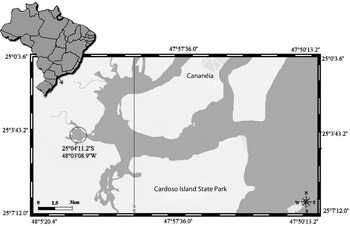
The sampling area was an intertidal estuary (25°04′11.2″S 48°03′08.9″W) (Figure 1) characterized by sediment composed of a mixture of sand, mud and rocks that are randomly dispersed throughout the site. Rocks are exposed during low tide, but small puddles of water form and provide refuge to A. brasileiro. The edges of the estuary are composed of a dense mangrove forest and are partially flooded during high tide.
Study area, intertidal estuarine zone of Cananéia, São Paulo, Brazil.

Sampling
Due to A. brasileiro's low population density at the study site in previous samplings and the limited size of the sampling area (~600 m2), collections were performed bimonthly in order to avoid any major population disruptions. Samples were collected from March 2013 to January 2014 during low tide periods. The sampling area was divided into three sub-areas perpendicular to the water line, 10 m apart, and measuring 20 m in length and 5 m in width. In each sub-area, three 1 m2 units were marked, for a total of nine units sampled each month. Units were set equidistant from each other in each sub-area (methodology adapted from Vergamini & Mantelatto, Reference Vergamini and Mantelatto2008; Costa-Souza et al., Reference Costa-Souza, Rocha, Bezerra and Almeida2014).
All A. brasileiro specimens present in each sampling unit were collected during each sampling event. Shrimp were collected manually by two people with a catch effort of 2 h per person. Rocks and sediment were removed to facilitate specimen capture. Upon collection, shrimp were kept in coolers with crushed ice. Paired individuals were kept together. Next, the shrimp were transported to the laboratory where different measurements were recorded.
All specimens captured were identified according to specific keys (Chace, Reference Chace1972; Anker, Reference Anker2012; Soledade & Almeida, Reference Soledade and Almeida2013), and sex was identified according to the presence (males) or absence (female) of appendices masculinae in the endopods of the second pair of pleopods (Bauer, Reference Bauer2004). Carapace length (CL) was measured from the postorbital margin to the posterior margin of the carapace using a digital calliper (0.01 mm) and a stereomicroscope with an ocular micrometre.
Testing for social monogamy
We compared the observed distribution (i.e. frequency of occurrence of refuges with paired and unpaired shrimps) with a Truncated Poisson distribution. Significant differences between the distributions were examined using a Chi-square test of goodness-of-fit (Sokal & Rohlf, Reference Sokal and Rohlf1981).
A Chi-square test of independence (Sokal & Rohlf, Reference Sokal and Rohlf1995) was used to determine any differences in the frequency of pairings that included females carrying eggs at different stages of development. The carapace lengths (CL) of paired and unpaired shrimp were measured in order to determine the sizes at which pairing started. The difference in size (CL) between categories (paired and unpaired shrimp) and sex (males and females) was tested by two-way ANOVA. The correlation between the sizes of males and females was determined by applying Pearson's correlation coefficient (α = 0.05).
Egg production
Eggs were removed from each ovigerous female, placed in a Petri dish, counted, and then classified as one of three stages of embryonic development (Mossolin et al., Reference Mossolin, Shimizu and Bueno2006): early stage (I), with no eyes and with yolk occupying 75–100% of egg volume; intermediate stage (II), with vestigial eyes and with yolk occupying about 50–75% of egg volume; and final stage (III), with developed eyes and with the yolk occupying 25–50% of egg volume. Twenty eggs were randomly selected from each female and the length and width of each egg was measured under a stereomicroscope equipped with an ocular micrometre. The measurements above were used to calculate egg volume (EV) using the formula EV = 1/6*π* × I 3 (EV: volume; I: mean diameter) (Jones & Simons, Reference Jones and Simons1983).
All females with eggs in stage I were used for the analysis of fecundity and variability in this parameter with female body size. The Kruskal–Wallis test was used to determine any differences in number and volume of eggs between stages of development. The Pearson correlation was used to analyse the relationship between female size and fecundity, as well as the relationship between female size and egg volume separately.
RESULTS
Testing for social monogamy
During the study period, 186 specimens were captured (92 males and 94 females). Carapace length ranged from 2.82 to 8.52 mm (5.23 ± 1.48 mm) in males and from 2.95 to 10.07 mm (5.15 ± 1.48 mm) in females. A total of 100 shrimp were found living under solitary conditions: 49 males and 51 females. A total of 43 pairs were collected; these pairs corresponded to 46.24% of all specimens sampled. All of the shrimp living in pairs were heterosexual couples. The population distribution of A. brasileiro displayed a random pattern (Chi-square test of goodness-of-fit, χ2 = 142.87, df = 2, P = 0.999). There was no difference in the proportion of refuges with paired shrimps compared with the number expected by chance alone (χ2 test of goodness-of-fit, χ2 = 0.308, df = 1, P = 0.578), as well as in the number of refuges with one shrimp compared with the number expected by chance alone (χ2 test of goodness-of-fit, χ2 = 0.121, df = 1, P = 0.726). The proportion of paired shrimp specimens was higher than 50% in 3 months during the study period (May 2013, 54%; September 2013, 80%; January 2014, 60%). In the other 3 months, however, the proportion of paired shrimp specimens was less than 50% (March 2013, 47%; July 2013, 43.63%; November 2013, 17%).
A total of nine unpaired females were carrying eggs. Females were carrying eggs in 26 (60.46%) of the 43 pairs; this was more frequent in May 2013 (Table 1). Of these 26 ovigerous females, 20 (76.9%), 4 (15.4%) and 2 (7.7%) were carrying eggs in stages I, II and III, respectively. There was no statistically significant difference in the frequency of ovigerous or non-ovigerous paired females (Chi-square test of independence χ2 = 3.01, df = 1, P = 0.0827). However, the frequency of ovigerous paired females in each stage of egg development was compared, and there were significant differences in the frequency of paired females with eggs in stage I vs stage II (χ2 = 10.67, df = 1, P = 0.0011) and in stage I vs stage III (χ2 = 14.73, df = 1, P = 0.0001). There were no significant differences in the frequency of paired females with eggs in stage II vs eggs in stage III (χ2 = 0.67, df = 1, P = 0.4142).
Alpheus brasileiro Anker (Reference Anker2012). Monthly frequency of male-female pairs specimens collected from March 2013 to January 2014 in Cananéia, São Paulo, Brazil.

*Indicates months in which pairing was greater than 50%.
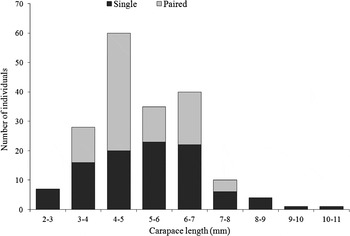
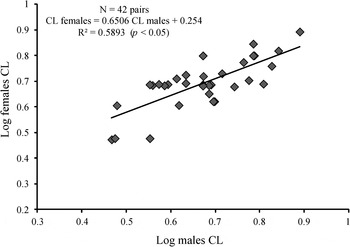
The size of paired males (CL) ranged from 3.57 to 7.76 mm (4.88 ± 1.18 mm), while paired female size (CL) ranged from 3.72 to 7.81 mm (5:04 ± 1:01 mm). The size of unpaired males (CL) ranged from 2.77 to 8.52 mm (5.38 ± 1.49), while unpaired female size (CL) ranged from 2.50 to 10.07 mm (5.37 ± 1.47). A two-way ANOVA detected an effect of group size (paired vs unpaired) on shrimp body size (F = 4.21, P = 0.042). However, sex (male vs female) in both categories (paired and unpaired) did not affect shrimp body size (F = 0.13, P = 0.715). The formation of pairs occurred in size classes (CL) from 3–4 to 7–8 mm (Figure 2). There was a statistically significant positive correlation between the carapace length (CL mm) of paired males and females (Pearson's correlation, r = 0.78; P < 0.05) (Figure 3).
Alpheus brasileiro Anker (Reference Anker2012). Number of paired shrimps (male-female) organized by size class; collected in Cananéia, São Paulo, Brazil.

Alpheus brasileiro Anker (Reference Anker2012). Correlation between carapace length (CL) of paired males and females collected in Cananéia, São Paulo, Brazil.

Egg production
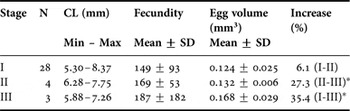
A total of 35 ovigerous females were analysed: 28 were found in development stage I, four were found in stage II, and three were found in stage III. The data on average fecundity and egg volume relative to embryo development stages are shown in Table 2. The egg number in each stage of embryonic development was different; however, this variation was not statistically significant (Kruskal–Wallis/Dunn: H = 3.32; P > 0.05).
Alpheus brasileiro Anker (Reference Anker2012). Fecundity, egg volume (mm3), and increase in egg volume during different stages of development among specimens collected in Cananéia, São Paulo, Brazil.

*Statistically significant values.
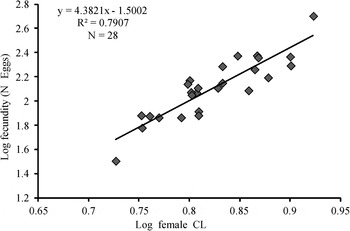
Egg volume differed significantly (Kruskal–Wallis/Dunn: H = 85; P < 0.05) when the developmental stages were compared; there was a 35.4% increase in egg volume between stages I and III (Table 2). A positive correlation between the number of eggs and carapace length was found (Pearson's correlation, r = 0.82; P < 0.05), with a proportional increase in the number of eggs according to the size of females (Figure 4). However, there was no correlation between egg volume and the size of the females (Pearson's correlation, r = 0.32; P > 0.05).
Alpheus brasileiro Anker (Reference Anker2012). Correlation between carapace length (CL) and the fecundity of females with eggs in development stage I. Specimens were collected in Cananéia, São Paulo, Brazil.

DISCUSSION
Testing for social monogamy
Although there is no difference in the proportion of refuges with paired shrimp compared with the number expected by chance alone, the A. brasileiro population studied exhibits other characteristics that suggest that this species is socially monogamous, for instance, heterosexual pairs were found during periods in which females were not receptive (non-ovigerous). Also we found a positive correlation between paired male and female sizes (size-assortative pairing). This system has also been confirmed for other Alpheus species (Nolan & Salmon, Reference Nolan and Salmon1970; Knowlton, Reference Knowlton1980; Boltaña & Thiel, Reference Boltaña and Thiel2001; Mathews, Reference Mathews2002b; Correa & Thiel, Reference Correa and Thiel2003; Rahman et al., Reference Rahman, Dunham and Govind2003). The presence of heterosexual pairs with refuge sharing even in periods in which females are not receptive, and the correlation between male and female sizes within pairs, are considered indicators of a monogamous mating system (Knowlton, Reference Knowlton1980; Baeza & Thiel, Reference Baeza and Thiel2003; Baeza, Reference Baeza2008, Reference Baeza2010).
Alpheus brasileiro pairing occurred among specimens that were smaller than the smallest ovigerous female, a finding which indicates that pairing occurs prior to the first reproductive cycle. Due to the low population density and the small number of ovigerous females collected during the study, it cannot be concluded that pairing always occurs prior to the first reproductive cycle. However, considering that females of many species of Alpheidae are sexually receptive only for a short period of time after moulting (Correa & Thiel, Reference Correa and Thiel2003), males displaying the pre-copulatory behaviour of guarding females prior to their moulting period may have a selective advantage (Mathews Reference Mathews2002a). Because the period in which females are receptive is short, the earlier formation of couples could reduce the risk of reproductive male exclusion from a reproductive cycle (Correa & Thiel, Reference Correa and Thiel2003).
Additional evidence of monogamy in A. brasileiro is the existence of size-assortative pairing. Size-assortative pairing is present mainly in species that form long-term monogamous pairs and is associated with restrictions of space and growth under similar resource conditions for long periods of time (Baeza, Reference Baeza2008). This feature is frequent among species with a monogamous social system, and it has also been found in A. estuariensis (Costa-Souza et al., Reference Costa-Souza, Rocha, Bezerra and Almeida2014), A. heterochaelis (Nolan & Salmon, Reference Nolan and Salmon1970), A. armatus (Knowlton, Reference Knowlton1980) and Alpheus inca (Boltaña & Thiel, Reference Boltaña and Thiel2001). Size-assortative pairing also has been reported for various other monogamous crustaceans like Pontonia margarita, Pinnixa transversalis and Pontonia maningi (Baeza, Reference Baeza1999, Reference Baeza2008; Baeza et al., Reference Baeza, Simpson, Ambrosio, Guéron and Mora2016). One explanation for this formation of similarly sized pairs is intensity of the behavioural interactions during pairing and courtship, in which the smaller females escape while females that are similar in size to males remain until pairing occurs (Nolan & Salmon, Reference Nolan and Salmon1970).
The benefits of sharing a refuge may also contribute to the monogamous behaviour exhibited by A. brasileiro. Pairing reduces the territory maintenance costs for both sexes, but the roles played by the sexes differ. Mathews (Reference Mathews2002a) studied territorial cooperation in A. angulosus populations (also part of the A. armillatus species complex) and found that, when paired, females use more energy in the construction and maintenance of burrows and males are more active in territory defence; both sexes participate in foraging.
The low population density of A. brasileiro inhabiting dispersed burrows is a trait that is commonly found in species with monogamous social behaviour (Correa & Thiel, Reference Correa and Thiel2003). Refuges for species presenting this behaviour are usually discrete and inhabited by a heterosexual pair (Thiel & Baeza, Reference Thiel and Baeza2001), as also observed for A. brasileiro. These species are commonly found in environments with a high predation risk, which reduces the displacement of individuals; therefore, shelters such as burrows are used by the couples in a territorial cooperation (Correa & Thiel, Reference Correa and Thiel2003; Bauer, Reference Bauer2004, Baeza et al., Reference Baeza, Bolaños, Hernandez, Lira and López2011).
Our results suggest that the studied population of A. brasileiro is socially monogamous. However, future studies are needed to more precisely understand the factors that affect the duration of monogamous pairing. Experimental studies are of fundamental importance to better understand this complex system in A. brasileiro.
Egg production
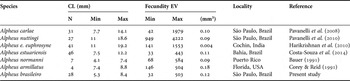
The snapping shrimp A. brasileiro exhibited lower fecundity relative to other species of the family Alpheidae, including those from the A. armillatus complex (Table 3). This variation may be a reflection of differences specific to the sample area; egg production can be influenced by many factors, from genetic factors to environmental parameters such as salinity, temperature and the photoperiod (Sastry, Reference Sastry, Vernberg and Vernberg1983). The availability and energetic quality of the food available can also influence egg production by crustaceans: gonad development (and, as a result, egg production) is affected in situations of low food availability or poor quality food (Cavalli et al., Reference Cavalli, Lavens and Sorgeloos1999; Bertini & Baeza, Reference Bertini and Baeza2014).
Alpheus brasileiro Anker (Reference Anker2012) Size, fecundity, and egg volume of females from the family Alpheidae (CL, carapace length; EV, egg volume).
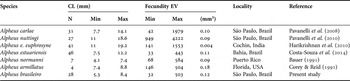
Adapted from Pavanelli et al. (Reference Pavanelli, Mossolin and Mantelatto2008) and Costa-Souza et al. (Reference Costa-Souza, Rocha, Bezerra and Almeida2014).
Fecundity and female size were found to be positively correlated, a finding which indicates that body size influences egg production by A. brasileiro. This correlation has also been reported for various other species, including A. estuariensis (Costa-Souza et al., Reference Costa-Souza, Rocha, Bezerra and Almeida2014), A. carlae (as A. armillatus) (Pavanelli et al., Reference Pavanelli, Mossolin and Mantelatto2008, Reference Pavanelli, Mossolin and Mantelatto2010), and Alpheus euphrosyne De Man, 1987 (Harikrishnan et al., Reference Harikrishnan, Unnikrishnan, Maju, Greeshma and Kurup2010). Female size is considered the main determining factor in fecundity, with larger females having higher fecundity compared with smaller females; the larger the female, the more space there will be for the accommodation of eggs in the abdomen (Corey & Reid, Reference Corey and Reid1991). The maximum size of 10.07 mm (CL) found in the present study may explain the lower fertility exhibited by A. brasileiro when compared with the rate found by Pavanelli et al. (Reference Pavanelli, Mossolin and Mantelatto2008) in their study on A. carlae (as A. armillatus), since the maximum size for this species was higher (Table 3).
Fecundity can vary among populations, but differences between initial and final stages of development have been reported as a loss of eggs (Corey & Reid, Reference Corey and Reid1991). These differences in fecundity during embryonic development are commonly found in species of the Infraorder Caridea (Wehrtmann & Lardies, Reference Wehrtmann and Lardies1999). However, as for A. carlae (as A. armillatus) (Pavanelli et al., Reference Pavanelli, Mossolin and Mantelatto2008), the fecundity in A. brasileiro has not decreased during egg developmental stages. This consistency may be the result of female morphology, which requires enough space in the abdomen for egg development until the larvae hatch. It may also be linked to the presence of males during egg incubation, since their presence ensures additional defence for both females and their territory (Pavanelli et al., Reference Pavanelli, Mossolin and Mantelatto2008).
Variation in fecundity among development stages may be caused by parasite infestation, maternal cannibalism, or even by risks that are intensified as incubation time increases, such as the friction between the eggs and the substrate (Balasundaram & Pandian, Reference Balasundaram and Pandian1982). The females’ egg mass cleaning activity may also influence embryo survival. Females with eggs use the chelae of the second pereopods to clean the egg mass and to remove sediment and unfertilized eggs, thereby preventing bacterial growth in fertilized eggs (Bauer, Reference Bauer2004). In A. brasileiro, socially monogamous behaviour may help to reduce predation risks and may also allow females to take greater care of the egg mass, thus decreasing the risk of egg loss.
Despite the constant increase in egg volume during incubation found in the present study (an increase which reached 35.4% between stages I and III), this increase is considered low when compared with the 64.3% increase found in a study on A. carlae (as A. armillatus) (Pavanelli et al., Reference Pavanelli, Mossolin and Mantelatto2008), the 87.4% found in a study on A. nuttingi (Pavanelli et al., Reference Pavanelli, Mossolin and Mantelatto2010) and the 45.4% increase found in a study on A. estuariensis (Costa-Souza et al., Reference Costa-Souza, Rocha, Bezerra and Almeida2014). The positive correlation between developmental stage and the increase in egg volume is due to the increased permeability of the membranes (Pavanelli et al., Reference Pavanelli, Mossolin and Mantelatto2008). During the final developmental stage, the eggs absorb water more quickly, a process which regulates osmotic pressure and facilitates membrane rupture during hatching (Pavanelli et al., Reference Pavanelli, Mossolin and Mantelatto2008).
The present study provides the first insights into the biology of A. brasileiro, including information that suggests social monogamy in this species. Future studies should focus their attention on the behaviour and reproductive biology of A. brasileiro.
ACKNOWLEDGEMENTS
The authors are grateful to the São Paulo Research Foundation (FAPESP) (Grant No. 2013/12136-4 awarded to R.A.P.), to Thematic Biota (Grant No. 2010/50188-8 awarded to R.C.C.) and to the Brazilian National Council for Scientific and Technological Development (CNPq) (Research Scholarship No. 305919/2014-8 awarded to R.C.C.). The authors are grateful to Dr J. Antonio Baeza for the help with statistical analyses and all suggestions. We also thank the LABCAM co-workers for their help during the fieldwork. All experiments conducted during this study complied with current applicable state and federal laws in Brazil.