Introduction
Over the last thirty years the growing academic interest in both Victorian periodicals and women's issues in the nineteenth century has focussed interest on the women journalists who wrote for the serious quarterlies and monthlies published during this period. The part played by such writers as Harriet Martineau, Elizabeth Eastlake, and Frances Power Cobbe in the development of Victorian thought is now well known, while that of less prolific contributors is increasingly attracting scholarly attention. One of the authors gradually being rescued from oblivion is Anne Mozley (1809–1891), with her views on both contemporary literature and debates about the social position of women being seen as of interest.Footnote 1
Anne Mozley came from a conservative High Church background. Two of her brothers were Tractarian clergymen directly educated by Keble and Newman and two others were the religious publishers John and Charles Mozley of Derby. Her work thus represents a generally more conservative point of view than that of Martineau and Cobbe, and can be used, along with the journalism of, for example, Margaret Oliphant and Eliza Lynn Linton, to extend the spectrum of our understanding of the attitudes of educated Victorian women to both literature and society. Nevertheless much of Mozley's journalism has yet to be identified. She was one of the most determinedly anonymous of all female journalists, and the extent of her contributions to such periodicals as Bentley's Quarterly and Blackwood's Edinburgh Magazine was only revealed through the researches into publishers’ archives in the 1950s. Yet it is reported in a “Memoir” of her written by a nephew that during the 1840s and 1850s she also wrote extensively for the Christian Remembrancer, a High Church journal edited by her brother James and published by her family's firm.
An examination of the contents of the Christian Remembrancer during these decades reveals a number of articles on topics dealt with by Mozley in her later writings that may be of interest to contemporary scholars: recent fiction, particularly that written by women, issues raised by the Women's Movement, and developments within the Anglican church. There is some evidence identifying certain Christian Remembrancer articles as by her: a review of Charlotte Brontë's Villette, and an article on “Youth in Modern Fiction” (Nicoll 255; Wilkes 110). Furthermore, in 2006 members of the Centre for Literary and Linguistic Computing [CLLC] at the University of Newcastle reported on the results of a pilot study in the use of what is coming to be known as the “Burrows Method” to discover whether Anne Mozley was likely to be the author of three articles on the Brontë sisters that appeared in the 1840s and 1850s, and came to the conclusion that this was “highly probable” (Jordan, et al.).
This paper reports on more recent efforts to use these methods to test her authorship of a larger group of Christian Remembrancer articles, and the authors have come to the conclusion that thirteen of the twenty-six articles investigated are almost certainly by Mozley, and a further five are probably by her. Several of these articles are likely to be of interest to scholars of Victorian literature and history. These newly identified articles include the well-known, highly critical review of Jane Eyre that appeared in 1848, an 1859 survey of sensation fiction, “Our Female Novelists,” and three articles giving her response to contemporary debates on the position of women: “The Rights of Women” (1855), “Female Occupation and Influence” (1858), and “The Work of Charity” (1861).
Using the Burrows Method
It was once thought that authors’ use of the very common words of English showed no patterned variation: any competent user of the English language used them at the same rate, and individuality of style only emerged from less common lexical words. In the early days of computer analysis of texts, however, Professor John Burrows showed that the incidence of these very common words varies significantly between texts by different authors while remaining comparatively constant within a single author's work.Footnote 2 By subjecting the most common words of a large set of texts to statistical procedures, Burrows was able to show that rates of usage vary systematically, and that most authors have a characteristic use of these common words that distinguishes their style from that of their fellows. Burrows followed this up by founding the Centre for Literary and Linguistic Computing at the University of Newcastle, Australia, where, for the past thirty years he and his colleagues have been devising and refining the statistical procedures that can most effectively isolate these distinctive usages.
Attribution of authorship is one of the major areas in which the Burrows Method has been used. It has proved to be a particularly useful tool for testing hypotheses devised by the researcher on the basis of fragmentary or ambiguous “external” evidence, or on “internal” evidence of style, tone, or subject matter (Love 142–45). The first step is to create a “base-set” of texts known to be by the putative author, and a “counter-set” of texts addressed to a similar audience by other known authors, and subject them to statistical analysis of the frequency of a set of commonly used words. It is expected that authorial groupings based on the authors’ idiosyncratic usage will emerge, and that if a text of doubtful or contested authorship is placed among these texts, the validity of the attribution can be assessed. The results of such tests are, of course, matters of probability, not of certainty.
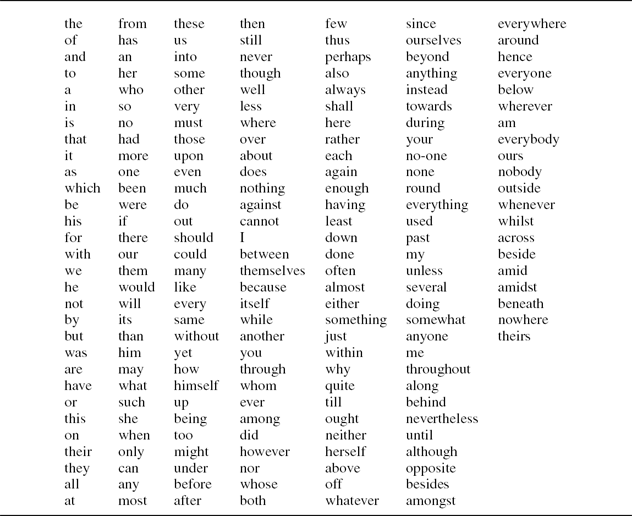
Since the 2006 pilot study tests were completed, a greatly enlarged corpus of Victorian periodical articles has been developed. The counter-set of articles available for comparison now consists of 191 articles by twenty-one authors, while the Mozley base-set, instead of consisting of six periodical articles, as in the pilot study, now contains twenty.Footnote 3 This enlarged corpus has been used in the analyses reported on here. A list of the 200 most commonly used function words in the entire corpus has also been constructed. Footnote 4 We are able to make use of these function words in various ways according to the requirements of the test. For initial testingFootnote 5 we generally follow Burrows's preference for using an unselected set of the most common wordsFootnote 6 – thus allowing the “texts themselves . . . to dictate which word-types should be studied” (Burrows 311).
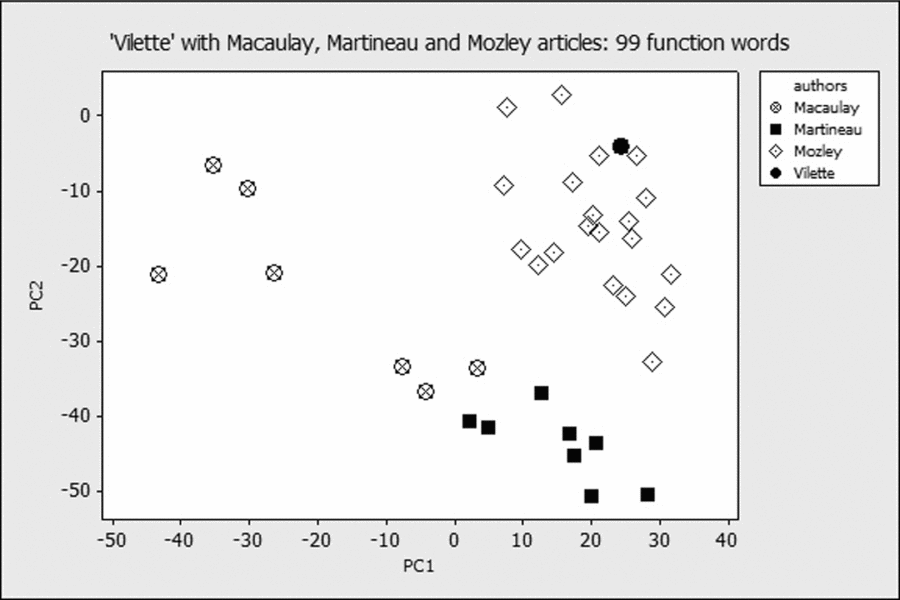
An example of how this method operates can be seen in Figure 8 where a Principal Component Analysis (PCA) is used to test the assertion (Nicoll 255) that Anne Mozley wrote the review of Villette published in the Christian Remembrancer in 1853. PCA is a data reduction technique, which finds “in order of importance the sets of weightings for the variables that account for the most significant variations in the data” (Craig 200). It highlights the most important likenesses and differences among the specimens and allows us to see something of the complexity of the relationships between the variables in the data. For this analysis the ninety-nine most common function words in the CLLC periodicals corpus (see Appendix B:1) are used to assess the likelihood that Mozley was the author of the Villette review by comparing the use of function words in that article with that in articles by Mozley and two of her contemporaries.
Principal Component Analysis plot using 99 most common function words as variables.

As can be seen, the Villette review is positioned among the articles by Mozley in the north-east quadrant, while the articles by Macaulay and Martineau are located in the north-west and south east sectors. The figure also demonstrates a problem that a quarter of a century of work at the CLLC on projects covering diverse centuries and genres has highlighted: even in the choice of the most common words an author is influenced by the conventions of writing in the particular genre chosen. Articles by two separate authors with similarities in tone and subject matter can, on occasion, show a greater correspondence in the use of the most common words than two articles by the same author with divergent emphases. This can be seen in Figure 8 where the Macaulay articles fall into two groups, with one of the groups closer to the Martineau articles than to the larger Macaulay group. The explanation for this can be found in the fact that, though all the Macaulay articles are biographical, the four in the left quadrant discuss recently deceased or historical figures, while the other three deal, like the Martineau articles, with largely contemporary issues. Whereas the words used for the test seen in Figure 8 were unselected, in a further refinement of the Burrows Method we can seek to identify “marker” words for a particular author. These are the words that this author uses significantly more or significantly less often than another author or a group of other authors.
Mozley Markers
A set of mozley markers was obtained by comparing the word usage in the twenty Mozley texts with that of two texts (the first and last in our alphabetical lists) by each of the other twenty-one journalists in our corpus.Footnote 7 A distribution testFootnote 8 using the 200 most common function words in the total corpus isolated 86 words used significantly more often or significantly less often by Mozley than by the other authors. This list of 86 words can be found in Appendix B:2.
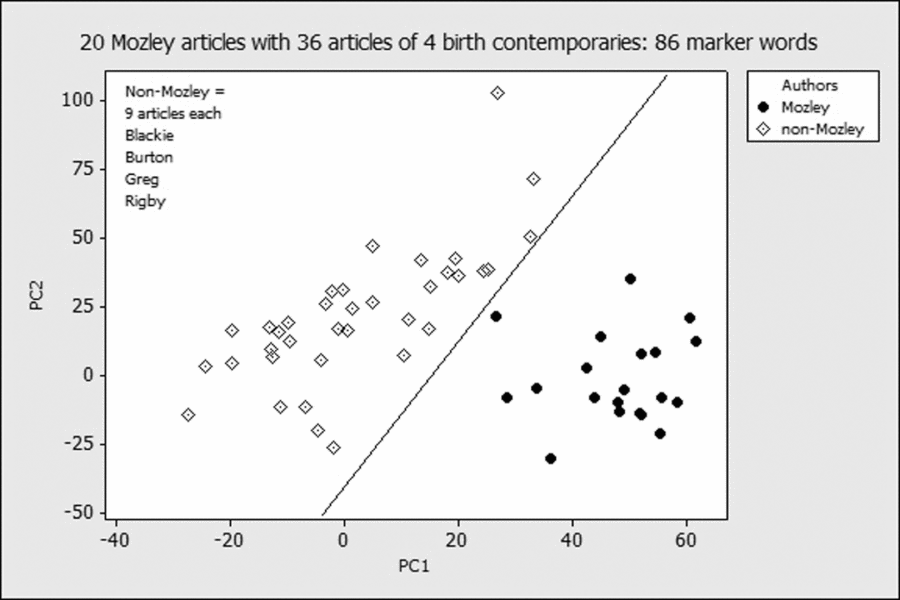
It was decided to assess the effectiveness of these words for separating Mozley texts from those of her contemporaries by running Principal Component Analyses using two distinct groups of authors for comparison. Two sets of texts by authors likely to have been subjected in forming their style to cultural influences similar to those impacting on Mozley were chosen. The differences between them can then be seen as resulting from what is idiosyncratic in Mozley's individual signature. The first of these tests compares the usage of the 86 marker words in the twenty articles known to be by Mozley with the usage in articles by four of her exact contemporaries, and the other compares it with that of three women journalists writing at the same time as Mozley.
Five Authors Born in 1809
Five authors in the corpus (including Mozley) were born in the year 1809. This circumstance suggested the notion of testing Mozley's relative use of the marker words with that of her precise contemporaries – John Stuart Blackie, John Hill Burton, William Rathbone Greg, and Elizabeth Rigby Eastlake. Nine texts were selected from each of these authorsFootnote 9 for testing with Mozley's twenty texts.
A principal component analysis test was then run on the selected texts using the set of 86 Mozley marker words. The results of this test can be seen in Figure 9 below. In this Figure Mozley's texts form a tighter authorial cluster than the texts of her four contemporaries which fan out across the left hand side of the plot. A line has been drawn in order to highlight the separation between the Mozley and non-Mozley articles.
Principal Component Analysis plot using 86 marker words as variables.
Anne Mozley and Three Women Journalists
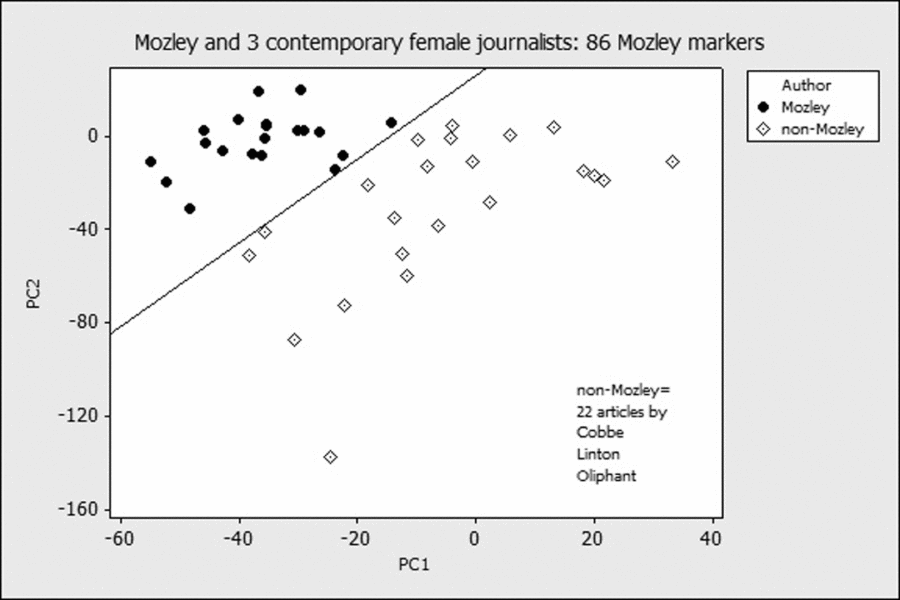
As jordan noted, mozley began her literary career as a contributor to periodicals issued by her family's publishing business and “did not begin publishing in mainstream, as distinct from sectarian, periodicals until she was in her fifties” (316). Her major identified articles are in consequence contemporaneous not with those of her female birth contemporaries (Elizabeth Rigby Eastlake and Harriet Martineau), but with the younger writers, Frances Power Cobbe, Eliza Lynn Linton, and Margaret Oliphant, who made their mark in the 1850s and 1860s. It was felt that comparison with this groupFootnote 10 could further test the validity of the set of 86 marker words. Figure 10 below shows once again that these 86 Mozley markers can separate Mozley's texts from those of her contemporaries. In this plot, although only prior knowledge of the authorship reveals where the discriminating line should be drawn, there is no intermingling of the two groups. Furthermore Mozley's texts again form a tighter authorial cluster than the texts of her four contemporaries which fan out across the right hand side of the plot.
Principal Component Analysis plot using 86 marker words as variables.
The Mozley Word Usage Signature
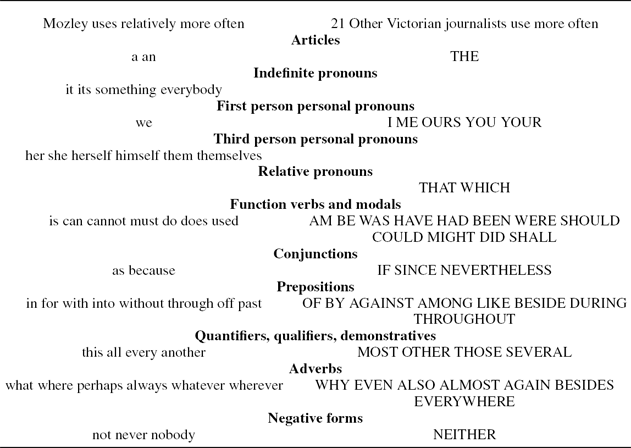
A close examination of mozley's use of these 86 marker words compared to that of her contemporaries (see the “Marker Words Analysis” tables in Appendix B:2) gives some indication of the idiosyncracies of her style. Mozley, it seems, is distinguished by her preference for the conjunctions as and because, and her relative avoidance of if, since and nevertheless, while the prepositional preferences she shows include in, into, with, without, through, and amongst, while of, by, against, beside, during, throughout, and among show relative avoidance. Other word frequency preferences are the adverbs what, whatever, where, and wherever, and the negative forms not, never, and nobody.
Mozley also shows a decided preference for using the indefinite articles a and an and a very decided disinclination to use the definite article.Footnote 11 Coupled with this liking of the indefinite articles is the highly significant frequency of her use of the indefinite personal pronouns it and its, which, along with what and whatever suggests something of a preference for the impersonal. While her contemporaries make more frequent use of past tense verb forms (was, had, been, were, should, could, might, and did), Mozley has more frequent resort to the present forms (is, can, cannot, must, do, and does).
The sort of style implied by some of these word selection preferences can be seen in the openings of a few of her articles. Mozley marker words are italicized.
It is a notorious difficulty for one class to put itself into the position of another, to adopt its tone of feeling, to comprehend its leading motives of action, its distinctive prejudices, prepossessions, and impulses; its likes and dislikes, and those constant pervading influences which form character, and lie at the root of the differences which separate order from order, and keep them at such an impassable distance from real intimacy. (“Hymns of the Populace” 27)
There is nothing so elastic as our estimate of time. In the mere act of reviewing them, fifty years may swell into a huge period, or contract into a moment – the mere twinkling of an eye. In many a retrospect a lifetime is nothing – memory making past existence all one present. It may be spanned in one grasp of thought as making no difference in a man's identity, leaving him absolutely the same to his own consciousness. In another mood, and looking out of and beyond self, he sees fifty years for what they are – a good slice not only of a long life but of the life of the world. (“Clever Women” 410)
This tendency towards generalization and impersonality can also be seen in the opening paragraphs of most of her reviews; for example her review “Novels by Sir Edward Bulwer Lytton.”
WHAT do we look for in fiction? What do we want in a novel? Of course, first of all we require to be amused. This has been long pronounced to be the one essential without which all others are valueless. As we only take up a novel for relaxation, if it fails to afford amusement we are justified in laying the book down. (73)
These tests and analyses suggest that it can be reasonably assumed that these 86 marker words reflect the more habitual and enduring characteristics of Mozley's style. It therefore seemed feasible to use them to discover whether any of the as yet unattributed essays in the Christian Remembrancer seem likely to have been written by Anne Mozley.
Anne Mozley and the Christian Remembrancer
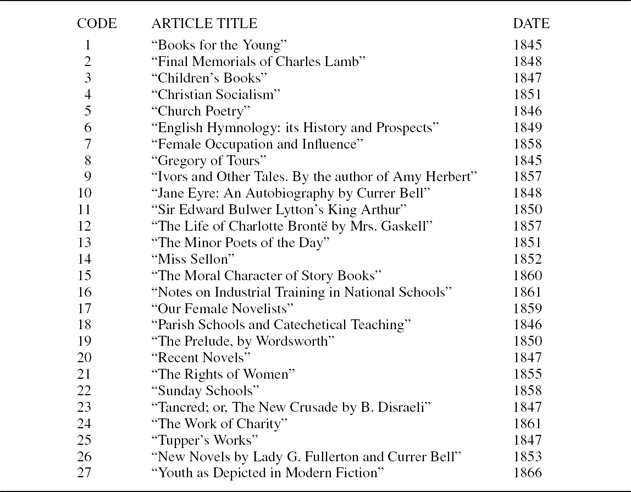
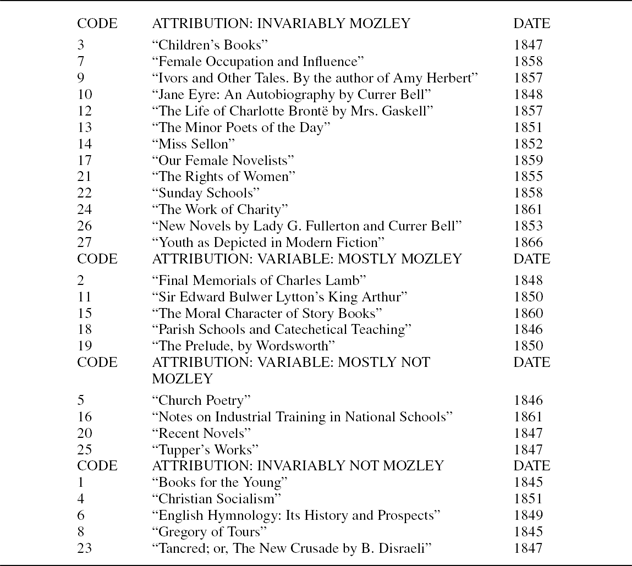
As a first step in trying to identify articles by Mozley that appeared in the Christian Remembrancer, twenty-seven articles dealing with the kind of topics Mozley favoured in her articles in Bentley's, Blackwood's and the Saturday Review were selected, specifically reviews of recent literature and discussions of social issues relating to women and to the Church of England.Footnote 12 There is some external evidence for her authorship of two of these articles: in 1919 W. Robertson Nicoll proposed Anne Mozley as the author of “New Novels by Lady G. Fullerton and Currer Bell” (255–57), and more recently Joanne Wilkes (110) has noted identical passages in “Youth as Depicted in Modern Fiction” and in a letter from Anne Mozley to John Blackwood dated April 1865. It was, however, felt that further confirmation would be useful so these articles were included among those tested. Table 1 below lists the articles selected, giving each text the number that identifies it in the plots that follow.
Twenty-Seven Christian Remembrancer Articles
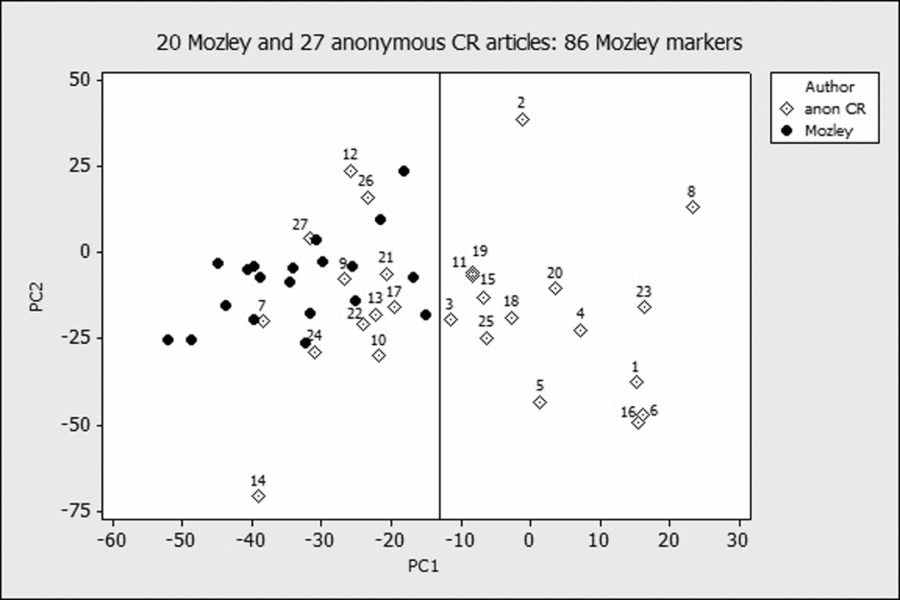
To get an initial indication of which of the Christian Remembrancer articles seemed most likely to have been written by Mozley a PCA test, using the 86 marker words in our list, was run comparing the Christian Remembrancer articles with the twenty known Mozleys. The resulting plot is shown as Figure 11 below.
Principal Component Analysis plot using 86 marker words as variables.
As can be seen, the known Mozley articles form a relatively tight group on the left-hand side of the plot, with twelve of the Christian Remembrancer articles distributed amongst them,Footnote 13 while the rest of those from the Christian Remembrancer spread across the right-hand half of the plot. The two Christian Remembrancer articles already attributed to Mozley, “New Novels” (26) and “Youth” (27), sit comfortably among her articles from other journals, thus affirming the accuracy of the external attributions. Yet, as can also be seen, six of the Christian Remembrancer articles, though not distributed among the known Mozleys, are only a little to the right of the dividing line, quite close to each other and fairly distant from the remaining, more widely scattered articles from the Christian Remembrancer. The articles occupying this ambiguous position are: “The Prelude, by Wordsworth” (19), “Sir Edward Bulwer Lytton's King Arthur” (11), “The Moral Character of Story Books” (15), “Parish Schools and Catechetical Teaching” (18), “Children's Books” (3), and “Tupper's Works” (25). Three further articles, “Final Memorials of Charles Lamb” (2), “Recent Novels” (20), and “Church Poetry” (5), lie just beyond the main Mozley cluster. These nine articles were all written before 1851, which was nine years before Mozley began publishing in the wider periodical press. Her final style, on which the marker words are based, may still have been maturing.There is, unfortunately, no further information attainable from this plot on whether they are or are not by Mozley.
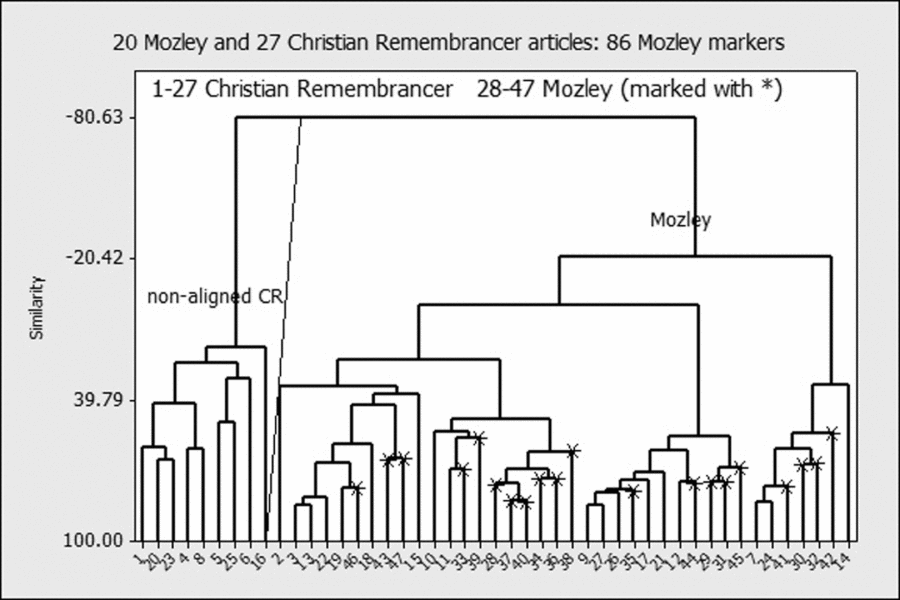
There is, however, another way of expressing graphically the relationship between sets of texts that appears to give less equivocal answers to questions of authorship. This is a cluster analysis. According to Chatfield and Collins “The basic aim of cluster analysis is to find the ‘natural groupings’, if any, of a set of individuals” (212), and this can be a useful tool in testing for attribution. Figure 12 below gives a rather more decisive picture of which of the Christian Remembrancer articles seem likely to be by Mozley. In this type of plot, those articles bearing the greatest similarity unite earliest, while the most dissimilar unite last. Though it is somewhat difficult to read the graph because of the large number of individual texts involved, it can clearly be seen that the very last division, that of greatest dissimilarity, separates nine Christian Remembrancer articles from all the Mozley and remaining Remembrancer articles.
Cluster Analysis plot using 86 marker words as variables.
The Mozley branch contains three sub-branches, with the left-most of these dividing into a further two branches. The twenty known Mozley articles are scattered throughout these four groupings; the line representing each of these known articles has been marked with an asterisk to facilitate identification. All of the Remembrancer articles which grouped with the Mozley articles in Figure 11 are to be found within the four Mozley groups, as well as six of the doubtful articles. The remaining three doubtful articles, “Church Poetry” (5), “Recent Novels” (20), and “Tupper's Works” (25) are located in the non-aligned Christian Remembrancer group.
Unfortunately cluster analyses, even when using marker words, do not invariably give entirely accurate authorial groupings. Whereas PCA plots can present findings that are too nuanced to be definitive, cluster analyses may present an over-positive case. Although in this Figure eighteen of the Christian Remembrancer articles appear in the Mozley side of the tree, there is always the possibility that one or two of them may be there, not because they were written by Mozley, but because they differ radically from all those in the non-Mozley side. “Final Memorials of Charles Lamb” (2), “Miss Sellon” (14), and to a lesser extent, “Moral Character” (15) for example, though positioned under the general Mozley umbrella, are the last articles to join their particular sub-branches. This makes their attribution to Mozley somewhat less certain. On the other hand, other Christian Remembrancer articles (including the two articles for which there was some external evidence) appear to affirm their affinity by uniting early to one or other of the known Mozley articles.
It can also happen, as the plots in Appendices C:2, C:3, and C:4 demonstrate, articles with a similar focus and subject matter, though written by different authors, can be drawn away from the main cluster of articles by each author into a greater proximity to one another. It is thus possible that an article actually written by Mozley may appear on a tree containing articles by one of her contemporaries. It is for these reasons that practitioners believe they must exercise caution when interpreting such plots. This caution usually takes the form of running additional comparative analyses with the works of other authors.
A series of tests was therefore run using the same Mozley and Christian Remembrancer articles with the articles of each in turn of the other twenty-one journalists in the CLLC corpus. Five of these tests can be seen in Appendices C:1 to C:5. In most cases the results supported the attributions shown in Figure 12, but there were occasional variations.Footnote 14 When this occurred with only one author it was presumed that this was probably due to underlying similarities in focus or subject matter between the Remembrancer article and a particular article by the author used in the test and that there was still a high likelihood it was by Mozley. On the other hand, when a Remembrancer article was attached to the Mozley tree in tests with only one or two of the other authors, it was assumed that all this showed was that it had greater similarities with the known Mozley articles than with any of those by the other author, and that this was not grounds for attributing it to Mozley.
Findings
A summary of the results of the tests is given in Table 2. The table displays the articles in four categories: those texts which invariably demonstrated affinity with the known Mozley articles; those which usually showed such affinity, but occasionally failed to; those which usually showed no affinity with the Mozley articles, but occasionally did so; those that never showed affinity. It should be noted that the two articles (26 and 27) for which there is external evidence of authorship invariably showed affinity with Mozley. These tests, it may be further noted, confirm the attributions made by the cluster analysis displayed in Figure 12.
Proposed Attribution Status of Twenty-Seven Christian Remembrancer Articles
These findings suggest that thirteen of the Christian Remembrancer articles tested can be attributed to Mozley with a high level of confidence, while a further five articles may be called probable. The other nine articles, though dealing with the sort of subjects Mozley chose for her other journalism, are very unlikely to have been written by her.
Conclusion
All this work necessarily raises the question of what benefit establishing Mozley's authorship of these eighteen articles brings to scholarship. Probably the most immediately obvious is our finding that Mozley was almost certainly the author of the review of Jane Eyre that appeared in the Christian Remembrancer in 1848, something that the earlier attempt at attribution with a much narrower corpus could not confirm. This review, the first to appear in any of the monthlies or quarterlies, and the first to identify the author as a woman, is already well known to Brontë scholars, having been reprinted in, for example, Miriam Allott's The Brontës: The Critical Heritage (105–12), but it can now be linked to Mozley's later reviews of the Brontës in the Christian Remembrancer.
More broadly, knowledge of Mozley's wider oeuvre can contribute to the growing interest in female journalism. Most of the work so far done has focussed on the more progressive and radical journalists like Harriet Martineau and Frances Power Cobbe. Mozley provides a contrast in revealing the attitudes of a woman writing on similar subjects but for a far more conservative audience. Two-thirds of the newly-identified articles deal with contemporary literature, and only two of these (“Ivors and Other Tales” and “The Moral Character of Story Books,” both quite late contributions) look at works with a specifically Anglican following, while in the earlier contributions Mozley, without ever revealing her sex, writes confidently about authors, Lamb, Wordsworth, and Lytton for example, arousing the interest of educated readers. Nevertheless she also shows a fairly strong interest in books by women writers, and Joanne Wilkes, in her book Women Reviewing Women in Nineteenth-Century Britain, has used several of the articles we have identified as by MozleyFootnote 15 in her comparative study of the response of female critics to the major female novelists of their century.
Mozley did not, however, write exclusively about literature. A third of these newly-attributed articles reveal the response of a widely-read woman who had grown up in a High Church environment to the cluster of concerns which made up what was known to her contemporaries as the “Woman Question.” “The Rights of Women” (1855) (which reveals that her earlier reading had included Mary Wollstonecraft's 1792 Vindication of the Rights of Women) and “Female Occupation and Influence” (1858) show her response to the claims of the emerging Women's Movement. On the other hand, “Miss Sellon” (1852) and “The Work of Charity” (1861), which deal with the emergence of Anglican religious orders and women's involvement in organized charity work, reveal the rather different response of many upper-middle-class Anglican women to the same concerns. Two further articles, “Parish Schools and Catechetical Teaching” (1846) and “Sunday Schools” (1858), are concerned with what was a major preoccupation for large numbers of such women, religious education of the poor in the Sunday and weekday schools connected with their parishes. Knowing these articles come from a single pen makes it possible to build a stronger picture of the way attitudes to contemporary social issues mesh together.
We would suggest, then, that establishing the authorship of these articles can contribute both to assessing the part played by female journalists in the Victorian literary world and to broadening knowledge of the spectrum of attitudes to women, work, and charitable activities within the same period.
200 Most Common Function Words of the CLLC Victorian Periodical Corpus
86 Mozley Marker Words
Appendix C:1 20 Mozley and 6 Cecil Periodical Articles with 27 Christian Remembrancer Articles.
The two major branches of the tree represent the Cecil and the Mozley clusters of sub-branches.
CR articles on Cecil branch:
“Books for the Young” (1); “Recent Novels” (20); “Tancred. . .” (23); “Tupper's Works” (25); “Church Poetry” (5); “Notes on Industrial Training. . .” (16); “Final Memorials of Charles Lamb” (2); “English Hymnology:. . .” (6); “Gregory of Tours” (8); “The Moral Character of Story Books” (15); “Christian Socialism” (4).
CR articles on Mozley branch:
“Children's Books” (3); “The Minor Poets of the Day” (13); “Sunday Schools” (22); “The Prelude, by Wordsworth” (19); “Parish Schools. . .” (18); “Jane Eyre: An Autobiography by Currer Bell” (10): “Sir Edward Buller Lytton's King Arthur” (11); “Female Occupation. . .” (7); “The Work of Charity” (24); “Miss Sellon” (14); “Ivors and Other Tales. . .” (9); “Our Female Novelists” (17); “New Novels by Lady G. Fullerton and Currer Bell” (26); “The Rights of Women” (21); “Youth as Depicted in Modern Fiction” (27); “The Life of Charlotte Brontë . . .” (12).
Appendix C:2 20 Mozley and 10 Martineau Periodical Articles with 27 Christian Remembrancer Articles.
The two major branches of the tree represent the Martineau and the Mozley clusters of sub-branches.
CR articles on the Martineau branch:
“Books for the Young” (1); “Recent Novels” (20); “Tancred. . .” (23); “Church Poetry” (5); “Tupper's Works” (25); “Notes on Industrial Training. . .” (16); “Christian Socialism” (4); “Gregory of Tours” (8); “English Hymnology:. . .” (6); “Parish Schools. . .” (18); “The Moral Character. . .” (15).
CR articles on the Mozley branch:
“Final Memorials of Charles Lamb” (2); “Ivors and other Tales. . .” (9); “Our Female Novelists” (17); “New Novels. . .” (26); “The Life of Charlotte Brontë. . .”; (12); “Youth. . .” (27); “Female Occupation. . .” (7); “The Work of Charity” (24); “The Rights of Women” (21); “Miss Sellon” (14); “Children's Books” (3); “The Minor Poets of the Day” (13); “Sunday Schools” (22); “The Prelude. . .” (19); “Jane Eyre:. . .” (10); “Sir Edward Buller Lytton's. . .” (11).
Appendix C:3 20 Mozley and 11 Rigby Periodical Articles with 27 Christian Remembrancer Articles.
The fact that Rigby's articles fall into two separate branches on either side of Mozley's branches reflects a finding in Antonia's 2009 dissertation which showed a distinct difference between the early and late phases of Rigby's writing career. Her earlier articles show a greater affinity with Mozley's, and have drawn away from the main Mozley branch three articles known to have been written by Mozley – “Past and Present Conditions of Domestic Labour” (30), Tennyson's Idylls of the King” (37) and “Mr Mill on the Subjection of Women” (41) – and three from the Christian Remembrancer, all on social subjects: “Female Occupation. . .” (7), “Miss Sellon” (14) and “The Work of Charity” (24).
CR articles on main Mozley branch:
“Final Memorials of Charles Lamb” (2); “Children's Books” (3); “The Minor Poets of the Day” (13); “Sunday Schools” (22); “The Prelude. . .” (19); “Parish Schools. . .” (18); “Jane Eyre:. . .” (10); “Sir Edward Buller Lytton's. . .” (11); “The Moral Character. . .” (15); “Ivors and other Tales. . .” (9); “Our Female Novelists” (17); “New Novels. . .” (26); “The Rights of Women” (21); “Youth. . .” (27); “The Life of Charlotte Brontë. . .” (12).
CR articles attached to the main Rigby branch (1872–81 articles):
“Books for the Young” (1); “Recent Novels” (20); “Tancred. . .” (23); “Tupper's Works” (25); “Church Poetry” (5); “Christian Socialism” (4); “Gregory of Tours” (8); “English Hymnology:. . .” (6); “Notes on Industrial Training. . .” (16).
Appendix C:4 20 Mozley and 8 Cobbe Periodical Articles with 27 Christian Remembrancer Articles
Seven of Cobbe's eight articles are located in the main left hand branch of the dendrogram, while all Mozley's articles are in the main right hand branch. There is however an anomalous grouping lying between the two. One Cobbe article, her review of a biography of Mary Sommerville, has been attracted to Mozley's review of the Ferronays family biography (“Recit”) while two CR articles, “Final Memorials of Charles Lamb” (2) and “The Life of Charlotte Brontë. . .” (12) – both reviews of biographies – complete the sub-branch.
CR articles on the main Cobbe branch:
“Books for the Young” (1); “Recent Novels” (20); “Tancred. . .” (23); “Tupper's Works” (25); “Christian Socialism” (4); “Gregory of Tours” (8); “Church Poetry” (5); “English Hymnology:. . .” (6); “Notes on Industrial Training. . .” (16).
CR articles on the main Mozley branch:
Children's Books” (3); “The Minor Poets of the Day” (13); “Sunday Schools” (22); “The Prelude. . .” (19); “Parish Schools. . .” (18);
“The Moral Character. . .” (15); “Jane Eyre:. . .” (10); “Sir Edward Buller Lytton's. . .” (11); “Female Occupation. . .” (7); “The Work of Charity” (24); “The Rights of Women” (21); “Ivors and other Tales. . .” (9); “Our Female Novelists” (17); “New Novels. . .” (26); “Youth. . .” (27); “Miss Sellon” (14).
Appendix C:5 20 Mozley and 7 Linton Periodical Articles with 27 Christian Remembrancer Articles
The main left hand branch of the tree contains the “non-Mozley” CR articles and five of Linton's seven articles. Two of Linton's “Woman Question” articles “The Higher Education of Woman” (50) and “The Modern Revolt of Women” (53) have attached themselves (belatedly) to the Mozley side right-most branch and the CR article “Miss Sellon” (14), which in turn has attached itself to two Mozley articles “Convent Life” (30) and “English Converts to Romanism” (32), topics not too far removed from that of “Miss Sellon.”
CR articles on the Linton branch:
“Books for the Young” (1); “Recent Novels” (20); “Tancred. . .” (23); “Christian Socialism” (4); “Church Poetry” (5); “Tupper's Works” (25); “English Hymnology:. . .” (6); “Notes on Industrial Training. . .” (16); “Gregory of Tours” (8); and “Final Memorials of Charles Lamb” (2) apparently attracted to Linton's “Alfred de Mussett” (54).
CR articles on Mozley branch:
“Jane Eyre:. . .” (10); “Sir Edward Buller Lytton's. . .” (11); “The Moral Character. . .” (15); “Parish Schools. . .” (18); “Children's Books” (3); “The Minor Poets of the Day” (13); “Sunday Schools” (22); “The Prelude. . .” (19); “Ivors and other Tales. . .” (9); “Youth. . .” (27); “New Novels. . .” (26); “Our Female Novelists” (17);
“The Rights of Women” (21); “The Life of Charlotte Brontë. . .”; (12); “Female Occupation. . .” (7); “The Work of Charity” (24); “Miss Sellon” (14).