INTRODUCTION
Ideologies, cultural conceptualizations, and the like exist only insofar as persons orient to them and must thus take some kind of material semiotic form, they must pass through the bottleneck of existence as sinsigns. In this respect, generic referential expressions—forms of reference that denote not particular entities but rather classes or kinds of entities—seem to play an essential role in the interactional articulation and social reproduction of ideology.Footnote 1 This can be seen perhaps most clearly in cases where it is people or ‘kinds’ of people being talked about by means of such generic reference. Consider the following headlines.
(1)
a. Americans love guns, but they have no idea how to use them.
(Pacific Standard Magazine, July 27, 2017)
b. Canadians are nice and polite. Maybe that's why it's so hard to make friends here.
(The Toronto Star, September 12, 2019)
c. A new study could explain why Americans think Canadians are so damn nice.
(Mother Jones, November 21, 2018)
Examples such as these suggest that, when applied to socially defined groups such as ‘Americans’ and ‘Canadians’, generic reference casts them as ‘natural kinds’ on a par with non-human animal species in the following.Footnote 2
(2)
a. Rabbits eat mostly lettuce.
b. A dog makes a loyal companion.
c. The lion is a friendly beast.
In what follows, I consider generic reference in extracts from a conversation among speakers of Vietnamese.Footnote 3 In this context, the participants use generic reference to ‘jump-scale’ as they weave back and forth between talk about specific persons and talk about kinds of persons (Koven Reference Koven2016) and, in doing so, they articulate and fill out stereotyped characterizations of socially defined groups conceived as natural kinds (see Kockelman Reference Kockelman2013). And, while the four participants in the conversation I consider do not agree on all points, none of them ever questions the fundamental ontological assumptions that such generic references seem to necessarily imply. Most importantly, I aim to show that generic reference not only allows these conversationalists to position stereotyped kinds of people as ‘ontological other’, it also provides a basis upon which to establish (fractionally) congruent evaluative stances and, in this way, to assure themselves of their own civility and urban sophistication.Footnote 4 Such ‘acts of alterity’ function then to tacitly characterize ‘us’ as the presupposed indexical ground against which a stereotyped ‘them’ is figurated (Hastings & Manning Reference Hastings and Manning2004).
GENERIC REFERENCE, GENERIC PROPOSITIONS, AND DEICTIC SELECTIVITY
Identifying acts of generic reference in everyday interaction is not always a simple matter and, even once identified, specifying their functions—the way such forms of reference articulate with other practices of social interaction—is more challenging still. Part of the problem here results from thinking about generic reference as a ‘semantic’ notion. Lyons, for instance, writes that the sentence, the lion is a friendly beast, may be used to ‘assert a generic proposition’ (1977:194), which is to say ‘a proposition which says something, not about this or that group of lions or about any particular individual lion, but about the class of lions as such’ (1977:194). For Lyons then, a given noun phrase admits of a generic reading in the context of a generic proposition. Now, although Lyons suggests that ‘(t)he linguist can contribute to the study of reference by describing the grammatical structures and processes which particular language-systems provide for referring to individuals and groups of individuals’ (1977:197) and although he acknowledges that ‘(d)efinite noun-phrases, like ‘the lion’, and indefinite noun-phrases, like ‘a lion’, are far from being intersubstitutable in all kinds of sentences expressing generic propositions’ (1977:196), the emphasis in his account is squarely on the presumed ‘semantics’ of generic references and the propositions with which they are associated.
An alternative way of thinking about these matters has been developed by Asif Agha (Reference Agha2007) in his elaboration of the Peircean notion of deictic selectivity. On this view, the generic reading is a pragmatic (or interactional) effect of co-occurring signs which together constitute a particular grammatico-textual pattern. Thus, according to Agha, deictic expressions differ in terms of their ‘degree and type of selectivity’ (2007:42) where selectivity refers to the way, as Peirce (Reference Peirce1895/1998:16) put it, they ‘inform the hearer how he is to pick out one of the objects intended’.Footnote 5 Deictics then ‘link the scenario of utterance more or less tightly to a universe of referents, making referents more or less specifically locatable vis-à-vis the here-and-now of utterance’ (Agha Reference Agha2007:43). Agha considers the differences between propositions the referent of which is identified by the following expressions.
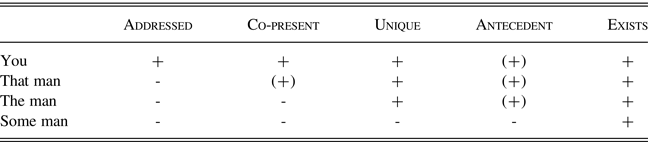
You > that man > the man > some man
These differ in terms of how tightly the referent is anchored to the context of utterance, ‘the anchoring becoming progressively looser as we move rightwards in the series’ (Agha Reference Agha2007:43). At one extreme, you formulates the referent as both co-present and more specifically as the particular participant addressed by the utterance. Moving rightwards one step, that man formulates the referent as a non-addressed but either co-present and perceptually accessible, or, anaphorically presupposed, other. The man serves as an anaphor the referent of which is presupposed, or, as part of a definite description used to introduce either a hypothetical person or one mentioned for the first time. Finally, some man ‘differs from the others in providing no formulation of address, physical co-presence, uniqueness, or antecedence in discourse, merely the presupposition that a referent x exists and is characterizable as a man’ (2007:43, see table 1).
Deictic selectivity, adapted from Agha Reference Agha2007.

One particularly important aspect of Agha's account is the way it shifts attention towards those grammatico-textual features by which a referent is tied more or less tightly to the context of utterance. On this view, nomic or generic reference is understood not as the total absence of deictic instruction but rather as the least selective form thereof, such that ‘(i)t permits talk of referents (things, times, places, etc.) that are not locatable in a determinate way with respect to the current speech scenario and, hence, presented in generic, abstract or collective terms’ (2007:44).Footnote 6
Agha's useful grading of noun phrases in terms of degree of selectivity should not be allowed to obscure the fact that a generic reading is the product of an encompassing grammatico-textual pattern. Consider, for instance, English definite noun phrases such as ‘the lion’ and ‘the waiter’ which, as Lyons noted, admit both generic and specific interpretations. While the interpretation is ultimately determined by a larger context of co-occurring signs, we can tip the balance one way or the other by inserting such a phrase within different grammatical frames.
(3)
a. The waiter is bringing the food.
b. The waiter brings the food.
c. The waiter is the one who brings the food.
For the first case, in which the NP ‘the waiter’ figures as the subject of a present progressive sentence, it is difficult if not impossible to derive a generic reading. In the second, the non-past habitual aspect makes the generic reading much easier to get. In the final case, the combination of non-past habitual aspect with a restrictive relative clause makes a generic reading even more natural. What these examples serve to make clear, I think, is that generic meaning involves a type of presupposition not so different from that associated with so-called ‘definite descriptions’. In the case of definite descriptions which, since Russell's ‘On denoting’ (Reference Russell1905) have stood close to the centre of philosophical controversy, what is presupposed, on one analysis at least, is the unique existence of a particular individual. In the case of generics, by contrast, what is presupposed is the unique existence of a class of individuals such as a natural kind (see Graff Reference Graff2001). It is in this sense that generic reference is intimately connected with (social) ontology.
DEICTIC SELECTIVITY IN VIETNAMESE INTERACTION
I now turn to consider examples drawn from a conversation between a group of four friends and consisting of two couples: Thanh and Linh, Huy and Phuong. The participants, close friends for many years, gathered at this café at the request of Linh. At the time the recording was made, all four had completed an undergraduate degree and Phuong had also completed a masters. Thanh was working as a journalist, Huy as an engineer in a hospital, while Phuong and Linh were continuing their studies as graduate students. Like many others, these people consider Hanoi their home, although all of them have family in rural areas and all make periodic visits to their natal village to attend death anniversaries, weddings, and other important events. An initial sense of the more selective deictic forms used in ordinary conversation can be had from a consideration of the following short stretch of interaction. Here the participants are talking about the café in which they are having coffee. Prior to the talk shown, several members of the group have complained that the service is very slow at the café and that they have available very few of the items listed in the menu.
(4) VNR_05
105 Phuong: Cái quán này rất là thoải mái trông cũng được, đẹp đẽ
cl café prox very comp comfortable looking also get, nice
‘This restaurant is very comfortable and looks nice.’
106 Thanh: Ủa, mà sao lại biết quán này nhỉ
Oh, yet why again know cafe prox tfp
‘So how do you know about this café?’
107 Huy: Ui giời. Vào một ngày đẹp trời.
INTJ sky. Enter one day beautiful weather.
‘Gosh. On a nice day. The rain was heavy, the road was blocked’
108 Trời mưa to, đường tắc thì
Sky rain big, road blocked
‘The rain was heavy, the road was blocked’
109 ta rẽ vào đây uống cà phê thì biết
we turn enter here drink coffee then know
‘We came in here to drink coffee so that's how we know about it’
110 Linh: À
INTJ
‘Oh’
111 Phuong: Hai tiếng sau đỡ tắc ta lại về
Two hours later, reduce block we again return
‘After two hours, the roads cleared and we went back home.’
In this case, the referring expression, cái quán này ‘this café’ (line 105) is highly selective, specifying by means of the classifier cái and the post-posed proximal deictic này a singular café located somewhere in close vicinity with the current speech encounter, or co-extensive with it. Quán này ‘this café’ though produced without a classifier is similarly selective. Finally, in line 107, một ngày ‘one day’ specifies a particular day but not one that the hearers should attempt to identify. These observations accord with a literature on the expression of definiteness in languages that have classifier constructions but not articles.Footnote 7 It is generally agreed that within this group of languages there are two types exemplified by Mandarin on the one hand and Cantonese on the other. In Mandarin bare nouns may have definite interpretations when they occur in subject or object position whereas in Cantonese such an interpretation is only possible if the noun occurs with a numeral classifier. Vietnamese patterns with Cantonese in this respect since bare nouns do not permit definite readings (see, inter alia, Jenks Reference Jenks2018; Löbel Reference Löbel, Unterbeck, Riassanen, Nevalainen and Saari2000; Trinh Reference Trinh and Reich2011).
In the following case, Phuong refers to the café again, now formulating it, however, as a ‘business’ by using the expression bọn này. Bọn is used to refer to a group of persons. In responding, Thanh first clarifies the sense of this expression, reformulating it as Quán này. He then refers to the same entity using the anaphoric pronoun nó.
(5) VNR_05
116 Phuong: Hay là bọn này là nó gọi là đi rửa tiền ở đâu nhỉ
Or is group here is it call is go wash money where tfp
‘Or is this here what is called money laundering?’
117 Thanh: Quán này à. Thông thường thì nó phải làm cái gì khác nữa
Café prox q. Usually top 3 must do something else more
‘This café eh? Usually they must do something else here as well.’
These are highly selective referential expressions used to identify specific entities—groups of people (e.g. the proprietors of a business), places (e.g. a café), segments of time (e.g. a day), and so on. Compare such references with those contained in the following utterance which is said by Phuong to Huy in an effort to persuade him to take off Thanh's glasses, which he has been wearing, apparently as a joke.
(6) VNR_05
43 Phuong: Giàu đôi con mắt, khó đôi bàn tay
Rich cl cl eyes, hard cl hands
‘Rich eyes, hard hands’
Interpretations of this bit of proverbial wisdom vary widely. Here, however, Phuong appears to mean something along the lines of ‘both eyes and hands are important for success’. In any case, the references to ‘eyes’ and to ‘hands’ appear to be quite generic. Often at least, references to body parts such as ‘eyes’ and ‘hands’ are embedded within a possessive construction, one that links the referenced entity either to some specific person talked about or to one of the speech act participants. Here there is no such encompassing noun phrase and the parts are left, as it were, floating independent of any body to which they might otherwise be attached (cf. Boas Reference Boas1911:64). Consider also the case given as (7) in which the participants have been talking about the attitudes of older people and have proposed that there is a widespread preference among them for sons over daughters. At line 286, Huy is delivering something close to proverbial wisdom when he suggests, as a possible reason for this preference, that when a woman marries she leaves her family and patrilineage but when a boy marries he brings his wife home.
(7) VNR_05
286 Huy: Con gái lấy chồng là mất. Còn con trai thì nó mang về
cl girl take husband is loss. And cl boy 3 bring home
‘A girl takes a husband, her family loses her. But a boy brings her home.’
287 Nó còn lấy được
He still take acquire
‘He takes a wife, he gains.’
288 Phuong: Cả trâu lẫn nghé
All buffalo rec calf
‘Both buffalo and calf’
Here then the references to con gái ‘girl’ and con trai ‘boy’ are clearly generic referring not to specific individuals but rather to kinds of persons. Furthermore, these references are embedded within a generic proposition, which purports to articulate a timeless truth about the consequences of marriage for families. More striking still is Phuong's addition, Cả trâu lẫn nghé ‘Both buffalo and calf’ which extends the observation by metaphorically casting the wife brought home as a buffalo and the child she bears as the calf, both of which are incorporated into the husband's patrilineage. In a case like this, the referring expressions (trâu and nghé) lack any deictic selectivity, and, as there is no predicate, there is also no selectivity for tense either. The phrase then is cast as a timeless, nomic truth completely independent of any particular time or place.
Another common pattern for generic reference involves total elision of the referring expression altogether such that the generically formulated entity is merely presupposed. The example given as (8) is said to Huy while he is wearing Thanh's glasses.
(8) VNR_05
28 Linh: đeo Footnote 8 vào trông có vẻ trí thức
Wear enter looks like intellectual
‘Wearing glasses makes one look like an intellectual’
Here then there is no reference to the glasses at all, but this is nevertheless presupposed by the utterance. And what is presupposed is generic, not specific, that is, not the specific pair of glasses Huy is at this point wearing but rather glasses as a class.
ON SEX, GENDER, AND SUFFERING
In the wake of the discussion about the preference for sons among older people, Thanh raises the matter of differences between men and women more generally. This he introduces with the following.
(9) VNR_05
291 Thanh: Nhưng mà anh, anh thì anh nghĩ là, nam nữ
But eb eb eb think comp, man woman
‘But I- I- I think that, man and woman,’
292 thì nói chung là, nam thì nó cũng có cái hay của nam
comp speak general comp man top 3 also have cl good poss man,
‘that generally speaking, there are good things about man,’
293 nữ thì nó cũng có cái hay của nó
female top 3 also have cl good poss 3
‘there are also good things about woman.’
294 Nếu mà chẳng có nữ, thì anh em mình nam thì đi đâu. Nhể
If no have woman, then eb ys self man comp go where. tfp
‘If there were no women, where would we be? Right?’
In the talk at line 291, Thanh introduces the topic of sex and gender using the collocation, nam nữ ‘male female’. Although used here to refer to persons and thus to ‘man’ and ‘woman’, these terms have a slightly more biological, as opposed to social, connotation than the expressions đàn ông ‘man’ and đàn bà ‘woman’. Here Thanh uses them with no classifier and no deictic marking thereby formulating the topic in the most generic way possible. Having established the generic reference to ‘man’ and ‘woman’, Thanh goes on to suggest, apropos of the discussion regarding a widespread preference for sons, that there are, in fact, good things about men and good things about women. Then, taking a decidedly male perspective he proposes (line 294), ‘If there were no women, where would we be? Right?’ (apparently said to Huy).
Below in (10), Phuong (line 296) asks Thanh, ‘But you agree that women suffer more than men right?’. This leads into a discussion and something of a joking disagreement between Thanh on the one hand and Phuong, Linh, and Huy on the other. Specifically, Thanh maintains that men actually suffer more than women because, as he says initially in line 300, they must endure bitterness (chịu cảnh cay đắng). After the other participants question this, Thanh reveals his reason for saying it. The bitterness he means is that which is directed towards a man by a woman whose affections are not reciprocated.Footnote 10
(10) VNR_05
296 Phuong: Nhưng mà anh có thấy là- à- à- nữ khổ hơn nam không
But eb q see is woman suffer more than man q?
‘But you agree that women suffer more than men right?’
297 Thanh: Khổ hơn nhiều chứ, rất nhiều thứ
Suffer more, many tfp, very many things
‘Suffer more, much eh? Very many things’
298 Linh: Bản thân sinh ra đã khổ hơn rồi
Oneself born pst suffer more already
‘Women suffer more by birth.’
299 Thanh: Nhưng mà thật ra như nam cũng khổ nhiều hơn nữa
But actually man also suffer many more again
‘But actually men suffer more than women’
300 Bơi vì nam toàn phải chịu cảnh cay đắng thôi
Because men only must endure state spicy bitter only
‘Because only men must endure bitterness’
301 Linh: Chả đâu vào đâu. Toàn cay đắng rượu chè, bia bọt ế
Talking nonsense. All bitterness alcohol to excess beer stale
‘What nonsense. Just the bitterness that comes from drinking too much beer!’
302 Phuong: Ừ
intj
‘Right!’
303 Linh: Thuốc lá, thuốc liếc Footnote 9
Medicine leaf, medicine shmeath
‘Tobacco, shmotaco’
304 Huy: Cay đắng thì ai chả có, trai hay gái đều thế
Bitterness then who all have, boy or girl equal
‘Everybody experiences bitterness, boy or girl doesn't matter’
305 Thanh: Không, nhưng mà nam nhà mình thì phải chịu đựng nhiều hơn
neg, but man self must endure hold many more
‘No, but men like us must suffer more’
(six lines omitted)
314 Nam thì cũng khổ
Man also suffer.
‘Men also suffer.’
315 Khổ là chỗ là các cô nhiều khi cũng là mê nhiều
Suffer comp place comp pl woman many when also cop fond much
‘Suffering in a way because many girls are fond of them.’
Thanh's account of relative suffering is apparently tongue in cheek. What is interesting here is that the basic ontological assumptions, introduced through the generic referential expression nam ‘male’ and nữ ‘female’, are never questioned by the participants. The discussion that follows Thanh's opening salvo concerns whether or not men indeed suffer more than women and not whether such a distinction has merit, whether it can serve as the basis for further generalization and argumentation. The essentially ontological matter – that the human world is divisible into these two parts—introduced via the generic referential expression is rolled into the ensuing discussion as its fundamental presupposition.Footnote 11
That this is treated as a basic aspect of social ontology—pertaining to ‘human kinds’—can be seen when we compare it with any number of other distinctions that Vietnamese people routinely make. For instance, people distinguish between một mí ‘single eyelid’ and hai mí ‘double eyelid’ (i.e. the Vietnamese ontology of eyelids includes these two possibilities) but this distinction is not part of a larger social ontology pertaining to kinds of persons.Footnote 12
ON REGIONAL STEREOTYPES
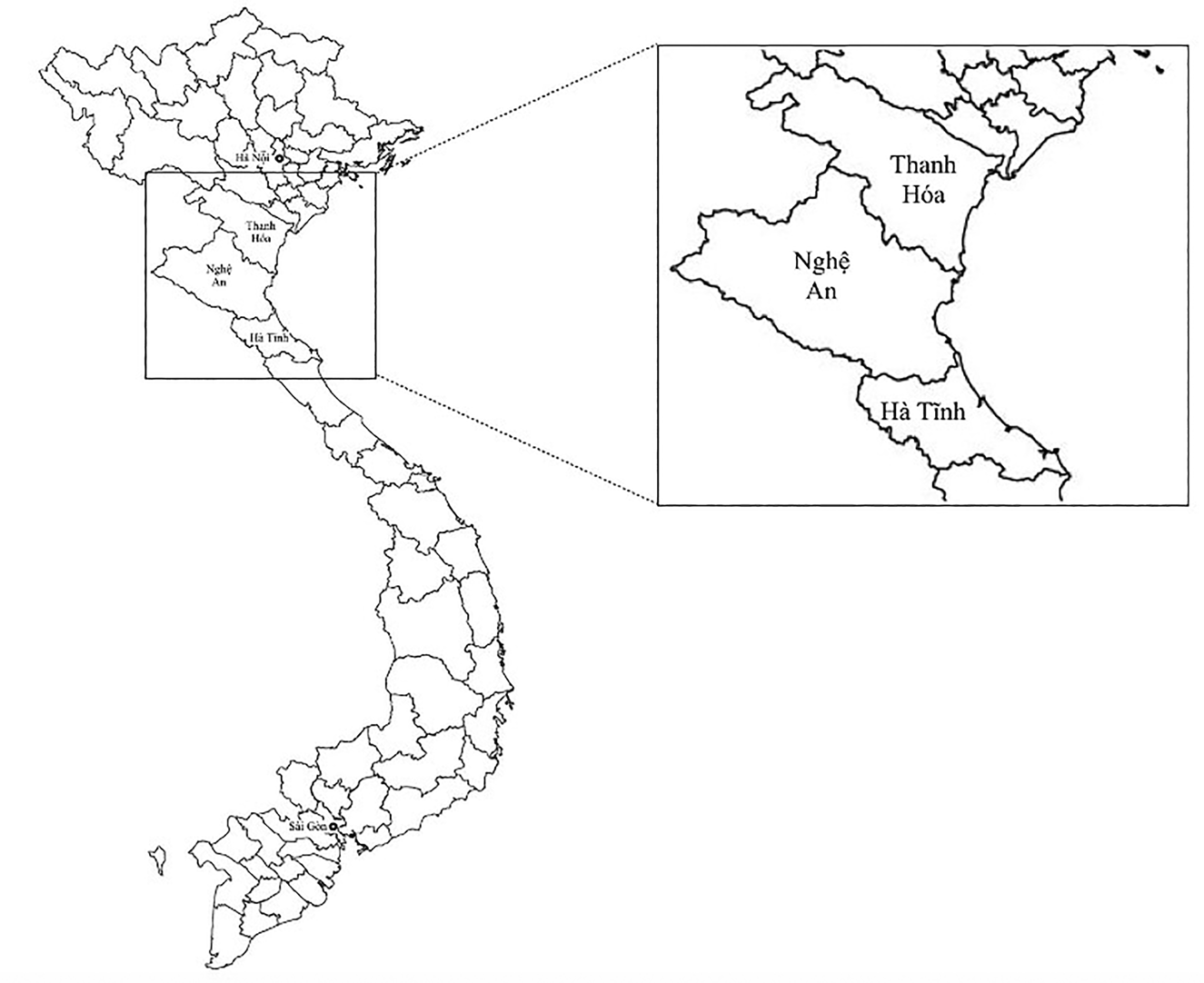
Let us now consider a final, more complex case in which the participants turn to discuss persons from several provinces of Central Vietnam, most prominently Nghệ An and Thanh Hoá (see Figure 1). This topic is again introduced by Thanh, the oldest member of the group. Earlier, the participants, all of whom live in Hanoi, have been talking about Ho Chi Minh City, which they agree offers better and cheaper options for both karaoke and dining out. With respect to this topic of conversation, Thanh has the most expertise having lived and worked in the southern city for several years in the past. More proximately, the discussion has turned to the topic of vegetable sellers and specifically the disagreeable attitude of some venders who sell their goods in stalls on the street.
Map of Vietnam showing provinces and cities discussed by the participants.

In (11) below, Thanh (line 711) links these two previous topics (HCMC and disagreeable vegetable sellers) together by suggesting that, ‘In my opinion, you are unlikely to find yourself in that situation down there’. But Thanh immediately follows up with the caveat, ‘Unless you go to the areas full of people from Nghệ An and Hà Tĩnh’.
(11) VNR_05
709 Thanh: Riêng ở trong kia sẽ khó
In my opinion LOC in DIS FUT difficult
‘In my opinion, you are unlikely’
710 mà gặp những cảnh ấy
COMP meet PL situations PROX
‘to find yourself in that situation down there’
711 Trừ khi là về mấy vùng toàn người Nghệ An, Hà Tĩnh
Unless COP return some parts full person Nghệ An, Hà Tĩnh
‘Unless you go to the areas full of people from Nghệ An and Hà Tĩnh’
713 Phuong: Người Nghệ An trong đấy ấy à
Person Nghệ An in there PROX TFP
‘It's mostly people from Nghệ An around there?’
714 Thanh: Nói chung là nó- nói chung là nó đỡ hơn
Say general is 3 say general is 3 better
‘Generally speaking they- Generally, they are not as bad’
715 nhưng mà vẫn rất có vẻ rất là láo láo nhá
but still very seem very COMP insolent TFP
‘but still they seem very insolent, you know?’
The expression used here, người Nghệ An, denotes a class of people—not some particular group of people from Nghệ An. What makes this reference generic is, in part, the absence of plural and deictic marking. To talk about some particular group of people from Nghệ An one would need to say something along the lines of:
(12) Những người đến từ Nghệ An đó
pl person come from Nghệ An dis
‘Those people from Nghệ An’
In contrast, người Nghệ An means something like ‘the Nghệ An-ese’ which is to say, a group of people construed as a natural kind.Footnote 13 The generic reference here allows for further generalization, a filling out of the characteristics of the persons so designated and this, in turn, provides a basis upon which to build interactional alignment between the participants as all, mostly, converge in their expressed opinion.
But in advance of discussing these matters in more detail, we should note that the distinctions being made here, along with the social ontology that they point to, have a very long history. The area of Vietnam that makes up the contemporary provinces of Nghệ An and Thanh Hóa is collectively known as Thanh-Nghệ, while the provinces of Nghệ An and Hà Tĩnh are together known as Nghệ Tĩnh. As historian Keith Taylor (Reference Taylor1998) notes, the people attached to these place names are often understood in relation to ‘timeless categories’ and ‘regional stereotypes’. In attempting to soften ‘the coherencies of historicized regions and nations’, Taylor (Reference Taylor1998:955) considers episodes of conflict in which, at the beginning of the eleventh century for instance, royal armies were sent to wage war on the ‘the inhabitants of what are now the provinces of Vĩnh Phúc, Thanh Hóa and Nghệ An’. At that time, Lý Công Uẩn (founder of the Lý dynasty) explained that he ‘could not refrain from attacking the people of Nghệ An because they “did not honour civilizing instructions”’ (Taylor Reference Taylor1998:955).Footnote 14 Taylor goes on to consider the drawn out conflict between the Mạc and Lê dynasties, which he suggests is ‘nearly invisible behind the historiographical screen of resistance to Ming rule during the first three decades of the fifteenth century’. For instance, although Lê Lợi (1384–1433, reign 1428–1433) today figures as a national hero, according to Taylor, his anti-Ming campaigns can be read as a conquest of Đông Kinh by Thanh-Nghệ, ‘with the Ming perceived by many Đông Kinh worthies as protectors against the rustics of the southern provinces’.Footnote 15 So, these ontological distinctions—between ‘them’ from rural Thanh-Nghệ and ‘us’ from urban Hanoi (Đông Kinh)—reach back well into the fifteenth century.
The other aspect of this, which is invoked by Thanh's suggestion that you are unlikely to meet a huckster in Saigon unless, in fact, they are actually from one of these rural provinces, is the spectre of ungoverned movement. In his rich discussion of urbanization and development at the fringes of Ho Chi Minh City, Erik Harms (Reference Harms2011:204) notes that the continuous movement of people confounds ‘the notion that rational urbanization requires separation and ordered interaction, a relationship of exchange, but not one of mixing, such that country and city must interact in a carefully ordered division of labor that is based on the maintenance of difference’. His interlocutors, much like Thanh here, insist that they can distinguish an immigrant from the countryside, even if he or she is dressed in proper urban attire (Harms Reference Harms2011:214, see also Reyes Reference Reyes2017).
Look at the people eating in the street restaurants near the Prudential building, he told me. They are all dressed up in urban clothes, and they work in air-conditioned offices. But just watch them eat! They throw their bones everywhere, toss their trash in the street. He told me that these people still had a peasant mentality. They wore the superficial uniform of urban living and moved through urban space, but they were urban imposters who still treated the city as if it was the countryside. They were city folk on the outside but still peasants on the inside.
As Harms (Reference Harms2011:215) puts it, ‘country mouse is pure when he stays home in the country. But in Ho Chi Minh City, when the mouse moves from the country to the city, he turns into a rat’.Footnote 16
Returning to the conversation between Thanh, Huy, Phuong, and Linh we can observe that there are various ways in which these participants build out the stereotype from the initial generic reference. First, consider the way that, once reference is established, both Linh and Thanh find supporting evidence in the fact that other persons act on the basis of similar if not identical assumptions about the people from Nghệ An, Thanh Hoá, and Hà Tĩnh. Linh, for instance, notes that, when recruiting new workers, many employers indicate that they will not take people from Thanh Hoá.
(13) VNR_05
718 Linh: Nhiều những chỗ họ tuyển người,
Many pl place they recruit people,
‘Many places, when they are recruiting’
719 họ ghi thẳng ra cái bảng là không tuyển người Thanh Hoá
they write straight out the board cop neg recruit people Thanh Hoá
‘They write on the board they will not take people from Thanh Hoá’
And Thanh has a similar anecdote in (14).
(14) VNR_05
752 Thanh: Ở trong kia đúng thật là rất nhiều mấy ông sếp của anh nhá
LOC in there true real COMP very many some GF boss POSS EB TFP
‘Down there it's also true that many of my superiors’
753 Mấy ông bạn anh làm sếp to
Some GF friends EB are boss big
‘Some of my older friends are big bosses’
754 Tuyển người ông dặn thẳng là chỉ cần thấy là
recruitment people GF instructed straight COMP only need see COP
‘Recruiters are told directly, only need to see that’
755 Nghệ An, Thanh Hoá là loại ngay
Nghệ An Thanh Hoá COMP reject immediately
‘it's a person from Nghệ An, Thanh Hoá - reject them immediately’
756 Huy: Không cần hỏi.
NEG need ask
‘No need to ask’
757 Thanh: Không cần biết nó giỏi hay là sao
NEG need know 3 good or COP bad
‘No need to know whether they are good or bad’
The value of such evidence lies, it seems, in its apparent ‘objectivity’—not only are these opinions reportedly shared broadly outside this particular group of conversationalists but moreover they serve as the basis for hiring decisions. This is, in other words, not a matter of personal like or dislike. Rather, Linh and Thanh imply, it is a matter of widely accepted ‘fact’ and real-world consequence.Footnote 17
By contrast, evidence from personal experience may also be offered to shore up generalizations built on the back of generic reference. For instance, in support of the co-participants’ shared assessment of people from these provinces, Huy offers an anecdote about his own uncle.
(15) VNR_05
769 Huy: Bác đấy là bác trai. Còn bác dâu, gốc Thanh Hoá
FEB there COP uncle and FEB bride origin Thanh Hoá
‘We have an uncle and uncle's wife is from Thanh Hoa’
770 Vào chơi cả ngày không biết mặt bác ở đâu
Enter play all day NEG know face FEBW is where
‘Spent the whole day there with them and never saw her face’
771 Xuống ăn cơm xong lên luôn. Bác trai bây giờ nhiễm
Descend eat, finished go up. FEB boy now infected.
‘She comes down to eat, finishes, goes back up. My uncle is now infected’
772 Một năm, à mấy năm mới về quê một lần
One year, uh few years just return home one time
‘Over a year, a few years, he only came home one time’
773 Giỗ bố thì gọi điện bảo là mai
Death anniversary father, TOP call phone say COMP tomorrow
‘On my father's death anniversary, he called saying tomorrow’
774 sẽ về Xong là đến gần lúc ăn cơm
FUT come home Done come close time eat
‘I'll come home. It comes almost time to eat’
775 gọi thế đã về chưa thì bảo là có việc bận mất rồi
call PST return yet, TOP say COMP have work busy take already
‘we called to ask if he'd arrived yet, he said he was busy with work’
Whereas Thanh and Linh's evidence is objective in as much as its supposed source lies outside this group of participants, Huy's narrative here is markedly subjective and incorporates his own affective stance towards persons from Thanh Hoá. More specifically, in Huy's story, the characteristics of the people of Thanh Hoá are cast as contagion. Huy's uncle is married to a woman from the region and her behavior lines up with this group's assumptions. Specifically, she is characterized as selfish and anti-social, only descending from the house to eat with others and then, immediately upon finishing, hurrying back into some private part of the home that can't be accessed by guests. Now, says Huy, his own uncle has been ‘infected’. This is evidenced by the fact that when the family held the death anniversary for Huy's father, the uncle never showed up, claiming by way of an excuse, that he was busy with work. Clearly, the crimes of which Huy's uncle and aunt are guilty are not minor matters. Hospitality, demonstrated by a warm and welcoming attitude towards a guest, is more than an expectation, it is a defining feature of stereotyped Kinh culture understood from within. In other words, Huy saying that his aunt did not welcome him into her house is close to saying that she did not act Vietnamese. And what of the uncle? After promising to attend the death anniversary of his brother and Huy's father, he did not show up thereby forcing the family to call and ascertain his whereabouts. His excuse involved citing work obligations and, in this way, prioritized employment and money above filial piety and ritual commitments. In sum, these diacritics of regional stereotype position the persons referred to at the very margins of Kinh culture and ethnic belonging. People from Thanh Hoá are cast as the ‘others within’ (see Thongchai Reference Winichakul and Turton2000).
As was the case for the generic formulation of ‘man’ and ‘woman’ once the reference to the entity is established, the ensuing discussion tends only to presuppose the validity of the underlying distinctions (the ontological assumptions about kinds upon which generic references are premised). This is true even of talk that otherwise raises questions about what the class of entities is like or how it got that way. In the case examined here, for instance, at one point, Phuong seeks confirmation from Thanh as to whether people from the region really do have typical characteristics. When Thanh answers in the affirmative suggesting that the present-day characteristics are rooted in ancient times and custom, Phuong pursues that matter further asking why these people are the way they are, that is, seeking some kind of causal account.
(16) VNR_05
727 Phuong: Chắc nó cũng có đặc trưng thật. Anh nhể
Sure 3 also have characteristic real. eb tfp
‘I guess they do have their typical characteristics. Right?’
(two lines omitted)
730 Thanh: Đặc trưng từ- từ thời ngày xưa mà
Characteristic since time day old tfp
‘These are characteristics from ancient times for sure.’
(three lines omitted)
734 Thanh: Em biết ngày xưa từ thời mà Trịnh Nguyễn ấy
ys know day old from time Trinh Nguyen dis
‘You know from ancient times of Trinh Nguyen’
735 hay là từ thời các triều trước ấy
or, comp from time pl dynasty before dis
‘or, from the times of the earlier dynasties’
736 muốn lấy lính để lật đổ triêu đại nọ,
wanted take troops to overthrow dynasty dis
‘when someone wants to overthrow the dynasty’
737 triều đại kia, toàn về xứ Thanh,
dynasty dis, entire return region Thanh
‘the other dynasties, they come to the region of Thanh’
738 xứ Nghệ để lấy lính
region Nghệ to take soldiers
‘or the region of Nghệ to recruit soldiers.’
739 Huy: Tuý
Depends
‘Depends’
740 Thanh: Thật
True
‘No, it's true!’
741 Phuong: Sao lại xấu tính thế nhể. Do hoàn cảnh sống à
Why bad character tfp tfp. Reason conditions live tfp
‘Why are they such bad people? Due to living conditions perhaps?’
742 Khó khăn à
Tough tfp
‘Difficult, right?’
743 Thanh: Do cái đất
Reason cl land
‘Because of the land’
744 Phuong: Hay do long mạch
Or reason dragon veins
‘Or because of subterranean vectors of spiritual power’
745 Thanh: Có thể lắm
Can much
‘Probably’
746 Huy: Mình chưa đi sâu nghiên cứu nên chưa biết là cái gì ((…))
Self yet go deep research so yet know what
‘The research has not been done and so we can't know what the cause is’
747 Linh: Nhưng mà cái tinh thần cái kiểu như là địa phương gì
But cl spirit cl style like cop locality
‘But that's the spirit of the region’
748 Đi đâu nó cũng ấy vời nhau. Kinh hồn
Go where 3 also tfp with each other. Terrifying
‘Wherever they go, they stick together. Terrifying!’
749 Phuong: Nó bảo vệ, bao che cho nhau. khiếp
3 protects, defend each other. Fearful
‘They protect and defend one another. Frightening!’
We can see here that Thanh first invokes history, citing the Trịnh-Nguyễn wars (1627–1672) during which time the region provided a human reserve from which to enlist soldiers. Keying to the ambiguities of ‘them’ and ‘us’ which run through this period for contemporary Kinh (Taylor Reference Taylor1998), Thanh avoids saying directly who did the recruiting of which he speaks.Footnote 18 It is enough apparently to note that the people of this region made the best soldiers. After Huy expresses some doubt (line 739, tuý ‘depends’), Phuong presses on. Her ‘because of living conditions’ is treated by Thanh as pointing to the importance of ecology and physical geography (line 743). And her subsequent invocation of long mạch links the stereotyped characteristics of the people to underground circuits of power in this way accounting perhaps for their assumed timeless and essential nature.Footnote 19
Finally, when Huy suggests that the coparticipants can't know the cause because the research has not yet been done (which of course accepts all the previous presuppositions about these people which have been detailed in the preceding conversation), Linh attempts to summarize what has been said by suggesting that there is a discernable tinh thần ‘spirit’ or kiểu ‘style’ of the people of this region which leads them to stick together. And she adds the final evaluation kinh hồn, which one dictionary defines as ‘to be frightened out of one's wits’. Phuong caps this part of the discussion off with a paired utterance which replicates the grammatical structure of Linh's just prior turn, punctuating her completion with the evaluative term khiếp ‘frightening’. We can conclude this section by noting that, while such talk about the causal factors that led to the people having the characteristics they are assumed to have point to historical, sociological, and even spiritual contingencies, they do not challenge the underlying presuppositions upon which acts of generic reference to types or classes of people rest. In other words, the participants in this conversation seem assured that, regardless of how they got to be that way, persons from the area of Nghệ An and neighboring provinces of Thanh Hoá and Hà Tĩnh share a set of essential characteristics which differentiate them from others, most notably from the present co-participants.
When a social category is essentialized—linked to a set of beliefs about ‘an almost substance-like entity that pervades its insides, and which causally grounds its more stable and enduring properties’ (Leslie Reference Leslie, Knobe, Lombrozo and Nichols2014:211; see also Gelman Reference Gelman2003)—it is amplified by the determinate content which is imposed upon it.Footnote 20 That is to say, essentialized social categories such as the ones discussed here, do not serve merely as particular ‘kinds’ within a larger social ontology. Instead, they provide the dramatis personae—the cast of characters whose essentialized, and thus knowable, motivations, ways of thinking, and modes of action give the world its teleological coherence.
A final set of observations has to do with what these generic references afford, what kinds of subsequent action and characterization they allow for. One prominent possibility here is the rhematic linking of accent or dialect to personal character (see Irvine & Gal Reference Irvine, Gal and Kroskrity2000). This region is well known for its distinctive dialect(s). Taylor (Reference Taylor1998:955) writes, ‘even today the language spoken in the southern part of Thanh Nghệ, the so-called Nghệ Tĩnh (Nghệ An and Hà Tĩnh) dialect, is closer to Mường than to Kinh’. Alves & Nguyễn (Reference Alves, Nguyễn, Alves, Sidwell and Gil2007) have described some of the regional dialect diversity focusing on the specific variety spoken in the district of Thanh Chương in the western hills of Nghệ An. This highly conservative dialect is distinguished from the Vietnamese of Hà Nội and Sài Gòn in its phonological characteristics (it has twenty-four consonants whereas the Vietnamese of Hà Nội has twenty due to various mergers) and its lexicon, which includes many Vietic and Mon-Khmer words not found in the urban varieties of the language.Footnote 21
And so it should come as no surprise to find that the participants eventually turn to consider the matter of accent (or giọng ‘voice’). Thanh, for instance, suggests that the accent of the people of Nghệ An reveals their insolence.
(17) VNR_05
759 Thanh: Nghệ An ấy. Anh nghe cái giọng của bọn nó,
Nghệ An DIS. EB hear CL voice POSS group 3
‘Nghệ An there! I hear the dialect of those people’
760 Nó cứ láo láo làm sao ấy. Thật. Láo láo xấc xấc nữa cơ
3 just insolent how DIS. True. Insolent insolence more TFP
‘Wow, just insolent. Truly insolent’
And, after Huy admits he doesn't mind the accent of those from Hà Tĩnh, Phuong subjects the various regional accents to grading, suggesting that she prefers that of Thanh Hoá to that of Nghệ An (Carruthers Reference Carruthers2017). The charge of ‘insolence’ (xấc xấc cf. xấc xược, láo láo cf. láo xược) seems to imply a willful refusal to speak urban or official varieties of the language and for Thanh, at least, use of this dialect presumably alludes to centuries of resistance to the centralized authority of Động Kinh, a theme he invoked earlier in his response to Phuong.Footnote 22
CONCLUSION
In a brief yet lucid summary, Lyons (Reference Lyons1977) suggests that referring expressions such as ‘the lion’, ‘a lion’, and ‘lions’ all admit a generic reading and can be used in sentences asserting generic propositions such as ‘The lion is a friendly beast’. Turning to consider the matter from the perspective of universal quantification wherein the generic interpretation should have the form x(Lx → Fx), ‘For all values of x, if x is a lion, then x is friendly’, Lyons (Reference Lyons1977:194) notes that generics pose something of a challenge in so far as the formula seems to be both too strong (falsifiable by a single deviant case) and too weak (not distinguishing between something characteristic of lions from matters of contingent fact). Here I have considered these issues through an examination of some conversations in Vietnamese focusing on two occasions in which participants weave generic reference into the fabric of their talk. We have seen that, in these cases, generic references and the propositions in which they are embedded allow speakers to ‘jump scale’ from talk about the here and now to talk about general categories and kinds as well as history and spiritual essences (Koven Reference Koven2016). The way the participants do this is instructive and seems to speak against some aspects of Lyon's analysis. Specifically, the participants in these conversations find evidence for generic propositions not only in a consideration of particular cases but also by pointing to possible underlying historical, sociological, and spiritual contingencies.
Whenever people talk vigorously and explicitly about ‘them’ we have good reason to suppose that they may also be communicating about ‘us’ (Hastings & Manning Reference Hastings and Manning2004). The conversation examined here is no exception and it is not difficult to see that in talking about persons from Nghệ An, the participants reassure themselves of who they are, and in what ways they differ from these others. A key term of self-definition and social imagination in contemporary Vietnam is văn minh, variously translated as ‘civility’, ‘civilized’, and ‘civilization’. Although used in a range of ways across public and more intimate settings, văn minh often provides a vantage point from which to morally evaluate others. Erik Harms (Reference Harms2016:63) has described some of the important critical possibilities the term affords as well as the ‘unsavory pretensions to elitism’ with which it is often associated. In the present case, it seems clear that, in describing an aunt who does not welcome a guest into her house, an uncle who fails to attend his brother's death anniversary, and people whose dialect reveals their own insolence, these speakers are simultaneously conveying to themselves and to each other their own sense of propriety and their own sense of what it means to be urban, modern, and middle class in contemporary Vietnam. And so, while generic reference may be seen as a means by which to ‘carve up the social world’ (Leslie Reference Leslie, Knobe, Lombrozo and Nichols2014), in the examples considered here it serves also to performatively constitute those who employ it as the contrastive indexical ground against which these others are figurated.
APPENDIX: ABBREVIATIONS
- 3
third person
- cl
classifier
- comp
complementizer
- cop
copula
- dis
distal deictic
- eb
kin term meaning elder brother
- feb
kin term meaning father's elder brother
- febw
kin term meaning father's elder brother's wife
- fut
future
- gf
kin term meaning grandfather
- intj
interjection
- loc
locative
- neg
negative
- pl
plural
- poss
possessive
- prox
proximal deictic
- pst
past
- q
question word/particle
- rec
reciprocal
- tfp
turn final particle
- top
topicalizer
- ys
kin term meaning younger sibling