1 Introduction
Along with genocide, apartheid and slavery, torture constitutes one of the oldest issues in international human rights. Attempts by the international community to eliminate torture practices date back to as far as the immediate aftermath of World War II (Rodley, Reference Rodley2009a; Nowak and McArthur, Reference Nowak and McArthur2008). At the heart of these attempts has been the use of so-called ‘legalised accountability’ – that is, the definition of torture as an illicit behaviour and the mobilisation of law-enforcement agencies, prosecutorial offices, and national and international courts to gather evidence, prosecute and eventually convict torture perpetrators.Footnote 1 The premise has been that, by holding such perpetrators legally accountable, countries around the world would gradually dissuade the practice of torture: ‘Ending impunity for torturers is seen as crucial, along with the provision of redress to victims of torture’ (Carver and Handley, Reference Carver and Handley2016, p. 15).
This agenda has pulled together a variety of social movements, civil-society organisations and experts, whose work has led to remarkable changes in law, policy and institutions of global and regional governance over time and across jurisdictional borders (Rodley, Reference Rodley2009b). Most notably, in 1984, the UN adopted its Convention Against Torture and other Cruel, Inhuman or Degrading Treatment or Punishment (UNCAT). The UNCAT reaffirmed a ‘customary’ prohibition to torture and sought means to make this prohibition more effective. These included the adoption of an internationally shared definition of torture, along with the obligation of states to make torture a crime and to subject torture perpetrators to universal jurisdiction (Rodley, Reference Rodley2009a; Nowak and McArthur, Reference Nowak and McArthur2008). Ever since the UNCAT was adopted, international organisations and non-governmental organisations (NGOs) have invested heavily in assistance to improve the capabilities for torture legalised accountability among developing nations.
Brazil has not been out of this picture. While torture is widely documented throughout Brazilian history, particularly under the civil-military regime (1964–1985), after redemocratisation, the country quickly caught up with the legal advancements produced by the global anti-torture movement.Footnote 2 In 1988, Brazil's new Constitution restored civil and political liberties, stating, further, that ‘no one shall be subject to torture or to inhumane and degrading treatment’ (cf. Art. 5, III). In 1990, Brazil ratified the UNCAT, furthering its commitment with the preventive doctrine that the international community had been advancing. In 1997, Brazil passed a statute making torture a criminal offence in terms similar to those requested by the UNCAT.
How has this expansion of law affected anti-torture work? Based on legal-consciousness scholarship and in-depth interviews, this paper investigates the place and meaning that law takes in the everyday lives of Brazilian anti-torture activists. Do the principles and tools of legalised accountability gain any priority in these activists’ work? If so, under what conditions and with what intent? If not, for what reasons?
In response to these questions – and counter-intuitive as it may sound – my interviewees articulated an account in which law's authority is by and large rejected, while non-legal tools for the prevention and combatting of torture look much more preferable – even if interviewees residually and cynically engage with the law.Footnote 3 While exploring the discursive roots of such account, this paper highlights the role of law and justice institutions, particularly those in the criminal justice system, in the of building social support for – or rejection of – the law. These findings add to our knowledge of law's hegemony, while providing valuable insights for future legal-consciousness studies.
This paper proceeds in four additional sections. Section 2 lays out the theoretical background of my study, namely the constitutive approach to law and society research and the studies on legal consciousness. Section 3 addresses the methods used in my empirical investigation. Section 4 consolidates my analysis. Section 5 derives conclusions and implications.
2 Legal consciousness
The expression legal consciousness has been used widely and in disparate ways across disciplines and intellectual traditions over time (e.g. Kennedy, Reference Kennedy and Spitzer1980; Klare, Reference Klare1978; Reference Klare1981; Trubek, Reference Trubek1984; Merry, Reference Merry1990). Yet, in socio-legal studies, it became more salient as academics in the field shifted from an instrumental to a constitutive approach to the law/society relationship (Sarat and Kearns, Reference Sarat, Kearns, Sarat and Kearns1995, p. 25; Engel Reference Engel, Garth and Sarat1998). The instrumental approach assumed that law could be a tool to change reality but recognised that gaps tend to be produced between law in books and law in action. Researchers worked to map out, account for and eventually propose solutions to narrow such gaps. The constitutive approach also grew as part of scholarly efforts to address the gaps between law in books and law in action. But, since academics were now influenced by a larger cultural or interpretive turn in social sciences and humanities, their analyses of such gaps began to take into account what law represented to people – that is, what meaning people would give to law in their daily lives and what using or not using law signified to them.
The result was a paradigmatic shift in scholarship, which, in Silbey's synthesis, involved three components: (1) the abandonment of a ‘law-first’ paradigm, so that scholars would begin their investigations not with officially enacted legal rules and the intent ‘to trace how policies or purposes are achieved or not’, but rather with ‘ordinary life’ and the intent ‘to find, if there were, traces of law within’ (Silbey, Reference Silbey2005, p. 326); (2) the abandonment of a predominant focus on ‘measurable behaviour’ in favour of a ‘Weberian conception of social action …, including analyses of the meanings and interpretive communication of social transactions’ (Silbey, Reference Silbey2005, p. 326); and (3) the embracement of a new unit of analysis, ‘legal consciousness’, relating to people's experience with – and participation in – the construction of law's hegemony or ‘legality’.
The vast sea of studies that followed covered many areas and issues, from women being sexually harassed on the streets (Nielsen, Reference Nielsen2000) and in the workplace (Blackstone et al., Reference Blackstone, Uggen and McLaughlin2009; Marshall, Reference Marshall2005; Munkres, Reference Munkres2008) to women and racial minorities facing discrimination on the job (Albiston, Reference Albiston, Fleury Steiner and Nielsen2006; Hirsh and Lyons, Reference Hirsh and Lyons2010), from poor people seeking welfare rights (Cowan, Reference Cowan2004; Merry, Reference Merry1990; Sarat, Reference Sarat1990) to undocumented migrants deciding whether or not to file claims with government agencies (Abrego, Reference Abrego2011), from sex workers dealing with abuses while trying to generate income (Boittin, Reference Boittin2013) to family members of brain-injured patients facing decisions about life and death (Halliday et al., Reference Halliday, Kitzinger and Kitzinger2015). Broadly speaking, these studies have offered three kinds of original contributions to a more rigorous and critical understanding of law in society. For one, they have allowed a thick documentation of the ways in which individuals actually experience legal norms. For another, they have invited explanations on what social forces are shaping each and all of those unique socio-legal experiences. Finally, they have invited explanations on how, through our individual and cumulative experiences, ‘we, the people’ become participants in the construction of ‘legality’, helping to sustain a ‘rule of law’ that we ourselves often admit is imperfect and serving as ‘both the authors and victims of our collectively constructed history’ (Silbey, Reference Silbey2005, p. 335).
With regard to this third and more ambitious contribution, the benchmark study continues to be that by Ewick and Silbey (Reference Ewick and Silbey1998; Silbey, Reference Silbey2018). These authors identify three schemas that mediate people's relationship with – and support for – the law. In one of these schemas (‘before the law’), individuals recognise law as a rational and just order. In another (‘with the law’), individuals separate law from claims of justice and objectivity and conceive of it as a ‘game’ (a set of rules), which they decide to play as they pursue their self-interest. In a third one (‘against the law’), individuals recognise that law encompasses instances of unfairness but, through small acts of resistance and workarounds, work to reconcile their dramas with law's order. These schemas synthesise stories that are sometimes contradictory but in operation are not separable; in fact, Ewick and Silbey argue that this complexity is what provides legality – or the rule of law – with durability and strength. The more general and principled account of law (‘before the law’) needs the more instrumental and concrete account (‘with the law’) to remain valid; individual acts of resistance (‘against the law’) can only be conceived as such against the backdrop of law as either a general and principled order (‘before the law’) or as a game (‘with the law’).
In 2005, the promises of legal-consciousness studies were put into question. The challenge came from Silbey herself, who wrote an essay provocatively entitled ‘After legal consciousness’. Silbey's argument was as direct as it was acute. After tracing the origins and historical development of legal-consciousness research, she contended that, while legal consciousness had provided solid ground for numerous studies meant to map what people think and do with regard to law, scholars had failed to further theorise about how law's hegemony is sustained and, therefore, had ‘lost the social’. She thus claimed that the time might have come for us to abandon the concept and move elsewhere with our research.
Silbey's essay only served to reinvigorate legal-consciousness research. Legal consciousness remained an area of high-intensity scholarly activity, while many in academia set out to renew the critical potential of its core concept for socio-legal inquiry (Chua and Engel, Reference Chua and Engel2019, pp. 342–344; Halliday, Reference Halliday2019). One of the contributions in this context was produced by Fritsvold (Reference Fritsvold2009). Fritsvold drew from accounts of ‘radical environmental activists’ who see the law as part of a corrupt and oppressive political order and often engage in ‘flamboyant acts of instrumental lawbreaking for the purpose of symbolic or actual subversion’ (Reference Fritsvold2009, p. 807). In light of such accounts, Fritsvold proposed a fourth scheme (‘under the law’), which, he claimed, filled in some gaps left by Ewick and Silbey's – first by looking at the legal consciousness shared by members of social movements, as opposed to ordinary citizens, and second by shedding light on a socio-legal experience that rejects legal authority and, therefore, is more committed to breaking than to upholding law's hegemony.
Further steps on the road opened by Fritsvold were taken by Halliday and Morgan (Reference Halliday and Morgan2013). These authors analysed accounts from ‘radical environmental activists’ in the UK with support from the cultural theory of British anthropologist Mary Douglas (Reference Douglas and Douglas1982). Douglas built a 2 × 2 matrix with four social types, conceived on the basis of two kinds of societal controls: incorporation within groups and constraint by external rules (respectively, ‘groups’ and ‘grid’). Each of the four quadrants in her model produces a different ‘cultural bias’ or ‘way of life’: individualism (low group/low grid), isolationism/fatalism (low group/high grid), deferential collectivism (high group/high grid) and dissenting collectivism (high group/low grid).
With this model in mind, Halliday and Morgan found, among the activists they studied, a form of legal consciousness that entails a ‘collective rejection of the authority of state law’ (Reference Halliday and Morgan2013, pp. 1, 6). Law is rejected as an expression of a corrupt and oppressive order, even if activists occasionally and cynically engage with it. In light of these findings, Halliday and Morgan outlined a two-pronged agenda for legal-consciousness research. For one, they argued that data on what people think and do with regard to the law should be interpreted with a ‘greater sense of context’; for another, they argued that the theoretical potency of legal-consciousness studies should come from its ability to explain not just law's hegemony (why people support a legal order that we know is imperfect), but also the challenges to law's hegemony (why, when people recognise the disadvantages and injustices that the law causes to them, they sometimes challenge the status quo and sometimes not).Footnote 4 These two moves would open up ‘fertile sites’ for legal-consciousness scholars to ‘[access] the social’.
My research has both similarities and differences with that of Fritsvold (Reference Fritsvold2009) and Halliday and Morgan (Reference Halliday and Morgan2013). Similar to their works, I focus on activists who share a form of legal consciousness in which law's authority is rejected. At the same time, I cover an area in which formal law might appear to support, rather than oppose, the concerns of activists. While there is an inherent tension between concerns with environmental protection and liberal-capitalist legality, which emphasises property rights and freedom of initiative, modern anti-torture laws are clearly set out to prohibit torture practices and punish torture perpetrators. What would explain that rejecting attitude when activists could well be postulating a place ‘within’ the law? Faced with this crucial puzzle, my research builds on – and adds to – the scholarly conversation those authors have initiated.
3 Research and data
The idea for this research first came up in 2017, when I was asked to collaborate with an international organisation and identify advocacy groups in Brazil that might be interested in using international human rights laws and standards in order to confront torture. The organisation was willing to provide these professionals and/or groups with training and/or technical assistance in order to enable such efforts of legal mobilisation.
It was not difficult for me to reach out to the groups the organisation was interested in. Anti-torture activism in Brazil had become highly institutionalised, in part thanks to local adoption of international human rights laws, namely the Optional Protocol to the Convention against Torture and other Cruel, Inhuman or Degrading Treatment or Punishment (OPCAT).Footnote 5 In 2013, the Brazilian government created a ‘national system for the combatting and prevention of torture’.Footnote 6 The system comprises a ‘national committee’Footnote 7 with twenty-three members, twelve of whom represent the civil society. These civil-society representatives – and their surrogates – are appointed by the Brazilian president, after a public consultation among civil-society organisations and professional associations whose work is relevant to the prevention and combatting of torture. They thus stand out among the civil-society activists working in this area. The system also comprises a ‘national mechanism’Footnote 8 composed of eleven ‘experts’ with proven knowledge and experience in the prevention and combatting of torture. These experts are recruited through public-selection processes held by the ‘national committee’ and then are appointed by the Brazilian president. Most of them also come from a civil-society background.
The civil-society representatives from the committee – and their surrogates – and the experts from the mechanism became my targets and, in the spring of 2017, I made my first contact with these subjects to introduce the project to them. I expected, perhaps naively, that they would receive the project with great enthusiasm. There would be no costs involved, while activists would have a chance to learn how to make better use of laws already in place. To my surprise, the average reaction was of scepticism, if not disinterest. The talks went on, the project ended up happening and several activists were trained, but the scepticism of activists towards the use of legal tools to fight torture did not cease to surface during the trainings.
As this process ended, I tried to process the puzzle I had observed. At this point, I had enough knowledge of the Brazilian anti-torture movement to determine that those in the committee and the mechanism were, indeed, representative of anti-torture activism in the country. They were sufficiently diverse in terms of race, gender, age, socio-economic status and geographic location, as well as the organisational setting – traditional vs. contemporary and grassroots vs. elite – and area of anti-torture work – prisons, psychiatric hospitals, juvenile-correction facilities, etc. – they had come from.
In the spring and summer of 2018, I contacted these subjects again and asked whether they were willing to participate in an interview with me. This sample included thirty-five potential participants,Footnote 9 of whom twenty were interviewed. The list of those interviewed, however, was sufficiently diverse to ensure the kind of representativeness that is desired in qualitative and interpretive research. At the request of some interviewees, all answers were anonymised and treated confidentially.
The interviews were on average an hour long. The script had questions about the trajectories and experience of interviewees with anti-torture activism and the resources and strategies they have used to fight torture. There was also a specific probe about the value they assign to, and the use they make of, legalised accountability. Interviewees were asked questions such as whether they have geared efforts to get torture perpetrators investigated, prosecuted and punished – why and why not; whether they have found this to be an effective strategy for torture prevention – why and why not; and how they would compare the use of legalised accountability to other torture-prevention strategies. Whenever it was possible and appropriate, they were asked to illustrate their claims or viewpoints with stories from their everyday activism. My analysis of such interview records is reported next.
4 The legal consciousness of Brazilian anti-torture activists
Among the vast majority of the interviewees, there was a widely shared sense that what Ewick and Silbey (Reference Ewick and Silbey1998) once designated the ‘game’ of legalised accountability is not worth playing – a sense that informs a disengagement from the law and a reluctance, on their part, to consider legalised accountability as a valuable tool in their efforts to fight torture. For example, when faced with probe questions about what role the investigation and punishment of torture perpetrators play in her anti-torture work, INT-3 said that she does ‘not believe that punishment can play any such role’. Facing similar questions, INT-11 said that ‘the punishment of perpetrators has historical importance, but it is something we need to interrogate more critically’. INT-20 said: ‘I wouldn't bet all my chips on holding perpetrators criminally accountable.’ One way or the other, these and other interviewees positioned themselves not ‘within the law’, but outside of it.
This scepticism rests on three discursive premises. The first is that torture is a complex phenomenon. It reflects larger and more structural features of the Brazilian society and, as such, it can seldom be addressed through individualised criminal lawsuits. The second is that legalised accountability in torture cases suffers from limitations intrinsic to criminal law, including what critical criminologists call its selectivity: cases against state officials are less likely to succeed than those against private torture perpetratorsFootnote 10; cases take an incredibly long time to be adjudicated and punishment tends to affect the most vulnerable in the chain that leads to torture practices. The third premise is that, as a general rule, Brazilian legal professionals represent not facilitators, but obstacles for anti-torture activists to mobilise the law and to seek torture accountability successfully. Judges, prosecutors and even public defenders, the interviewees contended, do not give enough priority and attention to torture cases and, oftentimes, they contribute to trivialising, naturalising and even legitimising torture practices.
4.1 It is more complicated: legalised accountability as a limited tool to address a complex problem
The activists interviewed in this research were unanimous and emphatic in characterising torture as a complex phenomenon. The reasons why interviewees invoked such complexity vary, but they usually amounted to what they considered to be deeper linkages between torture and the Brazilian social structure. These linkages have both a synchronic and a diachronic component. They often appear amidst references to broader historical processes – from eighteenth-century colonialism and slavery to recurrent periods of authoritarianism in the twentieth century – which would have helped legitimise torture in the Brazilian social fabric. For example, when INT-13 was asked about her personal and professional trajectory and how she became engaged in torture prevention, she said that it all started in her college education, when she began to attend conferences, and she
‘Was touched by how violence against children and adolescents was naturalized, by how beating up, whipping up, putting [kids] to kneel down over corn seeds, how all these forms of physical and psychological punishment were so naturally used to discipline kids. And I later came to understand that this is all rooted in slavery. During the 20th century, we started to think about these issues through other references, but deep inside the Brazilian society there is [a] tradition of violating someone else's body integrity to subordinate and [to] exercise power. This becomes more visible in places like prisons and juvenile detention centers, but it is part of our day-to-day lives, of who we are.’
Those linkages also appear amidst references to more recent trends in criminal justice law and policy, which have led to a scenario of mass incarceration and a local version of the US war on drugs. Hence, when I was discussing the efficacy of torture-prevention measures with INT-2, she said that ‘Mass incarceration is a problem; we need to find ways to de-incarcerate’. INT-4 said that
‘Mass incarceration impedes, in practice, that rights be respected. Nothing is going to work if we continue to put so many people in jail. My emergency plan for torture these days would be to release people from jail and [not to] put more people in jail.’
This discursive association between torture and structural features of the Brazilian society has two practical consequences for the issues analysed herein. First and foremost, it lowers the expectations of interviewees about legalised accountability significantly. The social structure is seen as conducive to torture and criminal lawsuits targeting individualised cases in the attempt to hold perpetrators accountable are not seen as sufficient to changing this state of affairs. Instead, that adverse social structure appears as an explanation for why, as a rule, anti-torture legalised accountability fails. As INT-12 put it:
‘Impunity is overwhelming, but this has deeper roots in our history. From colonial times to civil-military dictatorships to now, torture endures as a non-reprimanded practice. In all the work that I have done, I [helped] some torture victims to collect damages, but I never got any torture perpetrators criminally convicted.’
Second, interviewees tend to prefer anti-torture solutions of a larger and non-legalistic scope, even if these are more difficult or take more time to be put together than individual criminal lawsuits. Interviewees (INT-5, INT-16, INT-17, INT-12) were enthusiastic about the construction of the ‘national system for the prevention and combatting of torture’, whose approach is based on inspections of sites where torture is more likely to happen followed by feedback to, and constructive engagement with, administrators. But an even more widely preferred solution among the interviewees involves intervening in public opinion to reshape the social atmosphere that they see as conducive to torture. As INT-10 defines it:
‘We need to build some form of counterculture to confront this, that has always been around.… To achieve this, we must invest in education, awareness, communication. We must find ways to assert that lives matter, that there are no lives of lesser value.’
INT-5 elaborates further that
‘Torture prevention is complicated, because torture is a crime of opportunity. If those who can commit torture feel that there is nothing wrong with it, that no one around will care or be outraged about them doing it, then they are obviously more likely to do it. This is why we must sensitize the society at large and fight against, for example, the naturalization of torture practices. However, if we look at public opinion polls, we will see that tolerance of torture is growing. And even the media seems to conspire against basic civil and political rights. There needs to be a permanent campaign against torture!’
At this point, one could legitimately ask: is something not better than nothing? While legalised accountability may not attack the deep roots of torture in Brazilian society, can it not provide a response to this problem, and should this response not be given more value by activists? The interviewees, however, have further criticisms of legalised accountability in theory and in practice, as detailed next.
4.2 But if it works … will it work? The limits of criminal law as a policy tool
Interviewees also share a negative assessment of the criminal justice system, which informs their scepticism towards the use of legalised accountability in torture-prevention efforts and their resistance to consider that torture or any other social ill can be confronted through the criminal process. Part of this takes place on a rather personal level and involves an almost moral conflict that interviewees face. When asked about the role that criminal accountability plays in their attempts to fight torture, several interviewees would respond like INT-1 did, when she said: ‘It's paradoxical. We fight against incarceration, but at the same time we ask for the incarceration and criminal punishment of those who violate rights.’
The reason behind this recurring moral conflict is that, in their anti-torture activism, all the interviewees bring to bear a certain stock of critical assumptions, built through readings of Foucault (Reference Foucault1977; Reference Foucault2001), critical criminologistsFootnote 11 and penal abolitionists,Footnote 12 which are in utter opposition to the use of criminal law to confront torture or any other policy problem. For example, INT-3, cited above, who said she does ‘not believe that the punishment of torture perpetrators can play [a role in torture prevention]’, later grounded her answer on her academic training and work, all of which take a highly deconstructive approach to the prison system. ‘I am an abolitionist,’ she said at some point. ‘I agree that we must come up with better, more effective tools of antitorture accountability, but I do not believe that these should follow the lines of vengeance,’ she concluded.
Another part of the resistance, however, was linked to an actual experience with the criminal justice system and the consequent realisation of the many shortcomings it bears for the actual prevention of torture. Some interviewees, for example, observed that the system works too slowly for its decisions to have any pedagogic effect on systemic practices of torture. INT-5 said that
‘there are instances in which we have evidence solid enough to accuse and we get somebody to be suspended from their duties in a correctional facility, but the court case takes too long to be processed, and the person gets sent back to his duties. Do you see how complex antitorture accountability can be?’
INT-9 echoed this when he said:
‘We must be aware of the limits of the criminal justice system … of where punishment comes from, where it goes, and what limits it has. If everything works out, somebody will be criminally convicted several years from now, and … that conviction will [not necessarily] have any pedagogic effect on others who are routinely committing torture.’
This sentiment finds larger support in other data sources. In 2016, Juan E. Mendez, the United Nations Special Rapporteur on torture and other cruel, inhuman or degrading treatment or punishment, conducted a visit to Brazil. His report points to both a ‘frequent use of torture and ill-treatment, varying in methods and the severity of the pain and suffering inflicted’ (United Nations, 2016, p. 10) and to deficits in legalised accountability. Mendez ‘learned of cases of administrative disciplinary measures, and of initiation of prosecutions’ but detected that, ‘for the most part …, agents accused of serious crimes, including torture, had not been arrested, or, if arrested, had soon been released’ (United Nations, 2016, p. 12). Reports from Brazil's National Council for Prosecutorial Services (CNMP) also indicate sizeable gaps in torture investigation and punishment in this country. For example, in 2013, state prosecutors’ offices received 8,050 notices of wounds and injuries committed against prisoners. That same year, the offices initiated 4,134 investigations and made only 253 indictments for torture (Conselho Nacional do Ministério Público, 2013a; 2013b). In 2014, state prosecutors’ offices indicted suspects in 32.20 per cent of the cases of unlawful possession of firearms they were investigating. In cases of drug trafficking and drug possession, the percentage of indictments was 22.30 per cent. In cases of torture, this figure was of a mere 7.11 per cent (Conselho Nacional do Ministério Público, 2014).
An even more common criticism of Brazil's criminal justice system involves what critical criminologists call its selectivity – that is, the fact that it operates with an intrinsic bias against those who are most vulnerable in society. Interviewees see this same pattern in the anti-torture investigations and prosecutions they follow. As INT-14 defined, in response to the probe question about the role of criminal accountability in her torture-prevention efforts:
‘I am skeptical of accountability meaning criminal punishment. I think this is a bit too perverse. The system urges that the police officer go to the favela, engage in warfare, and kill someone if need be. So, when he eventually kills someone, are we going to imprison him and forget about the institution, about those who give him orders and articulate the discourse he abides by? … Same with prison officers. Their work conditions are terrible, they too are imprisoned, they commit and suffer violence, and they have to make difficult decisions, sometimes to meet unclear and ambiguous superior orders. It is a system that degrades everybody, it degrades prisoners, but it also degrades prison officers.’
INT-19 echoed this, by saying:
‘The issue of criminal accountability is complicated. I have clarity about the contradictions involved in your question and that we lack the elements to properly address it. We are in the process of creating symbolic mechanisms to make torture visible and not trivialized, but we must be careful not to reproduce the logic of the criminal justice system, which targets those more socially vulnerable, the low-end guy.’
In a similar fashion, INT-7 said:
‘I have been working to reduce incarceration rates; the criminal accountability of torture perpetrators raises a personal dilemma to me. Because when you look [at] things more closely, the ones who are getting arrested for torture are the poor, black law enforcement agents. Am I going to send these people to the same prison system I am trying to change? Very feel people are held accountable for torture, and it is always the low-end guy or a private caregiver. Catching these people, who in fact look a lot like the prison population and putting them in jail will not solve the problem.’
Available data about the adjudication of torture cases corroborate this sentiment. Looking at cases that were decided by the Sao Paulo State Court of Appeals (N = 455, with 752 defendants involved), the NGO Conectas (2010) found that it was much easier for ‘private’ torture agentsFootnote 13 to be convicted for torture. Although 61 per cent of the cases involved public and 37 per cent involved private agents,Footnote 14 22 per cent of the public agents accused were deemed not guilty and 4 per cent were convicted for less serious crimes; among the cases involving private agents, these numbers were 10.5 per cent and 5.50 per cent, respectively. What is more, in 19.2 per cent of the cases involving public agents, the Court of Appeals overruled the conviction and in 6.5 per cent convicted the defendants for less serious crimes; among the cases involving private agents, these numbers were 6.5 per cent and 10.3 per cent. While, in 53.2 per cent of the cases involving public agents, the Court of Appeals deemed that torture had been proved, among the cases involving private agents, this number was 72 per cent.
Yet, these structural failures of Brazil's criminal justice system, which significantly hinder the ability of criminal accountability to produce solid outcomes in torture prevention, are only one of the aspects that interviewees will mention as a justification to reject law's authority. Those behind the system – namely legal professionals – emerge as targets of a special line of critical considerations, as reported next.
4.3 Agents of change or accomplices of rights violations? The uncertain place of the Brazilian legal profession in torture prevention
The legal field was deeply transformed during the Brazilian democratic transition in the 1980s. The judiciary regained its independence, while the Public Prosecutor's Office was reconfigured in ways that make it unique worldwide. Besides conventional tasks of criminal prosecution, Brazilian prosecutors were given standing to start investigations and to file civil lawsuits in defence of the public interest (Vieira, Reference Vieira2008; Arantes, Reference Arantes2002). The Constitution also established a right to access to justice in both criminal and civil cases, to be fulfilled by a publicly funded Public Defender's Office (Vieira, Reference Vieira2008; Moura et al., Reference Moura2013).
In Brazil and abroad, many have expected this renewed legal profession to take up the challenge of fighting torture. Post-Constitution legislation has put legal professionals at the heart of anti-torture work. For example, judges and prosecutors were given the duty to monitor prisons and juvenile-correction facilities and to start disciplinary procedures, as well as criminal investigations and lawsuits, if they encountered torture perpetration.Footnote 15 In addition, as mentioned earlier, capacity building in the legal field has been a hallmark of development assistance, leading to the production of materials and the training of practitioners to enforce the standards that Brazil has adopted locally or subscribed to internationally (e.g. Foley, Reference Foley2013). The experience of interviewees with legal professionals, however, is far gloomier. As INT-20 states:
‘Judges and prosecutors won't investigate torture cases. Most prosecutors overseeing sentence implementation think of prisoners as their adversaries in an endless criminal case, when their duty is to ensure that sentences will be served in conformity with the law. In fact, it seems that both the Executive and the Justice System are closely united behind the flag of protecting society [from criminals].’
To many interviewees, this state of affairs came as a surprise. They hoped they would find judges and prosecutors who would represent the winds of change that blew in the Brazilian democratic transition. Hence, they were disappointed to see that there was seemingly more continuity than change. INT-7 said that
‘Before I started doing this work, I had another perspective. I thought that all that we needed to do was to narrow the gap between international laws and local practices, to create the preventive mechanism, to follow the Istanbul Protocol, etc. But now I understand that we won't go any farther without having a conversation with judges and prosecutors.’
Her conclusion was, however, that ‘There is no way to have such [a] conversation’. She exemplifies:
‘The prosecutor [acting in a given state] worked for the military dictatorship. He says he goes visit the prison every day and he doesn't see anything wrong. Judges and prosecutors send people to prison, turn a blind eye to what is happening there, and don't care at all about holding perpetrators accountable.’
Custody hearings appear quite frequently as examples of how Brazilian legal professionals have fallen short in providing a meaningful contribution to torture prevention. This is in many ways understandable. These hearings were established by the Brazilian Judiciary,Footnote 16 which, since 2015, has required the police to present detainees before a judge within twenty-four hours of their detention. In such a hearing, judges should: (1) determine whether or not the detainee must wait for trial in custody or he/she could qualify for alternatives to pre-trial detention (e.g. release with bail); and (2) verify whether there are signs that the detainee has been subjected to torture and, if so, order the appropriate investigation to start. As it turns out, custody hearings have opened up the black box of judicial and prosecutorial arbitrariness in criminal justice law and policy. INT-14 illustrates:
‘I follow these custody hearings since they started in [her state]. In the beginning, the judicial officials directly involved were more open minded, but there was already a lot of resistance in the judiciary and the Public Prosecutor's Office. At some point, there was a 53% rate of release of prisoners who appeared before the court. Now that rate is at about 20% or 25%. The court leadership changed and the judges in charge of the hearings were replaced. With respect to torture per se, what I observed firsthand and what I read in research reports is that it is usually accepted. Unless the evidence is too ostensive – the prisoner shows up with a broken arm – torture is naturalized and even justified. When the police stomp someone on their chest or slap them on their face, that is justified as being necessary to their arrest. In the hearings that I attended, whenever the judge questioned prisoners about these facts, there was always some nudging in place. “What was it? A slap? Oh, but that's nothing.” Psychological torture is totally overlooked.’
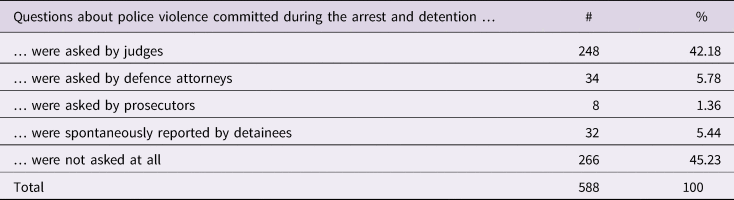
Since 2015, several governmental and NGOs have been assessing the implementation and effectiveness of such hearings. The available data for the Sao Paulo state, where the largest prison population in Brazil is located, back up the sentiment of interviewees. In almost half of the cases, the detainees were not at all asked about whether the police had committed violence during the arrest and detention (Table 1; Instituto de Defesa do Direito de Defesa, 2016, p. 67). Moreover (Instituto de Defesa do Direito de Defesa, 2016, p. 68), in fifty of the 141 hearings in which detainees did confirm that violence had been inflicted against them, no measures were taken by the authorities, such as referring the case for investigation (n = 90) or for legal assistance (n = 1).
Torture assessment by judges in Sao Paulo custody hearings

Author's elaboration based on Instituto de Defesa do Direito de Defesa (2016).
One could argue – and international organisations have shared the premise – that legal professionals could have their mindset changed if they were properly exposed to information. This could happen, for example, through participation in training programmes. Based on their own experiences with training programmes, however, interviewees would argue that their transformative potential is very limited. As a rule, judges, prosecutors and even public defenders tend to resist the messages they get in these training sessions. For example, as INT-3 was telling me about her experience with legalised accountability and what she finds problematic about engaging legal professionals in torture prevention, she said that
‘We had a seminar about torture accountability with judges, and the first thing I realized is that we have a lot of work to do. They don't engage in any serious conversation about torture, they don't even accept that it exists. It's a big taboo, a constant denial. They say things like, “I know when a criminal is lying, I look at them and I recognize it.”’
In a similar vein, INT-1 said:
‘A couple of months ago, a colleague and I were invited to teach for a course offered to judges upon their admission to the bench. We gave them talks about mental health and security in the prison system, topics of this sort. We talked; they didn't participate much. After that I met with a court official and asked about [his] evaluation of the course. He said, “I was shocked: they said your talks had nothing to do with their work as judges.” That is, many of them will be assigned to oversee prisons and prison sentences, and [they] don't want to have anything to do with what happens during one's imprisonment. There is a wide gap between their world and the social problems outside of it.’
The efficacy of training programmes in torture prevention – and human rights work in general – is admittedly problematic. Carver and Handley (Reference Carver and Handley2016) found that programmes that are more practically oriented tend to be much more effective than programmes geared to just raising awareness and disseminating conceptual information. The accounts from my interviewees, however, touched on a deeper issue: a lack of empathy for torture victims, which, to many, reflects the socio-economic gap separating legal professionals from the rest of the Brazilian populace. In the words of INT-12: ‘legal professionals who should oversee the prison system share some common class, race, and gender attributes, and based on those, they cannot make sense of torture. Unless somebody is bleeding in front of them, they will not recognize torture.’ INT-8 adds:
‘there is no empathy for torture victims on the part of courts, the Public Prosecutor's Office, and even the Public Defender's Office. How can someone who never got close to mud feel empathy for those who have their feet mud-covered?’
The solution proposed by interviewees once again indicates a reformist aspiration. They would like to reconfigure the profession, beginning with new recruitment standards. Hence, as INT-7 continued to report on her frustration with a prosecutor, she told a story in which
‘A correctional officer was murdered, then seven inmates were reportedly beaten and “disappeared.” This prosecutor did not even start an investigation; he only did it after we requested, but he [did not] follow up. Many inmates we interviewed said that they were afraid of leaving their cells for medical appointments or court hearings, fearing that they would be taken to be tortured, and he says he does not see any torture happening? He was also supposed to oversee police activities, but he will not.’
She concluded: ‘You know, before, I had some faith in the criminal justice system; now, I believe it has to go through a more structural reform, which should include, for example, changes in recruitment of these judges and prosecutors.’ INT-16 and others agreed, coming from different experiences and adding new pieces of information. He said that
‘As a rule, judges do not go visit prisoners and, when they go, they do not listen carefully enough to the stories that prisoners have to tell. I have countless examples of how judges can be insensitive to the realities of prisoners. In [cites a Brazilian state], I saw judges facing prisoners who had fled Venezuela with their families, who were living under extreme poverty, [who] committed small thefts to feed their starving children, and [who] were given astronomic bails, which they obviously couldn't pay for. In [cites another state], I saw judges facing indigenous prisoners who were brought in their light clothes to this freezing court room and, because they were freezing, their communication [was] monosyllabic; sometimes [they] made statements that were taken for confessions. This is not what judges are supposed to do in these cases. They should request an anthropological report before making their decision[s].’
He then concluded: ‘So, if we want to be serious about torture prevention, we must change this. We should begin with the way judges are recruited. Just strict legal knowledge is not enough; they've got to have a stronger sense of ethics.’
5 Building law's hegemony or confronting institutional failures? The place and meaning of legal recourse among activists
Reference and recourse to law are not absent among my interviewees. But three aspects make these uniquely relevant to discussions of law's hegemony – or lack thereof. First off, recourse to law is residual; very few interviewees would deem the tools and principles of legalised accountability central to their anti-torture work. Second, when interviewees turn to law, they often do so in a rather cynical manner, with no hopes that torture perpetrators will be convicted and that torture practices will be dissuaded. Lastly, interviewees construe their reference and recourse to law as an expression of their critique of – and attempt to reform – institutions. INT-10 offers a good example. Like all other interviewees, for most of our conversation, she developed an account marked by law's rejection. ‘Nevertheless,’ she added, in response to a probe question on the value and use of law, ‘whenever we know of a case, in spite of everything, we follow the path of law. We communicate everybody, the public prosecutor's office, the public defender's office, the judge. We don't have much success with these claims, but we keep presenting them.’ How can we make sense of such engagement in a losing legal game? The critique of – and attempt to reform – institutions emerges as a justification as she concludes her line of reasoning. She states: ‘We've got to follow the rules and procedures, the rule of law. We've got to file motions … to demonstrate that the problem is … the lack of commitment [of courts and law-enforcement agencies].’Footnote 17
Another illustration involves forensic services. Brazilian forensic services lack resources and training and, more crucially, they operate under the authority – direct or indirect – of public-safety forces (the police, the prison system and sometimes juvenile-correction services). In practice, this power imbalance has inhibited rigorous and independent investigations in cases like torture, where public-safety officers are the ones to be put under scrutiny. In the words of INT-3: ‘forensic services are subordinated to the police, and [they] will never investigate.’ Here, an interesting dynamic between law and anti-torture activism gets established. The legal principle that torture perpetrators must be held accountable supports and legitimises activists’ claims for better and more independent forensic services. INT-2 stated that
‘It is vital that we improve our capacity to produce good forensic evidence. If judges are presented with better evidence, things may be different.… Judges may be resistant, but they can't simply refuse to look into the evidence. It becomes more difficult for them to acquit perpetrators.’
The interviewees are not the only ones to assume that strong, independent forensic services are needed for lawsuits to be effective against torture. A similar understanding appears, for example, in the report from the National Conference on Public Safety,Footnote 18 the reports by the Brazilian National Preventive MechanismFootnote 19 and statements by the UN Special Rapporteur on Torture and Other Cruel, Inhuman or Degrading Treatment or Punishment,Footnote 20 to name a few sources. But, given these interviewees’ scepticism of the law, their approach to this issue gains a special connotation. While it may indicate their interest in seeing the law ‘work’ in their behalf, it definitely shows how central it is for them to reform criminal justice and law-enforcement agencies, which includes altering these agencies’ power imbalance.
6 Discussion
For over a decade now, legal-consciousness research has been called to give new proof of its critical potential and many scholars have been invested in such a task. A promising way ahead has been presented by Fritsvold (Reference Fritsvold2009) and Halliday and Morgan (Reference Halliday and Morgan2013). Their works highlight the importance of legal detractors – those who reject law's authority. While Fritsvold argued that these should be included in Silbey's three-pronged schema, Halliday and Morgan called for studies with greater heed to the cultural context of the subjects studied, whose cultural biases of ‘collective dissenters’ may lead to a rejection of law's authority. Turning to law does not mean recognising law's authority; recognising law's authority does not mean accepting it.
This paper builds on – and adds to – such efforts. The Brazilian anti-torture activists I interviewed share a form of legal consciousness similar to that encountered by Fritsvold (Reference Fritsvold2009) and Halliday and Morgan (Reference Halliday and Morgan2013): they reject law's authority. At the same time, my research covers an area in which formal law might appear to support, rather than oppose, the concerns of activists. As such, my research is met with a specific puzzle: why do people reject law's authority when they could well be postulating a place ‘within the law’?
While an answer to this puzzle could be searched for in the ‘cultural biases’ of my interviewees, their accounts bring up another explanatory vein. Their rejection of law's authority is construed amidst a critical assessment of law and justice institutions, particularly those in the criminal justice system. This touches upon a potential limitation of Douglas's model – and cultural theory in general. Her model captures stable social configurations and their corresponding cultural biases – or identities – but not the processes by which these are constructed. What makes one reject law's authority? How are dissenting identities produced? My research points to the role of continuous and shared experiences with failed institutions in these processes.
How can this help us to theorise about law's hegemony and further the critical legacy of legal-consciousness research? In Ewick and Silbey's work, the explanation for law's hegemony is twofold. Law's authority derives from the ideals and principles it announces – which can galvanise popular support – as well as from the fact that it can be a tool for the pursuit of individual interest. But, while this can help sustain the rule of law – or legality – it can also cover up law's failures and promote, instead, a ‘headless tyranny’ in which ‘all are obedient subordinates tending to their particular tasks, and no one is responsible for the overall outcome’ (Arendt, Reference Arendt1972, p. 178; Silbey, Reference Silbey and Feenan2013). My research shows that there can be both limits to and preconditions for such a system to operate. When institutions fail systematically and legal ideals and principles become nothing more than empty promises to people, it may be naive to expect that they will fall for the law – or continue to uphold law's authority. And, while this conclusion comes from fieldwork in a developing country, where the ‘rule of law’ can always be thought of as a foreign construct adopted or imposed locally, there is no reason why it should not be applicable, for example, to minorities and powerless groups in developed countries where some argue that ‘legal alienation’ has become the status quo (Hertogh, Reference Hertogh2018). These, too, in the absence of a continuous experience of inclusion, may at any point in time no longer ‘fall for the law’. In addition, my research calls for more attention to the complexity of legality or what we could call a pluralism internal to state legality.Footnote 21 Most likely, my interviews would not object to a legal prohibition of torture. Yet, they have many reservations, justified in theory and in practice, to legal reliance on criminal punishment in attempts to curb torture. Perhaps they could find the ‘game’ of law more attractive if it were played more often in another ‘field’ or domain of legality, such as administrative or even civil law.
7 Conclusion
The definition of torture as a crime and the mobilisation of law-enforcement and criminal justice agencies to investigate, prosecute and punish torture perpetrators – simply put, legalised accountability – has been a hallmark of torture-prevention law and policy around the globe. After Brazil's redemocratisation, the country quickly caught up with such legal advancements. Based on the legal-consciousness scholarship – at a time when it has been asked to give new proof of its critical vein – and drawing from accounts from Brazilian anti-torture activists, this paper intended to determine the place and meaning of legalised accountability in the everyday fight against torture. Do activists rely on legalised accountability? If so, to what extent or under what circumstances? If not, why not?
Analysis of the data led to a form of legal consciousness in which law's authority is rejected, while non-legal approaches to the prevention and combatting of torture look preferable to the activists studied. The activists studied deem the torture problem too complex and the means – the criminal legal process – and mediators – the legal profession – of legalised accountability too deficient to generate solid preventive outcomes. And, even when these activists report turning to law in their anti-torture work, this happens in a residual and cynical fashion.
Although others in legal-consciousness research have encountered similar instances of legal detraction, the case discussed in this paper is particularly intriguing. Here, law might appear to support, rather than oppose, the interests of activists. Why do people reject the law, even if the law seems to provide them with new opportunities to attain their goals? The data bring valuable insights to this puzzle. The rejection of law's authority by the activists studied is construed amidst a critical assessment of law and justice institutions, particularly those in the criminal justice system. When it comes to theorising law's hegemony, these findings highlight the role of institutions and domains of legality in making legality a credible governing script – or not.
Going forward, this paper raises three points relevant to future legal-consciousness research. First, it reiterates the importance of looking at legal detractors, as Fritsvold (Reference Fritsvold2009) and Halliday and Morgan (Reference Halliday and Morgan2013) have done. The rejection of law's authority is part of the story of law's hegemony. By better understanding the former, we can better understand the latter (Halliday, Reference Halliday2019, pp. 871–872).
Second, it calls for attempts to track the institutional production of legal detractors. Of what social locale – considering issues of gender, race, class, immigrant status, relational ties (Chua and Engel, Reference Chua and Engel2019; Abrego, Reference Abrego2019) and others – do those come from? What is their experience with government institutions? How well are their interests represented and their demands recognised in their polities and by specific domains of legality? Where does their allegiance to law begin and end? These are some of the questions we should be also asking as we track ‘what people think and do’ with regard to the law.
Third – and along these same lines – I argue that legal-consciousness research would take benefit from the use of comparative and international research designs and a greater proximity with studies of law and globalisation (Dezalay and Garth, Reference Dezalay and Garth2002a; Reference Dezalay and Garth2002b) and law and development (Trubek and Santos, Reference Trubek and Santos2006; Trubek et al., Reference Trubek, Coutinho and Schapiro2013), which have grappled with attempts and failures to institutionalise the rule of law. This would bring scholars closer to places where law's hegemony is more visibly under dispute and shed a brighter light on the institutional factors that contribute to legal hegemony being achieved and sustained, some of which tend to be overlooked or simply taken for granted by Anglo-American scholars.
Conflicts of Interest
None
Acknowledgements
I thank my interviewees, who generously shared their stories and thoughts with me, as well as the two anonymous reviewers, who provided me with their generous and constructive feedback on an earlier version of this article. The remaining flaws in the article are, nevertheless, my sole responsibility.