Introduction
Clinically unsuspected differentiated thyroid cancer is not uncommon, and may occur in 1–10 per cent of the population.Reference Nishiyama, Ludwig, Thompson, De Groot, Frohman, Kaplan and Refetoff 1 – Reference Autelitano, Spagnoli, Santeusanio, Villaschi and Autelitano 4 In autopsy studies, occult foci of papillary thyroid carcinoma have been found in up to 35.6 per cent of the population.Reference Harach, Franssila and Wasenius 5 These tumours rarely become apparent, although clinical disease may developReference Allo, Christianson and Koivunen 6 ; however, the prognosis of affected patients is generally excellent.Reference Vassilopoulou-Sellin and Weber 7 The initial presentation of a papillary thyroid carcinoma may be detection of a metastatic cervical lymph node; in such cases, the carcinoma is generally discovered after thyroidectomy.Reference Nussbaum and Bukachevsky 8
Foci of thyroid tissue may also be found during the final histological analysis of specimens from neck dissection performed for other reasons. These inclusions may be histologically compatible with nodal metastases of papillary thyroid carcinoma, but may sometimes appear as benign thyroid follicles. According to some authors, all thyroid tissue specimens found in cervical lymph nodes should be considered metastases of a primary thyroid tumour, irrespective of the histological appearance.Reference Kozol, Geelhoed, Flynn and Kinder 10 Other authors have proposed that benign thyroid inclusions may be present in cervical lymph nodes.Reference Block, Wylie, Patton and Miller 11 – Reference Ansari-Lari and Westra 14 The therapeutic implications of such findings are therefore not universally accepted, and their optimal management remains controversial.
This retrospective study aimed to evaluate the incidental nodal metastasis rate of differentiated thyroid carcinoma in neck dissection specimens obtained during the treatment of head and neck squamous cell carcinoma (SCC), and to discuss implication for the overall prognosis of patients affected by another more aggressive tumour.
Materials and methods
The medical records of 372 consecutive patients who underwent neck dissection for head and neck SCC between 1996 and 2008 were retrospectively reviewed. All surgical procedures were performed by the senior author (LM). Exclusion criteria were previous radiotherapy to the head and neck region and previous or current thyroid disease. After applying these criteria, 304 patients remained eligible for the study. All patients underwent pre-operative neck ultrasonography, computed tomography and/or magnetic resonance imaging to identify any abnormality of the thyroid gland; patients with stage III–IV disease also underwent total body positron emission tomography.
Neck dissection was monolateral in 153 patients and bilateral in 152; therefore, 457 neck dissection specimens were included in the study. In all, 272 patients underwent radical or modified radical neck dissection (levels I–V), 98 (with hypopharyngeal and subglottic laryngeal carcinomas) underwent selective neck dissection (levels II–VI) and ipsilateral hemithyroidectomy, and 87 underwent selective neck dissection (levels II–IV).
Results
Of the cohort of 304 patients, 245 were men and 59 were women. The mean age at surgery (neck dissection) was 60.4 years (range 23–90 years). Ten patients (3.3 per cent) had nodal metastasis from papillary thyroid cancer; the involvement was bilateral in one patient. Therefore, 11 out of 457 neck dissection specimens (2.4 per cent; 10 patients) contained metastasis from a papillary thyroid carcinoma.
These 10 patients comprised 9 men and 1 woman. The mean age at surgery (thyroidectomy) was 49.0 years (range 43–66 years; Table I). Pre-operative radionuclide scanning ruled out distant metastasis from the papillary thyroid carcinoma. All patients underwent total thyroidectomy (two who had previously undergone hemithyroidectomy underwent completion total thyroidectomy) and central neck dissection. A primary thyroid tumour was found in eight patients (80 per cent). The primary thyroid tumour was pathologically staged according to the Union for International Cancer Control tumour–node–metastasis (TNM) 2002 staging system as T1 in seven patients and T2 in one patient. Central neck metastases were not identified. All patients received post-operative 131iodine therapy at a dosage of 100 mCi. When adjuvant therapy was indicated for the head and neck SCC, 131iodine therapy was administered at a later time point.
Demographic data

M = male; F = female; PTC = papillary thyroid carcinoma
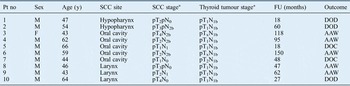
The mean post-operative follow up was 64.3 months (range 18–150 months). Progression of the thyroid tumour was not observed, and all patients were considered free of thyroid cancer at the end of follow up (patient characteristics are shown in Table II).
Characteristics of head and neck squamous cell carcinoma patients with nodal metastasis from occult papillary thyroid cancer

Pt = patient; no = number; y = years; SCC = squamous cell carcinoma; FU = follow up; M = male; p = pathologically staged; DOD = dead of disease (i.e. head and neck SCC); F = female; AAW = alive and well; DOC = dead of another cause
Discussion
Several studies have reported that clinically unsuspected differentiated thyroid cancer may occur in 1–10 per cent of the population.Reference Nishiyama, Ludwig, Thompson, De Groot, Frohman, Kaplan and Refetoff 1 – Reference Autelitano, Spagnoli, Santeusanio, Villaschi and Autelitano 4 This is consistent with both the estimates of differentiated thyroid carcinoma occurrence in the general population,Reference Bisi, Fernandes, Asato de Camargo, Koch, Abdo and de Brito 3 and the most recent evidence on incidental thyroid cancer, as previously described by Miccoli et al.Reference Miccoli, Minuto, Galleri, D'Agostino, Basolo and Antonangeli 15 Nodal metastasis from differentiated thyroid cancer can also be incidentally found in specimens from neck dissections performed for other head and neck malignancies. The incidence of this finding is lower than the reported incidence of occult thyroid carcinoma. For example, in 2003, Ansari-Lari and Westra reported that 0.7 per cent of patients who underwent neck dissections for pathological staging and treatment of a primary head and neck malignancy showed unsuspected nodal metastases from a papillary thyroid carcinoma.Reference Ansari-Lari and Westra 14 This finding might reflect the rate of incidental metastases from papillary thyroid carcinoma in the general population.
Owing to the indolent nature of most papillary thyroid carcinomas, there is no consensus on the management of patients with incident thyroid cancer (found after thyroidectomy for another reason)Reference Minuto, Miccoli, Viola, Ugolini, Giannini and Torregrossa 16 or those with thyroid cancer metastases in the lymph nodes discovered after extensive neck dissection performed for another (generally, more aggressive) head and neck neoplasm.Reference Vassilopoulou-Sellin and Weber 7 , Reference Fliegelman, Genden, Brandwein, Mechanic and Urken 13 , Reference De Jong, Demeter, Jarosz, Lawrence and Paloyan 17 , Reference Clark, Hickey, Butler, Ibanez and Ballantyne 18
Previously, there was considerable controversy about whether these lesions truly represent nodal metastases from differentiated thyroid carcinoma or are merely benign inclusions.Reference Block, Wylie, Patton and Miller 11 In 1964, Gerard-Marchant examined 16 649 cervical lymph nodes after radical neck dissections in 647 patients with head and neck SSC and identified 4 patients with benign thyroid follicle inclusions.Reference Gerard-Marchant 19 No further investigation or surgical management was performed, and all patients were free of disease at follow up. Rosai et al. suggested several criteria that might be useful for discriminating metastatic foci from these benign thyroid inclusions.Reference Rosai, Carcangiu, DeLellis, Rosai, Carcangiu and DeLellis 20 Intranodal thyroid tissue might be regarded as a possible benign inclusion when it: (1) is limited to a few small follicles in a single lymph node; (2) is located in or immediately beneath the nodal capsule; or (3) does not demonstrate any cytoarchitectural features of papillary thyroid carcinoma.
Lateral aberrant thyroid tissue is currently believed to represent metastatic cervical lymphadenopathy from a primary thyroid carcinoma.Reference Nussbaum and Bukachevsky 8 , Reference Butler, Tulinius, Ibanez, Ballantyne and Clark 9 , Reference De Jong, Demeter, Jarosz, Lawrence and Paloyan 17 , Reference Park and Min 21 In 1944, Clay and Blackman contended that lateral aberrant thyroid tissue represents cervical lymph node metastases from a primary thyroid carcinoma despite the presence of a normal thyroid gland.Reference Clay and Blackman 22 This was later confirmed in 1966 by Clark and colleagues.Reference Clark, Hickey, Butler, Ibanez and Ballantyne 18 When treating the thyroid tumour, several studies suggest that the ultimate outcome for patients with coexisting head and neck carcinomas is determined by the biology of the more aggressive primary tumour and not by that of the less aggressive thyroid carcinoma.Reference Vassilopoulou-Sellin and Weber 7 , Reference Fliegelman, Genden, Brandwein, Mechanic and Urken 13 , Reference Pacheco-Ojeda, Micheau, Luboinski, Richard, Travagli and Schwaab 23 – Reference Yamamoto, Tatemoto, Hibi, Ohno and Osaki 25
-
• Clinically unsuspected differentiated thyroid cancer may occur in 1–10 per cent of the population and is generally discovered after thyroidectomy
-
• There is no consensus on managing patients with incidentally discovered thyroid cancer, even if metastatic to the locoregional lymph nodes
-
• Incidental local or metastatic thyroid carcinoma may be present in head and neck squamous cell carcinoma patients
-
• In such patients, total thyroidectomy with subsequent radioiodine therapy can prevent complications of thyroid carcinoma
In the present series, 10 patients (3.3 per cent) had nodal metastases from occult papillary thyroid cancer, with bilateral neck involvement in 1. Therefore, 11 out of 457 neck dissections (2.4 per cent) were positive for metastases from papillary thyroid cancer. These values are higher than those reported for other series.Reference Ansari-Lari and Westra 14 , Reference Leòn, Sancho, Garcìa, Sañudo, Orús and Quer 24 All patients in the present study underwent total thyroidectomy, and a primary thyroid tumour was found in eight patients. No patient developed a thyroid tumour after surgery. These results confirm that, despite the metastatic spread, the thyroid cancer does not affect the overall prognosis of patients who are being treated for a more aggressive malignancy. However, in otherwise healthy patients, it is worth treating this second malignancy to avoid potential future complications related to local disease or metastatic thyroid cancer. Total thyroidectomy and dissection of the central lymph node compartment followed by 131iodine therapy is a safe, effective treatment.
In the present series, the primary thyroid tumour could not be identified in two patients. Potential explanations were previously proposed by Fliegelman et al. as (1) possible malignant transformation of the lateral aberrant thyroid tissue; (2) failure to detect an occult primary tumour; or (3) spontaneous regression of a primary malignancy.Reference Fliegelman, Genden, Brandwein, Mechanic and Urken 13
Potential drawbacks of our study are its retrospective nature and out-of-date case series. Indeed, management protocols for thyroid cancer have evolved over the last few years and are now more conservative. Moreover, the length of follow up was adequate for head and neck SCCs, but not for papillary thyroid carcinomas.
Conclusion
The presence of incidentally discovered nodal metastasis of a differentiated thyroid carcinoma does not affect the overall prognosis of patients undergoing surgery for head and neck SCC. The present authors consider that total thyroidectomy with subsequent radioiodine therapy can prevent future complications related to local disease or metastatic thyroid carcinoma in otherwise healthy patients treated with curative intent for head and neck SCC. According to the literature, a watchful waiting policy is an acceptable alternative for reducing treatment-related morbidity, especially in patients with an uncertain prognosis related to the presence of a more aggressive tumour, such as a head and neck SCC.