Introduction
Insights from the Developmental Origins of Health and Disease (DOHaD) paradigm and epigenetics are elucidating the biological pathways through which social and environmental cues affect human health. These insights do not only advance biological and medical knowledge. They also lay bare the biological effects of social inequities on the health and well-being of individuals. The implications of these new insights raise ethical concerns that warrant discussion. These concerns are presented in this article.
Insights from DOHaD and epigenetics describe how social deprivation and poverty become biologically impinged.Reference Hanson, Godfrey, Lillycrop, Burdge and Gluckman 1 Adverse fetal and childhood exposures such as poor environmental quality, stress, smoking, drinking and poor nutrition all of which are typically associated with life in an underprivileged environment, leave developmental and epigenetic traces on the developing fetus. Together, these socio-biological traces not only maintain but also exacerbate the effects of social deprivation, thereby propagating the persistence of health disparities, from early life to adulthood.Reference Messer, Boone-Heinonen, Mponwane, Wallack and Thornburg 2 Moreover, ‘there is a strong rationale to consider developmental and epigenetic mechanisms as links between early life environmental factors like maternal stress during pregnancy and adult race-based health disparities in diseases like hypertension, diabetes, stroke, and coronary heart disease.’Reference Kuzawa and Sweet 3 These factors have durable and even transgenerational adverse effects on health thereby propagating existing race-based health inequalities.Reference Kuzawa and Sweet 3
Despite this knowledge about the possible social and racial mechanisms underpinning health inequalities, health is increasingly being described and presented as a matter of individual responsibility; thereby suggesting that one’s health mirrors one’s efforts to be healthy. This view on health encourages a passive response from policymakers. In this article we argue that this oversimplified view on individual responsibility for health may be reinforced by an oversimplified interpretation of DOHaD and epigenetics. We will present an ethical framework to assist professionals and policymakers to determine the balance between individual and societal responsibility for health that takes into account the evolving insights of DOHaD and epigenetics.
We argue that the concepts avoidability and fairness are of critical importance for the proper assessment of responsibility. Building on the work of political philosopher John Rawls, we present a philosophical distinction between individual responsibility and social responsibility which follows from the Rawlsian principles of justice. We focus especially on the responsibility for the health and well-being of parents-to-be and newborns as the effects of inequality have a significant and long-lasting impact on these groups. We conclude by presenting two initiatives that empower mothers-to-be to take responsibility for their own and their (future) children’s health.
Responsibility
A deep rooted moral intuition is that one has to accept (some) responsibility for one’s actions. Incentives encouraging healthy behavior, penalties for unhealthy behavior, taxing of unhealthy products, variable health insurance premiums and the prioritizing of organs based on accountability are examples of how this moral intuition about individual responsibility is currently manifested in healthcare and public health policy. Insights from DOHaD and epigenetics can be used to strengthen this view of responsibility. These insights describe the possible long-term detrimental effects of poor maternal lifestyle choices such as smoking, drinking alcohol, having a poor diet and having a sedentary lifestyle, on the development and health of the newborn. Given these insights, mothers(-to-be) have a serious and robust responsibility to promote the health of their newborns through healthy-choice behavior, or so the argument goes. This view is reflected in multiple headlines in the popular press such as: ‘Mother’s diet during pregnancy alters baby’s DNA’ (BBC), ‘Grandma’s Experiences Leave a Mark on Your Genes’ (Discover) and ‘Pregnant 9/11 survivors transmitted trauma to their children’ (The Guardian).Reference Richardson, Daniels and Gillman 4
There are several reasons why an over-emphasis on individual responsibility for health presents serious concerns. First, colloquial and careless interpretations of DOHaD and epigenetic research findings are at risk of unfairly targeting mothers as being primarily responsible for the health of their children.Reference Richardson, Daniels and Gillman 4 For example, although it is true that a mother’s nutrition influences the development of her fetus, insights from DOHaD and epigenetics do not suggest a mono-causal pathway from a mother’s dinner to a newborn’s disease. Fetal development and epigenetic programming are both complex processes, steered by a myriad of endogenous and exogenous factors such as nutrition, hormones and environmental toxins that together affect the risk of disease development. The translations of these new scientific insights for a lay audience will require significant care so that these concepts are understood at a level of complexity to appropriately inform policy recommendations. The complex and multifactorial nature of disease development is itself an important insight that should not be compromised for the sake of clarity. If anything, the complexity and multifactorial nature of disease etiology should be emphasized. The tendency to solely characterize mothers as irresponsible in their conduct before and during pregnancy and therefore blameworthy for the poor health of their offspring (as children and adults), is unwarranted.
This focus on individual responsibility also draws attention away from an arguably more important question. As one’s social and environmental conditions have deep and pervasive effects on one’s health, what responsibility does society have vis-à-vis individuals living in that society? In the next sections we will clarify and aim to answer this question by presenting a basic ethical framework.
From insights to avoidability
DOHaD research describes how the environmental factors before conception up to the first 2 years after birth affects fetal development and consequently both child and adult health.Reference Barker 5 Epigenetic research describes how social and environmental cues affect the way genes are expressed and thereby how susceptibility for disease is to a certain extent ‘programmed under one’s skin.’Reference Gluckman, Hanson and Low 6 These biological insights corroborate decades of epidemiological research where a stable association has been observed between people’s social conditions and their health.Reference Marmot, Allen, Bell, Bloomer and Goldblatt 7 This association, which is widely known as the social determinants of health, is observable both in perinatal and adult health inequalities.
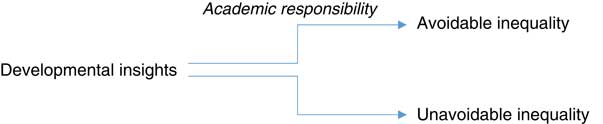
Understanding the developmental sources of poor health outcomes alone however, does not make them avoidable. Avoidability depends on the possibility to mitigate the effects of detrimental sources on health. In other words, fascinating as they are, insights from DOHaD and epigenetics are of little help to the promotion of child and adult health if they are not used as the scientific base for the development, implementation and evaluation of actual pregnancy-related interventions. This gives rise to the academic responsibility to determine the degree of avoidability (Fig. 1). That is, given that (i) perinatal and adult health inequalities present a serious healthcare and public health challenge and (ii) the responsibility to avoid these poor health outcomes hinges on their degree of avoidability, there is an academic responsibility to determine the avoidability of these poor health outcomes.
Academic responsibility to determine avoidability.

There are good reasons to believe that addressing developmental risk factors during the period surrounding pregnancy increases the avoidability of poor pregnancy outcomes and many chronic diseases that manifest in adult life. Insights from DOHaD and epigenetics indicate that the risk of these diseases is set during fetal development.Reference Gluckman, Hanson and Low 6 , Reference St. Fleur, Damus and Jack 8 Therefore, a shift towards preventive measures which focus on the mother–child pair during the periconceptional period has been called for.Reference Barouki, Gluckman, Grandjean, Hanson and Heindel 9 ‘Measures which improve nutrition, and reduce exposures to environmental chemicals, from all environmental compartments (air, water, soil) and in food and consumer products, are likely to improve child and maternal health significantly over the short term, as well as reduce disease incidence and the cost of health care overall….’Reference Barouki, Gluckman, Grandjean, Hanson and Heindel 9 Illustrative of the academic responsibility to determine the degree of avoidability of poor health outcomes is the ‘Healthy Pregnancy 4 All’ study. This study, combines insights from public health and epidemiological research to estimate the avoidability of poor pregnancy outcomes in the Netherlands that would be achieved by delivering the current best clinical practices of preconception and antenatal care.Reference Denktas, Poeran and van Voorst 10
Avoidability and fairness
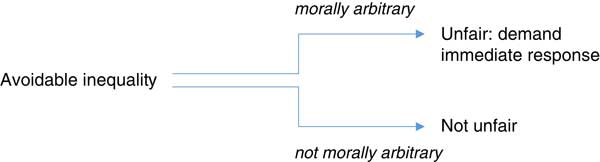
Determining the avoidability of a health inequality alone is not sufficient to determine the social responsibility to counteract this inequality. The degree to which avoidable inequalities are unfair also determines the moral urgency, that is the responsibility, to counteract this inequality. Michael Marmot, chair of the WHO commission on the social determinants of health writes ‘Health inequalities that could be avoided by reasonable means are unfair.’Reference Marmot and Bell 11 To claim that a health inequality is unfair is to say that the inequality is the result of morally arbitrary factors. That is, if we agree that morally arbitrary factors such as race and socio-economic background should not increase the risk of disease yet DOHaD and epigenetic insights provide evidence that they do, then the resulting health inequalities are unfair (Fig. 2).
Moral responsibility to determine unfairness.
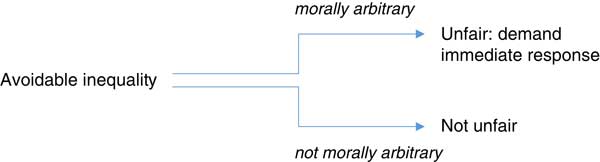
To appeal to fairness is, as philosopher Thomas Nagel states, ‘to claim priority over other values. [Unfairness] is not just another cost; it is something that must be avoided, if not at all costs, then at any rate without counting the costs too carefully.’Reference Nagel 12 Unfair health inequalities are of the highest priority to be mitigated, the corollary being that a passive response to this inequality is morally indefensible. This raises the question: ‘to what extent are perinatal and adult health inequalities unfair?’ or, more precisely, ‘which factors that result in avoidable inequalities are morally arbitrary?’ Factors like race and socio-economic background are obviously morally arbitrary; they ought not to matter. However, cigarette smoking, drinking alcohol, the use of drugs, having an unhealthy lifestyle and not seeking free and high-quality care in the period surrounding pregnancy are prima facie not morally arbitrary. That is, people can be held, to some extent, responsible.
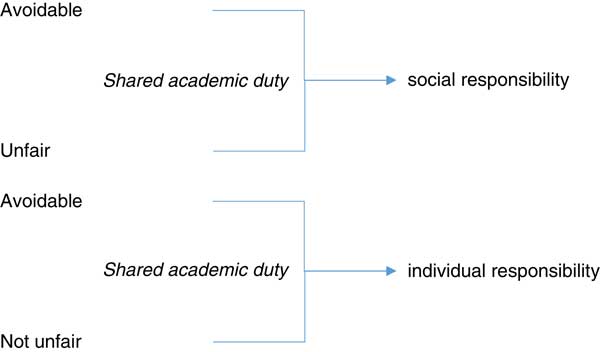
For example, in Rotterdam inequality in perinatal mortality, ‘as tip of the iceberg of perinatal morbidity’Reference Steegers, Barker, Steegers‐Theunissen and Williams 13 in neighborhoods ranges between 2 and 34 per 1000 births.Reference Poeran, Denktas, Birnie, Bonsel and Steegers 14 Women with a low socio-economic status and with a non-Western background face the highest risk for poor pregnancy outcomes. On the other hand, however, the Netherlands offers free and high-quality pregnancy-related care. One might ask ‘to what extent are these perinatal health inequalities unfair and to what extent are they a matter of parental responsibility’ – given that pregnancy-related care is in place. The resolution of this moral dilemma requires the assessment of both the scientific component (the degree of avoidability) and of the ethical component (the degree of unfairness) as shown in Fig. 3.
Academic and moral responsibility to determine social responsibility.

The pivotal question to determine responsibility is ‘when exactly are inequalities unfair?’ In answering this question, John Rawls’s philosophical ideas about ‘justice as fairness’ and insights from DOHaD and epigenetics come together.
Justice as fairness
In his book ‘A theory of justice’ John Rawls aims to identify and describe ‘the principles of justice’ which are the principles on which a just society should be based. In his search for these principles Rawls writes: ‘the principles of justice for institutions must not be confused with the principles which apply to individuals and their actions in particular circumstances. These two kinds of principles apply to different subjects and must be discussed separately.’Reference Rawls 15 Here Rawls is claiming that the principles used to shape society should not be responsive to the conduct of those living in that society. Consider for instance whether the offering of pregnancy-related care should be responsive to the way parents-to-be typically prepare for pregnancy. From a Rawlsian point of view, the answer is no, as the reasons to introduce pregnancy-related care which are: ‘the principles of justice for institutions’ should not be confused with ‘the principles that apply to individuals and their actions…’ namely, the way they prepare for pregnancy. In other words, it is a ‘category mistake’ to base a policy response to health inequalities on judgments about individual responsibility for health. But why? Rawls gives three reasons for making the category distinction between the ‘principles of justice’ (e.g. healthcare and public health policy) and the principles that apply to individuals and their conduct (e.g. individual responsibility for health).Reference Rawls 15
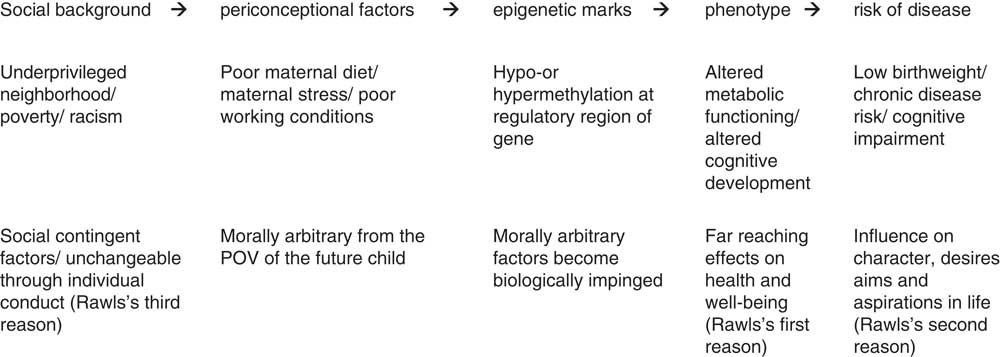
First, the principles applied to shape society (e.g. healthcare and public health policy) have profound and far-reaching effects and inequalities resulting from people’s initial social position are likely to be deep and pervasive.Reference Barouki, Gluckman, Grandjean, Hanson and Heindel 9 Second, these principles affect the way people shape their character, desires, aims and aspirations making them ‘more’ or ‘less’ likely to escape their initial position of poor health and destitution. Third, given the scale and complexity involved in shaping society (e.g. healthcare) it is not feasible to expect that the principles of individual conduct are adequate to counteract unjust states of affairs resulting from an unfairly shaped society. In sum, Rawls argues that the principles of justice should ‘secure just background conditions against which the actions of individuals and associations take place.’ Unless this structure is appropriately regulated and adjusted, an initially just social process will eventually cease to be just, however free and fair particular transactions may look when viewed by themselves’.Reference Rawls 16 That is, because the ability to take individual responsibility for health depends on contingent social factors, it is mistaken not to improve these social factors (such as healthcare and public health), however, irresponsible one may judge individual conduct to be. Simply stated: the duty to help the marginalized communities should not depend on their conduct.
Claims about the influence of environment and social background on individuals’ well-being and life prospects have since moved beyond philosophical assertions. They are now a scientific fact, corroborated by developmental insights as depicted in Fig. 4.
Confluence of developmental insights and ethical analysis.(Adapted from Gluckman PD, Hanson MA, Low FM. The role of developmental plasticity and epigenetics in human health. Birth Defects Research Part C: Embryo Today: Reviews. 2011; 93, 12–18.)

Together, ethical reflection and developmental insights show that perinatal and adult health inequalities are to a significant extent the result of contingent social and environmental factors which are morally arbitrary (or even reprehensible such as racism). These health inequalities are avoidable, unfair and unsolvable solely through individual conduct and therefore demand an active response from the academic community (Figs 1–3) as well as from policymakers (Fig. 4) as they can improve socially contingent factors such as the provision of public health and healthcare.
Discussion
In the healthcare and public health debate, individual responsibility and social responsibility tend to be erroneously pitted against one another. Taking individual responsibility for health calls for social and environmental conditions in which individuals can be reasonably expected to make responsible health-related choices. Insights from DOHaD and epigenetics are sufficiently robust to show that more needs to be done to improve these conditions. Rather than viewing mothers(-to-be) as targets of blame, culpable for the poor health of their offspring, special attention for the conditions of the parents-to-be is required.
Here are two initiatives that demonstrate how taking social responsibility creates the right conditions in which mothers-to-be to are empowered to take individual responsibility. The Special Supplemental Nutrition Program for Women, Infants and Children (WIC), which provides disadvantaged families with regular supplies of food essential for physical and cognitive development, has improved the quality of maternal and child nutrition, and the physical and cognitive development of children.Reference Jackson 17 This demonstrates how a coordinated care program benefits the health of mothers and newborns. The ‘Mothers for Rotterdam’ initiative, in which women living in deprived neighborhoods are assisted and guided in addressing their medical and non-medical conditions, is another example. 18 Young mothers are aided through mediation in cases of evictions, supported in the acquisition of proper health insurance and assisted in finding education and employment. In this way mothers are empowered, giving them and their children a fairer chance to prevent poor health and escape their destitute situation. Michael Marmot writes: ‘Why treat people and send them back to the conditions that made them sick?’Reference Marmot 19 This statement poignantly captures the social dimension of the health inequality problem we are facing. Some ideas ought to cut across social, cultural and political beliefs. Securing the conditions for good health and well-being of newborns, regardless of how culpable one judges parents to be, is a prominent one.
Acknowledgments
None.
Financial Support
This research received no specific grant from any funding agency, commercial or non-profit sectors.
Conflicts of Interest
None.