The tradition of Rossinian music has long been lost … That
vivacious, bold, brilliant music requires great lightness of technique,
flexibility, and skills in trills and runs … The practice of so-called
dramatic shrieking and acts of violence engaged in by today's singers
has made their larynxes resistant to such subtleties.Footnote 1
Théophile Gautier, 1847In spite of Gautier's nostalgic effusion, coloratura did not vanish in the mid-nineteenth century. Although certainly a rarity later in the century, coloratura began as a normative singing style that was associated with all types of singers. At mid-century, however, it became the almost exclusive domain of the female singer. Indeed, the greatest exponent of vocal pyrotechnics in this era was a Parisian soprano: Caroline Carvalho (née Marie Félix-Miolan, 1827–95).
Gautier's critique does, however, accurately reflect a growing tension between older and more modern singing styles, a tension that was part of a broader struggle for authority between operatic performers and composers. The widespread perception of this struggle is that composers' increasing disdain for vocal embellishments without regard for dramatic context was caused by greater demands for dramatic realism, thereby making the ‘skills in trills and runs’ of bel canto obsolete. Yet this view focuses on a compositional shift, one teleologically defined in terms of the ‘winners’ – Wagner and the late Verdi. The absence of mid-century coloratura singers such as Carvalho from opera history narratives therefore betrays an all too common tendency to forget, and even to dismiss, the creative and historical importance of performers. Three composers' reactions to Carvalho's singing confirm this unfortunate trend. Hector Berlioz deemed Carvalho and other contemporary coloratura sopranos part of a ‘lapdog school’, whose high notes were ‘about as pleasant as the yelp of a dog whose paws are being stepped on’.Footnote 2 Reynaldo Hahn remembered Carvalho as a demanding tyrant who had ‘ineffable bad taste, an immense arrogance concealed under bourgeois charm and an implacable will’.Footnote 3 Finally – and most oddly – at parties the bearded Camille Saint-Saëns enjoyed mocking the soprano by dressing in drag (complete with false hair plaits) and employing his high voice in an impersonation of Carvalho's rendition of Marguerite's Jewel Song from Faust.Footnote 4
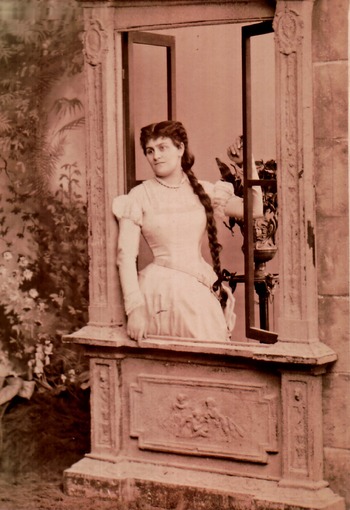
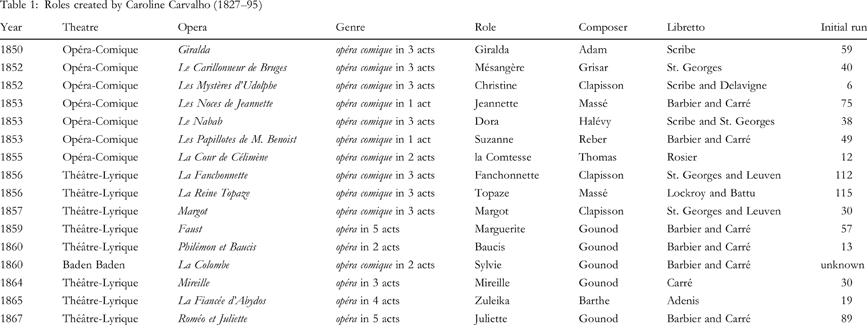
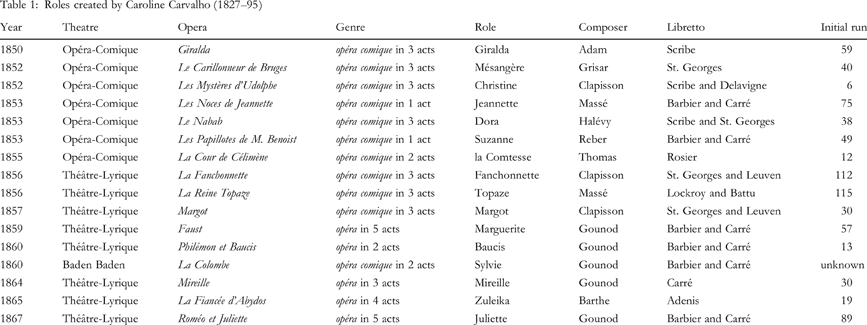
As these dismissive and irreverent diatribes suggest, Caroline Carvalho was a powerful and significant singer. She created sixteen roles between 1850 and 1867, including five by Gounod: Marguerite in Faust (1859, Fig. 1), Baucis in Philémon et Baucis (1860), Sylvie in La Colombe (1860), the title role in Mireille (1864) and Juliette in Roméo et Juliette (1867).Footnote 5 (See Table 1 for further details of these and the other operas in which Carvalho created a role.) All of these roles include at least one substantial coloratura moment. Although based primarily in Paris, Carvalho also sang throughout France, as well as at Covent Garden and in Brussels. In Paris, she was one of few singers to perform extensively at the Opéra-Comique, the Théâtre-Lyrique and the Opéra. The Parisian press compared her vocal prowess to the instrumental pyrotechnics of Paganini and Liszt, and her nuanced artistry to the deft pianism of Chopin.Footnote 6
(Colour online) Carvalho as Marguerite, Bibliothèque nationale de France

Roles created by Caroline Carvalho (1827–95)
These facts only hint at the importance of this musician and the far-reaching effects of her singing. For Carvalho was also connected to newer singing styles: she studied and sang at the Paris Conservatoire with Gilbert-Louis Duprez (1806–96), the tenor associated with a new style of declamatory, loud singing, who famously (though perhaps mythically) sang the first high C in full chest voice. At the same time, however, Carvalho was known for coloratura showpieces, ones specifically written and added for her and upon which we today have a tendency to frown. Carvalho's performing style thus presents an interesting paradox, between coloratura as an old-fashioned singing style and a tool of a forward-looking créatrice.
My aim in this article is not to try to recover Carvalho's voice or to wax lyrical about a now-forgotten soprano, though the evidence might invite me to do this. Rather, I would like to show that engaging with this fascinating singer reveals much about coloratura, composition and genre in mid-century Paris. In particular, it allows us to uncover vital intersections between mid-nineteenth-century vocal, instrumental and dance idioms. After delving into the singing world from which Carvalho emerged, I will explore how her break-out moment in Victor Massé's La Reine Topaze (1856) was a springboard to ‘superdiva’ status, to use Susan Rutherford's term.Footnote 7 Carvalho achieved this status by cultivating her voice – her ‘mécanisme prodigieux’ – to handle coloratura on a scale that explicitly invoked and rivalled instrumental virtuosity.Footnote 8 I argue that Carvalho thereby acquired enough authority to catalyse a new genre, the valse-ariette. Her later association with this genre suggests even greater creative agency and indicates a shift in coloratura's signification from instrumentality to dance and the expressive body.
Beginnings
Born in Marseilles in 1827, Marie Félix-Miolan studied music with her father, François, an oboist. She was admitted to the Paris Conservatoire in 1843 and studied there with Duprez until 1849.Footnote 9 It is interesting that she studied with Duprez instead of with Laure Cinti-Damoreau (1801–63), also a teacher at the Conservatoire and a soprano well known for her vocal beauty and agility, for whom Rossini wrote five leading roles. As noted by Gregory Bloch, however, Duprez was also capable of singing passages requiring vocal agility, as well as pitches in the extreme upper range, above high C – all this in addition to his loud high notes and declamatory approach to roles.Footnote 10 By studying with Duprez, Félix-Miolan was perhaps preparing for roles that demanded both types of singing.Footnote 11 The ability to handle a combination of dramatic and sustained, but also delicate, lyric and florid passages would certainly become apparent in her Gounod roles.
In 1848, Duprez began introducing his pupil to the public with a tour through France. The following year she was presented in a benefit concert for her teacher at the Opéra, where she sang excerpts from Donizetti's Lucia di Lammermoor (1835) and Fromental Halévy's La Juive (1835). This was a carefully prepared introduction, typical of those planned for promising debutantes, as the press was notified about the Parisian debut beforehand and described the performance as auspicious.Footnote 12 Soon thereafter she was engaged by the Opéra-Comique as a première chanteuse.
Remarkably, in 1850, her first full year at the Opéra-Comique, Félix-Miolan sang five leading roles. Her performance as the title role in Adolphe Adam's Giralda, her first role creation, garnered considerable attention from the Parisian press. According to Henri Blanchard in La Revue et Gazette musicale, for example, ‘Félix-Miolan has created … the role of Giralda in a way which requires more than simple encouragement’ (‘Mlle Félix Miolan a créé … le rôle de Giralda d'une façon qui demande plus que des encouragements’).Footnote 13 According to the composer Fromental Halévy:
The third act opens with a brilliant aria, admirably performed by Félix-Miolan. Have you not noticed that her name, Félix, suggests happiness? Félix's voice is a high soprano: she likes to soar at the top of the musical scale, and, like an intrepid aeronaut, takes pleasure in being sky-high. Rounds of applause follow such moments.Footnote 14
Already in this first year at the Opéra-Comique, Félix-Miolan was associated with coloratura. Halévy saw her as sailing through the air like an ‘intrepid aeronaut’, a phrase used in the nineteenth century as a reference to balloonists and also as a metaphor for one who flies: floating on threads like a spider floats on wisps of its web, or in this case flying delicately at a high vocal tessitura. This was certainly due in part to the fact that all five of the roles Félix-Miolan performed in 1850 had a significant amount of fioritura. For example, her debut role in L'Ambassadrice, originally created by Cinti-Damoreau, contains melismatic passagework not only in her arias, but also in duets and ensembles. It is possible that Félix-Miolan's career began quite self-consciously, with leading chanteuse légère roles and beginning with a role that would lead to direct comparisons with Cinti-Damoreau. She was also compared to other past leading sopranos. Le Ménestrel, reviewing her Giralda as full of grace and sensibility, predicted that she would become the Persiani of the Opéra-Comique, after the Italian soprano, Fanny Tacchinardi-Persiani (1812–67), known for her delicate, sweet and agile voice and for her interpretations of the bel canto repertory, including Adina in L'elisir d'amore, Lucia in Lucia di Lammermoor, and Rosina in Il barbiere di Siviglia.Footnote 15
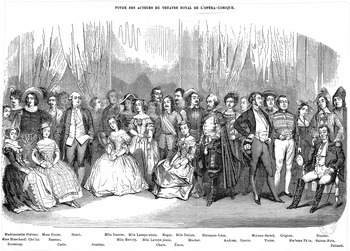
Although Félix-Miolan's later role creations featured markedly high and difficult melismatic singing, far beyond the capabilities of the typical leading soprano of the time, the vocal demands of her early roles were fairly standard. Indeed, Félix-Miolan was only one of several premières chanteuses at the Opéra-Comique in 1850, all of whom were more than capable of the type of vocal agility required by operas such as Giralda. None of the five roles Félix-Miolan sang goes above high C (except for Virginie in Le Caïd who touches a high D briefly), if they go that high. The tessituras are well within the conventional range for French and Italian soprano roles in the first half of the nineteenth century. Although not a complete roster, Figure 2 reminds us that in 1850 the Opéra-Comique troupe was actually made up of only a few singers. Louise Lavoye (1823–90) and Delphine Ugalde (née Beaucé, 1829–1910) along with Félix-Miolan sang most of the leading soprano roles and, consequently, most of the coloratura passagework.Footnote 16 Lavoye premièred the leading roles in Auber's La Sirène (1844) and Halévy's Les Mousquetaires de la reine (1846), roles that Félix-Miolan would sing at the Opéra-Comique in 1852. Ugalde, to whom I will return, premièred roles in two of Ambroise Thomas's works, Virginie in Le Caïd and Elisabeth I in Le Songe d'une nuit d'été (1850).
Opéra-Comique roster, 1850, Bibliothèque nationale de France

A new stage
1853 was a pivotal year for Félix-Miolan. In her third Opéra-Comique creation, she embarked on her first collaboration with Victor Massé, Les Noces de Jeannette, premièred on 4 February 1853. The opera is the only non-Gounod opera premièred by Félix-Miolan that has had a number of revivals. The opera was quite successful, particularly in France where its initial run yielded seventy-five performances, but also in Italy and Germany.Footnote 17
In the same year, Félix-Miolan embarked on another highly collaborative relationship, becoming Caroline Carvalho on 6 August when she married Léon Carvalho (1825–97). Having met at the Opéra-Comique (Léon was a baritone who sang several minor parts; his voice was thought unremarkable), their marriage would prove hugely and mutually beneficial for their future careers. Carvalho would sing only two more roles at the Opéra-Comique after 1853 before moving to the Théâtre-Lyrique in 1855, where she would remain until 1868.
The move to the Théâtre-Lyrique was fraught with difficulty. Carvalho was ill for a good portion of 1854, so much so that she was unable to fulfil her contractual obligations with the Opéra-Comique. In 1855 she began hopeful negotiations with the Opéra, but was blocked by Émile Perrin, then director of the Opéra-Comique, who held Carvalho to her contract.Footnote 18 Her ‘illness’ was likely her pregnancy with her son, Henri. After returning, the soprano apparently sang even better than before and at the end of her contract, she moved to the new theatre. Although transferring to the Théâtre-Lyrique may not have been Carvalho's preferred choice at the time, it gave her unprecedented freedom to choose and create roles, thereby enabling her to become the most prolific créatrice of the Second Empire.
Once at the Théâtre-Lyrique, Carvalho made a shrewd move that ensured this: as Pierre Pellegrin was stepping down as director, she and the composer Louis Clapisson suggested that her husband become his replacement. It is no exaggeration to say that this was a watershed for nineteenth-century French opera. As director of the Théâtre-Lyrique, Léon Carvalho revived Mozart, Weber and Beethoven in Paris, produced many of Gounod's operatic premières, and also staged the first performances of Bizet's Les Pêcheurs de perles (1863) and Berlioz's Les Troyens (1863). Later, as director of the Opéra-Comique, he produced the premières of Offenbach's Les Contes d'Hoffmann (1881), Delibes' Lakmé (1883) and Massenet's Manon (1884, dedicated to Caroline Carvalho). His keen ear for operas with potential is indubitable. The Carvalhos together assumed control of the theatre – he as directeur and she as the première chanteuse and as an unofficial ‘directrice’ – and proceeded to make choices that would raise its status so that it rivalled productions at the Opéra and the Opéra-Comique.Footnote 19 Impressively, this was accomplished before the Théâtre-Lyrique began receiving state financial support in 1863.Footnote 20
In her first year at the Théâtre-Lyrique, Carvalho sang only two roles, but both were premières and written with her voice in mind, and both were extremely successful. Louis Clapisson (1808–66), a professional violinist turned composer, achieved his greatest operatic success with La Fanchonnette (1856), composing the title role for Carvalho. Here she played the part of a singer in the story, so the fact that the score features more and higher melismatic passagework than any role Carvalho had sung before is not entirely surprising. A long and energetic bolero aria showcases Carvalho's coloratura with extensive staccato and legato articulated fioritura as well as acuti (extreme high notes) above high C: Ds, Es and even an F-sharp.Footnote 21 The staccato articulation and high-voice extension strongly imply that Carvalho had mastered the flageolet or whistle voice technique, the means by which female singers, particularly sopranos, are able to sing in a lighter head-voice register and access high notes above the staff. Carvalho almost certainly employed this singing technique in creating Fanchonnette and her many subsequent roles with arias consisting of demanding passagework that ascends into the extreme upper range and lingers at a very high tessitura.Footnote 22 From Fanchonnette onward, all of Carvalho's creations would contain arias that demanded greater vocal resources than those required of the typical première chanteuse of the period.Footnote 23
Variations
After Clapisson's Fanchonnette, Victor Massé collaborated again with Carvalho, writing La Reine Topaze (1856) for her. This provided Carvalho with an aria that would prove to be not only one of her favourites, but also one that would define her as the pre-eminent French virtuosa of her era.
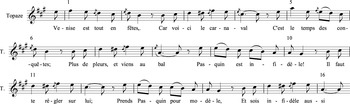
The ‘Carnaval de Venise’ aria from Act II of Massé's opéra-comique is a variations aria based on the Carnival of Venice folk song, also known in English as ‘My Hat It Has Three Corners’.Footnote 24 The song's theme, shown in Example 1, begins after a musical introduction in which Topaze tells the story of the jilted Ninette. In the text, Topaze essentially urges women not to bemoan the infidelities of men, but to join them in this behaviour instead.
Theme of the ‘Carnaval de Venise’ aria from Massé's La Reine Topaze (1856)

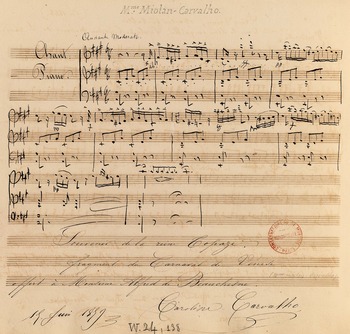
The sheer difficulty of the variations is the most striking feature of the aria. Carvalho herself may have composed some of them, and perhaps hoped to show her skill in singing lines with huge registral leaps, as difficult as those that virtuoso instrumentalists played.Footnote 25 Sometimes referred to as ‘Carvalho's variations’, the aria became one of her signature pieces, not only in concert but also as a souvenir. When a certain Alfred de Beauchesne (1804–76) asked for her autograph along with a representative musical sample, Carvalho sent him one of the variations – the third, consisting of two-octave leaps – with her signature at the bottom and name at the top, thereby seeming to credit herself as the composer (Fig. 3).Footnote 26 And when singing in London at Covent Garden, Carvalho used the piece as the insertion aria in Rosina's lesson scene in Il barbiere di Siviglia.Footnote 27
(Colour online) Carvalho's ‘signature’ variation, facsimile of autograph of Carvalho's third variation in the ‘Carnaval de Venise’ aria from La Reine Topaze (1856), Bibliothèque nationale de France

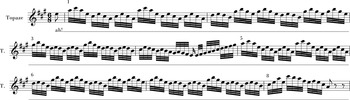
After the initial variation highlights the trill as the primary ornament, the second suggests that Carvalho's vocal facility was uncanny. A note in the score indicates that the music is Paganini's (taken directly from an 1846 edition of Paganini's variations on the same theme).Footnote 28 The material Carvalho sang corresponds to the second half of the virtuoso violinist's second variation, a flurry of demisemiquavers in arpeggios that extend over an octave and a half, repeatedly rising to high Bs and C-sharps.Footnote 29 What Carvalho sang is in the same key, but does not have Paganini's staccato articulation (Ex. 2). Melismatic clarity was one of Carvalho's strengths and her method of articulation – most likely vowel articulation due to the speed of the variation – probably yielded crystalline strands of notes.Footnote 30 The idiomatically instrumental, violinistic character of this variation gives it, when sung, a sense of the mechanical. The constant, motoric barrage of notes aligns Carvalho's voice not with human vocality, but with the technical accomplishments of an almost superhuman instrumental virtuoso.Footnote 31
Second variation of the ‘Carnaval de Venise’ aria

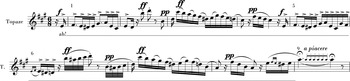
The third variation, Carvalho's ‘signature’ variation, ranges over two octaves, but is most striking for its leaps from pure chest register (down to middle C) to above-the-staff head tones (reaching high D). The fortissimo indication and accents marking each of the notes in the low register suggest a diaphragmatic articulation. This would provide direct contrast with the high notes, which are first articulated staccato and then legato. The shift from the speech-like, dark, chest register to the sung, highest, brightest, head register made for an arresting effect.
Third variation of the ‘Carnaval de Venise’ aria

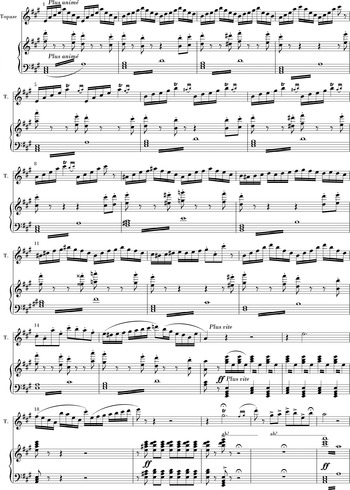
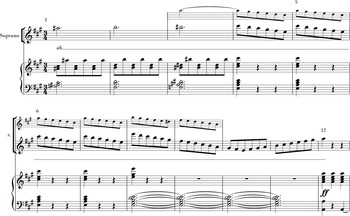
A turn followed by a ribattuta di gola (staccato rearticulations of the same note, also called a trillo) on high A – possibly indicating laughter – serves as a transition to the fourth variation which shifts to the parallel minor. After the faux sobbing of this variation, the fifth initially resembles the second, then shifts to turning and scalar figures lying mainly at a very high tessitura and ascending to high Ds, and finally develops an accumulative motoricity as it approaches the coda (Ex. 4). Arching arpeggios are scaled back into ascending flourishes followed by ever-higher trills (bars 1–8). The passages of ascent gestures and increasing tessitura finally reach a peak of intensity as the soprano reaches high E, a difficult feat after the previous pages. By the end of the aria the triumph of the singer-as-instrument is complete.Footnote 32
Coda of the ‘Carnaval de Venise’ aria

Hector Berlioz praised Carvalho's performance of this music at length and made particular note of the variations:
As for the Carnival of Venice variations, the composer's main achievement was to skilfully efface himself before the singer and produce technical feats that expertly show off her talent. One of these variations is by Paganini; Massé had the good sense to preserve it intact. When writing these difficult violin passages, the celebrated virtuoso surely didn't imagine that a soprano would one day sing them and inspire the acclamations and frantic applause of the audience … I believe I have already emphasised that the musical execution of La Reine Topaze is the best that one has ever heard at the Théâtre-Lyrique … As for Mme Miolan-Carvalho, her triumph lasted for four hours; the gloved and ungloved applauded, shouted brava! Flowers, recalls, encores to the point of delirium tremens. This is Ariel singing, especially in the imposing Carnival of Venice variations, the last of which she makes sparkle in ascending and descending arpeggios, with an extraordinary sureness of pitch and range of nuances. Not only that, but s/he performed this long role perfectly as an actress, sometimes tender and impassioned, sometimes ironic and bold.Footnote 33
In affirming Carvalho's many and overwhelming talents, Berlioz seems to hint at the idea of the performer as a kind of composer and recognises the singer as the lynchpin to the opera's success. In addition to her execution of the aria ‘sans fatigue et sans effort’, sureness of intonation, prodigious and precise vocalisations, and marvellous expression are recurring themes in reviews of Carvalho's triumph as Topaze.Footnote 34 The 115 performances she sang during the initial run of the opera offer additional testimony to her success in the role.Footnote 35
Prior to her variations, Carvalho had already tended to sing in tandem with instruments in other operas written for her. In Adam's Giralda, she sang with an oboe; in Massé's Les Noces de Jeannette she combined with a flute in the nightingale aria; in Henri Reber's Les Papillotes de M. Benoist (1853) she sang with a solo violin. By invoking the virtuoso instrumentalist (the composer-virtuoso Paganini) and perhaps even the idea of the performer as composer, the ‘Carnaval de Venise’ aria represented for Carvalho a new pinnacle of vocal authority.Footnote 36
The variations aria and its reception have important implications for attitudes towards the voice and virtuosity in the mid-nineteenth century. Increasingly seen as a questionable, if not outright shallow and morally reprehensible, artistic act, virtuosity in the second half of the century was even talked about or framed as a guilty pleasure.Footnote 37 Virtuosity of course calls attention to itself and the performer, rather than the composer, hence its increasingly fraught status as composers gained authority over the course of the nineteenth century. The case of Carvalho's variations also calls attention to gender. The switches from laughter to delirious deluges of notes to sob figures, while certainly a typical move in a set of instrumental variations, can also be read as musical gestures suggesting a staged subtext in an opera. Topaze's singing not only puts the soprano's voice on display in a virtuosic and instrumentalised fashion; it also seems to communicate the message that women can and should do all the things men do. As Katharine Ellis and Maiko Kawabata have demonstrated, instrumental virtuosity in mid-century Paris was a decidedly ‘masculine’ and even ‘virile’ enterprise.Footnote 38 Therefore, when the ‘Carnaval de Venise’ aria invoked a specific violin virtuoso, it also invoked a virtuosity that was gendered masculine. In this case, the voice of a woman recalled the violin performance of a man and demonstrated equal mastery over technique. Perhaps, then, we might consider a parallel between the narrative of the aria and the cultural work of Carvalho's performance; in the same way that Topaze urges Ninette to join Pasquin by also being unfaithful, Carvalho subversively joined Paganini in her virtuosic – and idiomatically instrumental – singing. By situating the singer in the same realm as the male virtuoso and composer, the aria blurs the issue of authorship between Massé, Paganini and Carvalho. The case of Carvalho's variations therefore encourages us to consider the prominence and musical legitimacy of the female singer as the final arbiter in performance.
From a purely theatrical perspective, the variations are a striking moment of admiration, exemplifying the celebration of the female, singing voice, by both the audience and those onstage. It was after La Reine Topaze and another similarly virtuosic title role in Clapisson's Margot (1857) that one reviewer explicitly described Carvalho's voice as a mechanical instrument, a ‘prodigious mechanism’ that allowed her to ‘play’ it like Paganini played the violin and like Liszt played the piano.Footnote 39 It is particularly striking that Carvalho's performance as Topaze resulted in a shift in her artistic peer group – from past female singers (such as Persiani) to male virtuosi instrumentalists. Of course, there is a long history of comparison between singers and instrumentalists, but the voice did maintain primacy over the instrumental realm until the rise of virtuosi in the early nineteenth century. In other words, the singing voice reigned supreme on its own terms and was often imitated by instruments, until instrumental music supplanted vocal music as the dominant medium in the late eighteenth and early nineteenth centuries, with the growth of symphonic culture and the arrival of instrumentalists such as Paganini and Liszt. Coloratura singers such as Carvalho tell the next part of the story; at mid-century, the voice as an instrument reasserted a technical dominance rivalling that of virtuosi such as Paganini. Although Berlioz lamented this fact, observing that the melismatic female singer who displayed ‘instrumental agility’ garnered fanatical acclaim from Parisian audiences who went wild for the aural delight of high notes and coloratura, he singled out Carvalho as exemplary in this regard.Footnote 40 Aural scintillation allowed female singers to aver vocal and technical dominance most emphatically, thus making vocal virtuosity a highly prized commodity in mid-century Paris.Footnote 41 Carvalho, then, claimed for the female virtuosa singer what had been claimed earlier by the male virtuoso instrumentalist.
Waltzes
In 1859, Carvalho organised her own benefit concert, where she created two more works intimately linked to violin melodies, continuing the instrument-voice connection. One of these is still extremely well known: Gounod's ‘Ave Maria’, a meditation on Bach's first prelude in C, BWV 846. The ‘Bach–Gounod Ave Maria’ was originally published as an instrumental piece, Méditation sur le 1er Prélude de piano de J. S. Bach (Paris, 1853), and scored for violin, cello, piano and organ, ad libitum. In late May of 1859, only a couple of months after the première of Faust, Carvalho sang the vocal arrangement at her benefit concert with Gounod at the organ, Massé at the piano and Félicien David leading the orchestra. The performance at this concert ignited the work's enduring fame and led to its immediate republication as Ave Maria, mélodie religieuse adaptée au 1er prélude de J. S. Bach (Paris, 1859).
The other work premièred was a duet-version of a little-known aria that Gounod arranged for Carvalho, ‘Ah! Valse légère’, based on the violin melody of his waltz chorus ‘Ainsi que la brise légère’ from Act II of Faust. Although not performed as part of the opera, the aria was published as a ‘waltz sung by Mme Carvalho’ along with other separable numbers from the work. Its popularity spurred a vogue for the vertiginous waltz ariette. The genre is characterised by triple metre with strong downbeats and anacrusis, fanfare openings, codas with cascades of coloratura and rondo form. The emergence of this new vocal genre not only reflects Carvalho's influence on operatic composers, it also represents an expansion of the musical performance possibilities of dance forms from the domain of instrumental music and choruses to that of the solo female singer.
The waltz was entrenched first in the dance hall, but found its way into the concert hall beginning in the late eighteenth century. As a musical genre, it spread rapidly in the early nineteenth century with the help of well-known orchestral and chamber settings by composers such as Schubert, Liszt, Chopin, and Johann Strauss I and II. Until the mid-nineteenth century, the waltz was rarer on the operatic stage, where it was usually present as on-stage music performed by the orchestra or chorus (and, if danced, by the ballet), such as the ballroom scene at the conclusion of Act I in Mozart's Don Giovanni (1787). The waltz's connection with a particularly feminine sensuality elucidates how the distinctive vocality of Carvalho and other contemporary coloratura sopranos motivated the mid-nineteenth-century shift from an instrumental and ensemble genre to a solo, song form.
By far the most popular social dance in Europe at mid-century, the waltz was the first ballroom dance that positioned dancers face to face and aligned their torsos. This closed position and bodily contact caused scandal early in the century and associations with risqué behaviour. As Sevin Yaraman has shown, the outrage caused by the waltz was focused primarily on the dance's dangerous effects on women, the excitement of physical and eye contact allegedly arousing agitated emotions and vertigo.Footnote 42 The implicitly sexual nature of the dance led to it being forbidden in some parts of Europe. Yaraman notes that rules were established that restricted when, where and with whom women were allowed to waltz, but, despite this, the waltz was a dance ‘that wouldn't stay banned’.Footnote 43 Although less scandalous by mid-century, the waltz continued to connote bodily frisson and even overt sexuality in Second Empire Paris, where it was a defining accoutrement of Napoléon III's ‘spectacular politics’.Footnote 44
It is easy to imagine how this proximity of bodies, often-wandering arms, sustained eye-contact, whirling music and breathless turning speed encouraged couples to embrace each other more and more tightly as they continued to waltz. Perhaps most relevant to the case of Carvalho are the physical traits of the dance: the double circular, whirling movement (the coloratura of her arias might be imagined as an analogue); the pulsating drive in triple metre; and the resulting centrifugal pull that forced dancers to lock eyes in order to avoid dizziness.
On the operatic stage the waltz gained general acceptance.Footnote 45 Couples dancing waltzes onstage had always been permitted, and it would seem that when Carvalho began singing solo waltzes onstage that, too, was acceptable. Before the collapse of social regulation, the theatre world perhaps seemed removed from ‘real-life’ standards, allowing for fanciful displacement on the part of the audience. Although the politics of dancing onstage seem wholly different and entirely relaxed by comparison, for a woman to sing a waltz, alone, onstage and in a moment of explicit vocal display reveals just how much freedom was afforded a female singer of Carvalho's status.
In their historical context, Carvalho's waltz ariettes were a vocal expression of the intoxication said to be felt by women dancing.Footnote 46 And yet, in any staging of one of these ariettes, the mapping between dance and aria is not isomorphic. Two people dance, but only one woman sings. The soprano's eyes and more importantly her voice connect with the audience, rather than a partner. We might then imagine Carvalho as taking the lead in the dance so to speak, with the audience in the yielding role. Just as dancing women held on more and more tightly as the spinning increased in velocity, so too might listeners be prone to move to the edges of their seats, ignited by the soprano's vocal pyrotechnics. By inserting the valse-ariette into operatic practice and developing it as a genre, Carvalho took the lead in another sense, as her agency as an artistic collaborator and créatrice grew during her time working with Gounod.Footnote 47 The circumstances surrounding three exemplars of the genre will illustrate this progression – ‘Ah! Valse légère’, ‘O légère hirondelle’ in Mireille, and ‘Je veux vivre’ in Roméo et Juliette.
An imagined entrance
After two failures at the Opéra (Sapho, 1851, and La Nonne sanglante, 1854), Gounod had turned to Carvalho's husband who was eager to have his works premièred at the Théâtre-Lyrique. The role of Marguerite was originally to be sung by Delphine Ugalde. However, when Carvalho heard Gounod's music, she insisted on an exchange with Ugalde, who would take Carvalho's role in Massé's La Fée Carabosse (1859).Footnote 48 It was an important move, as Carvalho's interpretation of Marguerite became the standard by which sopranos were measured in the role for the remainder of the century. It would also initiate a series of collaborations with the composer. Of Carvalho's sixteen creations, five would be as the heroine in operas by Gounod.
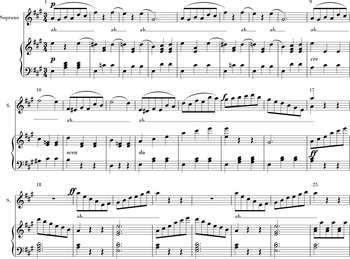
Fairly lengthy for an ariette, ‘Ah! Valse légère’ is laden with roulades, but there is no evidence that the ariette was ever performed as part of the opera proper. The only example of coloratura singing in Faust as it has been performed from its première is in the ‘Air des Bijoux’, Marguerite's Jewel Song. Dramaturgically considered, the melismatic singing makes perfect sense in this scene. Marguerite has come upon a jewel box that was placed there for her by Méphistophélès as well as a bouquet left for her by Siébel. In her excitement, Marguerite tries on the jewellery and expresses her wonder with coloratura. Coloratura's resonance with youthful exuberance, and laughter, combines with the supernatural, seductive lure of the jewels (a gift from the devil meant to render Marguerite more receptive to Faust's advances) to make the melismatic setting of the text an obvious choice.Footnote 49 However, compared to ‘Ah! Valse légère’, the melismas are few, not too high and quite routine (Ex. 5).
Melismatic phrase from Marguerite's Jewel Song

Carvalho sang ‘Ah! Valse légère’ at concerts, and the published versions (in multiple keys) circulated widely in France and throughout Europe.Footnote 50 And yet, if it was never performed as part of the opera, why was it labelled No. 3 and inserted with Act I material when published with the morceaux détachés that were performed? Although possibly nothing more than a marketing strategy (Carvalho's name and the coloratura may have heightened buyers' interest), it is perhaps fruitful to think of the aria as a kind of imagined entrance aria for Marguerite, occurring as Méphistophélès presents Faust with the image of Marguerite to entice him to make the pact.Footnote 51 Such an imagined spot for the valse-ariette works well with what we know about Gounod's later coloratura waltz additions for Carvalho in Mireille and Roméo et Juliette, both of which are near-entrance arias. Following this premise, Marguerite's singing as presented by Méphistophélès is anything but innocent, if the aria's text is any indication.
‘Ah! Valse légère’, valse-ariette arranged from Faust for Carvalho (1859)

As the text intimates, ‘Ah! Valse légère’ is manically cheerful and breathlessly seductive as its scalar lines ascend to the leading note and playfully move away before winding back to the tonic. The melismatic teasing continues with undulating patterns that were perhaps first intended to mirror the chorus's gliding dance steps as it waltzed to those murmuring violin lines (Ex. 6). According to the original livret de mise-en-scène, during the Act II waltz chorus of Faust, centre stage is taken by the ballet dancers who waltz onstage while the (non-dancing) chorus surrounds them singing their part from behind and on the sidelines.Footnote 53 In the solo ariette version, Carvalho sings the violin lines, while the choral part is buried in the accompaniment.
Melismas from Gounod's ‘Ah! Valse légère’

We might think of this ariette as a prototype for Carvalho's later waltz ariettes. ‘Ah! Valse légère’ is in rondo form with a breathless refrain. The piece begins with a maestoso fanfare and concludes with a climactic melismatic coda. These features are all present in the other ariettes.Footnote 54 By popularising the ariette in concert, beginning at her benefit concert, Carvalho took the first steps in identifying herself with coloratura waltz pieces, initiating a vogue for the genre, and thereby also making it more likely that a waltz ariette would be included in future role creations.
A real addition
Although Marguerite's valse-ariette was never sung as part of Faust, the question of adding a valse-ariette to the opera proper comes to the fore in the case of Mireille. One of the first changes made following the 19 March 1864 première was at Carvalho's request – the addition of a first-act display piece.Footnote 55 Her suggestion to add a coloratura aria may have seemed more persuasive to Gounod in light of the rhetoric surrounding Carvalho's performance in the title role. As we will see, the reviews also imply an added estimation of authority and even authorship for the soprano. Although Mireille garnered many accolades from the press, it was not an overall success when it premièred, and Gounod drastically revised the opera for its subsequent run in December 1864, possibly at the behest of Léon Carvalho who was notorious for his (over)involvement with productions of operas at the Théâtre-Lyrique.Footnote 56 Among some of the more prominent revisions, he altered the structure from five to three acts, changed the ending from tragic to happy, and added the valse-ariette ‘O légère hirondelle’ for Carvalho. This ariette was not based on music from Mireille, unlike the connection between ‘Ah! Valse légère’ and the Act II chorus of Faust. Positioned early in the first act, ‘O légère hirondelle’ is striking for its stylistic difference from the rest of the opera, its loose relevance to the plot, and its difficult, high-lying coloratura. Pressure from the Carvalhos and Gounod's sensitivity to popular opinion partially explain the addition, but the question remains why Gounod inserted the piece for actual inclusion in performances of Mireille instead of merely appending it to the separable numbers as he did with the valse-ariette for Faust.
While always a darling for her technical prowess, Carvalho had gained even more accolades for her comedic flair, dramatic characterisation, and ability to handle sustained, pathetic vocal passages, particularly as Marguerite.Footnote 57 The critics' regard for the soprano was such that in the case of Mireille, when the Act IV ‘Air de la Crau’ was thought to be too fatiguing and ‘too dramatic’ for her voice, the press found a way to spin the flaw into an asset. Carvalho had urged Gounod to cut parts of the aria and the press determined that ‘[t]his kind of good sense and modesty is too rare among our singers to go unnoticed.’Footnote 58 An ennobling of Carvalho is borne out in the reviews of the première of Mireille, many of which emphasise further Carvalho's status as a créatrice. Critic Etienne Desgranges focused on Carvalho's grace in performance – both musical and poetic:
Carvalho made the role of Mireille the most ravishing creation in the world. She imbues the role with an adorable poetry, an exquisite poetic grace. And her singing! What purity! What style! What perfection!Footnote 59
In addition to the exclamatory tone, this review is striking in its invocation of poetry and for the explicit agency it claims for Carvalho in defining a role, making her first performance of Mireille a ‘ravishing creation’.Footnote 60 Carvalho's performance of Mireille was artistic, creative, poetic and captivating. As evidenced in a review by journalist Charles Desolme, this claim about Carvalho was made not only in relation to the audience but also to the composer and librettist:
With Mireille, Carvalho has succeeded in pushing her remarkable talent into a new phase, she has transformed herself into a strong dramatic singer in the most positive sense of the word, and she is a kind of revelation for which librettists and composers will applaud each other equally.Footnote 61
For Desolme, Carvalho's performance signifies a new stage in her career. Although he ascribes a greater sense of authorship to librettists and composers than to performers, his use of the future tense also suggests that Carvalho's strengthened dramatic skills may enhance the possibility of integrated expression in future operatic writing. Such is the impact of her characterisation in fusing the musical and the dramatic, that Desolme claims that the librettists and composer have inspired Carvalho to become a new kind of singer, with the implication that this reflects back and gives new meaning to their work. Music journalist, boulevardier, sometime theatre director, and notoriously trend-conscious Nestor Roqueplan further accents Carvalho's recently deepened acting skill:Footnote 62
Carvalho, whose repertory is already so rich, has just increased it by a creation which will not displease. I am not referring to her talent as a singer, which has already been demonstrated. In this respect, every kind of praise has been exhausted. I am referring to her talent as an actress. She has managed to give the figure and passion of Mireille an altogether different appearance from that of Marguerite. Marguerite is a passive and tender being. Mireille is energetic. Marguerite dies after having yielded, and because she was alone in the midst of danger. Mireille dies unstained, but perhaps also without having faced danger. Carvalho has conveyed all these differences with a rare talent of composition. Mistral must recognise in her his own Mireille.Footnote 63
Roqueplan emphasises the detail in Carvalho's acting, the gradations of character. For him, Carvalho does not merely represent Mireille as conceived of by Gounod and Michel Carré (Carré's frequent collaborator, Jules Barbier, was not involved); she embodies the Mireille from Frédéric Mistral's epic poem, Mirèio (1859), the source of the story. She has expertly put together, or ‘composed’, the character of Mistral's Mireille in her performance. In a later review, critic and Berlioz biographer Joseph D'Ortigue echoed Roqueplan's words, even attributing a thespian virtuosity to Carvalho's Mireille.Footnote 64 A final review by A. de Rovray (pseudonym for Italian journalist, poet and dramatist Pier Angelo Fiorentino) draws attention to Carvalho's ability to take a piece of music and make it better, even one already well written for the voice. Her performance turns good music into a masterpiece:
Mireille's aria consists of a larghetto of tenderness and passion, extremely well written for the voice and marvellously sung by Carvalho who has made a masterpiece out of it, and a lively cabaletta in the Italian style.Footnote 65
Taken together these reviews do more than extol Carvalho's vocalism and performance. They exalt the singer – bestowing on her the power to make a masterwork of Gounod's music, to make Mireille the most ‘ravishing creation in the world’, by means of her ‘rare talent of composition’. By ‘creation’ and ‘composition’ the reviewers are not speaking of music, but of Carvalho's keen ability to create a layered, unique characterisation. Of course, all performers create something of their own when executing music, but few nineteenth-century singers premièred as many roles as Carvalho did (sixteen), many of which were written specifically for her voice.Footnote 66 On top of this, the closeness of ‘composition’ to its other usage, that of composing music, combined with the evocative ‘creation’ rhetoric and Carvalho's evident musical abilities, suggest that reviewers might have been conferring on the soprano the status of a kind of ‘author’ in the broad sense.
Carvalho went beyond text and music in her performance to create something of her own that surpassed in song what had been written by Gounod and Carré. Her performances could even cause composers and librettists to think about their work in a new way. In light of these adulations it is no small wonder that Gounod was encouraged to add the ariette. Once he did, the piece was judged to have enhanced the first act. As one reviewer noted:
Gounod enriched his first act, already so complete, with a coloratura waltz, whose execution was full of the intrepidity which made Carvalho's fortune: it is dazzling, it is vertiginous!Footnote 67
Carvalho's insistence on performing the ariette as part of Mireille when it was remounted in December 1864 encouraged its positive reception and it was this insertion into operatic practice that confirms her involvement in the establishment of the genre.Footnote 68 Carvalho's influence in adding coloratura to Mireille also adumbrates the addition of a similar ariette in the last work Gounod wrote for the soprano, Roméo et Juliette.
The waltz as integral
The coloratura valse-ariette, ‘Je veux vivre’, from the 1867 Roméo et Juliette is by far the most well-known example of the genre, and it is the only one of the three explored in this article that Gounod planned to include at the opera's première. Indeed, one could argue that, with this piece, and because of Carvalho's previous success in the genre, the valse-ariette finally moved from being a mere lyrical addition to being an integral part of the operatic ‘work’.
Like the other examples, ‘Je veux vivre’ is marked by its fioritura. The ariette is the only example of coloratura vocality in Roméo et Juliette and lies at a much higher tessitura than the rest of Juliette's singing. The ariette was originally performed and published in G major, but was transposed down a whole step to F major in later editions and is commonly performed in this lower key today precisely because of the gap between its tessitura and the rest of Juliette's music.Footnote 69 It seems as if Gounod had by this point realised that, in spite of its musical markedness, a virtuosic aria placed near the beginning of an opera could aid the work's reception and eventual success.Footnote 70 Juliette's waltz portrays the heroine in all her youthful exuberance and eagerness for love. In a way, the ariette encapsulates the opera's plot – just as the heroine's text reveals an awareness that the intoxication of youth is short-lived, so this singular instance of exuberant coloratura reflects the brevity of the innocent and joyful love that the singing style represents. The piece athletically shows off the lyricism and ebullience of Juliette, and a close reading suggests how the melismatic musical gestures might strongly connect the valse-ariette genre to the body. In order to demonstrate more clearly how the music of these ariettes presents a strong case for a connection between coloratura and the expressive body, I would like to continue by locating the waltzing body in the composed vocality of ‘Je veux vivre’.
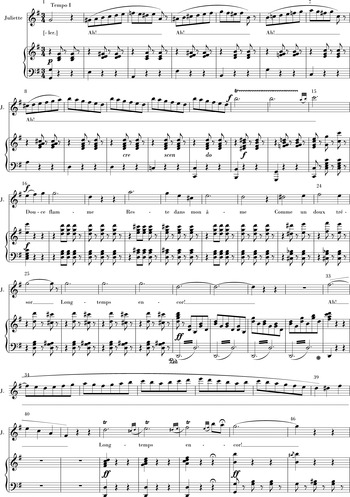
Immediately following the aria's fanfare introduction, Juliette launches into a chromatically descending a cappella cadenza.Footnote 71 This joyful ‘ah’ exclamation leads to the beginning of the aria proper. The A section of the rondo form is characterised by breathless pairs of one-syllable words with coy grace notes that lead to the primary pitch. The grace notes are usually lower neighbour notes and combine with the intervening rests to create an aurally seductive affect. The frequent rests isolate ‘je’, ‘veux’ and many other words, and heighten the focus on the downbeat, yielding driving metrical accents with anacrusis.Footnote 72 A repeat of the A section is capped by a short melismatic sweep ending on the tonic. The parallel-minor B section is less ebullient and more syllabic, providing a sustained moment of musical relaxation.
A full chromatic vocalise ranging one octave serves as the transition back to the A section after which a brief C section in the minor languorously presents Juliette's wish to indulge in smelling the rose. The relaxation in this C section prepares for the subsequent accumulation effect: melismatic momentum builds to a climaxing cascade of roulades in the coda. A series of wordless scales slowly but consistently rising in pitch introduces the coda (Ex. 7). Each bar-long ascent builds energy but then falls away slightly in the next bar, though not all the way back to the starting pitch. The ebb and flow seems very demure, slowing the climbing pitch level in an almost teasing way until the tumbling scales begin. These cascades heighten the joyful anticipation with downbeat-accented high Bs that function as increasingly amorous leading-note sighs to the eventual high C. The four cascades increase the ardour of the moment and the quivering trill on a high B–C that ensues is reminiscent of the beginning cadenza, but this time more explicitly ecstatic. The build-up of energy continues towards the climax. The first texted phrase of the coda, ‘Douce flamme’, accentuates the downbeat of its second bar, but in the second phrase, ‘Reste dans mon âme’, the accent falls on the initial downbeat, thereby jumpstarting the rhythmic drive. The orchestral punctuations then move from on the beat to syncopated, providing further rhythmic thrust as Juliette's line vocally drives the G tonic towards the final cadenza. Tremolo and triangle return to announce the a cappella cadenza in which swirling waves of coloratura rise and surge, climaxing on a high E, the highest note of the aria. There is no doubt that Carvalho's mouth would be open to its fullest extent for this note; sopranos tend to open wider the higher they sing. An ascending series of trills reminiscent of Mireille's ariette serves as the satisfying afterglow of the rhythmic and vocal rapture. The orchestral play-out takes over the sigh gestures of the A section rounding off the ariette.
Coda of ‘Je veux vivre’

I want to suggest that in this coda several vocal gestures align coloratura with dance and the body by setting up parallels between operatic and sexual sounds.Footnote 73 The series of trills are like ululations of joy, with the tongue in rapid movement. The swirling coloratura wending up to high E is like a sung exclamation of ecstasy, with its alignment between rising pitch and the move from open to gaping mouth, as well as between the shift from chest to extreme head notes and the corresponding sympathetic body vibrations that give name to those vocal registers. Finally, the melismatic cascades are repeated breathlessly, with excited exhalation-sigh gestures that fall quickly from gleeful high notes. One might hear the coda then as the progression and resolution of a sexual climax. Although such a hearing may seem discursively essentialist, it is historical commonplace that during this period in France's history, sexuality and gender ceased to appear fluid and instead were increasingly organised into rigidly defined categories.Footnote 74 Locating the female body and femininity in the coloratura of the valse-ariette thus situates a familiar gender role in the very era when the virtuosity of the female singer was progressively more valued in Second Empire Paris. Heard as a representation of female sexuality, coloratura therefore serves to elaborate and define divisions between male and female singing at mid-century.
Indeed, in all of Carvalho's ariettes, the ‘ah’ melismas seem to wordlessly display ecstasy, but the most strikingly consistent connection between coloratura and bodily expression are the climaxing codas of cascades of roulades at the close of her ariettes (see Exx. 7, 8a and b). This triple connection between the female body, the voice and the erotic crucially informs our understanding of a genre far too often dismissed. The ariettes thus forge an association between coloratura and the sexual rather than, as in examples I discussed earlier in this essay, with the mechanical and even disembodied.Footnote 75
Coloratura cascades from ‘Ah! Valse légère’

Coloratura cascades from ‘O légère hirondelle’

Carvalho and History
Early in her career, Carvalho's instrument-like coloratura allied her voice with the musical inventiveness of a Liszt or a Paganini, who had achieved deific renown and artistic authority. As such, her singing voice amplified her personal voice and granted her artistic power. With her Gounod creations, Carvalho took on an even more explicitly collaborative, creative position in establishing a new genre (the valse-ariette) and in integrating her prodigious vocal skill with a growing sense of expressivity in her acted portrayal of the characters. It was the integration of vocal and expressive virtuosity that led to her identity as a créatrice. An important facet of Carvalho's Gounod creations – that Marguerite, Mireille and Juliette all sing coloratura only near the beginning of their respective operas – reveals the atypicality of melismatic writing for these heroines as well as the idea that coloratura in these instances represents an excited feminine youthfulness before the opera's plot truly begins (and, importantly, before the heroine loses her innocence). By affecting the compositional process, Carvalho increased her popularity while at the same time furthering her image as a singer who could master both agile and sustained singing. Carvalho revolutionised the possibilities of melismas and high notes for sopranos. The fact that the soprano's vocal prowess gave her the opportunity to do more creating and collaborating than any other female singer of her era is the surest indicator of the ambition, talent and heightened artistic agency she so successfully deployed in her career.
In setting the bar so high, Carvalho perhaps made it more difficult for subsequent sopranos to sing these roles, because of the paucity of sopranos who have been able to handle the high coloratura passagework as well as the more sustained, pathetic vocal lines at a lower tessitura. At mid-century, coloratura was a mode of expressive and technical excess, employed with increasing rarity by composers and marked feminine by its performers. After Carvalho, French operatic composers joined Italian and German composers in employing a more declamatory, sustained singing style for soprano roles, while coloratura became the art of specialists. This shift is demonstrated by the melismatic exceptions later in the century, echoes of Carvalho's voice that are apparent in the works of Massenet, who played timpani during the Carvalhos’ tenure; Delibes, who served as rehearsal pianist and arranged several piano-vocal editions while working at the Théâtre-Lyrique – Lakmé's Bell Song is an obvious harkening to Carvalho's virtuosity; Offenbach, whose only full opera, Les Contes d'Hoffmann (1881), famously features an act devoted to a coloratura automaton, Olympia, whose varied strophes might seem reminiscent of Carvalho's variations; and in the concert showpiece waltz arias that have a continuous performance tradition to this day, such as Luigi Arditi's ‘Il bacio’ (1860) and Johann Strauss's ‘Frühlingsstimmen Walzer’ (1884). It is perhaps because of the arduousness of these roles and arias that we now have such a specialised voice category for coloratura sopranos.
However, I do not wish to end by focusing on how these reverberant echoes of Carvalho's creations might make the soprano a kind of vocal herald of the coloratura soprano as a voice type. Doing so would risk precisely the same gender role typing and blinkered mind-set that allowed commentators such as Berlioz, Hahn and Saint-Saëns to actively seek to write her out of history. Carvalho was indeed a seminal coloratura soprano, but she was much more than that. Rather than reinforce ideas of vocal typing, I have here suggested that the specific case of Carvalho shows how a woman can give voice to the body and at the same time be viewed as a créatrice. Emboldened by her command of melismas at mid-century, Caroline Carvalho carved out an important position for herself in operatic history, a position that revalues music as performance over music as text. In so doing, she compels us to think about coloratura at mid-century not as something to frown on, but as one example of a singer's ability to adapt an obsolescent operatic vocality in thrillingly new ways.