



Introduction
In a recent issue of Antiquity, Ammerman et al. (Reference Ammerman, Pearson, Kuniholm, Selleck and Vio2017) (henceforth AA17) presented three new radiocarbon dates on seventh- or eighth-century AD samples—including two peach stones—obtained by coring of ‘canal fill’ beneath St Mark's Basilica in Venice, Italy. This result was soon reported in Nature (2017) and by other media outlets, creating the impression that the newly dated peach stones provide the earliest evidence of settlement in the historic centre of the city. In fact, since the 1990s, when the coring actually took place, Ammerman and colleagues have published many papers on the origins of Venice, and approximately 20 seventh- or eighth-century AD radiocarbon dates—many on samples from cores in St Mark's Square. Moreover, even older dates from the same coring campaign as the AA17 samples were published by Martinelli (Reference Martinelli and Cecchi2003).
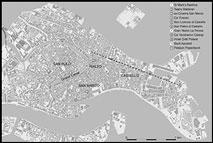
More importantly, however, AA17 overlooked the results of archaeological fieldwork from recent decades: wooden structures and other in situ settlement remains—at least as old as the AA17 peach stones—have been found at several locations in the historic city centre (Figure 1). Martinelli and Kromer (Reference Martinelli, Kromer and D'Amico2002) published a floating tree-ring chronology, dated by radiocarbon wiggle-matching, showing that there were mid seventh-century AD structures beneath Teatro Malibran (near Rialto) and ex-Cinema San Marco (100m from St Mark's Square). Meadows et al. (Reference Meadows, Martinelli, Pignatelli, Cester, Fozzati and Kromer2012) linked these sites to mid seventh-century structures at Ca’ Foscari (on the opposite shore of the Grand Canal) (Fozzati & Cester Reference Fozzati, Cester, Pilo, Rossi, Alessandri and Zuanier2005), using Bayesian chronological modelling to combine radiocarbon dates, dendrochronology and stratigraphy. In this brief comment, we update the 2012 model with the radiocarbon results from St Mark's and San Lorenzo di Castello (De Min Reference De Min and Anglani2000), to give a better understanding of the current state of research on the original settlement of the islands that would eventually become the urban core of Venice.
Modern Venice, showing locations mentioned in the text (outlined circles: sites with seventh- or eighth-century settlement evidence, revealed by archaeological excavation) and (dashed line) axis of early development proposed by Ammerman (Reference Ammerman2003) (figure by J. Meadows).

Housley et al. (Reference Housley, Ammerman and McClennen2004: 142) describe the Venetian Lagoon as “a continually changing mosaic of mudflats, marsh islands and meandering channels”, rich in natural resources but unsuited to urban development; dry land was scarce and, where available, unstable. The clearest sign of long-term settlement—rather than casual use of natural islands—is land reclamation. Methods were developed in the Roman period to consolidate and extend sand islands, or barene, using rows of wooden posts and wattle fences (volparoni) or broad planks to retain infill of natural sediment and recycled building materials. Geoarchaeological research has taken place at several sites in the lagoon to determine the ages and natural topography of barene before human settlement (e.g. Favero et al. Reference Favero, Heyvaert and Barbero1995; Serandrei Barbero et al. Reference Serandrei Barbero, Albani and Bonardi2004); the location and extent of natural barene in what became central Venice, however, are unclear. Crouzet-Pavan's (Reference Crouzet-Pavan1992) palaeo-topographic map (adapted by Ammerman (Reference Ammerman2003) and then reproduced by Gelichi (Reference Gelichi2010)) appears to be a speculative reconstruction based on historical research, rather than geoarchaeological fieldwork.
There is no reliable documentary evidence for permanent settlement in central Venice until the ninth century AD, yet a bishopric was founded at Olivolo (San Pietro di Castello) as early as AD 774/775, and, in AD 810/811, the ducal seat (notionally representing Byzantine authority) was transferred from an outer island, Malamocco, to Rivoalto (Rialto) (Gelichi Reference Gelichi2010; Ammerman et al. Reference Ammerman, Pearson, Kuniholm, Selleck and Vio2017). In AD 828, the first Basilica was built at St Mark's Square. The extent, nature, status and organisation of pre-ninth-century settlement in the area that would become Venice are therefore important archaeological research questions.
Archaeological excavations
Until quite recently, archaeological fieldwork in the historic centre of Venice was regarded as nearly impossible: rescue excavations must be conducted rapidly, minimising the use of public and private space, and must contend with dense modern infrastructure. Moreover, the costs of deep excavations in a permanently wet environment, and of conserving the abundant organic remains recovered, can be prohibitive (Fozzati Reference Fozzati2011). Since 1987 and the founding of the Servizio Tecnico per l'Archeologia Subacquea of the Ministero per i Beni Culturali e Ambientali, however, over 1200 archaeological interventions have taken place, including complex open-area excavations conducted during restorations of, for example, the Gran Teatro La Fenice.
Area excavations are occasionally deep enough to expose in situ structures from the earliest phase of settlement. Pre-ninth-century AD structural remains consist predominantly of wooden waterfronts and land-reclamation structures, although small wooden houses with masonry plinths appear in the seventh to ninth centuries at San Pietro di Castello, San Lorenzo di Castello and Ca’ Vendramin Calergi (Tuzzato Reference Tuzzato and Scarfi1994; De Min Reference De Min and Anglani2000; Fozzati Reference Fozzati2005; Bortoletto Reference Bortoletto2009). At the Hotel Gritti Palace near San Marco, the first wooden structures are attributed to the early seventh century AD, while stone foundations date to the late seventh to early eighth centuries (Asta et al. Reference Asta, Bortoletto, Canazza, Lezziero and Zandinella2014). A lack of funding for post-excavation analysis and publication means that only preliminary reports are available in most cases, but the widespread survival of in situ seventh- to eighth-century AD remains is well known (e.g. Housley et al. Reference Housley, Ammerman and McClennen2004: fig. 1).
Scientific dating
Since the turn of the millennium, significant progress has been made in dating these pre-ninth-century AD structures. Although volparoni are unsuited to dendrochronology, land-reclamation structures also contain broad wooden planks, from which a 250-year floating oak chronology was constructed (Martinelli & Kromer Reference Martinelli, Kromer and D'Amico2002). The cross-dating of 65 tree-ring series from three sites (Figure 2) is supported by high statistical values between site chronologies (Teatro Malibran and ex-Cinema San Marco), or single series (Ca’ Foscari), with tBP (Student's t-test adapted by Baillie and Pilcher (Reference Baillie and Pilcher1973)) from 5.1 to 9.7 and CDI (cross-date index) from 31 to 72 (Rinntech 2011). The Eastern Veneto oak chronology now spans 327 years, and includes tree-ring series from the city of Treviso (Martinelli, unpublished data), suggesting a common timber source for structures built both in Venice and Treviso. We can hypothesise that old oak trees suitable for making planks used in land-reclamation structures grew on the Venetian mainland—perhaps in mixed oak stands containing large elms.
Dating of cross-matched timbers from Teatro Malibran, ex-Cinema San Marco and Ca’ Foscari, relative to the Eastern Veneto floating oak chronology (Martinelli & Kromer Reference Martinelli, Kromer and D'Amico2002), showing sapwood (in black) and waney edge (hatched squares). All timbers ending before year 199 (floating chronology) have no sapwood, and may not have been felled before the earliest precise felling date, year 212 (figure by N. Martinelli).

Martinelli and Kromer (Reference Martinelli, Kromer and D'Amico2002) wiggle-matched the floating oak chronology to the INTCAL98 calibration curve (Stuiver et al. Reference Stuiver, Reimer, Bard, Beck, Burr, Hughen, Kromer, McCormac, Van Der Plicht and Spurk1998), with year 250 dated to cal AD 699±21 (at 95.4 per cent confidence). Wiggle-matching to the current calibration curve gives a date of cal AD 672–707 (95.4 per cent probability) for year 250 (Figure 3), and absolute felling date ranges for dendrochronologically cross-matched timbers at three early sites. Structure E at Teatro Malibran, made of oak felled in year 212 of the floating chronology, for example, dates to cal AD 635–670. Thus, all three sites were clearly settled by the mid seventh century AD, if not earlier, as the cross-matched timbers are not from the stratigraphically oldest structure at each site.
Radiocarbon wiggle-match dating of the Eastern Veneto floating chronology (Martinelli & Kromer Reference Martinelli, Kromer and D'Amico2002), using OxCal v4 (Bronk Ramsey Reference Bronk Ramsey2001, Reference Bronk Ramsey2009) and IntCal13 (Reimer et al. Reference Reimer2013), and felling-date ranges for some timbers dendrochronologically cross-matched with this chronology (figure by J. Meadows).

There are also seventh- or eighth-century AD radiocarbon dates on land-reclamation structures at several sites (some unpublished), confirming the extent of early settlement (see below). The interpretation of radiocarbon dates from samples retrieved by coring is more difficult. The taphonomic history of cored plant remains is unknowable, particularly in Venice, where canal-dredging and infilling mean that older waterlogged material was often re-deposited in later anaerobic contexts. Too few samples from any one core have been dated to check for the possibility of re-deposition. Furthermore, absolute heights cannot easily be compared between cores due to differences in original topography, the presence of cut features, and post-depositional compression of the stratigraphy by overlying urban structures. Branch-wood from cores may not be anthropogenic. Unidentified wood samples may incorporate a wood-age offset, a residence time (a significant interval between tree-felling and discard dates), or both, and may not be structural.
Peach stones have no inbuilt age and should have been discarded immediately following consumption, but only indicate local consumption, not production or storage, and therefore are not necessarily associated with permanent settlement. Without excavation to investigate the coring results, AA17's argument that the dated peach stones were from an anthropogenic layer is unconvincing; it might be easier to follow the logic of AA17 had the authors included some of the “high-quality drawings of 73 cores” (Ammerman et al. Reference Ammerman, Pearson, Kuniholm, Selleck and Vio2017: 1623) now available. The purported ceramic fragments in the cored sediment appear to be the size of sand grains, and the proposal that the peach stones must be from the fill of a canal due to their vertical positions disregards the compression of sediment over time by the weight of the Basilica. Even if the peach stones were discarded into water, the canal narrative ignores a more obvious explanation—that they pre-date land reclamation in this area, and were simply dropped into the lagoon.
Nevertheless, the number of seventh- to eighth-century AD radiocarbon samples from cores in and around St Mark's Square supports AA17's interpretation that they reflect local settlement before the Basilica. When realistic wood-age offsets are applied, all 12 samples dated by Ammerman and colleagues in this area (2017: tab. S1) appear to pre-date the early ninth century AD. Most of the 17 samples reported by Martinelli (Reference Martinelli and Cecchi2003), which were selected as potential structural timbers associated with the Basilica, however, are from timbers felled in the ninth to tenth centuries. Martinelli (Reference Martinelli and Cecchi2003) suggests that the four oldest samples—with fourth- to seventh-century dates—either incorporate large wood-age offsets, or come from recycled timber; as these timbers were sampled by coring, their shapes and surfaces are not recorded. Seven samples, including the four oldest, were also not identified.
To estimate the date of the first settlement in this area, we created a Bayesian chronological model of radiocarbon results from St Mark's Square (see the online supplementary material), using the four oldest dates as termini post quos for the Basilica. While model output is sensitive to the wood-age offsets applied, under any reasonable assumptions, settlement probably began in the mid to late seventh century AD (Figure 4). At least two of the four oldest samples in Martinelli (Reference Martinelli and Cecchi2003) could easily be from timbers felled in this period. We also modelled radiocarbon dates from San Lorenzo di Castello, using stratigraphic information from Hedges et al. (Reference Hedges, Housley, Ramsey and van Klinken1992, Reference Hedges, Pettitt, Ramsey and van Klinken1996). Our model again suggests that settlement began in the mid to late seventh century AD. Figure 4 also shows the modelled dates of three volparoni sites, which are more secure as they do not depend on assumptions about wood-age offsets or taphonomic processes.
Estimated start of settlement at five locations in central Venice, based on the Bayesian chronological models in Meadows et al. (Reference Meadows, Martinelli, Pignatelli, Cester, Fozzati and Kromer2012) and the online supplementary information (the Teatro Malibran date is for the cross-matched timber structure shown in Figure 3) (figure by J. Meadows).

Discussion and conclusion
Ceramic imports show that several settlements in the Venetian Lagoon were active in international trade in the sixth and eighth centuries, although relevant ceramic assemblages from rescue excavations of early settlements in the historic centre of Venice are largely unpublished. While it would therefore be premature to comment on the economic status of what would become Venice, we can use scientific dating to begin to understand the location, timing and direction of spread of the first settlement of the historic centre.
The dated land-reclamation structures demonstrate extensive settlement activity in Venice during the seventh to eighth centuries. Ammerman (Reference Ammerman2003) provocatively proposed that, given the locations of churches reputed to have been founded in the eighth century AD, the main axis of the original settlement was a line between San Pietro di Castello and Santi Apostoli (Figure 1), rather than the waterway that would become the Grand Canal. This theory was questioned, as traditional church foundation dates are not (yet) supported by documentary evidence (e.g. Gelichi Reference Gelichi2010). The point is not easily resolved: strictly speaking, documents provide only terminus ante quem dates for churches, but rescue excavations are restricted in area and depth, and therefore also provide only termini ante quos for settlement. The oldest archaeological sites appear to follow the Grand Canal, rather than Ammerman's northern axis—perhaps only because deeper excavations have taken place when major late medieval palazzi along the Canal have been restored (e.g. Ca’ Vendramin Calergi, Ca’ Foscari, Hotel Gritti Palace and Palazzo Papadopoli).
As AA17 noted, there is still no evidence that Venice was settled in the sixth century AD, for example, in response to the Lombard invasion of AD 569. A few unidentified wood samples from cores have older radiocarbon dates, but, given the cross-matching of timbers in the Eastern Veneto chronology (Figure 2), it is almost inevitable that coring timbers felled in the mid seventh century will occasionally produce fifth- to sixth-century AD dates (i.e. sample tree-rings that grew before approximately year 150 of the floating chronology). It is conceivable that there were sixth-century AD settlements on the barene, and that seventh-century land reclamations represent expansion of these settlements, or communal attempts to create a canal network. It is also possible, however, that settlement only began in the seventh century AD, and that even this settlement was rural in nature. Pollen and plant macrofossils suggest that the first permanent features at Palazzo Papadopoli, dated by pottery to the early seventh century, were gardens and orchards (Asta et al. Reference Asta, Bortoletto, Canazza, Lezziero and Zandinella2014).
A plausible scenario is that much of the area between Rialto, San Polo, San Marco and Castello (Figure 1) was first settled in the middle third of the seventh century AD. There is no obvious historical event to trigger such a large-scale settlement, and new archaeological discoveries may eventually push back the origins of Venice to AD 600 or earlier. If central Venice was settled in only a few decades, however, it will be difficult to map the spread of settlement within this core area without dendrochronological cross-matching of timbers with complete sapwood. Nevertheless, the calibration curve is helpful in this period, and precise radiocarbon ages for volparoni—together with Bayesian chronological modelling—could reveal spatio-temporal patterns. Neither method can address these questions without deep-area excavations, particularly at sites farther from the Grand Canal, and significant investment in post-excavation analysis. More radiocarbon dates on unstratified finds are unlikely to provide additional insight.
Acknowledgements
The authors would particularly like to thank Alessandro Asta (Soprintendenza Archeologia, Belle Arti e Paesaggio per il Comune di Venezia e Laguna), Marco Bortoletto, Sandra Donnici (CNR ISMAR, Venice) and Rossana Serandrei-Barbero (formerly CNR ISMAR) for their helpful comments on the current state of research on early Venice.
Supplementary material
To view supplementary material for this article, please visit https://doi.org/10.15184/aqy.2018.159



