1. Introduction
Mature shumardiid trilobites are generally small and blind, with a yoked free cheek and a few thoracic segments. Their occurrence ranges from the Furongian to Upper Ordovician, being a key constituent in trilobite faunas during the early Palaeozoic. The unique morphology of these small trilobites has promoted interest in their life habit, functional morphology and evolutionary origin. Fortey & Rushton (Reference Fortey and Rushton1980) considered shumardiids as benthic deposit feeders which frequently burrowed, and suggested that the blindness of these trilobites was associated with the burrowing life habit. The long macropleural spines on the third and fourth thoracic segments in many shumardiids were thought to be a device supporting the trilobite on the sediment surface during enrolment (Fortey & Rushton, Reference Fortey and Rushton1980), or to be a snowshoe-like device to prevent the animal body from sinking into soft sediments (Waisfeld et al. Reference Waisfeld, Vaccari, Chatterton and Edgecombe2001). Park & Choi (Reference Park and Choi2012a) also noted that the macropleural spines on the third thoracic segment of Elaphraella microforma Lu & Qian, Reference Lu and Qian1983 were a stopping device to prevent extra dorsal flexibility of the body, or were a defensive structure when enrolled. The origin of this family has been debated on the basis of the presence of palpebral lobes (Peng, Reference Peng1992; Peng et al. Reference Peng, Babcock, Hughes and Lin2003; Park et al. Reference Park, Moon, Han and Choi2008; Park & Choi, Reference Park and Choi2012a). In the most recent study on the origin of shumardiids, Park & Choi (Reference Park and Choi2012a) documented the oldest shumardiid species, Elaphraella? taebaeksanensis Park & Choi, Reference Park and Choi2012a, from the Kaolishania fauna of Korea, which is middle Furongian in age (Jiangshanian Stage), and concluded that shumardiids likely arose from a stock which had anteriorly situated, small palpebral lobes, dorsally arched cephalic doublure and a conical glabella. In this regard, the morphology of the menomoniid trilobite, Alataspis sesongensis Park & Choi, Reference Park and Choi2011a from the Prochuangia mansuyi Zone of the Sesong Formation, which is early Furongian (Paibian Stage) in age, is notable in that this trilobite had all the morphological features mentioned above. However, the ordinal assignment of this family currently remains uncertain (see Adrain, Reference Adrain and Zhang2011).
Among other studies on shumardiids, the ontogenetic research of the Early Ordovician Shumardia (Conophrys) salopiensis (Callaway, Reference Callaway1877) by Stubblefield (Reference Stubblefield1926) was a landmark in that it was the first study that revealed the segmentation process in the trunk during trilobite development: i.e., trunk segments proliferated in the terminal part of the pygidium while the anteriormost pygidial segment was released into the thorax during the meraspid phase. This study was also the first to document the protaspis of shumardiids. Although several studies have documented partial ontogeny of shumardiids since then (e.g. Fortey & Owens, Reference Fortey and Owens1991; Peng, Reference Peng1992; Peng et al. Reference Peng, Babcock, Hughes and Lin2003), the shumardiid protaspis was not reported again until Waisfeld et al. (Reference Waisfeld, Vaccari, Chatterton and Edgecombe2001) documented the protaspides of the three Ordovician shumardiids, Kweichowilla salasae Waisfeld et al. Reference Waisfeld, Vaccari, Chatterton and Edgecombe2001, Changchowilla riojana (Benedetto, Caňas, & Astini, Reference Benedetto, Caňas and Astini1986) and Changchowilla? carrerai Waisfeld et al. Reference Waisfeld, Vaccari, Chatterton and Edgecombe2001. The quality of the illustration of the protaspis in Stubblefield (Reference Stubblefield1926, pl. 15, fig. 11) was too poor to be reasonably evaluated, but the line-drawing reconstruction of the protaspis (Stubblefield, Reference Stubblefield1926, pl. 14, fig. 1; Whittington, Reference Whittington1957, fig. 11) suggests that it had a flat, adult-like morphology which did not undergo metamorphosis in subsequent development. In contrast, the protaspides of the three shumardiids reported by Waisfeld et al. (Reference Waisfeld, Vaccari, Chatterton and Edgecombe2001) differ markedly in morphology from that of S. salopiensis of Stubblefield (Reference Stubblefield1926). In reporting somewhat bulbous and non-adult-like shumardiid protaspides, which indicate the presence of metamorphosis between the protaspid and meraspid phases, Waisfeld et al. (Reference Waisfeld, Vaccari, Chatterton and Edgecombe2001) cast doubt on Stubblefield's (1926) assignment of a protaspis. The two markedly different protaspid morphologies necessitate a further clarification on the issue of shumardiid protaspid morphology.
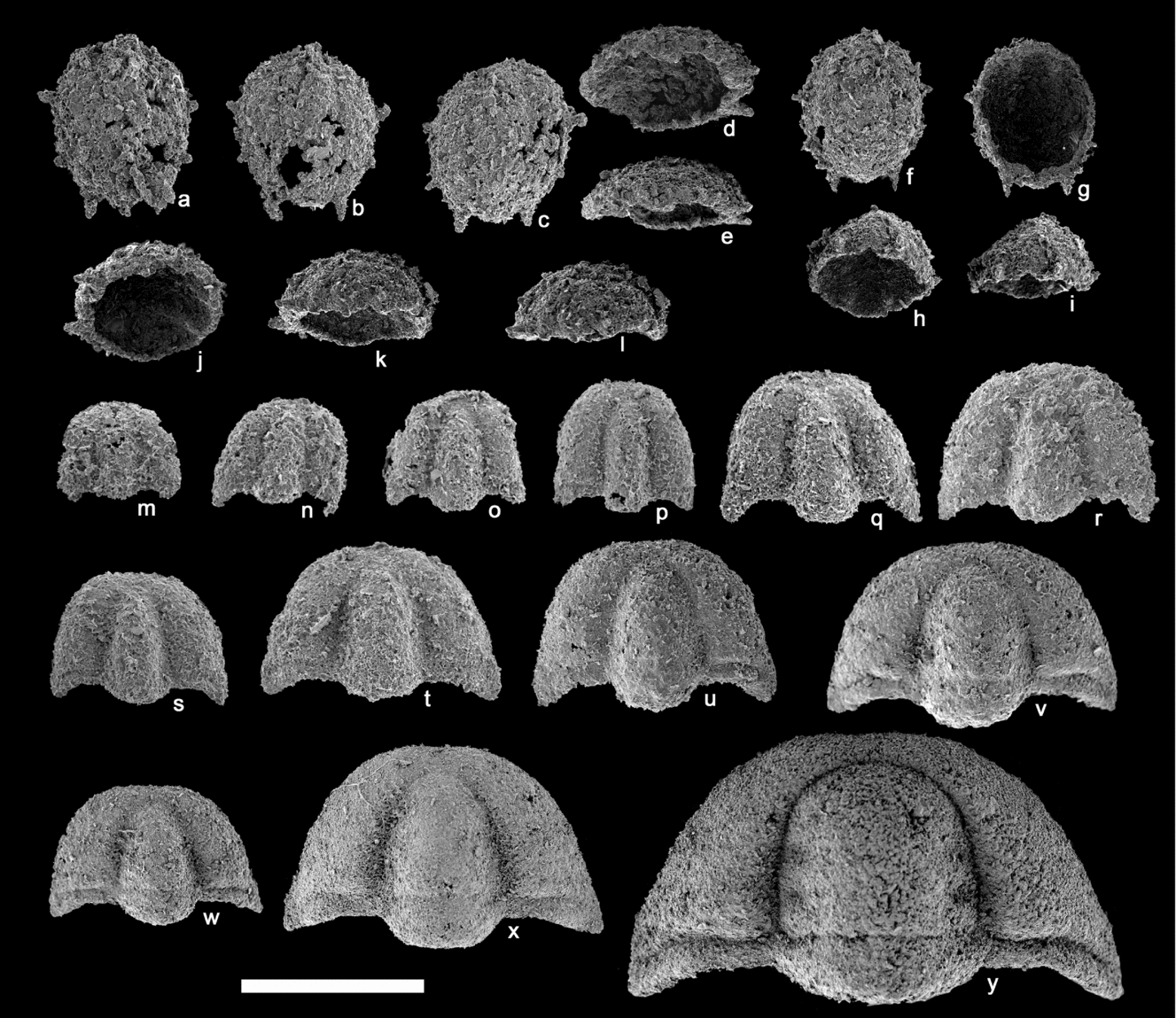
Protaspides and post-protaspid cranidia of Akoldinioidia latus Park & Kihm, Reference Park and Kihm2015a from the Hwajeol Formation, Taebaeksan Basin, Korea. (a–l) Protaspides: (a) KOPRIF1204; (b) KOPRIF1205; (c–e) KOPRIF1206, dorsal (c), oblique lateral (d) and ventral (e) views; (f–l) KOPRIF1207, dorsal (f), ventral (g), postero-ventral (h), posterior (i), oblique ventral (j), oblique lateral (k) and lateral (l) views. (m–y), Post-protaspid cranidia: (m) KOPRIF1208; (n) KOPRIF1209; (o) KOPRIF1210; (p) KOPRIF1211; (q) KOPRIF1212; (r) KOPRIF1213; (s) KOPRIF1214; (t) KOPRIF1215; (u) KOPRIF1216; (v) KOPRIF1217; (w) KOPRIF1218; (x) KOPRIF1219; (y) KOPRIF1189. The scale bar is 0.5<5 type="Other">mm for A–R, 0.62 mm for S–V, 1 mm for W–X and 1.25 mm for Y.

This article deals with the ontogeny of two co-occurring middle Furongian (Jiangshanian Stage) shumardiids, Akoldinioidia latus Park & Kihm, Reference Park and Kihm2015a and Koldinioidia choii Park & Kihm, Reference Park and Kihm2015a from the Hwajeol Formation, Taebaeksan Basin, Korea. The silicified material from the Hwajeol Formation includes protaspides of these two shumardiid trilobites. To date, reports of shumardiid protaspides have been limited to the Ordovician representatives (Stubblefield, Reference Stubblefield1926; Waisfeld et al. Reference Waisfeld, Vaccari, Chatterton and Edgecombe2001). The protaspid morphology of these primitive Cambrian shumardiids is essential to understand the protaspid morphology of shumardiid trilobites: i.e. whether it is similar to the adult-like protaspis suggested by Subblefield (1926) or to the metamorphosis-undergoing protaspides documented by Waisfeld et al. (Reference Waisfeld, Vaccari, Chatterton and Edgecombe2001).
2. Fossil locality and material
Material for this study was recovered from the Asioptychaspis subglobosa Zone of the Hwajeol Formation in the Sagundari section (37° 04′ 57.0″ N, 129° 01′ 03.4″ E) (see Park & Choi, Reference Park and Choi2010, for locality map, and Park & Kihm, Reference Park and Kihm2015a for stratigraphic occurrences). The geological settings of the Taebaeksan Basin were given in detail by Choi et al. (Reference Choi, Chough, Kwon, Lee, Woo, Kang, Lee, Lee, Sohn, Shinn and Lee2004). The Hwajeol Formation is an alternating succession of limestone and shale beds, with frequent intercalation of limestone conglomerate beds, and is interpreted to have been deposited in inner to outer ramp environments (Kwon et al. Reference Kwon, Chough, Choi and Lee2006). Sohn & Choi (Reference Sohn and Choi2007) recognized three trilobite faunas within the formation: in ascending order, the Asioptychaspis Zone, the Quadraticephalus Zone and the saukiid-dominated fauna. Subsequently, Park & Kihm (Reference Park and Kihm2015a) revised the biostratigraphy of the lowermost part of the Hwajeol Formation, documenting 14 polymerid species belonging to 14 genera. They renamed the Asioptychaspis Zone the Asioptychaspis subglobosa Zone, and correlated it with the Asioptychaspis–Tsinania Zone of North China, and the Rhaptagnostus clarki patulus – Caznaia squamosa-Hapsidocare lilyensis and Rhaptagnostus clarki prolatus – Caznaia sectatrix zones of Australia, which are Jiangshanian (middle Furongian) in age. Limestone–shale couplets from the horizon 2.5 m above the base of the formation (CHBd08 horizon of Park & Kihm, Reference Park and Kihm2015a, fig. 1) were digested by hydrochloric acid to collect silicified specimens of trilobites. The recovered specimens included Psuedokoldinioidia sp. cf. P. granulosa Endo, Reference Endo1944, Tsinania canens (Walcott, Reference Walcott1905), Gumunsoia sp. 2, ?Mansuyia sp. 1, Guangxiaspis sp. 1, Caznaia coreaensis Park & Kihm, 2015, ?Saukia aojii (Kobayashi, Reference Kobayashi1933), Asioptychaspis subglobosa (Sun, Reference Sun1924), Koldinioidia choii Park & Kihm, Reference Park and Kihm2015a, and Akoldinioidia latus Park & Kihm, Reference Park and Kihm2015a (see Park & Kihm Reference Park and Kihm2015a). Ontogenetic researches of Tsinania canens, Asioptychaspis subglobosa and Haniwa quadrata have been carried out on the basis of the silicified specimens from this horizon (Park & Choi, Reference Park and Choi2009, Reference Park and Choi2010, Reference Park and Choi2011b, respectively). For this study, eight protaspides, more than 150 cranidia, 48 free cheeks, and 88 post-protaspid pygidia of A. latus, and two protaspides, 72 cranidia, five free cheeks and 53 post-protaspid pygidia of K. choii were collected. Length and width of protaspides, post-protaspid cranidia, and pygidia were measured; for the post-protaspid cranidia of A. latus, only 120 well-preserved post-protaspid cranidia were measured. Forty-one thoracic segments of shumardiids were also collected. The protaspides, cranidia, free cheeks, and morphologically mature pygidia of the co-occurring two shumardiids in this study were relatively easily distinguished. The meraspid pygidia of the two trilobites are quite similar in morphology, but the size and subtle differences in morphology enable them to be assigned to two different species. Nevertheless, it is currently almost impossible to differentiate thoracic segments of the two species; only those with the axial ring sculptured with transversely arranged nodes may be assigned to Akoldinioidia latus. The unassigned shumardiid thoracic segments are illustrated collectively. All of the specimens illustrated in this study are deposited in the palaeontological collections of the Korea Polar Research Institute, prefixed with KOPRIF.
3. Ontogeny of Akoldinioidia latus
Designation of lectotype. Park & Kihm (Reference Park and Kihm2015a) did not designate the holotype of this species, hence KOPRIF1189 (Fig. 1y) is designated here as the lectotype of A. latus.
Protaspid phase. Eight protaspides have been collected, which likely represent a single instar. The protaspid exoskeleton is oval in outline, 0.33–0.46 mm long and 0.30–0.38 mm wide, with the surface weakly effaced. The overall morphology is non-adult-like, being ovoid. The axis is clavate and convex, marked by slightly incised narrow axial furrows; the maximum width of the axis is 0.40–0.47 of the exoskeletal width. Three pairs of marginal spines are present; the laterally directed anteriormost pair is located at c. 0.4 of the exoskeletal length; the second pair of marginal spines is located at c. 0.7 of the exoskeletal length, and is directed obliquely backward; and the posteriormost pair of marginal spines is directed rearward from the posterior margin of the exoskeleton. The weakly sinuous facial suture is recognizable in lateral views (Fig. 1e, l). A doublure is present in the posterior margin. A notch is indented dorsally in the central part of the doublure (Fig. 1h, i). A pair of weak apodemes is recognized on the ventral side of the glabellar front (Fig. 1j).
Development of post-protaspid cranidium. During metamorphosis from the protaspid phase to the meraspid phase the cranidium became less convex, the lateral spines disappeared and the moderately wide axis became a slender glabella.
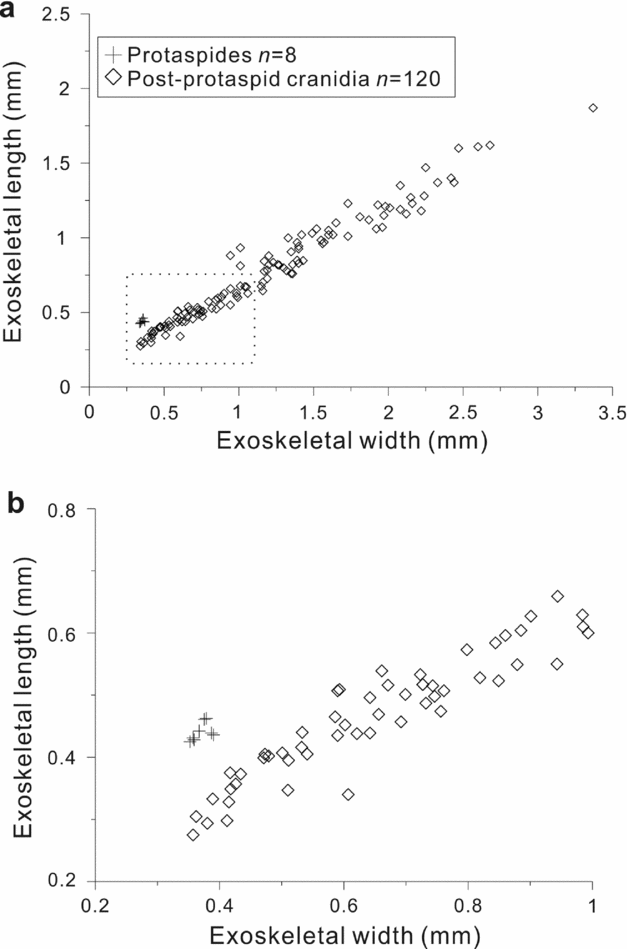
The smallest morphologically immature post-protaspid cranidia (Fig. 1m, n) are 0.27–0.30 mm long and 0.35–0.41 mm wide, and semicircular in outline. Given the similar width of the smallest cranidia and the protaspid exoskeletons (Fig. 2), the smallest cranidia likely includes the earliest meraspid instar. The glabellar is parallel-sided or conical, defined by moderately incised axial furrows, and is c. 0.36 of the cranidial width at the base. The preglabellar area is short, less than 0.1 of the cranidial length. The lateral margin is smooth and rounded. The posterior border is hardly defined. The posterior margin is abaxially curved rearward.
Scatter plots of exoskeletal length vs width dimensions of protaspides and post-protaspid cranidia of Akoldinioidia latus Park & Kihm, Reference Park and Kihm2015a from the Hwajeol Formation, Taebaeksan Basin, Korea. The dotted rectangle in (a) denotes the portion which is magnified in (b).

During the subsequent development (Fig. 1o–r), the preglabellar area became longer (sag.); more than one-tenth of the cranidial length. The axial furrows became deeper except for the frontal part. The posterior border is defined by a shallowly incised, narrow and straight posterior border furrow.
Subsequently, the cranidial outline became more transverse; the glabella became more broad-based and less tapering forward; the posterior border furrows abaxially curved rearward, eventually attaining the holaspid morphology (Fig. 1y) which has been described by Park & Kihm (Reference Park and Kihm2015a).
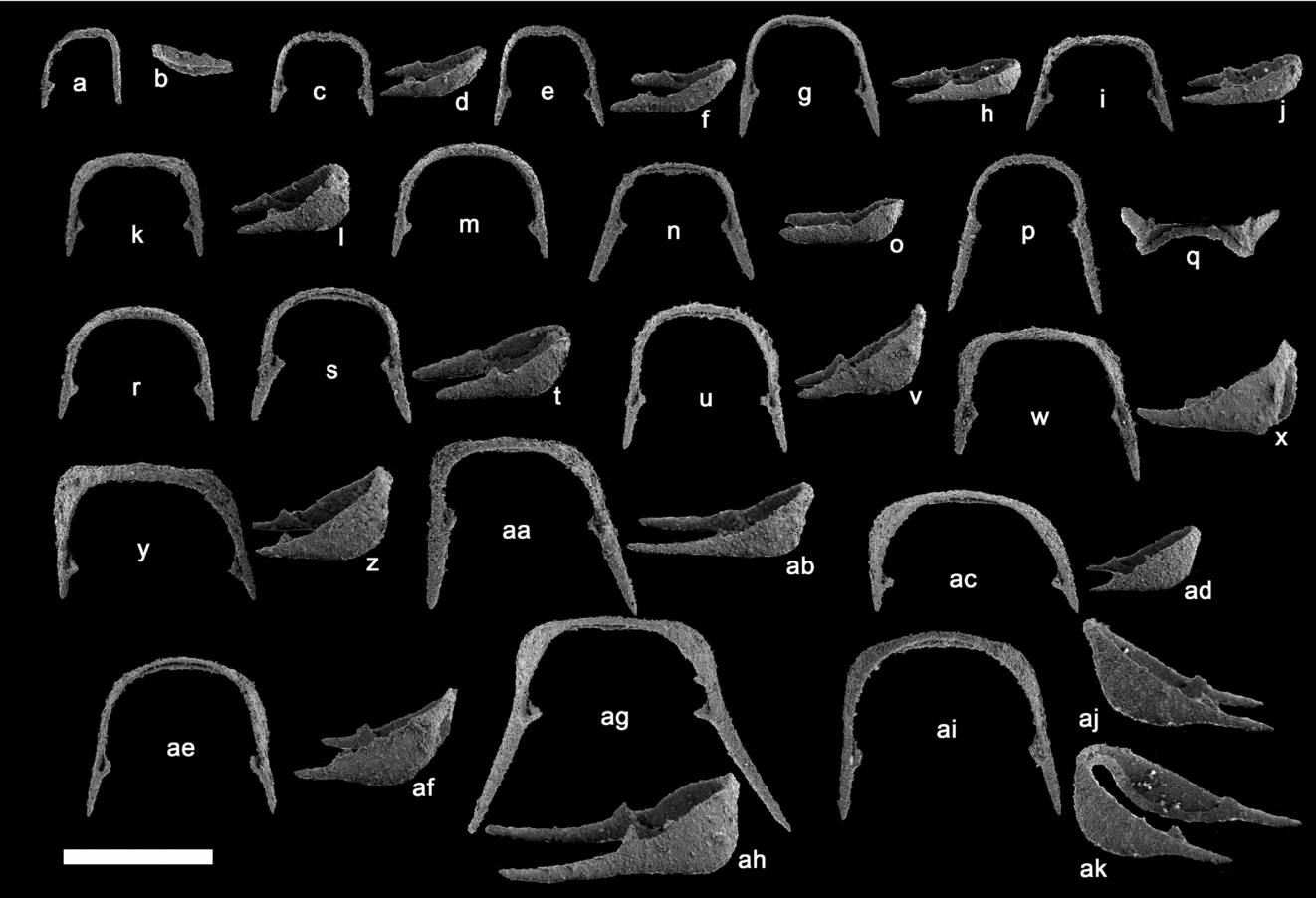
Development of free cheek. Free cheeks remained yoked throughout the ontogeny. The smallest free cheeks (Fig. 3a–j) have a narrow genal field, and short, tumid genal spines. The frontal part is slightly raised. Then the genal field became larger, and the frontal part became elevated to form a dorsally arched cephalic doublure. Interestingly, the genal spines seem to be morphologically variable throughout the ontogeny; some have short and tumid genal spines (Fig. 3k, m, r, y and ac), while others have a long genal spine (Fig. 3n, p, aa and ag).
Free cheeks of Akoldinioidia latus Park & Kihm, Reference Park and Kihm2015a from the Hwajeol Formation, Taebaeksan Basin, Korea. (a, b) KOPRIF1220, dorsal (a) and lateral (b) views; (c, d) KOPRIF1221, dorsal (c) and lateral (d) views; (e, f) KOPRIF1222, dorsal (e) and lateral (f) views; (g, h) KOPRIF1223, dorsal (g) and lateral (h) views; (i, j) KOPRIF1224, dorsal (i) and lateral (j) views; (k, l) KOPRIF1225, dorsal (k) and lateral (l) views; (m) KOPRIF1226; (n, o) KOPRIF1227, dorsal (n) and lateral (o) views; (p, q) KOPRIF1228, dorsal (p) and posterior (q) views; (r) KOPRIF1229; (s,t) KOPRIF1230, dorsal (s) and lateral (t) views; (u, v) KOPRIF1231, dorsal (u) and lateral (v) views; (w, x) KOPRIF1232, dorsal (w) and lateral (x) views; (y, z) KOPRIF1233, dorsal (y) and lateral (z) views; (aa–ab) KOPRIF1234, dorsal (aa) and lateral (ab) views; (ac, ad) KOPRIF1235, dorsal (ac) and lateral (ad) views; (ae–af) KOPRIF1236, dorsal (ae) and lateral (af) views; (ag, ah) KOPRIF1237, dorsal (ag) and lateral (ah) views; (aiak) KOPRIF1238, dorsal (ai), lateral (aj) and postero-lateral (ak) views. Scale bar is 1 mm.

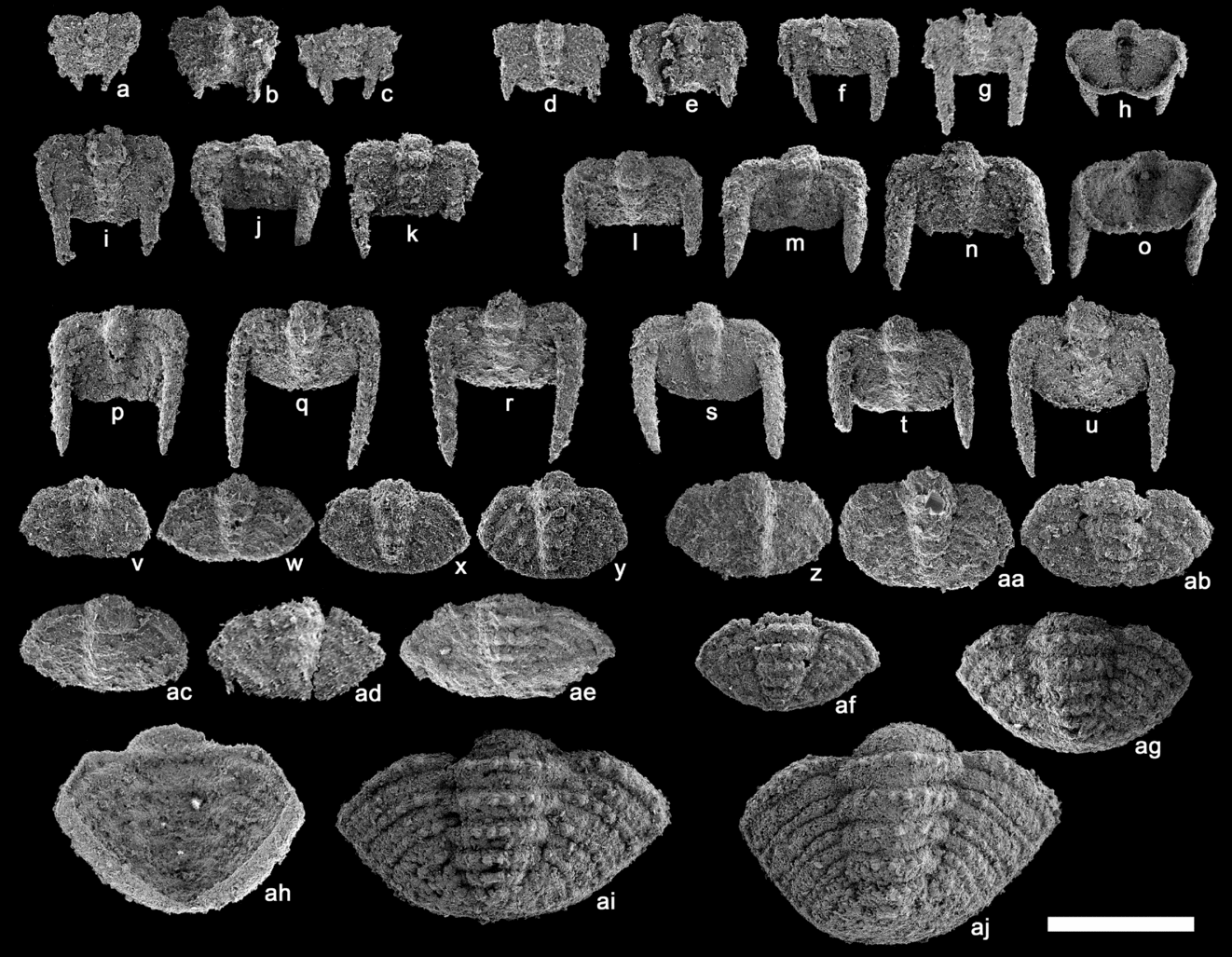
Development of post-protaspid pygidium. The morphologically immature pygidia of Akoldinioidia latus has been divided into eight developmental stages including the earliest holaspid stage by size and morphology. The third and fourth thoracic segments likely have macropleural spines, but the macropleural spines of the fourth segment are much larger those of the third segment. The position of the fourth segment might be helpful in defining the degree of disarticulated meraspid pygidia. However, determining the meraspid degree for the earliest developmental stages is difficult because the macropleural spines are not prominent and the preservation is not sufficient. The developmental stages prior to the meraspid degree 2 are collectively grouped into the early meraspid developmental stage (EDS). Most shumardiids are known to have possessed six thoracic segments in the holaspid phase, although some species, such as Acanthopleurella grindrodi Groom, Reference Groom1902 (see Fortey & Rushton, Reference Fortey and Rushton1980) and Koldinioidia orientalis (Mansuy, Reference Mansuy1916) (see Zhu & Peng, Reference Zhu and Peng2006), had four or five thoracic segments. One of the oldest shumardiid species, Elaphraella microforma, from the Kaolishania fauna of the upper part of the Sesong Formation, which immediately underlies the Asioptychaspis subglobosa Zone of the Hwajeol Formation, had six thoracic segments (Park & Choi Reference Park and Choi2012a). With only disarticulated pygidia at hand, however, it is hard to ascertain whether Akoldinioidia latus had six thoracic segments or not. The designation of the last three developmental stages of the morphologically immature pygidia of A. latus as the meraspid degree 4, the meraspid degree 5, and the holaspid phase, in this study is based on an assumption that A. latus had six thoracic segments in the holaspid phase. There is likely to be no release of new thoracic segments between some developmental stages: between the meraspid degree 2a and meraspid degree 2b, and between meraspid degree 3a and meraspid degree 3b. Such a phenomenon is not uncommon in trilobite developments (see Hughes, Minelli & Fusco, Reference Hughes, Minelli and Fusco2006; Dai, Zhang & Peng, Reference Dai, Zhang and Peng2014), and is frequently observed in minute trilobites, such as eodiscoids (Dai & Zhang, Reference Dai and Zhang2011, Reference Dai and Zhang2013; Dai, Zhang & Peng, Reference Dai, Zhang and Peng2016).
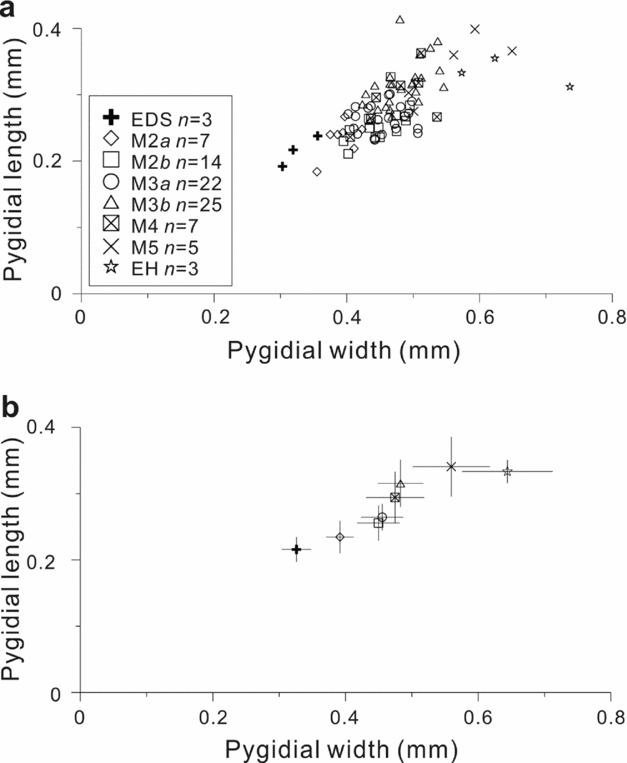
The early meraspid developmental stage pygidia (Fig. 4a–c) are 0.19–0.0.24 mm long and 0.30–0.36 mm wide, and characterized by having multiple segments before the macropleural segment destined to be the fourth thoracic segment. One of the three specimens is assignable to meraspid degree 1 (Fig. 4c), but it is unclear whether the others belong to meraspid degree 0 or 1. They are inverted-trapezoidal in outline, with the posterior margin weakly indented medially. The axial width is 0.26–0.30 of the pygidial width. The wide axial furrows are weakly incised. Three axial rings including the terminal piece can be recognized. The segment destined to be the third thoracic segment has small pleural spines. n = 3.
Post-protaspid pygidia of Akoldinioidia latus Park & Kihm, Reference Park and Kihm2015a from the Hwajeol Formation, Taebaeksan Basin, Korea. (a–c) Early meraspid developmental stage (EDS) pygidia: (a) KOPRIF1239; (b) KOPRIF1240; (c) KOPRIF1241. (d–g) Meraspid degree 2a pygidia: (d) KOPRIF1242; (e) KOPRIF1243; (f) KOPRIF1244; (g) KOPRIF1245; (h) KOPRIF1246, ventral view. (i–k) Meraspid degree 2b pygidia: (i) KOPRIF1247; (j) KOPRIF1248; (k) KOPRIF1249. (l–o) Meraspid degree 3a pygidia: (l) KOPRIF1250; (m) KOPRIF1251; (n) KOPRIF1252; (o) KOPRIF1253, ventral view. (p–u) Meraspid degree 3b pygidia: (p) KOPRIF1254; (q) KOPRIF1255; (r) KOPRIF1256; (s) KOPRIF1257; (t) KOPRIF1258; (u) KOPRIF1259. (v–y), Meraspid degree 4 pygidia: (v) KOPRIF1260; (w) KOPRIF1261; (x) KOPRIF1262; (y) KOPRIF1263. (z–ab) Meraspid degree 5 pygidia: (z) KOPRIF1264; (aa) KOPRIF1265; (ab) KOPRIF1266. (ac–ae) Early holaspid stage pygidia: (ac) KOPRIF1267; (ad) KOPRIF1268; (ae) KOPRIF1269. (af–aj) Pygidia of later holaspid stages: (af) KOPRIF1270; (ag) KOPRIF1271; (ah) KOPRIF1272, ventral view; (ai) KOPRIF1273; (aj) KOPRIF1194. Scale bar is 0.5 mm for (a–ae), 0.83 mm for (af–ai), and 1 mm for (aj).

The meraspid degree 2a pygidia (Fig. 4d–h) are 0.18–0.27 mm long and 0.36–0.42 mm wide. The segment destined to be the third thoracic segment forms the anteriormost segment. The pleural spines of this segment are relatively longer than that of the previous stage. They are inverted-trapezoidal to rectangular in outline excluding the macropleural spines. The posterior margin is weakly indented medially. The axial width is 0.26–0.33 of the pygidial width. Three or four axial rings including the terminal piece can be recognized. n = 7.
The meraspid degree 2b pygidia (Fig. 4i–k) are 0.21–0.33 mm long and 0.40–0.50 mm wide. They are morphologically similar to the previous stage, but are larger and longer, probably due to the proliferation of new segments at the rear end. The variation in the length of the macropleural spines in the segment destined to be the fourth thoracic segment became prominent from this stage. Four axial rings including the terminal piece can be recognized. n = 14.
The meraspid degree 3a pygidia (Fig. 4l–o) are 0.23–0.30 mm long and 0.40–0.51 mm wide. The segment destined to be the fourth thoracic segment which has large macropleural spines forms the anteriormost segment. They are inverted-trapezoidal in outline excluding the macropleural spines. The posterior margin weakly indented medially. The axial width is 0.31–0.33 of the pygidial width. Three or four axial rings including the terminal piece can be recognized. n = 22.
The meraspid degree 3b pygidia (Fig. 4p–u) are 0.26–0.41 mm long and 0.42–0.55 mm wide. They are morphologically similar to the previous stage, but are larger and longer. The posterior margin is generally rounded, probably due to the proliferation of new segments at rear end. Pleural furrows are recognized in a specimen which does not have a rounded posterior margin (Fig. 4p). Four axial rings including the terminal piece can be recognized. n = 25.
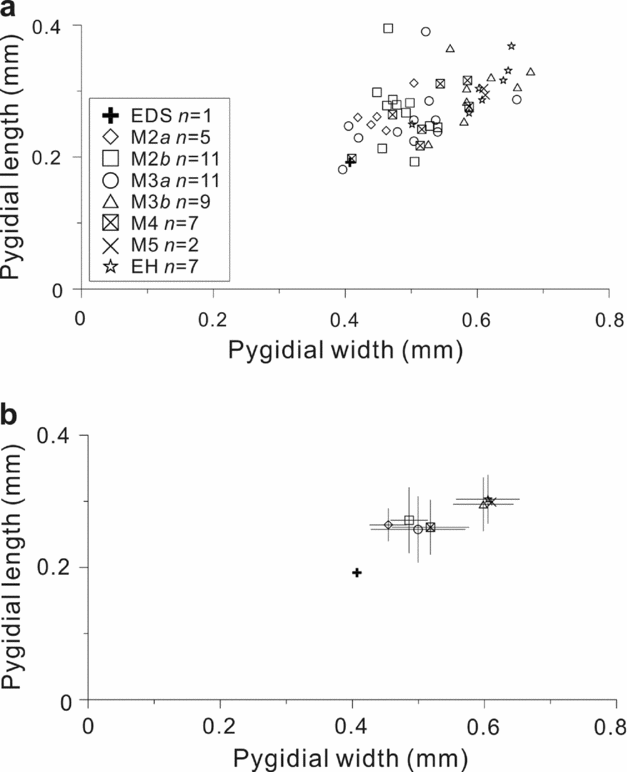
The meraspid degree 4 pygidia (Fig. 4v–y) are 0.24–0.36 mm long and 0.41–0.54 mm wide. Due to the release of the large macropleural spines-bearing segment, they have a simple morphology, and the overall size is slightly smaller than the previous stage (Fig. 5). The pygidia are sub-oval in outline. The posterior margin is weakly indented medially or rounded. The axial width is 0.27–0.33 of the pygidial width. Five axial rings including the terminal piece can be recognized. Pleural and inter-pleural furrows are weakly incised. The anterior margin of pleurae runs horizontally outward, and then abruptly curves obliquely rearward. n = 7.
The relationship between the developmental stages and the size of the post-protaspid pygidia of Akoldinioidia latus Park & Kihm, Reference Park and Kihm2015a from the Hwajeol Formation, Taebaeksan Basin, Korea. Large holaspid pygidia are excluded. (a) Scatter plots of pygidial length vs width. (b) The mean for each stage, and the standard deviation bars extending to horizontal and vertical sides of the mean. EDS: early meraspid developmental stage; M2a: meraspid degree 2a; M2b: meraspid degree 2b; M3a: meraspid degree 3a; M3b: meraspid degree 3b; M4: meraspid degree 4; M5: meraspid degree 5; EH: early holaspid stage pygidia.

The meraspid degree 5 pygidia (Fig. 4z–ab) are 0.28–0.40 mm long and 0.49–0.65 mm wide. They have a similar morphology to the previous stage, but are larger, with a flat posterior margin. The axial width is 0.30–0.33 of the pygidial width. Five axial rings including the terminal piece can be recognized. The anterior margin of pleurae runs horizontally outward, and then smoothly curves obliquely rearward. n = 5.
The early holaspid stage pygidia (Fig. 4ac–ae) are 0.31–0.36 mm long and 0.57–0.74 mm wide. They have a more transverse outline, compared to those of the previous stage. The axial width is 0.30–0.33 of the pygidial width. A rim-like ridge running sub-parallel to the posterior margin is present, which is reminiscent of the rim-like ridge of Elaphraella nodus from the underlying Kaolishania fauna (see Park & Choi, Reference Park and Choi2012a). Four or five axial rings can be recognized in front of the rim-like ridge. n = 3.
During the subsequent development, the number of axial rings increased, eventually with six axial rings including the terminal pieces. The description of the large holaspid pygidia has been given by Park & Kihm (Reference Park and Kihm2015a) and is not repeated here.
4. Ontogeny of Koldinioidia choii
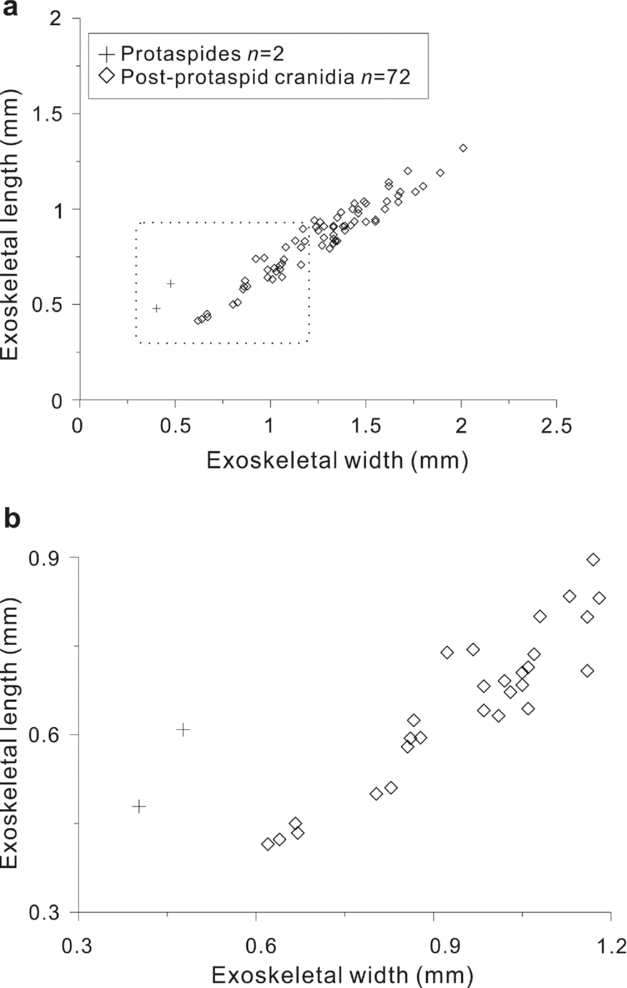
Protaspid phase. Two protaspid exoskeletons are available. One is 0.48 mm long and 0.40 mm wide, and the other is 0.61 long and 0.48 mm wide. In spite of the different size, it is uncertain whether the two protaspides represent different developmental stages, since their morphology is almost identical.
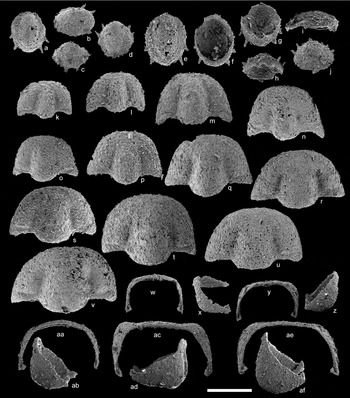
The protaspid exoskeleton is oval in outline, with the surface moderately effaced. The overall morphology is non-adult-like, being convex and ovoid, like that of A. latus. The clavate axis is broad, marked by weakly incised wide axial furrows; the maximum width of the axis is c. 0.6 of the exoskeletal width. A narrow preglabellar area is visible in the anterior views (Fig. 6d). Three pairs of marginal spines are present; the anteriormost pair is located at c. 0.63 of the exoskeletal length, and is oblique-posteriorly and oblique-dorsally directed; the second pair of marginal spines is located at c. 0.85 of the exoskeletal length, and is directed more oblique-posteriorly and oblique-dorsally than the anteriormost pair; and the ventrally directed posteriormost pair of marginal spines is located at each flank of a dorsally indented notch. The weakly sinuous facial suture is visible in lateral views (Fig. 6i). A moderately thick doublure with the dorsally indented notch in the central part is present in the posterior margin (Fig. 6f–h).
Protaspides, post-protaspid cranidia, and free cheeks of Koldinioidia choii Park & Kihm, Reference Park and Kihm2015a from the Hwajeol Formation, Taebaeksan Basin, Korea. (a–j) Protaspides: (a–d) KOPRIF1274, dorsal (a), oblique lateral (b), posterior (c) and oblique anterior (d) views; (e–j) KOPRIF1275, dorsal (e), ventral (f), oblique ventral (g), postero-ventral (h), lateral (i) and anterior (j) views. (k–v) Post-protaspid cranidia: (k) KOPRIF1276; (l) KOPRIF1277; (m) KOPRIF1278; (n) KOPRIF1279; (o) KOPRIF1280; (p) KOPRIF1281; (q) KOPRIF1282; (r) KOPRIF1283; (s) KOPRIF1284; (t) KOPRIF1175; (u) KOPRIF1285; (v) KOPRIF1286. (w–af) Free cheeks: (w, x) KOPRIF1287, dorsal (w) and oblique lateral (x) views; (y, z) KOPRIF1288, dorsal (y) and lateral (z) views; (aa, ab) KOPRIF1289, dorsal (aa) and lateral (ab) views; (ac, ad) KOPRIF1178, dorsal (ac) and lateral (ad) views; (ae, af) KOPRIF1179, dorsal (ae) and lateral (af) views. The scale bar is 0.5 mm for (a–n), 0.69 mm for (o–s) and 0.79 mm for (t–af).

Development of post-protaspid cranidium. The width of the smallest post-protaspid cranidia is somewhat greater than the width of the larger protaspis (Fig. 7), which means the earliest post-protaspid cranidial instar might be missing in this study. It should be noted that during metamorphosis from the protaspid to the meraspid phase the broad axis of the protaspides became a less broad glabella in the post-protaspid cranidia, as in A. latus.
Scatter plots of exoskeletal length versus width dimensions of protaspides and post-protaspid cranidia of Koldinioidia choii Park & Kihm, Reference Park and Kihm2015a from the Hwajeol Formation, Taebaeksan Basin, Korea. The dotted rectangle in (a) denotes the portion which is magnified in (b).

The smallest morphologically immature post-protaspid cranidia (Fig. 6k, l) are 0.42–0.45 mm long and 0.62–0.67 mm wide, and semicircular in outline. The tapering-forward glabella is convex, defined by moderately incised axial furrows. The glabellar width at the base is c. 0.4 of the cranidial width; the frontal part of the glabella is effaced, so the glabellar front is not delineated. The lateral margin is smooth and rounded. The posterior border is defined by a shallow border furrow, and slightly widens abaxially. The posterior margin is abaxially curved rearward.
During the subsequent development (Fig. 6m, n), the axial furrows and the posterior border furrows tend to become shallower. With development (Fig. 6o–s), the frontal part of the axial furrows became effaced, and the glabellar width at the base became c. 0.46 of the cranidial width. A slight and gentle constriction in the middle part of axial furrows can be recognized in some specimens (Fig. 6q). Subsequently, the glabella became broader-based, eventually attaining the holaspid morphology (Fig. 6v) described by Park & Kihm (Reference Park and Kihm2015a).
Development of free cheek. Only five yoked free cheeks were collected for this species, the largest two of which have been illustrated and described by Park & Kihm (Reference Park and Kihm2015a) (Fig. 6ac, ae). The free cheeks of K. choii are easily distinguished from those of A. latus in lacking genal spines and having a relatively wider genal field. The smaller free cheeks are morphologically similar to the larger free cheeks, but the genal field is significantly small (Fig. 6w, y). With growth, the genal field expanded, as in the case of the free cheeks of A. latus.
Development of post-protaspid pygidium. The morphologically immature pygidia of Koldinioidia choii has also been divided into eight developmental stages, including the earliest holaspid stage, by size and morphology. The third and fourth thoracic segments seem to have macropleural spines, but that of the fourth segment is much larger than that of the third segment as in A. latus. The position of the fourth segment could also be used to define the meraspid degree of disarticulated pygidia, but the developmental stages prior to meraspid degree 2 are also assigned to the early meraspid developmental stage (EDS). A congeneric species, Koldinioidia orientalis (Mansuy, Reference Mansuy1916), had five thoracic segments in holaspides (see Zhu & Peng, Reference Zhu and Peng2006). Nevertheless, the last three developmental stages of the morphologically immature pygidia of K. choii are designated as meraspid degree 4, meraspid degree 5, and the holaspid phase as in A. latus, because the trunk segmental pattern is morphologically more similar to A. latus than to K. orientalis, which had no macropleural segment. Still, it should be noted that this is based on the assumption that this species also had six thoracic segments in the holaspid phase. As in A. latus, there was likely to be no addition of new thoracic segments between meraspid degrees 2a and 2b, and between meraspid degrees 3a and 3b.
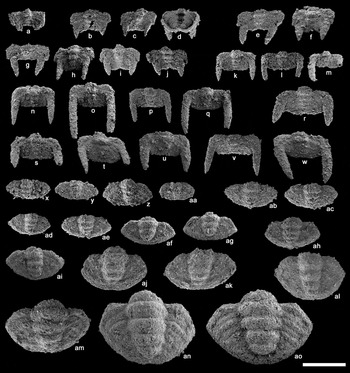
The early meraspid developmental stage pygidium (Fig. 8a) is 0.19 mm long and 0.41 mm wide. Due to the ambiguity of the position of the macropleural segments, it is unclear whether this single specimen belongs to meraspid degree 0 or 1. It is rectangular in outline, excluding the posteriorly protruded spines. The axial width is c. 0.27 of the pygidial width. The wide axial furrows are weakly incised. Three axial rings including the terminal piece can be recognized. Narrow pleural furrows are moderately incised, and inter-pleural furrows are more deeply incised. n = 1.
Post-protaspid pygidia of Koldinioidia choii Park & Kihm, Reference Park and Kihm2015a from the Hwajeol Formation, Taebaeksan Basin, Korea. (a) Early meraspid developmental stage (EDS) pygidium, KOPRIF1290. (b–d) Meraspid degree 2a pygidia: (b) KOPRIF1291; (c) KOPRIF1292; (d) KOPRIF1293, ventral view. (e–j) Meraspid degree 2b pygidia: (e) KOPRIF1294; (f) KOPRIF1295; (g) KOPRIF1296; (h) KOPRIF1297; (i) KOPRIF1298; (j) KOPRIF1299. (k–q) Meraspid degree 3a pygidia: (k) KOPRIF1300; (l) KOPRIF1301; (m) KOPRIF1302; (n) KOPRIF1303; (o) KOPRIF1304; (p) KOPRIF1305; (q) KOPRIF1306. (r–w) Meraspid degree 3b pygidia: (r) KOPRIF1307; (s) KOPRIF1308; (t) KOPRIF1309; (u) KOPRIF1310; (v) KOPRIF1311; (w) KOPRIF1312. (x–aa), Meraspid degree 4 pygidia: (x) KOPRIF1313; (y) KOPRIF1314; (z) KOPRIF1315; (aa) KOPRIF1316. (ab, ac) Meraspid degree 5 pygidia: (ab) KOPRIF1317; (ac) KOPRIF1318. (ad–ag) Early holaspid stage pygidia: (ad) KOPRIF1319; (ae) KOPRIF1320; (af) KOPRIF1321; (ag) KOPRIF1322. (ah–ao) Pygidia of later holaspid stages: (ah) KOPRIF1323; (ai) KOPRIF1324; (aj) KOPRIF1325; (ak) KOPRIF1326; (al) KOPRIF1327; (am) KOPRIF1328; (an) KOPRIF1329; (ao) KOPRIF1330. Scale bar is 0.5 mm for (a–an), and 0.62 for (ao).

The meraspid degree 2a pygidia (Fig. 8b–d) are 0.24–0.31 mm long and 0.42–0.50 mm wide. The segment destined to be the third thoracic segment forms the anteriormost segment. They are inverted-trapezoidal to rectangular in outline, excluding the macropleural spines. The surface is more effaced than at the previous stage. The posterior margin is weakly indented medially. The axial width is 0.30–0.33 of the pygidial width. Three or four axial rings including the terminal piece can be recognized. n = 5.
The meraspid degree 2b pygidia (Fig. 8e–j) are 0.19–0.40 mm long and 0.46–0.54 mm wide. They are morphologically similar to the previous stage, but are larger, and the macropleural spines are thicker. There seems to be a variation in the pygidial length; some are short and transverse (Fig. 8e, g), while others are long (Fig. 8h, i). The axial width is 0.30–0.34 of the pygidial width. Three or four axial rings including the terminal piece can be recognized. n = 11.
The meraspid degree 3a pygidia (Fig. 8k–q) are 0.18–0.29 mm long and 0.40–0.66 mm wide. The segment destined to be the fourth thoracic segment which has large macropleural spines forms the anteriormost segment. They are rectangular to sub-oval in outline excluding the macropleural spines. The posterior margin is weakly indented medially. The axial width is 0.25–0.30 of the pygidial width. Three or four axial rings including the terminal piece can be recognized. The length of the macropleural spines is variable. n = 11.
The meraspid degree 3b pygidia (Fig. 8r–w) are 0.22–0.37 mm long and 0.56–0.68 mm wide. They are morphologically similar to the previous stage, but are larger and slightly longer, due to the proliferation of new segments at the rear end. The macropleural spines are relatively thicker than those of the previous stages. The axial width is 0.28–0.32 of the pygidial width. Shallow and wide pleural furrows are recognized in the anteriormost segment. Four axial rings including the terminal piece can be recognized. n = 9.
The meraspid degree 4 pygidia (Fig. 8x–aa) are 0.20–0.32 mm long and 0.41–0.59 mm wide. Due to the release of the large macropleural spines-bearing segment, the overall size is significantly smaller than at the previous stage (Fig. 9). The pygidya are sub-oval in outline. The axial width is 0.29–0.33 of the pygidial width. Four or five axial rings including the terminal piece can be recognized. Pleural and inter-pleural furrows are weakly incised. n = 7.
The relationship between the developmental stages and the size of the post-protaspid pygidia of Koldinioidia choii Park & Kihm, Reference Park and Kihm2015a from the Hwajeol Formation, Taebaeksan Basin, Korea. Large holaspid pygidia are excluded. (a) Scatter plots of pygidial length vs width. (b) The mean for each stage, and the standard deviation bars extending to horizontal and vertical sides of the mean. EDS: early meraspid developmental stage; M2a: meraspid degree 2a; M2b: meraspid degree 2b; M3a: meraspid degree 3a; M3b: meraspid degree 3b; M4: meraspid degree 4; M5: meraspid degree 5; EH: early holaspid stage pygidia.

The meraspid degree 5 pygidia (Fig. 8ab–ac) are 0.29–0.30 mm long and c. 0.61 mm wide. They have a similar morphology to the previous stage, but are larger, and can be distinguished by the relatively wide axis; the axial width is 0.34–0.35 of the pygidial width. Despite the poor preservation, it is likely that there are five axial rings including the terminal piece. n = 2.
The early holaspid stage pygidia (Fig. 8ad–ag) are 0.25–0.37 mm long and 0.50–0.65 mm wide. The axial width is 0.30–0.35 of the pygidial width. A rim-like ridge running sub-parallel to the posterior margin is present as in A. latus and Elaphraella nodus. Four axial rings including the terminal piece can be recognized in front of the rim-like ridge. The anterior margin of pleurae runs horizontally outward, then abruptly curves obliquely rearward. The posterior margin is rounded. n = 7.
During the subsequent development, the number of axial rings did not increase. The description of the large holaspid pygidia has been given by Park & Kihm (Reference Park and Kihm2015a) and is not repeated here.
5. Thoracic segments
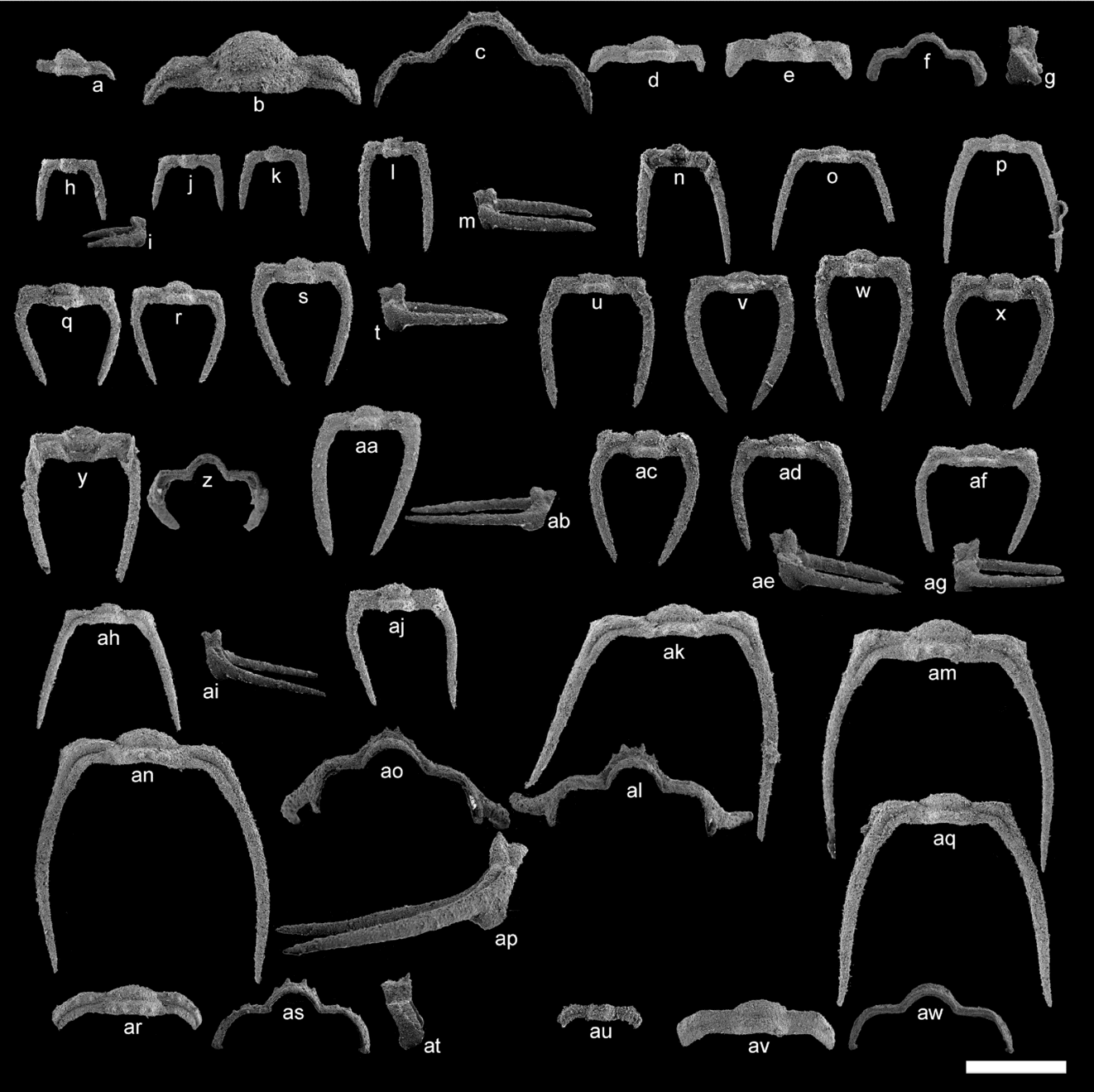
The meraspid pygidial morphology and development of the two shumardiid species indicate that they likely had a similar morphological pattern for thoracic segments, so distinguishing disarticulated thoracic segments of the two shumardiids is extremely difficult. Therefore, thoracic segments of the two shumardiids are described collectively here. The morphology of the meraspid pygidia and the articulated trunk of the Furongian shumardiids, Elaphraella microforma (see Park & Choi Reference Park and Choi2012a) and Koldinioidia orientalis (see Zhu & Peng, Reference Zhu and Peng2006), helps to determine the relative position of disarticulated thoracic segments within the thorax. The thoracic segments could be divided into three groups: the first and second thoracic segments (Fig. 10a–g); the third and fourth macropleural thoracic segments (Fig. 10h–aq); and the fifth and sixth thoracic segments (Fig. 10ar–aw).
Thoracic segments of the two shumardiids, Akoldinioidia latus Park & Kihm, Reference Park and Kihm2015a and Koldinioidia choii Park & Kihm, Reference Park and Kihm2015a from the Hwajeol Formation, Taebaeksan Basin, Korea. (a–g) The first and second thoracic segments: (a) KOPRIF1331; (b, c) KOPRIF16035, dorsal (b) and anterior (c) views; (d) KOPRIF1332; (e–g) KOPRIF1333, dorsal (e), anterior (f) and lateral (g) views. (h–aq) the third and fourth thoracic segments: (h,i) KOPRIF1334, dorsal (h) and lateral (i) views; (j) KOPRIF1335; (k) KOPRIF1336; (l, m) KOPRIF1337, dorsal (l) and lateral (m) views; (n) KOPRIF1338, ventral view; (o) KOPRIF1339; (p) KOPRIF1340; (q) KOPRIF1341; (r) KOPRIF1342; (s, t) KOPRIF1343, dorsal (s) and lateral (t) views; (u) KOPRIF1344; (v) KOPRIF1345; (w) KOPRIF1346; (x) KOPRIF1347; (y, z) KOPRIF1348, ventral (y) and anterior (z) views; (aa, ab) KOPRIF1349, dorsal (aa) and lateral (ab) views; (ac) KOPRIF1350; (ad, ae) KOPRIF1351, dorsal (ad) and lateral (ae) views; (af, ag) KOPRIF1352, dorsal (af) and lateral (ag) views; (ah, ai) KOPRIF1353, dorsal (ah) and lateral (ai) views; (aj) KOPRIF1354; (ak, al) KOPRIF1355, dorsal (ak) and anterior (al) views; (am) KOPRIF1356 – the left macropleural spine is morphologically different from the right macropleural spine due to abnormality; (an–ap) KOPRIF1357, dorsal (an), posterior (ao) and lateral (ap) views; (aq) KOPRIF1358. (ar–aw) the fifth and sixth thoracic segments: (ar–at) KOPRIF1359, dorsal (ar), anterior (as) and lateral (at) views; (au) KOPRIF1360; (av, aw) KOPRIF1361, dorsal (av) and anterior (aw) views. Scale bar is 1 mm.

The first and second thoracic segments tend to have a wider axis than the others; the maximum width of the axis is 0.4–0.5 of the width of the thoracic segment. The pleurae are deflected rearward. Clearly incised pleural furrows are curved rearward. Two small nodes are sculptured on the axial ring of the largest specimen (Fig. 10b). The pleural region is convex. The anterior band is about twice as long (sag.) as the posterior band. The articulating facets are relatively narrow in some specimens (Fig. 10a, b), but wider in others (Fig. 10d, e). It is likely that those with narrow facets represent the first thoracic segment. Park & Choi (Reference Park and Choi2011b, fig. 8a, b) mistakenly assigned a thoracic segment (likely the first thoracic segment) of a shumardiid to Haniwa quadrata Kobayashi, Reference Kobayashi1933, which is re-illustrated herein (Fig. 10b, c).
The third and fourth thoracic segments are distinguished by the presence of macropleural spines. Given the morphology of meraspid degree 2, the macropleural spine of the fourth segment is significantly longer than that of the third segment, and the macropleural spine of the third segment of K. choii is likely to be shorter than that of A. latus. However, because it is unknown how the macropleural spines of the third thoracic segments developed after releasing from the meraspid pygidium, and the length of the macropleural spines of the fourth segments are rather varied in the meraspid pygidia, differentiation of the third and fourth thoracic segments is not attempted for now. The axis is c. one-third of the width of the thoracic segment. The pleural furrows are curved rearward and extend slightly into the pleural spine. The smaller specimens tend to have a straight macropleural spine (Fig. 10h–l). As they grow, the macropleural spines of some specimens became so curved that the endpoints are directed adaxially (Fig. 10q–s, v–af), while those of some other specimens are moderately curved and the endpoints are directed rearward (Fig. 10u, aj, am–aq), or are still straight (Fig. 10n, ah). The axial rings of the largest specimens at hand are sculptured with transversely arranged nodes which are reminiscent of those in the holaspid pygidia of A. latus (Fig. 10ak–aq).
The thoracic segments possibly belonging to the fifth and sixth segments are relatively rare (Fig. 10ar–aw). The pleural region of these specimens is slightly directed rearward with the axial width c. one-third or less than one-third of the width of the thoracic segment. One of the specimens has transversely arranged nodes on the axial ring and the anterior band (Fig. 10ar).
6. Ontogenetic comparison of two co-occurring shumardiids
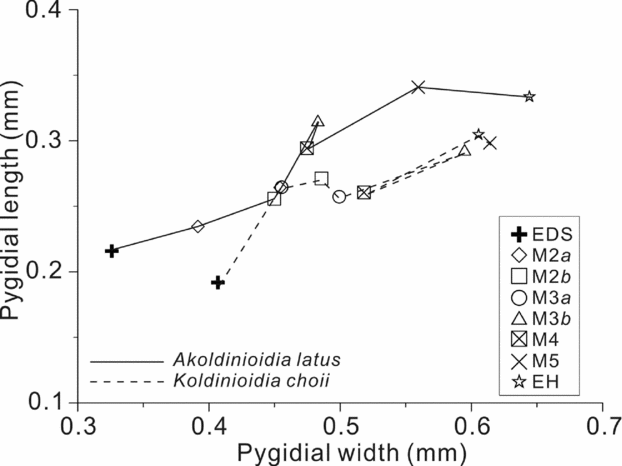
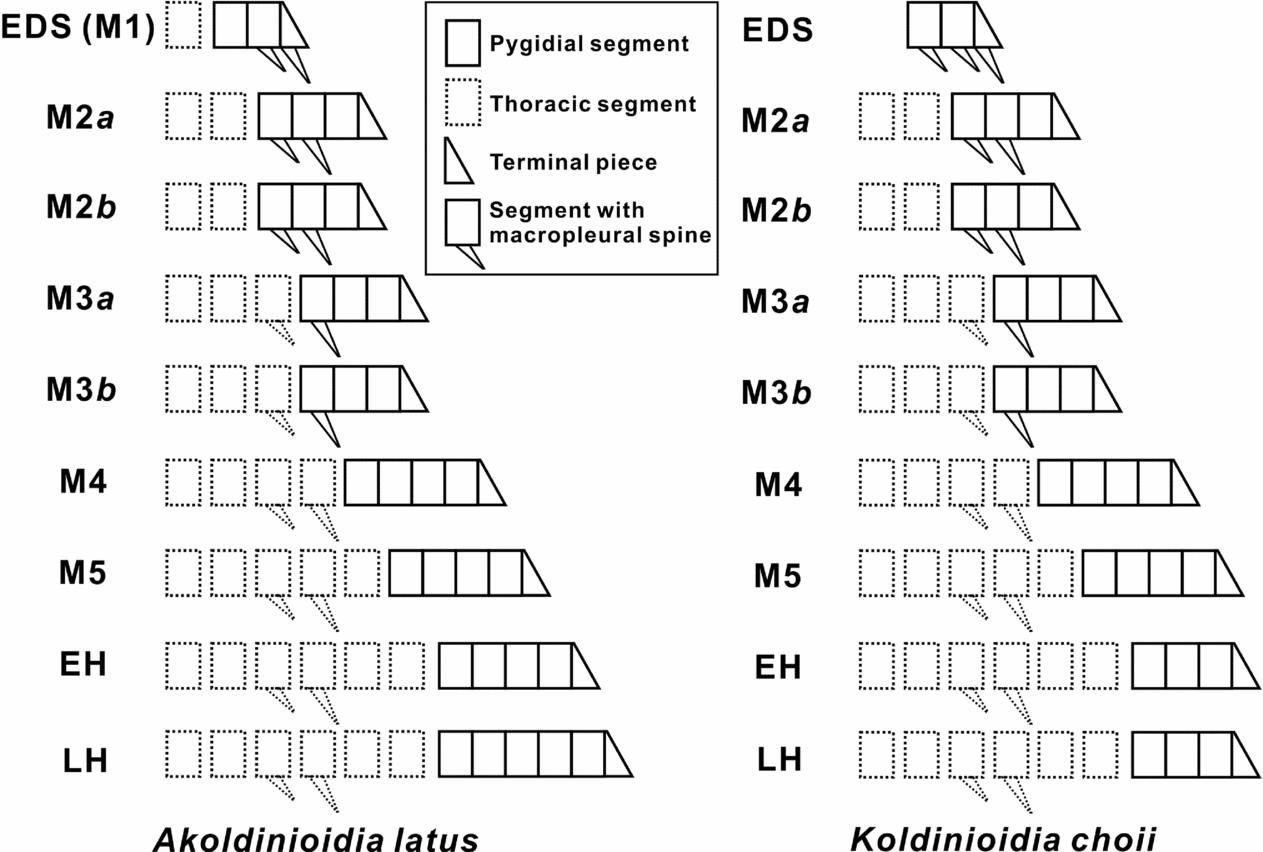
The two shumardiids in this study have different cranidial and pygidial morphology from the protaspid phase onward, although the thoracic segments of the two shumardiids are not distinctive enough for differentiation. The protaspides of Koldinioidia choii are larger than those of Akoldinioidia latus. Comparing protaspid morphology requires careful consideration (Park & Choi, Reference Park and Choi2011c), and the size difference in protaspides in closely related taxa may have been due to the difference in the appearance timing of the first articulation, as in the case of the two closely related ptychaspidids, Asioptychaspis subglobosa (Sun, Reference Sun1924) and Quadraticephalus elongatus Kobayashi, Reference Kobayashi1935 (see Kihm, Park & Choi, Reference Kihm, Park and Choi2013). However, given the metamorphosis occurring at the protaspid/meraspid phase transition, and the significantly wider axial width in the protaspides of K. choii, the size difference of the two shumardiid protaspides does not seem to be related to the difference in appearance timing of the first articulation. The axial width in the protaspides became relatively less in the post-protaspid cranidia of both trilobites. The macropleural segments in meraspid pygidium tend to be thicker in K. choii. The pygidia of K. choii are wider than those of A. latus at the equivalent meraspid stage (Fig. 11). In the trunk segmentation schedule diagrams (Fig. 12), the two trilobites had a similar number of pygidial segments from meraspid degree 2a to meraspid degree 5. Interestingly, the number of trunk segments in A. latus kept increasing after entering the holaspid phase, until there were six axial rings including the terminal piece in the pygidium, while those of K. choii did not increase after meraspid degree 5 (Fig. 12). This indicates the trunk developmental mode of A. latus is protarthrous, in which the onset of the holaspid phase preceded the onset of the epimorphic phase, while that of K. choii is protomeric in which the onset of the epimorphic phase precedes the onset of the holaspid phase (see Hughes, Minelli & Fusco, Reference Hughes, Minelli and Fusco2006).
Comparison of the mean for each stage of pygidial development of two shumardiid trilobites in this study. Note that the pygidia of K. choii are wider than those of A. latus at equivalent meraspid stage.

Trunk segmentation schedule diagrams for the two shumardiids in this study. Where the exact number of axial rings in the pygidium is equivocal, the maximum number was taken to reconstruct the diagrams. Note that the trunk developmental mode of A. latus is protarthrous, in which the onset of the holaspid phase precedes the onset of the epimorphic phase, while that of K. choii is protomeric in which the onset of the epimorphic phase precedes the onset of the holaspid phase. EDS: early meraspid developmental stage; M2a: meraspid degree 2a; M2b: meraspid degree 2b; M3a: meraspid degree 3a; M3b: meraspid degree 3b; M4: meraspid degree 4; M5: meraspid degree 5; EH: early holaspid stage pygidia; LH: late holaspid stage pygidia.

Since no thoracic segment was released between M2a and M2b, and M3a and M3b in the two shumardiid trilobite developments, the growth rate between those developmental stages can be calculated. The size of the complicated morphology of the spine bearing meraspid pygidia is difficult to measure precisely, but the estimated size from simple pygidial length and pygidial width (see Supplementary Material at https://doi.org/10.1017/S0016756817000012) can be used for simplicity. It reveals that in A. latus, the growth rate between M2a and M2b is c. 1.26, and interestingly, that between M3a and M3b is also c. 1.26. This value seems rather high, but is still within the range of average growth rate (AGR) values for meraspid pygidium (1.03–1.33) suggested by Fusco et al. (Reference Fusco, Garland, Hunt and Hughes2012). However, in K. choii, the growth rate between M2a and M2b is c. 1.10, while that between M3a and M3b is c. 1.38, which beyond the range of AGR values given by Fusco et al. (Reference Fusco, Garland, Hunt and Hughes2012). This might indicate that the growth rate was rather high in K. choii, but the AGR value of K. choii could be much lower if the growth rates between all moults within the meraspid degree are taken into account.
7. Discussion
7.a. Protaspis of shumardiids
Morphology of the metamorphosis-undergoing protaspides of the two middle Furongian shumardiids in this study is similar to that of the protaspides documented by Waisfeld et al. (Reference Waisfeld, Vaccari, Chatterton and Edgecombe2001), rather than to that of the protaspis of Stubblefield (Reference Stubblefield1926), in having an oval outline and a slightly inflated morphology; a noticeable difference is that the Ordovician shumardiid protaspides documented by Waisfeld et al. (Reference Waisfeld, Vaccari, Chatterton and Edgecombe2001) had only one pair of spines at the rear end of the trunk, while the middle Furongian shumardiid protaspides in this study had three pairs of marginal spines. Given the presence of similar protaspid morphology in the rather primitive middle Furongian shumardiids in this study, and in the derived, middle to late Ordovician shumardiids documented by Waisfeld et al. (Reference Waisfeld, Vaccari, Chatterton and Edgecombe2001), the protaspis of flat, adult-like morphology of Stubblefield (Reference Stubblefield1926) must have been a result of misidentification. In trilobite evolution, having an adult-like protaspid morphology is the plesiomorphic condition, whereas the presence of metamorphosis-undergoing bulbous commutavi protaspis (sensu Park & Kihm, Reference Park and Kihm2015b) is the derived condition (see Chatterton & Speyer, Reference Chatterton, Speyer and Kaesler1997). Therefore, it is highly unlikely that the early Ordovician shumardiid Shumardia (Conophrys) salopiensis retained the plesiomorphic adult-like morphology, while the middle Furongian shumardiid Akoldinioidia and Koldinioidia already had the metamorphosis-undergoing commutavi protaspid morphology.
Currently, there are three shumardiid species older than Akoldinioidia and Koldinioidia. The oldest member of the Shumardiidae is Elaphraella? taebaeksanensis Park & Choi, Reference Park and Choi2012a from the Sesong Formation, Korea, which immediately underlies the Hwajeol Formation (Park & Choi, Reference Park and Choi2012b). The occurrence of this oldest species is succeeded by two species of Elaphraella: E. microforma Lu & Qian, Reference Lu and Qian1983 and E. nodus (Qian, Reference Qian1994) from the uppermost part of the Sesong Formation (see Park & Choi, Reference Park and Choi2012a). The lowermost part of the overlying Hwajeol Formation contains the Asioptychaspis subglobosa Zone from which Akoldinioidia latus and Koldinioidia choii in this study occur (Park & Kihm, Reference Park and Kihm2015a). The protaspid morphology of the three shumardiid species from the Sesong Formation is needed in order to see whether having a commutavi protaspis is a plesiomorphic condition for the whole shumardiids or not. Nevertheless, given the stratigraphic occurrences of Koldinioidia choii and Akoldinioidia latus which are quite close to the occurrence of the oldest member of shumardiids, it can be inferred that commutavi protaspis appeared quite early in the shumardiid evolution.
7.b. Co-occurring of two shumardiids
It is interesting to note that two shumardiids of similar morphology and size co-occur throughout the Asioptychaspis subglobosa Zone (see Park & Kihm, Reference Park and Kihm2015a), despite the possibility of occupying a similar, if not the same, ecological niche. The possibility of sexual dimorphism is worth considering for this occasion. Cases of sexual dimorphism in trilobites have been reported several times. For recent examples, Fortey & Hughes (Reference Fortey and Hughes1998) presented possible examples of brood pouches, and Knell & Fortey (Reference Knell and Fortey2005) proposed a case of secondary sexual features of trilobite spines. More recently, Cedeström et al. (Reference Cederström, Ahlberg, Nilsson, Ahlgren and Eriksson2011) described two co-occurring forms in middle Cambrian trilobites, and inferred that this reflects sexual dimorphism. Nevertheless, the claims of sexual dimorphism in trilobites have invariably been based on exoskeletal criteria, so critical examination of trilobite sexual dimorphism essentially remains elusive (Knell & Fortey, Reference Knell and Fortey2005). If the two co-occurring shumardiids in this study reflect sexual dimorphism, it is, at least, expected that the other shumardiids in the immediately underlying and overlying strata also consist of two different forms. In this regard, it is noteworthy that a rather wide morphological variation was identified for the specimens of Elaphraella whose occurrence immediately underlies those of K. choii and A. latus (see Park & Choi, Reference Park and Choi2012a). However, it should also be noted that the two shumardiid trilobites in this study had different morphology from the protaspid phase onward throughout the whole ontogeny, while in modern arthropods sexually dimorphic features are usually expressed at the onset of sexual maturity (Hughes & Fortey, Reference Hughes, Fortey, Cooper, Droser and Finney1995). Further evidence from the well-preserved shumardiids of the younger strata of the Hwajeol Formation would be helpful for solving the issue of possible sexual dimorphism.
7.c. Evolution of metamorphosis-undergoing protaspis in the Furongian
The best-known case of metamorphosis in trilobite ontogeny is the transition from bulbous commutavi protaspis to flat, adult-like meraspis. Traditionally, this metamorphosis has been related to change in life mode from planktonic to benthic (life-history strategy I of Chatterton & Speyer, Reference Chatterton, Speyer and Kaesler1997). There are three renowned cases of independent evolution of commutavi protaspis: within Remopleuridioidea, Trinucleoidea and Asaphida (see Park & Kihm Reference Park and Kihm2015b). To this, the case of the Shumardiidae can be added, so now there are four cases of independent evolution of commutavi protaspis in trilobite evolutionary history. Interestingly, the Cambrian representatives of Remopleuridioidea, Trinucleoidea and Asaphida did not possess commutavi protaspis, but the Early Ordovician representatives of these lineages had commutavi protaspides. The commutavi protaspides of the two middle Furongian shumardiids in this study, therefore, represent the first documentation of commutavi protaspides in the Cambrian. The presence of Cambrian commutavi protaspides is also expected for the oldest members of the family Asaphidae which first appeared in the middle Furongian (see Jell & Adrain, Reference Jell and Adrain2003). Although it is known that trilobites rapidly radiated during the Middle Ordovician (Adrain, Fortey & Westrop, Reference Adrain, Fortey and Westrop1998), the ecological pressure which triggered the Great Ordovician Biodiversification Event (GOBE) could have begun to increase much earlier (e.g. Harper, Zhan, & Jin, Reference Harper, Zhan and Jin2015). Park et al. (Reference Park, Kihm, Woo, Kim and Lee2016) ascribed the convergent evolution of commutavi protaspides during the Furongian – Early Ordovician to adaptation to ecological pressure in the early phase of GOBE. The appearance of metamorphosis-undergoing commutavi protaspis in shumardiids, the small and blind trilobite group, might also have been due to the onset of ecological pressure in the early phase of GOBE.
8. Conclusion
The ontogeny of the two middle Furongian shumardiid trilobites reveals that the protaspid morphology of shumardiids is of a bulbous, metamorphosis-undergoing morphology, rather than a flat, adult-like morphology. Given the stratigraphic occurrences of the two shumardiids, which just overlie the occurrences of the oldest shumardiid trilobites, it can be inferred that commutavi protaspis appeared quite early in the shumardiid evolution. The co-occurrence of the two closely related trilobites of similar morphology might indicate sexual dimorphism, but further evidence is required to prove it. The appearance of metamorphosis-undergoing protaspis in the Furongian shumardiids may have been due to adaptation to increasing ecological pressure in the early phase of GOBE.
Acknowledgements
I am grateful to Nigel Hughes and an anonymous referee for valuable and constructive comments. This research is supported by Korea Polar Research Institute (KOPRI) fund PE15380. Hyounmyoung Shim aided with illustrations.
Supplementary material
To view supplementary material for this article, please visit https://doi.org/10.1017/S0016756817000012.