Today’s dynamic work environment brought about by economic, technological and demographic changes affecting the magnitude of employee job satisfaction. It has been well documented that highly satisfied employees are more likely to be committed to their organization (Cooper-Hakim & Viswesvaran, Reference Cooper-Hakim and Viswesvaran2005), have higher levels of job performance (Judge, Scott, & Ilies, Reference Judge, Scott and Ilies2006) and lower levels of turnover (Hulin & Judge, Reference Hulin and Judge2003). The accumulating evidence about the role of job satisfaction on various organizational outcomes triggered the studies investigating its predictors. Although job satisfaction was found to be affected by situational factors, it was also found to be shaped by individual factors such as dispositions (Templer, Reference Templer2012) and perceptions. Among these individual factors, followers’ perceptions of transformational leadership (Cicero & Pierro, Reference Cicero and Pierro2007) and followers’ personality traits (Judge, Heller, & Mount, Reference Judge, Heller and Mount2002; Hsieh, Reference Hsieh2013) have arisen as important predictors.
Transformational leadership is most commonly defined as a set of behaviours, which transforms followers’ needs by satisfying self-actualization needs and push their own and employers’ expectations to higher levels (Bass & Avolio, Reference Bass and Avolio1994). Transformational is based on the premise that such leadership encourages employee development and increases followers’ motivation levels and morale (Burns, Reference Burns1978). The research on transformational leadership has been predominantly leader centred, yet scholars have recently realized that followers remain an unexplored source of variance in the leadership process. Thereby, researchers have begun to take a more follower-centred perspective, emphasizing the role of followers in an interactive leadership process (Gardner & Avolio, Reference Gardner and Avolio1998; Ozaralli, Reference Ozaralli2003; Hetland, Sandal, & Johnsen, Reference Hetland, Sandal and Johnsen2008; Gumusluoglu & Ilsev, Reference Gumusluoglu and Ilsev2009; Braun, Peus, Weisweiler, & Frey, Reference Braun, Peus, Weisweiler and Frey2013; Qu, Janssen, & Shi, Reference Qu, Janssen and Shi2015). In contrast to the leader-centred perspective, scholars of the follower-centred perspective argue that becoming and remaining an effective leader does not only depend on the leader’s actual behaviour, but also on followers’ attributions, perceptions and characteristics.
Accumulating evidence confirms the direct relationship between employees’ transformational leadership perceptions regarding their supervisors and job satisfaction (Bass, Reference Bass1999; Krishnan, Reference Krishnan2012), however, studies on the moderating effects between perceived transformational leadership and job satisfaction are relatively rare and mostly neglect individual differences.
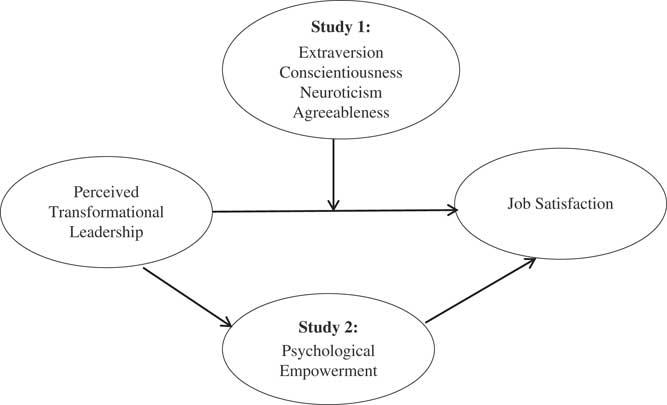
The present research aims to examine the processes by which followers’ perceptions of their leaders as more transformational precipitate their influence on job satisfaction. The purpose of this article is to extend the association between perceived transformational leadership and job satisfaction by adding to the body of work on the follower-centred leadership perspective. With this aim, Study 1 investigates the moderating effects of four personality traits (extraversion, conscientiousness, agreeableness and neuroticism) on the relationship between perceived transformational leadership and job satisfaction. Specifically, we assume that the effect of perceived transformational leadership on job satisfaction varies as a function of followers’ personality traits. We posit that follower’s perceptions of their leaders as transformational might interact with follower’s personality traits, and that this interaction contributes positively or negatively to job satisfaction. Understanding the moderating effects of followers’ personality traits associated with their transformational leadership perceptions may help to better understand the dispositional predictors of job satisfaction. Clearly, these findings may have important organizational implications, including for selection and human resources training and development.
Through focussing on followers, in Study 2, we examine the underlying mechanism and processes of how their perceptions of transformational leadership influence job satisfaction, with a focus on psychological empowerment. This concept is defined as the ‘intrinsic task motivation manifested in cognitions that reflect an individual’s active orientation to his or her work role’ (Spreitzer, Reference Spreitzer1995: 1443). Several studies report that transformational leaders empower their followers (Jung & Sosik, Reference Jung and Sosik2002; Joo & Lim, Reference Joo and Lim2013; Dust, Resick, & Mawritz, Reference Dust, Resick and Mawritz2014; Pai & Krishnan, Reference Pai and Krishnan2015). While research on perceived transformational leadership with job satisfaction has flourished, the effects of empowerment among followers have been virtually ignored. In line with the transformational leadership theory emphasizing the role of empowerment as a central mechanism (Avolio, Zhu, Koh, & Bhatia, Reference Avolio, Zhu, Koh and Bhatia2004) we explore psychological empowerment as the mediating variable in perceived transformational leadership and job satisfaction linkage. We argue that followers’ perceptions of their leaders as transformational affect their psychological empowerment levels and thus in turn contribute to their job satisfaction.
Before discussing the theoretical framework for the hypotheses of the study, it seems necessary to give information about the cultural values and business context in Turkey, given the fact that such information would provide more complete picture regarding the transformational leadership and its effects in organizations. Therefore, in the preceding sections, first information about Turkish culture and business environment; then theoretical rationale for hypotheses will be discussed.
Cultural values and business context in Turkey
Turkish culture is argued to be a blend of ‘Western’ and ‘Eastern’ values (Aycan, Reference Aycan2001), probably due to Turkey’s historical ties and geographic location connecting Asia and Europe. In early studies, Turkish culture was found to have high power distance and collectivistic tendencies (Hofstede, Reference Hofstede1980), which are peculiar to Eastern societies and their value systems. However, Turkish culture has been transformed like many other societies. Autonomy and self-determination have aroused as basic values in Turkish families (Kagitcibasi, Reference Kagitcibasi1996), which cause changes in power distance and collectivist tendencies. In fact, recent studies show that Turkey has become less collectivistic (Goregenli, Reference Goregenli1997; Aycan et al., Reference Aycan, Kanungo, Mendonca, Yu, Deller, Stahl and Khursid2000; Fikret-Pasa, Kabasakal, & Bodur, Reference Fikret-Pasa, Kabasakal and Bodur2001) and less hierarchical (Aycan et al., Reference Aycan, Kanungo, Mendonca, Yu, Deller, Stahl and Khursid2000) compared with past. The transformation in the societal values has reflected itself in Turkish organizations as well. After the adoption of liberal economy in 1980s, the organization structures in Turkey have become less hierarchical (Aycan et al., Reference Aycan, Kanungo, Mendonca, Yu, Deller, Stahl and Khursid2000) with less uncertainty avoiding (Kabasakal & Bodur, Reference Kabasakal and Bodur1998).
Despite the adoption of some Western values, still Turkish societal and organizational culture are characterized with collectivism and power distance, which shape leader–follower relations to a large extent. Studies investigating the leadership styles in Turkey reported that Turkish managers show parental consideration towards their subordinates (e.g., Aycan & Fikret-Pasa, Reference Aycan and Fikret-Pasa2003), and exhibit nurturing and authoritarian behaviours at the same time. In this paternalistic leadership style, supervisors assume the role of a parent and consider it an obligation to provide support and protection to those under their care (Aycan and Kanungo, 2000). Subordinates, in turn, reciprocate such care, support and protection of the paternal authority by showing loyalty, trust and respect to their supervisors. Turkish employees/subordinates are looking for leaders who are basically relationship oriented (i.e., showing individualized attention to followers), display concern with the private problems of followers and create an intimate atmosphere in the organization (Fikret-Pasa, Kabasakal, & Bodur, Reference Fikret-Pasa, Kabasakal and Bodur2001). Besides paternalistic leadership, these behaviours are compatible with the dimensions of transformational leadership. In fact, recent studies reported that transformational leadership is the most preferred leadership style in Turkey (Aycan & Fikret-Pasa, Reference Aycan and Fikret-Pasa2003; Gumusluoglu & Ilsev, Reference Gumusluoglu and Ilsev2009; Gumusluoglu, Karakitapoğlu-Aygün, & Hirst, Reference Gümüşsoy2013). As in other countries, much of the interest has been devoted to investigate the prevalent and preferred leadership styles in Turkey; however, less attention has been directed to the investigation of how these leadership styles affect employee’s perceptions such as perceived empowerment and job satisfaction. This study could provide insights about how transformational leadership influences the perceived empowerment and job satisfaction in Turkey, which is argued to differ from both Western and Eastern societies in terms of some societal values.
Theoretical background and hypotheses development
Transformational leadership and job satisfaction
Job satisfaction is the pleasurable emotional state that results from the appraisal of one’s job as achieving or facilitating one’s job values (Locke, Reference Locke1969). It is the evaluation of an individual’s own work in terms of the context and content of the work. Among many determinants of job satisfaction, an employee’s direct manager or leader has the greatest influence on whether an employee finds his or her job satisfying or not (Avolio, Bass, & Jung, Reference Avolio, Bass and Jung1999; Mardanov, Heischmidt, & Henson, Reference Mardanov, Heischmidt and Henson2008). Among various leadership styles, recent work suggests that transformational leadership (Bass, Reference Bass1985) has a more favourable impact on employee job satisfaction compared with other leadership approaches (Awamleh & Gardner, Reference Awamleh and Gardner1999; Bogler, Reference Bogler2001; Cicero & Pierro, Reference Cicero and Pierro2007; Top, Tarcan, Tekingündüz, & Hikmet, Reference Top, Tarcan, Tekingündüz and Hikmet2013; Ghanbari & Eskandari, Reference Ghanbari and Eskandari2014; Çoğaltay, Yalcin, & Karadağ, Reference Çoğaltay, Yalcin and Karadağ2016). Scholars regard transformational leadership as a tool to enhance follower satisfaction by encouraging employee development, interaction and promoting motivation (Avolio, Reference Avolio1999). Transformational leadership fosters autonomy and encourages challenging work, thus becoming increasingly important to followers’ job satisfaction (Bass, Reference Bass1999).
Transformational leadership consists of four interrelated behavioural components of idealized influence: (1) charismatic role modelling, (2) inspirational motivation that articulates an appealing vision, (3) individualized consideration and (4) intellectual stimulation that promotes creativity and innovation (Bass & Avolio, Reference Bass and Avolio1994). The related literature demonstrates that dimensions of transformational leadership have positive effects on job satisfaction (Judge & Bono, Reference Judge and Bono2000; Krishnan, Reference Krishnan2012). Particularly, intellectual stimulation leads employees to see their work as more interesting due to increased self-understanding and growth (Jung & Sosik, Reference Jung and Sosik2002). Leader charisma generates loyalty and appreciation from followers (Bass & Avolio, Reference Bass and Avolio1994) and inspirational motivation leads employees to feel involved in their tasks and understand the vision of the organization (Kerfoot, Reference Kerfoot2001). Individualized consideration involves caring management through personal attention and treatment (Slater, Reference Slater2003). From these factors, we expect that when a follower perceives his or her leader as more transformational, he or she will feel higher job satisfaction. Therefore
Hypothesis 1: Perceived transformational leadership is positively correlated with job satisfaction.
Moderating roles of followers’ personality traits (Study 1)
Although the relationships between perceived transformational leadership and job satisfaction have been clearly demonstrated (Judge & Bono, Reference Judge and Bono2000; Krishnan, Reference Krishnan2012), the potential moderating effects of individual differences remain largely inconclusive. Some scholars examining individual differences (Monzani, Ripoll, & Silla, Reference Monzani, Ripoll and Silla2014) argue that those differences serve as situational moderators for transformational leadership effectiveness (Wofford, Whittington, & Goodwin, Reference Wofford, Whittington and Goodwin2001). This argument has also been supported by Lord, DeVader, and Alliger (Reference Lord, DeVader and Alliger1986), suggesting that cognitive schemas composed of personality traits are important perceptual constructs that predict leadership perceptions. In this sense, Bass (Reference Bass1999) and Conger and Kanungo (Reference Conger and Kanungo1998) note that transformational leadership might be more effective for some followers than for others, thereby suggesting that follower characteristics could be important moderators on the effects of such leadership on followers’ job attitudes, including job satisfaction. If followers’ characteristics play an important role in transformational leadership perception, these characteristics should explain the variance of perceived transformational leadership in addition to the variance of followers’ job satisfaction. Consistent with other situational approaches to leadership, we presume that followers’ personality traits moderate the relationships between followers’ perceptions of their leaders as transformational and their job satisfaction. In discussing the proposed moderating hypotheses, we utilize and define personality in terms of the Big-Five personality traits excluding openness to experience (i.e., extraversion, conscientiousness, agreeableness and neuroticism) in line with prior studies. The traits are widely recognized and have been found to be related to many organizational attitudes and outcomes, including job satisfaction (Judge, Heller, & Mount, Reference Judge, Heller and Mount2002). However, openness to experience was found to have weak correlations with job satisfaction (Judge, Heller, & Mount, Reference Judge, Heller and Mount2002). DeNeve and Cooper (Reference DeNeve and Cooper1998) discovered the effect of openness to experience on job satisfaction was unclear. Nevertheless, there are contradictory findings about the relationship between followers’ openness and their perceptions for transformational leadership. Although some findings (Moss & Ngu, Reference Moss and Ngu2006) suggest that there is a positive, some identify (Hetland, Sandal, & Johnsen, Reference Hetland, Sandal and Johnsen2008) no correlation on this relationship. Therefore, openness to experience will not be investigated in this study.
Within the Big-Five personality model, extraversion is associated with being social, assertive, expressive, energetic, talkative and active (Goldberg, Reference Goldberg1990). As extraversion correlates with pleasant emotions (Lucas, Diener, Grob, Suh, & Shao, Reference Lucas, Diener, Grob, Suh and Shao2000), extraverted individuals experience more positive affective reactions compared with introverts (Rusting & Larsen, Reference Rusting and Larsen1997) when faced with the same pleasant events. Recent research suggests that higher extraversion scores are positively correlated with all components of job satisfaction (Judge, Heller, & Mount, Reference Judge, Heller and Mount2002). Put differently, employees who are high in extraversion perceive their working environment more positively (Weiss & Cropanzano, Reference Weiss and Cropanzano1996) which in turn generalizes to job satisfaction (Judge, Heller, & Mount, Reference Judge, Heller and Mount2002).
In terms of leadership practices, extraversion might play an important role in shaping individuals’ perceptions of leadership preferences (Keller, Reference Keller1999). Felfe and Schyns (Reference Felfe and Schyns2006) assert that extraversion in particular is positively related to the perception and acceptance of transformational leadership, finding that followers high in extraversion have a tendency to perceive their leaders as more transformational than do followers low in extraversion. Similarly, leaders may be more encouraged to activate a transformational style when encountering followers with high levels of social activity and initiative, as they will perceive their followers as having the appropriate characteristics for such leadership (Dvir & Shamir, Reference Dvir and Shamir2003). As individuals high in extraversion tend to place more emphasis on transformational leadership practices, one might presume that the relationship between perceived transformational leadership and job satisfaction becomes stronger. Thus
Hypothesis 2: Followers’ extraversion moderates the relation between perceived transformational leadership and job satisfaction such that the effect of the former on the latter will be stronger when followers are high in extraversion.
Conscientiousness involves being responsible, organized, dependable, careful and hardworking. Considerable research proves that none of the Big-Five personality traits except conscientiousness predicts global and subscale scores of actual job satisfaction (Winkelmann & Winkelmann, Reference Winkelmann and Winkelmann2008; Furnham, Eracleous, & Chamorro-Premuzic, Reference Furnham, Eracleous and Chamorro-Premuzic2009). Likewise, the findings of meta-analyses aggregating over different samples in different countries with different outcome criteria display that conscientiousness is most likely the best predictor of work-related behaviour (Salgado, Reference Salgado1997). Put differently, individuals who are high in conscientiousness are better-performing employees; they receive more rewards and recognition, which in turn increases their job satisfaction (Templer, Reference Templer2012). A potential explanation for this finding might be that as conscientious individuals are more likely to receive higher intrinsic and extrinsic rewards due to their efficient nature that might consequently increase their levels of job satisfaction (Furnham, Eracleous, & Chamorro-Premuzic, Reference Furnham, Eracleous and Chamorro-Premuzic2009).
In terms of leadership practices, research shows that the more conscientious the followers, the more they are recognized and the more they react positively to transformational leadership, leading to higher ratings of transformational leadership behaviour (Bono, Hooper, & Yoon, Reference Bono, Hooper and Yoon2012). Leaders may also be encouraged to activate a transformational leadership style while working with high self-esteem and conscientious followers (Dvir & Shamir, Reference Dvir and Shamir2003). Ehrhart and Klein (Reference Ehrhart and Klein2001) find that followers’ achievement orientation and high self-esteem, which are the main features of conscientiousness, are positively related to the preference of a transformational leader. Additionally, it has been defined that conscientiousness implies a positive attitude towards the work and the leader (Hetland, Sandal, & Johnsen, Reference Hetland, Sandal and Johnsen2008). Keller (Reference Keller1999) finds that conscientious followers are more likely to notice and recall transformational leadership behaviours because they view charisma and dedication as ideal leader characteristics. Additionally, as conscientious followers are very good performers, leaders may appreciate them more than other followers and place relatively more importance on their development needs, such as individualized consideration (Hurtz & Donovan, Reference Hurtz and Donovan2000). Consequently, leaders may think conscientious followers are worth the investment in terms of productivity and may be more likely to respond to the needs of these followers (Bono, Hooper, & Yoon, Reference Bono, Hooper and Yoon2012). Leaders have a tendency to activate a transformational style when they work with employees having high levels of responsibility, social activity and self-esteem (Walumbwa, Orwa, Wang, & Lawler, Reference Walumbwa, Orwa, Wang and Lawler2005). Hence, as followers high in conscientiousness have a tendency to place more emphasis on transformational leadership practices, we hypothesize that the relationship between perceived transformational leadership and job satisfaction becomes stronger. Thus
Hypothesis 3: Followers’ conscientiousness moderates the relation between perceived transformational leadership and job satisfaction such that the effect of the former on the latter will be stronger when followers are high in conscientiousness.
Agreeableness refers to being friendly, good natured, trusting, cooperative, forgiving and tolerant. McCrae and Costa (Reference McCrae and Costa1991) identified that agreeable individuals have greater motivation to achieve interpersonal relationships. As agreeableness involves getting along with others in pleasant and satisfying relationships, it is positively correlated with job satisfaction (Organ & Lingl, Reference Organ and Lingl1995). Tasks can be perceived as more distressing and cause less job satisfaction for followers with low agreeableness (Christiansen, Sliter, & Frost, Reference Christiansen, Sliter and Frost2014). Related to leadership practices, agreeableness is found to be a strong predictor of transformational leadership preference (Parmer, Green, Duncan, & Zarate, Reference Parmer, Green, Duncan and Zarate2013). Research suggests that followers with high agreeableness perceive their leaders as more transformational (Felfe & Schyns, Reference Felfe and Schyns2010) and followers low in agreeableness are less open to transformational leadership behaviours (Hetland, Sandal, & Johnsen, Reference Hetland, Sandal and Johnsen2008). Further, Hetland and Sandal (Reference Hetland and Sandal2003) posit that agreeableness has the strongest correlation to both transformational leadership and job satisfaction because it includes warmth. Therefore, we hypothesize that the relationship between perceived transformational leadership and job satisfaction will become stronger when followers are high in agreeableness. Thus
Hypothesis 4: Followers’ agreeableness moderates the relation between perceived transformational leadership and job satisfaction such that the effect of the former on the latter will be stronger when followers are high in agreeableness.
The last personality trait, neuroticism, includes being depressed, anxious, angry, embarrassed, emotional, worried and insecure. It is the strongest and most consistent negative correlate of job satisfaction (Judge, Heller, & Mount, Reference Judge, Heller and Mount2002). Individuals high in neuroticism generally view the world from a negative aspect, and they self-select into situations that foster negative influence. They are emotionally unstable, become easily upset and habitually experience negative emotions. Neurotic employees therefore have fewer fulfilling and rewarding interactions at work, which might lead them to feel lower job satisfaction than emotionally stable employees (Connolly & Viswesvaran, Reference Connolly and Viswesvaran2000). Indeed, research shows that employees high in neuroticism have relatively lower job satisfaction (Spector, Reference Spector1997; Templer, Reference Templer2012).
Regarding leadership preferences, research also suggests that followers with high neuroticism perceive their leaders as less transformational (Hetland, Sandal, & Johnsen, Reference Hetland, Sandal and Johnsen2008; Bodla & Hussain, Reference Bodla and Hussain2010). As neuroticism indicates lower self-esteem and higher anxiety, neurotic followers may withdraw when confronted with a transformational leader (Felfe & Schyns, Reference Felfe and Schyns2010). As neurotic employees view the world from a negative lens, they are not fully aware of the behaviours and attitudes of their superiors towards them, such as individual consideration and inspirational motivation (McCrae & Costa, Reference McCrae and Costa1997). In other words, the more neurotic the follower, the more negative the relationship between perceived transformational leadership and job satisfaction. Thus, we hypothesize
Hypothesis 5: Followers’ neuroticism moderates the relation between perceived transformational leadership and job satisfaction such that the effect of the former on the latter will be weaker when followers are high in neuroticism.
The mediating role of psychological empowerment (Study 2)
Psychological empowerment refers to a set of psychological states that are necessary for individuals to feel a sense of control in relation to their work. Spreitzer (Reference Spreitzer1995) suggests four cognitions of psychological empowerment: (1) meaning, the value of work goals judged in relation to an individual’s own ideas, (2) competence (self-efficacy), an individual’s belief in his or her capability to perform activities with skill, (3) determination, the reflection of autonomy in the initiation and continuation of work processes and (4) impact, the degree to which an individual can influence strategic, administrative or operating work outcomes (Thomas & Velthouse, Reference Thomas and Velthouse1990). These four perceived empowerment cognitions combine additively to create an overall construct of psychological empowerment.
It is well known that transformational leadership is increasingly encouraged to facilitate job satisfaction. Although the associations between transformational leadership and job satisfaction have been well reported (Awamleh & Gardner, Reference Awamleh and Gardner1999; Bogler, Reference Bogler2001) underlying processes among those relationships are inconclusive. As psychological empowerment is argued to be one of the main features distinguishing transformational leadership behaviours from other leadership styles (Kark, Shamir, & Chen, Reference Kark, Shamir and Chen2003), we believe that it acts as an important psychological mechanism to mediate the relationship between perceived and job satisfaction.
Research shows that transformational leadership is positively related to psychological empowerment (Judge & Bono, Reference Judge and Bono2000; Ozaralli, Reference Ozaralli2003; Castro, Villegas, & Casillas, Reference Castro, Villegas and Casillas2008) suggesting that psychological empowerment involves the delegation of responsibility to followers and the enhancement of their capacity to think for themselves in producing new and creative ideas (Spreitzer, Reference Spreitzer1995). Thus, the nature of transformational leadership in developing followers’ self-management and self-development skills relates to the notion of follower perceptions of empowerment (Jung, Chow, & Wu, Reference Jung, Chow and Wu2003). In this regard, one might propose that transformational leadership facets act through psychological empowerment in influencing work outcomes (Bass, Reference Bass1999).
Moreover, transformational leaders emphasize the independence and proactivity of their followers, and favour empowerment strategies rather than control (Dvir & Shamir, Reference Dvir and Shamir2003). Such leaders empower followers by generating enthusiasm for achieving a goal and by providing meaning (Bass, Reference Bass1999). In addition, such leaders favour psychological empowerment cognitions by expressing confidence in employee ability to deliver high performance (Conger, Kanungo, & Menon, Reference Conger, Kanungo and Menon2000). Such inspirational motivation enhances followers’ feelings of self-efficacy and perceived competence (Spreitzer, Reference Spreitzer1995). Transformational leaders use intellectual stimulation to challenge their followers’ imagination and creativity, which could result in this sense of self-determination (Castro, Villegas, & Casillas, Reference Castro, Villegas and Casillas2008).
Numerous studies have concluded that job satisfaction is a consequence of psychological empowerment, as it is associated with perceptions of control and competence, increased autonomy and working on an idea that is personally appealing and meaningful (Eylon & Bamberger, Reference Eylon and Bamberger2000). Individualized consideration for followers’ need for achievement and growth can encourage them to take on challenging responsibilities to develop their full potential, thus keeping them on track for cognitive states of empowerment (Avolio et al., Reference Avolio, Zhu, Koh and Bhatia2004). Likewise, empowering followers by providing them autonomy to manage their work and by increasing its perceived meaning facilitates work-related learning and thereby improves job satisfaction (Bartram & Casimir, Reference Bartram and Casimir2006). Thus, it is plausible to expect that when followers perceive their leaders as more transformational, such a perception would positively influence their psychological empowerment, which would result in higher job satisfaction. To summarize, previous research supports (1) links between perceived transformational leadership and job satisfaction, (2) the association between psychological empowerment and job satisfaction. However, to the authors’ knowledge there has been no research until now exploring whether this relationship is mediated through psychological empowerment. It might be that perceived transformational leadership is primarily related to the individual’s evaluation of empowerment and that this strong sense of empowerment might contribute to higher levels of job satisfaction. Therefore
Hypothesis 6: The effects of followers’ perceived transformational leadership on job satisfaction will be mediated by psychological empowerment.
The conceptual/theoretical framework of the mediating relationships between perceived transformational leadership, psychological empowerment and job satisfaction is summarized in Figure 1.
Perceived transformational leadership and job satisfaction: moderating role of personality traits and mediating role of psychological empowerment

Study 1 Method
Participants
The data from Study 1 consists of 221 white-collar employees working in R&D at various information technology companies located at three universities. All companies are small or medium sized, with 20–50 employees, and all are engaged in developing new products and improving existing products. Small- and medium-sized entrepreneurial companies were chosen rather than large ones because the former may be more innovative due to their greater flexibility and thus employ more growth-oriented employees (Ettlie, Reference Ettlie1983). Moreover, the reason for choosing the information technology sector is that employees there are more likely to perform continuous developments and respond to the new skills and demands generated by a rapidly changing and globalized labour market, in which innovation is inevitable. As transformational leadership is also positively related with innovation in the workplace (Jung, Chow, & Wu, Reference Jung, Chow and Wu2003), the aforementioned characteristics also reinforce displaying transformational types of leadership behaviours and attitudes in the organizations, which in turn makes them suitable environments for both the feeling of psychological empowerment from the follower side and the development of transformational leaders from the organizational side. Among the participants, 55% were male and 45% female. Almost half had worked with their current manager for up to 3 years at the time of the study. The average job tenure was 6.8 (SD=0.91) and the mean age of the participants was 38.6 (SD=4.12).
Measures
The self-reported survey for Study 1 included measures of transformational leadership, Big-Five personality traits and job satisfaction. The responses to all of the following multi-item scales were averaged to form composite variables.
Multifactor Leadership Questionnaire
Followers’ perceptions of transformational leadership were assessed with 20 items taken from the Multifactor Leadership Questionnaire (Form 5X-Short) (Bass & Avolio, Reference Bass and Avolio1995). Participants were asked to rate their supervisor’s leadership behaviours using a 5-point Likert scale format, ranging from 1=‘not at all,’ to 5=‘frequently’. Sample items include the following: ‘display a sense of power and confidence’ for idealized attribute; ‘consider the moral and ethical consequences of decisions’ for idealized behaviour; ‘talk optimistically about the future’ for inspirational motivation; ‘seek differing perspectives when solving problems’ for intellectual stimulation and ‘spend time teaching and coaching’ for individual consideration. In this study, rather than four dimensions, an overall measure of transformational leadership was used in all analyses for several reasons. First, the independence of transformational leadership dimensions has been a topic of some debate (Tepper & Percy, Reference Tepper and Percy1994; Bycio, Hackett, & Allen, Reference Bycio, Hackett and Allen1995; Avolio, Bass, & Jung, Reference Avolio, Bass and Jung1999). In the prior studies, high correlations were reported among the four transformational leadership dimensions (Lowe, Kroeck, & Sivasubramaniam, Reference Lowe, Kroeck and Sivasubramaniam1996). Second, both theoretical (Bass, Reference Bass1990; Yukl, Reference Yukl1994) and empirical studies (Yammarino, Dubinsky, Comer, & Jolson, Reference Yammarino, Dubinsky, Comer and Jolson1997) suggest that an overall measure is a valid and reliable approach. The items were translated into Turkish using a collaborative translation technique in order to ensure their conceptual equivalence. Two bilingual researchers translated the scale independently and one graduate psychology student examined which translation better reflected the items’ meanings. No analogous items were identified, and as a result, the comparability of the translations was assumed. The Cronbach’s α coefficient was 0.94.
Big-Five Inventory (BFI)
The 44-item BFI developed by John, Donahue, and Kentle (Reference John, Donahue and Kentle1991) was used to assess participants’ personality traits. Respondents rated each item on a 5-point scale ranging from 1=‘disagree strongly,’ to 5=‘agree strongly’, based on how much each statement described him or her. Sample items are as follows: ‘is outgoing/ talkative’ for extraversion; ‘perseveres until the task is finished/does a thorough job’ for conscientiousness; ‘likes to cooperate with others/is generally trusting’ for agreeableness; and ‘gets nervous easily/worries a lot’ for neuroticism. The Turkish translation and adaptation of the instrument was conducted by Sumer, Lajunen, and Ozkan (Reference Sumer, Lajunen and Ozkan2005). α coefficients for each of the BFI subscales were all at reasonable intervals, ranging from 0.72 to 0.86.
Job satisfaction
A 20-item short form of the Minnesota Satisfaction Questionnaire designed by Weiss, Dawis, England, and Lofquist (Reference Weiss, Dawis, England and Lofquist1967) was used to assess employees’ overall job satisfaction. Sample items include ‘the working conditions’ and ‘the way my boss handles his/her workers’. Each item generated responses ranging from ‘very dissatisfied’ (1) to ‘satisfied’ (5) on a 5-point scale. The Turkish adaptation and the validity of the Turkish version of the instrument have been established by Bilgic (Reference Bilgic1998). Cronbach’s α coefficient was found to be 0.85.
Procedure
The study questionnaires were administered by one of the researchers in an on-site meeting room during regular scheduled working hours. All participants gave consent after being informed that the study aimed to investigate several aspects of their work life and that they were assured anonymity and confidentiality. No incentives were offered. In total, 221 useable questionnaires were returned out of 300 distributed ones, a response rate of 73.6%.
Common method bias
As the data were collected from a single source, to diminish common method variance, we (1) used different response anchors for the predictor and outcome variables, (2) manipulated the order of the questionnaire items and (3) used Harman’s single-factor test. With Harman’s test, we put all the study variables into an exploratory factor analysis and then examined the unrotated factor solution to determine the number of factors that accounted for the variance in the variables (Podsakoff, MacKenzie, Lee, & Podsakoff, Reference Podsakoff, MacKenzie, Lee and Podsakoff2003). For the present study, principal component analysis extracted 10 factors, with the first factor explaining 28.4% of the variance. This gives confidence that no single factor accounted for a majority of the covariance and no general factor was apparent, suggesting that common method variance is not a serious issue in this study (Podsakoff & Organ, Reference Podsakoff and Organ1986). To confirm the result of Harman test, we controlled for the effects of an unmeasured latent methods factor following the suggestion of Podsakoff et al. (Reference Podsakoff, MacKenzie, Lee and Podsakoff2003). This technique involves adding a first-order factor with all of the measures as indicators to our theoretical model. Although the addition of common method variable improved the model, this improvement was not statistically significant (Δχ2 (df=1,136)=110.95; p>.05). Besides, when the significance of the structural parameters is examined both with and without the latent common methods variance factor in the model, all of the standardized loadings turned out to be significant even after the addition of common method factor. Therefore, in line with Harman’s single factor test, the results of common-factor modelling analysis suggested that common method variance is not a pervasive problem in this study.
Study 1 results
Confirmatory factor analysis (CFA)
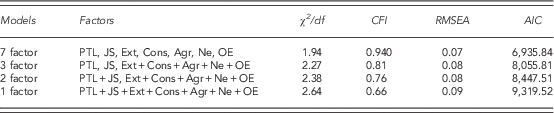
We performed a series of CFA to verify the distinctiveness of the constructs (i.e., study variables) in this study. However, before conducting CFA, we screened the data for accuracy and normality. For normality assumptions, outliers and univariate distributions were scanned for skewness and kurtosis scores, and found to be within reasonable ranges (skewness <2; kurtosis values <2). In addition, we inspected multivariate normality with Mardia’s coefficient of the value of kurtosis. No violation for multivariate normality was found in the data. After this initial data screening, we compared four measurement models to check the discriminant validity of the study variables. As shown in Table 1, all of the study variables were assumed to be independent in the seven-factor model. In the three-factor model, five personality factors were combined into one factor; in the second-factor model, five personality factors and other two variables (i.e., job satisfaction and perceived transformational leadership) and lastly in the one-factor model, all variables were bound into one overall factor. As it can be seen from model fit indices in Table 1, three-, two- and one-factor models exhibited poorer fit than the seven-factor model. Besides, the Akaike information criterion used to compare alternative models, was found to be smaller in seven-factor model compared with alternative models. Overall, CFA revealed that the variance among different variables was not same, suggesting the existence of discriminant validity.
Comparison of measurement models for main variables

Note. Agr=agreeableness; AIC=Akaike information criterion; CFI=comparative fit index; Cons=conscientiousness; Ext=extroversion; JS=job satisfaction; Ne=neuroticism; OE=openness to experience; PTL=perceived transformational leadership; RMSEA=root mean square error of approximation.
Although it was found to be superior to other models in terms of several fit indices, seven-factor model did not initially provide a good fit to the data (χ2 [3,390]=6,475.2; p<.001; χ2/df=1.94; comparative fit index [CFI]=0.89; root mean square error of approximation [RMSEA]=0.07). The inspection of standardized factor loadings of the BFI items revealed that three out of 44 (one for extraversion, one for openness to experience and one for neuroticism) were below the criterion of 0.40, and so we decided to delete these items from the model. Additionally, based on modification indices, we determined that the model fit improved substantially (χ2 [3,381]=6,357.8; p<.001, where χ2/df=1.88; CFI=0.91, and RMSEA=0.07) if the error covariance terms were added to some items of job satisfaction (i.e., between job satisfaction items 8 and 10; between items 15 and 16) and perceived transformational leadership (between items 5 and 6). After the aforementioned modifications, standardized factor loadings were examined and all of them found to be significant. We created the composite scores of the study variables by taking the average of the items shown to be statistically related to these study variables in CFA. However, because of the reasons cited in the literature review, we did not calculate composite score for openness to experience construct.
Descriptive statistics
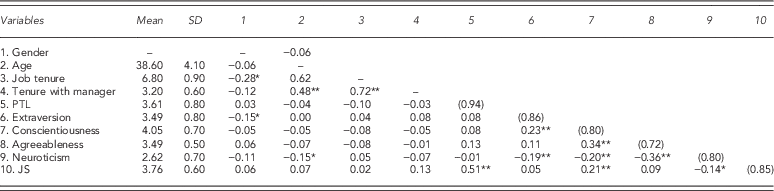
Table 2 lists the means, standard deviations, correlations and Cronbach’s α reliability coefficients for the variables. The correlations between variables provide initial support for the hypotheses, such that perceived transformational leadership is positively correlated with job satisfaction (r=0.505, p<.01). Among the personality traits, job satisfaction is positively correlated with conscientiousness (r=0.210, p<.01) and negatively correlated with neuroticism (r=−0.140, p<.05). As the demographic variables did not significantly correlate with the outcome variable of, we did not use them as control variables.
Descriptive statistics, α coefficients and correlations among Study 1 variables

Note. N=221.
Gender is coded as 0=woman, 1=man.
Cronbach’s α coefficients are in parentheses in the diagonal.
JS=job satisfaction; PTL=perceived transformational leadership.
* p<.05, ** p<.001.
Hypotheses testing for moderating effects of personality traits
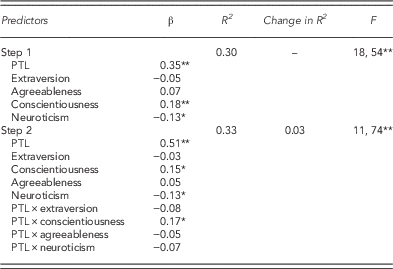
For testing the moderating effects of the personality traits on transformational leadership–job satisfaction linkage, we conducted moderated multiple regression analysis with job satisfaction as the dependent variable, perceived transformational leadership as the independent variable and the four personality traits as the moderators. Consistent with the recommendations of Cohen, Cohen, West, and Aiken (Reference Cohen, Cohen, West and Aiken2003), we mean centred the independent variable and the moderator variables just before computing the interaction term in order to reduce the multicollinearity problem. In the first step of the hierarchical regression analysis, we entered the independent variable and the moderator to the regression equation, whereas we added the interaction terms to the model in the second step. Table 3 provides the hierarchical regression findings where moderation is probed.
Hierarchical regression analysis for predicting job satisfaction

Note. N=221.
PTL=perceived transformational leadership.
**p<.01, *p<.05.
As evident in Table 3, perceived transformational leadership and personality traits accounted for 30% of the variance in job satisfaction (F(5, 216)=18.54; p<.001). Among the direct effects, the β coefficients for transformational leadership (β=0.351, p<.01), conscientiousness (β=0.181, p<.05) and neuroticism (β=−0.135, p<.01) were significant. The second step of the regression model was also significant, and the set of transformational leadership×personality product terms explained a significant incremental variance in job satisfaction (F(9, 211)=11.74; p<.001; ΔR 2=0.032). Among the direct effects perceived transformational leadership (β=0.516, p<.01), conscientiousness (β=0.150, p<.05) and neuroticism (β=−0.150, p<.05) were significant. The finding regarding the direct effect of perceived transformational leadership on job satisfaction supports Hypothesis 1. Among the interaction terms, the term between transformational leadership×conscientiousness (β=0.172, p<.05) was statistically significant. This result supports Hypothesis 3, regarding the moderating effect of conscientiousness on the relationship between transformational leadership and job satisfaction. However, contrary to the predictions of Hypotheses 2, 4 and 5, the moderating effects of neuroticism, extraversion and agreeableness, respectively, on the transformational leadership–job satisfaction linkage were not supported.
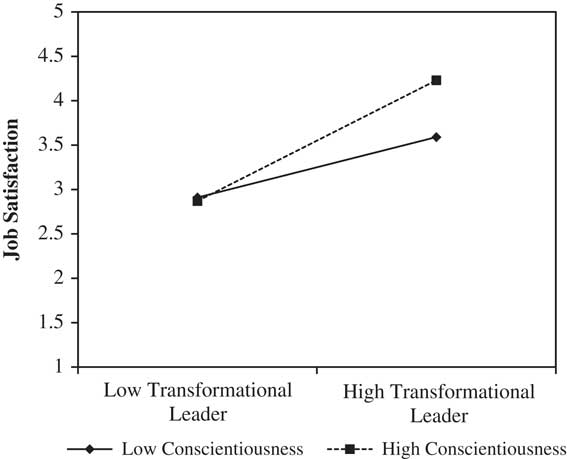
In order to illustrate the interaction effect, we plotted the regression of the dependent variable on the independent variable by taking 1 SD above and 1 SD below the mean of the moderating variable, as Cohen et al. (Reference Cohen, Cohen, West and Aiken2003) recommend. Figure 2 shows how the relationship between transformational leadership and job satisfaction varies as a function of the conscientiousness trait. A simple slope for the association between transformational leadership and job satisfaction was also tested for low, moderate and high levels of conscientiousness. Simple slope revealed a positive association for moderate (t=7.82, p<.00) and high levels of conscientiousness (t=6.45, p<.00). That is, the form of the moderating effect is consistent with Hypothesis 3, such that the more conscientious the individual, the stronger the relationship between perceived transformational leadership and job satisfaction.
The interactive influence of perceived TL and conscientiousness on job satisfaction

Study 2
As noted earlier, Study 2 provides an examination regarding the mediating role of psychological empowerment on the relationship between perceived transformational leadership and job satisfaction. In this respect, the study looks beyond the dispositional characteristics investigated in the first study and explores the underlying processes by which followers’ perceptions of their leaders as more transformational precipitate influence on job satisfaction.
Study 2 method
Participants
The participants for Study 2 were 348 academics working in the engineering departments of three universities in Ankara, Turkey. These departments undertake technological projects and allow opportunities for managing knowledge work, displaying innovative and creative behaviours and thus self-improvement, all of which reinforce the relevant factors of transformational leadership and psychological empowerment in organizations (Garcia-Morales, Jiménez-Barrionuevo, & Gutiérrez-Gutiérrez, Reference Garcia-Morales, Jiménez-Barrionuevo and Gutiérrez-Gutiérrez2012).
Of the respondents, 216 were male (62.24%) and 131 female (37.8%), with an average age of 37.8 and an organizational tenure of 5.7 years. One participant did not provide gender information.
Measures
Multifactor Leadership Questionnaire
In accordance with Study 1, we used the same Multifactor Leadership Questionnaire (Form 5X-Short) (Bass & Avolio, Reference Bass and Avolio1995) in Study 2. We found the Cronbach’s α reliability coefficient of the scale to be 0.93.
Psychological empowerment scale
Followers’ psychological empowerment perceptions were assessed using Spreitzer’s (Reference Spreitzer1995) psychological empowerment scale. For each of the four psychological empowerment components (meaning, competence, self-determination and impact), the scale contains three items, for a total of 12 items. Sample items are as follows: ‘The work I do is meaningful to me’ and ‘I have mastered the skills necessary for my job’. Participants were asked to evaluate each item by providing five alternatives, scoring from 1=‘strongly disagree,’ to 5=‘strongly agree’. Higher scores specify the perception of being more psychologically empowered. Since the psychological empowerment dimensions combine to provide a total empowerment score (Spreitzer, Reference Spreitzer1995), we used an overall measure of psychological empowerment in our analyses. The Turkish adaptation of the instrument was borrowed from Ergeneli, Saglam Ari, and Metin (Reference Ergeneli, Saglam Ari and Metin2007). The Cronbach’s α coefficient was 0.85.
Job satisfaction
As in Study 1, the 20-item short form of the Minnesota Satisfaction Questionnaire (MSQ) was used to assess employee satisfaction. Cronbach’s α coefficient was found to be 0.89.
BFI
As in Study 1, employee’s personality traits were measured with the 44-item BFI developed by John, Donahue, and Kentle (Reference John, Donahue and Kentle1991). Cronbach’s α coefficients for each personality trait was found to be satisfactory (α=0.76 for extroversion; α=−0.79 for conscientiousness; α=0.70 for agreeableness; α=0.76 for neuroticism; α=0.80 for openness to experience.
Procedure
All the data were collected and administered on site during work time. Questionnaires were distributed to participants on convenience method, meaning that only academics who were in their offices when the questionnaires were distributed took part in the study. When the aim of the study was introduced, confidentiality and anonymity were assured, and informed consent was obtained from all participants. No incentives were offered. Out of the 450 questionnaires distributed, 348 questionnaires were returned, for a response rate of 77.3%.
As the data for Study 2 were collected from a single source, we again performed Harman’s single-factor test, examining the unrotated factor solution to determine the number of factors that accounted for the variance in the variables (Podsakoff et al., Reference Podsakoff, MacKenzie, Lee and Podsakoff2003). Principal component analysis produced nine factors, with the first factor explaining 27.8% of the variances. This result gives confidence that no single factor accounted for a majority of the covariance and no general factor was apparent, suggesting that common method variance is not a serious issue in this study (Podsakoff & Organ, Reference Podsakoff and Organ1986). As in Study 1, we made common method factor model test to verify the results of Harman’s single factor test. The addition of common method factor to the measurement model deteoriated the model fit (Δχ2 [df=63]=1,365.3; p<.05). Except for one job satisfaction item, all of the standardized factor loadings were found to be significant in both with and without common factor models. These results together with the results of Harman’s single factor test suggested that common method variance problem was not a serious factor for this study.
Study 2 results
Preliminary analysis
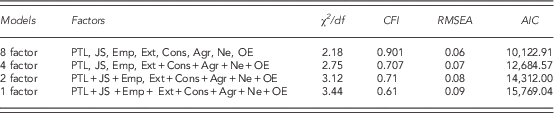
As in Study 1, we performed a series of CFA to check the existence of discriminant validity and to verify whether items were able to measure the constructs that they had been supposed to measure. Normality and outlier analyses did not reveal any problems. After this initial data screening, we compared four measurement models listed in Table 4. All of the study variables were assumed to reflect independent constructs in the eight-factor model. In the four-factor model, five personality factors were combined into one factor; the remaining variables were assumed to be independent factors. In the second-factor model, five personality factors and other three variables (i.e., job satisfaction and perceived transformational leadership) were assumed to measure two independent factors and lastly in the one-factor model, all variables were bound into one overall factor.
Comparison of measurement models for main variables in Study 2
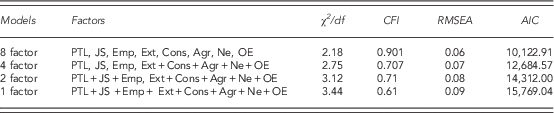
Note. Agr=agreeableness; AIC=Akaike information criterion; CFI=comparative fit index; Cons=conscientiousness; Emp=empowerment; Ext=extroversion; JS=job satisfaction; Ne=neuroticism; OE=openness to Experience; PTL=perceived transformational leadership; RMSEA=root mean square error of approximation.
As it can be seen from model fit indices in Table 4, four-, two- and one-factor models exhibited poorer fit than the eight-factor model. Comparison of alternative models with the Akaike information criterion again supported the superiority of seven-factor model (Akaike information criterion of seven-factor model was found to be smaller in seven-factor model compared with alternative models). Comparison of different measurement models revealed that the variance among different variables was not same, suggesting the existence of discriminant validity among study variables.
The closer examination of modification indices and standardized factor loadings of eight-factor model suggested the existence of some problems. The standardized factor loading of one job satisfaction item (i.e., item 8) was lower than the threshold value of 0.40 and some error covariance terms were found to be correlated. Considering the independency of factors principle, we decided to add error covariance terms between some items (i.e., between perceived transformational leadership items between 1 and 2 and between transformational leadership items between 13 and 14). After the modifications, the model improved and supported a acceptable fit (χ2 [4,448]=9,605.36; p<.001; χ2/df=2.16; goodness of fit index (GFI)=0.90; confirmatory fit index (CFI)=0.89; and root mean square error approximation (RMSEA)=0.06). Since all of the factor loadings were found to be significant, the scores of each study variable were calculated by taking the average of the scale items. However, as indicated before, one job satisfaction item was not taken into consideration when calculation job satisfaction scores of employees. As in Study 1, the composite score for openness to experience was not calculated.
Descriptive statistics
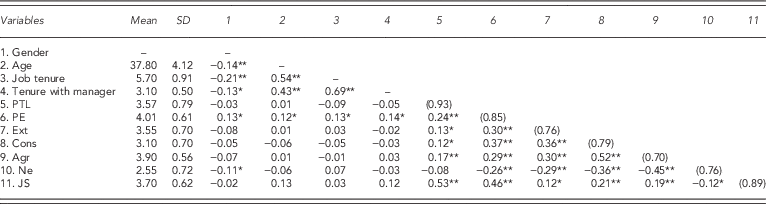
Means, standard deviations and intercorrelations among the variables are presented in Table 5. The correlations between variables provide initial support for our hypotheses, such that perceived transformational leadership is positively correlated with job satisfaction (r=0.530, p<.01) and with psychological empowerment (r=0.153, p<.01). Moreover, psychological empowerment is positively correlated with job satisfaction (r=0.459, p<.01). As the demographic variables did not significantly correlate with the outcome variable of job satisfaction, we rendered them as control variables.
Descriptive statistics, α coefficients and correlations among Study 2 variables

Note. N=348.
Gender is coded as 0=woman, 1=man.
Cronbach’s α coefficients are in parentheses in the diagonal.
Agr=agreeableness; Cons=Conscientiousness; Ext=extroversion; JS=job satisfaction; Ne=Neuroticism; PE=psychological empowerment; PTL=perceived transformational leadership.
*p<.05, **p<.001.
Hypotheses testing for the mediating effect of psychological empowerment
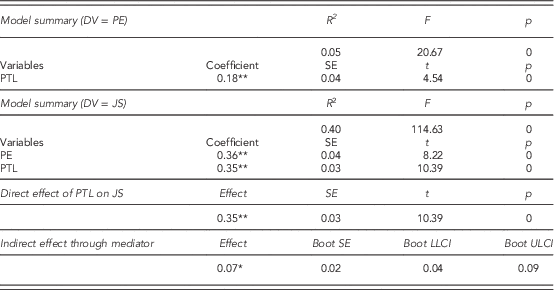
The hypothesized relationships were tested by Hayes and Preacher’s (Reference Hayes and Preacher2014) mediation procedure. The analysis was run for job satisfaction as the dependent variable, perceived transformational leadership as the independent variable and psychological empowerment as the mediator. Table 6 shows the β coefficients for the direct and indirect effects and bootstrap confidence intervals.
Results of the mediation analysis

Note. N=348.
DV=dependent variable; JS=job satisfaction; PE=psychological empowerment; PTL=perceived transformational leadership; LLCI=lower limit of confidence interval; ULCI=upper limit of confidence interval.
*p<.05, **p<.00.
As Table 6 shows, a significant positive association is observed between employee perceptions of transformational leadership and job satisfaction (β=0.35, p<.05), supporting Hypothesis 1. Moreover, a significant indirect effect of transformational leadership perceptions on followers’ job satisfaction through psychological empowerment was also observed (β=0.06, 95% bootstrap confidence interval=0.03–0.09; R 2 effect size=0.09), providing support for Hypothesis 5. The Sobel test was also significant (z=3.95, p<.01), which illustrates that psychological empowerment acts as a mediator between perceived transformational leadership and job satisfaction. That is, when employees perceive their leader as transformational, they feel more psychologically empowered, which increases their job satisfaction levels.
Using the data collected about personality traits, we combined the moderation model tested in Study 1 and mediation model tested in Study 2. Accordingly, we tested the moderating effect of personality traits on the mediated model in which empowerment mediates the relationship between perceived transformational leadership and job satisfaction. Using the model 59 specified in the Process macro (Hayes, Reference Hayes2013), we tested whether personality traits moderate the relationship between (1) transformational leadership and psychological empowerment; (2) psychological empowerment and job satisfaction; and (3) perceived transformational leadership and job satisfaction. Except conscientiousness, none of the personality variables moderated the aforementioned relations. The moderating effect of conscientiousness on the linkage between perceived transformational leadership and job satisfaction was found to be significant (β=0.21; t=2.20; p=.04). This finding seems to be in line with the findings obtained in Study 1 such that perceived transformational leadership seems to have stronger positive relationships with job satisfaction among employees high in conscientiousness.
General Discussion
The purpose of this research is to enhance the understanding of the link between perceived transformational leadership and job satisfaction by focussing on followers’ personality traits and followers’ psychological empowerment. Our findings concerning both studies suggest three main conclusions. First, consistent with previous studies (Podsakoff, MacKenzie, Moorman, & Fetter, Reference Podsakoff, MacKenzie, Moorman and Fetter1990; Piccolo & Colquitt, Reference Piccolo and Colquitt2006; Braun et al., Reference Braun, Peus, Weisweiler and Frey2013), we find a positive direct (Study 1) and indirect association (Study 2) between perceived transformational leadership and job satisfaction. That is, perceived transformational leadership serves as an informative framework in examining the predictors of job satisfaction. This finding suggests that when employees regard their leaders as more transformational they become more satisfied with their jobs. Since transformational leaders motivate their followers to perform beyond expectations (Keegan & Hartog, Reference Keegan and Hartog2004) and transmit a sense of mission and intellectual stimulation (Bass, Reference Bass1985) it seems reasonable that perceived transformational leadership could intrinsically foster more job satisfaction.
Second, as an important contribution to the literature, we tested the moderating roles of followers’ personality traits on the relationship between perceived transformational leadership and job satisfaction by focussing on a follower-centred perspective. The results of Study 1 provide evidence for the moderating effects of conscientiousness on the perceived transformational leadership–job satisfaction linkage. That is, perceived transformational leadership consistently yields stronger positive relationships with job satisfaction among employees high in conscientiousness compared with employees low in conscientiousness. This finding is partly in line with researchers (Howell, Dorfman, & Kerr, Reference Howell, Dorfman and Kerr1986; Shamir, House, & Arthur, Reference Shamir, House and Arthur1993; Epitropaki & Martin, Reference Epitropaki and Martin2005) who argue that followers’ personality traits may moderate the relationship between TL behaviours and organizational outcomes. A possible explanation for the moderating effect of conscientiousness on the perceived TL-job satisfaction linkage might be attributed to specific forms of self-fulfilling prophecies, such as the Pygmalion and Galatea effects. ‘The Pygmalion effect is a type of self-fulfilling prophecy in which raising manager expectations regarding subordinate performance boosts subordinate performance’ (Eden, Reference Eden1992: 271). That is, when leaders communicate high expectations to their followers, the followers may expect high expectations from themselves and perform much better. The Galatea effect is a self-driven phenomenon where individuals’ own opinions about their abilities and self-worth ideas influence their performance. It assumes that when followers expect more of themselves, these expectations will in turn enhance their performance (Eden, Reference Eden1992). In the Pygmalion effect, followers work towards meeting the expectations that are set by their leaders, whereas in the Galatea effect an individual sets expectations for himself or herself and strives to live up to them. As individuals who are high in conscientiousness have a tendency to attain more challenging goals that are set by leaders, it seems reasonable that Pygmalion effect might increase the strength of the relationship between perceived TL and job satisfaction specifically for conscientious followers.
High conscientious followers exhibit higher levels of sustained effort, which in turn may lead them to perform better. When such followers perceive their leaders’ behaviours as transformational, because of the Galatea effect, their expectations of themselves may increase, they may perform better and at the end feel relatively higher job satisfaction. However, one should be cautious about this kind of inference, as our study did not assess but merely suggests possible Galatea and Pygmalion effects.
Contrary to our initial expectations, we failed to find any significant moderating effects of extraversion, agreeableness and neuroticism on the relationship between perceived transformational leadership and job satisfaction. To author’s knowledge, as there has been no research exploring the possible moderating effects of personality traits on the stated relationship, we believe that this finding is an important contribution to the literature. Alternatively, apart from followers’ personality traits, other factors might interact with perceived transformational leadership in its relationship with job satisfaction. In this respect, individuals’ cultural value dimensions might be an intriguing factor. Some scholars argue that followers’ responses to transformational leadership and how transformational leadership affects work-related attitudes may not be consistent across cultures (Bass Reference Bass1997; Ergeneli, Gohar, & Temirbekova, Reference Ergeneli, Gohar and Temirbekova2007). There exists evidence that collectivistic culture orientations influence perceived transformational leadership and work-related outcomes (Walumbwa & Lawler, Reference Walumbwa and Lawler2003). Thus, the collectivistic culture of Turkish followers (Hofstede, Reference Hofstede1980) might lead them to expect their leaders to exhibit transformational leadership behaviours (Bass, Reference Bass1995), and such followers might readily respond to transformational leadership practices (Gumusluoglu & Ilsev, Reference Gumusluoglu and Ilsev2009). So, apart from personality characteristics, one might argue that cultural value orientations might cause followers to perceive their managers as more or less transformational.
Although not directly hypothesized, concerning the direct effects of personality traits on job satisfaction, we found a positive relationship for conscientiousness and a negative relationship for neuroticism in line with other studies made in Turkey (Camgoz & Karapinar, Reference Camgoz and Karapinar2011; Gümüşsoy, Reference Gumusluoglu, Karakitapoğlu-Aygün and Hirst2016). More specifically, congruent with prior research, our findings demonstrate that individuals who are high in conscientiousness report higher levels of job satisfaction (Winkelmann & Winkelmann, Reference Winkelmann and Winkelmann2008; Templer, Reference Templer2012), whereas individuals who are high in neuroticism report lower levels of job satisfaction (Connolly & Viswesvaran, Reference Connolly and Viswesvaran2000; Judge, Heller, & Mount, Reference Judge, Heller and Mount2002; Kim & Chung, Reference Kim and Chung2014).
The third conclusion of this research pertains to the findings of Study 2. In exploring the ‘black box’ of how perceived transformational leadership influences job satisfaction (Avolio et al., Reference Avolio, Zhu, Koh and Bhatia2004), we demonstrate that feelings of psychological empowerment mediate the relationship between perceived transformational leadership and job satisfaction. Based on the current sample of engineering academics, the results suggest that psychological empowerment partially mediates the relationship between perceived transformational leadership and job satisfaction. The findings imply that psychological empowerment is an important mechanism through which perceived transformational leadership exerts its effect on job satisfaction. That is, when followers perceive their leader as more transformational, they feel more psychologically empowered, which in turn contributes to increased levels of job satisfaction. This finding provides support to Bass’s (Reference Bass1999) argument that transformational leadership may act through psychological empowerment in influencing work outcomes. Further, our findings confirm previous research (Fuller, Morrison, Jones, Bridger, & Brown, Reference Fuller, Morrison, Jones, Bridger and Brown1999; Hechanova, Alampay, & Franco, Reference Hechanova, Alampay and Franco2006; Wang & Lee, Reference Wang and Lee2009) and also the studies made in Turkey (Gürbüz, Reference Gürbüz2009; Bitmiş & Ergeneli, Reference Bitmiş and Ergeneli2011; Pelit, Öztürk, & Arslantürk, Reference Pelit, Öztürk and Arslantürk2011) demonstrating that empowered followers are likely to have higher levels of job satisfaction.
Limitations and future research
This study is not without its limitations. The first concerns the use of a cross-sectional design, which does not allow for an assessment of causality. Further research using longitudinal designs might infer the causality of the relationships studied here. Second, this paper relies on data collected from academics and white-collar employees working in R&D at various information technology companies therefore participants are highly educated. It is possible that differences emanating from occupational classification (white/blue collar) and/or organizational culture or even national culture might affect the results. Especially, the unique characteristics of the academic sample (i.e., Study 2) need special consideration. The results reported in Study 2 might be affected by the fact that academics have a lot of autonomy in scheduling and handling their work, and often do not identify their supervisor as a specific leader. Therefore, it is noteworthy to mention that a more diverse sample may provide a different pattern or at least magnitude of results regarding the mediating role of empowerment. Replicating the study with a more heterogeneous sample in different organizations and cultures might increase the generalizability of future research. Third, as the data were collected from a single source (i.e., followers), there might be a potential threat for common method variance. Although several remedies were taken to reduce it (both Harman’s test and CFA indicated the existence of separate constructs), future studies could validate self-reported data on transformational leadership with other sources, such as employee–leader dyads. Fourth, this study utilizes a perceived transformational leadership paradigm from the follower perspective; another avenue for research could consider the assumed similarity theory (Watson, Hubbard, & Wiese, Reference Watson, Hubbard and Wiese2000), which argues the importance of the perceived similarity between the follower and the leader. Schyns and Felfe (Reference Schyns and Felfe2006) found that followers with similar characteristics to transformational leadership leaders perceive more transformational leadership behaviours in their leaders. Therefore, leaders’ personalities could also be included into the model to test the assumed similarity effect and then explore its potential moderating effect on the relationship between transformational leadership and job satisfaction. Last but not least, further research might also explore other situational moderators (i.e., organizational climate, feedback environment) and their relationships with other outcome variables, such as organizational commitment.
Practical implications
There are several practical implications of the current research. In a broad sense, perceived transformational leadership is found to be positively associated with job satisfaction. Prior research has demonstrated that transformational leadership behaviours can be learned (Parry & Sinha, Reference Parry and Sinha2005; Nielsen, Hrivnak, & Shaw, Reference Nielsen, Hrivnak and Shaw2009), and thus encouraging managers to adopt a transformational style in articulating a vision, inspiring employees, recognizing employees’ needs and promoting creativity would likely then result in higher levels of job satisfaction.
The moderating role of followers’ conscientiousness on the relationship between perceived transformational leadership and job satisfaction is the core finding of Study 1. That is, followers high in conscientiousness appraise their leaders as more transformational than those low in conscientiousness, and the former effect is more likely to increase job satisfaction. What implications do these findings hold for managers? For one, managers should acknowledge that to increase job satisfaction levels, emerging as and remaining an effective transformational leadership leader does not depend solely on their own behaviour but also on their followers’ personalities (Felfe & Schyns, Reference Felfe and Schyns2010). That is, when managers express transformational leadership behaviours, it is important to understand that the same behaviour is interpreted differently among employees. Followers high in conscientiousness perceive higher transformational leadership characteristics than their counterparts, and this manifests in higher job satisfaction. Understanding the personality differences of their followers would appear to be a good way for managers to analyse and understand follower feedback, and then behave accordingly. Managers should not hesitate to discuss evaluations of their leadership practices with their followers; in this way, they can gain a better understanding of their followers’ perceptions. Nevertheless, managers should likely expect more support and commitment from conscientious followers.
The mediating role of followers’ psychological empowerment between perceived transformational leadership and job satisfaction is the core finding of Study 2. That is, by creating a greater sense of empowerment, one can inspire, albeit indirectly, higher levels of job satisfaction. Managers who wish to enhance their followers’ job satisfaction should be aware and capable of increasing followers’ psychological empowerment by fostering goal internalization, creating a sense of choice and impact, and making followers feel that they have some choice in their work lives. Moreover, how managers demonstrate transformational types of leadership behaviours highly affects psychological empowerment feelings. For instance, by helping employees to become more innovative and creative, managers may engender feelings of competence. Additionally, by creating opportunities for followers to make changes in their own work, managers may increase employees’ feelings of impact and choice (Rafferty & Griffin, Reference Rafferty and Griffin2004). Further, managers could be more sensitive to followers’ developmental needs and support and coach their followers, which may foster self-determination and impact, thereby result in more intrinsic job satisfaction.
Conclusion
The aim of this paper is to investigate the moderating effects of personality traits (i.e., extraversion, conscientiousness, agreeableness and neuroticism) and the mediating effect of psychological empowerment on the relationship between perceived transformational leadership and job satisfaction. Although much progress has been made in how perceived transformation leadership affects employees’ attitudes towards their job, studies addressing the moderating and mediating effects on transformational leader–follower attitudes linkage are relatively rare. Understanding the moderating effects of followers’ personality traits may enhance the understanding of the dispositional predictors of job satisfaction, which would be helpful for devising proper employee selection, training and development programs. Furthermore, by demonstrating the key role of empowerment on perceived transformational leadership and job satisfaction, this study hopefully draws attention to the positive effects of delegation and participative management.
Acknowledgement
This research received no specific grant from any funding agency, commercial, or not-for-profit sectors. All authors have read and approved the paper and have met the criteria for authorship listed above.
Conflicts of Interest
None.