Introduction
Three Seleucid-Parthian period (c. 300 b.c.e.–200 c.e.) reclining female terracotta figurines from Babylon have been associated with the University of Pennsylvania Museum's Nippur corpus for the last one-hundred years, and are still often referred to as Nippur objects in scholarly publications. Through a historiographical analysis of the excavation documents, travel journals, and comparative archaeological material, this article reconstructs how and why this misleading connection (and, in some publications, false provenance) was established and perpetuated. As no reclining female figurines were recovered from the Nippur excavations, despite the popularity of such figurines at the other major cities of Seleucid-Parthian Babylonia, the purchase and publication of Babylon figurines with the Nippur corpus seems to have been motivated by the intent to fill out what was likely perceived as a gap in the Nippur evidence.
These nineteenth- and early twentieth-century actions—and the three, seemingly minor terracotta figurines with which they were concerned—have had unexpectedly significant consequences for the ways in which later scholars have understood the Nippur figurine corpus as a whole. In 1930, Van Buren labelled all three figurines as Nippur material in her comprehensive figurine catalogue (that is still used as a major reference work), and building upon that misassociation, she also repeated the Nippur attribution offered by an antiquities dealer who sold eight reclining female figurines to the Harvard Semitic Museum. As I will demonstrate, this Nippur attribution for the Harvard Semitic Museum's figurines should be questioned, and may be inauthentic. Due, however, to the publication of this information, an erroneous association of reclining female figurines with Seleucid-Parthian Nippur has persisted: as recently as 2014, Menegazzi referred to reclining female figurines from Nippur in her catalogue of Seleucia-on-the-Tigris figurines.
Once these reclining female figurines from Babylon are firmly disentangled from their Nippur associations, important regional differences emerge in the figurine traditions of Seleucid-Parthian Babylonia. The last section of this article presents an art historical interpretation of the reclining female figurines, which fit within a broader Seleucid-Parthian period trend of hybrid Greek-Babylonian imagery. These figurines’ specific depictions of recumbent banqueting were largely derived from Greek tradition, and may be entangled with the use of pan-Hellenistic ceramic tableware and Greek foodways in Babylonia. Revealingly, the absence of reclining female figurines at Nippur correlates with archaeological evidence of a similar unpopularity of pan-Hellenistic ceramics at Nippur. Together this suggests that the people of Nippur largely rejected the negotiated Greek-Babylonian social practices of banqueting. This significant difference between Nippur and its neighbours during the Seleucid-Parthian period has been obscured for over one-hundred years due to the misassociation of Babylon figurines with the Nippur corpus—a compounding error with broad implications that this article is the first to definitively correct.
Misattribution, part I: Purchase of Babylon figurines and association with the Nippur corpus
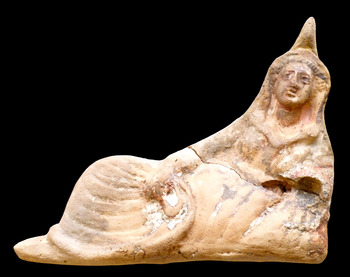
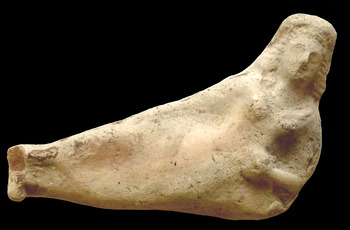
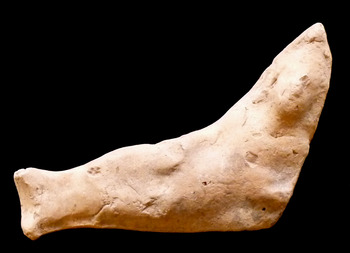
Among the published corpus of the excavated finds from the site of Nippur, catalogued and housed in the University of Pennsylvania Museum, lie three terracotta figurines of Seleucid-Parthian date that do not belong. These three figurines, known by their museum accession numbers as B9121 (Fig. 1), B9122 (Fig. 2) and B9000 (Fig. 3), each depict a female figure who reclines on her left side with her upper body held erect by placing weight on the bent left arm. These three reclining female figurines were purchased by the original excavators of Nippur; however, they were not obtained in the vicinity of the site. B9122 is noted in the University of Pennsylvania museum records as “Probably from Babylon. Bought at Hillah by the first Nippur expedition” (note that this object will be referred to as "from Babylon" throughout this article for ease of phrasing; however, the reader should be aware that this Babylon provenance is quite likely, but not completely certain). B9121 and B9000 are noted to have been purchased at the site of Babylon.Footnote 2 This suggests that the Nippur excavators were fully aware that these figurines most likely came from the city of Babylon, approximately fifty-three miles (as the crow flies) from the ancient city of Nippur. Why, then, did they acquire them?Footnote 3 And why would they keep such figurines with the Nippur collection? In order to document the misassociation of these three figurines with the site of Nippur—as well as to understand the reasoning behind it—the history of the excavation must be analysed.
Terracotta figurine of reclining female figure (B9121), Length: 16.2 cm, Babylon. (Photograph by author; printed courtesy of the University of Pennsylvania Museum).

Terracotta figurine of reclining female figure (B9122), Length: 13.5 cm, probably from Babylon. (Photograph by author; printed courtesy of the University of Pennsylvania Museum).

Terracotta figurine of reclining female figure (B9000), Length: 8.4 cm, Babylon. (Photograph by author; printed courtesy of the University of Pennsylvania Museum).

Excavations at Nippur (also called Niffer) were begun in 1889, by a University of Pennsylvania team directed by H.V. Hilprecht (Professor of Assyriology and later named as the first Curator of the Babylonian Section at the University of Pennsylvania Museum), and John Punnett Peters, Professor of Hebrew.Footnote 4 The first expedition was fraught with obstacles and practical difficulties, with the result that the team was only able to spend six weeks at Nippur.Footnote 5 Despite this short excavation season, there was strong pressure on all of the excavators involved in the expedition to bring back ancient artefacts, for study and display, in order to justify a return trip to the site—as well as fill the University of Pennsylvania's fledgling museum with objects.Footnote 6 Peters in particular was “deeply worried…and anxious to secure tangible results, in the shape of tablets and portable antiquities”,Footnote 7 and purchasing objects from local dealers was one strategy used to meet such goals.Footnote 8 The permit that the first Nippur Expedition team had obtained from the Ottoman government allowed them to not only excavate, but also “to purchase any excavated antiquities the Turkish authorities did not want”—permission that Hilprecht especially seems to have exercised.Footnote 9 Peters, in his volumes chronicling the Nippur excavation, recounts several episodes when Hilprecht purchased objects offered by antiquities dealers, and in some cases makes explicit the fact that Hilprecht was doing so with official monies “placed in Hilprecht's hands for this purpose” by the University of Pennsylvania,Footnote 10 in order to stock their collection of ancient artefacts.Footnote 11 These efforts on the part of Peters and Hilprecht during the first Nippur expedition seem to have convinced the University: “the results of the first season's work were considered sufficiently encouraging to warrant the despatch [sic] of a second expedition the next season…”.Footnote 12 All three of the figurines with which this article is concerned were among the many objects purchased in these first two years of the Nippur expedition.
Yet, the scholars of the Nippur expedition did more than just buy objects. The three reclining terracotta figurines from Babylon were mixed in with the legitimately excavated Nippur finds and kept with that corpus, even as the records of their Babylon origin were preserved. This comingling is curious, since the site of Babylon was famous enough that the University of Pennsylvania Museum might have benefited from having objects attributable to this ancient city—especially female figurines, which could easily have been linked to pagan idols discussed in the Hebrew Bible. The mixing of the Babylon figurines with the Nippur corpus thus appears to have been motivated by more than simply a desire for museum-worthy antiquities.
Hilprecht, likely the original purchaser of the figurines and one of the foremost scholars at the University of Pennsylvania Museum, might have comingled the Babylon figurines with the Nippur corpus for his own personal reasons. In 1904 and 1905, several years after the initial expeditions to Nippur, Hilprecht (while still a professor at the University of Pennsylvania) was accused of having “personally appropriated a bronze stag's head from Nippur…, kept some Museum finds, [and] had romanticized his books on Nippur with incorrect pictures”.Footnote 13 The latter two charges were levelled by Peters, who (as co-leader of the first Nippur expedition) would have been likely to know which objects were purchased and which were excavated.Footnote 14 The investigations of Hilprecht that followed have been dubbed “one of the most celebrated archaeological controversies of all time”.Footnote 15 When Peters was called as a witness before the Court of Inquiry,Footnote 16 he stated that (among other practices), Hilprecht had illustrated his books with “pictures of objects that had really been bought, or found at other times and places”—a charge that was confirmed by several other scholars associated with the Nippur expeditions.Footnote 17 Most of the objects that Peters described were cuneiform tablets; however, it seems possible that figurines might also have numbered among the items that Hilprecht had purchased, or otherwise acquired, and then passed off as legitimate pieces of the Nippur collection. Hilprecht himself defended such practices by arguing that purchased objects “might well have come from Nippur, and in any case typified the material that was from Nippur.”Footnote 18 This scandal effectively ended Hilprecht's career at the University of Pennsylvania; in its aftermath, some of the objects that Hilprecht purchased may have been removed from the Nippur corpus, some may still be contained “in the University Museum's vast collections…,[and] much may have been taken away by Hilprecht when he left the Museum in a rage, supposedly taking off with the keys to the Babylonian Section.”Footnote 19
Yet, despite this scandal and upheaval, the three Babylon figurines remained housed with the Nippur collection—even through several shifts in storage location (such as the move to the new University of Pennsylvania Museum building), the consolidation of the Ancient Near East finds into one room that housed the objects recovered by the excavations at both Nippur and Ur, and the later disentanglement of the Nippur Expedition objects from the rest of the Ancient Near East collections.Footnote 20 While the University of Pennsylvania Museum curators cannot say for certain that B9121, B9122, and B9000 were placed with the Nippur corpus in all of these various storage arrangements, there is no reason to believe that they were not. Even now, the three figurines are stored in a “Nippur” cabinet, albeit on a shelf that is labelled “BAB EXP, MISC SITES” (i.e. “Babylonian Expedition, Miscellaneous Sites”). However, although this shelf's label indicates that all of the objects stored on it are from “miscellaneous” sites (which would seem to imply sites other than Nippur), the shelf also contains Nippur objects as spillover from the other cabinet shelves. Thus, B9121, B9122, and B9000 are not spatially separated from the Nippur figurines in the museum storage arrangements.Footnote 21 In making this observation, I intend no criticism of the University of Pennsylvania Museum or its current staff. Rather, I simply suggest that the modern storage of the Nippur collection is a vestige of the organization practices of the early 1900s, and thus can illuminate the long, and seemingly continuous, history of association between B9121, B9122, and B9000, and the Nippur collection.
The reasons behind this continued association may be linked to the absence of reclining female figurines in the Nippur archaeological record. This “gap” in the Nippur material corpus became apparent as the University of Pennsylvania team continued its Nippur excavation project through the late 1890s (under John Henry Haynes), and began to more thoroughly explore the surrounding Babylonian sites.Footnote 22 In H.V. Geere's narrative of his experiences on the Nippur excavation under the direction of Haynes, he describes how the team members were continually able to see, and were offered the sale of, ancient artefacts from Babylon when they made necessary stops (often for several days or longer) at the nearby town of Hillah during their long journeys back and forth from Baghdad to Nippur.Footnote 23 On such trips, the group often “came in sight of the famous ruins of Babylon” and, during the 1895 trip, they “went out of our way to inspect the traditional Tower of Babel… (then we) rode on towards the modern town [Hillah] which occupies the site of Nebuchadnezzar's famous capital—or rather a part of its site.”Footnote 24 While staying in Hillah, the expedition members “were pestered by dealers in antiquities…We were prohibited by our agreement from purchasing any antiquities, but the examination of those which were brought to us served to pass away some of the time”.Footnote 25
There were no formal archaeological excavations of Babylon underway at this time,Footnote 26 so the artefacts for sale at Hillah likely lay close to the surface of the site where they would have been easy to dig up or collect. Since the Seleucid-Parthian era was the last period of ancient habitation at Babylon, objects (including terracotta figurinesFootnote 27 ) dating to this period would have comprised the majority of surface finds. Despite the fact that the members of the 1895 (and later) Nippur Expeditions were prohibited from purchasing Seleucid-Parthian figurines from Babylon, they still would have seen them, year after year, trip after trip—and thus would have been intimately familiar with, and able to assess for themselves, the variety of figurines that Seleucid-Parthian Babylon offered. This assessment of Seleucid-Parthian figurines from Babylon would have been especially significant during the several-day stops in Babylon/Hillah that were necessary for artefact cleaning and packing when the team was transporting excavated Nippur objects out of Iraq.Footnote 28 The staging of this packing process at Hillah meant that the Nippur figurines (and other artefacts) would have been seen, handled, and perhaps re-evaluated against the immediate backdrop of Babylon artefacts being offered for sale by local dealers.Footnote 29
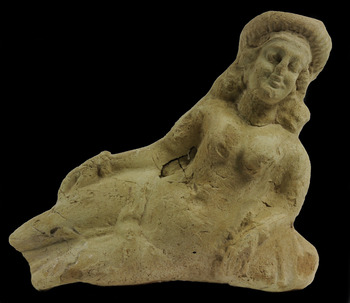
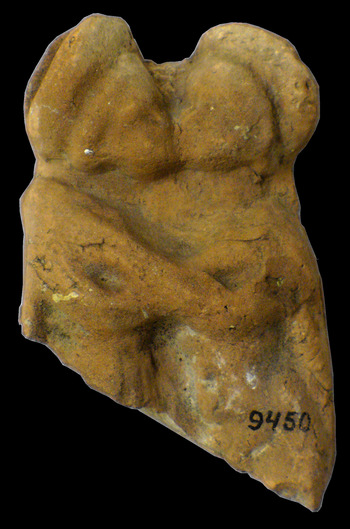
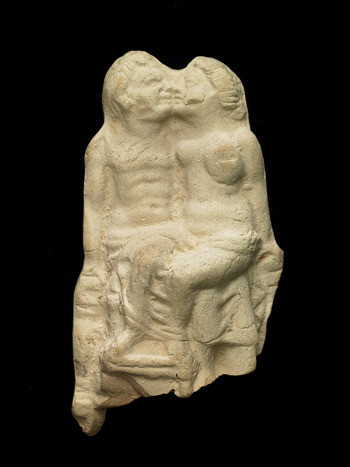
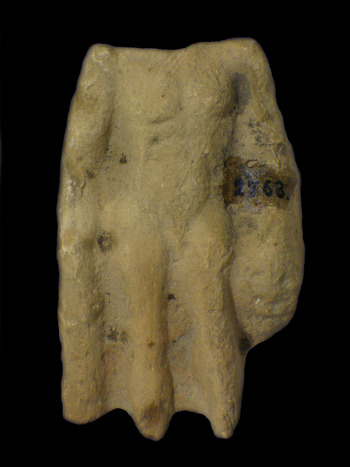
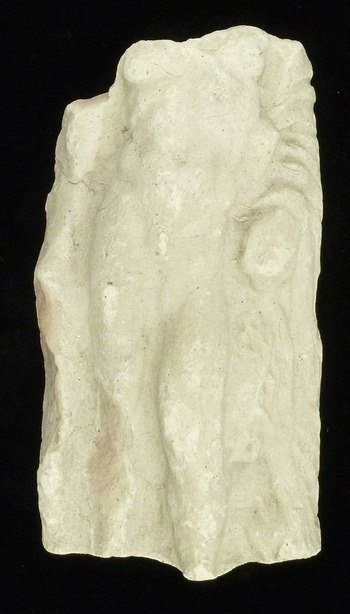
The three figurines under discussion in this article (B9121, B9122, B9000) were purchased during the first two seasons of the excavation; thus, repetitive exposure to the figurines from Babylon cannot explain their initial purchase. However, this continued exposure to the variety of Seleucid-Parthian figurines from Babylon (and, to a lesser extent, from Seleucia-on-the-TigrisFootnote 30 ) might explain why the later scholars on the Pennsylvania expedition and at the University of Pennsylvania Museum decided to embed B9121, B9122, and B9000 within the Nippur collection. Sizable numbers of reclining female figurines existed at both Babylon and Seleucia-on-the-Tigris (for an example from Seleucia-on-the-Tigris, see Fig. 4).Footnote 31 In general, the Seleucid-Parthian figurine corpus from Nippur is similar to that of Babylon and Seleucia-on-the-Tigris; many of the motifs, manufacturing techniques, and clay composition of figurines were shared among the major cities of Babylonia during this era.Footnote 32 For instance, similar figurines depicting embracing couples have been excavated at both Nippur (Fig. 5) and Babylon (Fig. 6); although the precise pose differs, both examples share the general motif, the awkward joining of the faces, and even the grainy yellowish tint of the clay. In another example of shared features, a figurine depicting a nude male torso, possibly Herakles, excavated at Nippur (Fig. 7), is similar in motif, style, and size to a nude male figurine excavated at Seleucia-on-the-Tigris (Fig. 8). Based on this substantive overlap of the Seleucid-Parthian terracotta figurine corpora of Seleucia-on-the-Tigris, Babylon, and Nippur, the excavators at Nippur could reasonably have expected to discover reclining female figurines in Seleucid-Parthian era contexts at their site—yet none were found. This absence of reclining female figurines in the Nippur corpus would easily have become apparent to the University of Pennsylvania team, year after year, whenever they packed and transported their Nippur finds at Hillah while simultaneously being offered Babylon figurines for sale by local dealers. I therefore propose that the continued storage and association of B9121, B9122, and B9000 with the Nippur collection was likely not accidental, and may have been designed to fill a perceived gap in the archaeological evidence from Nippur.
Terracotta figurine of reclining female figure (M14552), Length: 9.4 cm, Seleucia-on-the-Tigris (Photograph courtesy of Roberta Menegazzi and the Kelsey Museum of Archaeology, University of Michigan).

Terracotta figurine of embracing couple (B9450), Height: 9.3 cm, Nippur (Photograph by author, printed courtesy of the University of Pennsylvania Museum).

Terracotta figurine of embracing couple (BM Sp. III 21+ = 91789), Height: 11 cm, Babylon (Photograph © The Trustees of the British Museum).

Terracotta figurine of nude male torso (B2768), Height: 9.3 cm, Nippur (Photograph by author, printed courtesy of the University of Pennsylvania Museum).

Terracotta figurine of nude male torso (M15544), Height: 9.5 cm, Seleucia-on-the-Tigris (Photograph courtesy of the Kelsey Museum of Archaeology, University of Michigan).

The sizes of the figurines themselves lend support to the notion that these objects were methodically collected, and then deliberately kept, as representative samples of a figurine type otherwise unattested at Nippur. Most complete terracotta figurines from Hellenistic Babylonia fall roughly in a size range of 8–20 centimetres in height (which, in the case of reclining figurines, translates to a scale of width). The three figurines acquired from Babylon by the Nippur expeditions fall at very different points on this sizing spectrum: B9121 is 16.2 centimetres, B9122 is 13.5 centimetres, and B9000 is 8.4 centimetres in width. The three reclining figurines together give a visual impression of “Large, Medium, and Small” sizing, as if the scholars who purchased them, and then kept them stored with the Nippur collections, were attempting to simulate the range of reclining figurines found at Babylon through this supplement to the Nippur corpus.
But perhaps the most compelling evidence for regarding this continued misassociation as deliberate is the fact that it is (nearly) unique. Judging from the extensive object purchases made by Hilprecht and others in the early years of the Nippur Expedition, these three reclining female figurines likely represent only a small fraction of the total number of figurines bought by the team. However, B9121, B9122, and B9000 were among the only non-Nippur figurines that remained firmly connected with the Nippur collection through the following decades. Just two other Babylon figurines were similarly kept and published with the Nippur collection (B8956 and B8957), both of which also filled “gaps” in the Nippur corpus.Footnote 33 There must have been an unfavourable evaluation of the University of Pennsylvania's Nippur collection in comparison with the Seleucid-Parthian figurine corpora of the other Babylonian cities, and a recognition of lacunae, which motivated the continued association of B9121, B9122, and B9000 with Nippur.
Misattribution, part II: Publication of the Babylon figurines with the Nippur corpus
Publication of these three Babylon figurines with the Nippur corpus was the second step of the misattribution process. In 1930, Leon Legrain published his catalogue, entitled Terra-cottas from Nippur, which included B9121, B9122, and B9000. These three figurines were published not only in the same volume as the Nippur figurines, but were mixed in with them. Legrain integrated B9121, B9122, and B9000 seamlessly into his presentation of Nippur figurine typology, and listed them as numbers 144, 145, and 146 out of 445 figurines (thus failing to distinguish the Babylon figurines as separate by placing them at the beginning or end of the catalogue).
In his introduction to the volume, Legrain lays out the organization of his typology, in which B9121, B9122, and B9000 are included as the only examples of the type he calls “Reclining on a funeral couch”—a type placed under the category “Neo-Babylonian, Persian, Greek, and Parthian Periods”, and the sub-category “Dressed feminine figures”, both of which are implied by the format and the title of the book to contain only Nippur material.Footnote 34 Indeed, there is no mention in the introduction, nor in the typological structure, of the Babylon provenance of these three figurines. In a book clearly entitled Terra-cottas from Nippur, the reader can hardly be blamed for assuming that all the figurines catalogued were found at NippurFootnote 35 —and Legrain does nothing in his introduction to negate that assumption. Additionally, black and white photographs of B9121, B9122, and B9000 are published among the plates of the volume, with no mention or notation thereon to indicate these figurines were anything other than artefacts from Nippur.Footnote 36
In the “Description of the Figures” section, which comprises the majority of Legrain's volume and contains the detailed description of each figurine, a more accurate impression is given.Footnote 37 For B9122 (Legrain's 144), Legrain provides a lengthy description, which primarily serves to describe the physical appearance of the figurine, but also references its “funerary destination”.Footnote 38 Then, after the description, the manufacturing technique, the museum number, and the measurements are given, Legrain notes the following: “Probably from Babylon. Bought at Hillah by the first Nippur expedition”.Footnote 39 Similarly, for B9000 (Legrain's 146), Legrain provides a notation that states: “From Babylon. Bought by the second Nippur expedition”, at the end of all other information in the catalogue entry.Footnote 40 Although this information about Babylon provenance is offered, such minor notations are easily overlooked, and thus do little to correct the overall impression given by this publication—that these figurines belonged with the Nippur corpus, just like all the other figurines in the volume.
In Legrain's cataloguing of B9121 (Legrain's 145) no such notation is provided, even though the University of Pennsylvania Museum records state: “B9121: BEF 28-9-99. Babylon (?). Terracotta figurine, fragment, traces of chalk paste and color. Resting woman. Obtained by the first Babylonian expedition (purchased)”.Footnote 41 There is no trace of this information in Terra-cottas from Nippur. Legrain's publication thus had an active role in the dissemination of misinformation about these figurines, for in failing to publish the preserved Museum records about this figurine, B9121 was passed off, in print to the academic world, as an excavated artefact from Nippur.
The effect of Legrain's possibly unintentional mistake is more dramatic than one might expect.Footnote 42 The presentation of B9121 as a figurine from Nippur implies that the two Babylon figurines (B9122 and B9000) were inserted into the catalogue in order to flesh out—rather than to fabricate—evidence of reclining female figurines at Seleucid-Parthian Nippur.Footnote 43 Through the publication of these three figurines with the Nippur material—two of them with minor notations about their origins in Babylon, and one implied through silence to be a Nippur object—Legrain changed the status of B9121, B9122, and B9000. They were no longer just stored in a museum basement with the Nippur collection; they now belonged with the Nippur corpus. The force and impact of academic publication on the status of these figurines should not be underestimated. While archaeological excavation and research may be the means by which new information about the past is discovered, academic publication is the route by which that information enters (or does not enter) the accepted canon of scholarly knowledge.Footnote 44
I suggest that Legrain's fabrication of the “knowledge” that reclining female figurines belonged with the Nippur corpus was likely motivated by a desire to fill in the perceived “gap” that would otherwise exist within his figurine typology, owing to the absence of reclining female figurines from excavated Nippur contexts. This lack of reclining female figurines was likely noticed by earlier excavators, as described above; however, Legrain may have been the first to attribute special significance to this absence. This is hinted at in his notation of the “funerary destination” of B9122 (144 in Legrain's catalogue).Footnote 45 Legrain was not working from museum documentation (which gave only a general “Babylon” provenance) when he asserted a funerary context for B9122; rather, it is more likely that Legrain inferred B9122's purpose based on the systematic excavations of Babylon and other sites, which had taken place after the original Nippur Expeditions. At these later excavations (particularly of Babylon and Seleucia-on-the-Tigris), some reclining female figurines were discovered in Seleucid-Parthian period funerary contexts.Footnote 46 Even though such discoveries were relatively rare, the tenuous connection between reclining figurine types and grave-related object use (such as for funerary rituals and afterlife beliefs) was seized upon by figurine scholars. Both Van Buren (in her comprehensive catalogue of Mesopotamian figurinesFootnote 47 ) and Van Ingen (in her catalogue of Seleucia-on-the-Tigris figurinesFootnote 48 ) extensively discuss such figurines’ potential purposes and meanings as funerary dedications. Koldewey, when discussing similar reclining female figurines made of alabaster, makes a note of this figurine type's importance, as (in his estimation) few other figurine types were deliberately placed in graves.Footnote 49 Regardless of the actual uses and meanings of reclining female terracotta figurines in Seleucid-Parthian Babylonia (which seem to have had little connection with burials at Babylon,Footnote 50 although there is some evidence for their funerary use at Seleucia-on-the-TigrisFootnote 51 ), during Legrain's era such figurines would have seemed special due to the widespread scholarly belief in their funerary associations. Legrain's notation that B9122 had a funerary purpose indicates that he knew of the presumed distinctiveness of this figurine type, and thus he would have been even more likely than the original Nippur excavators to believe that the absence of this type in the University of Pennsylvania's Nippur corpus was an especially critical lacuna. Rather than remark upon this absence at Nippur, and spotlight B9121, B9122, and B9000's Babylon provenance in a discussion of possible differences in funerary tradition between Nippur and the other Babylonian cities, Legrain integrated the three figurines almost seamlessly into his published Nippur typology and obscured any differences they might represent.
Immediate impact of the misattribution on scholarship
Legrain's inclusion of B9121, B9122, and B9000 as Nippur material was accepted, and further perpetuated, by E. Douglas Van Buren in her publication Clay Figurines of Babylonia and Assyria,Footnote 52 which is still used as a major reference work in the field of Mesopotamian figurine studies. Van Buren claims to have closely collaborated with Legrain and to have received personal assistance from him in the writing of her extensive figurine catalogue. Indeed, she declares that Legrain “most kindly did everything in his power to further my work in every way, allowing me to examine and measure the objects, and to take all the notes necessary, in spite of the fact that his own catalogue was then being prepared for publication”.Footnote 53 In view of this close collaboration, it is intriguing that B9121, B9122, and B9000 are all referred to in Van Buren's book as Nippur material, with no mention of Babylon whatsoever.Footnote 54 If a scholar with such a close working relationship with Legrain could have become confused about his inclusion of B9121, B9122, and B9000 with the Nippur material—to the point of accepting that they were, in fact, Nippur objects—it is easy to see how other scholars have been similarly misled by Legrain's work.
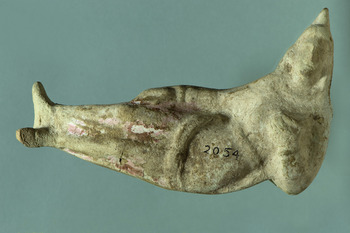
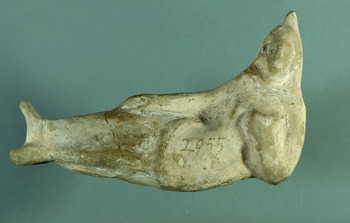
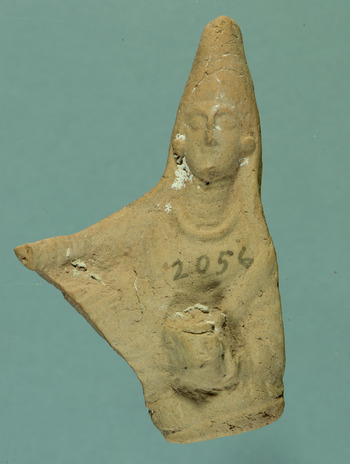
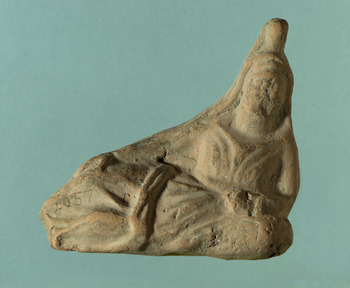
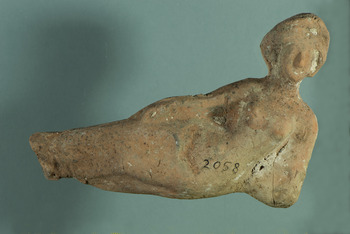
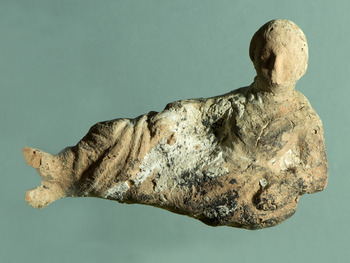
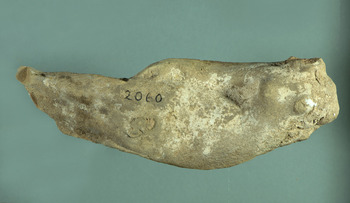
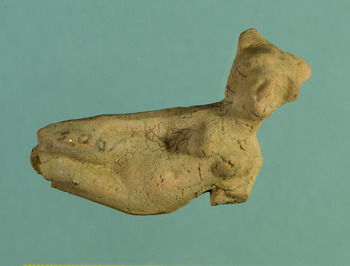
Van Buren's misconception concerning the Nippur origins of B9121, B9122, and B9000 may have had even further ramifications in her analysis of other Seleucid-Parthian period figurines. Van Buren is the first source (to my knowledge) who attributed unequivocally, and in print, eight reclining figurines in the collections of the Semitic Museum at Harvard University as originating from the site of Nippur: HSM 2054, HSM 2055, HSM 2056, HSM 2057, HSM 2058, HSM 2059, HSM 2060, and HSM 2061 (Figs. 9–16)Footnote 55 . These eight figurines represent human figures, predominantly identifiable as women (though the sex of three of the figures is unclear), reclining on the left side. Four of the figures hold a banqueting cup. The style of the figurines dates them all to the Seleucid-Parthian period; Greek elements, such as the supple naturalism of the female body and the wreathed or double-peaked headdress, are more dominant in four of them (1899.2.680; 1899.2.681; 1899.2.682; and 1899.2.683), whereas the heavy tunics and pointed caps of the other four (1899.2.676; 1899.2.677; 1899.2.678; 1899.2.679) indicate Parthian influenceFootnote 56 . Figurines in similar Greek and Near Eastern styles have been found in Seleucid-Parthian period contexts across Babylonia (including Nippur). Several of the Harvard Semitic Museum's figurines preserve traces of white ground (likely gypsum) and red or pink pigments (likely hematite or madderFootnote 57 ); these were common surface treatments for Seleucid-Parthian period figurines at all the major Babylonian sites. Thus, most of these figurines’ art historical features do not definitively indicate, nor rule out, a Nippur provenance.
Terracotta figurine of reclining figure (Harvard Semitic Museum 1899.2.676 [originally HSM 2054]), Length: 16.2 cm (Photograph courtesy of the Semitic Museum, Harvard University).

Terracotta figurine of reclining figure (Harvard Semitic Museum 1899.2.677 [originally HSM 2055]), Length: 16.2 cm (Photograph courtesy of the Semitic Museum, Harvard University).

Terracotta figurine of reclining figure (Harvard Semitic Museum 1899.2.678 [originally HSM 2056]), Length: 6.9 cm (Photograph courtesy of the Semitic Museum, Harvard University).

Terracotta figurine of reclining female figure (Harvard Semitic Museum 1899.2.679 [originally HSM 2057]), Length: 10.9 cm (Photograph courtesy of the Semitic Museum, Harvard University).

Terracotta figurine of reclining female figure (Harvard Semitic Museum 1899.2.680 [originally HSM 2058]), Length: 15.7 cm (Photograph courtesy of the Semitic Museum, Harvard University).

Terracotta figurine of reclining female figure (Harvard Semitic Museum 1899.2.681 [originally HSM 2059]), Length: 11.4 cm (Photograph courtesy of the Semitic Museum, Harvard University).

Terracotta figurine of reclining female figure (Harvard Semitic Museum 1899.2.682 [originally HSM 2060]), Length: 16.4 cm (Photograph courtesy of the Semitic Museum, Harvard University).

Terracotta figurine of reclining female figure (Harvard Semitic Museum 1899.2.683 [originally HSM 2061]), Length: 6.3 cm (Photograph courtesy of the Semitic Museum, Harvard University).

However, two of the figurines (1899.2.682 and 1899.2.683) present an exception to this: both were made with the left arm deliberately modelled as a finished-off stump, for a separately-made lower arm to be attached. Several figurines with such separately-made and attached arms have been discovered at Babylon and Seleucia-on-the-Tigris (and, to a lesser extent, at Uruk); indeed, B9121 is one such example. The use of separately-made and attached arms was not limited to reclining figurines; thus, the technique could have been used at Nippur even if the reclining figurine pose was not. However, to my knowledge, there are no securely-provenanced examples of figurines manufactured in this technique from Seleucid-Parthian Nippur (see also the discussion in footnote 107 of this article). This indicates that at least two of eight reclining figurines in the Harvard Semitic Museum's collection are very unlikely to be Nippur objects on art historical grounds alone.
As with the three figurines in the Penn Museum's collection (with which this article is primarily concerned), this grouping of eight figurines gives a sense of a deliberately collected and curated “sampling” of figurine variety. With the exception of 1899.2.676 and 1899.2.677, which were likely made in the same mold, the rest of the figurines exhibit striking differences in size, headdresses, depiction of the body nude or in either Greek or Parthian clothing, and explicit depiction of banqueting activity. Such variety in so small a corpus seems specifically designed to give a sense of the full range of reclining figurine possibilities that Seleucid-Parthian Babylonia had to offer. What the Semitic Museum curators today can tell us is that these eight figurines were purchased by the Semitic Museum's “founding curator David Gordon Lyon, from the antiquities dealer D. Z. Noorian in Jerusalem in 1899…They are all said to be from Nippur in Iraq”.Footnote 58 In addition to the art historical analysis discussed above, a close investigation of the circumstances of this purchase reveals that, in my estimation, it is quite improbable that these figurines were from Nippur.
While such attestations of archaeological context by antiquities dealers should always be treated with caution, this particular claim seems especially suspect. The discovery of the so-called “Temple Library” at the site of Nippur in the 1898–1900 season vaulted the University of Pennsylvania's expedition, and the city of Nippur itself, into the imagination of the American people. Over the next few years, Nippur became a fascinating place in the eyes of the public; indeed, “lectures by Hilprecht at the University late in 1902 drew such crowds, despite his German accent, which made comprehension a strain, that some of the Museum's contributing members complained that they could not get in.”Footnote 59 What better site for an antiquities dealer to associate his ancient objects with—and thereby draw a higher purchase price for them—than the currently captivating city of Nippur?
Noorian was in a prime position to offer a veneer of authenticity to the claim that his saleable antiquities came from Nippur, as he had worked as part of the Nippur expedition team ten years earlier (from March 1889 to April 1890), primarily as an interpreter.Footnote 60 However, Noorian does not seem to have played any substantial role in the excavations, and none of the field notes or reports from the 1889–1890 season were written by him.Footnote 61 As described above, the Nippur excavation team was only at the site of Nippur for six weeks during the 1889–1890 season—hardly enough time for Noorian to collect and export a sizable number of figurines without attracting the notice of the several University of Pennsylvania scholars who were supervising the excavations, and who were eminently concerned with acquiring (rather than selling) ancient objects.
There is no indication that Noorian was still involved in the Nippur excavation project ten years later, in 1899, when he sold the “Nippur” figurines to Harvard.Footnote 62 Without membership on the excavation team, it would have been particularly difficult (although, admittedly, not impossible) for Noorian, or anyone else, to have illicitly acquired objects from the site of Nippur in 1899. Haynes had been in charge of running the excavations at Nippur since 1892, and had made close connections with many of the local people. When he returned to the site on the fourth expedition (on February 4, 1899), he was greeted by several members of a local Arab tribe who had taken on the role of guardians and assumed diligent watch over the site in his absence.Footnote 63 Haynes took the business of guarding Nippur very seriously—he worked constantly and would almost never leave the site (except to travel to Hillah to pack the finds himself), even to the extreme extent that he ignored his health and eventually drove himself to an early grave.Footnote 64 While it would not have been impossible for someone to illicitly collect figurines from the site of Nippur around 1899, it would certainly have been difficult. It seems especially likely that the Harvard Semitic Museum's figurines did not come from Nippur when the numbers of figurines involved in the 1899 sale are considered. Noorian sold not only these eight reclining female figurines, but also many other figurines of different types; in total, at least 106 figurines were sold by Noorian to the Harvard Semitic Museum in 1899, under the pretext that they were all Nippur material.Footnote 65 While three or four figurines could be stolen from a site unnoticed, it would require a more substantial operation (and a much more noticeable one) to abscond with over one-hundred figurines from a site while it was currently under excavation.
Other sites, such as Babylon or Seleucia-on-the-Tigris, neither of which hosted a formal excavation at that time, would have been much easier targets.Footnote 66 Both sites lie considerably closer to Baghdad than Nippur does, and were much easier to access via major roads. Noorian would have been familiar with both sites—and the ease with which antiquities could be collected at them or purchased from the local people—because of his travels through the area on his way from Baghdad to Nippur. To attach the currently fashionable name of “Nippur” to figurines actually from Babylon or Seleucia-on-the-Tigris in order to ask a higher price for them does not seem to have been out of character for Noorian. Indeed, this might not have been the first time that Noorian colluded in passing off unprovenanced material as Nippur objects: it was he who sold Hilprecht the non-Nippur antiquities that Hilprecht published as excavated Nippur artefacts (although Hilprecht claimed that it was “local Arabs”, and not Noorian, who falsified the attribution), which led to Hilprecht's career-ending scandal.Footnote 67
Van Buren did not, however, question the attribution offered by the antiquities dealer, and unequivocally labelled the eight reclining female figurines in the collection of the Harvard Semitic Museum with a Nippur provenance. She might have done this anyway, regardless of what Legrain published or did not publish regarding the origins of B9121, B9122, and B9000. However, the published association of these three figurines with the site of Nippur would likely have made it easier to accept the testimony of the antiquities dealer and assume that the reclining female figurines in the Harvard Semitic Museum were also from Nippur. Legrain's publication therefore potentially changed more than just the scholarly perception of B9121, B9122, and B9000. With Van Buren's publication, the scholarly community now had a sizeable, authoritative corpus of eleven reclining female figurines attributed to Nippur.
Later Impact of the Misattribution on Scholarship
The ramifications of this likely inauthentic Nippur provenance for reclining female figurines, as disseminated by Legrain and Van Buren, have been substantial. Many later scholars have not noticed the misattribution of B9121, B9122, and B9000, and those who have noticed seem to have largely ignored the issue. Keall, in his dissertation on Late Parthian Nippur, does not address the issue of the three reclining female figurines and omits them entirely from his broader discussion of Nippur figurines.Footnote 68 While this does serve the purpose of not perpetuating the erroneous association between B9121, B9122, B9000 and the site of Nippur, it also does not correct the mistake. In Wild's monograph, which extensively discusses reclining figurines from Seleucid-Parthian Babylonia, B9121 is erroneously listed as a Nippur object, and Nippur provenance is also given to the eight reclining female figurines in the Harvard Semitic Museum.Footnote 69 Karvonen-Kannas, in her publication of the Seleucid-Parthian figurines from Babylon, cites only two of the three figurines (which she designates as “Legrain Reference Legrain1930, No. 144” and “Legrain Reference Legrain1930, No. 145”) in her catalogue footnotes, where she correctly attributes them to Babylon.Footnote 70 However, Karvonen-Kannas fails to list B9000 as a Babylon object in her notes, and she repeats the Nippur attribution for the Harvard Semitic Museum's eight reclining female figurines.Footnote 71
Invernizzi references Legrain's publication of B9121, B9122 and B9000 as comparative material for reclining female figurines found at Uruk and Seleucia-on-the-Tigris, in his ground-breaking art historical approach to the figurines of Seleucid-Parthian Babylonia.Footnote 72 However, he does not discuss the provenance of these figurines, and the citation of Legrain's volume without an explanatory note could easily leave the reader with the impression that the artefacts were from Nippur. Menegazzi's more recent work on the figurines of Seleucia-on-the-Tigris is more specific (and thus, unfortunately, incorrect) in discussing Nippur as an important site for the production and use of reclining female figurines.Footnote 73 For instance, in her extensive 2014 catalogue of figurines from Seleucia-on-the-Tigris, Menegazzi includes “reclining figurines clad in a tight-fitting tunic and reclining figures wearing a kyrbasia” in her list of figurine types produced at Nippur.Footnote 74 As evidence of this, she specifically cites Legrain Reference Legrain1930, numbers 144–45; this error further perpetuates, and introduces into twenty-first century scholarship, the misassociation between the site of Nippur and (two of) the three figurines with which this article is concerned.Footnote 75 Furthermore, it means that the presence and use of reclining female figurines at Seleucid-Parthian Nippur has still not been explicitly questioned in the published scholarship.
The haphazard publication references to B9121, B9122, and B9000, as well as the inconsistent scholarly discussion concerning the existence of reclining female figurines at Seleucid-Parthian Nippur, can be traced back to the series of scholarly events surrounding the purchase and publication of B9121, B9122, and B9000 with the University of Pennsylvania Nippur corpus. The confusion created by the history of these objects is understandable; however, it has also resulted in a flawed understanding of the city of Nippur and its figurine tradition. The correct attribution of B9121, B9122, and B9000 as Babylon objects, and the unlikelihood of a Nippur provenance for the eight reclining female figurines in the Harvard Semitic Museum, necessitates a re-evaluation of regional differences in Seleucid-Parthian figurine tradition between the Babylonian cities.
Reevaluating Terracotta Figurine Use at Seleucid-Parthian Nippur
A comprehensive consideration of all the regional differences in figurine use between Nippur and the other Babylonian cities during the Seleucid-Parthian period is beyond the scope of this article. Yet, observations pertaining specifically to the issue of reclining female figurines can be made. First and foremost, the absence of reclining female figurines with secure Nippur provenance suggests the lack (or at least the unpopularity) of a particular kind of Greek-Babylonian cross-cultural hybridity within that ancient community. The figurines of Seleucid-Parthian Babylonia were extensively hybridized across cross-cultural lines, in ways that reflected local community preferences.Footnote 76 Cultural concepts and motifs that overlapped or were shared between both Greeks and Babylonians (and, later, Parthians) were emphasized in popular figurine choices,Footnote 77 while figurines that were alienating or unappealing to one cultural group were less frequently made or used.Footnote 78 Reclining female figurines fit within this Seleucid-Parthian period trend of hybrid figurines. They drew upon Greek imagery of symposium participants (including in their frequent depictions of naked or semi-clothed figures), have the sensitive naturalism characteristic of Greek artistic styles, and were often made in the Greek double-mould technique.Footnote 79 However, most of these figurines transformed the reclining banqueter from male (as would be expected in Greek figurine tradition) to female, and present this female figure with a strongly frontal body posture and gaze.Footnote 80 Female participants in feasting and revelry scenes were not unknown in pre-Hellenistic Greek art; examples include Archaic and Classical Greek depictions of hetairai at symposiaFootnote 81 and wives sitting or reclining near their banqueting husbands’ feet.Footnote 82 Yet, the reclining figurines from Seleucid-Parthian Babylonia differ significantly from these Greek precedents in that the female figure replaces, rather than adjoins, a male figure.Footnote 83 These solitary reclining female bodies are more closely modelled on Greek imagery of a male banqueting participant occupying his own couch—suggesting that the reclining woman seen in the Seleucid-Parthian Babylonian figurines is a banquet participant in her own right, entitled to her own “seat at the table”.Footnote 84 The strong preference for female bodies in these reclining figurines might have been a concession to Babylonian cultural norms, which were more comfortable with depicting naked females than naked males.Footnote 85 Yet, an aversion to male nudity cannot completely explain the rarity of male reclining figurines in Seleucid-Parthian Babylonia, since many of the female reclining figurines are depicted either partially or fully clothed (as is seen with B9121, B9122, and B9000).Footnote 86
Such depictions of female banqueters reclining alone cannot be interpreted as straightforward representations of the male-dominated Greek symposium—at least, not as we understand its practice in the Classical period on the Greek mainland.Footnote 87 But I suggest that these figurines could have served as negotiated, Babylonian-sensitive enticements into broader Greek social practices of banqueting. Pan-Hellenistic Greek ceramic vessels spread across the Near East in the wake of Alexander, becoming one of the Hellenistic World's most widely shared forms of material culture.Footnote 88 The Greek vessels most consistently adopted and imitated in Babylonia by local potters were fine serving wares used for presenting and eating, rather than preparing or cooking.Footnote 89 This preference for Greek tableware, which would have been conspicuously visible especially to visitors and dinner guests, implies that the appearance and performance of Greek dining practices—including a reclining, leisurely banqueting style—may also have been appealing.Footnote 90 Figurines such as B9121, B9122, and B9000 would have reinforced the social status and pleasures of such Greek-style banquets—and suggested the alluring prospect of beautiful female companionship during feasting—by presenting this dining practice within the pleasingly tactile format of the terracotta figurine.Footnote 91
Openness and accessibility to touch are common qualities among the Seleucid-Parthian figurines of Babylonia; generally, their smooth surfaces, relatively sturdy construction, and hand-held size encouraged their users to grasp, handle, and caress them.Footnote 92 Reclining female figurines were especially likely to encourage such tactile encounters. Some versions of these reclining female figurines (such as B9121) included modelled couches or cushions that serve as figurine bases and thus can stand alone on a flat surface; yet, most reclining female figurines (including B9122 and B9000) lack an obvious couch support and cannot stand alone.Footnote 93 Naked or partially naked (from the waist or hips upwards) reclining female figurines were especially likely to lack a modelled couch and the vertical stability it suppliesFootnote 94 —thus, in order to be viewed upright and inspected closely, such figurines needed to be held in the hand.Footnote 95 The female figure's nakedness or, if clothed, the depiction of tight or revealing clothing added an erotic dimension to such intimate tactile interactions. Examples of such revealing clothing can be seen in B9121, with its low V-shaped neckline and suggestive gathering of cloth in the hand placed near the genital region, as well as in the pinched, narrow waist and wide hips seen through the clinging garment of B9122. This sexualisation of the reclining, banqueting body—a construction which would have been very much at home in Greek ideas of the symposium—may explain why such figurines needed to depict female bodies, rather than male ones, in order to be acceptable in Seleucid-Parthian Babylonia.Footnote 96
Overlap of Greek and Babylonian cultural tradition may also explain the directly frontal (albeit reclining) postures and straightforward gazes of these solitary reclining female figures, which echoed both Greek imagery of male symposiasts and earlier Mesopotamian imagery of assertive, frontal, unabashedly display-oriented (and possibly erotic) female figures.Footnote 97 The Babylonian viewer may also have recognized an invitation to sexual encounter in the female body's solitary reclining posture, which draws upon deeply-rooted local precedents including, but not limited to, Old Babylonian erotic plaques.Footnote 98 A seduction effect would have been enhanced in some of the Seleucid-Parthian reclining figurines (such as B9121) by the addition of a separately-moulded left arm that would have extended outwards towards the viewer and likely held a banqueting cup.Footnote 99 The intimate tactility and inclusive gestures of such figurines encouraged the (male) user to envision himself as a co-participant in banqueting, with this festive and assertive female figure as his companion. Such figurines reinforced the visual enticement and exotic luxury that Greek ceramic tablewares already provided, yet more explicitly invited inclusive cross-cultural participation in Hellenistic banqueting practices.
In choosing not to create or use reclining female figurines, the community of Seleucid-Parthian Nippur may also have been rejecting this specific Greek-Babylonian negotiation of feasting traditions. The pan-Hellenistic ceramic tableware made and used at Seleucia-on-the-Tigris, Babylon, Uruk, and Failaka is relatively rare at Nippur.Footnote 100 When “Hellenistic” styles did appear in the Seleucid-Parthian Nippur ceramic corpus, they usually consisted of Greek motifs added as superficial surface ornament to local Babylonian ceramic forms, rather than substantial alterations reflecting deep engagement with Greek ceramic tradition.Footnote 101 A greater use of pan-Hellenistic ceramics is to be expected at the Greek foundation of Seleucia-on-the-Tigris and, to a lesser extent, at Babylon (with its Greek theatre and other evidence of Hellenistic culture) than at Nippur.Footnote 102 However, the contrast between Uruk and Nippur (both of which are generally considered to have been conservatively Babylonian during the Seleucid-Parthian periodFootnote 103 ) is particularly striking: “Greek origin” ceramics make up 24.5 per cent of the Seleucid-period ceramic assemblage at UrukFootnote 104 and are recovered “from all the major sanctuaries and residential structures so far excavated”,Footnote 105 whereas the numbers of similar ceramics at Nippur are negligible.Footnote 106
The absence of reclining female figurines recovered from excavated contexts at Nippur, when considered in light of that community's parallel lack of a significant use of pan-Hellenistic ceramics, suggests that the issue that this article set out to address—namely, the misassociation of three Seleucid-Parthian reclining female figurines from Babylon with the University of Pennsylvania's Nippur corpus, as well as the possible misattribution of a further eight reclining female figurines, ostensibly from Nippur, in the Harvard Semitic Museum—is of more critical importance than it might first have seemed. Together, this evidence suggests an almost total rejection by the Seleucid-Parthian Nippur community of certain Hellenistic foodways and banqueting practices, as well as a rebuff of the association of female sexuality and nudity with such feasts.Footnote 107 Indeed, the entanglement of reclining female figurines with pan-Hellenistic ceramic types and Greek-inspired banqueting practices, as I have just proposed it, may actually explain why reclining female figurines seem to have been unappealing to the people of Seleucid-Parthian Nippur—not because of their Greek associations generally, but rather because of their connections with Greek banquets specifically. Indeed, other heavily Greek-influenced figurine forms (such as those resembling or depicting the Greek gods Aphrodite, Eros, and Herakles; for the latter, see Fig. 7) were made and used successfully within the same community. Thus it seems that the people of Nippur were not rejecting “Greekness” per se, nor refusing all use of Greek cultural forms. Rather, the Nippur community seems have been specifically uninterested in engaging in a particular kind of cross-cultural negotiation of the social activity of banqueting.
It is also possible that the lack of reclining female figurines at Seleucid-Parthian Nippur may reflect regional differences in funerary tradition. Although the evidence is tenuous and disputed, there are some indications that such reclining female figurines in Seleucid-Parthian Babylonia held funerary significance. Koldewey, excavator of Babylon, specifically mentioned the grave contexts of several reclining female figurines in alabaster, in contrast to the domestic contexts in which most other figurines were found.Footnote 108 Klengel-Brandt similarly remarked upon the “special connection” between “figurines of recumbent women” and burial rites in Parthian Babylon;Footnote 109 however, her more recent work seems to refute this evaluation: “In Babylon kann aus den Fundumständen der Frauenterrakotten, die sich im gesamten Stadtgebiet befinden, kein besonderer Zusammenhang mit Bestattungen ersehen werden. Eine überzeugende Erklärung für den Typ der ruhenden Frau muß für Babylon offen bleiben”.Footnote 110 Van Buren discusses Seleucid-Parthian reclining female figurines as “reclining on a funeral couch”.Footnote 111 Van Ingen asserts that “it is generally agreed that they [i.e. reclining female figurines] sometimes have a funerary significance, for many have been found in graves”; yet, she goes on to note that most such figurines at Seleucia-on-the-Tigris were found in domestic contexts.Footnote 112 Invernizzi mentions reclining female figurines found associated with tombs at Seleucia-on-the-Tigris and Uruk.Footnote 113
Menegazzi offers some of the most concrete evidence for a correlation between reclining female terracotta figurines and funerary contexts: “10 of the 41 figurines found in burials [at Seleucia-on-the-Tigris] represent reclining women”, a high percentage (roughly 25 per cent) which she argues is “of great significance in determining the function and meaning of reclining figurines”.Footnote 114 However, the significance of this finding is somewhat lessened by the overall rarity of figurines found in tombs at Seleucia-on-the-Tigris (forty-one figurines out of a total of nearly 11,000 figurines excavated at the siteFootnote 115 ), as well as the very small proportion (approximately 1.4 per cent) of the total number of reclining female figurines that are found in graves (ten figurines out of a total of 717 whole or partial reclining female figurines excavated at the siteFootnote 116 ). With such a limited number of Seleucia-on-the-Tigris's reclining female figurines being deposited in tombs, it seems likely that other, non-funerary functions and meanings for these figurines also existed.
It is not my purpose in this article to resolve the issue of whether or not reclining female figurines had a particular connection with Seleucid-Parthian funerary practice in Babylonia—or, if they did, if such funerary associations were consistent across all the cities of Babylonia where such figurines were used.Footnote 117 Terracotta figurines of any form or motif are quite rare in such funerary contexts (even at Seleucia-on-the-Tigris) and, even for those figurines that are found with graves, it can be difficult to distinguish figurines that were deliberately placed in tombs from those belonging to the domestic spaces into which the tombs were usually dug. On the other hand, figurines (indeed, any objects) can have funerary, mourning, and commemorative meanings without physical placement in a tomb. With both of these possibilities in mind, I therefore offer the limited observation that if reclining female figurines in Seleucid-Parthian Babylonia did indeed have funerary functions or meanings, the absence of such figurines at Nippur points to an additional (and, indeed, an important) kind of regional difference between the community of that city and those of the neighbouring urban centres. This funerary difference (if it existed) may have been intricately entangled with the banqueting differences between Nippur and its neighbours, as discussed above, especially given the wide-spread and longstanding history of a close association between banqueting practices (as well as banqueting imagery) and afterlife belief across the ancient Mediterranean and Near East.Footnote 118 The absence of reclining female figurines at Nippur may thus provide evidence of this Seleucid-Parthian period community's complete rejection of negotiated, Greek-inspired banqueting practices—both in this life and the next.
Conclusions
This article has presented a detailed documentation of excavation and museum records relating to the provenance of three reclining female terracotta figurines (B9121, B9122, B9000) in the collection of the University of Pennsylvania Museum. Although these three figurines were purchased at or near the site of Babylon, rather than excavated at the site of Nippur, they have been stored and published with the Nippur collection through a series of scholarly decisions over a period of more than one hundred years. I have proposed that these figurines became associated with the Nippur corpus through a purposeful series of acts, which were designed to supplement the excavated material record of that site. No reclining female figurines were recovered from the Nippur excavation itself, despite their popularity at the other major cities of Seleucid-Parthian Babylonia. The three reclining figurines from Babylon—purchased, retained, and published in association with the Nippur collection—filled out what was likely perceived as a gap in the Nippur corpus. Yet these actions also obscured the actual Seleucid-Parthian figurine tradition practiced in Nippur—an effect that continues to be reflected even in recent scholarship. Additionally, this misassociation of the three Babylon figurines may have led to the acceptance of a Nippur provenance for eight reclining female figurines purchased by the Harvard Semitic Museum; this article casts doubt upon that attribution.
In light of this lack of securely-provenanced reclining female figurines at Nippur, the figurine tradition as a whole—and its relationships to the other Seleucid-Parthian cities in Babylonia—must be reconsidered. For the purposes of this article, I have limited my discussion of these topics to a consideration of the meanings of the reclining female figurines themselves, which fit within broader trends of Greek-Babylonian hybrid imagery in the figurine corpora of Seleucid-Parthian Babylonia. The specific hybrid combination in the reclining female figurines draws upon Greek imagery of banqueting, as well as Babylonian motifs of assertive female sexuality. This cross-culturally negotiated idea of pleasurable, and possibly erotically-charged, feasting may also have been linked to popular Babylonian use of pan-Hellenistic ceramic tableware. Both forms of material culture involved (the reclining figurines and the Hellenistic ceramics) were unpopular at Nippur, and I have suggested herein that these parallel absences indicate—indeed, may be explained by—a Nippur-specific lack of interest in Greek-style banquets and their attendant foodways, visual spectacles, and social performances.
While perhaps surprising, such selective hybridities and regional differences in cross-cultural interaction are very common in the negotiated middle ground of multicultural contact and social change.Footnote 119 Interactions between cultural groups do not proceed along identical lines in every community, and the material culture and social practices produced as a result of such exchanges can take disparate forms.Footnote 120 A possible explanation for the particular situation described in this article may be found in the limited evidence for Seleucid-period activity at Nippur, in contrast to more extensive habitation of the site during the Parthian period.Footnote 121 Reclining female figurines were made and used at other Babylonian cities during both the Seleucid and Parthian periods—thus, reduced Seleucid-period occupation at Nippur would not necessarily preclude their use. However, the specific connection of these figurines with pan-Hellenistic ceramics and Greek banqueting practices may indicate that the cross-cultural negotiations with which they were involved were taking place soon after Alexander's conquests. Such negotiations may not have had a place at Nippur and, without a local, Seleucid-period precedent, may have been unappealing and unnecessary to Nippur's Parthian-period community. It is this richly textured and individualized fabric of cultural identity and social life in Seleucid-Parthian Babylonia, with its local flavours and community variations, that the nineteenth and early twentieth century scholarly attempts to create a “whole” corpus of Nippur objects by including Babylon figurines within that collection have distorted and obscured—and that this article has attempted to reconstruct.