Introduction
Time perception describes one’s ability to judge the passage of physical time by estimating the duration of a presented interval or by producing an interval when a duration is provided, which an extensive body of research suggests is a robust and stable cognitive function in healthy populations (e.g., Meck, Reference Meck2005). The subjective experience of time perception requires an individual to use an internal clock to judge the rate at which time passes, or how much time has passed since the onset of a particular event. Accurate internal timing of intervals ranging from seconds to minutes is a vital capability when considering everyday activities, such as driving, crossing a busy street, or cooking a meal (Block, Zakay, & Hancock, 1998). While there are several models of time perception in the literature, scalar timing theory (or scalar expectancy theory; SET) is perhaps the most commonly cited and well established (e.g., Gibbon, Church, & Meck, Reference Gibbon, Church and Meck1984). In brief, the model entails a modular information processing system that consists of three main processes: (1) a “clock process,” in which a pacemaker emits pulses that are entered into an accumulator, a process that is largely reliant on intact attentional resources; (2) a “memory process,” in which the accumulator content is stored in working memory to be compared to a long-term memory representation of the appropriate number of pulses; and (3) a “decision process,” in which the value in the accumulator corresponding to the current duration is compared to the long-term memory value, a process that is largely reliant on strategic and complex attentional factors (Harrington & Haaland, Reference Harrington and Haaland1999). As such, it is the general consensus that successful time perception is supported by the cerebellum, basal ganglia, hippocampus, and frontal cortex (e.g., Meck, Reference Meck2005).
Not surprisingly, time perception has been studied in the context of several neurologic populations in which at least one of these brain systems is affected. The methods most commonly used are tests of time estimation (i.e., the examinee must report how long a time interval lasted), production (i.e., the examinee is told the interval length and must produce the duration in some way), and reproduction tasks (i.e., the examinee is shown a time duration and must reproduce that duration in some way), with the latter two thought to be most taxing on executive functioning resources (e.g., Barkley, Murphy, & Bush, Reference Barkley, Murphy and Bush2001). Time misperception is evident in several clinical populations, including Parkinson’s (Pastor, Artieda, Jahanshahi, & Obeso, Reference Pastor, Artieda, Jahanshahi and Obeso1992), Huntington’s (Beste et al., Reference Beste, Saft, Andrich, Müller, Gold and Falkenstein2007), and Alzheimer’s (Caselli, Iaboli, & Nichelli, Reference Caselli, Iaboli and Nichelli2009) diseases, but there are no well-established population differences with respect to the pattern of effects across the three types of time perception measurements.
In the current study we evaluate time perception in persons with HIV-associated neurocognitive disorders (HAND). Despite the effectiveness of combination antiretroviral therapies (cART) on the immunovirological aspects of HIV, neuropathologies of HIV are still quite prevalent and cause neurocognitive complications in an estimated 30–50% of infected individuals (Heaton et al., Reference Heaton, Clifford, Franklin, Woods, Ake, Vaida and Grant2010). In the cART era, HIV-associated neuropathologies preferentially affect frontostriatal circuitry, producing a neuropsychological profile that includes deficits in domains that affect time perception, including attention and working memory, executive control, and episodic memory (see Reger, Welsh, Razani, Martin, & Boone, Reference Reger, Welsh, Razani, Martin and Boone2002). As such, we predicted that individuals with HAND would evidence poorer time estimation and production abilities as compared to HIV+ individuals without HAND and HIV− comparison subjects, perhaps with more prominent deficits on tasks of time production that are believed to be more susceptible to frontal circuit injury (Zakay, Reference Zakay1990). In accordance with SET, we hypothesized that within the HIV+ group, performance on measures of time estimation would relate most strongly to domains of attention and working memory, and performance on measures of time production would relate most strongly to domains of memory and executive function.
Methods
Participants
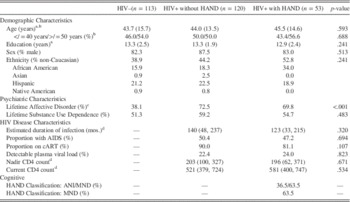
This study was approved by the institution’s human research protections program. The study sample included 53 HIV+ participants diagnosed with HAND, 120 HIV+ participants without HAND, and 113 HIV− participants without HAND, and 114 HIV− participants who were recruited from the San Diego community and local HIV clinics. HAND was diagnosed based on results from a comprehensive neuropsychological, medical, and psychiatric evaluation according to current Frascati criteria (Antinori et al., Reference Antinori, Arendt, Becker, Brew, Byrd, Cherner and Wojna2007) as detailed below. Participants were drawn from an NIH-funded study examining the combined effects of HIV and aging on memory in which a discrepant age classification approach was used such that no individuals between the ages of 40 and 50 were enrolled in the study (younger adult age range=18–40; older adult age range=50–83). Exclusion criteria included history of severe psychiatric (e.g., schizophrenia) or neurologic (e.g., seizure disorder) illness, a verbal IQ estimate <70, a diagnosis of substance dependence within 1 month of assessment (as determined by the Composite International Diagnostic Interview; CIDI version 2.1; World Health Organization, 1998), and a urine toxicology screen positive for illicit drugs (excluding marijuana) or a positive breathalyzer test.
Table 1 describes the demographic, psychiatric, and HIV disease characteristics of the study groups. Both of the HIV+ groups were significantly more likely than the HIV− group to meet criteria for lifetime affective disorder (i.e., Major Depressive Disorder or Generalized Anxiety Disorder) based on the CIDI.
Demographic, psychiatric, disease, and cognitive characteristics of the study sample

a Data represents means and standard deviations.
b Because of parent study criteria, individuals between the ages of 41 and 50 were not included in the study. Participants were classified as younger (18–40 years) or older (50+ years) adults.
c Affective disorder=diagnosis of Major Depressive Disorder and/or Generalized Anxiety Disorder.
d Data represent medians and interquartile ranges.
cART=combination antiretroviral therapy. ANI=asymptomatic neurocognitive impairment. MND=mild neurocognitive disorder.
Materials and Procedure
After providing informed consent, participants completed the time estimation and production tasks, a general neuropsychological assessment, and medical evaluations.
Time Estimation and Production Tasks
Time estimation task
Participants verbally estimated pre-specified time interval durations to the examiner who used a stopwatch with no audible timing indications. Neither the stopwatch nor any other time-keeping devices were visible. Participants were instructed that once the examiner said, “begin,” they were to begin counting silently at a rate of one digit every second. Once participants indicated that they understood the task, the examiner said “begin.” There was a short break in between trials, during which the examiner indicated that they were going to do the task again. The time estimation task was administered before the time production task and consisted of four time intervals: 15s, 30s, 45s, and 90s, which were presented in the same randomized order for all participants.
Time production task
The time production task was administered following the estimation task, and consisted of the same four time interval durations administered above in the same randomized order. The examiner told participants the number of seconds to be counted, and after the examiner said, “begin,” participants were to tell the examiner when the given amount of seconds had elapsed. No practice sessions were administered for either time estimation task or the time production task.
Scoring
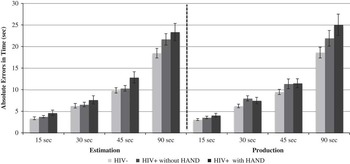
For our primary outcome variables, absolute discrepancy scores (i.e., the absolute value of the discrepancy between participants’ estimation or production and the correct number of seconds to be estimated or produced) were derived for both the time estimation and time production items. Consistent with much of the time perception literature (e.g., Barkley et al., Reference Barkley, Murphy and Bush2001; Pastor et al., Reference Pastor, Artieda, Jahanshahi and Obeso1992) and as recommended by Brown (Reference Brown1985), absolute discrepancy scores were used as they reflect the magnitude of errors in timing regardless of directionality (Figure 1).
Absolute errors in time estimation and production across the study groups. Note. Data represent means and standard errors.

General Neuropsychological Assessment
All participants received a comprehensive neuropsychological test battery that assessed domains of attention/working memory, executive functions, information processing speed, episodic memory, motor skills, and verbal fluency (see Morgan et al., Reference Morgan, Woods, Delano-Wood, Bondi and Grant2011 for details). For the purposes of this study, we opted to use global deficit scores (GDS) for determination of impairment, which is becoming increasingly common within the HIV literature. While clinical ratings are considered by some to be the “gold standard” of impairment classification (Antinori et al., Reference Antinori, Arendt, Becker, Brew, Byrd, Cherner and Wojna2007) and are more sensitive to subtle impairment (Blackstone et al., Reference Blackstone, Moore, Franklin, Clifford, Collier, Marra and Heaton2012), the GDS has several notable strengths, including its objectivity, greater range of scores, and validation within HIV (Carey et al., Reference Carey, Woods, Gonzalez, Conover, Marcotte, Grant and Heaton2004). To calculate GDS, raw scores from individual tests were first converted into demographically-adjusted t scores per published normative standards (which were subsequently used for correlational analyses). The t scores were then converted into deficit scores (range 0–5, with higher scores indicating greater dysfunction). GDS was calculated by averaging the individual domain deficit scores, and a standard cutoff score of GDS≥0.5 classified individuals as evidencing neurocognitive impairment (i.e., HIV+ with HAND). Of those with HAND, 37% evidenced asymptomatic neurocognitive impairment (ANI) and 63% evidenced mild neurocognitive disorder (MND).
The current study also sought to explore potential relationships between time perception and prospective memory. To date, findings have been mixed with respect to whether these constructs are related (Graf & Grondin, Reference Graf and Grondin2006). To our knowledge, there has been one previous study to explore this relationship in HIV, although this study was highly restricted in its scope, noting a single correlation (non-significant) between long-delay time-based prospective memory and time estimation (Morgan, Weber, et al., Reference Morgan, Weber, Rooney, Grant and Woods2012). In the current study, participants’ time- and event-based prospective memory functioning was assessed via the research version (Woods et al., Reference Woods, Moran, Dawson, Carey and Grant2008) of the Memory for Intentions Screening Test (MIST; Raskin, Buckheit, & Sherrod, Reference Raskin, Buckheit and Sherrod2010), which is a standardized, performance-based measure of time- and event-based prospective memory (for details, see Woods et al., Reference Woods, Moran, Dawson, Carey and Grant2008).
Results
Time Estimation and Production
Two mixed effects analyses of variance (ANOVAs) were conducted to determine the association between HAND and the time perception tasks. While lifetime affective disorder rates were significantly different among the groups, this variable was not included as a covariate in these models as it was not related to time estimation nor time production (ps>.10). However, age group was added as a covariate to these models given this study’s unique age criteria (see Table 1). In the first model, absolute discrepancy values across the four time estimation conditions served as the within-subjects factor, with HAND group as the between-subjects factor. Results revealed a main effect of HAND (p=.04), such that the HIV+ with HAND group made significantly larger estimation errors as compared to the HIV− sample (49.2 vs. 38.1 s; p=.01; d=.43). While the HIV+ with HAND group made greater discrepancy errors than the HIV+ without HAND group, this effect did not reach significance (49.2 vs. 41.7 s; p=.08; d=.27). There was also a main effect of time duration (p<.001), such that participants made larger estimation discrepancies on the longer interval items (d range=.58–1.69). There was no significant interaction between HAND group and time duration (p=.11). There was no main effect of age group, nor was there an interaction between age group and HAND (ps>.05).
In the second model, absolute discrepancy values across the four time production conditions served as the within-subjects factor, again with HAND group and age group entered as predictors. Results revealed a trend-level effect of HAND group (p=.06), such that the HIV+ with HAND group made larger production errors as compared to the HIV− sample (48.5 vs. 37.4 s; p=.03; d=.42). The effect of HAND within the HIV+ group on production was not significant (48.5 vs. 45.3 s; p=.53; d=.09). We also observed a significant main effect of time duration (p<.001), such that as with the time estimation task, participants made larger estimation discrepancies on the longer interval items (d range=.43–1.42). The interaction between HAND group and time duration was not significant (p=.10). As with the previous model, there was no main effect of age group, nor was there an interaction between age group and HAND (ps>.05).
To examine whether HAND effects were driven by differences between HAND subgroups (i.e., ANI vs. MND), we conducted a series of post hoc t tests which revealed no significant differences between HAND subgroups on time estimation (p=.15) or production (p=.43).
In addition to our analyses involving absolute discrepancy scores, a reviewer’s comment led us to evaluate the mean and variability of the directionality of timing errors. First, we collapsed the raw discrepancy scores across the four time interval durations within estimation and production conditions, as our models revealed no interactions between time interval duration and group. Results of an ANOVA revealed a similar, but initially counterintuitive pattern across the means of both estimation and production, whereby the HIV+ with HAND group evidenced significantly more accurate raw discrepancy scores on time estimation than the HIV− (−6.0(56.9) vs. −20.9(38.4); p=.04) and HIV+ without HAND (−6.0(56.9) vs. −21.0(44.0); p=.04) groups. A similar pattern emerged for time production, although these effects did not reach significance (HIV+ with HAND=13.1(56.5); HIV+ without HAND=26.5(51.6); HIV−=16.0(40.8); ps>.05). These counterintuitive results on raw discrepancy were not conceptually consistent with our absolute discrepancy findings detailed above; indeed, Brown (Reference Brown1985) cautioned against the use of raw discrepancy scores in time perception studies, as the mean values may be biased by variability in over- and under-estimation across trials. To evaluate the possibility that our counterintuitive mean raw discrepancy pattern was explained by elevated intraindividual variability (IIV) in the HIV+ with HAND group, we computed an intraindividual standard deviation (ISD; e.g., Christensen et al., 1999) variable by averaging the standard deviations of raw Z-scores across the eight time perception trials. An ANOVA revealed an omnibus group effect on IIV (F=3.72; p=.03), such that the HIV+ with HAND group was significantly more variable in their responding compared to the HIV− group (0.97(0.68) vs. 0.73(0.49); p=.01; d=.43). Even when controlling for mean level of performance, ISD was a significant predictor of group status (overall χ2=14.89; p<.01; ISD χ2=7.28; p=.03)
Neurocognitive Correlates of Time Estimation and Production
For correlational analyses, we used summary variables that represented the total absolute discrepancy for the estimation and production trials. Additionally, we collapsed the two HIV+ groups (i.e., HIV+ without HAND and HIV+ with HAND) to more fully understand the cognitive mechanisms that underlie time estimation and production across the spectrum of HIV disease. False discovery calculation was used given that we ran multiple correlational analyses (Benjamini & Hochberg, Reference Benjamini and Hochberg1995). In the HIV+ group, time estimation was significantly, but weakly correlated with neurocognitive domains of episodic learning (ρ=−.18; p=.04) and delayed memory (ρ=−.18; p=.04), as well as auditory attention (ρ=−.19; p=.04). All correlations with the other cognitive domains were not significant (ρ range=.05–.12; ps>.10). With respect to prospective memory, time estimation ability was associated with the time-based (ρ=−.26, p<.01) but not event-based (p=.48) subscale of the MIST. No significant correlations between time production and the any of the seven primary clinical neurocognitive domains were observed (ρ range=.07–.13; ps>.10). However, similar to estimation, production abilities were significantly correlated with the MIST’s time-based (ρ=−.22, p=.03) but not event-based subscale (p=.35).
Discussion
While there exists a robust literature on the disruption of time perception mechanisms in various neurologic populations, the current study extends this body of work to HAND. Our primary results indicated a moderate main effect of HAND on time estimation and a trend-level effect on time production, in which participants internally monitored the passage of time over brief intervals (i.e., 15–90 s) without overt distraction. These effects were observed independent of demographic and psychiatric factors. While time interval judgment is noted as being a complex cognitive ability supported by several different neurocognitive processes, dysfunction in this group is likely due to HIV-associated neuropathologies affecting higher cortical functions that influence attention to internal time monitoring, as well as retrospective recall of the long-term memory representation of the appropriate number of pulses within a given interval duration. According to the SET model, such cognitive processes play an important role in the earlier stages of time perception.
Our follow-up analyses regarding directionality of timing errors initially revealed a counterintuitive pattern of results, such that the HIV+ with HAND group appeared to be more accurate as compared to the other groups when examining the raw scores. However, as noted by Brown (Reference Brown1985), measures of central tendency on raw timing scores can possibly lead to the erroneous conclusion that a group is, on average, accurate in their estimations, as individuals may have actually been more variable in terms of over- and under-estimation/production. Indeed, recent research has demonstrated that individuals with HIV show increased performance variability across neurocognitive tests (Morgan et al., Reference Morgan, Woods, Delano-Wood, Bondi and Grant2011), the effect of which is related to poor functional outcomes (Morgan, Woods, et al., Reference Morgan, Woods and Grant2012). Commensurate with those findings, our data revealed that the HIV+ with HAND group was more variable across time perception compared to the HIV− group (the effect of HAND among HIV+ participants was not significant). This suggests that individuals with HAND demonstrate increased attentional dyscontrol of time perception, as expressed by greater inconsistency of performance across timing trials that resulted in higher ISD and absolute discrepancy scores. In everyday terms, this means that frequent errors in perceiving time result in a notable overall deficit for individuals with HAND. As such, further examination of IIV in time perception among individuals with HIV may be warranted. For example, IIV in timing tasks may be exacerbated when individuals are concurrently engaged in other ongoing tasks, which also mimics real-world situations more closely.
Although we only observed a trend effect of HAND on time production, the magnitude of the effect sizes for production and estimation were largely comparable, suggesting a broadly similar impact of HAND on these aspects of time perception. One possibility for this finding is that the cognitive requirements of estimation and production tasks are more similar than what is commonly considered. Indeed, other studies in neurologically compromised populations using similar timing procedures have also failed to find group differences with respect to time production, including traumatic brain injury (Perbal, Couillet, Azouvi, & Pouthas, Reference Perbal, Couillet, Azouvi and Pouthas2003). However, our trend-level finding on production may still suggest that the earlier stages of the SET model are driving timing dysfunction in HAND, versus later stages which are hypothesized to rely more so on fronto-executive processes.
To this end, time estimation ability in the HIV+ cohort was related to domains of episodic verbal memory and auditory attention. This is consistent with our interpretation and with disruption of earlier SET phases (i.e., the clock and memory process stages). Interestingly, time production in this group was not correlated with any of the seven primary clinical domains. It is also somewhat surprising that time perception was not related to executive function, given both the neuropsychological profile of HAND and our findings regarding intraindividual variability, which is purportedly related to a loss of executive control (e.g., West, Murphy, Armillo, Craik, & Stuss, Reference West, Murphy, Armillo, Craik and Stuss2002). This could be due in part to this study’s executive function measures, which largely captured planning and switching ability, as opposed to other sub-constructs such as impulsivity, monitoring, and decision-making, which may be more relevant to time perception. Future studies may wish to use executive function measures that assess these constructs as they may better relate to time perception abilities.
However, consistent with our hypotheses, both production and estimation were related to time- but not event-based prospective memory, suggesting that the ability to adequately judge time intervals may play a role one’s ability to carry out intended actions at their predetermined times (cf. Morgan, Weber, et al., Reference Morgan, Weber, Rooney, Grant and Woods2012). The primary model for time-based prospective memory, the test-wait-test-exit (TWTE; Harris & Wilkins, Reference Harris and Wilkins1982) model, states that successful performance of a time-based prospective memory task depends on one’s ability to wait an appropriate amount of time before checking the clock. As such, it may be that time-based prospective memory dysfunction commonly observed in HIV could be due in part to deficit time interval judgment during the “wait” intervals of such tasks. However, the relationship between these two constructs is not yet fully understood (Graf & Grondin, Reference Graf and Grondin2006); as such, further empirical investigation into this relationship is warranted.
Several limitations of this study warrant consideration. First, order effects may have existed in our measure, in that estimation items were always administered before production items. Second, our range of estimation and production intervals was relatively restricted (i.e., 15 to 90 s), thus limiting our ability to generalize to shorter and longer intervals, in which other cognitive processes may play a more salient role. Third, time reproduction, which is considered to be the most taxing on executive processes of the three types of time perception tasks (Zakay, Reference Zakay1990), was not assessed in this study. It is possible that a reproduction measure would have been more sensitive than the production in its ability to pick up on executive dyscontrol that is characteristic of HAND. Similarly, the addition of conditions in which participants are concurrently engaged in other activities (e.g., reading) may better reflect everyday situations, thereby potentially exacerbating the effects observed in this study and drawing more heavily upon executive processes. Finally, some studies using similar time perception measures have had participants count aloud instead of silently (e.g., Pastor et al., Reference Pastor, Artieda, Jahanshahi and Obeso1992); thus our findings may have differed had we imposed this element of structure on timing ability. As such, future studies may wish to explore differences between these two types of timing tasks.
Taken together, the current study’s findings indicate a moderate deficit in time perception in HAND, driven by deficits in attention and episodic memory processes. Dysfunction in interval judgment duration from the seconds to minutes range in this group could potentially impact a variety of vital everyday functioning tasks that occur over the course of brief time intervals, from meal preparation to driving. As such, future studies may wish to broaden the exploration of time misperception in HAND, perhaps by evaluating its ecological relevance via associations with results from laboratory-based tasks of everyday functioning. Moreover, to more fully understand mechanisms of time perception in HAND, exploration of other aspects of brain function (e.g., somatic awareness; Meissner & Wittman, Reference Meissner and Whitman2011) may be warranted, in addition to neuroimaging studies.
Acknowledgments
The San Diego HIV Neurobehavioral Research Program [HNRP] group is affiliated with the University of California, San Diego, the Naval Hospital, San Diego, and the Veterans Affairs San Diego Healthcare System, and includes: Director: Igor Grant, M.D.; Co-Directors: J. Hampton Atkinson, M.D., Ronald J. Ellis, M.D., Ph.D., and J. Allen McCutchan, M.D.; Center Manager: Thomas D. Marcotte, Ph.D.; Jennifer Marquie-Beck, M.P.H.; Melanie Sherman; Neuromedical Component: Ronald J. Ellis, M.D., Ph.D. (P.I.), J. Allen McCutchan, M.D., Scott Letendre, M.D., Edmund Capparelli, Pharm.D., Rachel Schrier, Ph.D., Debra Rosario, M.P.H., Neurobehavioral Component: Robert K. Heaton, Ph.D. (P.I.), Steven Paul Woods, Psy.D., Mariana Cherner, Ph.D., David J. Moore, Ph.D., Matthew Dawson; Neuroimaging Component: Terry Jernigan, Ph.D. (P.I.), Christine Fennema-Notestine, Ph.D., Sarah L. Archibald, M.A., John Hesselink, M.D., Jacopo Annese, Ph.D., Michael J. Taylor, Ph.D.; Neurobiology Component: Eliezer Masliah, M.D. (P.I.), Cristian Achim, M.D., Ph.D., Ian Everall, FRCPsych., FRCPath., Ph.D. (Consultant); Neurovirology Component: Douglas Richman, M.D., (P.I.), David M. Smith, M.D.; International Component: J. Allen McCutchan, M.D., (P.I.); Developmental Component: Cristian Achim, M.D., Ph.D.; (P.I.), Stuart Lipton, M.D., Ph.D.; Participant Accrual and Retention Unit: J. Hampton Atkinson, M.D. (P.I.); Data Management Unit: Anthony C. Gamst, Ph.D. (P.I.), Clint Cushman (Data Systems Manager); Statistics Unit: Ian Abramson, Ph.D. (P.I.), Florin Vaida, Ph.D., Reena Deutsch, Ph.D., Anya Umlauf, M.S.
This research was supported by National Institutes of Health grants R01-MH073419, T32-DA31098, F31-DA034510, L30-DA032120, and P30-MH62512. The authors have no financial conflicts of interest related to this work. The views expressed in this article are those of the authors and do not reflect the official policy or position of the Department of the Navy, Department of Defense, nor the United States Government. The authors thank Marizela Cameron and P. Katie Riggs for their help with study management and Donald Franklin and Stephanie Corkran for their help with data processing.