“Which ONE issue mattered most in deciding how you voted for president?” This survey question, which appeared on the 2004 National Election Pool (NEP) exit poll, attracted as much controversy as any in recent years. More respondents chose “moral values” than any other issue. Among this 22% of respondents, 80% voted for President Bush. Initially, news reporters and pundits interpreted this finding as indicating that moral values played a decisive role in Bush's victory. The morning after the election, Chris Matthews, host of the MSNBC program Hardball, suggested the election was “a referendum on values” (“Chris Matthews Gives his Assessment”). Tim Russert, host of NBC's Meet the Press, said that “People had an agenda. They put their moral values ahead of some of their economic interests” (“Analysis”). A reporter for the CBS Morning News concluded that “in the end, the number-one voter motivator [was] morality” (“Morality Proves Number One”).
In the weeks that followed, cooler heads prevailed. Polling experts (e.g., Langer 2004), columnists (e.g., Krauthammer 2004), and political scientists (e.g., Jacobs 2004) poked holes in the “great moral values theory” (Meyer 2004, 1). Critics pointed out that the term “moral values” is conceptually broader than the other response choices on the exit poll and the percentage of respondents who chose moral values was not appreciably greater than the percentage that chose economy/jobs (20%), terrorism (19%), or Iraq (15%). The inclusion of moral values in the list of most important issues and the subsequent emphasis on moral values in post-election analysis “distracted the country from the real sources of the president's victory and fuelled much distracting debate” (Jacobs and Shapiro 2005, 638). This “misplaced debate” (Fiorina 2004, B5), critics suggested, “undermined rather than elucidated our understanding of the 2004 election” (Langer and Cohen 2005, 756). The headline of more than one newspaper column referred to the moral values “myth” (e.g., Krauthammer 2004; Meyer 2004). “The ‘moral values’ story line,” Fiorina concluded, “is wrong…. This was not an election about moral values” (2004, B5).
Moral Issues vs. Moral Values
At the risk of adding to the distraction, this analysis revisits the influence of moral values on voting behavior in the 2004 presidential election. While much has been written about this subject already, such an analysis is warranted for at least two reasons. First, no study to date has addressed directly the influence of moral values on presidential vote choice in 2004. To be sure, studies have shown that moral issues—in particular attitudes toward gay marriage and abortion—generally did not influence whether people voted for Bush or Kerry (Campbell and Monson 2006; Hillygus and Shields 2005). But these studies do not address directly the influence of moral values. This is a distinction with an important difference. Opinions on moral issues such as gay marriage and abortion reflect attitudes toward specific policies. Values are conceptually broader than attitudes. Values such as freedom, equality, and individualism reflect general beliefs about good behavior or the good society. As one type of value, moral values reflect general beliefs about societal standards, lifestyles, the family, and the relation between each of these and social stability (Conover and Feldman 1986; Stoker 1987; Weisberg 2005). Moral values are thus easily distinguished from these and other moral issues. This distinction between policy attitudes and values is well-known to political scientists (e.g., Feldman 1988), as much research has demonstrated the influence of general values on specific policy attitudes (e.g., Hurwitz and Peffley 1987).
Moral Values and the Vote
Second, studies of voting in recent presidential elections suggest that moral values are influential. Controlling for a variety of factors, Arnold and Weisberg (1996), Hammond and his colleagues (1994), Layman and Carmines (1997), and Miller and Shanks (1996) found that progressive vs. traditional conceptions of morality influenced the vote in the 1992 presidential election. All else constant, moral progressives voted for Clinton-Gore and moral traditionalists voted for Bush-Quayle. Also based on data from the 1992 election, Abramowitz (1997, 220) found that a combined index of “moral issues,” including gay rights and abortion, “had a stronger influence on candidate choice than any other issue, including national economic conditions and personal economic well-being. In fact, the only variable that had a stronger influence on candidate choice was party identification.” In 2000, a pre-election survey conducted by Harvard University and others found that a plurality of 17% of voters chose “moral values” as one of the two most important issues in informing their vote choice (Blendon et al. 2001). The same year, the Los Angeles Times national exit poll found that a plurality of 33% chose “moral/ethical values” as most important to their vote (Los Angeles Times Poll 2000).
In their studies of religion and the presidential vote, Layman (1997; 2001) and Green, Smidt, Guth, and Kellstedt (2005; Green et al. 2001a, 2001b, 1997; Guth et al. 2001; Kellstedt et al. 1994a, 1994b) have shown that emergent cleavages between religious progressives and traditionalists both between and within the major faith traditions have been consequential for presidential voting in recent elections, with religious progressives voting Democratic and religious traditionalists voting Republican (see also Mockabee 2007). Given the influence of moral values and religiosity on voting in recent elections, it should hardly be surprising that moral values might have mattered in 2004.
Data and Analysis
I tested the influence of moral values on vote choice in 2004 using data from the American National Election Study (ANES).1
The 2004 post-election ANES included 1,066 respondents, of whom 811 reported voting for George Bush or John Kerry.
- The world is always changing and we should adjust our view of moral behavior to those changes.
- The newer lifestyles are contributing to the breakdown of our society.
- We should be more tolerant of people who choose to live according to their own moral standards, even if they are very different from our own.
- This country would have many fewer problems if there were more emphasis on traditional family ties.
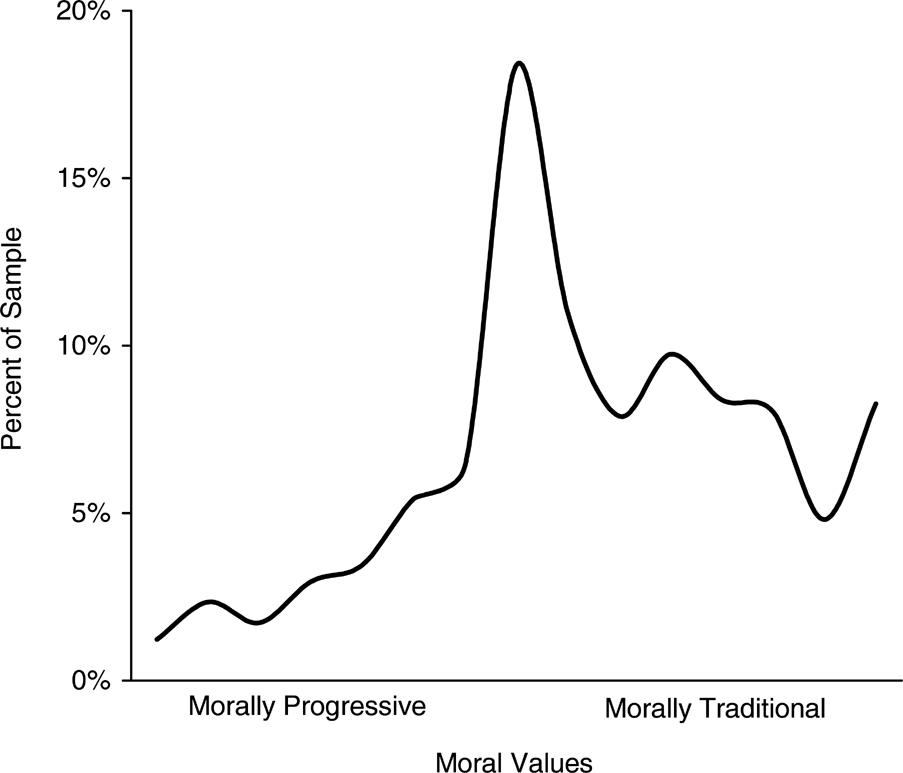
Respondents placed each item on the same five-point scale which ran from “strongly disagree” to “strongly agree.” I coded all items to run from the most progressive to the most traditional response and averaged them together. The scale has an alpha of .67, a mean of .56, and a standard deviation of .22. Figure 1 presents a line graph of the moral values scale. It is relatively normal, skewed to the right, and widely dispersed. It shows that Americans tend toward moderation in their moral values but with substantial variation and more traditionalists than progressives.

Distribution of Moral Values in 2004
Source: 2004 ANES
Notes: Sample Includes Two Party Presidential Voters
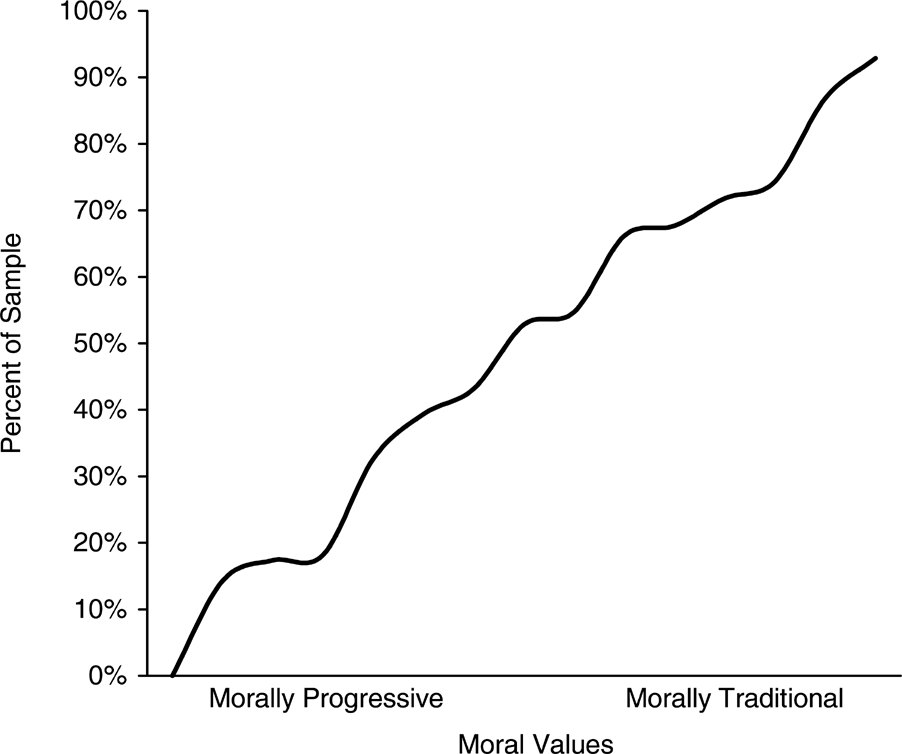
To begin to address the effects of moral values on voting in 2004, Figure 2 presents a bivariate line graph of moral values by the percentage of Bush voters. The line in Figure 2 shows a fairly linear association between moral values and the vote—moral progressives supported the candidate who took more liberal stands on cultural issues and moral traditionalists supported the candidate who took conservative stands on these issues, with moral moderates splitting their votes between the two candidates.

Moral Values by Vote for Bush in 2004
Source: 2004 ANES
Notes: Sample Includes Two Party Presidential Voters
The bivariate association between moral values and vote choice is similar to the strong association we have come to expect between party identification and the vote. To control for this and other potential confounds I regressed presidential vote choice on moral values while controlling for the same set of issues and demographics as Hillygus and Shields (2005), including attitudes toward the Iraq War, terrorism, the economy, gay marriage, and abortion, as well as partisanship, ideology, race, sex, and marital status.2
The one exception to this is personal income, which was uniformly nonsignificant in Hillygus and Shields' (2005) analysis. I exclude it here because it would increase missing data by about 10%. As a check, I ran the model with income. The coefficient on income was small in magnitude and did not approach statistical significance.
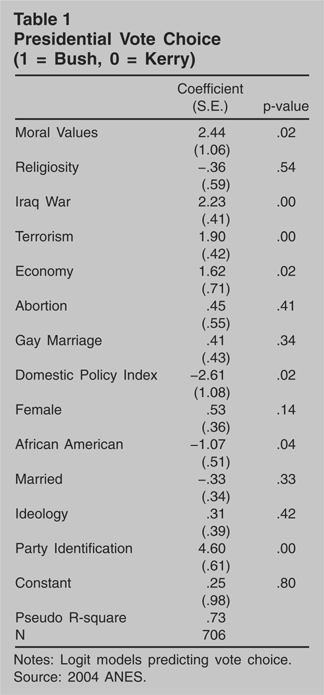
The results of the logit model are presented in Table 1. The coefficients on Iraq, terrorism, the economy, the domestic policy index, race, and party identification are all signed in the expected direction and statistically significant. Consistent with the results of Campbell and Monson (2006) and Hillygus and Shields (2005), gay marriage and abortion are not statistically significant. In the national electorate these two moral issues did not influence vote choice in 2004. Religiosity is also not significant—controlling for other factors, people high in religiosity were no more likely to vote for Bush than Kerry in 2004. However, the coefficient on moral values is signed correctly, statistically significant, and of greater magnitude than every other significant predictor in the model except the domestic policy index and party identification.
Presidential Vote Choice (1 = Bush, 0 = Kerry)

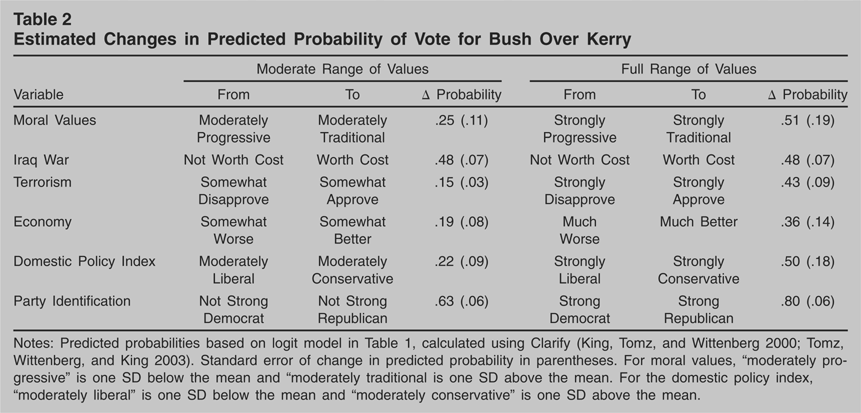
To get a more thorough view of these effects, I calculated the change in the predicted probability of voting for Bush across different values of the predictors, holding the other variables constant at their means and indicators at zero.3
Like Hillygus and Shields (2005), this analysis includes average white males who are Independents.
Estimated Changes in Predicted Probability of Vote for Bush Over Kerry

These results suggest that perceptions of the war in Iraq outstripped moral values and other policy attitudes in terms of influence on the vote. However, the ranges of these variables may make this analysis misleading. Whereas the Iraq War variable is dichotomous, and thus ranges from its minimum to its maximum, the others are not dichotomous, and have, in this analysis, a more limited range. Perhaps a more even-handed comparison would compare the effects of the variables as each ranges from its minimum to its maximum. The right side of Table 2 presents this analysis. It presents the change in the predicted probability of voting for Bush across the full range of values for each predictor. Here, as moral values changes from its minimum (labeled “strongly progressive”) to its maximum (labeled “strongly traditional”) the increase in the predicted probability of voting for Bush (.51) is similar to the minimum-to-maximum changes for the domestic policy index (.50), the Iraq War (.47), terrorism (.43), and the economy (.36), and, again, substantially less than that of party identification (.80). Overall, the results of this analysis show clearly that moral values influenced vote choice in 2004. Moral progressives voted for Kerry, moral traditionalists for Bush, and the effect of moral values on the vote was about as great as the effects of terrorism, the Iraq War, the economy, and domestic policy issues.
Discussion
Until recently, moral values have been largely overlooked as a source of political attitudes and behavior (Weisberg 2005). The results of this study show the influence of moral values in the 2004 presidential election. They have at least four implications for our understanding of political behavior. First, this study shows the importance of distinguishing between issues and values. The study of values in political and social psychology is longstanding but scholars have been slow to incorporate values into their analysis of voting behavior. This study shows that both values and issues influenced the vote in 2004, but it also shows that the two do not necessarily go hand in hand. In 2004, moral values influenced vote choice but attitudes toward two high-profile moral issues—gay marriage and abortion—did not. Future research might explore just how moral values influence the vote. Perhaps people vote for the candidate who they perceive shares their values.
Second, studies of voting in presidential elections that omit moral values are missing an important determining influence on the vote. Clearly the results presented here show that party identification is the most influential factor and that issues matter. But so do moral values. Future work might address the influence of moral values across elections and the possible influence of other values, such as equality and support for activist vs. limited government, on voting behavior.
Third, it is important to define “moral values.” This study defined moral values in a way consistent with prior research on the topic. The “most important issue” question on the NEP exit poll was controversial because it left the term “moral values” undefined and open to interpretation. When a plurality of voters chose moral values as the most important issue in casting their vote, the meaning of this result was unclear. The ambiguity of the term “moral values” and the lack of direct influence of gay marriage and abortion on the vote led researchers to suggest that the effect of moral values was overstated and that moral values should be removed from the list of most important issues on the NEP exit poll. Given the influence of moral values on the vote, an alternative would be to change the term on the exit poll to “traditional moral values.” This would place “moral values” in context and avoid the possibility of biasing the results of the poll through omission.
Finally, this study shows that a values divide (White 2003) was evident in the 2004 presidential election. To be sure, many Americans fall between the extremes of moral progressivism and traditionalism; this divide may or may not materialize in the general election later this year and scholars debate whether or not Americans are divided over controversial cultural issues (Ansolabehere, Rodden, and Snyder 2006; Brewer and Stonecash 2006; Campbell 2006; Fiorina, Abrams, and Pope 2006; Hunter 1991; Layman and Green 2005). Regardless, this study shows that in the last presidential election moral progressives and moral traditionalists were divided in their voting for president. In 2004 moral progressives voted for Kerry and moral traditionalists voted for Bush. The moral values story line was at least partly correct. This was an election about moral values after all.
Author Bio
Kenneth Mulligan is assistant professor, department of political science, Southern Illinois University, Carbondale. His research and teaching interests include mass political behavior, public opinion, political psychology, and political communication.
Appendix
Question Wording and Coding of Response Options
Vote choice. “Who did you vote for?” 0 = Kerry, 1 = Bush
Issues
Iraq War. “Taking everything into account, do you think the war in Iraq has been worth the cost or not?” 0 = War Not Worth the Cost, 1 = War Worth the Cost
Terrorism. “Do you approve or disapprove of the way George W. Bush is handling the war on terrorism? (Do you approve/disapprove strongly or not strongly?) Coded 4-point scale, from 0 = disapprove strongly to 1 = approve strongly
Economy. “Now thinking about the economy in the country as a whole, would you say that over the past year the nation's economy has gotten better, stayed about the same or gotten worse? (If better/worse: “much better/worse or somewhat better/worse?”) Coded 5-point scale, from 0 = much worse to 1 = much better
Abortion. “There has been some discussion about abortion during recent years. Which one of the opinions on this page best agrees with your view? … By law, abortion should never be permitted…. The law should permit abortion only in case of rape, incest, or when the woman's life is in danger…. The law should permit abortion for reasons other than rape, incest, or danger to the woman's life, but only after the need for the abortion has been clearly established…. By law, a woman should always be able to obtain an abortion as a matter of personal choice.” Coded 4-point scale, from 0 = personal choice to 1 = never permitted
Gay Marriage. “Should same-sex couples be allowed to marry, or do you think they should not be allowed to marry?” 0 = allowed, .5 = not allowed but allow civil unions (vol.), 1 = not allowed
Domestic Policy Index. Scale based on averaging together the following five items (each coded to range from 0 to 1, where most liberal response is coded 1). (1) “Some people think the government should provide fewer services even in areas such as health and education in order to reduce spending. Suppose these people are at one end of a scale, at point 1. Other people feel it is important for the government to provide many more services even if it means an increase in spending. Suppose these people are at the other end, at point 7. And, of course, some other people have opinions somewhere in between, at points 2, 3, 4, 5, or 6. Where would you place yourself on this scale, or haven't you thought much about this?” (2) “There is much concern about the rapid rise in medical and hospital costs. Some people feel there should be a government insurance plan which would cover all medical and hospital expenses for everyone. Suppose these people are at one end of a scale, at point 1. Others feel that all medical expenses should be paid by individuals through private insurance plans like Blue Cross or other company paid plans. Suppose these people are at the other end, at point 7…. Where would you place yourself on this scale, or haven't you thought much about this?” (3) “Should federal spending on welfare programs be increased, decreased, or kept about the same?” (4) “What about Social Security?” (5) “What about public schools?”
Controls
Sex. 0 = male, 1 = female
Race. 0 = otherwise, 1 = African American
Marital Status. 0 = otherwise, 1 = married
Ideology. Standard NES 7-point scale, from 0 = extreme liberal to 1 = extreme conservative
Party Identification. Standard NES 7-point scale, coded from 0 = strong Democrat to 1 = strong Republican
Religiosity. Scale based on averaging together the following three items (each coded to range from 0 to 1). (1) Do you consider religion to be an important part of your life, or not? (2) Lots of things come up that keep people from attending religious services even if they want to. Thinking about your life these days, do you ever attend religious services, apart from occasional weddings, baptisms or funerals? (If yes) Do you go to religious services every week, almost every week, once or twice a month, a few times a year, or never? (3) People practice their religion in different ways. Outside of attending religious services, do you pray several times a day, once a day, a few times a week, once a week or less, or never?