Introduction: space probes for searching the emergence of life in the universe
We assume a close integration of the phenomenon of life and all cosmic matter, both dark and visible. We further assume that life is subject to evolutionary convergence. The close integration of life and matter forms a single and self-regulating complex system, maintaining the conditions for life in the universe. Our aim is to set the basis for a theoretical biology interpretation of the ongoing measurements of the local sector of our galaxy by current and future space probes. We argue that our hypothesis of viewing the cosmos as a single complex system can lead to insights into the phenomenon of life interpreted as an emergent phenomenon with testable predictions that have escaped the standard approach of chemical evolution. We refer the readers to extensive reviews of the considerable achievements of the earlier successes of chemical evolution (Ponnamperuma & Chela-Flores Reference Ponnamperuma, Chela-Flores, Ponnamperuma and Chela-Flores1995; Chela-Flores & Raulin Reference Chela-Flores and Raulin1996; Chela-Flores et al. Reference Chela-Flores, Owen and Raulin2001).
We attempt to produce a more holistic understanding of life as a network of interacting processes that can be related to the information sciences in the same manner that systems biology has focused on genetics (cf. Glossary and Buchanan et al. Reference Buchanan, Caldarelli, de los Rios, Rao and Vendruscolo2010) and on chemistry (Szostak Reference Szostak2009). The present work is based on the analogue of the recent successful manner in which certain branches of biology, other than astrobiology, do not insist on reductionism as the bases for understanding complex systems. Our chosen biological phenomenon, the emergence of life as a consequence of galactic chemical evolution, will be shown how it can emerge from large data banks (currently in the process of formation) of detailed geophysical and astronomical observation of a rapidly growing number of exoplanets. The measurements of the present space missions (cf. section ‘Can a system's astrobiology contribute to rationalize the emergence of life in the universe?’) concern our local galactic sector. In the previous case of successful systems biology, the work had been based on large data banks of molecular biology, rather than geophysical or astronomical measurements (Sauer et al. Reference Sauer, Heinemann and Zamboni2007).
Our concepts can be retraced to Lawrence J. Henderson, especially those of fitness and biocentrism. The fitness of the cosmos for the origin and evolution of life is discussed in Henderson's ‘The Fitness of the Environment’ (Henderson Reference Henderson1913; for recent reviews, cf. Chela-Flores Reference Chela-Flores and Kumar2008, Reference Chela-Flores2011a).
In Henderson's work two separate discussions, one for cosmic evolution and the other for biological evolution (Darwinism) began to merge. In his influential book, Henderson's attempt was to rationalize the question of fitness of the environment for the evolution of life. For many chemical compounds, he discussed the difficulties that the evolution of life would have encountered had these compounds not been freely available in the terrestrial environment. Water was one example. Its search, even today, is a main objective of the exploration of the Solar System and other solar systems (Tinetti et al. Reference Tinetti2007; Cosmovici et al. Reference Cosmovici, Pluchino, Salerno, Montebugnoli, Zoni and Bartolini2008; Stoker et al. Reference Stoker2010). Henderson concludes that: ‘The properties of matter and the course of cosmic evolution are now seen to be intimately related to the structure of the living being and to its activities; they become, therefore, far more important in biology than has been previously suspected’.
In the present case, we are also postulating a close relationship between the phenomenon of life and the matter content of the universe. Life in the universe, living matter, galaxies and their contents, dense interstellar clouds of dust and gas and all the numerous solar systems that emerge from them form a complex system with the capacity to keep our universe ‘a fit place for life’, paraphrasing Henderson's seminal statement. As in his century-old hypothesis, in modern terms our own hypothesis points out an intimate relationship between life as a complex system and the (cosmic) environment of visible and dark matter. In effect, the universe is assumed to have self-regulating processes (SRPs) capable of ensuring the survival of life. Such SRPs are known in biological systems tending to maintain stability (homoeostasis), while adjusting to conditions that favour life's survival.
Can a system's astrobiology contribute to rationalize the emergence of life in the universe?
New approaches to biology such as systems biology (cf. Glossary) still have to make an impact on all branches of biology. This is especially the case for astrobiology, one of the most recent branches in the life sciences. Research in astrobiology, especially in the origin of life in the universe does not focus on systems as a whole (systems biology); rather it pursues the organic chemical approach of attempting to synthesize deoxyribonucleic acid (DNA) or protein monomers. An approach analogous to systems biology can take advantage of current technological progress to maintain and enlarge the growing fleet of space missions for the exploration of both our solar system and the cosmos at large, and profiting from the broad experience in handling data in both proteomics and genomics.
The related work in complex systems from the point of view of chemistry serves as an additional input to support the thesis that a systems astrobiology may be a fruitful pathway to follow. The work of Phil Anderson implies that in chemistry, as well as in biology, exclusively the laws that govern its component parts do not regulate complex systems. In this case, collective behaviour is relevant. In Anderson's own words, we can say that ‘more is different’ (Anderson Reference Anderson1972). This remark has been amply demonstrated subsequently in questions related firstly, to genetics in systems biology (Sauer et al. Reference Sauer, Heinemann and Zamboni2007), secondly, to biochemistry for solving fundamental problems, such as protein folding (Wolynes et al. Reference Wolynes, Onuchic and Thirumalai1995; Dobson Reference Dobson2003), or proteome folding (cf. Glossary and Frydman Reference Frydman2001; Hartl et al. Reference Hartl, Bracher and Hayer-Hartl2011; Vendruscolo et al. Reference Vendruscolo, Knowles and Dobson2011) and thirdly to chemistry in relation to questions closer to aspects of chemical evolution on the early Earth (Szostak Reference Szostak2009).
The catalogue of known exoplanets is expected to increase rapidly beyond those obtained by astronomical means, such as stellar eclipses, also known as the transit method (Friedlung et al. Reference Friedlung2010). Observing a very large number of stars simultaneously where, assuming a random orientation in space, between 0.5 and 10% of the objects will experience an eclipse of a portion of the stellar surface, which will cause a temporary drop in the stellar flux (Mayor et al. Reference Mayor, Udry, Lovis, Pepe, Queloz, Benz, Bertaux, Bouchy, Mordasini and Segransan2009). Among these new worlds there are a considerable number of possible Earth-sized planets. In the coming years, careful consideration of these putative solar systems will be followed up for definite confirmation.
The data have been retrieved in two stages. Firstly, the French Space Agency (CNES) mission CoRoT (COnvection ROtation and planetary Transits) was launched in 2006 in a Sun-synchronous polar orbit around Earth (Auvergne et al. Reference Auvergne2009). The method used is specifically designed to search for transiting super-Earths (1–2 Earth radii) in short-period orbits (<15–20 days, though larger planetary radii are detectable up to periods of 50 days). Secondly, the National Aeronautics and Space Administration (NASA) Kepler mission was launched with a larger telescope. Kepler can remain focused on the same sector in the sky for years and its funding allows it to make observations for a period of 3–4 years having the potential to detect small long-period planets.
The star field that Kepler observes is in the constellations Cygnus and Lyra. The production of data is truly astounding: at the time of writing Kepler had identified 2326 exoplanet candidates of which 207 are approximately Earth-size (both Earth-like and super-Earths; cf. Glossary), 1181 are Neptune-size, 203 are Jupiter-size and the remainder 55 are larger than Jupiter. The earlier Kepler estimate (Borucki et al. Reference Borucki2011) had identified 5.4% of stars hosting Earth-size candidates, 6.8% hosting super-Earth-size candidates, 19.3% hosting Neptune-size candidates and 2.55% hosting Jupiter-size or larger candidates. Multi-planet systems are common: 17% of the host stars have multi-candidate systems and 33.9% of all the planets are in multiple systems.
Cosmic events as SRPs
Our solar system formed in the midst of a dense interstellar cloud of dust and gas, essentially a circumstellar disk around the early Sun. Some evidence suggests that this event was triggered by the shock wave of a nearby supernova explosion more than five billion years ago. Indeed, some evidence indicates the presence of silicon carbide (SiC; carborundum) grains in the Murchison meteorite, a fact demonstrating that they are matter from a type II supernova (Hoppe et al. Reference Hoppe, Strebel, Eberhadt, Amari and Lewis1997). Supernovas are at the bases of the supply of chemical elements that will form solar systems and biomolecules can be considered to be an example of cosmic events as SRPs.
We may now be observing an extrasolar circumstellar disc around a young three-million-year-old Sun-like star in the constellation Monoceros (Kerr Reference Kerr2002). Several earlier examples of circumstellar disks are known, including a significantly narrow one around an eight-million-year-old star. The narrowness of this disc suggests the presence of planets constraining the disc (Schneider et al. Reference Schneider1999). The following additional information further supports the arguments in favour of universal mechanisms of convergence in the formation of solar systems; that is, the matter of the original collapsing interstellar cloud does not coalesce into the star itself, but collapses into the spinning circumstellar disc, where planets are thought to be formed by a process of accretion. Some planetesimals collide and stay together because of the gravitational force. In addition, a variety of small bodies are formed in the disc, prominent among which are comets, asteroids and meteorites.
Another example of cosmic events as SRPs is provided by the convergent origin of hydrospheres and atmospheres. The earliest preserved geologic period (the lower Archaean) may be considered to represent the tail end of the Late Heavy Bombardment. During that time, various small bodies, including comets, collided frequently with the early precursors of the biomolecules that eventually ignited the evolutionary process on Earth and in its oceans.
In addition, comets may be the source of other volatile substances that are significant to the biosphere, as well as the biochemical elements that were precursors of the biomolecules. Collisions with comets, therefore, are thought to have played a significant role in the formation of the hydrosphere and atmosphere of habitable planets, including the Earth. The source of comets is the Oort cloud and Kuiper belt. These two components of the outer solar system seem to be common in other solar systems. Hence, cosmic collisions with proto-planets can be interpreted as a case for cosmic events that can be interpreted as SRPs.
Convergence and contingency in evolutionary biology
The question: ‘What would be conserved if the tape of evolution were played twice?’ is relevant to astrobiology, especially for understanding the proper role played by contingency in the evolution of life on Earth (Gould Reference Gould1989; Fontana & Buss Reference Fontana and Buss1994). We argue that achieving this objective is feasible with missions that are in principle possible within the budgets that are already available to any of the several national space agencies. Since all forms of life known to us are terrestrial organisms, it is reasonable to question whether the universality of biology is a valid research objective (Dawkins Reference Dawkins and Bendall1983; Chela-Flores Reference Chela-Flores2007).
The complementary nature of chance (contingency) and necessity (natural selection as the main driving force in evolution) is relevant to astrobiology. Independent of historical contingency, natural selection is powerful enough for organisms living in similar environments to be shaped to similar ends, to a certain extent and in certain conditions natural selection may be stronger than chance (Conway-Morris Reference Conway-Morris1998, 2003).
We raise the question of the universality of biochemistry, one of the sciences supporting chemical evolution. Beyond the specialists of the theory of evolution, the Nobel Laureate Jacques Monod discussed the relative importance of chance and necessity (Monod Reference Monod1971). The main issue is which features of the history of life are inevitable and which are highly contingent and, hence unpredictable. There is a broad list of publications addressing this issue. Following the publication of a series of books (de Duve Reference De Duve1995, Reference De Duve2002, Reference De Duve2005), especially interesting discussions have been published discussing extensively the question of the relative importance of contingency and convergence (Knoll Reference Knoll1995; Foote Reference Foote1998; Szathmary Reference Szathmary2002; Erwin Reference Erwin2003).
The fraction of planetary atmospheric O2 is a measurable bioindicator
In the standard models of the early Earth, the volatile content includes nitrogen (N), water, carbon dioxide (CO2) and carbon monoxide, leaving oxygen as a gas that accumulated to significant proportions only at a later stage, due to the emergence of the living process itself, closely linked to the emergence of the earliest cyanobacteria. The fossil evidence suggests that biomarkers typical of eukaryotes, and hence of the rising presence of an oxygenic atmosphere, are already present in the 2.7 Ga (109 years) shales in Western Australia – the Pilbara Block's Fortescue Group (Brocks et al. Reference Brocks, Logan and Summons1999). For details, in a more general context, we refer the reader to Chela-Flores (Reference Chela-Flores2011b, Reference Chela-Flores2012).
Among the volatiles N is singular, since it is mainly confined to the outer reservoirs of the Earth: its atmosphere, its oceans and its sediments. Water and carbon are different due to a large fraction that is also contained in the mantle. To testify the existence of a possible ancient nitrogenous atmosphere, it was suggested that soon after accretion N was degassed reaching the present atmospheric level (PAL) rapidly in some 200 million years, possibly remaining constant since these early times (Zhang & Zindler Reference Zhang and Zindler1993). This suggestion is further supported by the view that the ratio N/36Ar (Argon) is different between the terrestrial mantle and its atmosphere, N being preferentially partitioned in the terrestrial core with respect to 36Ar.
These arguments rationalize the present values of N/36Ar in the atmosphere (∼104) and the mantle (>106) (Miyazaki et al. Reference Miyazaki, Hiyagon, Sugiura, Hirose and Takahashi2004). An important ingredient in the chemical evolution scenarios is the presence of ammonia (NH3). After release in outgassing two possibilities have been discussed: it may have been photo-oxidized to N2 in a short period of time (Kuhn & Atreya Reference Kuhn and Atreya1979), or the presence of sulphur in the atmosphere could have prevented ultraviolet radiation substantially and thus NH3 could have remained as an important atmospheric component for a longer period (Kasting Reference Kasting1982).
The mainly biological flux of N is restricted to the atmosphere, oceans and sediments as follows: bacteria may fix N as NH3 in the process of N fixation. The N cycle is followed by a combined process of nitrification – with the help of autotrophs – and denitrification that returns N to the atmosphere. The additional contribution of replenishing the atmosphere by volcanic activities is negligible by comparison (Fischer et al. Reference Fischer, Hilton, Zimmer, Shaw, Sharp and Walker2002). The biologically driven N flux replenishes the atmosphere in about 10 million years (Mather et al. Reference Mather, Pyle and Allen2004). The emergence of the biologically driven N flux has been reviewed, including the ongoing debates regarding whether N takes part in additional fluxes, such as being cycled into the mantle by subduction (Rollinson Reference Rollinson2007). It is likely that the early Earth had a nitrogenous atmosphere that has been maintained ever since the Hadean.
Convergent biological and stellar evolutions
Stars evolve as nuclear reactions convert mass to energy. In fact, stars such as our Sun follow a well-known pathway along a Hertzprung–Russell (HR) diagram, named after the Danish astronomer Ejnar Hertzsprung and, independently, by the American astronomer Henry Norris Russell. They observed many nearby stars and found that in the plot of their luminosity (i.e. the total energy of visual light radiated by the star per second), and surface temperatures, a certain regularity emerges: the stars lie on the same curve in the HR diagram, whose axes are the two parameters considered by the above-mentioned early 20th -century astronomers. Such stars are called Main Sequence (MS) stars that lie on a diagonal from the upper left of the HR diagram (represented by bright stars) to the lower right (cool stars). The set of large, cool stars turn up in the upper right, and the white dwarfs lie in the lower left. In this spectroscopic classification tour own star, the Sun is GV2. The Sun lies near the middle of the MS. The surface temperature of the star is indicated by its Planckian radiation measured by its spectral type or colour index. We may ask questions that are relevant to our objective of formulating appropriately our concept that the universe may be considered to be complex system:
How do stars move in the HR diagram as hydrogen is burnt, and what does it tell us about stellar ages? Extensive calculations show that MS stars are funnelled into the upper right hand of the HR diagram, where we find red giants of radii that may be 10–100 times the solar radius. Stellar evolution puts a significant constraint on terrestrial habitability and, in general, on habitability in an exoplanet. For estimating stellar ages, the shapes of the HR diagrams are useful. Stars more massive than about 1.3 solar masses have evolved away from the MS at a point just above the position occupied by the Sun. The time required for such a star to exhaust the hydrogen in its core is about 5 to −6 Ga, and the cluster to which the Sun belongs must be at least as old. More ancient clusters have been identified. In our galaxy, globular clusters are all very ancient objects, with ages measured in Ga. Exact ages, however, cannot yet be assigned to globular clusters. The details of the evolutionary tracks depend on hydrogen–metal ratios, helium–hydrogen ratios and the precise theory of stellar evolution. We may expect that the sector of our galaxy that is being probed in the next few years will yield useful data. This forthcoming information can be fed into our model of a universe as a complex system with evolutionary convergence. The data can arise from various sources:
• Kepler astronomical data (KAD). This parameter is related to the age and size of the stellar host of the exoplanets, especially for Earth-like planets in habitable zones (HZs) that will emerge from Kepler and subsequent missions when such planets are confirmed, following their preliminary identification (Borucki et al. Reference Borucki2011).
• Kepler spectroscopic data (KSD) of anomalous fraction of biogenic atmospheric gases. This parameter is measurable not only in hot exo-Jupiters that have already been detected by precision infrared spectroscopy with the Hubble Space Telescope (HST) but also in super-Earths and Earth-like planets (Tinetti et al. Reference Tinetti2007; Swain et al. Reference Swain, Vasisht and Tinetti2008). But eventually we will have some information available on the atmospheres of Earth-like planets in HZs. These worlds will begin to emerge from Kepler and in due course from subsequent missions.
These two types of data are intimately related. One aspect of astronomical data concerns the size of the stellar host of exoplanets. This is relevant, since stars with mass similar to that of the Sun remain at the red giant stage for a few hundred million years. In the last stages of burning the star pushes off its outer layers forming a large shell of gas much larger than the star itself (a planetary nebula). The star itself collapses under its own gravity, compressing its matter to a degenerate state. The laws of quantum mechanics eventually stabilize the collapse. This is the stage of stellar evolution that we called earlier a white dwarf. The stellar evolution of stars more massive than the Sun, live a shorter lifespan than stars in the MS of the HR diagram. Possibly such stars are not old enough to bear an evolutionary line that will produce the gradual atmospheric anomalies that will mean the evolution of life on the exoplanet or the exosatellite (Kipping Reference Kipping2009).
In the case of the Earth, the theory of stellar evolution tells us that the Sun is a middle-aged star. Even though in the first 5–8 Ga of its existence the Earth has been able to evolve in the Sun's habitability zone and to preserve a biota, the KAD are relevant to understand solar evolution. The radius of the Sun is bound to increase, as it moves away from the MS on the HR diagram, reducing the habitability of the once-habitable planet. The Sun's expected radial growth will be such that its photosphere will reach the Earth's orbit. This will eventually alter radically habitability on Earth. Likewise in exoplanets, the spectroscopic data will have to be correlated statistically for early-evolved exoplanets with gradual variations of the atmospheric data.
Discussion
Testing the validity of systems approach to astrobiology
We have attempted to illustrate how systems astrobiology assumes a new role in the science of astrobiology. In our theory of life in the universe, we have underlined several stages that are analogous with the standard systems biology, namely:
1. The theory: the universe is treated as a complex system with evolutionary convergence.
2. The computational modelling: statistical correlations of astronomical data are needed from Kepler and subsequent missions and spectroscopic data from the HST and the next generation of space telescopes.
3. A testable hypothesis: the Earth-like exoplanets in HZs of MS stars will yield anomalous fractions of biogenic gases in the spectroscopic analyses of their atmospheres.
4. The complex system: the universe itself is interpreted as a complex system.
5. Experimental validation: We need to expand the rapidly growing data banks of exoplanetary searches in the present Kepler and in the future post-Kepler era that will yield sufficient data that is required in our systems astrobiology approach.
In other words, a clear prediction from the present work can be tested in the foreseeable future with feasible instrumentation (to prove, or falsify the theory). We have assumed the universe can be treated as a complex system. Space probes continue to gather large amounts of data concerning measurable parameters from their search for exoplanets. Among the forthcoming data there will be the identity of the elements present in the exoplanet atmospheres by spectroscopic means.
On handling the forthcoming data
To plot at least some point in a figure that shows the correlation between KAD and KSD is a type of quantitative information that would strongly support the idea that the life may originate naturally from the composition of the environment. These correlations will be forthcoming in due course, but at the present time we can begin to illustrate how the data may be handled.
As a working hypothesis we have assumed that there will be evolutionary convergence when biology is considered at a cosmic scale. In those planets that are Earth-like and placed within the star's HZ the evolution of biota will produce atmospheres that will have an anomalously large fraction of biogenic gases, for example oxygen and methane.
The Kepler Mission data are still gathering in the data banks corresponding to the Earth-like planet candidates that have already been tentatively identified and published (Borucki et al. Reference Borucki2011). In anticipation of the confirmation of these results, we can illustrate the significance of the hypothesis of the universe as a complex phenomenon by referring to an Earth-like planet that we already know with its host star, namely our own planetary system. When more reliable results are obtained in the near future with Kepler and its successors, we will know the anomalous fraction of biogenic gases whenever they are present in the list of Earth-like planets in their own habitability zones.
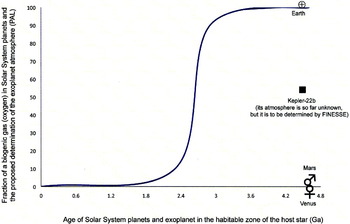
In due course we will have a series of graphs one of which is already available and illustrated in Fig. 1. Later on the anomalous fractions of biogenic gas in other Earth-like planet atmospheres (oxygen and methane) will be available for a number of star planetary systems that are within the scope of Kepler, namely, over 100 000 stars a sample that we have called KAD. The forthcoming results will contain a subset of Earth-like planets, whose KSD will also be available in the near future with the remarkable present pace of progress in instrumentation. The proportion of anomalous biogenic gas (oxygen) by volume in the atmosphere in the single case (out of three possibilities) of Fig. 1 is 21%.
Towards an eventual correlation of KAD and KSD. This figure represents an example for planets in the HZ of a G2V star (cf. the Morgan–Keenan system the stellar spectra) in which the atmospheres are known. We have inserted an additional exoplanet in the HZ of its own star, whose atmosphere is to be determined in due course. The abbreviations KAD and KSD denote, respectively, the Kepler astronomical data and the Kepler spectroscopic data. We have suggested plotting the age of the star's confirmed Earth-like planets in its HZ against the anomalous atmospheric fraction of a biogenic gas (in the present case it is oxygen). In the familiar case of the G2V planetary system, there are three planets in the star's HZ, but the only appreciable presence of biogenic gas (oxygen) corresponds to the planet at 1 AU from its host star (the Earth). Those at 0.7 AU (Venus) and 1.5 AU (Mars) have a mainly CO2 atmosphere (96.5 and 95% respectively, with negligible biogenic gases, hence they were inserted in Figure 1, where we have chosen oxygen as the most relevant biogenic gas in our solar system. The abundant biogenic gas in the planet at 1 AU (Earth) is oxygen. However, in other stars the exoplanets in their HZ, such as Kepler-22b (an exoplanet whose age is undetermined, orbiting a G5 dwarf star in the same Class as the Sun, cf. Borucki et al. Reference Borucki2012), could have an anomalous fraction of any of the biogenic gases. Since the time of the origin of the Earth, we have the benefit of knowing even the evolution of the anomalous biogenic gas (oxygen). For drawing the curve, we have assumed that the large increase in oxidation of the atmosphere occurred at 2.45 Ga after the planet’s origin (Kump Reference Kump2008). By focusing on Sun-like stars of similar age and Class in the Main Sequence of the HR diagram, the data banks will begin to provide evidence for life. For younger stars, this illustration (and the corresponding data banks) will not exclude transient episodes of life-bearing exoplanets in their HZ, as may have been the case of Mars at an earlier epoch (Formisano et al. Reference Formisano, Atreya, Encrenaz, Ignatiev and Giuranna2004). We have used the standard astronomical symbols for the planets of the Solar System. The black square represents a typical exoplanet in its HZ. We have taken Kepler-22b, whose atmosphere, including any biogenic gas will be determined in due course by NASA's FINESSE (cf. section ‘Life fingerprints in exoplanet atmospheric gases’.).

Earlier estimates of biogenic gas in other planets – methane – were attempted with the help of the HST for a Jupiter-like planet. For other Earth-like planets, such as the recently confirmed Kepler-22b (cf. subsection ‘The phenomenon of the emergence of life in the universe’), the identification of chemical elements in their atmospheres is still a challenge being faced by the Kepler team. However, for a Jovian-like planet HD 189733b (Swain et al. Reference Swain, Vasisht and Tinetti2008), methane was tentatively identified. Subsequent research, based on the Keck Telescope, has not confirmed this result (Mandell et al. Reference Mandell, Deming, Blake, Knutson, Mumma, Villanueva and Salyk2011). The confirmation of the preliminary Kepler data of Earth-like planets (KAD) will allow the next step in building of the data banks for the anomalous biogenic gases. In other words, the KSD data could grow into substantial data banks if the present tendency is confirmed (cf. section ‘Can a system's astrobiology contribute to rationalize the emergence of life in the universe?’): 5–6% of the preliminary samples of exoplanets are Earth-like. In turn, this implies that some of these will lie in the host star's zone of habitability.
Life's fingerprints in exoplanet atmospheric gases
Our work is part of a larger body of papers that have discussed biogenic gases as signatures for life. Not only has this topic been advanced in the past, but a new mission is under consideration by NASA Jet Propulsion Laboratory (JPL) – FINESSE (Fast INfrared Exoplanet Spectroscopy Survey Explorer) – that would measure the spectra of stars and their planets in two alternative situations that would correspond firstly, to the spectra of both the star and their exoplanets when both are visible, and secondly when the exoplanet is hidden by its star (Swain Reference Swain2010). This will allow FINESSE to analyse the planetary atmospheric components (to provide the data that are missing in graphs such as the preliminary one shown in Fig. 1). Indeed, this JPL proposal would use a space telescope to survey more than 200 planets around other stars. This would be the first mission dedicated to finding out the fraction of biogenic gases in exoplanet atmospheres and how the Solar System fits into the family of planets in the galactic neighbourhood being explored by the Kepler mission.
However, returning to recent efforts in the discussion of biogenic indicators of the origin and evolution of life in exoplanets in the context of the present paper, it is worth highlighting:
(i) The development of better models has been suggested for the Earth early atmosphere, including the presence of biosignatures like oxygen (O2), water (H2O), ozone (O3), methane (CH4), methyl chloride (CH3Cl) and nitrous oxide (N2O), in order to be able to select between geophysically produced atmospheres and those that have received an input from biosystems (Darling Reference Darling2001; Kiang Reference Kiang2008).
(ii) In addition to atmospheric biogenic gases such as oxygen, other gas biosignature scientists have already considered the surface reflectance spectra of vegetation, or the amount of light reflected off plant matter at different wavelengths (Kiang et al. Reference Kiang, Segura, Tinetti, Blankenship, Cohen, Siefert, Crisp and Meadows2007). This work is based on an extension to Earth-like planets in their star's HZ of the events that led to the emergence of oxygenic photosynthesis on Earth (Wolstencroft & Raven Reference Wolstencroft and Raven2002). We are at an early stage, but in an inexorable route towards the first verification of life elsewhere, microbial or multicellular, either in our own solar system (microbial), as emphasized repeatedly in our earlier research focused on the outer Solar System (Chela-Flores & Kumar, Reference Chela-Flores and Kumar2008; Chela-Flores, Reference Chela-Flores2010) or (microbial or multicellular) in other solar systems (Kiang Reference Kiang2008; Schneider et al. Reference Schneider2009, Reference Schneider2010).
The phenomenon of the emergence of life in the Universe
The implications for the distribution of life can be searched in the potentially habitable planets—Earth-like and placed within the star's HZ. The hypothesis leads to a prediction for a radical change from the atmospheric fractions compared with companion planets (super-Earths and Jovian-like and other planets) in the same stellar planetary systems being explored by the space probes (Kepler and successors, HST and its successors, and by the High Accuracy Radial velocity Planet Searcher (HARPS) Spectrograph, cf. Glossary).
We are at the very beginning of this search. Earth-like planets in HZs of their stars only begin to be known with certainty. At the time of writing Kepler-22b that is 600 light years away and is 2.4 times the Earth's radius, becomes the first in a list of 207 approximately Earth-size planets to have been confirmed, with a subset of 48 actually lying in the HZ of their corresponding stars (Borucki et al. Reference Borucki2011).
Life in the universe will emerge from statistical analysis of large data banks that are now beginning to accumulate. Our combined assumptions of convergence and the cosmos as a complex system imply that all the Earth-like exoplanets that will be in the HZ of their corresponding star will have an identifiable bioindicator (anomalous production of biogenic gases). The signs of life are predicted to be a biologically produced atmosphere, largely fractionated towards one of the biogenic gases (in the case of the Earth the large fractionation triggered by biosystems is the 21% of oxygen). Such atmospheres would not be the result of natural accretion processes in the processes that give origin to the planets, but instead, the emergence of the biogenic atmospheres would be the result of the innate phenomenon of life that the laws of biochemistry will allow in brief geologic times.
Systems astrobiology is analogous to systems biology, but it has to wait for its full implementation until after we have gathered enough data from the sector of our galaxy that is being probed by the CoROT, Kepler and by subsequent searches (cf. section ‘Can a system's astrobiology contribute to rationalize the emergence of life in the universe?’). The practical reason why systems biology is a promising frontier for the future of astrobiology is that it is not easy to have access to information on these planets, except through the now incipient data banks of observable geophysical data, such as methane and oxygen atmospheres, as well as information on the presence of liquid water beyond the present data that has already been searched for (Tinetti et al. Reference Tinetti2007; Cosmovici et al. Reference Cosmovici, Pluchino, Salerno, Montebugnoli, Zoni and Bartolini2008; Seager & Deming Reference Seager and Deming2010).
The search for exoplanets can be viewed as the first step in an eventual discovery of life as a complex cosmic system. Following the lines outlined above, we expect that a rationalization of life will eventually emerge from the data banks of a very large number of stars in our galactic sector. The geophysical data, rather than data banks of biological information, will provide a gradual emergence of the living phenomenon. The geophysical (atmospheric) bioindicators point towards ecosystems that have evolved around stars producing measurable biomarkers in our galactic sector. Subsequently, with better missions and with improved instrumentation, this identification of life as a complex system can be extended from a sector of the galaxy now being probed to other more distant parts of the universe.
To sum up, we have suggested that one evident advantage of viewing the cosmos as a complex system (and life as an emergent phenomenon) is to anticipate, organize and interpret the data that are provided by Kepler, as well as the data that are to come in the post-Kepler/FINESSE era. We have described how the hypothesis of life as a complex system will lead to relevant insights into the whole cosmic system (life and its intimate relation with matter).
Glossary
Carborundum: SiC is an exceedingly hard crystalline compound of silicon and carbon that can be synthesized in the laboratory, but it has also been found in the Murchison meteorite. Carborundum has been identified in a pre-solar grain presumably arising from a type II supernova (Hoppe et al. Reference Hoppe, Strebel, Eberhadt, Amari and Lewis1997).
Convergent evolution: Independent evolution of similar genetic or morphological features. Since biochemistry (Pace Reference Pace2001), as well as biology (Dawkins Reference Dawkins and Bendall1983) are assumed to be a universal sciences, evolutionary convergence has been assumed to be possible even in other lines of biological evolution elsewhere in the universe, (Conway-Morris Reference Conway-Morris1998, Reference Conway-Morris2003; Chela-Flores Reference Chela-Flores2007).
CoRoTMission: The first space mission designed to search for exoplanets similar to the Earth itself was launched with a Soyuz-Fregat rocket in December 2006. CoROT is the French Space Agency (CNES) mission containing a small space telescope orbiting at a height of 900 km.
Earth-like planet: In the emerging Kepler catalogues, there are candidate planets that are to be confirmed whose radii are equal, or smaller than the Earth.
Exoplanet: The term refers to any planet that is part of a stellar system other than the Sun.
FINESSE: A NASA proposal to use a space telescope for surveying planets around other stars, dedicated to finding out the nature of exoplanet atmospheres (Swain Reference Swain2010).
HARPS instrument. This is a spectrograph that is part of ESO's (European Space Observatory in Chile) 11.8-foot (3.6-meter) telescope at the La Silla Observatory in Chile. This instrument has allowed the identification of more than 50 exoplanets, including 16 super-Earths, one of which is 35 light years (ly) away in the Vela constellation, HD 85512b (3.6 times the Earth mass) lying at the edge of the HZ (Pepe et al. Reference Pepe, Lovis, Ségransan, Benz, Bouchy, Dumusque, Mayor, Queloz, Santos and Udry2011).
HR diagram: is a graph in which the absolute magnitudes (intrinsic brightness) of stars are plotted against their spectral types.
HST: an optical observatory placed into a terrestrial orbit at about 600 km above the Earth. It was named in honour of the American astronomer Edwin Hubble. It contains a 2.4-metre primary mirror, and recording instruments for the detection of visible, UV and infrared light.
Kepler mission: Launched on March 7, 2009 from Cape Canaveral Air Force Station in Florida, it is a mission designed to observe more than 150 000 stars in less than 4 years. Its main objective is to search for exoplanets, especially Earth-like planets.
Morgan–Keenan system: The spectrum letter is enhanced by a number from 0 to 9 indicating tenths of the range between two star classes, so that G5 is five-tenths between G0 and K0, but G2 is two-tenths of the full range from G0 to K0 (where, as usual: O (a class of stars that are very hot and extremely luminous, being bluish in colour; in fact, most of their output is in the UV range.), B (a class of stars that is very luminous and blue), A (a class of (common) stars that is white or bluish-white, they have strong hydrogen lines), F (a class of stars with spectra that are characterized by their white colour (approximately 1 in 33 in the MS in the solar neighbourhood are in this class)), G (a class of stars including the Sun is of this class (approximately 1 in 33 in the MS in the solar neighbourhood are in this class)), K (a class of orange-coloured stars that is cooler than the Sun, including giants and supergiants (instead orange dwarfs are MS stars)), and M (a class of cool stars totalling 76% in the MS, including red dwarfs, most giants and some supergiants.) are shorthand for O stars—the hottest and successively cooler stars up to the coolest M class. According to informal tradition, O stars are called ‘blue’, B ‘blue-white’, A stars ‘white’, F stars ‘yellow-white’, G stars ‘yellow’, K stars ‘orange’, and M stars ‘red’. Another dimension is the luminosity class denoted with the help of five Roman numerals (I, II, III, IV and V), associated with the width of the stellar absorption lines (especially relevant are I corresponding to supergiants, III to giants and V to MS stars. From the point of view of exoplanets where life may arise, special attention has been paid to Earth-like planets in HZ that may orbit MS stars from spectral type F0 V to M0 V (Wolstencroft & Raven Reference Wolstencroft and Raven2002).
Proteome: The proteome refers to the complete set of proteins that a given genome is capable of expressing in a living organism.
Proteome folding: The complexity of the phenomenon of protein folding in all the proteins that are expressed in the cell has forced upon us the concept of a collective phenomenon. From the point of view of a cell, folding, is not only a single process, but it is rather a phenomenon that involves multiple molecules, whose function is closely related to guarantee homoeostasis.
Super-Earth: An exoplanet with a mass higher than Earth's, but smaller than the mass of Jupiter. Sometimes the alternative expression ‘approximately Earth-sized’ is used in the literature.
Systems astrobiology: An approach to astrobiology, as a branch of biology, proposed in the present paper, in which instead of applying the new methodology of systems biology (cf. below) to genetics, the approach is applied to other biologically relevant questions, namely the origin, evolution, distribution and destiny of life in the universe.
Systems chemistry: This is a physical science clearly outlined (Anderson Reference Anderson1972), in which an interdisciplinary approach focuses on complex interactions in chemical systems, using a new point of view, holism rather than reduction, where collective phenomena are the main ingredient in basic research of chemical systems. It attempts to produce a more holistic understanding of biochemistry, especially the question of folding both in proteins and proteomes.
Systems biology: This is a life science in which an interdisciplinary approach focuses on complex interactions in biological systems, using a new point of view (holism rather than reduction). It attempts to produce a more holistic understanding of biology, especially genetics. The new approach aims to construct a network of interacting processes that can be related to the information sciences (Buchanan et al. Reference Buchanan, Caldarelli, de los Rios, Rao and Vendruscolo2010). The main aim is to discover emergent properties of a system that would be understood by focusing on its complex interactions and relying on the information sciences.