INTRODUCTION
Recent estimates indicate that approximately twenty million individuals require palliative care worldwide, which poses a challenge to modern medicine (Connor & Bermedo, Reference Connor and Bermedo2014). In fact, end-of-life care involves a more integrative and interdisciplinary approach that encompasses many different aspects of the individual, including the spiritual dimension (Puchalski et al., Reference Puchalski, Ferrell and Virani2009).
A number of studies have already investigated the influence of patient spirituality and religiosity (S/R) on the dying process, showing that higher S/R scores are associated with improved quality of life, well-being, and mental health at the end of life (Puchalski et al., Reference Puchalski, Ferrell and Virani2009; Peres et al., Reference Peres, Arantes and Lessa2007; Puchalski et al., Reference Puchalski, Kilpatrick and McCullough2003). However, very few studies have addressed the experiences related to the dying process.
Indeed, many phenomena that take place during the final hours of life are widely observed in clinical practice, spanning different periods of history and cultures (Betty, Reference Betty2006). According to some authors, impending death can be heralded by “visions” and “apparitions” that comfort patients during the dying process and prepare them spiritually for death or for transition to a new reality, events that are known as end-of-life experiences (ELEs) or deathbed phenomena (DBPs) (Fenwick & Brayne, Reference Fenwick and Brayne2011; Fenwick et al., Reference Fenwick, Lovelace and Brayne2010; Brayne et al., Reference Brayne, Lovelace and Fenwick2008; Reference Brayne, Farnham and Fenwick2006).
These experiences can be basically divided into two categories (Fenwick et al., Reference Fenwick, Lovelace and Brayne2010): transpersonal and final-meaning ELEs. Transpersonal ELEs refer to transcendent qualities (i.e., deathbed visions, an ability to transit to and from other realities, coincidences that occur around the time of death), and final-meaning ELEs refer to substantive qualities, firmly based in the here and now, often prompted by profound waking dreams, or dreams that help the person to process unresolved business so that they can let go and die peacefully (i.e., a desire to put their affairs in order and reconcile with estranged family members).
Although ELEs are commonly seen in clinical practice, few scientific studies on the subject existed until the mid-1990s (Fenwick & Brayne, Reference Fenwick and Brayne2011). More recently, some studies have investigated ELEs in a more systematic fashion, showing that 62–87% of patients reported ELEs (Kerr et al., Reference Kerr, Donnelly and Wright2014) and 62–89% of healthcare professionals had experiences of ELEs (firsthand or reported) (Lawrence & Repede, Reference Lawrence and Repede2013; Fenwick & Brayne, Reference Fenwick and Brayne2011; Fenwick et al., Reference Fenwick, Lovelace and Brayne2010). Studies have also shown that the most common phenomena include “vivid dreams through which the patient seems to be comforted and prepared for death,” “vivid dreams or visions that help resolve unfinished business,” and “the desire to mend family rifts” (Koedam-Visser & Fenwick, Reference Koedam-Visser and Fenwick2012; Fenwick et al., Reference Fenwick, Lovelace and Brayne2010; Lawrence & Repede, Reference Lawrence and Repede2013).
A striking aspect of ELEs is the presence of the same phenomena across diverse cultures, such as those of the United Kingdom (Brayne et al., Reference Brayne, Lovelace and Fenwick2008), the United States (Lawrence & Repede, Reference Lawrence and Repede2013), the Netherlands (Koedam-Visser & Fenwick, Reference Koedam-Visser and Fenwick2012), Switzerland (Renz et al., Reference Renz, Mao and Omlin2015), India (Muthumana et al., Reference Muthumana, Kumari and Kellehear2010–Reference Muthumana, Kumari and Kellehear2011) and Moldova (Kellehear et al., Reference Kellehear, Pogonet and Mindruta-Stratan2011–Reference Kellehear, Pogonet and Mindruta-Stratan2012).
Despite the increased number of studies on ELEs in recent decades (Daher, Reference Daher2016), some gaps in this area of research remain. Replication of studies in other societies with different religious and cultural backgrounds is rare (Broadhurst & Harrington, Reference Broadhurst and Harrington2015), and, in the case of South America, no such studies have been conducted. Moreover, previous research has largely focused on assessing reports of ELEs in specific settings (e.g., nursing homes and palliative care). However, to our knowledge, no comparison among different settings has been carried out. Finally, many questions remain concerning the influence of religious factors on an openness toward and recognition of ELEs.
Therefore, the objectives of the present study were to describe and compare the characteristics and reports of ELEs by healthcare professionals at different institutions and to investigate the influence of religious beliefs on these reports.
METHOD
Study Design
A cross-sectional multicenter study was performed in the Brazilian cities of Barretos and Juiz de For between June of 2014 and June of 2015. The study was assessed and approved by the research ethics committee of the Barretos Cancer Hospital (HCB) (report no. 824.562). All study participants signed an informed consent form.
Participants and Venue
The study included healthcare professionals (physicians, nurses, psychologists, physiotherapists, speech therapists, nursing technicians/assistants, and paid caregivers) practicing in one of the following three types of settings: six nursing homes in the city of Juiz de Fora (Minas Gerais, Brazil) (NH); a palliative care unit (PC); and a cancer center (ONC) of the HCB in Barretos (São Paulo, Brazil).
The HCB is a public tertiary care hospital dedicated exclusively to oncology that treats ~4,000 patients per day from different regions of Brazil. The main building houses most of the clinical and surgical departments, including those responsible for cancer prevention, diagnosis, and treatment. Unit I also houses the clinical and surgical inpatient facilities, the surgical center, the intensive therapy unit, and the emergency department. Patients with terminal cancers are referred to a separate unit (Unit II), dedicated exclusively to palliative care. The PC unit comprises an outpatient facility and a 42-bed inpatient unit. Approximately 70% of patients admitted to the PC unit die during their hospital stay (Hui et al., Reference Hui, dos Santos and Chisholm2014).
The six nursing homes involved in the study are not-for-profit institutions dedicated to the long-term care of the elderly, the vast majority of whom are partially or totally dependent on others for the basic activities of daily living. These institutions vary in size (small to large) and operate with interprofessional/multidisciplinary teams.
Inclusion and Exclusion Criteria
To be included in our study, participants had to be at least 18 years of age, have contact with patients at the end of life during their work (with a prognosis of <6 months), and have more than 5 years of experience with this type of patient. Professionals not available at the time of study recruitment or those refusing to take part or sign the consent form were excluded.
Procedures
The researchers requested a list of healthcare professionals who practiced in the three settings with permission of the managers of the respective healthcare units. All the healthcare professionals in the PC and NH units were approached, and those who met the inclusion criteria were selected. In the ONC unit, due to the large number of staff, selections were performed randomly. The ideal number of healthcare professionals for the study was based on the sampling calculations detailed below.
Previously trained researchers approached the selected healthcare professionals before or after their work shifts, explaining the objectives of the study and providing them with a questionnaire for completion. The researchers resolved any queries arising without influencing participants' questionnaire responses.
Instruments for Data Collection
The self-report questionnaire was filled out by the interviewee, which took an average of 20 minutes to complete. The questionnaire included the following aspects.
Section 1: Sociodemographic information (gender, age, race, income, marital status) and work characteristics (place of work, years working with end-of-life patients, number of end-of-life patients treated).
Section 2: End-of-life experiences. For the present study, we used the ELE questionnaire developed by Fenwick et al. (Reference Fenwick, Lovelace and Brayne2010). This English-language instrument has been tested in many international studies and was translated and adapted into Portuguese according to the following procedure (see Beaton et al., Reference Beaton, Bombardier and Guillemin2000). Two researchers (CSS and GL) translated it into Portuguese independently. This translated version was synthesized into one version by CSS, GL, and another author (ALGL), and the scale was back-translated into English by an independent translator whose mother tongue was English. Finally, two authors (BSRP and CEP) assessed semantic and idiomatic equivalence. The final version of the instrument was approved by the author (PF) who originally developed it.
The ELE questionnaire was subdivided into two parts. In the first, dichotomous questions (yes/no) were used to assess whether healthcare professionals had ever witnessed or heard of an ELE and whether they had ever witnessed or heard of each specific ELE (i.e., “experiencing a radiant light that envelops the dying person,” “a sense of being ‘called’ or ‘pulled’ by something or someone,” “a sudden desire to sing or hum religious songs”) (Fenwick & Brayne, Reference Fenwick and Brayne2011). In the second part, Likert-type scale questions (scored 1 [“strongly disagree”] to 5 [“strongly agree”]) were utilized to assess the opinions of healthcare professionals about the effects of medication, the impact of ELEs on spiritual or religious beliefs, and their training experiences and needs (e.g., “I consider a DBP to be a profound spiritual event,” “I never discuss DBPs with any of my colleagues”).
Section 3: Religious and spiritual beliefs. Three instruments were applied. (1) The Duke Religion Index (DUREL), previously validated for Portuguese/Brazil (Lucchetti et al., Reference Lucchetti, Lucchetti and Peres2012), which is a five-item instrument addressing three dimensions: organizational, nonorganizational, and intrinsic religiosity. The first two items (scores ranging from 1 to 6) address organizational (religious attendance) and nonorganizational (time spent on private religious activities) religiosity, while the other three items assess intrinsic religiosity (range = 3–15), where higher scores indicate greater religiosity. The value of Cronbach's alpha for our sample was 0.75. (2) The Spirituality Self-Rating Scale (SSRS), previously validated for Portuguese/Brazil (Gonçalves & Pillon, Reference Gonçalves and Pillon2009), which consists of six Likert-type items (1 [“totally agree”] to 5 [“totally disagree”]). Final scores are calculated by summing the points scored (after reversal of the responses given to the six statements), which range from 6 to 30, where a higher score indicates greater reported spirituality. The value of Cronbach's alpha for our sample was 0.82. (3) Questions about beliefs about life after death, reincarnation, and the existence of a soul (Lucchetti et al., Reference Lucchetti, de Oliveira and Koenig2013).
Section 4: Mental health (depression, anxiety and stress). The Depression, Anxiety and Stress Scale (DASS-21), also previously validated for use in Brazil (Vignola & Tucci, Reference Vignola and Tucci2014) was employed. It is a combination of three Likert-type four-point subscales containing 21 questions. Each subscale comprises seven items, designed to assess depression, anxiety, and stress. Scores range from 0 to 21. The values of Cronbach's alpha for our sample ranged between 0.77 and 0.84.
Sample Size Calculation
Based on the principal hypothesis of our study that healthcare professionals involved in palliative care are more often exposed to unusual deathbed experiences than other individuals, and given the dearth of previous studies addressing this subject, we decided to determine the sample size after collecting our first 20 participants in each setting. The data collected showed the following frequency of ELE reports: 85% in the PC unit, 60% in nursing homes, and 55% in the cancer hospital. Thus, a total of 34 participants per group would be required to detect group differences in our sample (α = 0.05, 1 – β = 0.8).
Statistical Analysis
A descriptive analysis was first conducted based on frequency for categorical variables and upon mean, median, standard deviation, and quartiles for numeric variables, to determine sociodemographic profiles and prevalence of end-of-life spiritual experiences.
The statistical analysis was then performed as follows: (1) the frequencies of these experiences among groups (NH, PC, ONC) were compared using the chi-square test (for categorical variables) and the ANOVA test (for continuous variables); and (2) the influence of participants' spiritual and religious beliefs on their opinions about the subject was assessed (using the chi-square test for dichotomous variables and Student's t test for continuous variables). The variables employed were the responses given to questions about perceptions about “deathbed phenomena”), while the predictors were the different dimensions of religiosity (the Duke Religion Index), spirituality (the SSRS), and beliefs in general.
A level of statistical significance of p < 0.05 was adopted. All statistical analyses were performed using the SPSS statistical software package (v. 21.0) (SPSS Inc., Chicago, Illinois).
RESULTS
Of the 437 healthcare professionals screened for eligibility, 137 had 5 or more years of professional experience. Of this group, 4 refused to take part (3 cited a lack of time and another did not sign the consent form), yielding a final total of 133 participants enrolled (46 ONC, 36 PC, and 51 NH).
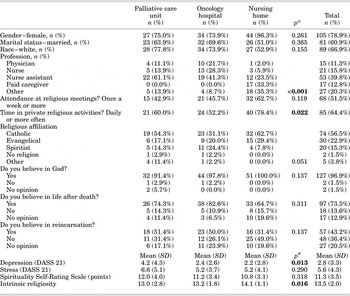
The sociodemographic data of the participants are presented in Table 1. Overall, the sample comprised predominantly individuals who were female, married, had a high level of education, were nurses or nurse assistants, and had a mean age of 41 (SD = 10) years. Comparison among settings revealed that the group of healthcare professionals working at nursing homes was older, had a lower income, contained a greater proportion of paid caregivers, and had higher intrinsic and nonorganizational religiosity (time spent on private religious activities). By contrast, healthcare professionals working in the palliative care units had higher levels of depressive symptoms.
Characteristics of the sample

*Chi-square test; #ANOVA.
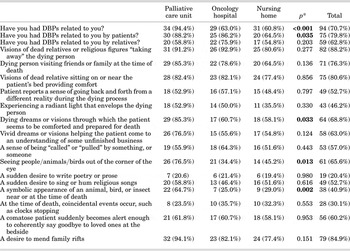
With regard to end-of-life spiritual experiences (see Table 2), 70.7% reported observing ELEs or having these experiences reported to them. Palliative care professionals reported more ELEs than those from the other two settings (94.4 PC vs. 63 ONC vs. 60.8% NH, p < 0.001). The estimated median ELEs each healthcare professional has observed or heard during the previous 5 years were as follows: 15 ELEs for PC (Q 25–75% = 4.0–62.5); 3 ELEs for ONC (Q 25–75% = 0.0–6.5); and 1 ELE for NH (Q 25–75% = 0.0–3.0). The most frequently cited deathbed phenomena were “visions of dead relatives or religious figures who appear to have the express purpose of ‘collecting’ or ‘taking away’ the dying person” (88.2%), “a desire to mend family rifts” (84.9%), “visions of dead relatives sitting on or near the patient's bed who provide emotional warmth and comfort” (80.6%), and “coincidences, usually reported by friends or members of the family of the dying person, who say that the dying person visited them at the time of their death” (76.3%).
Types of end-of-life experiences reported by healthcare professionals in the previous five years# (table gives percentage of healthcare professionals who answered “yes” to questions)

*Chi-square test; DBP = deathbed phenomenon.
#Questions from Fenwick's ELE questionnaire (dichotomous questions “yes/no”).
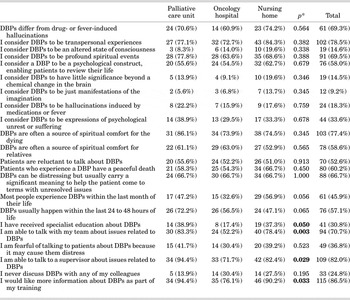
The healthcare professionals' opinions concerning ELEs are provided in Table 3. In general, most healthcare professionals believed that ELEs constituted a transpersonal experience (78.5%), a profound spiritual event (69.5%), differed from drug- or fever-induced hallucinations (69.3%), and were a source of spiritual comfort for the dying (77.4%). No differences in opinions about ELEs were found among settings (only with regard to aspects related to education and the openness of the institution and colleagues on the issue). Healthcare professionals from the hospital (ONC) were less educated on the issue (p = 0.050), were less able to talk with team members and supervisors about ELEs (p = 0.029), and were less willing to receive more information about ELEs (p = 0.033).
Healthcare professionals' opinions concerning end-of-life experiences# (table gives percentage of healthcare professionals who answered that they “agree” or “strongly agree” with the question)

*Chi-square test; DBP = deathbed phenomenon.
#Questions from Fenwick's ELE questionnaire (5-point Likert-type scale).
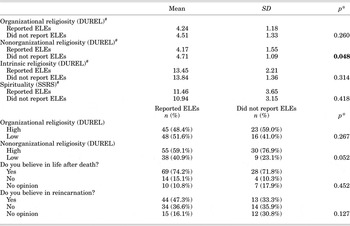
No relevant influence of religious beliefs on the perceptions of ELEs by healthcare professionals was found (see Table 4). Only low nonorganizational religiosity was associated with greater perception of ELEs (p = 0.048), whereas associations with the other dimensions of religiosity were not significant.
Faith and its relationship with end-of-life experiences

# t test; *chi-square test.
DUREL = Duke Religion Index; SSRS = Spirituality Self-Rating Scale.
DISCUSSION
The present study found a high percentage of ELEs reported by healthcare professionals, which seemed to be little influenced by religious or spiritual beliefs. In addition, those having greater contact with patients at the end of life (as in palliative care) had a higher number of reports, a greater openness about the issue, and a greater desire for further training.
Our findings that at least 70% of healthcare professionals have already observed or heard of ELEs are similar to that of other studies conducted in different cultures, such as the Netherlands (70%) (Koedam-Visser & Fenwick, Reference Koedam-Visser and Fenwick2012), the United Kingdom (62–84%) (Fenwick et al., Reference Fenwick, Lovelace and Brayne2010), and the United States (98%) (Lawrence & Repede, Reference Lawrence and Repede2013), demonstrating that ELEs are not greatly influenced by cultural factors, and confirming that this is not a determinant of perception of ELEs. In relation to studies assessing the families of the deceased, the prevalence of these observations tends to be lower (36.2% in Moldova [Kellehear et al., Reference Kellehear, Pogonet and Mindruta-Stratan2011–Reference Kellehear, Pogonet and Mindruta-Stratan2012] and 28% in India [Muthumana et al., Reference Muthumana, Kumari and Kellehear2010–Reference Muthumana, Kumari and Kellehear2011]), given that family members are not exposed to the numerous deaths witnessed by healthcare professionals.
Consistent with the international literature, the main ELEs reported by our healthcare professionals were “visions of dead relatives collecting the dying person,” “a desire to mend family rifts,” and “dead relatives near the bed who provide emotional comfort” (Fenwick et al., Reference Fenwick, Lovelace and Brayne2010; Koedam-Visser & Fenwick, Reference Koedam-Visser and Fenwick2012), supporting the hypothesis that ELEs promote calm and are associated with preparation for death, aided by the comfort brought through contact with relatives (Fenwick & Brayne, Reference Fenwick and Brayne2011; Fenwick et al., Reference Fenwick, Lovelace and Brayne2007; Betty, Reference Betty2006).
Interestingly, the religious and spiritual beliefs of the healthcare professionals had no major impact on perception of ELE reports. Indeed, some measures of religiosity (e.g., nonorganizational religiosity) were inversely associated with ELEs—that is, healthcare professionals with low religiosity had greater exposure to ELEs. These data indicate that religious beliefs are not determinants of ELE perception, contrary to the conclusion that might be drawn given the mystic or religious connotation often conferred on these experiences. These results are similar to the findings of other authors who also failed to confirm this relationship in healthcare professionals (Fenwick & Brayne, Reference Fenwick and Brayne2011), but they are different from an Indian study which found that end-of-life patients who followed the Muslim faith had fewer visions (Muthumana et al., Reference Muthumana, Kumari and Kellehear2010–Reference Muthumana, Kumari and Kellehear2011).
Regarding comparison of different settings, an increased perception or incidence of reports of ELEs was noted in the palliative care units. Although expected, since healthcare professionals with this role have much more frequent contact with end-of-life patients, this finding corroborates the fact that these experiences are more strongly associated with the care setting at the end of life than with beliefs and cultural aspects per se (Lawrence & Repede, Reference Lawrence and Repede2013). There was also a contrast between healthcare professionals working at the cancer hospital and those at the nursing homes, but the most notable difference was in relation to professionals who worked in palliative care. Healthcare professionals involved in palliative care exhibited greater openness about the issue and a higher interest in undertaking further training. This finding corroborates the results of a more recent study of healthcare professionals which showed that higher S/R scores are correlated with greater incidence of daily contact with death (de Camargos et al., Reference de Camargos, Paiva and Barroso2015). This finding might also be explained by the principles of palliative care as pioneered by Cicely Sanders (Clark, Reference Clark2007) and the current guidelines for the specialty, which adopt the approach and view spirituality as an important aspect of being human and something that should be taken into account in end-of-life care (Puchalski et al., Reference Puchalski, Ferrell and Virani2009).
Another important point is that 70% of our healthcare professionals agreed that DBPs are different from drug- or fever-induced hallucinations. The prevalence of delirium in end-of-life care is very high, frequently caused by dehydration, infection, drugs, or hypoxia, and it is characterized by abrupt onset of fluctuating confusion, inattention, and reduced awareness of the environment (Hosker & Bennett, Reference Hosker and Bennett2016). In contrast to delirium, some authors argue that ELEs occur in patients whose consciousness is clear and who have an awareness of their surroundings, who recall the experiences with clarity and experience them as promoting positive outcomes (e.g., peace, comfort, acceptance) (Grant et al., Reference Grant, Wright and Depner2013). These differences were also noted by our participants, who were able to separate one condition from another.
Finally, there are clinical implications for ELEs. These experiences can provide profoundly spiritual moments that offer hope, meaning, and connection for the dying as well as their relatives and support family members throughout the grieving process (Fenwick & Brayne, Reference Fenwick and Brayne2011). Listening to these experiences may also change the healthcare team, shifting them toward more compassionate, empathetic, humanistic, and better overall care, which can have an impact on their clinical practice, as well as on their own lives. According to Puchalski (Reference Puchalski2001), this compassionate care “calls physicians to walk with people in the midst of their pain, to be partners with patients rather than experts dictating information to them.”
STRENGTHS AND LIMITATIONS OF THE STUDY
The present study has some limitations. First, we employed a cross-sectional design, thus precluding determination of a cause-and-effect relationship. Second, the study was based on ELE reports recalled by healthcare professionals, so that memory bias may have been introduced. Third, the healthcare professionals themselves were assessed as opposed to the patients. Finally, although 70% believed that ELEs differed from hallucinations, no scales were utilized to investigate acute confusional states in the patients who had these experiences, with professionals drawing solely on reports and their own opinions. Notwithstanding these limitations, the study also has several strengths, such as the fact that it involved a comparatively large sample for this type of research, compared different settings, and employed religiosity and spirituality scales to determine the influence of these beliefs on reports of ELEs.
CONCLUSION
In conclusion, our study revealed that ELE reports are not uncommon in clinical practice and seem to be little influenced by religious or spiritual beliefs. Although frequently reported in all settings, palliative care professionals tend to be more open to this issue and have a more favorable perception of ELEs.